- Product Description Description
- Table of Contents TOC
- List of Table & Figure LOT
- Get Free Sample PDF Sample PDF
Market Size, 2025
$44.26 BnMarket Estimate, 2026
$54.75 BnMarket Forecast, 2034
$300.37 BnCAGR, 2026–2034
23.71%Executive Summary: Global Mobile Robotics Market
- Market Scope: Comprehensive global mobile robotics market analysis covering products, applications, components, regional adoption landscapes, and industrial automation drivers.
- Market Valuation: Valued at USD 44.26 billion (2025), estimated at USD 54.75 billion (2026), and projected to reach USD 300.37 billion by 2034, registering a strong CAGR of 23.71% (2026–2034).
- Primary Growth Drivers: Surging global demand for industrial automation, rise of e-commerce and smart warehouse logistics (Industry 4.0), and the deployment of autonomous mobile robots for efficient task execution in manufacturing and defense.
Key Market Segment Metrics (2026–2034)
| Category | Leading Segment (2025 Position) | Fastest-Growing Segment |
|---|---|---|
| By Product | Unmanned Ground Vehicles (UGV) (dominant segment led by military, defense, and industrial logistics) | Unmanned Aerial Vehicles (UAVs) / Drones (expanding rapidly via surveying, mapping, and security applications) |
| By Application | Industrial Segment / Manufacturing & Warehousing (holding the major market share via automated material handling) | Service Applications (professional healthcare, agriculture, and personal domestic cleaning/service robots) |
| By Component | Hardware & Control Systems (core foundational elements for processing and movement) | Software & AI Integration (fueling advanced 3D vision, mapping, and autonomous navigation) |
| By Region | North America (holding the lion’s share backed by sophisticated robotic techniques and industrial deployment) | Asia-Pacific (growing rapidly due to accelerating manufacturing activities in China, Japan, and India) |
Major Market Players & Market Structure
Market Structure: Highly dynamic and competitive ecosystem comprising industrial automation giants, defense contractors, and specialized robotics innovators focusing on autonomous navigation, AI-driven analytics, and scalable warehouse integration.
Key Companies: Bluefin Robotics Corporation, Mobile Industrial Robots (MiR), Aethon, OMRON Adept Technologies, KUKA AG, Clearpath Robotics, Gecko Systems Intl. Corporation, Northrop Grumman Corporation, Amazon Robotics, and iRobot Corporation.
Global Mobile Robotics Market Size
The global mobile robotics market size was valued at USD 44.26 billion in 2025 and is anticipated to reach USD 54.75 billion in 2026 to reach USD 300.37 billion by 2034, growing at a CAGR of 23.71% from 2026 to 2034.
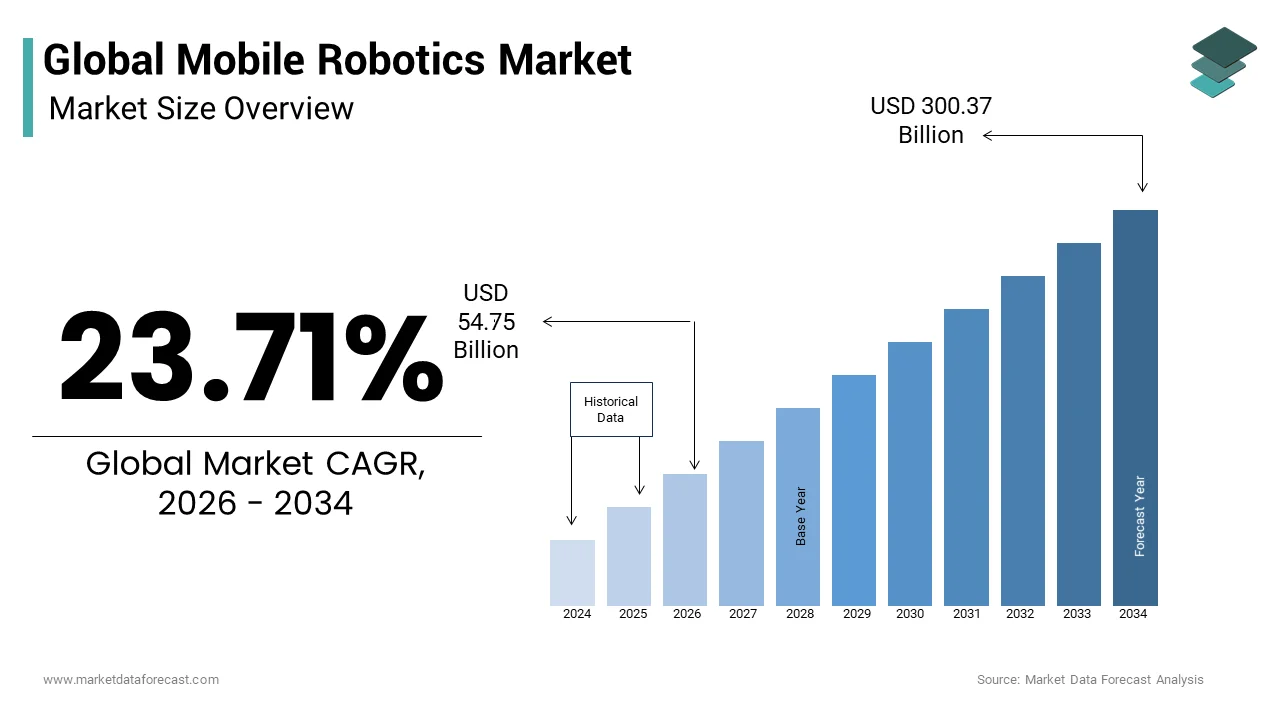
Mobile robots are systems that can move in a physical environment. They use artificial intelligence, processors, sensors, motors, and power electronics to move on the ground, in space, underwater, and in the air. Mobile robotics are capable of navigating without additional guidance. They provide uninterrupted execution of monotonous tasks, such as monitoring and inspecting sites inaccessible to humans, such as locations with hazardous environments. The adoption of mobile robotics is found in various industries like defense and military, logistics, household, space exploration, automotive, and so on, driving this market growth.
MARKET DRIVERS
The growing demand for automation is driving the global mobile robotics market growth.
Strong demand for automation has been observed worldwide in almost all industries. Companies automate their manufacturing and operating processes to reduce costs, save time, and offer better-quality products. In many parts of Europe and North America, low-cost, fast delivery is trending due to the rise of online retail. This has been a positive development for customers who have improved access to electronic commerce. For example, large Chinese online retailers are making great efforts to build an intelligent logistics system by deploying robots in warehouses to enhance work efficiency.
The growth of industrial production networks requires smarter solutions in logistics, which is contributing to the growth of the mobile robotics market.
The emergence of Industry 4.0 in logistics and warehousing is increasing due to the increasing automation of the devices used and their operation. For example, according to an online portal, PICK-PLACE, by 2018, 45% of the world's top 200 trading companies had implemented a robotic system in their order processing, warehousing, and delivery operations. For example, crop management is the most widely used application in agricultural robots. It plays an essential role in understanding the variability of fields and helps farmers maximize their yields. Additionally, Autonomous Mobile Robots (AMRs) operate advanced 3D vision systems, and flexible clamps are used to automate the sampling process.
MARKET RESTRAINTS
High costs associated with mobile robotics are primarily hampering the global market growth.
The high cost of installation and the integration competencies mandatory for the initial setup of mobile robotics limit its adoption. In addition, the need for an increased initial investment limits mobile robotics in various industries such as health, logistics, education, agriculture, etc., making it difficult for the market to grow. The main challenge hampering the growth of the global mobile robotics market is navigating unassigned environments. Mobile robots are designed and programmed to perform tasks and functions in a defined environment. However, logistics robots cannot be programmed or operate in untested environments, hindering market growth.
REPORT COVERAGE
| REPORT METRIC | DETAILS |
| Market Size Available | 2025 to 2034 |
| Base Year | 2025 |
| Forecast Period | 2026 to 2034 |
| CAGR | 23.71% |
| Segments Covered | By Product, Application, and Region |
| Various Analyses Covered | Global, Regional & Country Level Analysis, Segment-Level Analysis, DROC, PESTLE Analysis, Porter’s Five Forces Analysis, Competitive Landscape, Analyst Overview on Investment Opportunities |
| Regions Covered | North America, Europe, APAC, Latin America, Middle East & Africa |
| Market Leaders Profiled | Bluefin Robotics Corporation, Mobile Industrial Robots, Aethon, OMRON Adept Technologies, KUKA AG, Clearpath Robotics, Gecko Systems Intl. Corporations, such as Northrop Grumman Corporation, Amazon Robotics, and iRobot Corporation. |
SEGMENTAL ANALYSIS
By Product Insights
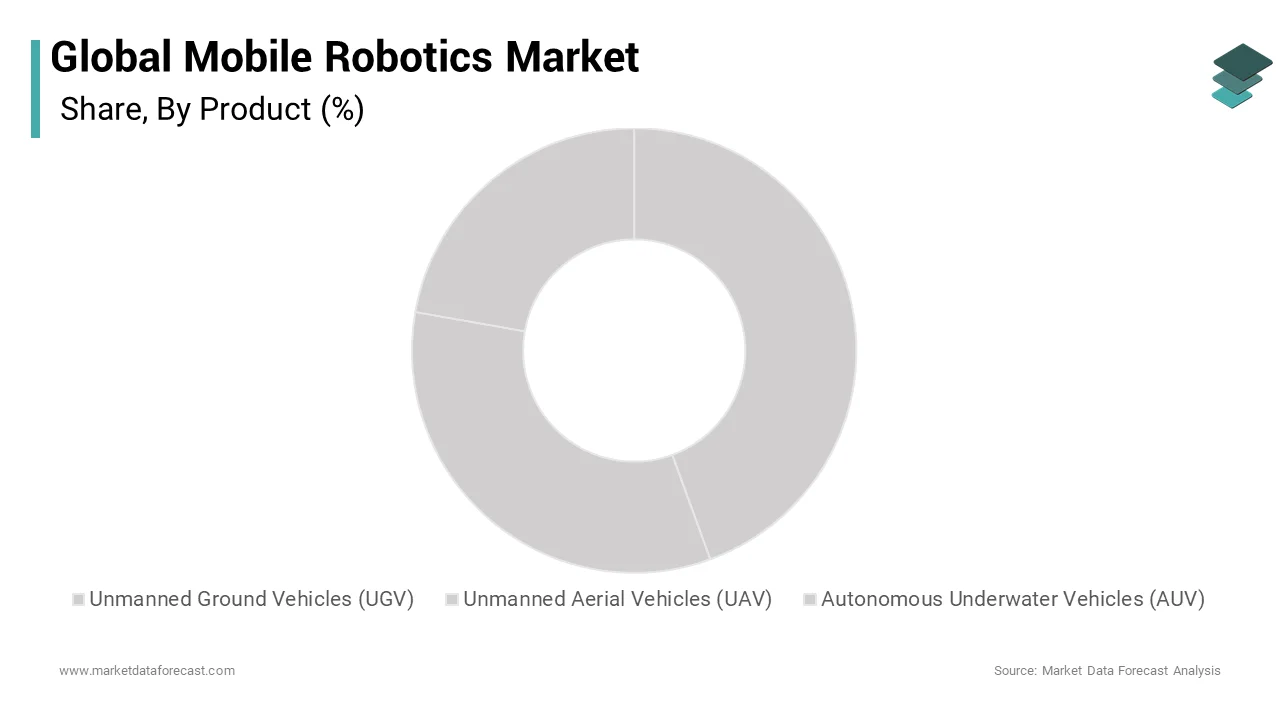
The UGV segment is the most dominant segment during the forecast period due to the increase in military and defense applications. Drones are expected to grow steadily throughout the forecast period due to increased demand in military, defense, photography, surveying and mapping, wildlife research, and survey and security applications. In addition, the USV market has been fuelled by profitable global positioning systems and wireless data systems, which are expected to continue for six years.
By Application Insights
The industrial segment had the major share of the global mobile robotics market in 2023. The industrial segment is sub-segmented into storage and distribution, painting and coating, and coating and distribution. Service applications are divided into professional and personal applications. Professional applications include military and defense, mining, medicine, agriculture, forestry, and logistics. Personal applications consist of household chores like entertainment, cleaning, and maintenance. Demand for home robots like lawn mowers and vacuum cleaners used in personal service applications has been spurred by the availability of open-source software development platforms and falling prices for sensors and cameras.
REGIONAL ANALYSIS
The North American market held the lion’s share in the global mobile robotics market because of the sophisticated robotic techniques and the deployment of mobile robots in several industrial applications. In addition, the governments of the United States, Canada, and Mexico are encouraging the adoption of mobile robotics in the aerospace and defense industries. Besides, North America is experiencing strong adoption of mobile robotics for household purposes, such as vacuuming and cleaning floors, mowing lawns, and more. The Asia-Pacific region held the second-largest portion of this market due to this locale's rising industrialization and manufacturing activities. Countries like China, Japan, and India embrace large-scale mobile robotics for defense, manufacturing, healthcare, education, and personal assistance applications. Europe has the third-largest market for mobile robotics.
KEY MARKET PLAYERS
A few of the market players in the global mobile robotics market include
- Bluefin Robotics Corporation
- Mobile Industrial Robots
- Aethon
- OMRON Adept Technologies
- KUKA AG
- Clearpath Robotics
- Gecko Systems Intl
- Corporations
- Northrop Grumman Corporation
- Amazon Robotics
- iRobot Corporation
RECENT MARKET NEWS
- Rheinmetall, a defense contractor based in Germany, collaborated with the WB group in Poland to integrate the autonomous Mission Master UGV into the Warmate micro-combat UAV. This was unveiled at MSPO 2019, held in Poland in September.
- In August 2019, Teledyne Instruments, a U.S.-based subsidiary of Teledyne Technologies, received a contract to supply AUVs to the United States Navy, including supplies and services for the current development of AUVs.
- In July 2018, PT Bank Net Tbk was acquired by Softbank and the Lippo Group. ("Link Net") (Japan) has signed an agreement to collaboratively develop Internet of Things (IoT) platforms to be implemented in various cities in Japan.
- In June 2018, Northrop Grumman opened a new factory in Illinois, the United States. This expansion is expected to help Northrop Grumman better serve its customers in support of national security.
MARKET SEGMENTATION
This research report on the global mobile robotics market has been segmented and sub-segmented based on product, application, and region.
By Type
- Professional Robots
- Personal & Domestic Robots
By Component
- Hardware
- Sensors
- Actuators
- Power Supply
- Control Systems
- Others
- Software
- Services
By Product
- Unmanned Ground Vehicles (UGV)
- Unmanned Aerial Vehicles (UAV)
- Autonomous Underwater Vehicles (AUV)
By Application
- Agriculture
- Cleaning
- Educational
- Healthcare
- Manufacturing
- Warehousing & Logistics
- Others
By Region
- North America
- Asia Pacific
- Europe
- Latin America
- Middle East and Africa