- Product Description Description
- Table of Contents TOC
- List of Table & Figure LOT
- Get Free Sample PDF Sample PDF
Market Size, 2025
$342.28 MnMarket Estimate, 2026
$378.56 MnMarket Forecast, 2034
$848 MnCAGR, 2026–2034
10.6%Executive Summary: Global Mobile Travel Market
- Market Scope: Comprehensive global mobile travel market analysis covering booking categories, payment methods, regional leadership frameworks, and mobile app travel solutions worldwide.
- Market Valuation: Valued at USD 342.28 million (2025), estimated at USD 378.56 million (2026), and projected to reach USD 848 million by 2034, expanding at a robust CAGR of 10.60% (2026–2034).
- Primary Growth Drivers: Widespread adoption of smartphones enhancing accessibility and convenience for global travel planning and booking. Key industry trends include the dominance of online travel agencies (OTAs) consolidating services, AI/ML integration for personalized recommendations, and reliance on mobile apps for real-time updates, navigation, and digital passes.
Key Market Segment Metrics (2026–2034)
| Category | Leading Segment (2025 Position) | Fastest-Growing Segment |
|---|---|---|
| By Booking & Service Type | Accommodation booking segment (dominated due to frequent use across traveler types and global reach) | In-destination experiences, activities, and multimodal mobile transportation bookings |
| By Payment Method | Debit and credit cards segment (held the largest share due to global acceptance and security) | Digital wallets, mobile-first unified payment systems, and contactless gateways |
| By Platform & Technology | Dedicated OTA mobile applications and multi-service aggregator platforms | AI-driven personalized itinerary planners and real-time trip tracking assistants |
| By Region / Country | North America (led the market, particularly the U.S., supported by high smartphone penetration, followed by Europe) | Asia-Pacific region (emerging high-growth area driven by expanding middle classes in China and India) |
Major Market Players & Market Structure
Market Structure: Highly competitive global mobile travel ecosystem driven by app enhancements (such as Expedia’s real-time trip updates), health and safety protocol integrations (Booking.com), and comprehensive one-stop-shop booking integrations (TripAdvisor’s hotels, flights, and experiences consolidation).
Key Companies: Expedia Group, Booking Holdings (Booking.com, Priceline), Airbnb, TripAdvisor, Uber, Lyft, Kayak, Skyscanner, Agoda, Hopper, Travelocity, Orbitz, Trivago, Google (Google Flights, Google Maps), Ctrip (Trip.com Group), MakeMyTrip, Cleartrip, and eDreams ODIGEO.
Global Mobile Travel Market Size
The global mobile travel market was valued at USD 342.28 million in 2025, is estimated to reach USD 378.56 million in 2026, and is projected to reach USD 848 million by 2034, growing at a CAGR of 10.60% from 2026 to 2034.
Mobile travel refers to using smartphones or other mobile devices to plan, book, and manage your travel activities. It's like having a travel companion right in your pocket. With mobile travel apps, you can search for flights, hotels, and activities on the go, compare prices, and make reservations in just a few taps. These apps also provide maps, directions, and real-time updates, making it easier to navigate an unfamiliar place. You can also receive alerts about flight delays, gate changes, or special deals. Mobile travel keeps all your travel information organized in one place, from boarding passes to hotel confirmations. It is like having a travel agent and a guidebook rolled into one device, which makes your journey smoother and more convenient.
MARKET DRIVERS
The widespread adoption of smartphones is the major driver for the mobile travel market.
As more people own smartphones, they can access travel information, booking platforms, and navigation tools. This has led to the market growth of travel apps and services that cater to the convenience and accessibility that smartphones offer. As smartphones continue to be an integral part of daily life, the Mobile Travel Market is set to keep growing and making travel more accessible and enjoyable through digital convenience.
Online travel agencies (OTAs) like Expedia, Booking.com, and Airbnb have significantly boosted the growth of the mobile travel market demand. Through these platforms, users can easily search for and book accommodations, flights, and activities right from their smartphones. These mobile apps have gained immense popularity because they help in the entire travel planning and booking process and consolidate everything that is needed for a trip in one convenient place on our phones. As a result, this convenience has made travelling more straightforward and enjoyable, contributing to the notable growth of the mobile travel market.
MARKET RESTRAINTS
The mobile travel market faces a significant challenge due to internet connectivity.
In some places, like remote or less developed areas, the internet on our phones doesn't work very well. This can be a problem for travellers who rely on their phones for booking flights, finding hotels, and getting directions. As a result, internet connectivity is the restraining factor of mobile travel market growth.
MARKET OPPORTUNITIES
The Mobile Travel Market offers an exciting opportunity for ongoing integration with AI and machine learning. By using these technologies, travel apps can give you personalized recommendations and create custom travel plans. They can also provide real-time help, which makes your travel planning easier and more suited to your comfort. Therefore, this integration with AI and machine learning creates growth opportunities for the Mobile Travel Market.
REPORT COVERAGE
| REPORT METRIC | DETAILS |
| Market Size Available | 2025 – 2034 |
| Base Year | 2025 |
| Forecast Period | 2026 - 2034 |
| CAGR | 10.6% |
| Segments Covered | By Application, Payment Method, Age Group Type, and Region. |
|
Various Analyses Covered | Global, Regional and Country Analysis, Segment-Level Analysis, DROC, PESTLE Analysis, Porter’s Five Forces Analysis, Competitive Landscape, Analyst Overview of Investment Opportunities |
| Regions Covered | North America, Europe, APAC, Latin America, Middle East & Africa |
|
Market Leaders Profiled | Expedia Group, Booking Holdings (including Booking.com and Priceline), Airbnb, TripAdvisor, Uber, Lyft, Kayak, Skyscanner, Agoda, Hopper, Travelocity, Orbitz, Trivago, Google (Google Flights, Google Maps), Ctrip (now Trip.com Group), MakeMyTrip, Cleartrip, eDreams ODIGEO, and Others. |
SEGMENTAL ANALYSIS
By Application Insights
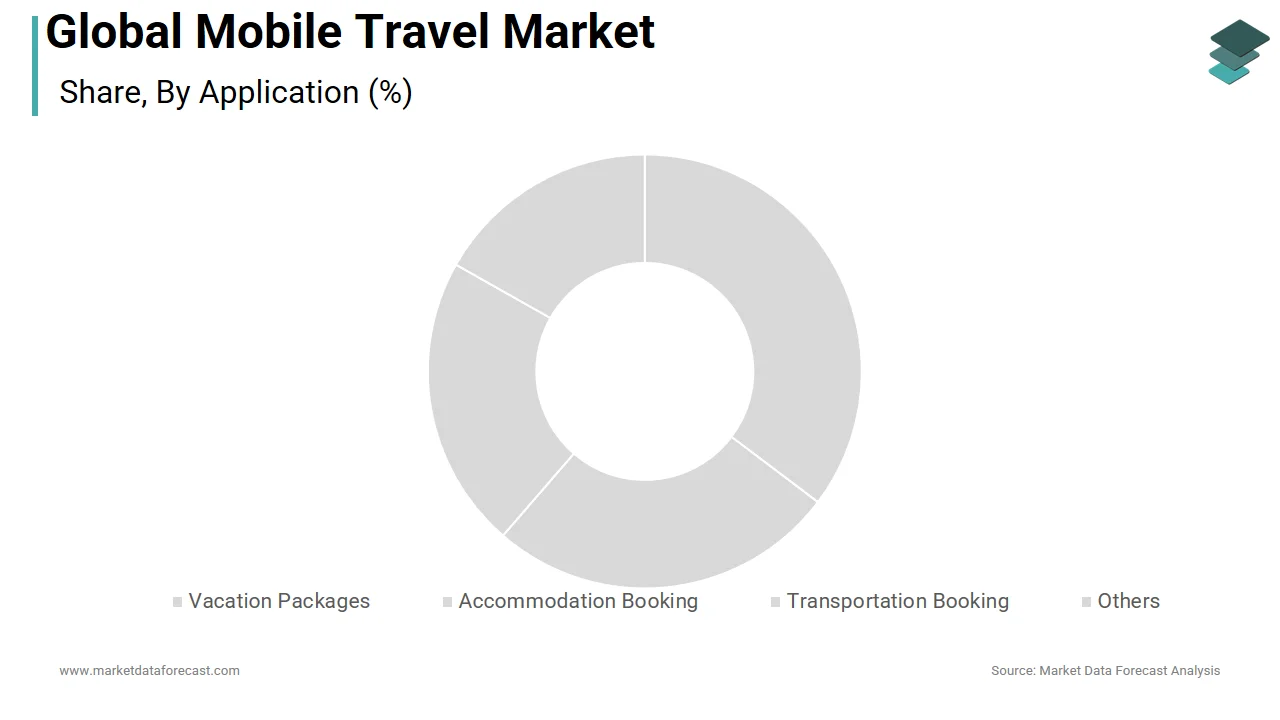
The accommodation booking segment holds a significant market share due to its frequent use in travel planning. It appeals to a broad user base, from budget to luxury travellers, offers a global reach, and benefits from repeat bookings throughout the year.
By Payment Method Insights
Debit and credit cards dominate due to their global acceptance, ensuring convenience for travellers. They offer robust security features, including fraud protection and charge dispute capabilities, instilling trust in users for secure online payments in the Mobile Travel Market.
REGIONAL ANALYSIS
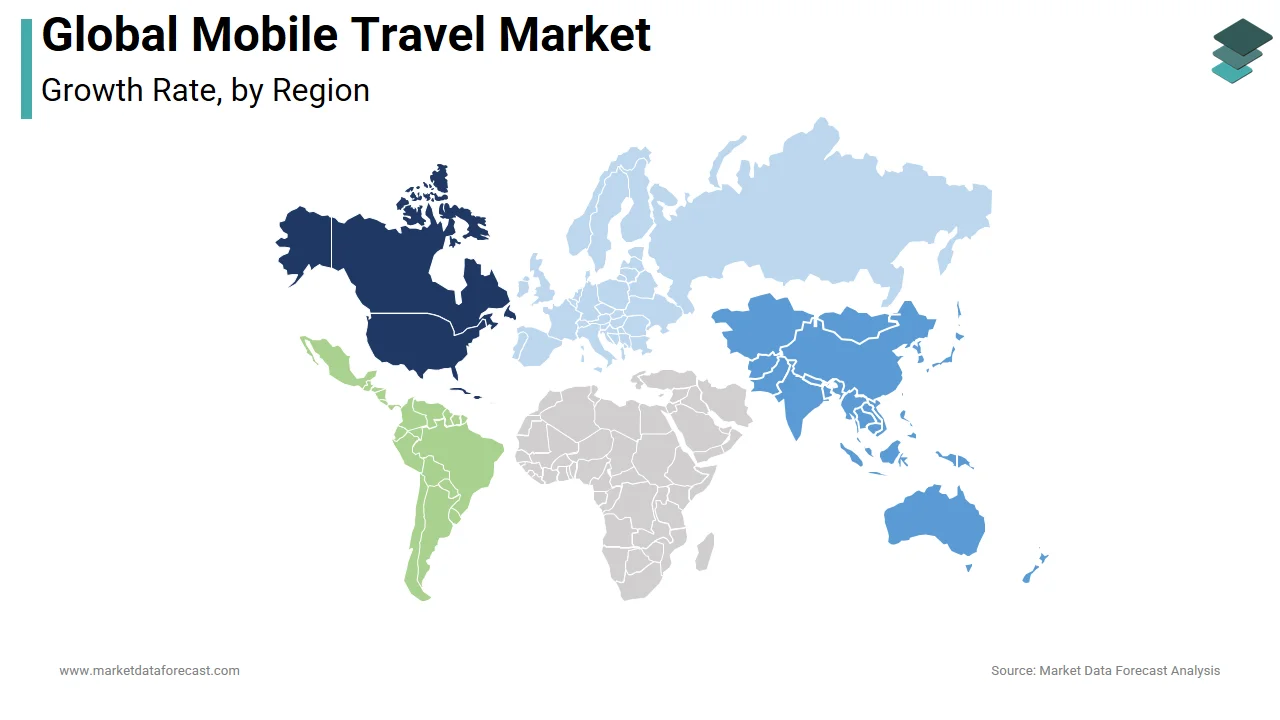
North America is dominating the market, especially the United States, which takes the lead because of its strong travel industry, many smartphone users, and comfortable population with technology.
Europe is next in leading the dominant shares of the market. They have a well-established tourism scene with lots of exciting places to visit, and people there are relying more and more on mobile apps to book their travel. Now, over in the Asia-Pacific region, led by countries like China and India, a new dominance is emerging. They have tons of people, a growing middle class, and they're really into using mobile phones for everything, including travel. The Middle East, especially places like the United Arab Emirates and Africa, are also on the rise. They're investing more in travel infrastructure and mobile technology. In Latin America, countries like Brazil and Mexico are contributing to the shares of the market. More and more people are travelling there, and they're getting into using mobile apps for their trips. The region's cultural attractions and beautiful places to visit, combined with improving digital technology, are driving the use of mobile travel apps.
KEY MARKET PLAYERS
Expedia Group, Booking Holdings (including Booking.com and Priceline), Airbnb, TripAdvisor, Uber, Lyft, Kayak, Skyscanner, Agoda, Hopper, Travelocity, Orbitz, Trivago, Google (Google Flights, Google Maps), Ctrip (now Trip.com Group), MakeMyTrip, Cleartrip, eDreams ODIGEO, and Others.
RECENT MARKET DEVELOPMENTS
- In 2021, Expedia focused on enhancing its mobile app, making it more user-friendly, and introducing features like real-time trip updates and flexible booking options. They also expanded their vacation rental platform to compete with Airbnb.
- In 2021, Booking.com, part of Booking Holdings, was emphasizing its mobile app, offering users exclusive discounts and deals. They were also investing in AI and machine learning to provide personalized recommendations and improve customer experience.
- In 2022, Airbnb continued to expand its services beyond accommodations, offering more experiences and adventures through its mobile app. They also introduced safety features and enhanced cleaning protocols in response to COVID-19 concerns.
- In 2022, TripAdvisor worked on becoming a one-stop shop for travellers, integrating booking services for hotels, flights, and experiences into its mobile app. They also emphasized user-generated content for recommendations.
MARKET SEGMENTATION
This global mobile travel market research report is segmented and sub-segmented into the following categories.
By Application
- Vacation Packages
- Accommodation Booking
- Transportation Booking
- Others
By Payment Method
- Debit/Credit Card
- UPI
- E-Wallets
- Others
By Age Group Type
- Below 15 years
- 16 to 25
- 26 to 35
- 36 to 45
- 46 to 55
- above 55
By Region
- North America
- Europe
- Asia Pacific
- Latin America
- Middle East & Africa