- Product Description Description
- Table of Contents TOC
- List of Table & Figure LOT
- Get Free Sample PDF Sample PDF
Global Modular Fabrication Market Report Summary
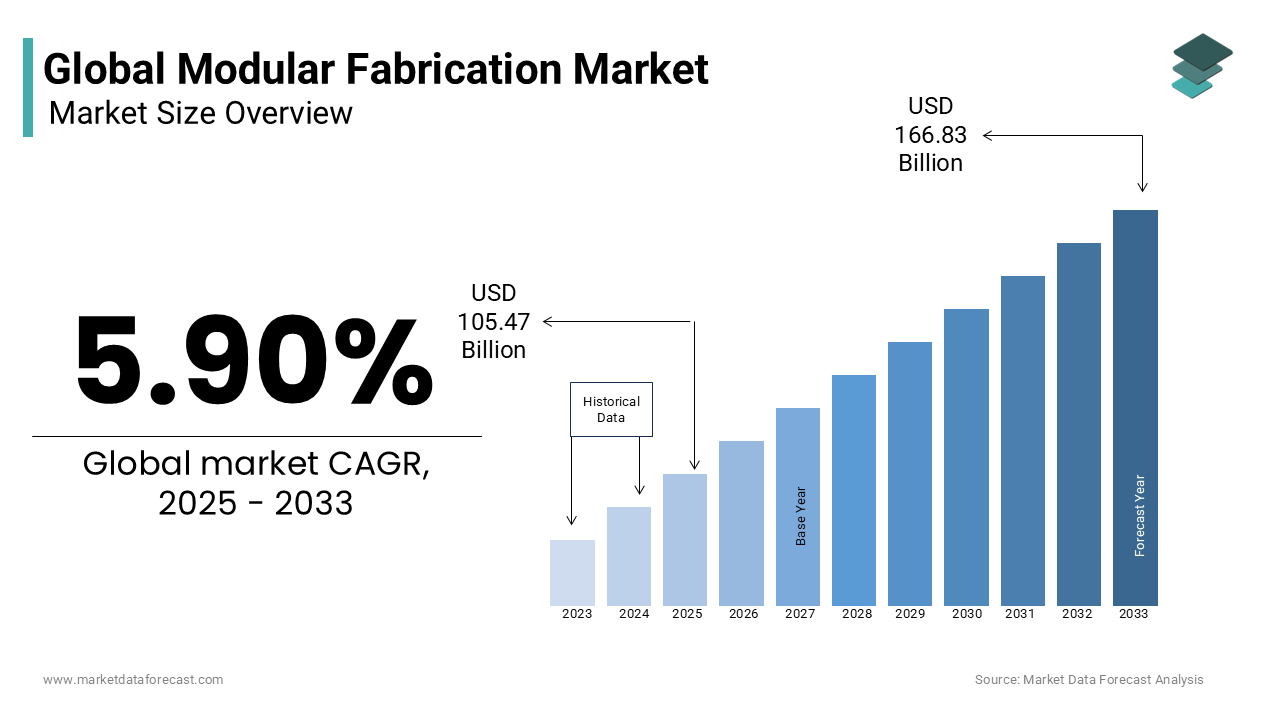
The global modular fabrication market was valued at USD 99.59 billion in 2024, is estimated to reach USD 105.47 billion in 2025, and is projected to attain USD 166.83 billion by 2033, growing at a CAGR of 5.90% during the forecast period from 2025 to 2033. The growth of the modular fabrication market is driven by rapid urbanization, expanding industrial infrastructure, and increasing demand for cost-effective and time-efficient construction solutions. Modular fabrication enables factory-controlled manufacturing of building components, ensuring higher quality, reduced material waste, improved safety, and faster project execution. The method is increasingly adopted across residential, commercial, and industrial sectors, particularly in oil & gas, infrastructure, and large-scale housing projects. Additionally, growing emphasis on sustainable construction practices and labor efficiency is further accelerating market expansion globally.
Key Market Trends
- Rising adoption of off-site and factory-based construction to reduce project timelines and labor dependency.
- Growing preference for sustainable and green construction methods due to lower material waste and emissions.
- Increased use of modular fabrication in oil & gas, petrochemical, and industrial facilities for operational efficiency.
- Expanding application of permanent modular construction in healthcare, hospitality, and educational infrastructure.
- Technological advancements in lean manufacturing and prefabrication techniques are enhancing design flexibility.
Segmental Insights
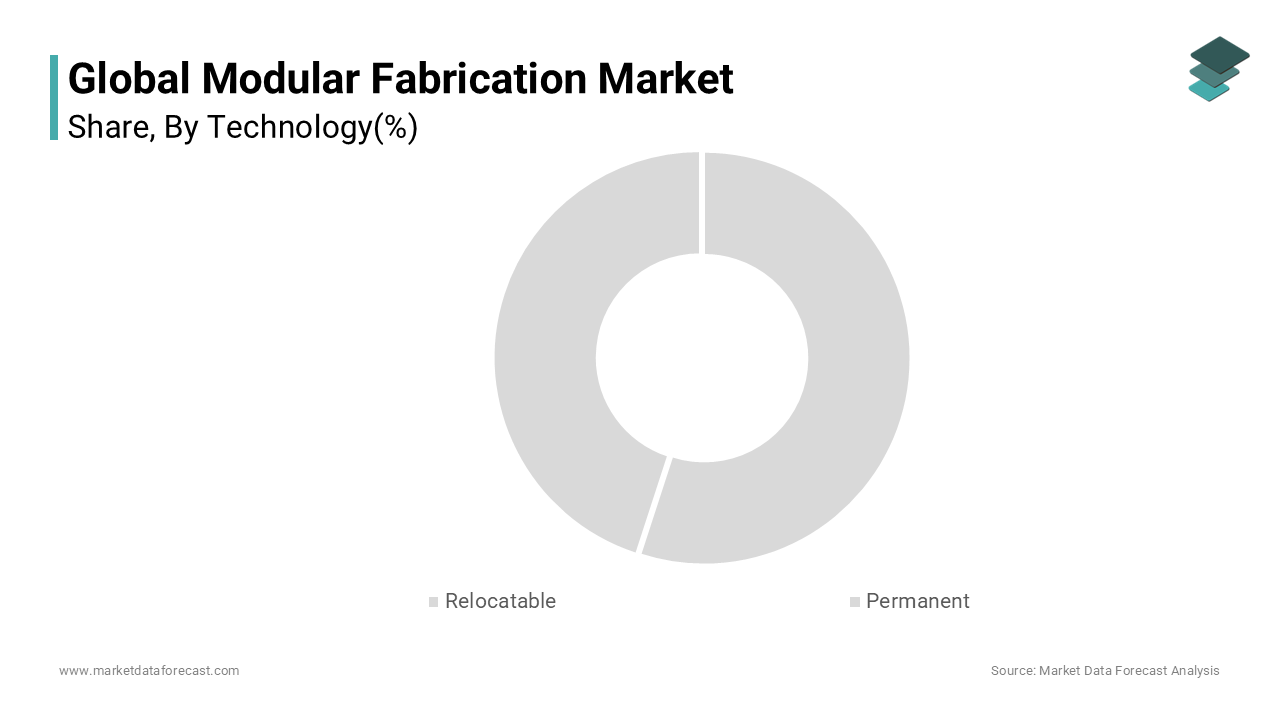
- Based on technology, the relocatable modular fabrication segment held a dominant share of the global modular fabrication market in 2024. This dominance is attributed to its portability, reusability, lower cost, and suitability for temporary and semi-permanent structures, such as site offices, schools, and medical units.
- The permanent modular construction segment is expected to register the fastest CAGR during the forecast period, driven by its growing use in hotels, hospitals, residential buildings, and educational institutions, where long-term durability and scalability are required.
- Based on end user, the industrial segment accounted for the largest share of the global modular fabrication market in 2024. The segment’s growth is driven by extensive adoption in the oil & gas industry, where modular fabrication reduces construction risk, enhances quality control, and minimizes on-site labor requirements.
Regional Insights
- The Asia-Pacific region dominated the global modular fabrication market in 2024, supported by rapid industrialization, infrastructure expansion, and large-scale residential and commercial construction projects in countries such as China, India, Japan, Singapore, and Indonesia.
- North America held a significant market share due to strong demand from the oil & gas sector, particularly driven by shale gas exploration and industrial facility development in the United States.
- Europe is witnessing steady growth, supported by infrastructure modernization initiatives, sustainability mandates, and increasing adoption of modular construction techniques across residential and commercial sectors.
Competitive Landscape
The global modular fabrication market is moderately fragmented, with the presence of established construction and engineering companies alongside specialized modular solution providers. Market players focus on strategic partnerships, technological innovation, and expansion of fabrication capabilities to strengthen their market presence. Emphasis on customized modular solutions, faster delivery timelines, and compliance with sustainability standards remains a key competitive strategy. Prominent players in the global modular fabrication market include Larsen & Toubro Limited, ZETON, Laing O’Rourke, Kleusberg, Lendlease Corporation, Algeco, CIMC Modular Building Systems, Heerema Fabrication Group, Bakrie Metal Industries, and Applied Machinery Corporation.
 Download Free Sample Report
Global Modular Fabrication Market Size
The global modular fabrication market was worth USD 99.59 billion in 2024. The global market is anticipated to grow at a CAGR of 5.90% from 2025 to 2033 and be worth USD 166.83 billion by 2033 from USD 105.47 billion in 2025.
Modular fabrication is transporting and assembling factory-made pre-engineered building sections or structures on-site. These constructions are built in a controlled atmosphere, guaranteeing that they are of high quality. As a result, modular fabrication is in high demand in the housing, infrastructural, and industrial sectors. Modular fabrication is a relatively new method of construction. However, it is a green construction method since it reduces site waste compared to on-site erected structures. Furthermore, the construction is done under strict supervision. This reduces the number of accidents and makes the workplace safer for employees.
MARKET DRIVERS AND RESTRAINTS
The global modular fabrication industry is being driven by rapid industrialization and urbanization. Housing, infrastructure, and industrial investments have all expanded dramatically in recent years. The demand for modular fabrication structures has risen as a result. During the forecast period, this state is expected to continue. Modular fabrication has many advantages, including lower construction and labour costs as well as speedier construction. Moreover, most of the work is done in a factory, and the built structures are then put on site. This is a significant benefit of modular construction. In addition, fabricated structures are built at production facilities. This reduces both the cost and the time it takes to run the business. As a result, advantages such as cheaper construction and labour costs, as well as faster construction, are likely to propel the worldwide modular fabrication market forward throughout the forecast period. Because of its rising uses in the construction industry, the Modular Fabrication Market has grown significantly over the years.
In addition, construction operations are becoming more common in urban areas worldwide, which has increased demand for the procedure. However, the labour cost related to site work makes up a large portion of the expenses combined with civil structures' construction, especially housing. In addition, site work is usually undertaken in challenging environments, which can lead to inferior results. Fabrication of modules in a factory setting is viewed as a potential solution to these problems. For many years, building components such as roof trusses have been prefabricated. The next stage was to design specific modules, such as bathrooms and toilets, to fit into the frameworks of larger structures and projects. As a result, the worldwide modular fabrication market will continue to rise. The worldwide modular fabrication market is hampered by limitations in the mass production of modular fabricated structures. For example, the environment, weather, and nature of the work all influence the construction of modular fabricated structures. As a result, mass manufacturing modular fabricated structures is challenging.
REPORT COVERAGE
| REPORT METRIC | DETAILS |
| Market Size Available | 2024 to 2033 |
| Base Year | 2024 |
| Forecast Period | 2025 to 2033 |
| CAGR | 5.90% |
| Segments Covered | By Technology, End User, and Region. |
| Various Analyses Covered | Global, Regional and Country Level Analysis, Segment-Level Analysis, DROC, PESTLE Analysis, Porter’s Five Forces Analysis, Competitive Landscape, Analyst Overview of Investment Opportunities |
| Regions Covered | North America, Europe, APAC, Latin America, Middle East & Africa |
| Market Leaders Profiled | LARSEN & TOUBRO LIMITED, ZETON, LAING O'ROURKE, Kleusberg, Lendlease Corporation, Algeco, CIMC Modular Building Systems, HEEREMA FABRICATION GROUP, Bakrie Metal Industries, Applied Machinery Corporation, and Others. |
SEGMENTAL ANALYSIS
By Technology Insights
Based on technology, relocatable is anticipated to dominate the global modular fabrication market in the upcoming years. Relocatable possesses many benefits. Buildings that can be moved (RBs), sometimes portable buildings, are partially or entirely constructed structures assembled in a regulated manufacturing facility using the modular construction technique and adhere to defined building codes. In addition, relocatable structures are designed to be recycled and transferred to different construction locations. As a result, they can be employed in various settings, including medical clinics, schools, sales centres, and construction site offices.
On the other hand, relocatable structures are built for a shorter period, such as a few months or a year. They're also made to last, having the ability to resist several relocations and installations. On the other hand, relocatable structures are typically composed of wood to be lightweight and easy to carry and reinstall.
Moreover, permanent modular fabrication is predicted to increase with the highest CAGR during the forecast period. PMC is a sustainable and creative building approach that prefabricates single or multi-story structures into modular pieces using offshore and lean manufacturing technologies. PMC can be created to integrate into an existing structure or to stand alone. After that, MEP interior finishes, fixtures, and appliances can be added to the modules. PMC was utilized by the Hawaii Film Studio, for example, to satisfy tight deadlines and budget constraints. Healthcare facilities, hotels, schools, and restaurants are all examples of permanent modular construction.
By End-user Insights
Based on end-user, industrial is expected to hold the most significant global modular fabrication market share during 2024 - 2032. In industrial, modular fabrication is majorly utilized in the oil & gas industry. The need for adaptation has grown increasingly critical in the oil and gas business due to its ever-changing nature. One of the primary advantages of modular fabrication is its efficiency. Because it takes place off-site in a specialized fabrication facility, the work environment can be fully adjusted to perform as efficiently as possible in terms of time, quality, and cost. In addition, the fabrication shop will already have the necessary equipment and materials on hand, and the work crew will be at ease and accustomed to the working atmosphere and process. Another advantage of modular fabrication is that it is often less expensive than component-based, site-built alternatives. Much of the cost savings are due to the increased efficiency of modular fabrication building systems and equipment. This corresponds to shorter working hours. Furthermore, because modular manufacture allows for close monitoring of quality and safety, costly accidents and replacements can be avoided. Therefore, due to these factors, modular fabrication is majorly utilized by the industrial end-user.
REGIONAL ANALYSIS
The Asia Pacific is expected to lead the worldwide modular fabrication market. During the projected period, the market in the region is expected to grow at a significant rate. This can be primarily attributed to APAC's rapid industrial expansion. As a result, the leading countries in the region's market are China, India, Japan, Singapore, and Indonesia. Furthermore, throughout the Asia Pacific, demand for modular fabrication is increasing dramatically in residential and commercial sectors.
North America is expected to conquer a significant share of the worldwide modular fabrication market in the upcoming years. The development of oil and gas exploration and production acts as an essential driver of the modular fabrication business. In addition, the United States is considered one of the world's primary shale gas producers, and it is likely to become dominant shortly. As a result, this region's oil and gas industry is expected to have a more robust demand for modular fabrication.
During the forecast period, the modular fabrication market in Europe is expected to grow at a stable rate.
KEY PLAYERS IN THE MARKET
Companies playing a prominent role in the global modular fabrication market include
- Larsen & Toubro Limited
- ZETON
- Laing O'Rourke
- Kleusberg
- Lendlease Corporation
- Algeco
- CIMC Modular Building Systems
- Heerema Fabrication Group
- Bakrie Metal Industries
- Applied Machinery Corporation
- Others
RECENT HAPPENINGS IN THE MARKET
- L&T's subsidiary, namely, L&T Hydrocarbon Engineering, has signed a memorandum of understanding (MoU) with KBR to build modular process facilities for refinery and petrochemical projects.
- On November 6th, 2019, Zeton delivered a five-module pilot plant to BASF in Texas. Zeton's project was implemented on a 33-week schedule.
MARKET SEGMENTATION
This research report on the global modular fabrication market has been segmented and sub-segmented based on technology, end-user and region.
By Technology
- Relocatable
- Permanent
By End-user
- Residential
- Commercial
- Industrial
By Region
- North America
- Europe
- Asia Pacific
- Latin America
- Middle East & Africa