- Product Description Description
- Table of Contents TOC
- List of Table & Figure LOT
- Get Free Sample PDF Sample PDF
Market Size, 2025
$7.82 BnMarket Estimate, 2026
$8.76 BnMarket Forecast, 2034
$21.69 BnCAGR, 2026–2034
12%Executive Summary: Global Modular Robotics Market
- Market Scope: Comprehensive assessment of the global modular robotics sector, evaluating robot types (collaborative robots, Cartesian, articulated, SCARA, parallel), key end-use industries (healthcare, automotive, electrical & electronics, food & beverages, chemicals, metals & machinery), and regional market dynamics across North America, Europe, APAC, Latin America, and MEA.
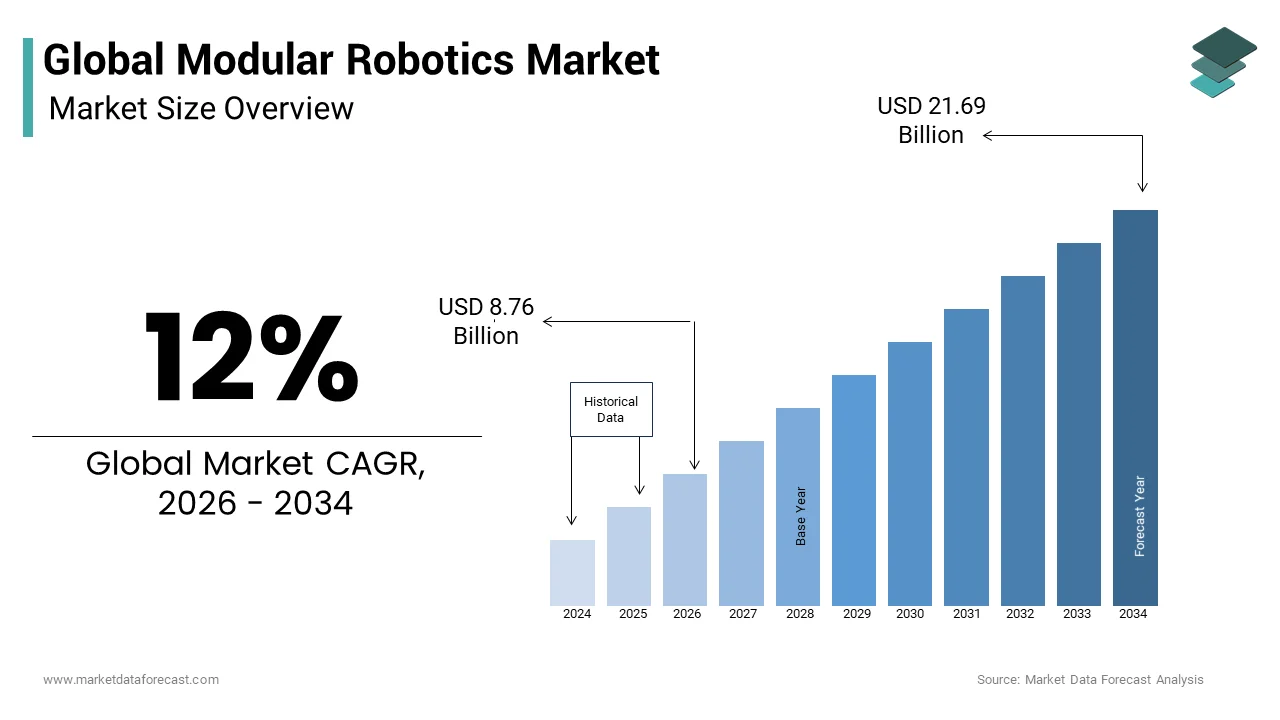
- Market Valuation: Valued at USD 7.82 billion in 2025, reaching USD 8.76 billion in 2026, and projected to expand to USD 21.69 billion by 2034, growing at a strong CAGR of 12.00% during the forecast period from 2026 to 2034.
- Primary Growth Drivers: Deepening Industrial Internet of Things (IIoT) penetration in smart manufacturing, rapid transition toward flexible plug-and-play production lines, rising demand for self-reconfiguring medical and surgical automation platforms, and real-time operational data integration.
Key Market Segment Metrics
| Category | Leading Segment (Base Year Position) | Fastest-Growing / High-Impact Segment |
|---|---|---|
| By Robot Type & Architecture | Collaborative Robots (Cobots) (dominant baseline share anchored by safe human-robot interaction, rapid re-positioning flexibility, and plug-and-play CAD programming) | Self-Reconfiguring & Articulated Modular Platforms (high-impact growth areas accelerating dynamic morphology adjustments and simplified hardware maintenance) |
| By End User & Region | Automotive / Electrical & Electronics & Asia-Pacific Region (leading baseline volumes driven by core manufacturing hubs in China, Japan, and India) | Healthcare Sector (14.6% growth rate) & APAC Region (fastest-expanding end-user segment propelled by robot-assisted surgical platforms and Industry 4.0 adoption) |
Major Market Players & Market Structure
Market Structure: Highly technological and competitive global landscape dominated by industrial automation conglomerates and medical robotics pioneers focusing on modular architectures, collision detection safety systems, and OEM ecosystem partnerships.
Key Companies: ABB Ltd, Acutronic Robotics, Kuka AG, Mitsubishi Electric Corp, FANUC Corp, Kawasaki Heavy Industries, Yaskawa Electric Corp, Denso Corporation, Universal Robots, Nachi-Fujikoshi Corp, and Rethink Robotics.
Global Modular Robotics Market Size
The global modular robotics market size was valued at USD 7.82 billion in 2025 and is anticipated to reach USD 8.76 billion in 2026 to reach USD 21.69 Bn by 2034, growing at a CAGR of 12% from 2026 to 2034.
Modular robots are self-configuring robots made up of many independent pieces with no predetermined morphology. They can accomplish a variety of tasks by rearranging their geometric structures in independent and dynamic ways. Modular robots can be combined and recombined to produce a single big model for specialized uses, or they can be divided into little identical models for mass manufacturing. These robots can be readily fixed by exchanging broken atoms with functioning ones since they are made up of numerous similar atoms. Due to their flexibility, resilience, and optimum functioning, modular robots are becoming increasingly popular in automotive, industrial, healthcare, and other industries. The rising residential and industrial infrastructures, such as chemical factories, public gardens, corporate housing, and others, will increase the need for Modular Robotics.
MARKET DRIVERS
The penetration of IIoT in industrial production, which has altered the industrial sector in terms of manufacturing capabilities, is a key trend in the modular robot industry.
In contemporary manufacturing, IIoT is helping to establish a new era of industrial growth and development by enhancing efficiency, simplifying maintenance, asset monitoring, and more. Machine maintenance may be planned ahead of time using enhanced data insights and real-time tracking. By transforming linear, traditional manufacturing supply chains into interconnected, dynamic systems, the IIoT is bringing major changes to industries.
MARKET RESTRAINTS
One of the primary challenges likely to slow the growth of the worldwide self-reconfiguring modular robot market is the high initial installation cost for low-volume manufacturing applications and, in terms of their designs, the complexity of modular robotics systems.
REPORT COVERAGE
| REPORT METRIC | DETAILS |
| Market Size Available | 2024 to 2033 |
| Base Year | 2024 |
| Forecast Period | 2025 to 2033 |
| CAGR | 12% |
| Segments Covered | By Robot Type, End Users, and Region |
| Various Analyses Covered | Global, Regional & Country Level Analysis, Segment-Level Analysis, DROC, PESTLE Analysis, Porter’s Five Forces Analysis, Competitive Landscape, Analyst Overview on Investment Opportunities |
| Regions Covered | North America, Europe, APAC, Latin America, Middle East & Africa |
| Market Leaders Profiled | ABB Ltd, Acutronic Robotics, Kuka AG, Mitsubishi Electric Corp, FANUC Corp, Kawasaki Heavy Industries, Yaskawa Electric Corp, Denso Corporation, Universal Robots, Nachi-Fujikoshi Corp, and Others. |
SEGMENTAL ANALYSIS
By Robot Insights
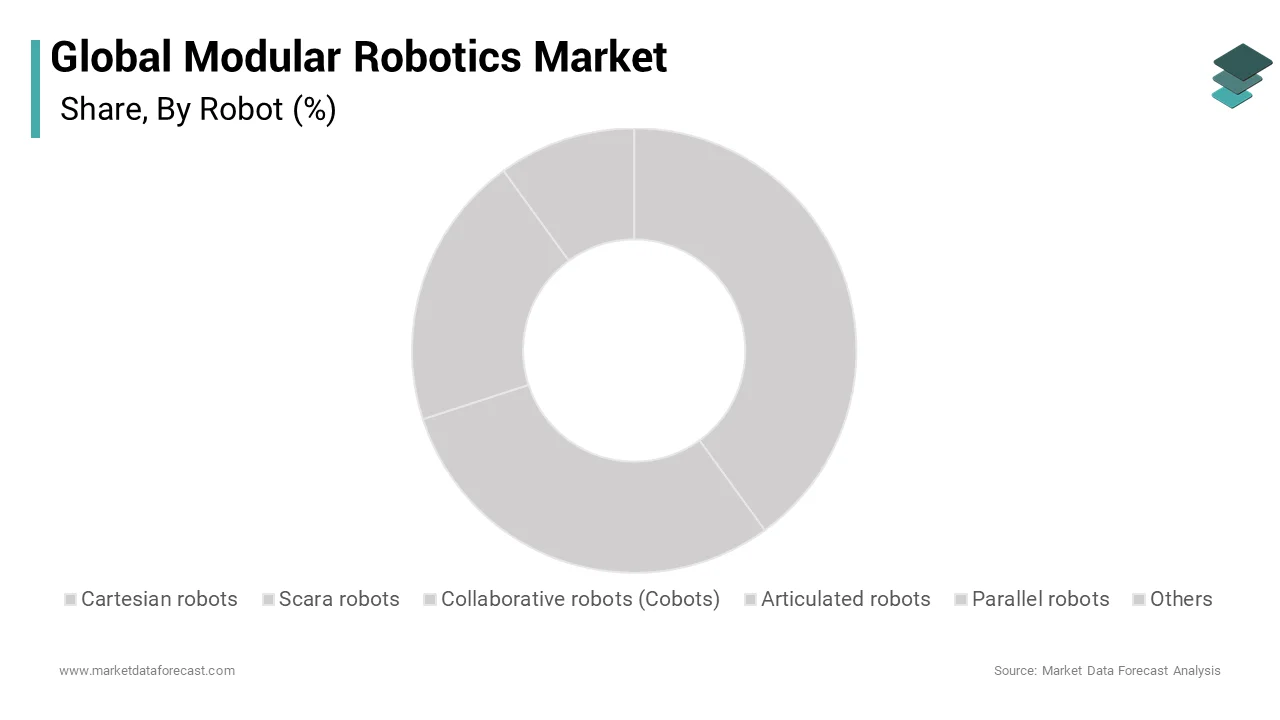
The modular robotics market is divided into Cartesian robots, Collaborative robots (Cobots), Articulated robots, Scara robots, Parallel robots, and others based on robot type. Collaborative robots, also known as cobots, held the largest share of the worldwide modular robotics market in 2020, accounting for 26.5 percent. A collaborative robot can complete tasks by physically engaging with workers throughout an industrial environment. Because cobots may be simply positioned or relocated based on customer demands, they aid in the elimination of any non-productive activities during work hours, assuring maximum flexibility, efficiency, and production capacities for a variety of end-use industries.
Furthermore, these robots are developed with human engagement and cooperation in mind, resulting in a safer working environment, particularly in sectors where human errors can cause large work interruptions, such as medical, food and beverage, and so on. Its market expansion has been influenced by features such as ease of use, cost, and the deployment of plug-and-play and CAD programming possibilities. Adoption of collaborative robots might gradually grow across key end-use verticals, including manufacturing, electronics, medical, and others, in the long run, thanks to technological developments in controllers, diverse robotic modules, and other areas.
By End Users' Insights
Food & Beverages, Healthcare, Electrical & Electronics, Metals & Machinery, Automotive, Chemicals, and many other industries have been divided by end-users in the worldwide modular robots market. Due to a rising movement towards automating medical treatment operations such as performing surgeries, running diagnostic tests, and many others with maximum flexibility and simplicity, the healthcare industry is expected to increase at a considerable rate of 14.6 percent through 2026. In the long run, demand for self-configurable robots will expand as hospitals execute a variety of demanding treatments that need a high level of accuracy and precision while eliminating large levels of human interference. Medtronic PLC introduced a robot-assisted surgical platform capable of laparoscopic applications in September 2019. Foot pedals are used in this modular and upgradeable built architecture to assist surgeons in interacting with patients or employees during surgeries. Such advancements are a key component in updating medical surgery techniques in the healthcare industry. CMR Surgical announced in October 2020 that the Versius surgical robotic system would be introduced at Argenteuil Hospital, a prominent public health center in France. In the foreseeable future, this robotic system was designed to strengthen the trend toward accessible and flexible surgical robots throughout worldwide healthcare systems.
REGIONAL ANALYSIS
Over the projected period, the APAC region is expected to have a considerable increase in the modular robots market. The expanding domination of industrial sectors such as automotive and electronics in China, India, Japan, and other countries, as well as the developing movement toward Industry 4.0 trends, have been important factors influencing the need for modular robots. High expenditures in research and development, as well as greater support for healthcare facility upgrades, will all contribute to the rise of modular robots in the region. The presence of key market participants such as Mitsubishi Electric Corporation, Yaskawa Electric Corporation, Toshiba Machine CCo,.Ltd., and others has fueled the strong demand for modular robots. Mitsubishi Electric plans to debut a series of collaborative robots called MELFA ASSISTA in Indian markets in August 2020. These robots are equipped with safety features such as collision detection, as well as international safety and robotic standardstoto provide end-user clients with the highest levels of productivity, flexibility, and automation. Such improvements are also expected to have a favorable influence on the modular robots market's long-term growth.
KEY MARKET PARTICIPANTS
These are the market players that are dominating the global modular robotics market.
- ABB Ltd
- Acutronic Robotics
- Kuka AG
- Mitsubishi Electric Corp
- FANUC Corp
- Kawasaki Heavy Industries
- Yaskawa Electric Corp
- Denso Corporation
- Universal Robots
- Nachi-Fujikoshi Corp
- Rethink Robotics
RECENT MARKET NEWS
-
February 2019 – Universal Robots has formed a partnership with Bharat Fritz Werner (BFW), an Indian machine tool maker. Through a modular platform, the alliance will aid in the integration of collaborative robot technology with MSME shop floors. Furthermore, it would increase BFW's production capability.
MARKET SEGMENTATION
This research report on the global modular robotics market has been segmented and sub-segmented based on the robot type, end users, and region.
By Robot Type
- Cartesian robots
- Scara robots
- Collaborative robots (Cobots)
- Articulated robots
- Parallel robots
- Others
By End Users
- Food & Beverages
- Automotive
- Healthcare
- Electrical & Electronics
- Chemicals
- Metals & Machinery
- Others
By Region
- North America
- Europe
- Asia-Pacific
- Latin America
- The Middle East and Africa