- Product Description Description
- Table of Contents TOC
- List of Table & Figure LOT
- Get Free Sample PDF Sample PDF
Market Size, 2025
$2.11 BnMarket Estimate, 2026
$2.87 BnMarket Forecast, 2034
$34.03 BnCAGR, 2026–2034
36.2%Global MulteFire Market Size, Growth, Trends & Forecast (2026–2034)
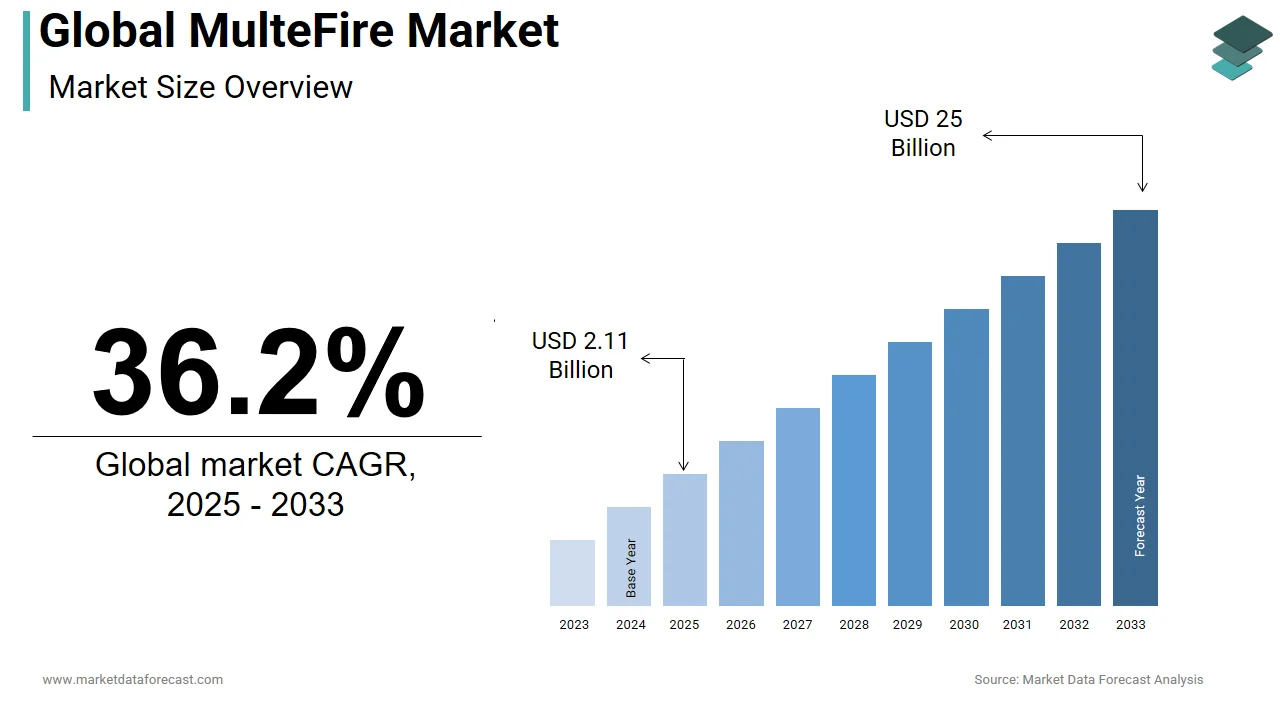
The global MulteFire market was valued at USD 2.11 billion in 2025, is anticipated to reach USD 2.87 billion in 2026, and is projected to scale up to USD 34.03 billion by 2034, registering a compound annual growth rate (CAGR) of 36.2% during the forecast period from 2026 to 2034. Driven by the accelerated adoption of IoT, cloud computing, industrial automation, and the demand for easy-to-install private LTE networks on unlicensed spectrum, the global automated connectivity sector continues to experience rapid expansion.
Key Executive Metrics (At-a-Glance)
- 2025 Base Valuation: USD 2.11 Billion
- 2026 Current Valuation: USD 2.87 Billion
- 2034 Forecast Valuation: USD 34.03 Billion
- Compound Annual Growth Rate (CAGR): 36.2% (2026–2034)
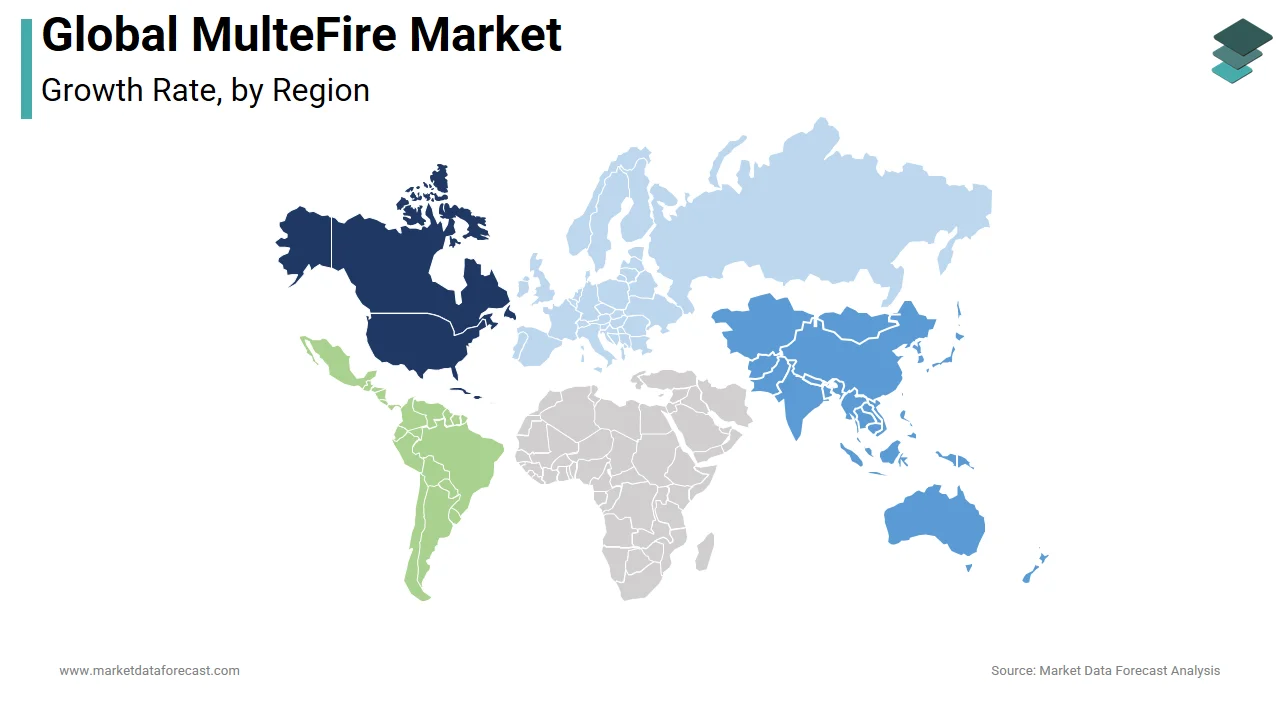
- Dominant Region: North America (anchored in early 5G NR deployment on unlicensed spectrum and advanced private network rollouts)
Core Market Drivers
- Industrial IoT (IIoT) & Automation: Rising integration of advanced digital systems in enterprises requiring robust, reliable, and high-capacity wireless connectivity.
- Unlicensed Spectrum Utilization: Ability to deploy standalone private LTE networks without mobile network operator participation using shared bands like 2.4 GHz and 5 GHz.
- Network Compatibility: Seamless operation alongside Wi-Fi, LTE-U, and LAA infrastructures to efficiently handle escalating internet traffic volumes.
Primary Market Restraints & Challenges
- Data Security & Maintenance Costs: Concerns over compromised data security coupled with high ongoing infrastructure maintenance expenses.
- Skilled Labor Shortage: A lack of specialized technical manpower to effectively manage, configure, and operate MulteFire environments within enterprises.
Global MulteFire Market Segmentation Breakdown
| Segment Category | Key Sub-Segments / Details |
|---|---|
| By Device | Small Cells, Controllers, Switches |
| By Application | Industrial Manufacturing, Commerce, Transportation, Healthcare, Oil and Gas, Mining, Power Generation, Hospitality, and Others |
| By Region | North America, Europe, Asia Pacific, Middle East & Africa, and Latin America |
Major Industry Players Profiled
Key technology leaders shaping the global MulteFire market include Qualcomm (United States), Nokia (Finland), Ericsson (Sweden), Huawei (China), Samsung (South Korea), Baicells Technologies (China), Casa Systems (United States), Redline Communications (Canada), Ruckus Networks (United States), SpiderCloud Wireless (United States), Airspan (United States), Athonet (Italy), ip.access (United Kingdom), Qucell (South Korea), and Quortus (United Kingdom).
Global MulteFire Market Size
The global MulteFire market was worth USD 2.11 billion in 2025. The global market is expected to be worth USD 34.03 billion in 2034, up from USD 2.87 billion in 2026, growing at a CAGR of 36.2% from 2026 to 2034.
MulteFire is a new-age technology that can simplify the existing Wi-Fi working procedure to avoid the need for mobile network providers. It is based on Listen Before Talk (LBT) network technology. MulteFire provides hassle-free mobility to assist service continuity between small cells and other networks. Businesses dealing with critical voice and data applications like high-speed mobile broadband for video, messages and imagery can benefit tremendously from using MulteFire. MulteFire technology is deployed in commercial and institutional buildings, the supply and distribution chain, retail, hospitality, public places and healthcare. MulteFire will be a critical enabler that will enable businesses to deploy private LTE networks without the participation of a mobile network operator in global and regional unlicensed spectrum bands around the world, including global 2.4 bands GHz and 5 GHz and those of 800/900 MHz and regional bands of 1.9 MHz. With the stand-alone functionality it offers, MulteFire will open up unlicensed spectrum to a host of new players, including wireless ISPs, global businesses, specialist verticals and even network operators where all could deploy LTE-based private networks on MulteFire.
By combining enhanced LTE performance with the simplicity of deploying unlicensed spectrum, MulteFire enables the deployment of enhanced broadband services in more locations. Since it is based on LTE, it will operate in wider bandwidths supporting up to 20 MHz to support high capacity and low latency, capable of maximum data rates up to 400 Mbps.
MARKET DRIVERS
The MulteFire market is expected to grow at a significant rate in the coming years. This is mainly due to the increasing adoption of advanced technologies such as IoT, cloud computing and automation in companies.
For this reason, technologies need a robust network to function and MulteFire technology is known for its reliable and reliable connections. Also, the technology works well with Wi-Fi, LTE-U, or LAA, and its compatibility with several business infrastructures is foreseen to promote the demand in the global MulteFire market over the forecast period.
Increasing demand for easy-to-install, high-capacity wireless connectivity networks, improved network connectivity, a scalable network with growing needs, and the adoption of industrial IoT (IIoT) applications are expected to deliver lucrative gains for market growth. MulteFire.
At present, the Internet is stable, but the traffic is expected to increase more in the next few days, and here it is necessary to use the frequency bands correctly to cope with the changes in traffic. Multiple private LTE networks can be deployed across multiple enterprises on shared, unlicensed spectrum, as well as locally dedicated licensed spectrum that helps increase the stability of internet traffic, and this is where MulteFire can be deployed. MulteFire enhances the LTE to operate on unlicensed shared spectrum in a private network environment that is host-neutral. With MulteFire, public and private sites, IoT (Internet of Things) verticals, businesses and homeowners can configure and operate their private network, which can result in efficient use of frequency bands.
MARKET RESTRAINTS
However, factors such as compromised data security, high maintenance costs, and a shortage of skilled manpower to manage the operation of the technology are important factors that are expected to hinder the growth of the global MultiFire market in enterprises in the next few years. In addition, the ease of deployment, customization, and high-quality services of MulteFire technology are some of the key features that drive companies to adopt MulteFire technology in the workplace, which is supposed to be driving the outlook for the global MulteFire market.
REPORT COVERAGE
| REPORT METRIC | DETAILS |
| Market Size Available | 2025 to 2034 |
| Base Year | 2025 |
| Forecast Period | 2026 to 2034 |
| CAGR | 36.2% |
| Segments Covered | By Device, Application and Region |
|
Various Analyses Covered | Global, Regional & Country Level Analysis, Segment-Level Analysis, DROC, PESTLE Analysis, Porter’s Five Forces Analysis, Competitive Landscape, Analyst Overview on Investment Opportunities |
| Regions Covered | North America, Europe, APAC, Latin America, Middle East & Africa |
|
Market Leaders Profiled | Qualcomm (United States), Nokia (Finland), Ericsson (Sweden), Huawei (China), Samsung (South Korea), Baicells Technologies (China), Casa Systems (United States), Redline Communications (Canada), Ruckus Networks (United States), SpiderCloud Wireless (United States), Airspan (United States), Athonet (Italy), ip.access (United Kingdom), Qucell (South Korea) and Quortus (United Kingdom) and Others. |
REGIONAL ANALYSIS
The North American region is undergoing standardization in the operations of 5G NR on unlicensed spectrum, which could allow private networks to expand rapidly. Autonomous NR on unlicensed spectrum will become MulteFire's evolution path towards 5G, and the US is seeing a massive rollout of the 5G network in 2020.
KEY PLAYERS IN THE MARKET
Qualcomm (United States), Nokia (Finland), Ericsson (Sweden), Huawei (China), Samsung (South Korea), Baicells Technologies (China), Casa Systems (United States), Redline Communications (Canada), Ruckus Networks (United States), SpiderCloud Wireless (United States), Airspan (United States), Athonet (Italy), ip.access (United Kingdom), Qucell (South Korea) and Quortus (United Kingdom) are some of the big dominant companies in MulteFire Market.
RECENT DEVELOPMENTS IN THE MARKET
-
In November 2019, Nokia launches industrial MulteFire devices that deliver the benefits of private wireless technology without worrying about spectrum availability and offer greater range and capabilities, greater flexibility and ease of use, which are important conditions for fostering the adoption of wireless networks for Industry 4.0.
-
In April 2019, Qualcomm is working on the continued development of the new 5G Radio standard and takes a collaborative approach to bring 5G to industries. The company sees unlicensed spectrum being aggregated with licensed bands for operators to increase capacity (LAA) and stand-alone deployments for primarily IoT applications where MulteFire can be deployed.
-
In February 2019, US Cellular partnered with Ericsson on the 5G New Radio team. The company will help them build a 5G network, targeting public safety users with priority network access and preferred services using advanced network technology like MuteFire. In this way, it provides a significant boost to the growth of the MuteFire market.
MARKET SEGMENTATION
This research report on the global MulteFire market has been segmented and sub-segmented based on device and application.
By Device
- Small Cells
- Controllers
- Switches
By Application
- Industrial Manufacturing
- Commerce
- Transportation
- Healthcare
- Oil and Gas
- Mining
- Power Generation
- Hospitality
- Others
By Region
- North America
- Europe
- Asia Pacific
- Middle East and Africa
- Latin America