Global Multilayer Ceramic Capacitor (MLCC) Market Size, Share, Trends, and Growth Analysis Report, Segmented By Dielectric Type, Case Size, Voltage Rating, Mounting Type, End User, & Region (North America, Europe, Latin America, Asia Pacific, Middle East & Africa), Industry Forecast From 2026 to 2034
Market Size, 2025
$14.25 BnMarket Estimate, 2026
$15.06 BnMarket Forecast, 2034
$23.43 BnCAGR, 2026–2034
5.68%Global Multilayer Ceramic Capacitor (MLCC) Market Summary
The global multilayer ceramic capacitor (MLCC) market was valued at USD 14.25 billion in 2025, is estimated to reach USD 15.06 billion in 2026, and is projected to reach USD 23.43 billion by 2034, growing at a CAGR of 5.68% from 2026 to 2034. The growth of the global multilayer ceramic capacitor (MLCC) market is driven by the rising adoption of consumer electronics, 5G technology, electric vehicles, and smart devices that require high-capacitance and miniaturized components.
Key Market Trends
- Growing demand for MLCCs in 5G infrastructure and IoT devices.
- Increasing integration in electric vehicles and advanced driver assistance systems (ADAS).
- Rising usage in consumer electronics such as smartphones, tablets, and wearables.
- Advancements in high-capacitance and compact MLCC designs.
- Expanding applications in industrial automation and renewable energy systems.
Segmental Insights
- Based on dielectric type, the Class 2 MLCC segment dominated the global market by capturing a significant share in 2024.
- Based on voltage rating, the medium voltage (100V–1000V) segment held the leading share of 54.8% in 2024.
- Based on end user, the consumer electronics segment accounted for the largest share with 42.1% in 2024.
Regional Insights
- Asia-Pacific led the global MLCC market with a 72.6% share in 2024, supported by strong manufacturing bases in China, Japan, South Korea, and Taiwan.
- North America experienced solid demand driven by growth in automotive electronics and defense applications.
- Europe showed steady adoption, particularly in automotive and industrial electronics.
- Latin America and the Middle East & Africa are emerging markets with rising adoption of smart devices and digital infrastructure.
Competitive Landscape
Key players dominating the global MLCC market include Murata Manufacturing Co., Ltd., Samsung Electro-Mechanics Co., Ltd., Taiyo Yuden Co., Ltd., Yageo Corporation, and TDK Corporation. These companies focus on developing miniaturized, high-capacitance MLCCs, expanding automotive-grade product lines, and strengthening global supply chains to meet increasing demand.
Global Multilayer Ceramic Capacitor (MLCC) Market Size
The global multilayer ceramic capacitor (MLCC) market was valued at USD 14.25 billion in 2025, is estimated to reach USD 15.06 billion in 2026, and is projected to reach USD 23.43 billion by 2034, growing at a CAGR of 5.68% from 2026 to 2034.
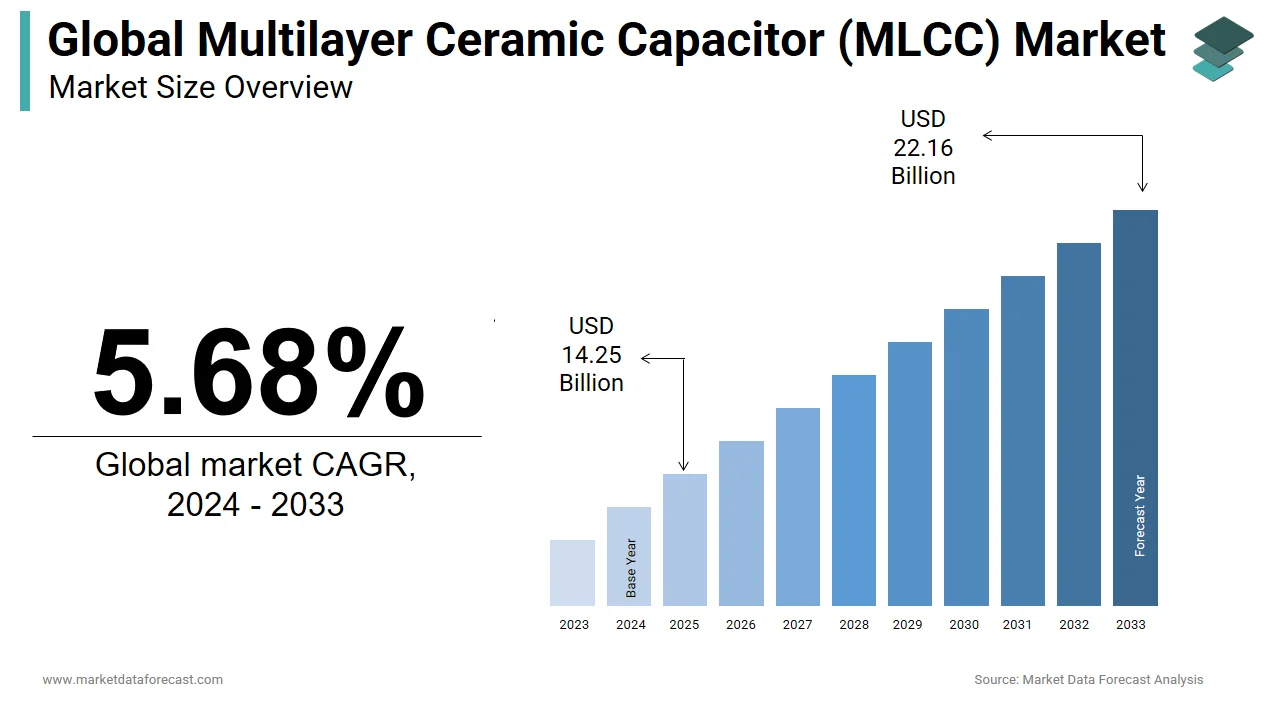
A multilayer ceramic capacitor (MLCC) is a passive electronic component constructed by stacking alternating layers of ceramic dielectric and metallic electrodes, which enables high capacitance in miniaturized surface-mount packages. These components are indispensable in stabilizing voltage, filtering noise, and ensuring signal integrity across virtually all modern electronic systems. According to a study, a large number of MLCC units were shipped globally, which emphasizes their ubiquity in consumer, industrial, and automotive electronics. As per research, the average smartphone now integrates between 700 and 1,000 MLCCs, while advanced driver-assistance systems (ADAS) in modern vehicles require more than 3,000 units per car. The relentless drive toward device miniaturization and increased circuit density has intensified demand for ultra-small 01005 and 008004 case-sized MLCCs, particularly in wearable and IoT applications.
MARKET DRIVERS
Surge in MLCC Demand Driven by EVs and Advanced Automotive Electronics
The escalating integration of advanced electronics in automotive systems in electric vehicles (EVs) and driver-assistance technologies is a key driver of the multilayer ceramic capacitor (MLCC) market. Each EV requires between 10,000 and 15,000 MLCCs, nearly five times more than conventional internal combustion engine vehicles, due to the complexity of battery management systems, power inverters, and onboard charging units. According to the study, global electric car sales were millions of units in 2023, representing a portion of all new car sales, a figure that has increased since 2020. This surge directly amplifies MLCC demand, especially for high-reliability, temperature-stable X8R and X7R dielectric formulations.
Growing MLCC Demand Fueled by 5G Devices and Infrastructure
The proliferation of 5G-enabled devices and infrastructure, which necessitates a significant increase in MLCC count per unit due to higher-frequency signal processing and power delivery requirements, propels the growth of the multilayer ceramic capacitor (MLCC) market. A single 5G base station requires notable MLCCs, primarily for RF filtering, impedance matching, and decoupling circuits, as per research. Consumer devices such as 5G smartphones and tablets also demand more MLCCs than their 4G predecessors. This exponential growth in connectivity drives demand for ultra-miniaturized and high-capacitance MLCCs capable of operating at millimeter-wave frequencies. The transition to compact as well as multi-band antennas and advanced RF front-end modules further intensifies component density, which strengthens MLCCs as foundational elements in next-generation wireless systems.
MARKET RESTRAINTS
Raw Material Supply Chain Vulnerabilities in MLCC Production
The persistent vulnerability of raw material supply chains, particularly for specialty ceramics and base metal electrodes, hinders the expansion of the multilayer ceramic capacitor (MLCC) market. Nickel, a primary constituent in internal electrode layers, experienced a price increase in 2022, as per the London Metal Exchange. Apart from these, the availability of high-purity barium titanate, the core dielectric material, is concentrated in a few chemical producers in Japan and China. These supply shocks delay MLCC production cycles and increase manufacturing costs, especially for Class I and high-capacity Class II capacitors. Smaller capacitor manufacturers face disproportionate risks due to limited inventory buffers and long-term supplier contracts held by tier-one players.
Supply Chain Vulnerability and Raw Material Constraints
Stringent qualification and lead time requirements in mission-essential industries are limiting the growth of the multilayer ceramic capacitor (MLCC) market. Aerospace, medical, and automotive sectors mandate extended reliability testing often exceeding hours of thermal cycling and humidity exposure before component approval, as per research. According to a study, the qualification cycle for a new MLCC in automotive applications spans several months, which delays product integration. Furthermore, lead times for high-specification MLCCs frequently exceed weeks during periods of high demand, as per research. This barrier restricts design flexibility and forces engineers to over-specify components early in development. This increases bill-of-materials costs and reduces agility in rapidly evolving markets such as consumer electronics and IoT.
MARKET OPPORTUNITIES
Expansion Through Embedded MLCCs in PCBs and SiP Modules
The development of embedded MLCCs within printed circuit boards (PCBs) and system-in-package (SiP) modules, which enables unprecedented space savings and improved electrical performance, opens new opportunities for the expansion of the multilayer ceramic capacitor (MLCC) market. As per the study, embedded passives could reduce PCB footprint in high-density applications. Companies are pioneering processes to integrate thin-film ceramic capacitors directly into substrate layers, eliminating surface-mount limitations. According to research, embedded MLCC technology achieved a reduction in parasitic inductance compared to discrete components, which enhances high-speed signal integrity. This shift represents a structural evolution in circuit architecture, with wearable devices and edge AI processors demanding minimal form factors.
AI-Driven Materials Innovation for Next-Generation MLCCs
The adoption of AI-driven materials discovery to accelerate the development of next-generation dielectrics with enhanced energy density and thermal stability is unlocking potential opportunities for the multilayer ceramic capacitor (MLCC) market. Traditional MLCC innovation relies on iterative experimentation, but machine learning models are now predicting novel ceramic compositions with optimized permittivity and aging characteristics. As per research, AI-assisted formulation can reduce development time for a new barium zirconate-based dielectric. These advancements promise capacitors with double the volumetric efficiency, vital for EV powertrains and renewable energy inverters. Thus, manufacturers can leapfrog incremental improvements and secure intellectual property in high-performance segments by leveraging computational design.
MARKET CHALLENGES
Physical Miniaturization Limits in Advanced MLCCs
The physical limitation of miniaturization as component sizes approach atomic-scale manufacturing tolerances is a major challenge for the multilayer ceramic capacitor (MLCC) market. The market has transitioned from 0201 to 01005 and now 008004 inch-case dimensions, where electrode layers are thinner than 500 nanometers. According to the study, at such scales, minor variations in sintering temperature or layer alignment cause significant capacitance drift and mechanical cracking. The yield rate for 008004 MLCCs remains below in mass production, as per research, compared to a portion for larger 0201 types. This technical barrier increases production costs and limits scalability, especially for ultra-high-capacitance variants.
Risk of Counterfeit and Substandard MLCCs in Critical Sectors
The rising risk of counterfeit and substandard MLCCs infiltrating the global supply chain in defense, aerospace, and medical sectors is an important barrier impacting the expansion of the multilayer ceramic capacitor (MLCC) market. According to the U.S. Department of Defense, nthe umber of suspect counterfeit electronic parts were intercepted, with MLCCs among the cloned components due to their standardized packaging. Unapproved recycling and remarking of used capacitors pose serious reliability risks, as these units may have undergone thermal degradation or mechanical stress. This affects system integrity and increases compliance costs, which forces OEMs to invest in blockchain traceability and advanced authentication technologies, such as embedded RFID tags and spectroscopic material verification, to safeguard important applications.
REPORT COVERAGE
| REPORT METRIC | DETAILS |
| Market Size Available | 2025 to 2034 |
| Base Year | 2025 |
| Forecast Period | 2026 to 2034 |
| Segments Covered | By Dielectric Type, Voltage Rating, End User, and Region. |
| Various Analyses Covered | Global, Regional, and Country-Level Analysis, Segment-Level Analysis, Drivers, Restraints, Opportunities, Challenges; PESTLE Analysis; Porter’s Five Forces Analysis, Competitive Landscape, Analyst Overview of Investment Opportunities |
| Regions Covered | North America, Europe, Asia-Pacific, Latin America, Middle East and Africa |
| Market Leaders Profiled | Murata Manufacturing Co., Ltd., Samsung Electro-Mechanics Co., Ltd., Taiyo Yuden Co., Ltd., Yageo Corporation, TDK Corporation, and Others. |
SEGMENTAL ANALYSIS
By Dielectric Type Insights
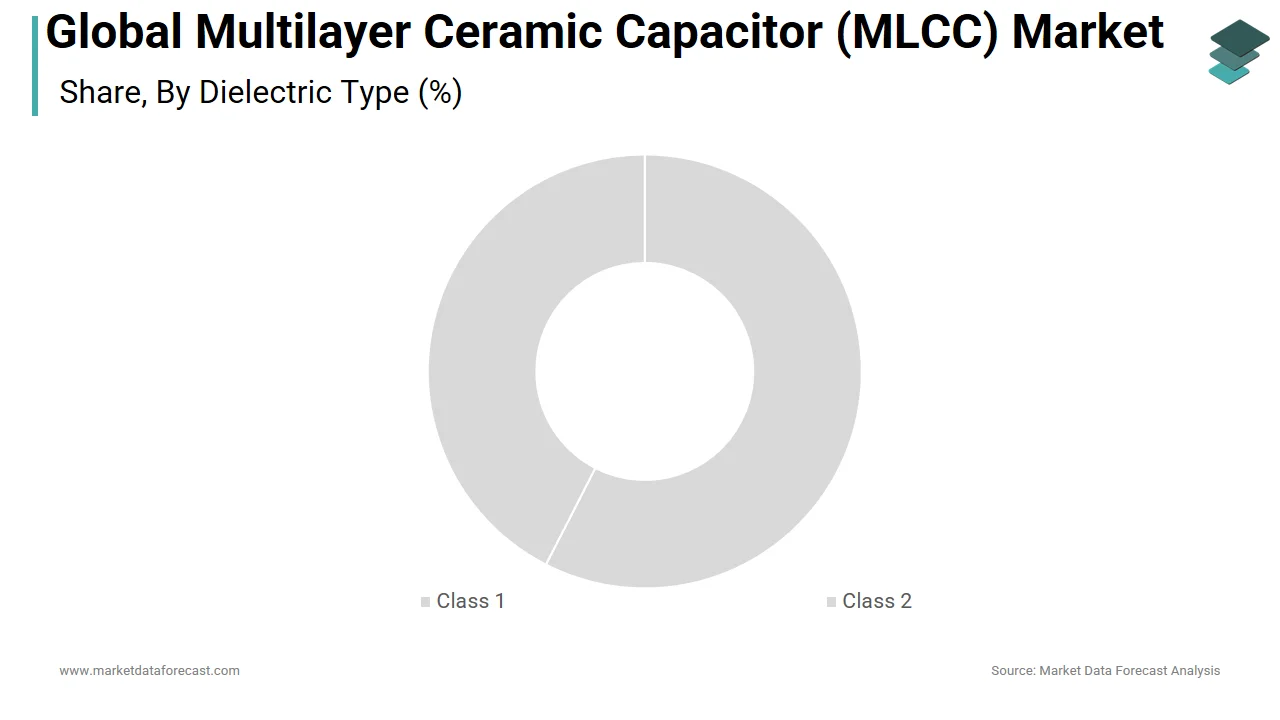
The class 2 MLCC segment was the dominant segment in the multilayer ceramic capacitor (MLCC) market by capturing a significant share in 2025. Its high volumetric efficiency and cost-effectiveness, which make it ideal for decoupling, filtering, and bypass applications in consumer electronics and power supplies, are primarily driving the growth of the class 2 MLCC segment in the global market. The global business for consumer electronics surged, with a significant number of smartphones shipped globally, as per a study. The rising integration of advanced features like 5G modems, AI processors, and multiple cameras has increased component density, directly boosting demand for Class 2 MLCCs. The cost-performance balance of barium titanate-based dielectrics used in Class 2 devices makes them indispensable in mass-market electronics, which strengthens their market dominance.
The class 1 MLCCs segment is positioned to lead the multilayer ceramic capacitor (MLCC) market with the highest CAGR of 6.8% over the forecast period due to the growth in 5G infrastructure and RF applications, and rising adoption in industrial and medical instrumentation. These capacitors, based on paraelectric materials like calcium zirconate, offer superior stability, low losses, and linear temperature coefficients, making them important in precision circuits. Class 1 MLCCs are essential in RF filters, oscillators, and impedance matching networks due to their stable capacitance across temperature and frequency ranges. The demand for Class 1 devices has surged as over 2.3 million 5G base stations were deployed globally by 2023, each requiring thousands of precision capacitors. Class 1 MLCCs are preferred in analog signal conditioning, timing circuits, and sensor interfaces where signal integrity is paramount.
By Voltage Rating Insights
The medium voltage (100V to 1000V) segment held the leading share of 54.8% of the multilayer ceramic capacitor (MLCC) market in 2025. The dominance is because of ubiquity in power management systems, and demand from Electric Vehicles and Charging Infrastructure. This segment bridges the gap between consumer-grade and industrial-grade applications, serving as the workhorse voltage class across multiple industries. A portion of switch-mode power supplies (SMPS) in consumer and industrial electronics operate within the 100–500V range, as per a study. These systems, found in laptops, servers, LED drivers, and home appliances, require MLCCs rated for 200V–630V to handle rectified AC input and DC-DC conversion. MLCCs in this voltage class offer an optimal balance between insulation thickness, size, and reliability, making them the default choice for bulk and filtering applications.
The high range voltage (>1000V MLCC) segment is expected to grow with an expected CAGR of 9.2% from 2025 to 2033 due to specialized industrial and energy applications. Global solar photovoltaic capacity was in terawatts (TW) in 2023, up from that in 2022, according to research. Inverters in solar farms operate at DC link voltages of 1000V–1500V, which requires high-voltage MLCCs for filtering and transient suppression. A single utility-scale inverter may use over 200 high-voltage MLCCs, as per a study. The solar installations are expected to surge annually in the coming years. Thus, the demand for >1000V capacitors is accelerating.
By End User Insights
In 2025, the consumer electronics segment remained the largest segment in the multilayer ceramic capacitor (MLCC) market by accounting for 42.1% of the global market share. Miniaturization and increased component density, and proliferation of IoT and wearable devices are majorly contributing to the expansion of the consumer electronics segment in the global market. This includes smartphones, tablets, laptops, wearables, and home entertainment systems. Modern smartphones integrate over 1,000 MLCCs per device. The need for ultra-small MLCCs (e.g., 0201, 01005 inch sizes) has surged because devices shrink while adding features like multiple lenses, 5G antennas, and haptic feedback. The trend toward system-in-package (SiP) and embedded passives still relies on surface-mount MLCCs for decoupling, which ensures sustained volume demand.
The aerospace and defense segment is anticipated to grow at the fastest pace by achieving the highest CAGR of 8.7% from 2025 to 2033. The growth of the aerospace and defense segment is fueled by technological modernization and defense spending. The global avionics business is expected to expand notably by 2030, according to research. Advanced radar, electronic warfare (EW), and communication systems in fighter jets and drones require high-reliability, temperature-stable MLCCs, often Class 1 or high-voltage types. Global defense spending reached a record high, according to the Stockholm International Peace Research Institute (SIPRI). The U.S. alone allocated a substantial amount for defense, with significant portions directed toward electronic warfare, satellite communications, and missile guidance systems, all reliant on high-performance MLCCs.
REGIONAL ANALYSIS
Asia-Pacific Multilayer Ceramic Capacitor (MLCC) Market Insights
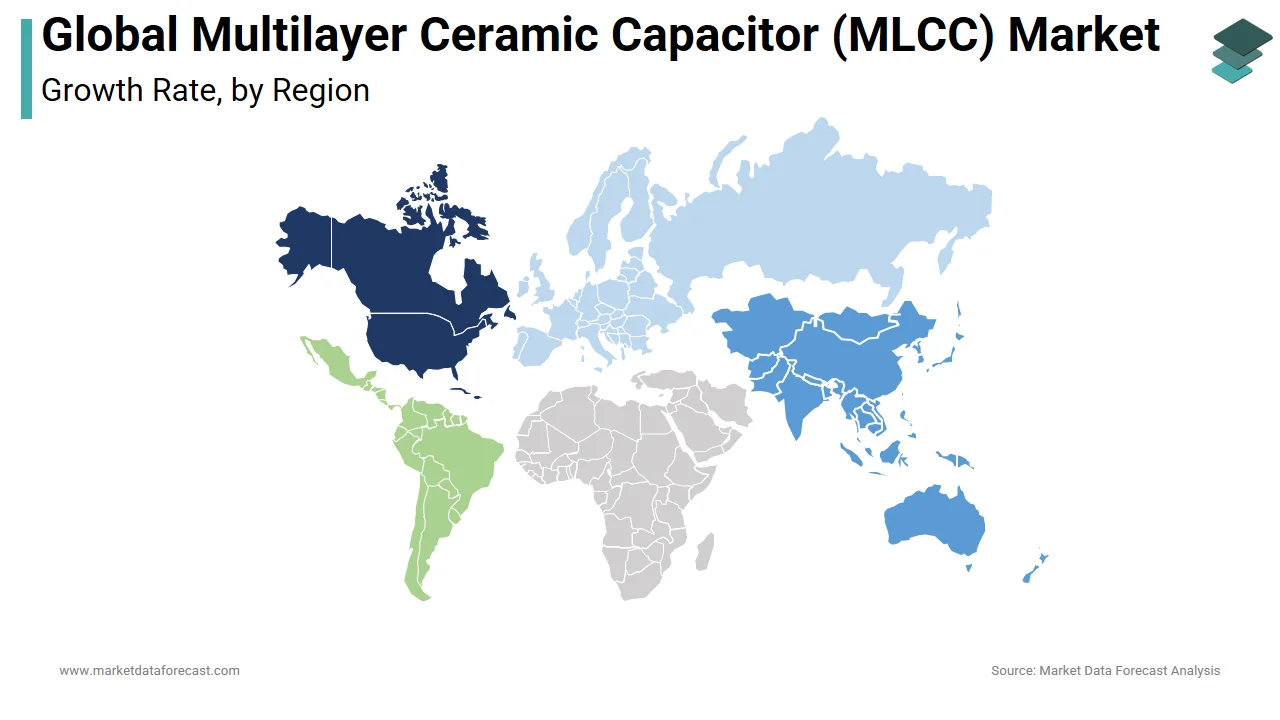
Asia-Pacific led the multilayer ceramic capacitor (MLCC) market in 2024 and accounted for 72.6% share of the global market in 2024. The domination of Asia Pacific is largely accelerated by manufacturing scale, supply chain integration, and regional electronics production. Japan leads in technology and production by hosting industry giants like Murata, which accounts for a portion of global MLCC output, as per a study. South Korea’s Samsung Electro-Mechanics and Taiwan’s Yageo are also top-tier suppliers. China, the world’s largest electronics manufacturer, consumes a portion of all MLCCs produced globally, driven by its smartphone, EV, and industrial automation sectors. The country produced a large number of smartphones, as per research, which creates massive domestic demand. Furthermore, government initiatives are accelerating local semiconductor and passive component development by reducing import reliance and strengthening regional dominance.
North America Multilayer Ceramic Capacitor (MLCC) Market Insights
North America is second only to one other region in the multilayer ceramic capacitor (MLCC) market by capturing 12.3% of the global market share in 2024. The growth of North America is primarily driven by being a center for R&D and high-reliability applications. The U.S. accounts for a portion of North American demand. This is driven by its prominence in aerospace, defense, and data centers. The country hosts major tech firms like Apple, Intel, and NVIDIA, which design cutting-edge devices requiring advanced MLCCs. Furthermore, the Department of Defense’s focus on microelectronics sovereignty has led to initiatives like the CHIPS Act, which allocated a notable amount in subsidies, including funds for passive component resilience. Companies like American Technical Ceramics (ATC) and Knowles Precision Devices supply Class 1 and high-voltage MLCCs for military and space applications, which ensures sustained high-value demand.
Europe Multilayer Ceramic Capacitor (MLCC) Market Insights
Europe is moving ahead steadily in the multilayer ceramic capacitor (MLCC) market, with Germany, France, and the UK as key consumers. The region’s strength lies in automotive and industrial automation. Germany alone produces millions of vehicles annually, many of which are electric or hybrid, as per a study. The European Union’s Fit for package mandates a reduction in CO2 emissions by 2030, accelerating EV adoption. Each EV uses more MLCCs than ICE vehicles. But Europe lacks major MLCC manufacturers.
Middle East & Africa Multilayer Ceramic Capacitor (MLCC) Market Insights
The Middle East and Africa are showing the most potential for growth in the multilayer ceramic capacitor (MLCC) market, with growth concentrated in Gulf Cooperation Council (GCC) countries. The UAE and Saudi Arabia are leading the charge. Saudi Arabia’s Vision 2030 includes infrastructure investments, including NEOM, a smart city project requiring extensive power electronics and communication systems, as per research. The UAE’s renewable energy target of a portion of clean energy by 2050 is driving solar inverter installations, which use MLCCs in DC filtering. The region imported notable quantities of passive components, as per the study. Rising urbanization and digital transformation are creating new demand pockets across telecommunications and energy sectors, while local manufacturing is minimal.
Latin America Multilayer Ceramic Capacitor (MLCC) Market Insights
Latin America is expected to see incremental growth in the multilayer ceramic capacitor (MLCC) market, with Brazil and Mexico as primary hubs. Brazil produced large number of vehicles, the highest in Latin America, according to a study, creating demand for automotive MLCCs. Mexico, integrated into North American supply chains, hosts over automotive plants, which rely on imported MLCCs. However, economic volatility and limited local manufacturing constrain faster growth. Still, with increasing foreign investment in electronics assembly in Monterrey and São Paulo, MLCC demand is expected to grow.
COMPETITIVE LANDSCAPE
The MLCC market is characterized by intense competition, dominated by a few technologically advanced players primarily based in Japan, South Korea, and Taiwan. Innovation in miniaturization, capacitance density, and reliability is the key differentiator among competitors. While Japanese firms lead in R&D and precision engineering, Korean and Taiwanese companies excel in high-volume production and cost efficiency. The market is witnessing increased rivalry in automotive and industrial segments, where reliability and qualification timelines create entry barriers. New entrants from China are gaining ground in consumer-grade MLCCs but face challenges in high-end applications. Companies are investing heavily in automation, supply chain diversification, and strategic alliances to maintain competitive edges. Price burden from commoditized segments coexists with premium pricing in specialty MLCCs, which creates a bifurcated competitive landscape shaped by technological prowess and manufacturing scale.
KEY MARKET PLAYERS
Some of the companies that are playing a dominating role in the global multilayer ceramic capacitor (MLCC) market include
- Murata Manufacturing Co., Ltd.
- Samsung Electro-Mechanics Co., Ltd.
- Taiyo Yuden Co., Ltd.
- Yageo Corporation
- TDK Corporation
Top Players in the MLCC Market
- Murata is a global leader in MLCC innovation and production, headquartered in Japan. The company plays a pivotal role in the Asia-Pacific market by driving advancements in miniaturization and high-capacitance technologies. Murata has consistently invested in R&D to develop ultra-small 008004-inch MLCCs, meeting demands from smartphone and wearable manufacturers. The company collaborates closely with key Asian OEMs in the automotive and IoT sectors. Murata also focuses on sustainability, introducing lead-free and recyclable packaging. Its strong technical support network across China, India, and South Korea strengthens design-in opportunities, which makes it a preferred partner for high-reliability applications in industrial and telecommunications infrastructure.
- Samsung Electro-Mechanics, based in South Korea, is a major force in the MLCC landscape, particularly within the Asia-Pacific region. The company supplies high-performance components to Samsung Electronics and external clients, supporting smartphones, data centers, and 5G base stations. SEMCO actively participates in Korea’s national semiconductor resilience program, enhancing local material sourcing. By strengthening partnerships with Chinese and Japanese Tier 1 automotive suppliers, it has deepened its footprint in electric vehicle electronics. Its focus on automation and yield optimization ensures competitive pricing and reliable delivery, which supports its position as a key enabler of high-volume electronics manufacturing in the region.
- Yageo, headquartered in Taiwan, is a dominant player in the MLCC market with extensive influence across the Asia-Pacific. Through its subsidiaries, including KEMET and Pulse Electronics, Yageo offers a broad portfolio spanning consumer, industrial, and automotive applications. Yageo has prioritized automotive electrification, launching AEC-Q200-qualified components for EV charging systems. Yageo now serves aerospace and medical clients across Japan and India by integrating KEMET’s high-reliability technology. Its strategy of vertical integration, from raw materials to finished goods, enhances cost control and delivery stability, which makes it a critical supplier in the regional electronics ecosystem.
Top Strategies Used by Key Market Participants
Key players in the MLCC market are deploying vertical integration to secure raw material supply and reduce dependency on external ceramic powder suppliers. Companies like Murata and Yageo have invested in proprietary dielectric formulations to enhance performance and yield. Another prevalent strategy is capacity expansion in Southeast Asia, Thailand, Malaysia, and Vietnam, to mitigate geopolitical risks and benefit from lower operational costs. Firms are also focusing on product differentiation by developing ultra-miniaturized and high-capacity MLCCs for 5G, EVs, and AI-driven devices. Strategic acquisitions, such as Yageo’s integration of KEMET, allow access to high-reliability markets. Besides, manufacturers are strengthening partnerships with automotive and industrial OEMs to ensure design-in advantages. Digital transformation of production lines using AI and IoT enables predictive maintenance and higher throughput. Sustainability initiatives, including lead-free terminations and energy-efficient manufacturing, are becoming central to brand positioning, which helps firms meet global regulatory standards and customer ESG expectations.
MARKET SEGMENTATION
This research report on the global multilayer ceramic capacitor (MLCC) market has been segmented and sub-segmented into the following categories.
By Dielectric Type
- Class 1
- Class 2
By Case Size
- 1005
- 201
- 402
- 603
- 805
- 1206
- 1210+
By Voltage Rating
- Low-Range Voltage
- Mid-Range Voltage
- High-Range Voltage
By Mounting Type
- Surface-Mount
- Metal-Cap
- Radial-Lead
By End User
- Automotive
- Consumer Electronics
- Industrial
- Telecommunications
- Aerospace and Defence
- Medical Devices
- Power and Utilities
- Other End Users
By Region
- North America
- Europe
- Asia Pacific
- Latin America
- The Middle East and Africa
Frequently Asked Questions
1. What is the Multilayer Ceramic Capacitor (MLCC) Market?
The Multilayer Ceramic Capacitor (MLCC) Market covers the production, distribution, and innovation in ceramic capacitors composed of multiple dielectric layers, used in a wide range of electronic devices for energy storage, filtering, and signal processing
2. What key industries drive the Multilayer Ceramic Capacitor (MLCC) Market?
Consumer electronics, automotive (EVs, ADAS), telecom, industrial, medical electronics, and power infrastructure are main verticals using MLCCs
3. What are the leading drivers for Multilayer Ceramic Capacitor (MLCC) Market growth?
Growth is led by demand for miniaturization, rising use in smartphones and IoT, adoption in electric vehicles (EVs), 5G rollout, and advanced computing needs
4. Who are the top manufacturers in the Multilayer Ceramic Capacitor (MLCC) Market?
Murata Manufacturing, TDK Corporation, Samsung Electro-Mechanics, Kyocera, Taiyo Yuden, Walsin, Yageo Corporation, Vishay, and Kemet Corp are key players
5. Which region dominates the Multilayer Ceramic Capacitor (MLCC) Market?
Asia Pacific is the largest regional market, driven by electronics production hubs in China, South Korea, Taiwan, and growing automotive electronics in Japan and India
6. What is driving MLCC demand in the automotive industry?
Rapid electrification, EV battery systems, ADAS, infotainment, and strict reliability requirements are fueling high-value MLCC use in automotive applications
7. Why is miniaturization important in the Multilayer Ceramic Capacitor (MLCC) Market?
Miniaturization meets the need for compact, high-performance electronics, enabling smaller devices with higher capacitance and power management
8. How is 5G technology impacting the Multilayer Ceramic Capacitor (MLCC) Market?
5G boosts MLCC demand in smartphones, network infrastructure, and IoT devices, requiring high-frequency, low-inductance, and miniaturized capacitors
9. What innovations are shaping the Multilayer Ceramic Capacitor (MLCC) Market?
Key trends are high-capacitance and low-inductance MLCCs, ultra-small chips, flexible form factors, material R&D for thermal and voltage stability, and RoHS/lead-free compliance
10. What are major challenges in the Multilayer Ceramic Capacitor (MLCC) Market?
Supply chain volatility, price fluctuations, raw material shortages, miniaturization limits, and global capacity constraints pose ongoing challenges
Access the study in MULTIPLE FORMATS
Purchase options starting from
$ 2500
Didn’t find what you’re looking for?
TALK TO OUR ANALYST TEAM
Need something within your budget?
NO WORRIES! WE GOT YOU COVERED!
Call us on: +1 888 702 9696 (U.S Toll Free)
Write to us: sales@marketdataforecast.com