- Product Description Description
- Table of Contents TOC
- List of Table & Figure LOT
- Get Free Sample PDF Sample PDF
Market Size, 2025
$1.86 BnMarket Estimate, 2026
$1.98 BnMarket Forecast, 2034
$3.23 BnCAGR, 2026–2034
6.31%Global Mustard Market Size
The global mustard market size was valued at USD 1.86 billion in 2025, and the global market size is predicted to reach USD 3.23 billion by 2034 from USD 1.98 billion in 2026 with a growing CAGR of 6.31% during the forecast period.

Mustard which is derived primarily from Brassica juncea, Sinapis alba, and Brassica nigra species is valued for its pungency, preservative qualities, and nutritional profile. As per the study, global mustard seed production was in millions of metric tons in 2023. In India, mustard cultivation spans large hectares, supporting millions of smallholder farmers, according to the research. The crop plays a dual role as a source of edible oil, accounting for a portion of India’s domestic oil supply, and as a key ingredient in regional cuisines. Increasing interest in natural preservatives and plant-based condiments has further elevated mustard’s relevance in global food systems.
MARKET DRIVERS
Rising Demand for Natural and Clean-Label Food Preservatives
The food industry’s shift toward clean-label ingredients has significantly boosted its application as a natural antimicrobial agent, is driving the grow of mustard market. According to a study, mustard extract demonstrates potent inhibitory effects against Listeria monocytogenes and E. coli, making it a viable alternative to synthetic preservatives like sodium benzoate. In the U.S., a portion of consumers prefer products without artificial additives, as per the research, driving food manufacturers to adopt mustard-based preservation systems. Companies like Kraft Heinz and Unilever have reformulated deli meats and sauces using mustard powder to extend shelf life without chemical labels.
Expansion of Ethnic and Fusion Cuisine in Global Foodservice
The proliferation of Indian, French, and Southeast Asian cuisines in international landscape has amplified demand for region-specific mustard varieties, drives the growth of mustard market. According to the World Tourism Organization (UNWTO), global international tourist arrivals reached 1.3 billion in 2023, fostering cross-cultural culinary exploration. Dijon mustard, crafted from black mustard seeds and verjuice, is a staple in French bistros, with France consuming millions of bottles annually, as per the study. In India, whole black mustard seeds and paste are integral to regional dishes like sambar, dal, and pickles, according to the study. U.S. restaurants featuring Indian and fusion fare have increased their mustard-based menu items, as noted by research. This gastronomic globalization has elevated mustard from a condiment to a cultural flavor anchor which drives both retail and foodservice demand.
MARKET RESTRAINTS
Climate Sensitivity and Yield Volatility in Mustard Cultivation
The high susceptibility of mustard crops to climatic fluctuations, particularly temperature extremes and erratic rainfall is restricting the growth of the mustard market. The rising night time temperatures in North India have reduced mustard yields over the past decade. In addition, unseasonal heatwaves during the flowering phase in Rajasthan and Haryana led to a drop in production, as per research. Similarly, in Canada, drought conditions in Saskatchewan affected a portion of mustard acreage, according to research. These yield instabilities increase price volatility and supply uncertainty, discouraging long-term contracts between farmers and processors. Smallholders, who constitute over 80% of mustard growers in India, lack access to irrigation and climate-resilient seed varieties, making them especially vulnerable.
Limited Mechanization and Post-Harvest Losses in Key Producing Regions
Limited mechanization and post-harvest losses is hampering the growth of mustard market. In major mustard-producing countries like India and Nepal, harvesting and threshing remain largely manual which results in inefficiencies and significant post-harvest losses. In Nepal, where mustard is grown on hectares, less share of farms use mechanized harvesters, as reported by the Ministry of Agriculture and Livestock Development. Delays in threshing lead to mold growth and aflatoxin contamination, disqualifying produce for export. Apart from these, fragmented landholdings and poor rural infrastructure hinder aggregation and timely transport to processing units. These inefficiencies increase production costs, reduce farmer incomes, and compromise the quality and consistency required by commercial food manufacturers.
MARKET OPPORTUNITIES
Growth of Mustard Oil in Traditional Medicine and Ayurvedic Applications
The renewed interest in traditional medicine systems, particularly Ayurveda, for its therapeutic properties provide an opportunity for the expansion of mustard market. Mustard oil is prescribed in many classical Ayurvedic formulations for treatments related to joint pain, respiratory ailments, and skin disorders. In India, the Ayurvedic medicine business expanded in 2023, with topical oils accounting for a portion of sales, as per the study. Clinical studies have shown that topical application of mustard oil enhances blood circulation and reduces muscle stiffness, leading to its inclusion in pain-relief balms and massage oils. Companies like Dabur and Patanjali have launched certified organic mustard oil lines for medicinal use, meeting rising consumer demand for natural remedies.
Development of Mustard-Based Biodegradable Packaging and Industrial Applications
Innovations in bio-based materials have positioned mustard as a feedstock for sustainable industrial products, which provides opportunity for the expansion of mustard market. According to a study, erucic acid derived from high-erucic mustard varieties is being used to produce biodegradable polymers for food packaging and coatings. Apart from these, the meal residue after oil extraction is being utilized as a green fumigant in organic farming due to its glucosinolate content, which naturally suppresses soil pathogens. These applications extend mustard’s utility beyond food by creating value-added revenue streams and aligning with global circular economy and decarbonization goals, particularly in the EU and North America.
MARKET CHALLENGES
Regulatory Restrictions on Mustard Oil for Consumption in Certain Countries
Import bans, labeling restrictions and other regulatory restrictions in several countries due to erucic acid content is challenging the growth of mustard market. According to the U.S. Food and Drug Administration (FDA), mustard oil is prohibited for edible use and can only be sold as for external use only because erucic acid exceeds safe limits established for long-term consumption. In Canada, Health Canada restricts erucic acid in edible oils, effectively limiting the import of traditional mustard oil. These regulatory barriers prevent Indian and Nepali exporters from accessing high-value Western markets, forcing them to focus on diaspora communities or reprocess oil to meet standards.
Competition from Alternative Oils and Synthetic Condiments
The stiff competition from cheaper vegetable oils and artificial flavourings in both culinary and industrial applications challenge the growth of mustard market. The soybean and palm oil dominate global edible oil trade, accounting for a portion of consumption, due to their lower cost and higher yield per hectare. In the condiment sector, synthetic mustard flavors and vinegar-based simulants are used in mass-produced sauces to reduce costs. These substitutes erode the premium positioning of authentic mustard products, particularly in price-sensitive markets. Therefore, natural mustard risks being marginalized in commoditized food segments owing to absence of differentiation through branding, certification, or functional benefits.
REPORT COVERAGE
| REPORT METRIC | DETAILS |
| Market Size Available | 2025 to 2034 |
| Base Year | 2025 |
| Forecast Period | 2026 to 2034 |
| CAGR | 6.31% |
| Segments Covered | By Form, Nature, Packaging Type, End Use, and Region |
| Various Analyses Covered | Global, Regional, and Country Level Analysis; Segment-Level Analysis; DROC; PESTLE Analysis; Porter’s Five Forces Analysis; Competitive Landscape; Analyst Overview of Investment Opportunities |
| Regions Covered | North America, Europe, APAC, Latin America, Middle East & Africa |
| Market Leaders Profiled | Backwoods Mustard Company, Mustard and Co., Woeber Mustard Manufacturing Company, Unilever, Boar's Head Brand, Bertman Foods Co, Colman's of Norwich, McCormick & Company, Inc, The French's Food Company LLC, The Kraft Heinz Company. |
SEGMENTAL ANALYSIS
By Form Insights
The mustard Oil segment dominated the mustard market by capturing 40.3% of share in 2025. The growth of the mustard oil segment is primarily driven by its dual role as a cooking medium and therapeutic agent in South Asia. In India, mustard oil accounts for a portion of domestic edible oil consumption, with annual usage exceeding large metric tons, according to the study. It is deeply embedded in regional cuisines across North and Eastern India, where it is used for frying, pickling, and tempering spices. Apart from these, its application in Ayurvedic massage and respiratory treatments strengthens household demand. Therefore, domestic consumption remains resilient due to cultural preference and perceived health benefits despite regulatory restrictions in Western markets which ensures sustained volume and economic significance in producing regions.
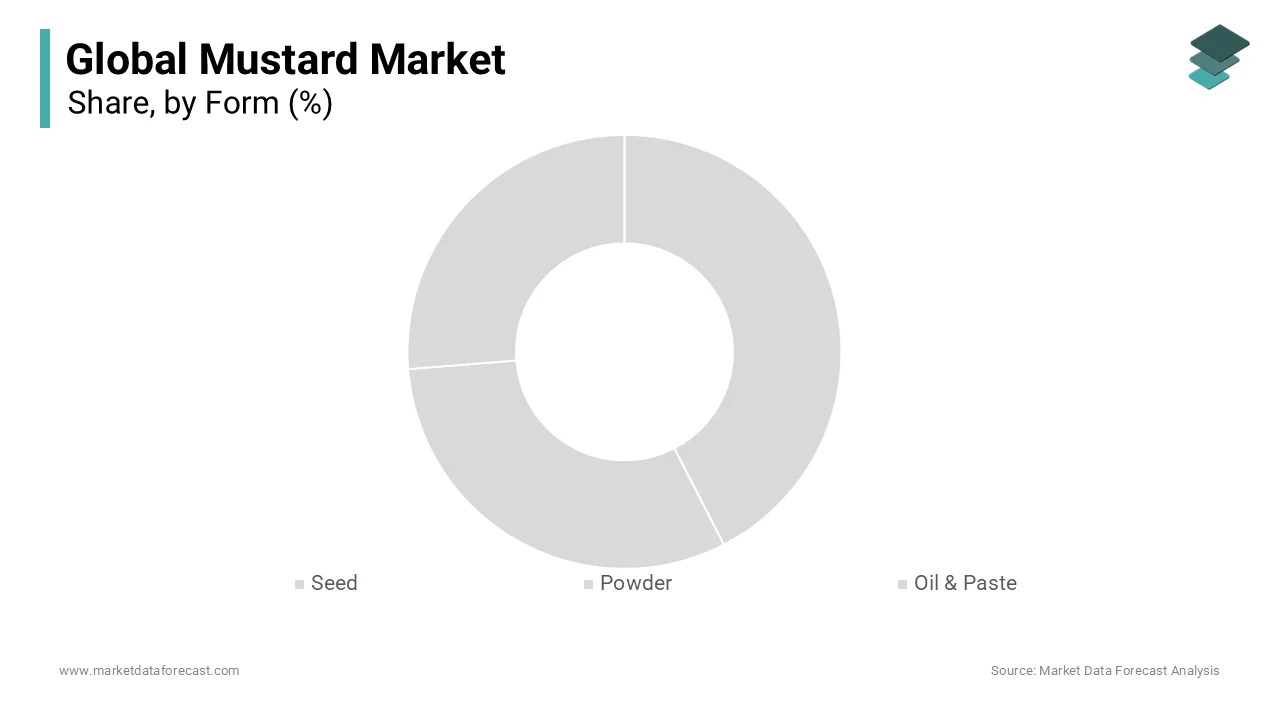
The paste/sauce segment is predicted to witness a CAGR of 8.3% from 2026 to 2034 due to the rising demand for ready-to-use condiments in both retail and foodservice sectors. France produces notable tons annually, with PDO (Protected Designation of Origin) certification enhancing premium positioning, according to the study. The rise of fast-casual dining and sandwich chains like Subway and Jimmy John’s has further institutionalized mustard sauce usage.
By Nature Insights
The conventional segment led the mustard market by capturing significant share in 2025. The growth of the conventional segment is driven by the widespread cultivation practices in major producing nations such as India, Canada, and Nepal, where smallholder farmers rely on high-yield hybrid seeds and chemical inputs to maximize output. The affordability and availability of conventional seeds, coupled with established procurement systems by state-run oil mills, strengthen its market entrenchment. Apart from these, most commercial food processors and oil refineries are configured for large-scale processing of non-certified raw material, limiting the integration of organic variants. Thus, structural and economic barriers continue to favor conventional production despite growing interest in sustainable agriculture.
The organic segment is estimated to register the fastest CAGR of 10.7% over the forecast period owing to the increasing consumer demand for pesticide-free, non-GMO food products in North America and Europe. According to the research, organic farmland in the EU grew by millions of hectares, with mustard increasingly included in crop rotation systems due to its biofumigant properties. In the U.S., organic mustard seed sales rose, as per the study, driven by demand from organic condiment brands and health-conscious consumers. Certification schemes like USDA Organic and EU Organic are enhancing traceability and market access, which is positioning organic mustard as a high-value niche with strong export potential.
By Packaging Type Insights
The bottles and jars segment dominated the mustard market by capturing for 58.7% of the global market share in 2025. The growth of the bottles and jars segment is driven by the premium positioning and shelf stability of glass and PET containers used for mustard paste and oil. In Western markets, glass jars are preferred for Dijon and whole-grain mustards due to their ability to preserve flavor and aroma, with a portion of premium condiments in France packaged in glass, according to the research. In India, PET bottles dominate the packaged mustard oil segment, offering durability and clarity for branding. Retailers favor bottles and jars for their stackability and visual appeal on shelves.
The sachets/pouches segment is predicted to witness the highest CAGR of 9.1% from 2026 to 2034 due to rising demand for single-serve, cost-effective packaging in emerging markets. Street food vendors and quick-service restaurants across Southeast Asia use mustard sauce sachets for dosas, burgers, and rolls, ensuring portion control and hygiene. In Bangladesh and Nepal, small-pack formats have increased mustard oil penetration in off-grid areas with limited storage facilities. Innovations in laminated pouches with oxygen barriers are extending shelf life without refrigeration. Thus, sachets and stand-up pouches are becoming essential for affordability, convenience, and last-mile distribution due to rising urbanization and on-the-go consumption.
By End Use Insights
The Retail segment dominated the mustard market by capturing significant share in 2025. The growth of the retail segment is driven by the habitual, at-home usage of mustard in cooking, pickling, and condiment applications. In India, a portion of mustard oil is purchased through local grocers, supermarkets, and e-commerce platforms like BigBasket and JioMart, according to the study. In Europe and North America, branded mustard paste in jars is a staple in household pantries with private-label variants gaining traction in discount retailers. The expansion of organized retail and digital grocery has enhanced product visibility and availability.
The foodservice segment is predicted to witness the highest CAGR of 7.9% from 2026 to 2034 due to the increasing use of mustard in restaurants, fast-casual chains, and institutional catering. In the U.S., a portion of sandwiches served in quick-service restaurants contain mustard-based sauces, according to the research. French bistros use Dijon mustard in emulsions, marinades, and sauces, with annual consumption exceeding notable tons in France, as per study. The rise of fusion cuisine, such as Indian-inspired burgers and mustard-glazed plant-based meats, has expanded culinary applications. Apart from these, foodservice operators are adopting bulk-packaged mustard oil and powder to reduce costs and ensure consistency.
REGIONAL ANALYSIS
Asia Pacific Mustard Market Insights
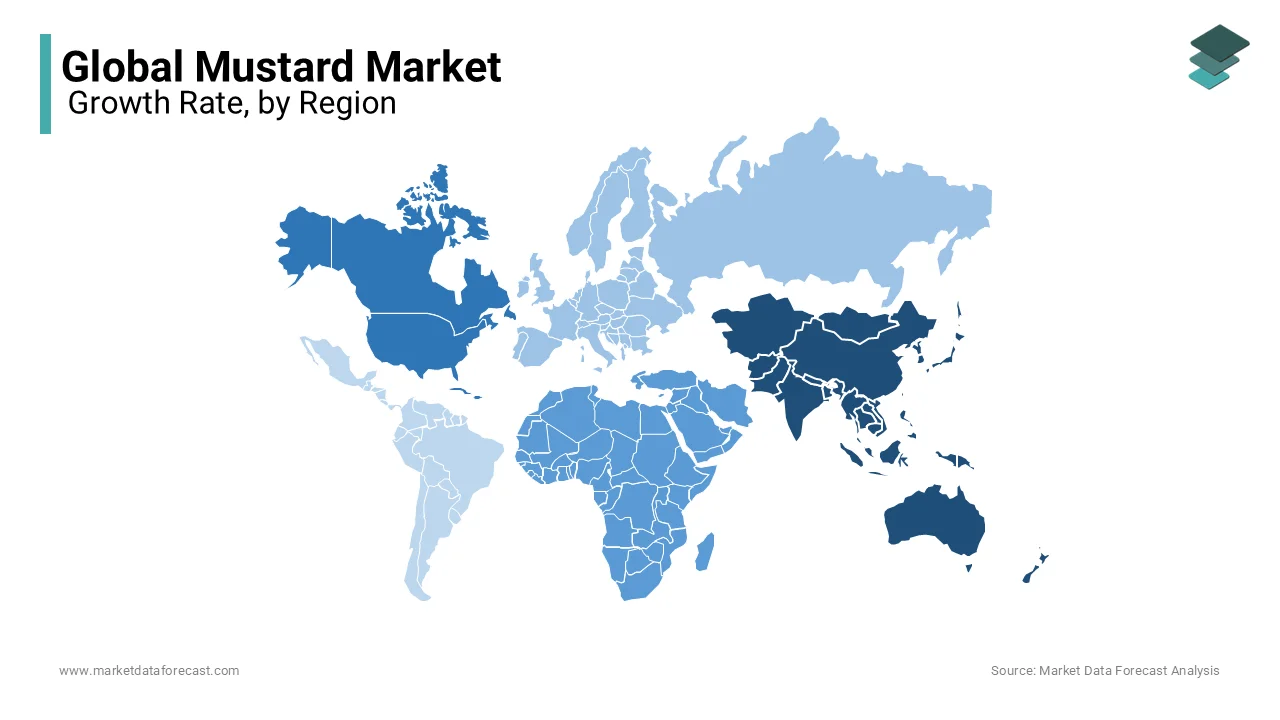
Asia Pacific was the top performer in the global mustard market with 45.1% of share in 2025. The growth of the Asia Pacific in the global market is primarily driven by India, the world’s largest producer and consumer of mustard, where the crop supports large number of farming households. India produced millions of metric tons of mustard seed, according to the study. Mustard oil is a dietary staple in North and Eastern India. Nepal and Bangladesh also rely heavily on mustard for cooking and traditional medicine. The region’s fragmented retail landscape favors small-pack sales, while rising urban demand for packaged and fortified oil is driving modernization.
Europe Mustard Market Insights
Europe mustard market was positioned next with France, Germany, and the UK leading in condiment consumption and processing. The growth of Europe in global market is driven by strong culinary traditions and export capabilities. Germany consumes millions of jars of mustard yearly, particularly in sausages and potato salads. The EU’s Common Agricultural Policy supports crop diversification, encouraging mustard cultivation as a break crop in cereal rotations. Apart from these, organic and artisanal mustard brands are thriving in specialty stores and gourmet markets. Regulatory frameworks ensure labeling accuracy and allergen disclosure, which is enhancing consumer trust. Therefore, Europe remains a high-value hub for processed mustard products.
North America Mustard Market Insights
North America grew steadily in the global mustard market, with the United States serving as the dominant consumer and innovation center. American consumers exhibit a strong preference for flavored mustards, including honey, spicy brown, and beer-infused varieties, with annual retail sales in millions. Canada is a major producer of yellow and brown mustard seeds, exporting notable metric tons annually, as per research. The rise of plant-based diets has increased demand for mustard as a binder and flavor enhancer in vegan sausages and burgers. Apart from these, craft condiment brands like Sir Kensington’s and Maille are driving premiumization.
Middle East & Africa Mustard Market Insights
Middle East & Africa mustard market growth is likely to grow ccwith Egypt, Saudi Arabia, and South Africa emerging as key consumption and distribution hubs. In Egypt, mustard seeds are used in traditional spice blends like duqqa and as a preservative in pickled vegetables, with domestic demand rising due to culinary revivalism. Gulf countries are increasing Halal-certified mustard paste imports for foodservice use in hotels and restaurants. Local production remains limited. On the other hand, urbanization and Western culinary influence are driving demand for packaged mustard. Therefore, the region provides untapped potential for specialty and organic variants due to growing interest in natural ingredients.
Latin America Mustard Market Insights
Latin America is likely to grow in the global mustard market with Brazil, Mexico, and Argentina serving as primary importers and processors. Brazil imports metric tons of mustard powder annually for use in sausages, sauces, and ready meals, as per the study. In Mexico, mustard is increasingly used in fast-food chains and fusion tacos, reflecting changing taste preferences. Argentina has developed niche mustard oil production for export to health food markets. However, domestic cultivation remains minimal due to limited agronomic suitability. Thus, rising middle-class consumption and restaurant chains adopting international menus are stimulating demand despite low production. Thus, Latin America is evolving into a structured, albeit modest, mustard market due to increased exposure to global flavours.
KEY MARKET PLAYERS AND COMPETITIVE LANDSCAPE
Key Players Of Mustard Market are Backwoods Mustard Company, Mustard and Co., Woeber Mustard Manufacturing Company, Unilever, Boar's Head Brand, Bertman Foods Co, Colman's of Norwich, McCormick & Company, Inc, The French's Food Company LLC, The Kraft Heinz Company.
Competition in the mustard market is shaped by regional disparities in consumption patterns, regulatory environments, and cultural significance. In Asia Pacific, local brands dominate due to deep-rooted culinary integration, while multinational players compete in premium and processed segments. The market is fragmented across form and function, seed, oil, and paste which requires specialized supply chains and marketing approaches. Differentiation is achieved through purity claims, organic certification, and heritage branding. Price sensitivity remains high in rural markets, whereas urban consumers prioritize packaging, convenience, and health attributes.
TOP PLAYERS IN THE MARKET
Everest Spices
Everest Spices is a leading player in the Asia Pacific mustard market, renowned for its packaged spices, condiments, and ready-to-use blends. The company offers a range of mustard-based products, including ground mustard powder, whole black mustard seeds, and pre-mixed pickling formulations tailored to regional Indian, Bengali, and South Indian cuisines. It has strengthened its supply chain by partnering with farmer producer organizations (FPOs) to ensure consistent quality and traceability. The brand leverages extensive retail distribution across India and exports to Southeast Asia and the Middle East. Its focus on authenticity, branding, and consumer education through digital campaigns has strengthened its position as a trusted household name in the spice and condiment sector.
Dabur India Ltd.
Dabur plays a pivotal role in shaping the mustard oil segment across Asia Pacific, particularly in India, where its branded edible oils are widely distributed. The company markets cold-pressed and refined mustard oil under its “Dabur” and “Saffola” brands, emphasizing purity, traditional value, and Ayurvedic wellness. It has invested in blockchain-based traceability to verify farm-to-bottle integrity, enhancing consumer trust. Dabur’s rural distribution network reaches notable number of outlets by ensuring deep market penetration. The company also promotes mustard oil in Ayurvedic massage and respiratory care which strengthens its dual culinary and therapeutic positioning. These initiatives strengthen its relevance in both traditional and modern wellness-driven markets.
Nestlé S.A.
Nestlé contributes significantly to the processed mustard segment in Asia Pacific through its global condiment and culinary product lines. While its presence is more pronounced in Western markets, Nestlé adapts its mustard-based offerings for regional foodservice and retail applications in Japan, Australia, and Southeast Asia. Nestlé collaborates with local suppliers to source mustard powder for ready-to-eat meals and sauces, ensuring flavor consistency. The company’s R&D centers in Singapore focus on taste modulation and shelf-life extension for tropical climates. Nestlé leverages its scale and innovation to expand the ingredient’s use beyond traditional condiment roles in urban food ecosystems by integrating mustard into soups, dressings, and protein-based meals.
TOP STRATEGIES USED BY KEY MARKET PLAYERS
Key players in the mustard market are employing multifaceted strategies to strengthen their foothold in a fragmented, regionally diverse industry. Product differentiation through organic certification, cold-pressed processing, and fortification is being used to appeal to health-conscious consumers. Companies are investing in traceability systems, including blockchain and QR-code labeling, to enhance transparency and combat adulteration. Geographic expansion focuses on emerging markets with rising disposable incomes and growing middle-class populations. Strategic partnerships with farmer cooperatives ensure raw material quality and sustainability. Branding and consumer education campaigns emphasize traditional value and functional benefits. Innovation in flavor variants and ready-to-use formats caters to urban, time-constrained households. E-commerce integration and sachet-based packaging are expanding reach in rural and price-sensitive regions, ensuring inclusivity and scalability.
RECENT HAPPENINGS IN THE MARKET
- Grey Poupon, a mustard seed-infused white wine from Kraft Heinz, is now available. The limited-edition La Moutarde Vin is being released by the Dijon mustard brand, which utilizes white wine in its recipe. It's a white wine with mustard seeds from Grey Poupon.
MARKET SEGMENTATION
This research report on the global mustard market has been segmented and sub-segmented based on form, nature, packaging type, end use, & region.
By Form
- Seed, Powder/Flour
- Oil
- Paste/Sauce
By Nature
- Conventional
- Organic
By Packaging Type
- Bottles and Jars
- Sachets/Pouches
- Others
By End Use
- Retail
- Foodservice
By Region
- Europe
- North America
- Middle East
- Latin America
- Asia Pacific