- Product Description Description
- Table of Contents TOC
- List of Table & Figure LOT
- Get Free Sample PDF Sample PDF
Market Size, 2025
$1.01 BnMarket Estimate, 2026
$1.26 BnMarket Forecast, 2034
$7.15 BnCAGR, 2026–2034
24.23%North America Cancer Metabolism Based Therapeutics Market Size, Growth, Trends & Forecast (2026–2034)
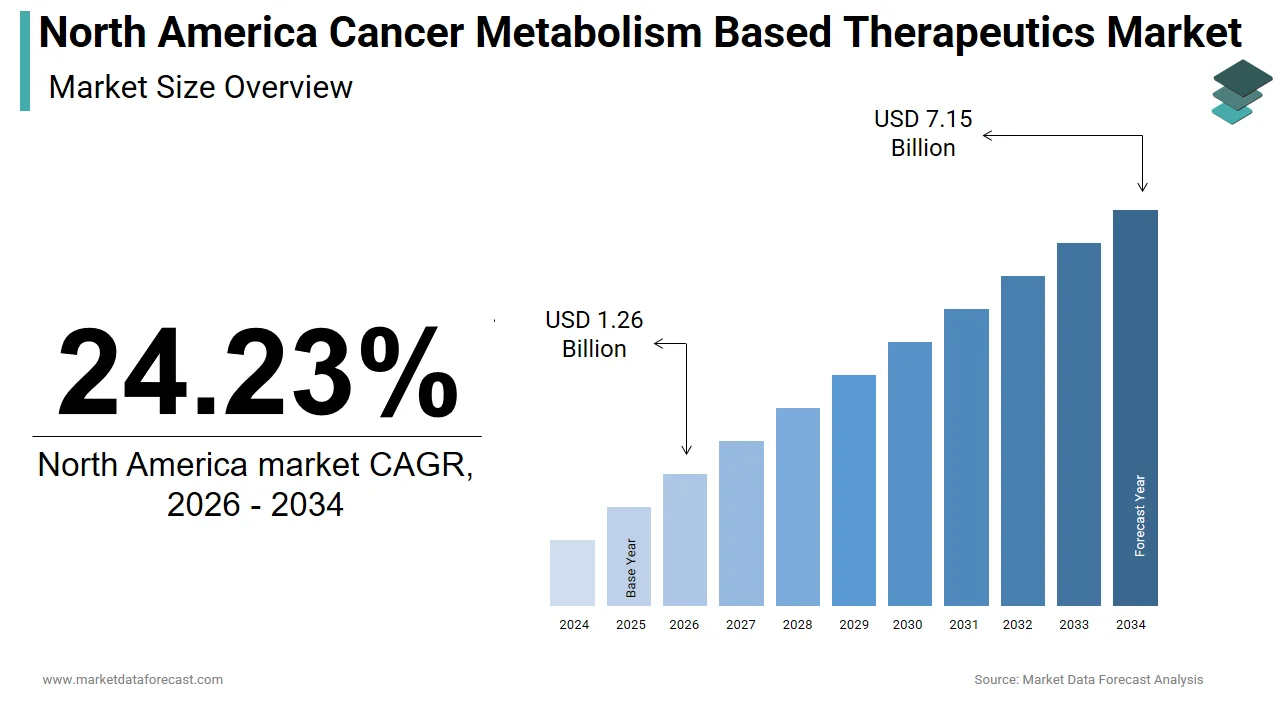
The North America cancer metabolism-based therapeutics market size was valued at USD 1.01 billion in 2025, is anticipated to reach USD 1.26 billion in 2026, and is projected to scale up to USD 7.15 billion by 2034, registering a compound annual growth rate (CAGR) of 24.23% during the forecast period from 2026 to 2034. Driven by rapid R&D advancements in targeted therapies, rising cancer incidence rates, and growing demand for personalized medicine, the industry continues to experience exponential growth across the region.
Key Executive Metrics (At-a-Glance)
- 2025 Base Valuation: USD 1.01 Billion
- 2026 Current Valuation: USD 1.26 Billion
- 2034 Forecast Valuation: USD 7.15 Billion
- Compound Annual Growth Rate (CAGR): 24.23% (2026–2034)
- Dominant Therapy Segment: Targeted Drug Therapies (leading the market due to precision mechanisms inhibiting specific cancer cell metabolic pathways)
- Dominant Indication Segment: Acute Myeloid Leukemia (AML) (holding major revenue share backed by approved targeted metabolic drugs like Enasidenib)
- Fastest-Growing Indication Segment: Melanoma (expanding rapidly due to high therapeutic innovation and targeted treatment adoption)
- Dominant Country Market: United States (leading regional market share backed by advanced biomedicine, high per capita healthcare income, and favorable government regulations)
Core Market Drivers
- R&D Advancements & Collaborations: Surging investments and strategic research partnerships focused on novel target-based therapies.
- Rising Cancer Incidence & Aging Population: Year-over-year growth in cancer diagnosis rates and an expanding elderly demographic susceptible to oncological conditions.
- Personalized Medicine Demand: Increasing shift toward tailored patient therapies and favorable government frameworks supporting innovative oncology solutions.
Primary Market Restraints & Challenges
- High Treatment Costs: Expensive therapeutic regimens and advanced drug development costs posing affordability challenges for patients.
- Adverse Therapy Side Effects: Risks of harmful side effects and toxic outcomes associated with aggressive cancer drug treatments.
North America Cancer Metabolism Based Therapeutics Market Segmentation Breakdown
| Segment Category | Leading Sub-Segment (2025 Base) | Fastest-Growing Sub-Segment (2026–2034) |
|---|---|---|
| By Therapy | Targeted Drug Therapies (dominant leader blocking distinct cancer metabolism pathways) | Targeted Drug Therapies (fastest-growing due to high clinical trial success and precision medicine adoption) |
| By Drug Type | Enasidenib (dominant revenue-generating targeted IDH2 inhibitor) | CPI-613 and Novel Pipeline Drugs (fastest-growing due to advancing clinical applications in difficult-to-treat cancers) |
| By Indication | Acute Myeloid Leukemia (AML) (leading segment supported by established metabolic therapies) | Melanoma (fastest-growing indication driven by rising clinical research and targeted metabolic strategies) |
| By Country | The United States (dominant market contributor with advanced clinical infrastructure) | The United States (fastest-growing country market propelled by rapid biomedicine expansion and funding) |
Major Industry Players Profiled
Key enterprises shaping the competitive North American cancer metabolism-based therapeutics market include AstraZeneca, Novartis, Celgene, Rafael Pharmaceuticals, Cornerstone Pharmaceuticals, Polaris Group, Agios Pharmaceuticals, Taiho Pharmaceuticals, 3-V Biosciences, Calithera Biosciences, and BERG Health.
North America Cancer Metabolism Based Therapeutics Market Size
The size of the North America cancer metabolism-based therapeutics market was worth USD 1.01 billion in 2025. The market is anticipated to grow at a CAGR of 24.23% from 2026 to 2034, reaching USD 7.15 billion by 2034, up from USD 1.26 billion in 2026.
MARKET DRIVERS
R&D Advancements and Rising Cancer Awareness
Growth in the R & D activities for the target-based therapies, Y-O-Y growth in the cancer incidence, growing awareness regarding the cancer symptoms, and the treatment procedures are expected to drive the market growth in North America. A growing number of strategic and research collaborations have been inscribed among the companies in developing research activities in this region.
MARKET RESTRAINTS
High Treatment Costs and Adverse Therapy Effects
High treatment costs associated with the related therapeutics are expected to restrain market growth. According to the American Cancer Society, pancreatic cancer proceeds for 3% of all cancers and across 7% of all cancer deaths in the U.S. Also, the risk of harmful side effects associated with cancer drug therapies and its use may produce adverse outcomes, which may hamper the market growth in this region.
REPORT COVERAGE
| REPORT METRIC | DETAILS |
| Market Size Available | 2025 to 2034 |
| Base Year | 2025 |
| Forecast Period | 2026 to 2034 |
| Segments Covered | By Therapy, Drug Type, Indication, and Region. |
| Various Analyses Covered | Global, Regional and Country-Level Analysis, Segment-Level Analysis, Drivers, Restraints, Opportunities, Challenges; PESTLE Analysis; Porter’s Five Forces Analysis, Competitive Landscape, Analyst Overview of Investment Opportunities |
| Countries Covered | United States, Canada, Mexico, Rest of North America |
| Market Leaders Profiled | AstraZeneca, Novartis, Celgene, Rafael Pharmaceuticals, Cornerstone Pharmaceuticals, Polaris Group, Agios Pharmaceuticals, Taiho Pharmaceuticals, 3-V biosciences, Calithera Biosciences, and BERG Health. |
REGIONAL ANALYSIS
North America is expected to dominate with the US and Canada's largest share as major contributing countries.
The market is attributed to the rise in the population diagnosed with cancer every year, the increase in the aging population, and body exposure to various radiations. Also, inventing new strategies in treating cancer among the patients is anticipated to have high market growth. The United States is leading and ruling the cancer metabolism-based therapeutics market during the forecasting framework. Increasing cancer, the surge in advances in therapies, and commodification of new bio-similar factors propel market growth. Smoking tobacco, alcohol intake, physical inactivity, low diet, obesity, and air pollution in urban areas, growing the latest technologies in treating cancer cells, are likely to boost the cancer metabolism-based therapeutics market growth in this region. Favorable government regulations towards cancer therapies and an increase in the growing demand for personalized medicine, together with the capability of existing economies that offer profitable opportunities in the market, are factors accelerating the market in this region. US market is driven by factors like growth in per capita income and rapid augmentation in the bio-medicine domain in the cancer metabolism-based therapeutics market growth in North America.
KEY MARKET PLAYERS
Some of the prime manufacturers of Cancer Metabolism Based Therapeutics in North America are AstraZeneca, Novartis, Celgene, Rafael Pharmaceuticals, Cornerstone Pharmaceuticals, Polaris Group, Agios Pharmaceuticals, Taiho Pharmaceuticals, 3-V biosciences, Calithera Biosciences, and BERG Health.
MARKET SEGMENTATION
This research report on the North America Cancer Metabolism Based Therapeutics market has been segmented & sub-segmented into the following categories.
By Therapy
- Biological Drug Therapies
- Targeted Drug Therapies
By Drug Type
- Enasidenib
- CPI-613
- Other Drugs
By Indication
- Melanoma
- Myelodyspalstic Syndrome (MDS)
- Acute Myeloid Leukemia (AML)
- Metastatic Renal Cell Carcinoma
- Others
By Country
- The United States
- Canada
- Rest of North America