- Product Description Description
- Table of Contents TOC
- List of Table & Figure LOT
- Get Free Sample PDF Sample PDF
Market Size, 2025
$285.58 MnMarket Estimate, 2026
$299.92 MnMarket Forecast, 2034
$443.79 MnCAGR, 2026–2034
5.02%North America Gibberellins Market Size, Share & Growth Analysis (2026–2034)
- Market Scope: Regional analysis covering manufacturing methods, physical forms (liquid and powder), country frameworks (United States, Canada, and Rest of North America), growth catalysts, restraints, opportunities, and competitive landscapes.
- Market Valuation: Valued at USD 285.58 million in 2025, estimated at USD 299.92 million in 2026, and projected to reach USD 433.79 million by 2034, registering a steady CAGR of 5.02% over the forecast period (2026–2034).
- Primary Growth Drivers: Surging demand for high-yield agriculture and specialty crops (vineyards, orchards), expansion of organic and sustainable farming practices aligned with EPA/PMRA standards, and growth in controlled-environment agriculture (CEA) and vertical farming systems. Key restraints include strict regulatory compliance costs and limited technical awareness among traditional farmers.
Key Market Segment Metrics (2026–2034)
| Category | Leading Segment (2025 Position) | Fastest-Growing Segment |
|---|---|---|
| By Manufacturing Method | Methylerythritol Phosphate (MEP) Pathway (commanded 63.5% market share due to efficient biosynthesis in higher plants and organic compatibility) | Trans-Geranylgeranyl Diphosphate (GGDP) Pathway (projected to expand at a CAGR of 8.4% via biotech innovations and CEA applications) |
| By Shape / Form | Liquid Form (led with 59.5% volume share anchored by ease of foliar spray and drip irrigation application) | Powder Form (expanding at a CAGR of 9.1% driven by long shelf-life preferences and seed-priming applications) |
| By Country | United States (commanded 76.5% revenue share backed by large specialty crop networks in California, Washington, and Florida) | Canada & Mexico (growing via greenhouse horticulture expansion, organic standard adoption, and cross-border agribusiness) |
Major Market Players & Competitive Landscape
Market Structure: Specialized agricultural biotechnology market featuring global fine chemical and biochemical manufacturers competing on fermentation efficiency, regulatory compliance, and eco-friendly product formulations.
Key Companies: Zhejiang Qianjiang Biochemical Co., Ltd., Shanghai Pengteng Fine Chemical Co., and Jiangsu Fengyuan Bioengineering Co.
 Download Free Sample Report
North America Gibberellins Market Size
The North American gibberellins market size was valued at USD 285.58 million in 2025 and is anticipated to reach a valuation of USD 299.92 million in 2026 and USD 433.79 million by 2034, estimated to be growing at a CAGR of 5.02% from 2026 to 2034.
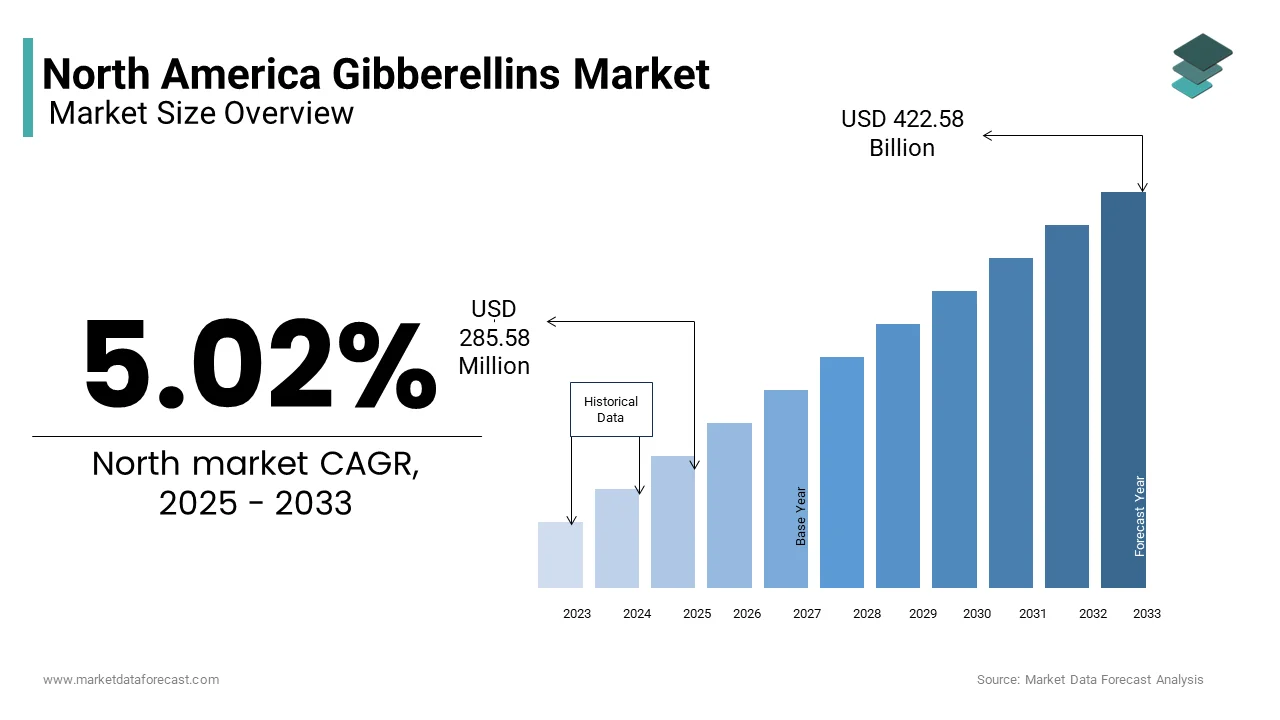
Gibberellins are naturally occurring plant hormones used to regulate growth processes such as stem elongation, seed germination, and flowering. Widely used in agriculture and horticulture, gibberellins play a critical role in enhancing crop yield and quality. The market encompasses various forms, including Gibberellic Acid (GA3), GA4, GA7, and other derivatives, which are applied in fruit cultivation, seed production, and greenhouse plant management.
The market is primarily driven by increasing demand for high-yield agricultural practices and the need for advanced plant growth regulators in specialty crops. In the United States and Canada, the adoption of precision agriculture and biostimulants has significantly contributed to the growth of this market. In addition, the use of plant growth regulators in commercial farming has grown steadily, with a particular increase in applications for vineyards, orchards, and greenhouse-grown vegetables.
The Environmental Protection Agency (EPA) has also recognized the importance of biologically derived plant regulators, promoting the use of environmentally sustainable alternatives to synthetic chemicals. These developments, combined with ongoing research into new applications and formulations, are shaping the trajectory of the North American Gibberellins Market.
MARKET DRIVERS
Increasing Demand for High-Yield Agriculture and Specialty Crops
The growing demand for high-yield agriculture and specialty crops, particularly in the U.S. and Canada, is one of the key drivers of the North American Gibberellins Market. Gibberellins are widely used in fruit cultivation, including grapes, citrus, and berries, where they help in enhancing fruit size, reducing seed formation, and improving overall yield.
In Canada, the horticulture sector has increasingly adopted gibberellins to manage plant growth in greenhouse-grown vegetables and ornamental plants. This trend is supported by the expansion of vertical farming and hydroponic systems, which rely on precise growth regulation for optimal output.
Expansion of Organic and Sustainable Farming Practices
The expansion of organic and sustainable farming practices is another major driver of the North American Gibberellins Market. Gibberellins, being naturally derived plant hormones, are compatible with organic certification standards, making them a preferred alternative to synthetic growth regulators. As per the Organic Trade Association reports that certified organic cropland in the United States grew between 2020 and 2023, with increasing adoption of biologically derived inputs like gibberellins.
In Canada, the Canadian Organic Standards have encouraged the use of natural plant growth regulators in certified organic production, further boosting market demand. Additionally, the rise in consumer preference for chemical-free and sustainably grown produce has prompted conventional farmers to integrate gibberellins into their crop management strategies. As per the U.S. Environmental Protection Agency (EPA), the shift toward reduced chemical dependency in agriculture is expected to drive continued growth in the use of natural plant regulators like gibberellins across North America.
MARKET RESTRAINTS
Regulatory and Environmental Compliance Requirements
The complexity of regulatory and environmental compliance requirements is a significant restraint in the NorAmericanica Gibberellins Market. Although gibberellins are naturally derived and generally recognized as safe, their application is still subject to scrutiny by regulatory agencies such as the U.S. Environmental Protection Agency (EPA) and Health Canada’s Pest Management Regulatory Agency (PMRA). These agencies require extensive testing and registration processes before a gibberellin-based product can be commercially marketed.
According to the EPA, the registration process for biochemical pesticides, including plant growth regulators like gibberellins, can take up to three years and involve significant financial investment. This lengthy approval process discourages smaller manufacturers from entering the market and limits the availability of diverse product options for growers. Additionally, as per the PMRA, certain formulations must undergo periodic re-evaluation to ensure they meet evolving environmental and safety standards. These regulatory hurdles, while essential for ensuring product safety, pose a challenge to the rapid expansion and accessibility of gibberellin-based solutions in North America.
Limited Awareness and Technical Expertise Among Farmers
The limited awareness and technical expertise among farmers regarding the optimal use of gibberellins is another major restraint in the North American Gibberellins Market. Despite their benefits in enhancing crop yield and quality, many growers, particularly in smaller-scale and traditional farming operations, remain unfamiliar with the precise application methods and timing required for effective results.
According to the U.S. Department of Agriculture (USDA), extension programs in several states have reported a knowledge gap among farmers regarding plant growth regulators, including gibberellins. As a result, improper application or underutilization of gibberellins can lead to suboptimal outcomes, discouraging further adoption.
MARKET OPPORTUNITY
Growth in Controlled Environment Agriculture (CEA) and Vertical Farming
The rapid expansion of controlled environment agriculture (CEA) and vertical farming systems is a major opportunity in the North American Gibberellins Market. These high-tech agricultural practices rely on precise environmental control and optimized plant growth regulators to maximize yield in limited spaces.
In the U.S., states like New Jersey, California, and New York have seen significant investments in indoor farming, where gibberellins are used to regulate plant height and improve uniformity in leafy greens and herbs. The ability of gibberellins to promote consistent growth under artificial lighting and limited space makes them an essential component of modern CEA systems, presenting a strong growth avenue for the market.
Increasing Use in Seed Germination and Turf Management
The growing application in seed germination and turf management is another emerging opportunity in the North American Gibberellins Market. Gibberellins are known to break seed dormancy and promote uniform germination, making them valuable in seed production and agricultural planting.
In the turf and landscaping industry, gibberellins are used to enhance seed germination rates and improve the establishment of lawns, sports fields, and golf courses. Additionally, in Canada, the Canadian Turfgrass Research Foundation reports increased interest in gibberellin applications for sports field rehabilitation projects.
MARKET CHALLENGES
Fluctuating Raw Material Availability and Production Costs
The fluctuation in raw material availability and production costs is one of the primary challenges in the North American Gibberellins Market. Gibberellins are typically derived from fungal fermentation, a process that requires specific strains of Gibberella fujikuroi and controlled production conditions.
In addition, the cost of energy and labor involved in fermentation and purification processes has been rising, particularly in the U.S., where manufacturing regulations are stringent. This trend has placed pressure on manufacturers to maintain competitive pricing while ensuring product quality.
Competition from Synthetic Plant Growth Regulators
Competition from synthetic plant growth regulators (PGRs) that offer cost-effective alternatives with longer shelf life and easier application is another significant challenge in the North American Gibberellins Market. While gibberellins are favored for their natural origin and compatibility with organic systems, synthetic PGRs often provide more predictable and consistent results across different crop types and growing conditions.
Additionally, the marketing efforts of major agrochemical companies have reinforced the adoption of synthetic products in mainstream agriculture.
REPORT COVERAGE
| REPORT METRIC | DETAILS |
| Market Size Available | 2025 to 2033 |
| Base Year | 2025 |
| Forecast Period | 2026 to 2034 |
| CAGR | 5.02% |
| Segments Covered | By Manufacturing Method, Shape, and Region. |
| Various Analyses Covered | Global, Regional, & Country Level Analysis, Segment-Level Analysis, DROC, PESTLE Analysis, Porter’s Five Forces Analysis, Competitive Landscape, Analyst Overview on Investment Opportunities |
| Regions Covered | The USA, Canada, Mexico, and the Rest of North America |
| Market Leaders Profiled | Zhejiang Qianjiang Biochemical Co., Ltd., Shanghai Pengteng Fine Chemical Co., and Jiangsu Fengyuan Bioengineering |
SEGMENTAL ANALYSIS
By Manufacturing Method Insights
Methylerythritol Phosphate (MEP) Pathway
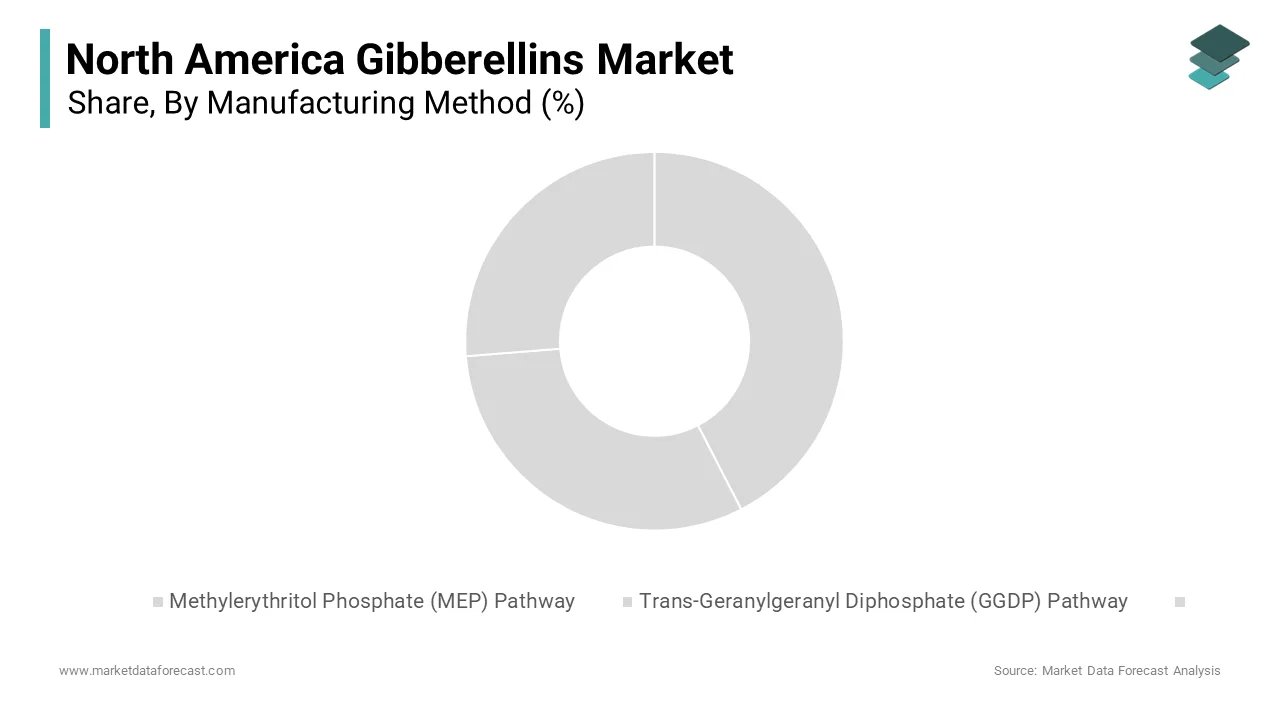
The Methylerythritol Phosphate (MEP) pathway segment dominated the North American Gibberellins Market by capturing 63.5% of the total market share in 2025. Its widespread use in the biosynthesis of gibberellins in higher plants, particularly in commercial agricultural applications, is primarily attributed to the dominance of this segment.
The dominance of the MEP pathway is further reinforced by its efficiency in producing bioactive gibberellins that are directly involved in plant growth processes such as stem elongation and flowering. Additionally, the pathway’s compatibility with organic farming standards has increased its adoption among growers seeking natural plant growth regulators.
Trans-Geranylgeranyl Diphosphate (GGDP) Pathway
The Trans-Geranylgeranyl Diphosphate (GGDP) pathway is the fastest-growing segment in the North American Gibberellins Market and is projected to expand at a CAGR of 8.4% from 2025 to 2033. The growth of this segment is mainly driven by advancements in biotechnological applications and the increasing use of synthetic biology in plant growth regulation. The pathway is gaining traction in controlled-environment agriculture (CEA) and vertical farming systems, where precise hormonal control is essential for optimizing growth in limited spaces. Additionally, the U.S. Department of Energy reports that biotech startups in California and Massachusetts are exploring GGDP-based biosynthesis for scalable, cost-effective gibberellin production. These innovations are expected to drive rapid adoption and solidify the GGDP pathway’s position as a key growth driver in the market.
By Shape Insights
Liquid Form
The liquid form segment led the North America Gibberellins Market by accounting for 59.5% of the total volume in 2025. The ease of application and rapid absorption of liquid gibberellin formulations in agricultural settings is propelling the growth of this segment. Also, liquid gibberellins are widely used in foliar sprays and irrigation systems, allowing for uniform distribution and effective plant response.
The preference for liquid formulations is particularly strong in the fruit and vineyard sectors, where growers rely on precise hormonal regulation for flowering, fruit set, and elongation. Additionally, liquid gibberellins are increasingly used in greenhouse vegetable production due to their compatibility with drip irrigation and fertigation systems. The versatility and effectiveness of liquid formulations continue to reinforce their leadership in the market.
Powder Form
The powder form segment is emerging as the fastest-growing segment in the North America Gibberellins Market and is projected to expand at a CAGR of 9.1% from 2025 to 2033. Increasing demand for long shelf-life formulations and ease of transportation, particularly in organic and specialty seed production, is fuelling the rise of this segment.
The segment is also gaining traction in seed priming applications, where dry formulations are preferred for pre-treatment before sowing. With growing emphasis on sustainable and efficient seed treatment methods, the powder form segment is poised for continued expansion.
COUNTRY ANALYSIS
United States
The United States commanded the North American Gibberellins Market by accounting for 76.5% of the total revenue in 2024. As the leading agricultural economy in the region, the U.S. benefits from a well-established network of specialty crop producers, particularly in California, Washington, and Florida, where gibberellins are widely used in vineyards, orchards, and greenhouse operations. The market is further supported by the expansion of controlled-environment agriculture (CEA) and vertical farming systems, particularly in states like New Jersey and Arizona.
Canada
Canada is another key player in the North American Gibberellins Market, which is driven by increasing adoption in specialty horticulture and organic farming. The country has a growing presence of greenhouse vegetable production, particularly in British Columbia and Ontario, where gibberellins are used to regulate plant growth and flowering cycles. The market is also supported by the expansion of organic agriculture, with the Canadian Organic Standards encouraging the use of naturally derived plant growth regulators. With growing emphasis on sustainable farming practices, Canada’s market for gibberellins is expected to continue expanding.
Rest of North America
The Rest of North America encompasses territories such as Mexico and other smaller agricultural markets. While Mexico has traditionally relied on conventional plant growth regulators, recent shifts toward sustainable farming practices have led to increased interest in gibberellins, particularly in high-value fruit and vegetable production. In addition, cross-border collaborations between U.S. and Mexican agribusinesses have facilitated the adoption of gibberellin-based solutions in integrated crop management systems. While market penetration remains limited compared to the U.S. and Canada, the Rest of North America is gradually emerging as a growth opportunity for gibberellin applications in specialty agriculture.
KEY MARKET PLAYERS
Zhejiang Qianjiang Biochemical Co., Ltd., Shanghai Pengteng Fine Chemical Co., and Jiangsu Fengyuan Bioengineering Co. are the leaders in the North American Gibberellins market.
Top Players In The Market
ValenBioScience, a subsidiary of Sumitomo Chemical Company, is a leading innovator in the biopesticide and plant growth regulator space. The company has a strong presence in the North American Gibberellins Market due to its focus on sustainable agricultural solutions. Valent BioSciences is known for its biologically based plant growth regulators, including gibberellin-based products that support high-value crop production. Its commitment to research, regulatory compliance, and farmer education has positioned it as a trusted partner in the development and distribution of environmentally responsible agrochemicals.
Corteva Agriscience is a major player in the agricultural biotechnology sector and has significantly contributed to the advancement of plant growth regulators in North America. With a diversified portfolio of crop protection and enhancement products, Corteva has integrated gibberellins into its offerings for specialty crops such as fruits, vegetables, and ornamentals. The company emphasizes innovation, farmer engagement, and precision agriculture, which has helped promote the adoption of gibberellin-based solutions in both conventional and organic farming systems.
Koppert Biological Systems is a global leader in sustainable crop protection and natural plant health solutions. In North America, Koppert has been instrumental in promoting the use of bio-stimulants and plant growth regulators, including gibberellins, within integrated agricultural systems. The company’s expertise in biologicals, combined with its strong technical support and grower training programs, has made it a key player in the market. Koppert's commitment to reducing chemical dependency in farming has further strengthened the role of gibberellins in modern agriculture.
Top Strategies Used By Key Market Participants
One of the key strategies employed by leading players in the North American Gibberellins Market is investing in research and development to innovate new formulations and application methods. Companies are focusing on developing more stable, effective, and targeted gibberellin-based products that cater to the needs of high-value crops and controlled-environment agriculture.
Another critical approach is expanding technical support and farmer education programs. Market leaders are actively engaging with growers through extension services, field demonstrations, and training workshops to improve understanding of gibberellin applications, ensuring optimal usage and maximizing benefits in crop production.
Lastly, companies are strengthening partnerships with agricultural cooperatives, research institutions, and regulatory bodies to align product development with industry needs and compliance standards. These collaborations help in accelerating product approvals, enhancing market reach, and fostering sustainable adoption of gibberellin-based plant growth regulators across North America.
COMPETITION OVERVIEW
The North America Gibberellins Market features a competitive yet evolving landscape, shaped by the presence of established agrochemical firms and emerging biostimulant-focused companies. While multinational corporations dominate due to their extensive R&D capabilities and strong distribution networks, smaller niche players are gaining traction by offering specialized, natural plant growth solutions tailored to organic and precision farming practices. The market is characterized by product differentiation, technical support, and alignment with sustainable agriculture trends.
A key differentiator among competitors is the ability to provide scientifically backed, reliable, and easy-to-apply gibberellin formulations that meet the specific needs of high-value crops such as fruits, vegetables, and ornamentals. Companies are increasingly focusing on farmer education, regulatory compliance, and strategic collaborations with agricultural institutions to enhance product adoption. Additionally, the rise of controlled-environment agriculture and vertical farming has created new opportunities for market players to expand their reach.
As consumer demand for sustainably grown produce increases and regulatory support for bio-based inputs strengthens, competition is expected to intensify. This is prompting companies to invest in innovation, localized market development, and strategic partnerships to maintain a strong foothold in the North American market.
RECENT HAPPENINGS IN THE MARKET
- In February 2023, Valent BioSciences launched a new line of gibberellin-based plant growth regulators specifically designed for controlled-environment agriculture. This product line was developed to enhance flowering and fruit development in greenhouse-grown crops, supporting the growing vertical farming industry in the U.S.
- In June 2023, Corteva Agriscience partnered with a leading California-based grape grower association to conduct field trials on gibberellin applications for seedless table grape production. The initiative aimed to optimize bunch size and uniformity, aligning with premium market demands and reinforcing Corteva’s position in specialty crop solutions.
- In October 2023, Koppert Biological Systems expanded its technical advisory team in Canada to provide on-site support for growers using gibberellin-based treatments in greenhouse vegetable production. This move was intended to improve application techniques and enhance grower confidence in natural plant growth regulators.
- In January 2024, BASF introduced a new formulation of gibberellic acid tailored for turfgrass management, targeting the landscaping and sports field maintenance sectors. The product was designed to improve seed germination and grass recovery, expanding BASF’s portfolio in non-traditional agricultural applications.
- In May 2024, Marrone Bio Innovations announced a collaboration with a biotech startup to develop next-generation gibberellin delivery systems using microencapsulation technology. The initiative aimed to improve stability and application efficiency, particularly in organic and precision agriculture settings.
MARKET SEGMENTATION
This research report on the North American gibberellins market is segmented and sub-segmented into the following categories.
By Manufacturing Method
- Methylerythritol Phosphate (MEP) Pathway
- Trans-Geranylgeranyl Diphosphate (GGDP) Pathway
By Type
- 19-Carbon Gibberellins
- 20-Carbon Gibberellins
By Shape
- Powder
- Granules
- Liquid
By Country
- The USA
- Canada
- Mexico