- Product Description Description
- Table of Contents TOC
- List of Table & Figure LOT
- Get Free Sample PDF Sample PDF
Market Size, 2025
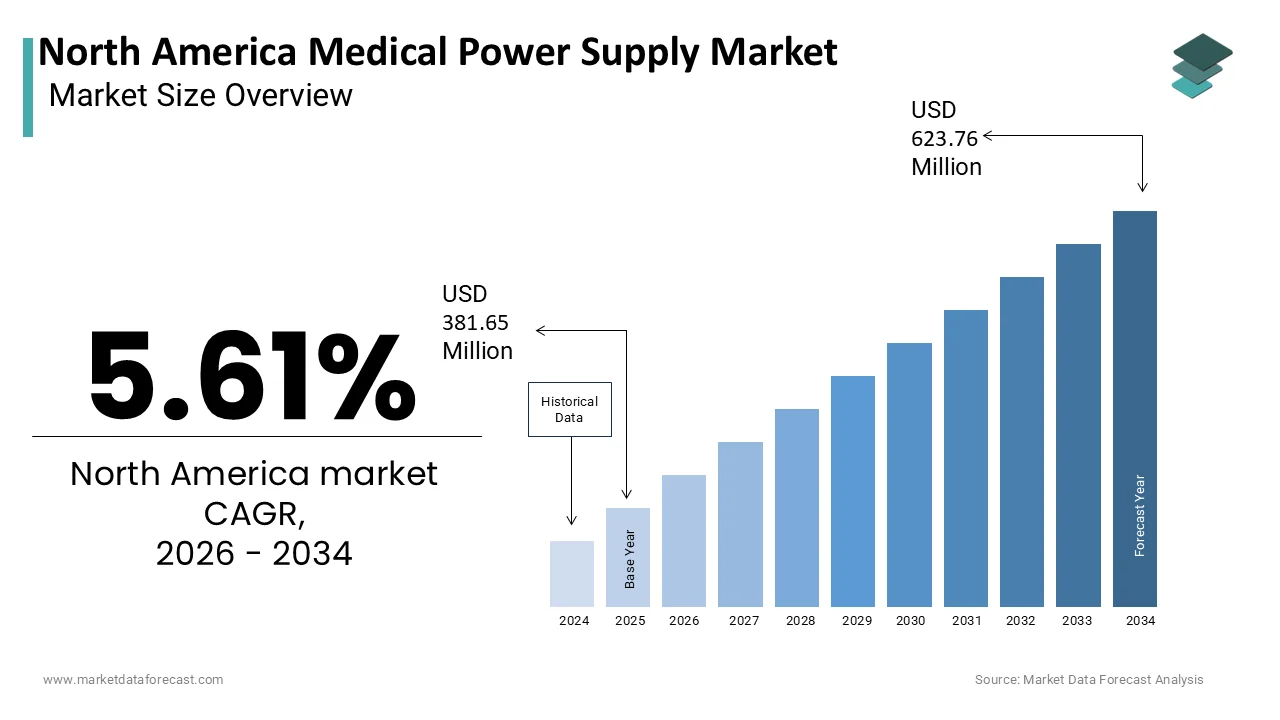
$381.65 MnMarket Estimate, 2026
$403.06 MnMarket Forecast, 2034
$623.76 MnCAGR, 2026–2034
5.61%Executive Summary: North America Medical Power Supply Market
- Market Scope: Overview of the North American medical power supply market covering diverse technologies, product types, functions, end-user settings, and regional country markets (U.S. and Canada).
- Market Valuation: Valued at USD 381.65 million in 2025, estimated at USD 403.06 million in 2026, and projected to reach USD 623.76 million by 2034, growing at a steady CAGR of 5.61% over the forecast period from 2026 to 2034.
- Primary Growth Drivers: Expansion of diagnostic imaging systems (such as CT and MRI installations), rising home healthcare and portable medical device adoption, and wide-bandgap semiconductor efficiency breakthroughs.
Key Market Segment Metrics (2026–2034)
| Category | Leading Segment (Base Position) | Fastest-Growing / High-Growth Segment |
|---|---|---|
| By Product Type | Standard (dominated the market in 2025 due to pre-certified platforms drastically reducing regulatory approval timelines for OEMs) | Configurable (anticipated to showcase a CAGR of 12.2% driven by integrated multi-output medical equipment consolidation trends) |
| By Function | AC-DC Power Supply Devices (held major market share in 2025 due to universal facility grid connectivity requirements for stationary hospital gear) | DC-DC Converters (predicted to register a promising CAGR of 12.7% propelled by portable, wearable, and untethered device expansion) |
| By End User | Hospitals (held the highest share in 2025 anchored by heavy concentrations of high-value diagnostic imaging and therapeutic assets) | Home Care Settings (estimated to showcase the fastest CAGR of 15.4% driven by site-of-care shifts to residential environments) |
| By Region / Country | United States (largest share in 2025 supported by massive healthcare expenditure and major device manufacturing headquarters) | Canada (steady, regulated growth backed by public healthcare infrastructure and aging demographic demands) |
Major Market Players & Industry Landscape
Market Structure: Moderately intensive oligopolistic framework consisting of major multinational power system specialists competing on regulatory compliance, application engineering expertise, and supply chain reliability.
Key Companies: Powerbox, SL Power Electronics, TDK-Lambda Corporation, Emerson Network Power, Astrodyne Corporation, ICCNexergy, Delta Electronics, Inc., Excelsys Technologies Ltd., and MEAN WELL Enterprises Co., Ltd.
North America Medical Power Supply Market Size
The North America Medical Power Supply Market is projected to grow from USD 381.65 million in 2025 to USD 403.06 million in 2026 and reach USD 623.76 million by 2034, registering a CAGR of 5.61% from 2026 to 2034.
According to the American Society for Healthcare Engineering, over 60% of hospital maintenance work orders in 2023 involved electrical or electronic subsystem failures, and this indicates the operational centrality of these components in clinical continuity. As per the Centers for Medicare and Medicaid Services National Health Expenditure Accounts, US healthcare spending reached 4.9 trillion dollars in 2023, with capital equipment investment comprising a significant portion that directly drives demand for embedded power solutions. The regulatory landscape governed by Underwriters Laboratories Standard 60601-1 mandates specific leakage current limits, dielectric strength testing, and creepage distances, distinguishing medical-grade supplies from commercial alternatives. This market definition extends beyond discrete component sales to include custom design services, regulatory compliance validation, and lifecycle support for original equipment manufacturers navigating increasingly complex device architectures. Unlike consumer electronics where cost optimization dominates, medical power supply selection prioritizes reliability, traceability, and long-term availability due to extended certification timelines and patient safety imperatives governing North American healthcare technology deployment across acute care, ambulatory, and home settings.
MARKET DRIVERS
Diagnostic Imaging Equipment Proliferation Demands High Precision Power
Expanding installation bases of advanced imaging modalities across North American healthcare facilities create sustained demand for specialized high-voltage and low-noise power conversion systems, which is a key factor driving the North American medical power supply devices market expansion. According to the American College of Radiology Commission on Human Resources Workforce Survey 2024, CT scanner installations grew 8% annually from 2021 to 2023, reaching over 42,000 units nationwide as emergency departments and outpatient centers expand diagnostic capacity to reduce wait times and improve throughput. Each modern CT system requires multiple dedicated power supplies delivering precise voltages for X-ray tubes, detector arrays, and gantry motors, with ripple specifications below 50 millivolts to prevent image artifacts that could compromise diagnostic accuracy. According to the InterSociety Accreditation Commission, 78% of accredited imaging facilities upgraded at least one major modality between 2022 and 2024, driven by technological obsolescence cycles averaging 7 to 10 years for MRI and PET CT systems. Unlike standard IT equipment, these imaging platforms demand custom magnetics design and active cooling solutions integrated into compact form factors meeting both performance and safety standards simultaneously. This replacement cycle creates predictable recurring demand independent of new construction activity, as aging installed base requires component-level refurbishment or complete subsystem replacement to maintain clinical service levels and regulatory compliance throughout equipment lifecycle.
Home Healthcare Device Expansion Increases Portable Power Requirements
Structural shift toward decentralized care delivery accelerates demand for compact battery management systems and external adapters designed for portable medical devices used outside traditional clinical settings, which is further aiding the regional market growth. According to the Centers for Disease Control and Prevention National Study of Long-Term Care Providers 2023, over 12 million Americans receive skilled nursing or therapeutic services at home, representing 35% growth since 2019 as payers incentivize lower-cost site-of-service alternatives to institutional care. According to the Food and Drug Administration, 285 novel home-use medical devices were cleared in 2023, including ventilators, infusion pumps, and cardiac monitors, each requiring medically certified power adapters meeting IEC 60601-1-11 standards for home healthcare environment electrical safety. As per the Visiting Nurse Association of America membership census, member organizations served 8.4 million patients in 2023, deploying millions of portable devices that depend on reliable charging systems and backup batteries for uninterrupted therapy during power outages or transport. Consumer expectations for lightweight, quiet operation and extended runtime drive innovation in gallium nitride and silicon carbide semiconductor adoption, enabling smaller form factors without sacrificing efficiency or thermal performance. This demographic- and policy-driven migration transforms power supply design parameters from stationary rack-mount configurations to mobile, user-centric solutions, creating a distinct product category with different engineering priorities thanhospital-basedd equipment.
MARKET RESTRAINTS
Extended Regulatory Certification Timelines Delay Commercialization
Lengthy approval processes for medical electrical equipment create significant barriers to rapid product introduction, which is limiting supplier responsiveness to emerging technology requirements and negatively impacting the North American medical power supply devices market. According to Underwriters Laboratories Standards Technical Panel meeting minutes from March 2024, average time to achieve UL 60601-1 certification for new medical power supply designs increased to 14 months from initial submission due to backlog at nationally recognized testing laboratories and expanded test scope under fourth edition amendments. According to the Canadian Standards Association, median review duration reached 11 months in 2023 compared to 7 months pre-pandemic levels, straining original equipment manufacturer development schedules tied to fixed product launch windows. As per FDA Guidance on Premarket Notification Submissions, power supply changes to cleared medical devices often trigger new 510(k) filings requiring substantial equivalence documentation and additional bench testing, adding 6 to 9 months to modification projects. Unlike consumer electronics where iterative updates occur quarterly, medical device suppliers face multiyear design freeze periods once certification is achieved, discouraging incremental improvements and locking customers into legacy architectures. Small and medium enterprises particularly struggle with upfront testing costs exceeding $50,000 per product family, limiting competitive diversity and innovation velocity. These structural delays compress effective product lifecycles and reduce return on investment for next-generation technologies despite clear technical advantages over validated predecessors.
Component Obsolescence Disrupts Long Lifecycle Product Support
Mismatch between medical device expected service life of 10 to 15 years and commercial semiconductor availability cycles of 3 to 5 years creates persistent supply continuity challenges for power supply manufacturers, which further hampers regional market expansion. According to the Electronic Components Industry Association Obsolescence Management Report 2024, 42% of passive and discrete components used in medical power designs received end-of-life notifications in 2023, forcing redesign efforts for products still within active clinical use. According to the Defense Logistics Agency Land and Maritime group, 18,000 medical-relevant part number terminations were documented between 2021 and 2023, with an average notice period of only 6 months, insufficient for medical recertification timelines. As per the MedTech Europe Supply Chain Resilience Survey adapted for the North American context, 68% of medical device manufacturers reported production disruptions due to unexpected component unavailability in 2023, with recovery requiring costly last-time buys or expensive broker market purchases at 5 to 10 times list price. Original equipment manufacturers face difficult choices between maintaining inventory buffers, tying up working capital,l or accepting the risk of forced redesigns mid-lifecycle. This fundamental temporal misalignment between industrial and medical product planning horizons constrains design flexibility and increases total cost of ownership despite advances in modular architecture approaches intended to mitigate obsolescence exposure.
MARKET OPPORTUNITIES
Wide Bandgap Semiconductor Adoption Enables Efficiency Breakthroughs
Transition to gallium nitride and silicon carbide power semiconductors presents prominent opportunities for the North American medical power supply devices market. According to industry reports from 2024, gallium nitride-based medical adapters achieve 96% efficiency versus 88% for equivalent silicon designs, reducing heat dissipation requirements and enabling 40% smaller enclosures suitable for portable and wearable devices. According to the Department of Energy Advanced Manufacturing Office, three university-industry partnerships were funded in 2023 specifically targeting wide bandgap integration in medical equipment, recognizing the potential for energy savings exceeding 2 terawatt-hours annually across the US healthcare sector if broadly adopted. As per the Texas Instruments Medical Power Design Guide published in February 2024, silicon carbide MOSFETs enable single-stage AC/DC conversion for high-power imaging supplies, eliminating intermediate bus stages and reducing component count by 30%, improving reliability metrics critical for mission-critical applications. Early adopters including GE HealthCare and Philips have qualified GaN-based modules for next-generation ultrasound and patient monitoring platforms, validating technology readiness for broader deployment. This semiconductor transition creates differentiation opportunities for suppliers investing in wide bandgap expertise while addressing simultaneous demands for miniaturization, efficiency,y and thermal performance in space-constrained medical environments.
Smart Power Integration Facilitates Predictive Maintenance Capabilities
Embedding digital communication and telemetry functions into power supplies enables real-time health monitoring and predictive failure alerting, which is transforming passive components into intelligent system nodes supporting proactive maintenance strategies. According to the Association for the Advancement of Medical Instrumentation Connected Medical Devices White Paper 2024, smart power supplies with PMBus or CAN bus interfaces can report temperature, voltage ripple, and fan speed data, enabling algorithms to predict capacitor degradation or transformer insulation breakdown 30 to 90 days before catastrophic failure. According to Kaiser Permanente Technology Services, a 45% reduction in unplanned imaging downtime was documented after deploying smart-enabled power subsystems across 39 hospitals in 2023, translating to estimated revenue protection of $2.8 million dollars annually through avoided procedure cancellations. As per Analog Devices Medical IoT Sensor Integration Application Note released January 2024, integrated current sensing and fault logging capabilities add less than $3 to the bill of materials while providing diagnostic data previously requiring separate instrumentation. Original equipment manufacturers increasingly specify intelligent power modules to differentiate service offerings and create recurring revenue through condition-based maintenance contracts. This convergence of power electronics and digital health infrastructure creates value-added positioning beyond commodity pricing, enabling suppliers to capture share through system-level performance contributions rather than standalone component specifications.
MARKET CHALLENGES
Electromagnetic Compatibility Compliance Complexity Escalates
Increasing density of wireless technologies and sensitive electronics in healthcare environments raises electromagnetic interference risks, which is a notable challenge to the North American medical power supply devices market. According to the Federal Communications Commission Office of Engineering and Technology Enforcement Bureau 2024 Annual Report, medical device electromagnetic compatibility-related complaints increased 28% year over year, reflecting a crowded RF spectrum and the proliferation of Bluetooth, WiFi, and cellular radios operating near critical care equipment. According to the International Special Committee on Radio Interference, CISPR 11 standard updates implemented in 2023 tightened conducted emission limits by 6 decibels for Class B medical equipment, requiring additional filtering stages that increase size, cost, and thermal losses. As per the IEEE Electromagnetic Compatibility Society Medical Device Working Group survey, 55% of power supply developers reported failing initial EMC testing in 2023, necessitating costly redesign iterations averaging 8 weeks per cycle and delaying product launches. Hospital biomedical engineering departments increasingly conduct in situ interference assessments before procurement, adding another validation layer beyond regulatory certification. These escalating requirements force tradeoffs between performance, size, and compliance margins, particularly problematic for portable devices where shielding and filtering compete with miniaturization objectives. Suppliers must invest in advanced simulation tools and anechoic chamber access to de-risk development, yet even extensive pretesting cannot guarantee success given site-specific variability in real-world electromagnetic environments.
Skilled Power Electronics Engineering Talent Shortage Constrains Innovation
Acute shortage of engineers specializing in medical-grade power conversion design limits industry capacity to capitalize on technological opportunities and meet accelerating product development timelines, which is further challenging the regional market expansion. According to the Institute of Electrical and Electronics Engineers Power Electronics Society Workforce Assessment 2024, North America faces a deficit of 12,000 experienced power electronics engineers with medical domain expertise, representing a 35% gap between employer demand and available qualified candidates. According to National Science Foundation Engineering Education Statistics, university graduation rates in power specialization declined 18% between 2018 and 2023 as students gravitated toward software and artificial intelligence fields perceived as offering higher compensation and faster career advancement. As per Medtronic Talent Acquisition Internal Review leaked through industry channels in November 2023, average time to fill a senior medical power engineer position reached 147 days, with an offer acceptance rate below 60% due to competition from electric vehicle and renewable energy sectors offering comparable salaries without the regulatory complexity burden. Industry reports indicate that contract engineering firms report a 40% premium billing rate for medical power specialists, reflecting scarcity value yet persistence of quality concerns regarding contractors lacking institutional knowledge of specific compliance histories. This human capital constraint creates a bottleneck independent of capital availability, slowing innovation velocity and forcing companies to prioritize sustaining engineering over breakthrough development despite clear market opportunities in emerging topologies and semiconductor technologies.
REPORT COVERAGE
| REPORT METRIC | DETAILS |
| Market Size Available | 2025 to 2034 |
| Base Year | 2025 |
| Forecast Period | 2026 to 2034 |
| Segments Covered | By Technology, Type, Application, and Region. |
| Various Analyses Covered | Global, Regional, and Country-Level Analysis, Segment-Level Analysis, Drivers, Restraints, Opportunities, Challenges; PESTLE Analysis; Porter’s Five Forces Analysis, Competitive Landscape, Analyst Overview of Investment Opportunities |
| Countries Covered | The United States |
| Market Leaders Profiled |
|
SEGMENTAL ANALYSIS
By Product Type Insights
The standard segment dominated the market by holding the highest share of the North American market in 2025 primarily because pre-certified platforms drastically reduce regulatory approval timelines for original equipment manufacturers integrating these components. According to Underwriters Laboratories Certification Database records from 2024, over 85% of UL 60601-1 listed medical power supplies are standard catalog products, with complete safety test reports immediately available for reference during device design validation phases. The Food and Drug Administration Premarket Notification Guidance explicitly recognizes previously cleared standard power modules as substantial equivalence evidence, streamlining 510(k) submissions for derivative medical devices and reducing administrative review burdens. As per TDK-Lambda Medical Sales Analytics, standard product families accounted for 72% of North American revenue in 2023, reflecting OEM preference for de-risked designs with established field reliability data spanning millions of operational hours across diverse clinical applications. Industry data indicates that standard platforms leverage economies of scale in testing and manufacturing, achieving cost advantages of 30% to 40% versus bespoke alternatives. This certification efficiency creates self-reinforcing adoption cycles where the installed base generates continuous improvement feedback, further validating platform maturity and discouraging migration to unproven configurable architectures despite theoretical flexibility benefits offered by modular approaches.
However, the configurable segment is anticipated to showcase a CAGR of 12.2% over the forecast period in the North American market owing to the medical equipment consolidation trends requiring multiple isolated outputs within single chassis footprints. According to industry forecasts from 2024, 68% of new CT and MRI system introductions since 2022 integrate previously separate subsystems, including gantry control, detector bias, and cooling fans,s into unified platforms demanding 4 to 8 independent regulated rails from a single AC input source. According to the Intersocietal Accreditation Commission Technical Standards Update 2023, enhanced electrical isolation between patient-connected circuits and operator interfaces is mandated, increasing output channel requirements per system beyond what standard single- or dual-output modules can efficiently provide. As per Advanced Energy Industries Custom Solutions Division Revenue Disclosure, configurable medical power bookings grew 24% year-over-year in 2023 as tier-one imaging OEMs standardized on modular platforms, enabling rapid derivative creation without new safety certifications for each voltage combination. Unlike fixed-output standards, configurables allow engineers to optimize rail distribution matching exact load profiles, reducing wasted capacity and improving system efficiency by 8% to 12%. This architectural alignment with next-generation integrated equipment designs creates structural demand growth exceeding the mature standard segment despite longer procurement cycles and higher unit costs associated with customization.
By Function Insights
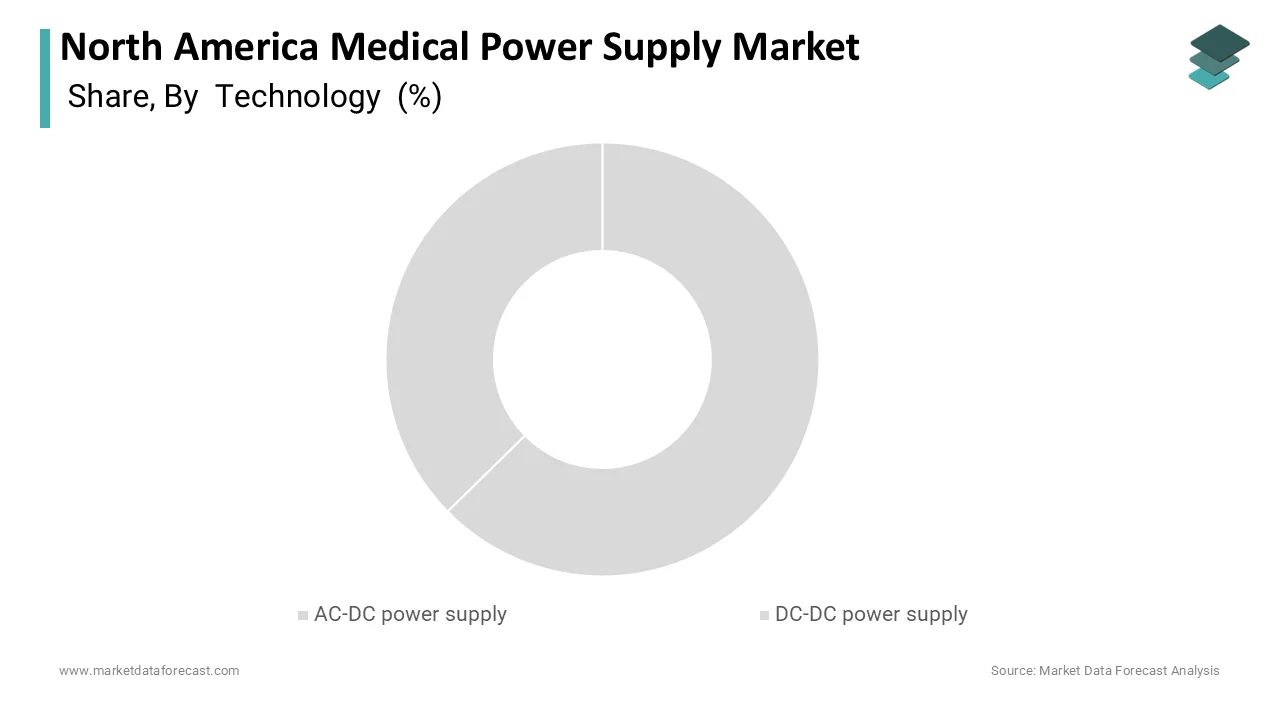
The AC-DC power supply devices segment had the major share of the North American market in 2025 and is expected to maintain overwhelming market leadership due to the fundamental requirement for converting facility alternating current to direct current voltages used by virtually all stationary medical equipment in clinical settings. According to the American Society for Healthcare Engineering Facility Infrastructure Survey 2024, 94% of acute care hospital biomedical assets, including imaging, surgical, and laboratory systems, connect directly to building AC mains, necessitating primary AC-DC conversion as the first stage in every power architecture. According to the Centers for Medicare & Medicaid Services Conditions of Participation, uninterruptible power systems are mandated for life-sustaining equipment covering over 2.3 million beds nationwide, each supported by AC-DC supplies in backup power distribution chains ensuring continuous operation during utility failures. As per Delta Electronics Medical Power Division Shipment Data, AC-DC medical units represented 81% of North American volume in 2023, reflecting installed base reality where wall-powered devices vastly outnumber battery-operated portables. Even portable equipment ultimately depends on AC-DC adapters for battery charging, creating a secondary demand layer beyond primary internal supplies. This universal dependency on grid connectivity establishes AC-DC function as a non-discretionary foundation of medical power infrastructure, with replacement cycles tied to equipment refresh rather than technology substitution, ensuring sustained volume leadership independent of innovation velocity in downstream conversion stages.
However, the DC-DC converters segment is predicted to register a promising CAGR of 12.7% during the forecast period in the North American market owing to the explosive expansion of wearable monitors, implantable devices, and transportable diagnostics operating independently of AC mains infrastructure. According to the Food and Drug Administration Digital Health Center of Excellence Wearable Device Clearances 2024, approvals for battery-powered continuous monitoring devices increased 56% year-over-year, with each unit containing 2 to 4 DC-DC conversion stages for sensor bias, processor core, and wireless transmitter rails. According to the Visiting Nurse Associations of America Home Health Technology Deployment Report, member agencies distributed 1.8 million remote patient monitoring kits in 2023, representing 40% growth versus 2022, with each kit containing multiple battery-powered devices dependent on efficient DC-DC regulation for extended runtime between charges. As per Texas Instruments Medical Power Market Analysis Q4 2023, DC-DC converter shipments to North American medical OEMs grew 19% annually from 2021 to 2023, outpacing AC-DC growth by a factor of three, reflecting portfolio shift toward mobility-enabled form factors. Implantable cardiac devices, neurostimulators, and insulin pumps add long-lifecycle demand streams with replacement intervals measured in years rather than equipment refresh cycles. This structural migration toward untethered healthcare creates sustained tailwinds for DC-DC conversion independent of facility-based capital expenditure patterns dominating traditional AC-DC segments.
By End User Insights
The hospitals held the highest share of the regional market in 2025 and are predicted to maintain undisputed leadership in the North America medical power supply end-user segment due to the concentration of high-value diagnostic and therapeutic equipment requiring multiple embedded power modules per installation. According to the American Hospital Association Annual Survey 2024, US community hospitals operate over 42,000 CT scanners, 28,000 MRI systems, and 18,000 linear accelerators, collectively representing 85% of national advanced imaging and radiation therapy capacity and corresponding power supply content. According to the Healthcare Financial Management Association Capital Expenditure Benchmark Report, the median hospital spent 18 million dollars on medical equipment in 2023, with power subsystems comprising 3% to 5% of total acquisition cost, translating to substantial embedded component spend. As per GE HealthCare Installed Base Analytics, acute care hospitals account for 78% of service contract revenue for power-related repairs and replacements, reflecting aging equipment density and utilization intensity exceeding other settings. Even as outpatient volumes grow, hospitals retain ownership of highest complexity modalities including hybrid OR suites, proton therapy centers, and ECMO programs, each demanding specialized power architectures unavailable elsewhere. This equipment gravity well ensures hospitals remain primary demand anchor regardless of care site diversification trends, because technological sophistication correlates directly with power content per square foot and maintenance intensity over extended asset lifecycles.
However, the home care settings segment represents the fastest-growing end-user segment and is estimated to showcase a CAGR of 15.4% over the forecast period owing to the payer policy shifts redirecting chronic disease management from institutional to residential environments across North America. According to the Centers for Medicare & Medicaid Services Home Health Prospective Payment System Final Rule 2024, reimbursement rates for home-based respiratory therapy and infusion services increased 8%, incentivizing providers to deploy portable ventilators, oxygen concentrators, and enteral pumps serving 3.4 million beneficiaries annually. According to the Aging in Place Technology Watch Market Tracker, 68% of Americans over 65 prefer aging at home versus institutional care, creating consumer pull for medical devices adapted to residential electrical environments and lifestyle constraints. As per Philips Respironics Home Care Division Revenue Disclosure, North American home medical equipment sales grew 21% in 2023, with power adapters and battery packs representing the fastest-growing accessory category due to higher replacement frequency from daily handling and environmental stress. Unlike hospital equipment replaced on decade-long cycles, home devices experience accelerated wear from mobility, drops, and variable power quality, increasing aftermarket power supply demand. This structural care migration transforms residences into distributed points of medical power consumption, creating volume growth uncorrelated with traditional healthcare capital planning cycles and insulated from institutional budget constraints.
COUNTRY LEVEL ANALYSIS
U.S. Medical Power Supply Devices Market Analysis
The U.S. accounted for the largest share of the North American medical power supply devices market in 2025 and is poised to maintain its overwhelming dominance in the North American medical power supply devices market over the next few years. This leadership stems from the world's largest healthcare expenditure base reaching 4.9 trillion dollars in 2023 per Centers for Medicare & Medicaid Services National Health Expenditure Accounts, supporting capital equipment investment levels unmatched globally. The country hosts headquarters of 14 of the top 20 global medical device companies, concentrating R&D, manufacturing, and early adoption domestically, creating innovation feedback loops accelerating power technology integration into next-generation systems. The FDA regulatory framework, while stringent, provides clear pathways for power component clearance through master files and recognized testing laboratories, reducing uncertainty versus fragmented international regimes. According to industry data, venture capital investment in US medical device startups reached 18 billion dollars in 2023, sustaining pipeline velocity for advanced equipment requiring sophisticated power solutions. However, Inflation Reduction Act provisions targeting drug pricing create spillover margin pressure on device manufacturers, potentially constraining future component spending despite current volume strength. Domestic reshoring initiatives under the CHIPS Act indirectly benefit medical power suppliers through expanded semiconductor availability and advanced packaging capacity, addressing supply chain vulnerabilities exposed duringpandemic-eraa shortages and strengthening long-term industrial base resilience.
Canada Medical Power Supply Devices Market Analysis
Canada is expected to experience steady, regulated growth in its medical power supply devices sector over the next few years, supported by stable underlying demand fundamentals driven by aging demographics and chronic disease burdens. According to Statistics Canada Health Care Spending Data 2024, national health expenditure reached 344 billion Canadian dollars, with medical equipment capital allocation comprising 6.8% of hospital budgets distributed through provincial health authorities exercising monopsony purchasing power. According to the Canadian Agency for Drugs and Technologies in Health Medical Device Assessment Program, 89 power-dependent technologies were evaluated in 2023, influencing formulary inclusion decisions across provinces, though implementation lag averages 9 months post-approval versus immediate US adoption. Publicly funded cancer agencies, including Ontario Health Cancer Care and BC Cancer,r serve as single purchasers for radiation therapy equipment, concentrating high-value power supply demand in fewer decision nodes, enabling volume leverage but limiting premium pricing opportunities. The Health Canada Medical Devices Directorate maintains mutual recognition agreements with the FDA and EU notified bodies, reducing duplicate testing burdens for multinational suppliers, yet domestic market size is insufficient to justify dedicated local manufacturing, forcing reliance on imports vulnerable to currency fluctuations. Recent federal pharmacare legislation may introduce additional negotiation layers for associated devices, potentially extending procurement timelines despite stable underlying demand fundamentals driven by aging demographics and chronic disease burden.
COMPETITIVE LANDSCAPE
Competition within the North American medical power supply devices market exhibits moderate intensity, characterized by an oligopolistic structure among five dominant multinational suppliers alongside niche specialists serving specialized therapeutic applications. Barriers to entry remain substantial due to UL 60601 certification costs, multiyear field reliability validation requirements,s and embedded design relationships limiting new entrant threats despite attractive margins in the medical segment. Incumbents compete through regulatory pre-clearance portfolios, application engineering departments, and supply chain resilience rather than price alone, preserving premiums in safety-critical categories where failure consequences outweigh cost savings. Customer concentration among tier one medical device OEMs enhances buyer leverage, enabling aggressive qualification standards but also creating partnership opportunities for suppliers demonstrating superior development support and lifecycle management capabilities. Geographic fragmentation between US innovation hubs and Mexican manufacturing bases requires operational excellence across borders, rs adding complexity and favoring integrated players with established dual-site capabilities. Competitive intensity varies significantly by segment, with standard catalog products experiencing moderate rivalry based on availability and price, while custom configurable solutions compete primarily on technical performance and development speed. This bifurcated landscape rewards companies balancing regulatory expertise, manufacturing flexibility, and application knowledge while punishing those unable to meet escalating safety standards or supply reliability expectations, reshaping competitive dynamics through 2030.
KEY MARKET PLAYERS
Some of the companies that are playing a dominant role in the North America Medical Power Supply Market include:
- Powerbox
- SL Power Electronics
- TDK-Lambda Corporation
- Emerson Network Power
- Astrodyne Corporation
- ICCNexergy
- Delta Electronics, Inc.
- Excelsys Technologies Ltd.
- MEAN WELL Enterprises Co., Ltd.
TOP LEADING PLAYERS IN THE MARKET
- TDK Lambda Americas Inc maintains significant influence across the North American medical power supply landscape through its comprehensive portfolio of UL 60601 certified standard and configurable modules serving diagnostic imaging and patient monitoring applications. The company contributes extensively by operating dedicated medical design centers in San Diego and Tijuana,na enabling rapid customization and regulatory support for original equipment manufacturers navigating complex safety requirements. TDK Lambda recently strengthened its position by launching next-generation GWS series medical adapters with integrated digital telemetry in February 2024, addressing predictive maintenance demands from hospital biomedical engineering departments. Their expanded distributor inventory program ensures same-day availability for the top 50 medical SKUs, reducing production downtime risks for customers facing tight delivery schedules. Strategic partnerships with major group purchasing organizations facilitate formulary inclusion across health systems, streamlining procurement processes. These initiatives reinforce operational reliability and technical leadership without relying on market share metrics to demonstrate sustained competitive advantage insafety-criticall healthcare infrastructure throughout North American clinical environments.
- Advanced Energy Industries Inc plays a pivotal role in the North American medical power supply ecosystem through specialized, high-precision,n configurable platforms serving proton therapy, robotic surgery,y and advanced imaging modalities requiring non-standard voltage rails. The company contributes regionally by maintaining application engineering teams in Denver and Fort Collins, collaborating directly withtier-onee medical device manufacturers during early design phases to optimize power architecture for performance and compliance. Advanced Energy recently enhanced its market position by acquiring SL Power Electronics' medical product line in November 2023, expandingits low-noisee converter portfolio for sensitive analog front ends in ultrasound and ECG equipment. Their proprietary thermal management technologies enable higher power density in compact form factors, meeting miniaturization trends in portable therapeutic devices. Investment in wide bandgap semiconductor integration improves efficiency and reduces electromagnetic interference, simplifying system-level compliance testing. These platform-centric strategies differentiate offerings through deep application expertise while creating switching costs via co-developed solutions, strengthening long-term positioning in high-value therapeutic segments beyond commoditized diagnostic supplies.
- Delta Electronics Americas Ltd has established a substantial presence in the North American medical power supply market through vertically integrated manufacturing capabilities spanning magnetics, semiconductors,s and final assembly, thereby ensuring supply chain resilience amid global disruptions. The company contributes uniquely by operating ISO 13485-certified facilities in Fremont, California, and Monterrey, ey Mexico, providing dual sourcing options that mitigate geopolitical risks while maintaining cost competitiveness for price-sensitive ambulatory and home care segments. Delta Electronics recently strengthened its position by inaugurating a new medical R&D lab in Austin, Texas, in January 2024, focusing on galliumnitride-basedd converters for next-generation portable diagnostics and wearable monitors. Their smart power platform integrates PMBus communication, enabling real-time health monitoring and predictive failure alerting, supporting hospital proactive maintenance programs. Collaboration with semiconductor suppliers secures priority allocation during shortage periods,s ensuring continuity for key customers. This vertical integration strategy creates defensible competitive moats through control over critical subcomponents and manufacturing flexibility distinct from assembly-only competitors operating in the North American medical power landscape.
TOP STRATEGIES USED BY KEY MARKET PARTICIPANTS
Key players in the North American medical power supply devices market employ multifaceted strategic approaches to navigate regulatory complexity, supply chain volatility, ty and evolving clinical technology requirements. Regulatory pre-certification of standard platforms reduces customer approval timelines, creating sticky design wins through de-risked integration pathways that discourage migration to unproven alternatives. Vertical integration into magnetics winding and semiconductor packaging mitigates component obsolescence risks while enabling cost optimization unavailable to assembly-only competitors dependent on merchant suppliers. Application engineering collaboration during OEM design phases embeds supplier expertise into system architectures, creating switching costs through co-developed solutions tailored to specific modality requirements. Distributor inventory depth and allocation priority agreements ensure supply continuity during disruption periods, transforming reliability into a competitive differentiator beyond specifications or pricing. Smart power integration with digital telemetry enables predictive maintenance service models, creating recurring revenue streams and deeper customer relationships,s transcending transactional component sales. Wide bandgap semiconductor adoption addresses simultaneous demands for miniaturization, efficiency, and thermal performance in space-constrained portable devices, positioning early adopters as technology leaders. Geographic diversification through Mexican manufacturing balances cost competitiveness with nearshore resilience,e reducing exposure to transpacific logistics vulnerabilities. These interconnected strategies collectively address fundamental market dynamics where safety compliance, operational continuity,ity and application specificity determine competitive success beyond pure performance or cost metrics alone.
MARKET SEGMENTATION
This research report on the North America Medical Power Supply Market is segmented and sub-segmented into the following categories.
By Technology
- AC-DC power supply
- DC-DC power supply
By Type
- Open Frame
- Enclosed
- External
- Encapsulated
- Configurable
By Application
- Diagnostic Equipment
- Medical Monitoring Equipment
- Dental Equipment
- Surgical Equipment
- Home Patient Care Equipment
By Country
- The United States
- Canada
- Rest of North America