- Product Description Description
- Table of Contents TOC
- List of Table & Figure LOT
- Get Free Sample PDF Sample PDF
Market Size, 2025
$25.05 MnMarket Estimate, 2026
$26.11 MnMarket Forecast, 2034
$36.36 MnCAGR, 2026–2034
4.23%North America Methadone Market Size, Growth, Trends & Forecast (2026–2034)
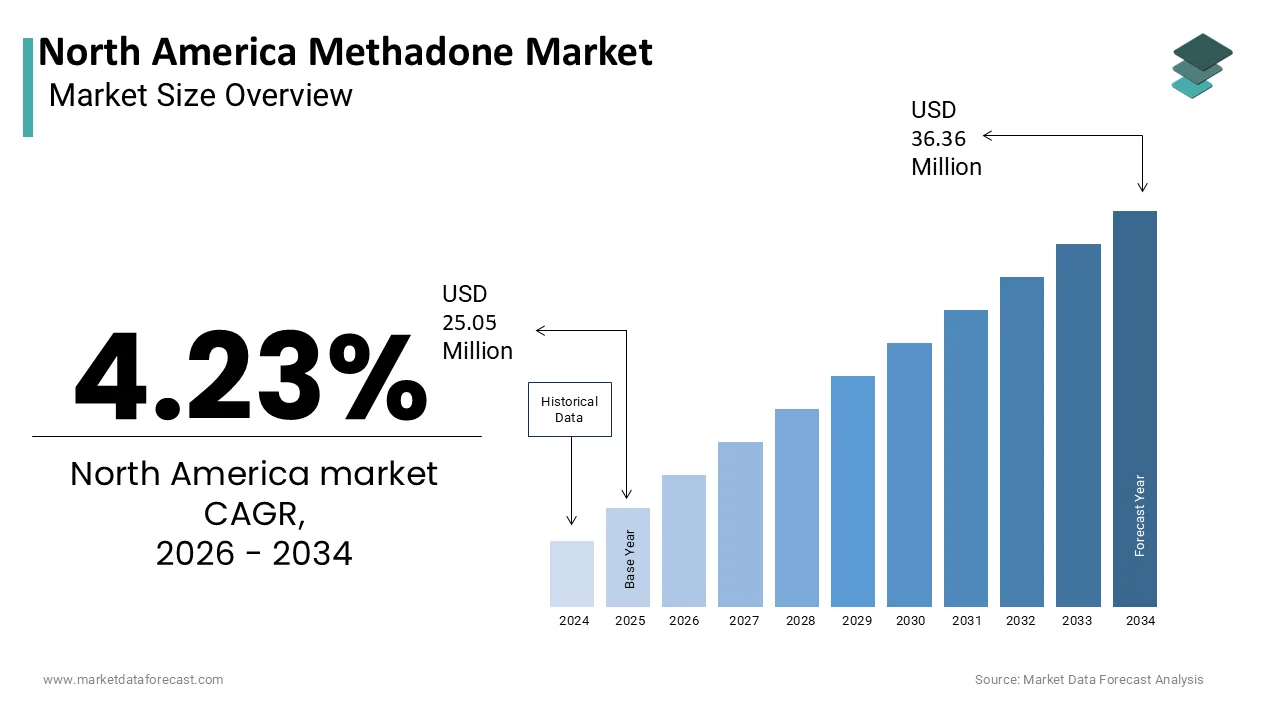
The North America methadone market size was valued at USD 25.05 million in 2025, is anticipated to reach USD 26.11 million in 2026, and is projected to scale to USD 36.36 million by 2034, expanding at a compound annual growth rate (CAGR) of 4.23% during the forecast period from 2026 to 2034. Market expansion across North America is primarily driven by the escalating synthetic opioid crisis (fentanyl-driven tolerance levels), permanent regulatory flexibility expansions, and increased government funding for evidence-based addiction treatment infrastructures.
Key Executive Metrics (At-a-Glance)
- 2025 Base Valuation: USD 25.05 Million
- 2026 Current Valuation: USD 26.11 Million
- 2034 Forecast Valuation: USD 36.36 Million
- Compound Annual Growth Rate (CAGR): 4.23% (2026–2034)
- Leading Country Market: United States (capturing 88.7% of the regional market share in 2025)
- Key Geographic Countries Covered: United States, Canada, and Rest of North America
Core Market Drivers & Opportunities
- Synthetic Opioid Crisis: High-potency fentanyl analogs increasing physical dependence and driving patient populations requiring full mu opioid receptor agonist therapy.
- Regulatory Reforms: SAMHSA final rules and CMS bundled payment models removing historical facility certification barriers and enabling integrated care.
- Institutional Reform: State and federal correctional system mandates expanding medication for opioid use disorder (MOUD) inside prison populations.
Primary Market Restraints & Challenges
- Stigma & Compliance Burden: Deeply entrenched social stigma and rigorous documentation/licensing requirements limiting primary care physician adoption.
- Alternative Competition: Growing prescriber and patient preference for buprenorphine and extended-release long-acting injectable formulations.
Market Segmentation
| Segment Category | Largest Segment | Fastest-Growing Segment |
|---|---|---|
| By Application | Opiate Withdrawal Management / OUD Treatment (Holding ~85% of total volume driven by public health crisis responses) | Chronic Pain (Projected at a CAGR of 9.2%, though tempered by strict opioid stewardship guidelines) |
| By Distribution Channel | Hospital Pharmacies & Certified Opioid Treatment Programs (OTPs) | Retail Pharmacies (Projected at a CAGR of 20.8% following recent regulatory liberalization) |
Major Industry Players Profiled
Key companies shaping the North American methadone landscape include Mallinckrodt Pharmaceuticals, SpecGx LLC, Pfizer Inc. (Roxane Laboratories / Boehringer Ingelheim portfolio), Diskets, Macfarlan Smith, VistaPharm, Qinghai Pharm, CentralPharm, and Aurolife Pharma LLC.
 Download Free Sample Report
North America Methadone Market Size
The North America Methadone Market is projected to grow from USD 25.05 million in 2025 to USD 26.11 million in 2026 and reach USD 36.36 million by 2034, registering a CAGR of 4.23% from 2026 to 2034.
According to the Substance Abuse and Mental Health Services Administration, over 2 million individuals in the United States received medication for opioid use disorder in 2023, with methadone serving approximately 400,000 patients through federally certified opioid treatment programs. The Centers for Disease Control and Prevention reports that synthetic opioids, including fentanyl,l were involved in over 75,000 overdose deaths in 2023, underscoring the persistent public health emergency driving demand for evidence-based pharmacotherapy. Furthermore, Statistics Canada indicates that opioid related harms cost the Canadian economy an estimated $13 billion annually, reinforcing governmental commitment to expanding access to opioid agonist therapies like methadone. The National Institute on Drug Abuse states that methadone reduces mortality risk by 50% or more among individuals with opioid use disorder, establishing its clinical indispensability despite regulatory complexity. Consequently, this market functions as a critical public health infrastructure component where utilization is dictated by epidemiological need, policy evolution, and treatment capacity rather than traditional market forces or consumer preference dynamics.
MARKET DRIVERS
Escalating Synthetic Opioid Crisis Necessitating High Potency Agonist Therapy
The proliferation of high-potency synthetic opioids, particularly fentanyl analogs, is fuelling the growth of the North American methadone market due to its unique pharmacological profile addressing severe physical dependence. According to the Centers for Disease Control and Prevention, fentanyl was involved in over 75,000 overdose deaths in the United States during 2023, which represents a 60% increase since 2020 and is creating patient populations with tolerance levels that render lower-potency medications clinically insufficient. According to the National Institute on Drug Abuse, methadone’s full mu opioid receptor agonist activity and long half-life provide superior withdrawal suppression and craving reduction for fentanyl dependent individuals compared to partial agonists with ceiling effects. Treatment admission data from the Substance Abuse and Mental Health Services Administration show that patients citing synthetic opioids as primary substance increased by 85% between 2019 and 2023, directly correlating with methadone program enrolment growth. Unlike buprenorphine, which may precipitate withdrawal in hhigh-tolerancepatients, methadone allows flexible dosing titration essential for stabilizing individuals exposed to illicitly manufactured fentanyl. This pharmacological necessity transforms methadone from legacy therapy into frontline intervention for the contemporary overdose crisis, ensuring sustained utilization independent of newer medication availability as synthetic opioid exposure continues escalating across diverse demographic and geographic populations throughout North America.
Regulatory Flexibility Expansion Increasing Treatment Accessibility
Recent permanent regulatory reforms removing barriers to methadone access have significantly expanded the addressable patient population by enabling treatment initiation outside traditional opioid treatment program settings, which is further boosting the North American market growth. As per the Substance Abuse and Mental Health Services Administration final rule published in February 2024, healthcare providers can now prescribe methadone for opioid use disorder in general medical settings without requiring separate facility certification, dramatically increasing geographic and temporal access points. The Centers for Medicare and Medicaid Services implemented bundled payment models in January 2024 covering methadone dispensing and associated services under Medicare Part B, removing historical reimbursement gaps that limited provider participation. Data from the National Academies of Sciences, Engineering, and Medicine indicates that only 11% of individuals with opioid use disorder received any medication treatment in 2021, largely due to structural access barriers that new regulations directly address. Telehealth flexibilities made permanent allow remote induction and monitoring, reducing transportation burdens that previously caused 40% dropout rates within the first month, according to addiction medicine research. These systemic changes transform methadone from a geographically constrained specialty service to an integrated component of mainstream healthcare, expanding utilization beyond saturated urban opioid treatment programs to reach underserved rural and suburban populations where overdose mortality rates are rising fastest.
MARKET RESTRAINTS
Persistent Stigma and Regulatory Burden Limiting Provider Adoption
Deeply entrenched stigma surrounding methadone combined with residual regulatory complexity is hampering the North American methadone market expansion. According to survey data published in JAMA Network Open, only 18% of primary care physicians expressed willingness to prescribe methadone even after regulatory changes, citing concerns about diversion liability, patient management complexity, and professional reputation damage. The American Medical Association reports that 65% of state medical boards maintain additional documentation requirements beyond federal standards, creating compliance overhead that discourages adoption in general medical settings. Research in Psychiatric Services demonstrates that patients perceive methadone clinics as stigmatizing environments, with 55% preferring alternative treatments specifically to avoid association with opioid treatment programs regardless of clinical appropriateness. Insurance prior authorization requirements persist in 30% of private plans,s according to a Kaiser Family Foundation analysis, creating administrative friction that delays treatment initiation during critical windows. Workforce training gaps compound these barriers as fewer than 10% of medical schools include comprehensive addiction medicine education, leaving graduates unprepared to manage methadone safely. This combination of attitudinal, institutional, and educational obstacles creates implementation lag where regulatory permission exists, but practical adoption remains constrained, limiting market expansion to early adopter segments rather than achieving mainstream integration necessary to address epidemic-scale need.
Competition from Buprenorphine and Emerging Long-Acting Formulations
Pharmaceutical competition from buprenorphine and extended-release formulations increasingly constrains methadone utilization by offering perceived safety advantages and convenience that align with modern treatment preferences, which is another significant restraint on the North American market. According to IQVIA prescription data, buprenorphine prescriptions grew 25% annually between 2020 and 2023 while methadone dispensing remained relatively flat, reflecting prescriber preference for medications with lower overdose risk and fewer regulatory restrictions. The Food and Drug Administration approved multiple long-acting injectable buprenorphine products since 2017, eliminating the daily dosing burden that causes significant adherence challenges with oral methadone, particularly among employed or caregiving populations. Clinical guidelines from the American Society of Addiction Medicine recommend buprenorphine as first-line for mild to moderate opioid use disorder, reserving methadone for severe cases and narrowing the eligible patient pool. Manufacturer marketing investment in buprenorphine products exceeds $200 million annually, according to Evaluate Pharma data, shaping prescriber awareness and patient expectations toward newer alternatives. Patient surveys indicate 70% prefer non-daily dosing options when available, prioritizing lifestyle compatibility over pharmacological potency. This competitive dynamic repositions methadone as rescue therapy for treatment-refractory populations rather than a broad-spectrum solution, constraining volume growth despite expanding the overall medication for opioid use disorder market as newer agents capture incident cases through aggressive positioning and convenience advantages.
MARKET OPPORTUNITIES
Integration into Primary Care and Hospital Settings Expanding Access Points
Healthcare system integration represents a prominent opportunity for the North American methadone market expansion by embedding treatment within existing care delivery infrastructure rather than maintaining a parallel specialty system. According to the Centers for Medicare and Medicaid Services, hospital-initiated methadone programs reduced 30-day readmission rates by 45% among patients with opioid use disorder, demonstrating a value proposition that drives health system adoption under value-based payment models. The Veterans Health Administration successfully integrated methadone prescribing into 85% of its medical centers, increasing veteran treatment engagement by 30% and providing a scalable model for large integrated delivery networks. Academic medical centers including Johns Hopkins and Massachusetts General established bridge clinics connecting emergency department initiations to ongoing primary care management, reducing the treatment gap from weeks to days. State Medicaid programs in New York and California now reimburse hospital-based methadone induction, creating financial sustainability for acute care integration. This mainstreaming addresses geographic maldistribution, where 40% of US counties lack opioid treatment programs,s according to the Rural Health Information Hub. By leveraging existing primary care workforce and facilities, integration circumvents the need for new standalone infrastructure, accelerating access expansion. Manufacturers supporting this transition through provider education, dosing protocols, and care coordination tools capture value from system-level adoption rather than individual prescriber decisions, creating sustainable growth aligned with healthcare delivery transformation priorities.
Correctional Healthcare System Reform Creating Institutional Demand
Criminal justice system reform mandating evidence-based addiction treatment in correctional facilities represents a substantial untapped opportunity for methadone utilization given disproportionate opioid use disorder prevalence among incarcerated populations. According to the Bureau of Justice Statistics, 65% of prison inmates meet criteria for substance use disorder, yet fewer than 5% received medication treatment before recent policy changes, creating a massive treatment deficit now being addressed through legislative mandates. The First Step Act implementation and subsequent state laws in California, New York, and Rhode Island require continuation of community-prescribed methadone during incarceration, establishing baseline institutional demand. Rhode Island’s statewide correctional medication program reduced post-release overdose mortality by 61% according to a study published in JAMA Psychiatry, providing compelling evidence driving policy adoption across 35 additional states as of 2024. The Federal Bureau of Prisons announced universal medication for opioid use disorder access in all facilities beginning in 2024, affecting over 150,000 inmates annually. Correctional health budgets allocated $400 million for addiction treatment expansion in fiscal year 2024, according to the Government Accountability Office, creating a funded demand stream. This systemic shift transforms corrections from a treatment desert to a major purchaser, establishing a stable institutional market segment insulated from retail pharmacy competition and stigma barriers affectingcommunity-basedd care.
MARKET CHALLENGES
Workforce Shortages and Training Deficits Constraining Service Capacity
Critical shortages of addiction medicine specialists and trained support staff severely limit methadone treatment capacity despite regulatory expansions and growing demand, which is a notable challenge for the North American methadone market. According to the Association for Addiction Professionals, national vacancy rates for certified addiction counselors reached 28% in 2023, with average times to fill positions exceeding 90 days, directly constraining patient intake at existing programs. The American Society of Addiction Medicine estimates only 7,000 board-certified addiction specialists serve over 2 million individuals needing medication treatment, creating a ratio of 1 physician per 285 patients, far below recommended standards. Nursing shortages similarly affect opioid treatment programs, where 40% report operating below licensed nursing capacity according to a National Council for Mental Wellbeing survey, forcing appointment caps and waitlists. The educational pipeline remains inadequate, with fewer than 15% of medical schools requiring an addiction medicine rotation and only 60 accredited fellowship programs graduating 300 physicians annually against a replacement need exceeding 1,000 positions. Complex methadone dosing requires specialized expertise unavailable in general practice, making the workforce bottleneck more acute than for other medications. Until training scales through loan forgiveness, curriculum mandates, and telehealth supervision models, treatment capacity will remain artificially constrained regardless of regulatory permission or funding availability, creating a persistent access gap between policy intent and operational reality.
Supply Chain Vulnerability and Manufacturing Concentration Risk
A highly concentrated manufacturing base and active pharmaceutical ingredient dependency create significant supply disruption risk for methadone despite its essential medicine status. According to the Food and Drug Administration, over 80% of US methadone active pharmaceutical ingredient originates from single-source facilities in China and India, creating vulnerability to geopolitical tensions, trade restrictions, and production quality issues that have caused intermittent shortages since 2020. The American Society of Health System Pharmacists reported methadone oral solution on the national shortage list for 14 consecutive months between 2022 and 2023, forcing treatment programs to ration doses and delay new admissions, compromising continuity of care for vulnerable populations. Only 3 manufacturers hold active Drug Master Files for methadone hydrochloride powder in the United States, limiting redundancy and competitive pressure to maintain supply resilience. Just-in-time inventory practices prevalent in healthcare amplify disruption impacts, with typical clinic buffer stocks covering only 7 to 10 days of dispensing needs. Regulatory requirements for bioequivalence testing when switching suppliers add 6 to 12 months to qualification timelines, preventing rapid sourcing alternatives during crises. Until domestic manufacturing capacity expands through strategic stockpiling incentives or advanced manufacturing grants, supply reliability will remain precarious, threatening treatment stability for hundreds of thousands of patients dependent on uninterrupted medication access.
REPORT COVERAGE
| REPORT METRIC | DETAILS |
| Market Size Available | 2025 to 2034 |
| Base Year | 2025 |
| Forecast Period | 2026 to 2034 |
| Segments Covered | By Application, Mode Of Administration, and Region. |
| Various Analyses Covered | Global, Regional, and Country-Level Analysis, Segment-Level Analysis, Drivers, Restraints, Opportunities, Challenges; PESTLE Analysis; Porter’s Five Forces Analysis, Competitive Landscape, Analyst Overview of Investment Opportunities |
| Countries Covered | The United States |
| Market Leaders Profiled |
|
SEGMENTAL ANALYSIS
By Application Insights
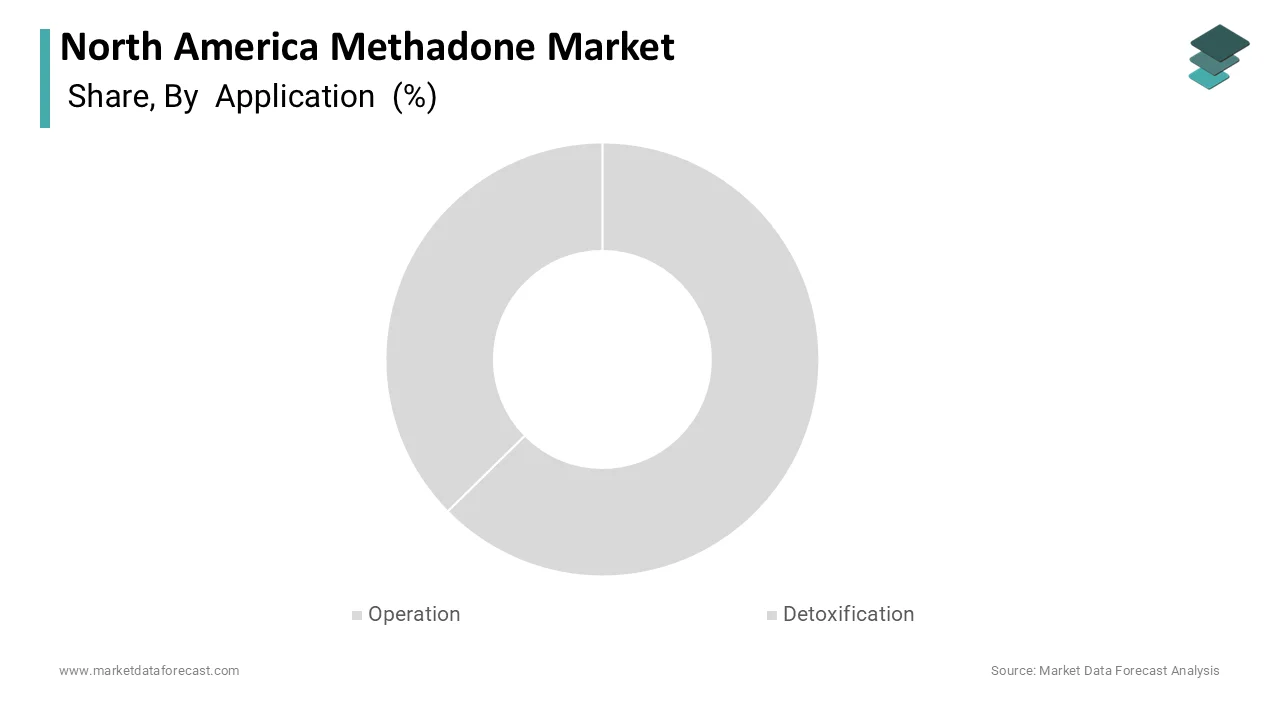
The opiate withdrawal management segment dominated the market by accounting for the highest share of the North America methadone market in 2025 because federal and provincial public health strategies have designated medication for opioid use disorder as the primary intervention for addressing the synthetic opioid overdose crisis. According to the Substance Abuse and Mental Health Services Administration, over 400,000 individuals in the United States received methadone specifically for opioid use disorder treatment in 2023, representing approximately 85% of total national methadone dispensing volume. The Centers for Disease Control and Prevention reports that synthetic opioids were involved in over 75,000 overdose deaths in 2023, creating an urgent governmental mandate to expand opioid agonist therapy access through dedicated funding streams, including $1.5 billion in State Opioid Response grants allocated exclusively for addiction treatment infrastructure. Canadian Institute for Health Information data indicates that opioid agonist therapy prescriptions increased 40% between 2019 and 2023, with methadone comprising the majority of initial treatment episodes due to established efficacy evidence. Unlike chronic pain applications where methadone faces competition from safer alternatives, opiate withdrawal treatment lacks equivalent substitutes for high-tolerance patients, making it clinically indispensable. This public health prioritization transforms methadone from a commercial pharmaceutical into an essential epidemic response tool, ensuring sustained utilization driven by mortality prevention imperatives rather than market dynamics or prescriber preference.
However, the chronic pain segment is estimated to register the highest CAGR of 9.2% over the forecast period in the North American market owing to the systematic de-prescribing initiatives responding to safety concerns and opioid stewardship mandates. According to the Centers for Disease Control and Prevention Guideline for Prescribing Opioids for Chronic Pain updated in 2022, it explicitly recommends against initiating methadone for pain due to complex pharmacokinetics, variable half-life, and disproportionate overdose risk compared to other opioids. Medicare Part D data analysed by the Kaiser Family Foundation shows methadone pain prescriptions fell from 4.2 million in 2015 to 1.7 million in 2023, reflecting a 60% reduction as prescribers transitioned patients to safer alternatives or non-pharmacological therapies. State prescription drug monitoring programs flag methadone as a high-risk medication, triggering automatic alerts and prior authorization requirements in 45 states, creating administrative barriers that discourage new initiations. Malpractice insurance premiums for pain physicians prescribing methadone increased 35% annually between 2019 and 2023, according to the Medical Liability Monitor, further disincentivizing use. Academic detailing programs funded by the Agency for Healthcare Research and Quality reached 15,000 prescribers with evidence-based messaging about methadone risks, accelerating voluntary deprescribing. This systematic contraction reflects successful public health intervention rather than market failure, transforming chronic pain from a mainstream indication to a legacy niche limited to palliative care and refractory cases where benefits clearly outweigh documented risks.
By Distribution Channels Insights
The hospital pharmacies and federally certified opioid treatment programs segment led the market by accounting for the largest share of the regional market in 2025 because federal regulations mandate observed daily dispensing for most patients, making institutional channels legally required rather than optional delivery mechanisms. According to the Substance Abuse and Mental Health Services Administration, Title 42 Code of Federal Regulations Part 8, it requires that methadone for opioid use disorder be administered under direct supervision at accredited programs, except for limited take-home doses earned through demonstrated stability, creating a captive distribution channel serving 400,000 patients daily. The Drug Enforcement Administration enforces strict chain of custody requirements prohibiting retail pharmacy dispensing of methadone for addiction treatment without special registration held by fewer than 5% of community pharmacies nationwide. The Canadian Controlled Drugs and Substances Act similarly restricts methadone dispensing to licensed treatment facilities or hospital pharmacies with provincial approval, concentrating distribution in institutional settings. This regulatory architecture ensures that over 90% of North American methadone volume flows through specialized channels regardless of patient preference or convenience considerations. Manufacturers structure supply chains around bulk liquid formulations and unit dose packaging optimized for observed administration rather than retail dispensing, reinforcing institutional channel primacy. Until regulatory reforms enable broader community pharmacy participation, hospital and opioid treatment program channels will maintain dominance through legal requirements rather than competitive advantage.
On the other hand, the retail pharmacies segment is estimated to showcase a CAGR of 20.8% over the forecast period in the regional market owing to the landmark regulatory reforms enabling community pharmacy methadone dispensing for opioid use disorder for the first time in decades. As per the Substance Abuse and Mental Health Services Administration final rule published in February 2024, eligible retail pharmacies can now dispense methadone under standing orders or prescriptions from authorized practitioners without requiring separate opioid treatment program certification, potentially expanding access points from 2,000 specialized programs to over 50,000 community pharmacies nationwide. The Centers for Medicare and Medicaid Services implemented pharmacy benefit coverage for methadone dispensing in January 2024, creating a reimbursement pathway that makes community pharmacy participation financially viable after decades of exclusion. Pilot programs in Rhode Island and Vermont demonstrated that pharmacy dispensing reduced patient travel burden by 70% and improved retention rates by 25,% according to an evaluation published in JAMA Network Open, providing an evidence base for nationascale-upup. Major chains including CVS and Walgreens announced methadone dispensing programs in 15 states by mid-2024, which is signalling rapid commercial adoption. This regulatory paradigm shift transforms retail pharmacies from a prohibited to a preferred channel for stable patients, capturing growth through accessibility expansion rather than market share theft from existing opioid treatment programs.
COUNTRY LEVEL ANALYSIS
U.S. Methadone Market Analysis
The U.S. dominated the market by capturing 88.7% of the regional market share in 2025 and is poised to maintain its overwhelming dominance in the North American methadone market over the next few years due to its massive opioid use disorder prevalence, extensive opioid treatment program infrastructure, and recent regulatory expansions serving over 330 million inhabitants. According to the Substance Abuse and Mental Health Services Administration, over 400,000 Americans receive methadone through 2,000 federally certified opioid treatment programs, representing the largest national cohort globally and consuming 85% of the North American methadone supply. The Centers for Disease Control and Prevention reports 107,000 overdose deaths in 2023, with synthetic opioids driving demand for high-potency agonist therapy that only methadone adequately addresses for severe fentanyl dependence. Federal State Opioid Response grants allocated $1.5 billion in fiscal year 2024 specifically supporting methadone treatment expansion, creating a funded demand stream insulated from commercial market forces. Recent regulatory reforms enabling primary care prescribing and retail pharmacy dispensing are uniquely impactful given vast geographic disparities, where 40% of counties lack opioid treatment programs,s according to the Rural Health Information Hub. Private equity investment in addiction treatment has exceeded $15 billion since 2020, consolidating programs and standardizing operations while accelerating technology adoption and quality improvement. This confluence of epidemic scale, regulatory evolution,n and capital investment makes the United States not just the largest, but also the primary innovation laboratory where policy experiments and care models subsequently influence Canadian and international approaches to methadone treatment.
Canada Methadone Market Analysis
Canada is expected to experience steady and flexible growth in its methadone market over the next few years due to provincial healthcare system administration and a distinct regulatory framework emphasizing harm reduction and primary care integration over the specialized clinic model predominant in the United States. According to the Canadian Institute for Health Information, over 35,000 Canadians received methadone for opioid use disorder in 2023, with per capita utilization rates exceeding those in the United States in several provinces, reflecting earlier adoption of office-based prescribing and community pharmacy dispensing models. Health Canada’s interim order enabling pharmacist-initiated methadone treatment during the pandemic became permanent in 2023, creating a more flexible access framework than current United States regulations despite a smaller absolute patient population. Provincial variation is significant, with British Columbia and Ontario accounting for 70% of national methadone dispensing while Atlantic provinces maintain lower utilization due to rural geography and provider shortages. Indigenous Services Canada funds culturally adapted treatment programs addressing disproportionate opioid harms among First Nations communities, creating specialized demand streams absent in the United States context. Supply chain vulnerabilities affected Canada more severely during the 2022 shortage due to single manufacturer dependency, prompting strategic stockpile initiatives and domestic production incentives. Despite its smaller scale, Canada serves as a policy innovator demonstrating the feasibility of decentralized models that the United States is now adopting, making bilateral learning critical for continental market evolution.
COMPETITIVE LANDSCAPE
Competition in the North American methadone market is characterized by an oligopolistic structure, with few manufacturers competing primarily on supply reliability, regulatory compliance,ce and institutional relationships rather than price or innovation due to mature molecule status and public health essentiality. Established players leverage decades of regulatory experience, manufacturing scale,e, and government contract history,ry creating high entry barriers for new entrants facing lengthy approval processes and thin margins. Competition intensifies during shortage periods when secondary suppliers gain temporary footholds through responsive allocation but recede when primary manufacturers restore capacity,ity demonstrating cyclical rather than structural competitive dynamics. Generic entrants face bioequivalence demonstration requirements and buyer risk aversion,sion limiting displacement of incumbent suppliers despite theoretical price advantages. Public sector procurement increasingly incorporates supply security criteria alongside cost considerations,tions rewarding manufacturers with domestic production redundancy and strategic stockpile commitments. Correctional and hospital system integration creates new competitive battlegrounds where formulation breadth and institutional service capabilities matter more than retail pharmacy pricing. Long-acting formulations and novel agonists represent potential disruptive threats but remain nascent, lleaving he current competitive landscape defined by operational execution within constrained regulatory and economic parameters. This unique environment rewards stewardship over aggression, making market position a function of sustained reliability rather than promotional intensity or patent exclusivity typical of conventional pharmaceutical competition.
KEY MARKET PLAYERS
Some of the companies that are playing a dominating role in the North America Methadone Market include:
- Diskets
- Mallinckrodt Pharmaceuticals
- Roxane Laboratories (Boehringer Ingelheim)
- Macfarlan Smith
- VistaPharm
- Qinghai Pharm
- CentralPharm
- Aurolife Pharma LLC.
TOP LEADING PLAYERS IN THE MARKET
- Mallinckrodt Pharmaceuticals serves as a foundational supplier of methadone hydrochloride active pharmaceutical ingredients and finished dosage forms across North America, supporting both opioid treatment programs and hospital systems. The company recently expanded domestic manufacturing capacity at its St Louis facility to reduce reliance on foreign active pharmaceutical ingredient sources and mitigate supply chain vulnerabilities exposed during recent shortages. Mallinckrodt partnered with federal agencies to establish strategic stockpile agreements ensuring continuity of essential medication access during disruption periods. Regulatory engagement focuses on maintaining Drug Master File compliance and expediting supplemental approvals for new production lines. Quality system investments enhance batch release consistency, addressing historical variability concerns among treatment providers. These actions demonstrate commitment to supply reliability as a core value proposition rather than volume competition, recognizing that methadone market stability depends on uninterrupted availability for vulnerable patient populations dependent on daily dosing continuity for treatment retention and overdose prevention.
- SpecGx LLC operates as a critical generic manufacturer of oral methadone solutions and tablets serving opioid treatment programs and retail pharmacies throughout the United States and Canada. The company recently secured additional Food and Drug Administration approvals for multiple methadone concentrations, expanding formulary options for clinics managing diverse patient titration needs. SpecGx invested in redundant manufacturing lines at the Webster Groves, Missouri, facility, ty creating production flexibility to respond rapidly to demand surges or competitor supply disruptions. Strategic partnerships with group purchasing organizations ensure broad distribution network coverage, reaching rural and underserved treatment facilities often overlooked by larger manufacturers. Post-marketing surveillance programs exceed regulatory minimums, building trust among clinicians concerned about bioequivalence and dose accuracy. Pricing strategies prioritize long-term supply contracts over spot market premiums, fostering stable relationships with public sector buyers. These initiatives position SpecGx as a reliable secondary supplier, strengthening market resilience through diversification while capturing value from consistent quality performance and responsive customer service rather than lowest-cost positioning alone in the essential medicine category.
- Pfizer Inc. maintains a significant presence in the North American methadone marketthrough thee legacy Roxane Laboratories acquisition portfolio, providing injectable and oral formulations for acute care and correctional settings. The company recently prioritized methadone injection production allocation to hospital customers,s addressing perioperative and emergency department initiation needs where oral administration is contraindicated. Pfizer leverages integrated distribution networks to reach institutional buyers, includingthe Veterans Health Administration and the Bureau of Prisons, expanding beyond the traditional opioid treatment program channel. Clinical education initiatives target hospitalists and emergency physicians, promoting evidence-based methadone induction protocols aligned with new regulatory flexibilities. Supply chain transparency commitments provide customers with real-time inventory visibility, enabling proactive planning during industry-wide shortage periods. Manufacturing modernization investments improve yield efficiency, reducing unit costs while maintaining quality standards essential for government contract eligibility. These actions strengthen position through institutional relationship depth and specialized formulation availability,y capturing value from healthcare system integration trends rather than competing solely in saturated retail dispensing segment where differentiation opportunities remain limited.
TOP STRATEGIES USED BY KEY MARKET PARTICIPANTS
Key players prioritize supply chain resilience through domestic manufacturing expansion and strategic stockpile agreements recognizing that uninterrupted availability constitutes the primary competitive advantage in the essential medicine market. Companies invest heavily in regulatory compliance and quality system modernization to maintain Drug Master File status and expedite approval timelines for capacity expansions addressing chronic shortage risks. Strategic partnerships with government agencies and group purchasing organizations secure baseline demand volumes and distribution access while insulating against commercial market volatility. Formulation diversification across oral solutions, tablets,s, and injectables addresses varied clinical settings and patient needs,d s creating multiple revenue streams beyond single product dependency. Customer relationship management emphasizes long-term supply contracts and transparent communication during disruption periods, building trust with treatment programs dependent on medication continuity. Workforce development support through training grants and educational materials addresses provider competency gaps limiting adoption despite regulatory expansions. Pricing strategies balance affordability for public payers with margin sustainability necessary to justify continued manufacturing investment in the low-margin essential drug category. These interconnected strategies reflect unique market dynamics where public health imperatives constrain pure commercial optimization, requiring alignment between business viability and treatment access goals to achieve sustainable competitive positioning distinct from conventional pharmaceutical markets.
MARKET SEGMENTATION
This research report on the North America Methadone Market has been segmented and sub-segmented into the following categories.
By Application
- Operation
- Detoxification
- Others
By Mode Of Administration
- Injections
- Oral Medicine
By Country
- U.S
- Canada
- Rest of North America