- Product Description Description
- Table of Contents TOC
- List of Table & Figure LOT
- Get Free Sample PDF Sample PDF
Market Size, 2025
$9.38 BnMarket Estimate, 2026
$10.17 BnMarket Forecast, 2034
$19.42 BnCAGR, 2026–2034
8.42%Executive Summary: North America Packaged Water Treatment System Market
- Market Scope: Overview of the North American packaged water treatment system market covering system types, application sectors, and regional country markets (U.S., Canada, Rest of North America).
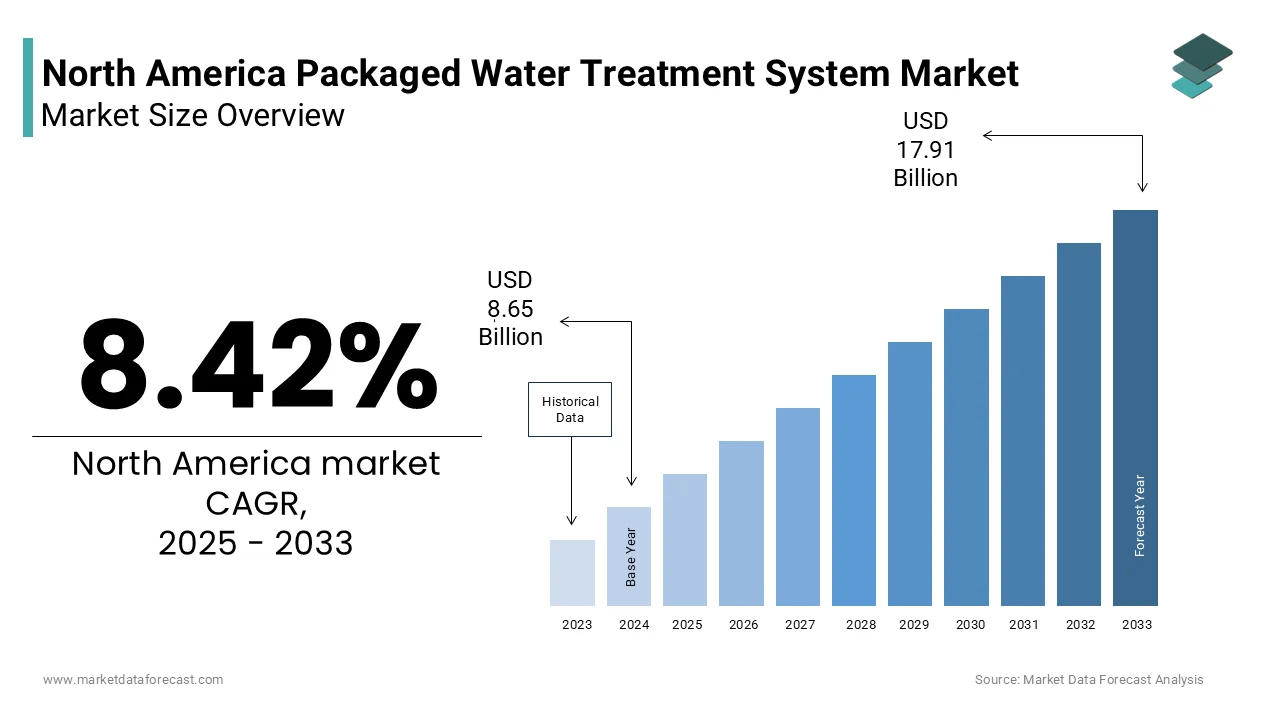
- Market Valuation: Valued at USD 9.38 billion in 2025, estimated at USD 10.17 billion in 2026, and projected to reach USD 19.42 billion by 2034, growing at a robust CAGR of 8.42% over the forecast period from 2026 to 2034.
- Primary Growth Drivers: Aging water and wastewater infrastructure needing urgent upgrades, rising demand for decentralized water treatment solutions in remote and rural communities, and stringent regulatory frameworks mandating environmental compliance.
Key Market Segment Metrics (2026–2034)
| Category | Leading Segment (Base Position) | Fastest-Growing / High-Growth Segment |
|---|---|---|
| By Type | Extended Aeration (largest segment capturing 28.1% revenue share in 2025 due to widespread use in small-to-medium municipal plants) | Membrane Bioreactor (MBR) (projected at the fastest CAGR of approximately 9.6% driven by high-quality effluent needs and water reuse demands) |
| By Application | Municipal Wastewater Treatment (biggest segment representing 42.7% revenue share in 2025 supported by infrastructure modernization) | Industrial Wastewater Treatment (fastest development at a CAGR of 10.2% fueled by tightening environmental regulations and corporate water reuse goals) |
| By Country / Region | United States (dominates regional revenue with 78.7% share in 2025 backed by massive federal infrastructure investments like the Bipartisan Infrastructure Law) | Canada (emerging growth hub focused on rural water access, indigenous community remediation, and climate adaptation strategies) |
Major Market Players & Industry Landscape
Market Structure: Highly competitive landscape comprising global industry leaders and regional specialists competing on modular efficiency, IoT integration, and customizable configurations.
Key Companies: Xylem Inc., Evoqua Water Technologies LLC, Suez Water Technologies & Solutions, Veolia Water Technologies, GE Water & Process Technologies, RWL Water, WesTech Engineering Inc., Smith & Loveless Inc., Napier-Reid Ltd., and Corix Water Systems.
North America Packaged Water Treatment System Market Size
The North America packaged water treatment system market size was valued at USD 9.38 billion in 2025 and is expected to reach USD 19.42 billion by 2034 from USD 10.17 billion in 2026, growing at a CAGR of 8.42%.
The North America packaged water treatment system market includes compact, pre-engineered systems designed for efficient water purification and wastewater treatment in municipal, industrial, and remote applications. These modular solutions offer scalable, cost-effective alternatives to traditional large-scale treatment plants, particularly beneficial in areas with fluctuating water demands or limited infrastructure.
According to the United States Environmental Protection Agency (EPA), aging water infrastructure and increasing regulatory scrutiny on water quality have heightened the need for reliable, standardized treatment solutions. In Canada, growing concerns over contaminants in rural drinking water sources have prompted increased deployment of packaged systems in small communities and First Nations settlements.
Besides, as per Environment and Climate Change Canada, climate change-induced disruptions such as droughts and floods are increasingly affecting freshwater availability, necessitating adaptive water treatment approaches.
Moreover, advancements in membrane bioreactors, reverse osmosis modules, and UV disinfection technologies are enabling more efficient and sustainable operations. So, federal funding are programs supporting modernization efforts and the market is witnessing robust growth driven by environmental compliance, public health imperatives, and resource conservation across North America.
MARKET DRIVERS
Aging Water Infrastructure and Need for Upgrades
Deteriorating condition of existing water and wastewater infrastructure, particularly in the United States is one of the primary drivers of the North America packaged water treatment system market.
According to the American Society of Civil Engineers (ASCE), the nation’s drinking water infrastructure received a grade of c in its 2021 Infrastructure Report Card, highlighting widespread inefficiencies and the urgent need for upgrades.
In response, municipalities are increasingly turning to packaged water treatment systems as a faster and more cost-effective alternative to rehabilitating outdated facilities. These modular systems can be rapidly deployed to replace failing components or supplement capacity during peak demand periods.
Similarly, in Canada, many rural and Indigenous communities rely on boil-water advisories due to outdated water treatment capabilities. As part of a national remediation effort, the Canadian government has funded the installation of packaged treatment systems equipped with advanced filtration and disinfection technologies. These developments underscore how infrastructure degradation is directly fueling market expansion across North America.
Increasing Demand for Decentralized Water Treatment Solutions
One more significant driver of the North America packaged water treatment system market is the rising preference for decentralized water treatment solutions, especially in remote, rural, and peri-urban areas where centralized infrastructure is either absent or inefficient.
According to the Natural Resources Defense Council (NRDC), over two million Americans lack access to basic water and sanitation services , primarily in underserved regions like Appalachia and the Navajo Nation.
Packaged systems provide a viable solution by offering self-contained, modular units that can treat water at the source without requiring extensive pipeline networks. This approach not only reduces distribution losses but also minimizes energy consumption and operational complexity.
Moreover, industries such as mining, oil & gas, and agriculture—often located in isolated regions—are adopting these systems to comply with environmental regulations while maintaining operational continuity. Decentralized water treatment gains traction and it continues to serve as a major catalyst for market growth across North America.
MARKET RESTRAINTS
High Initial Capital Investment and Operational Costs
A key restraint for the North America packaged water treatment system market is the high initial capital investment required for system procurement, installation, and commissioning, which can deter smaller municipalities and private operators from adopting these solutions. Although packaged systems offer long-term cost savings compared to conventional treatment plants, the upfront expenditure remains a barrier to widespread adoption.
In rural areas where budget constraints are severe, local governments often struggle to secure financing despite federal grant programs. According to a 2023 report by the Congressional Research Service, only 35% of eligible rural water projects received full funding under the USDA’s ReConnect Program , leaving many communities unable to proceed with planned installations.
Apart from these, ongoing operational expenses, including energy use, chemical dosing, and maintenance, add to the financial burden. In Canada, as per the Federation of Canadian Municipalities, nearly 50% of small-town utilities face challenges covering lifecycle costs of water treatment assets , limiting their ability to invest in newer, more efficient packaged systems. Until funding mechanisms become more accessible, affordability will remain a key constraint on market growth.
Regulatory Complexity and Compliance Burdens
An additional challenge facing the North America Packaged Water Treatment System Market is the complex and evolving regulatory landscape governing water quality standards, discharge permits, and environmental compliance. Both the United States and Canada enforce stringent regulations through agencies such as the EPA and Environment and Climate Change Canada, which require rigorous testing, monitoring, and reporting protocols.
According to the National Association of Home Builders (NAHB), compliance with federal and state-level water discharge regulations can delay project approvals by up to six months , increasing development timelines and associated costs. Like, in California, new groundwater recharge initiatives have imposed stricter limits on treated effluent quality, necessitating the use of more advanced—and expensive—packaged treatment systems.
Furthermore, variations in regulatory requirements across states and provinces create additional hurdles. These regulatory complexities increase administrative burdens and limit the speed at which packaged water treatment systems can be adopted, particularly by small municipalities and independent developers seeking streamlined implementation.
MARKET OPPORTUNITIES
Expansion of Industrial and Commercial Applications
A major opportunity emerging in the North America packaged water treatment system market is the growing adoption of these systems in industrial and commercial applications, particularly in food and beverage, pharmaceuticals, and data center cooling operations. These sectors require consistent, high-quality water supply and increasingly prefer modular, customizable treatment solutions that can be integrated into existing facilities without major infrastructure overhaul.
According to the Food Processing Suppliers Association (FPSA), over 60% of new food processing plants built in the U.S. since 2021 have incorporated packaged water treatment systems , primarily for process water purification and wastewater recycling. Similarly, in Canada, as per the Ontario Clean Water Agency, industrial users accounted for nearly 30% of all packaged system installations in 2023, driven by tightening environmental regulations and corporate sustainability goals.
Also, the pharmaceutical industry, which relies heavily on ultra-pure water for manufacturing, is increasingly utilizing packaged reverse osmosis and deionization units to meet Good Manufacturing Practice (GMP) standards.
Industries are prioritize water reuse as well as regulatory compliance and the demand for packaged water treatment systems in non-municipal sectors is poised for continued expansion across North America.
Integration of Smart Technologies and IoT in Water Treatment Systems
A further promising opportunity for the North America packaged water treatment system market is the integration of smart technologies and Internet of Things (IoT) platforms into treatment equipment. These advancements enable real-time monitoring, predictive maintenance, and remote diagnostics, improving system performance and reducing operational downtime.
Moreover, leading manufacturers such as Evoqua Water Technologies and Xylem Inc. have introduced smart control panels that allow operators to monitor flow rates, pressure levels, and filter integrity from mobile devices. As per a study by the University of Waterloo, smart water treatment systems reduced maintenance costs significantly by enabling early detection of issues before they led to system failures.
Increasing emphasis on automation, data-driven decision-making and energy efficiency is expected to make the incorporation of IoT and smart controls significantly enhance the value proposition of packaged water treatment systems across North America.
MARKET CHALLENGES
Limited Awareness and Technical Expertise in Rural Areas
One more challenge confronting the North America packaged water treatment system market is the limited awareness and technical expertise regarding system selection, operation, and maintenance, particularly in rural and remote communities. While packaged systems offer a practical solution for decentralized water treatment, their effective deployment requires trained personnel who understand system specifications, troubleshooting, and compliance requirements.
According to a 2023 survey conducted by the Rural Community Assistance Partnership (RCAP), nearly 60% of small-town water operators lacked formal training in modern water treatment technologies, leading to suboptimal system performance and higher failure rates. Like, in Canada, as per the Centre for Indigenous Environmental Resources, many Indigenous communities struggle with maintaining newly installed packaged systems due to insufficient operator training and support.
Until there is greater investment in education, certification programs, and on-site technical assistance, the potential of packaged water treatment systems to address water scarcity and contamination in underserved areas will remain unrealized.
Competition from Conventional Water Treatment Plants
Another pressing challenge for the North America Packaged Water Treatment System Market is the persistent dominance of conventional centralized water treatment plants, which continue to receive substantial funding and policy support despite their limitations in scalability and responsiveness. Established infrastructure and long-standing contracts with engineering firms make it difficult for packaged systems to gain traction in larger urban centers where legacy systems prevail.
According to the American Water Works Association (AWWA), over 75% of U.S. municipalities still rely on conventional water treatment plants, with many preferring incremental upgrades rather than transitioning to modular solutions.
This preference is reinforced by regulatory familiarity and institutional inertia, making it challenging for packaged systems to penetrate well-established markets. Apart from these, large-scale construction projects often favor traditional models due to perceived stability and ease of financing.
So, competition from conventional plants will continue to hinder broader adoption of packaged water treatment systems in North America.
REPORT COVERAGE
| REPORT METRIC | DETAILS |
| Market Size Available | 2025 to 2034 |
| Base Year | 2025 |
| Forecast Period | 2026 to 2034 |
| CAGR | 8.42% |
| Segments Covered | By Type, Application, and Region |
|
Various Analyses Covered | Regional & Country Level Analysis, Segment-Level Analysis, DROC, PESTLE Analysis, Porter’s Five Forces Analysis, Competitive Landscape, Analyst Overview on Investment Opportunities |
| Regions Covered | The United States, Canada, Mexico, and Rest of North America |
| Market Leaders Profiled | Veolia Water Technologies (France), GE Water & Process Technologies (U.S.), RWL Water (U.S.), WesTech Engineering Inc. (U.S.), Smith & Loveless Inc. (U.S.), Napier-Reid Ltd. (Canada), CST Wastewater Solutions Inc. (Australia), WPL International (U.K.), Enviroquip (U.S.), and Corix Water Systems (Canada), and others |
SEGMENTAL ANALYSIS
By Type Insights
Extended aeration remained the largest segment in the North America packaged water treatment system market, capturing 28.1% of total market revenue in 2025. This dominance is attributed to its widespread use in small- to medium-sized municipal wastewater treatment plants, particularly in rural and suburban areas where cost-effective, reliable solutions are essential.
Also, the U.S. Environmental Protection Agency (EPA) has recognized extended aeration as a suitable option for decentralized wastewater management, especially in regions facing aging infrastructure and nutrient pollution concerns. In Canada, as per the British Columbia Ministry of Environment, extended aeration systems were selected in 35% of new rural wastewater projects in 2023, reflecting their continued relevance despite emerging alternatives.
Well-established operational protocols and compatibility with modular design make extended aeration the go-to solution for municipalities seeking proven and scalable wastewater treatment capabilities across North America.
Membrane Bioreactor (MBR) technology is projected to grow at the fastest CAGR of approximately 9.6% through 2033 which is driven by increasing demand for high-quality effluent suitable for reuse applications and stringent discharge regulations. MBR systems combine biological treatment with membrane filtration, offering superior water quality compared to conventional methods.
As per the U.S. Department of Energy, MBR systems achieved a 25% reduction in energy consumption per cubic meter treated compared to older models , enhancing their economic viability.
Moreover, industries including food processing and pharmaceuticals are increasingly adopting MBR-based packaged systems for on-site wastewater recycling. According to a 2023 report by the Food Processing Suppliers Association, over 30% of new food plants incorporated MBR units for process water reuse , underscoring broader industrial acceptance.
Hence, continuous improvements in membrane longevity and cost efficiency are positioning MBR technology for sustained acceleration in the North American packaged water treatment landscape.
By Application Insights
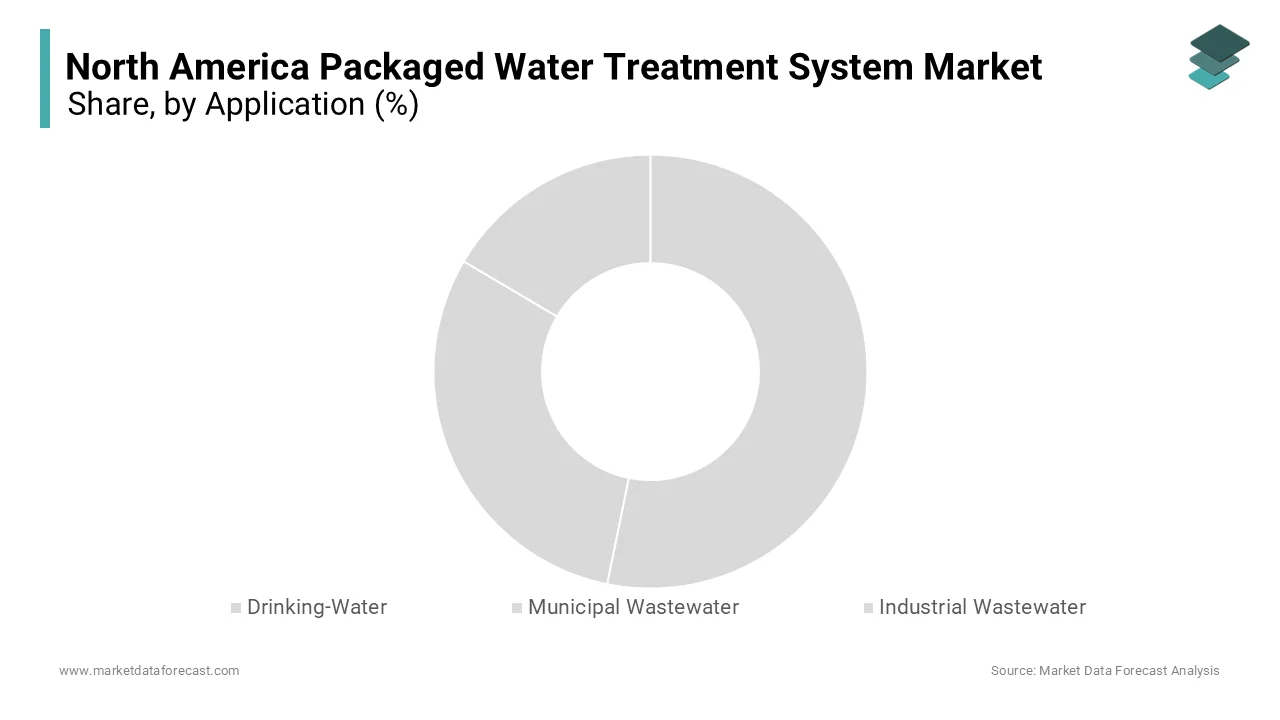
Municipal wastewater treatment constituted the biggest application segment in the North America packaged water treatment system market, representing 42.7% of total market revenue in 2025. This superiority is mainly supported by the urgent need to modernize aging sewage infrastructure, meet evolving regulatory standards, and address population growth in peri-urban areas.
According to the American Society of Civil Engineers (ASCE), the United States experiences over 240,000 water main breaks annually , contributing to significant wastewater infiltration and system inefficiencies. To mitigate these challenges, many municipalities are turning to packaged wastewater treatment systems as flexible, rapid-deployment solutions.
In Canada, the federal government’s Investing in Canada Infrastructure Program allocated CAD 18 billion from 2017 to 2027 for water and wastewater upgrades , with a growing portion directed toward modular treatment units in smaller communities. As per the Ontario Clean Water Agency, packaged systems accounted for nearly 40% of new wastewater installations in rural municipalities in 2023, reflecting strong institutional support.
Also, the U.S. Environmental Protection Agency (EPA) has prioritized decentralized wastewater solutions in its National Water Reuse Action Plan, further reinforcing the role of packaged systems in sustainable urban planning. These factors collectively sustain municipal wastewater as the leading application sector in the regional market.
Industrial wastewater treatment is witnessing the swiftest development in the North America packaged water treatment system market, rising at a CAGR of 10.2% during the forecast period. This surge is fueled by tightening environmental regulations, rising corporate sustainability goals, and the need for water reuse in resource-intensive sectors such as manufacturing, food processing, and pharmaceuticals.
According to the U.S. Department of Commerce, industrial water reuse capacity in North America grew by 18% between 2020 and 2023, with packaged treatment systems playing a pivotal role in enabling on-site recycling. In California, the State Water Resources Control Board mandated that large food processors implement water reclamation plans, prompting increased deployment of modular treatment units.
Similarly, in Canada, as per the Alberta Water Council, over 30% of new industrial water treatment installations in 2023 involved packaged reverse osmosis or membrane bioreactor systems , particularly in the oil sands and dairy processing sectors. Furthermore, the rise of environmental, social, and governance (ESG) reporting has incentivized corporations to invest in closed-loop water systems.
Industries are seeking compliance, cost efficiency, and environmental stewardship so the industrial wastewater segment is positioned for continued rapid expansion across North America.
REGIONAL ANALYSIS
United States
The United States prevailed in the North America packaged water treatment system market, contributing a 78.7% of total regional revenue in 2025. This lead position is due to extensive infrastructure modernization efforts, stringent environmental regulations, and increasing investment in decentralized water treatment solutions.
In addition, municipalities and private developers have increasingly adopted packaged treatment systems for rapid deployment and efficient operation.
Additionally, the Bipartisan Infrastructure Law allocated USD 55 billion for water infrastructure improvements, marking one of the largest federal investments in clean water initiatives. With growing emphasis on climate resilience, water reuse, and regulatory compliance, the United States continues to drive innovation and market expansion in the North American packaged water treatment sector.
 Canada
Canada is an emerging growth hub in the North America packaged water treatment system market, distinguished by its focus on rural water access, Indigenous community development, and environmental protection initiatives. While smaller than the U.S. market, Canada’s packaged water treatment sector is gaining momentum due to policy-driven investments and climate adaptation strategies.
According to Indigenous Services Canada, as of 2023, over 90 long-term drinking water advisories had been lifted in First Nations communities since 2015 , largely through the installation of packaged water treatment units equipped with advanced filtration and disinfection technologies. Also, the Government of Canada committed CAD 6 billion under the Safe Drinking Water Strategy to continue improving access in underserved regions. With continued federal support and industry-led innovations, Canada is strengthening its position as a key contributor to the North American packaged water treatment landscape.
KEY MARKET PLAYERS AND COMPETITIVE LANDSCAPE
Veolia Water Technologies (France), GE Water & Process Technologies (U.S.), RWL Water (U.S.), WesTech Engineering Inc. (U.S.), Smith & Loveless Inc. (U.S.), Napier-Reid Ltd. (Canada), CST Wastewater Solutions Inc. (Australia), WPL International (U.K.), Enviroquip (U.S.), and Corix Water Systems (Canada) are the key players in the North America packaged water treatment system market.
The North America packaged water treatment system market features a competitive landscape driven by technological innovation, regulatory pressures, and growing demand for decentralized water solutions. A mix of global industry leaders and emerging regional firms compete based on product differentiation, system efficiency, and post-installation support. While multinational corporations dominate due to their extensive experience and brand recognition, smaller firms are gaining traction by offering niche, cost-effective solutions tailored to local requirements. The market is also being shaped by increasing environmental regulations and infrastructure modernization initiatives, prompting manufacturers to develop more sustainable and adaptable treatment modules. Companies are differentiating themselves through integration of digital monitoring, energy optimization, and customizable system configurations to meet evolving municipal and industrial needs. Strategic collaborations, mergers, and localized distribution networks are becoming common tactics to expand market reach and improve customer engagement. As climate resilience and resource conservation become central concerns, competition is expected to intensify, pushing firms to continuously innovate while maintaining affordability and scalability in both urban and rural settings.
TOP PLAYERS IN THE MARKET
Xylem Inc.
Xylem is a global leader in water technology and plays a pivotal role in the North America Packaged Water Treatment System Market. The company offers a comprehensive portfolio of packaged treatment solutions tailored for municipal, industrial, and remote applications. Xylem’s expertise lies in integrating smart technologies, energy-efficient processes, and modular designs that cater to diverse water quality needs. Its strong R&D focus and commitment to sustainability have positioned it as a trusted partner in advancing decentralized water treatment systems across the continent.
Evoqua Water Technologies LLC
Evoqua is a key player known for its innovative and scalable packaged water and wastewater treatment systems designed for both public and private sector clients. The company provides end-to-end solutions ranging from small community systems to large-scale industrial applications. Evoqua's strength lies in its ability to customize treatment modules with advanced filtration, disinfection, and membrane technologies. Their extensive service network and technical support capabilities further enhance their market presence in North America.
Suez Water Technologies & Solutions (a subsidiary of SUEZ S.A.)
Suez Water Technologies & Solutions has established itself as a major contributor to the North America Packaged Water Treatment System Market through its robust, pre-engineered systems designed for efficiency and compliance. The company delivers integrated solutions that combine cutting-edge technologies with digital monitoring tools to optimize performance. With a long-standing reputation in water treatment innovation, Suez continues to drive advancements in sustainable water management practices across North America.
TOP STRATEGIES USED BY KEY PLAYERS
One major strategy employed by leading players is expanding their product portfolios through strategic acquisitions and partnerships , allowing them to offer a broader range of modular treatment solutions tailored to specific applications such as drinking water, municipal wastewater, and industrial reuse.
Another key approach is investing heavily in research and development to integrate smart technologies and IoT-enabled monitoring systems , enhancing system performance, predictive maintenance, and real-time data analytics for improved operational efficiency and customer satisfaction.
Additionally, companies are increasingly focusing on strengthening their after-sales services and technical support networks , particularly in rural and remote areas where reliable maintenance and operator training are critical for ensuring long-term system functionality and client retention across North America.
RECENT HAPPENINGS IN THE MARKET
- In February 2024, Xylem Inc. launched a new line of AI-powered control systems for packaged water treatment units, enabling real-time performance monitoring and predictive maintenance for enhanced operational efficiency.
- In July 2023, Evoqua Water Technologies expanded its manufacturing facility in Pennsylvania, aiming to increase production capacity and reduce lead times for customized packaged treatment systems serving municipal and industrial clients.
- In October 2023, Suez Water Technologies introduced a modular water recycling platform specifically designed for food processing facilities, supporting corporate sustainability goals and regulatory compliance in high-water-use industries.
- In January 2024, Pentair plc announced a partnership with a U.S. Indigenous tribal council to deploy off-grid packaged water treatment systems, improving access to safe drinking water in underserved communities.
- In May 2024, Trojan Technologies, a division of Danaher Corporation, unveiled an energy-efficient UV-based packaged disinfection unit optimized for small-town wastewater treatment, strengthening its foothold in the decentralized water solutions market.
MARKET SEGMENTATION
This research report on the North America packaged water treatment system market has been segmented and sub-segmented based on the following categories.
By Type
- Sequential Batch Reactor (SBR)
- Moving Bed Biofilm Reactor (MBBR)
- Reverse Osmosis (RO)
- Membrane Bioreactor (MBR)
- Extended Aeration.
By Application
- Drinking-Water
- Municipal Wastewater
- Industrial Wastewater
By Country
- The United States
- Canada
- Rest of North America