- Product Description Description
- Table of Contents TOC
- List of Table & Figure LOT
- Get Free Sample PDF Sample PDF
Market Size, 2025
$108.26 MnMarket Estimate, 2026
$115.63 MnMarket Forecast, 2034
$196 MnCAGR, 2026–2034
6.81%North America Radial Compression Devices Market Size, Growth, Trends & Forecast (2026–2034)
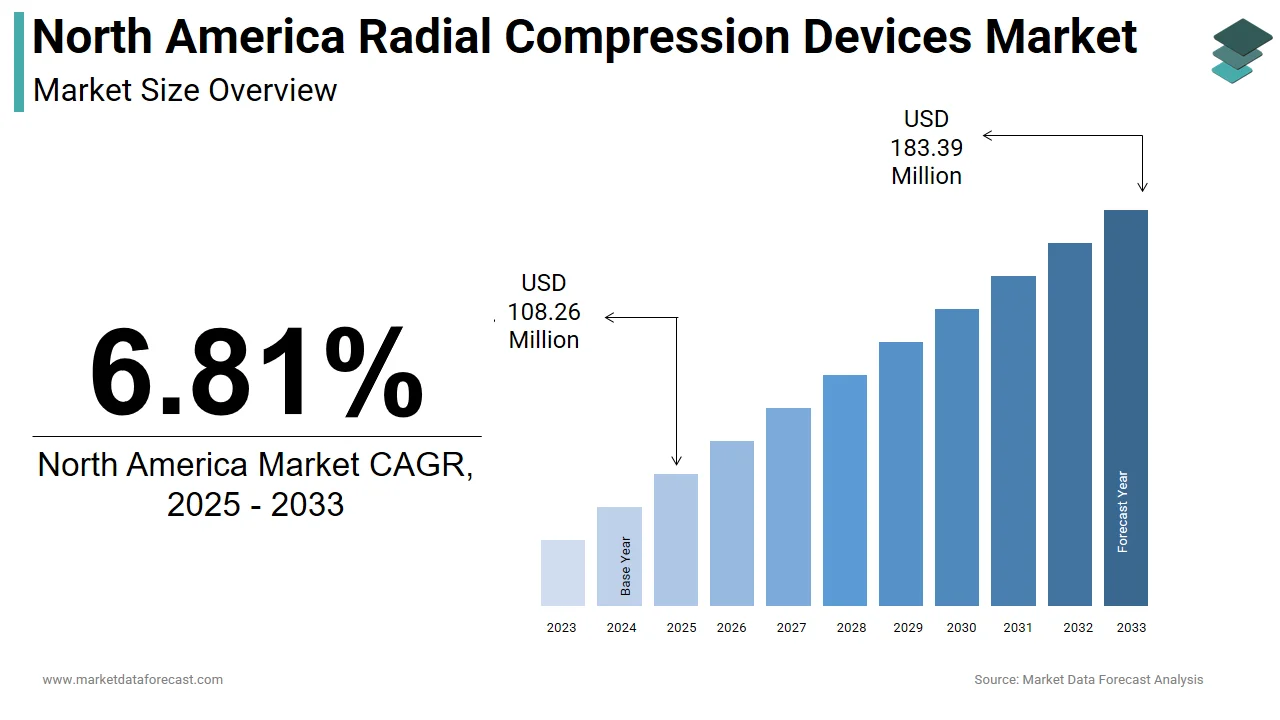
The North America radial compression devices market size was valued at USD 108.26 million in 2025, is estimated to reach USD 115.63 million in 2026, and is projected to reach USD 196 million by 2034, registering a compound annual growth rate (CAGR) of 6.81% during the forecast period. Propelled by the rising incidence of cardiovascular diseases, growing preference for minimally invasive trans-radial procedures, and the need to reduce hospital stays, the regional market continues to expand steadily.
Key Executive Metrics (At-a-Glance)
- 2025 Base Valuation: USD 108.26 Million
- 2026 Current Valuation: USD 115.63 Million
- 2034 Forecast Valuation: USD 196 Million
- Compound Annual Growth Rate (CAGR): 6.81% (2026–2034)
- Leading Country Market: United States (anchored by high volumes of percutaneous coronary interventions and a large aging demographic)
- Fastest-Growing Country Market: Canada (propelled by rising domestic manufacturing and robust regional distribution networks)
Core Market Drivers
- Rise in Cardiovascular Disorders: High prevalence of heart conditions across North America (affecting millions, such as the 92.1 million individuals reported by the American Heart Association in the U.S.) driving procedural volume.
- Patient Mobility & Reduced Costs: Shorter recovery times, lower infection risks, and minimized hospital billing associated with band-based trans-radial access compared to transfemoral methods.
Primary Market Restraints & Challenges
- Device Size Limitations: Narrow anatomical dimensions of the radial artery restrict the use of larger catheter diameters (above 2 mm to 2.5 mm), posing technical challenges for specific interventions.
- Supply Chain Vulnerabilities: Disruptions from transport bans, regulatory hurdles, and pandemic-style constraints affecting component availability.
Market Segmentation: Largest and Fastest-Growing Segments
| Segment Category | Largest Segment | Fastest-Growing Segment |
|---|---|---|
| By Product | Band / Strap Based Devices | Knob Based Devices |
| By Usage | Disposable Devices | Reusable Devices |
| By End-user | Hospitals | Ambulatory Surgery Centres & Specialized Clinics |
| By Country | United States | Canada |
Major Industry Players Profiled
Key market participants shaping the North American radial compression devices landscape include Abbott Laboratories, Terumo Corporation, Merit Medical, Inc., Comed B.V., Vascular Solution Inc., Advanced Vascular Dynamics, and Beijing Demax Medical Technology Co., Ltd.
North America Radial Compression Devices Market Size
The North America radial compression devices market was valued at USD 108.26 million in 2025. The North American market is projected to grow from USD 115.63 million in 2026 to reach USD 196 million by 2034, exhibiting a compound annual growth rate (CAGR) of 6.81% from 2026 to 2034.
MARKET DRIVERS
Reduced hospital stays due to band use saves patients money on pricey hospital bills, which is one of the market's primary drivers in North America.
The market's growth is further expected to be propelled forward by the growing older population and the increased frequency of cardiovascular illnesses. According to data from the American Heart Association on heart disease and stroke, cardiovascular diseases afflict 92.1 million persons in the United States. Because the incision site on band-based devices is smaller, the patient has more mobility, and the risk of infection is lower following surgery. As the cost of surgery falls, the market is expected to expand.
Radial compression devices assist patients in saving money on their medical bills by reducing their stay in the hospital. As a result, the use of radial bands increases, and the market grows. When opposed to transfemoral access, radial access bands allow patients to move around more quickly and have a lower risk of infection at the location. Players in the radial compression devices market should benefit from lower stent prices. Radial artery compression devices have become more popular as percutaneous coronary procedures have increased. The market for radial compression devices in North America is influenced by the rise in cardiovascular disorders due to longer life expectancy.
MARKET RESTRAINTS
Device Size Limitations and Pandemic-Induced Supply Disruptions
PCI operations can only be performed through the radial artery because it is smaller than the femoral artery. As a result, it is difficult for caregivers to use a catheter greater than 2 mm diameter. Radial access is not available when the catheter diameter is 2.5 mm. In addition, PCI procedures demand more significant, if not more, guidewire catheters, which is not possible with the radial technique. In North America, such restraints hinder the expansion of the radial compression devices market. The virus's breakout sparked a state-wide lockdown and transportation ban. A transit ban impacted the global supply chain for radial compression devices. Furthermore, the rigorous regulatory constraints imposed by Covid-19 limited the development of these devices.
REPORT COVERAGE
| REPORT METRIC | DETAILS |
| Market Size Available | 2025 to 2034 |
| Base Year | 2025 |
| Forecast Period | 2026 to 2034 |
| Segments Covered | By Product, Usage, End-user, and Region. |
| Various Analyses Covered | Global, Regional and Country-Level Analysis, Segment-Level Analysis, Drivers, Restraints, Opportunities, Challenges; PESTLE Analysis; Porter’s Five Forces Analysis, Competitive Landscape, Analyst Overview of Investment Opportunities |
| Countries Covered | United States, Canada, Mexico, Rest of North America |
| Market Leaders Profiled | Abbott Laboratories, Comed B.V., Terumo Corporation, Merit Medical, Inc., Vascular Solution Inc., Advanced Vascular Dynamics, and Beijing Demax Medical Technology co., Ltd. |
REGIONAL ANALYSIS
The radial compression devices market in North America has a wide range of growth potential, drawing new investors.
The rise in the incidence of lifestyle disorders, government attempts to build novel technology, and the need for advanced medical services contribute to the market’s growth. Furthermore, the North American area is predicted to develop at the fastest rate during the projection period, owing to increased catheterization-related operations (PCI), a desire for minimally invasive solutions, and increased vascular treatments. VCDs have become more popular due to their convenience of use and fast hemostatic qualities and increased trans-radial artery access.
The United States is predicted to showcase a healthy CAGR during the forecast period. This is attributed to an increase in the prevalence of lifestyle disorders, an aging population, and rising demand for newly released items and innovative technologies. Radial access is used for less than 2% of invasive cardiovascular procedures, according to the American College of Cardiology's National Cardiovascular Data Registry (ACC-NCDR, 2018), demonstrating that the common femoral artery remains the most prevalent arterial access location in the United States.
After the United States, Canada has the largest North American Radial Compression Devices market. The rise of big manufacturing organizations and new domestic competitors who manufacture and distribute top-of-the-line radial compression devices has benefited the Canadian Radial Compression Devices market.
KEY MARKET PLAYERS
A few major companies dominating the market by their products and services include Abbott Laboratories, Comed B.V., Terumo Corporation, Merit Medical, Inc., Vascular Solution Inc., Advanced Vascular Dynamics, and Beijing Demax Medical Technology co., Ltd.
MARKET SEGMENTATION
This research report on the North American radial compression devices market has been segmented and sub-segmented into the following categories.
By Product
- Band/ Strap Based Device
- Knob Based Device
- Plate Based
By Usage
- Disposable
- Reusable Devices
By End-user
- Hospitals
- Independent Catheterization Labs
- Ambulatory Surgery Centres
- Specialized Clinics
By Country
- The United States
- Canada
- Rest of North America