- Product Description Description
- Table of Contents TOC
- List of Table & Figure LOT
- Get Free Sample PDF Sample PDF
Market Size, 2025
$0.49 BnMarket Estimate, 2026
$0.52 BnMarket Forecast, 2034
$0.78 BnCAGR, 2026–2034
5.25%Executive Summary: North America Rodenticides Market
- Market Scope: Comprehensive North American rodenticides industry analysis covering product types, formulations, end-user categories, regional country leadership frameworks, strategic corporate developments, and competitive landscapes.
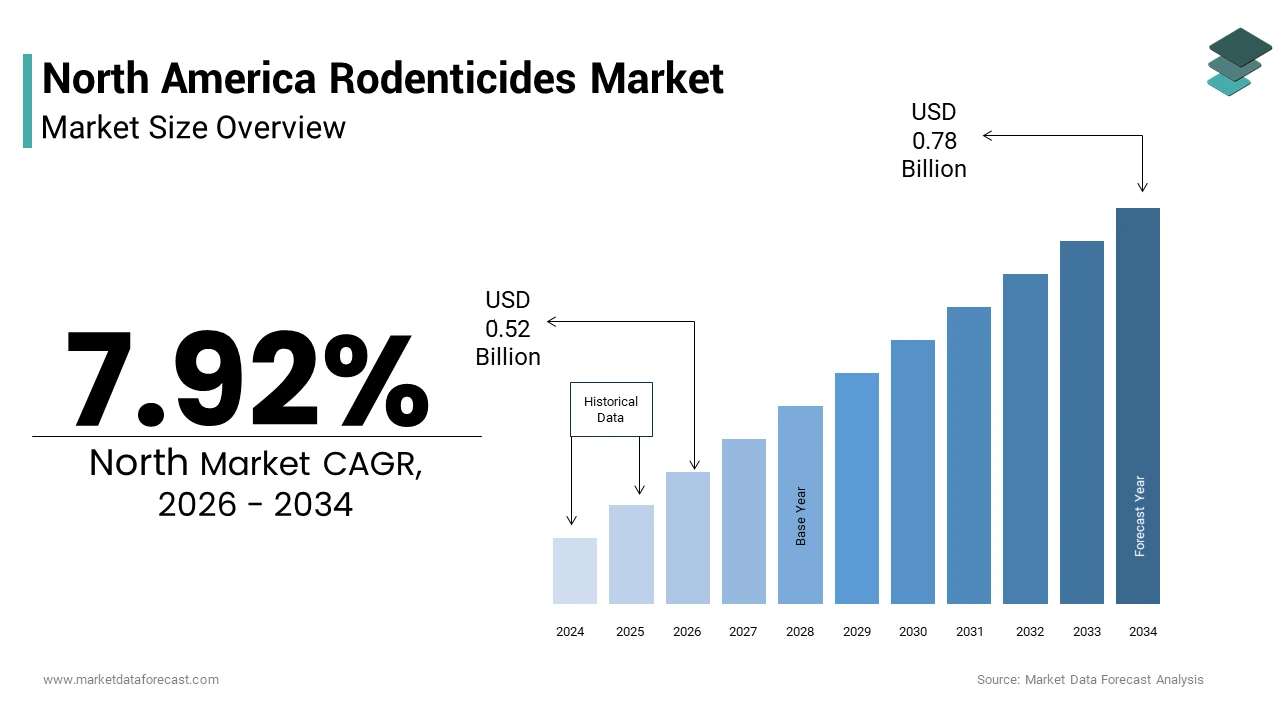
- Market Valuation: Valued at USD 0.49 billion (2025), estimated at USD 0.52 billion (2026), and projected to reach USD 0.78 billion by 2034, registering a steady CAGR of 5.25% (2026–2034).
- Primary Growth Drivers: Rising urbanization creating construction-site rodent habitats, increasing rodent-borne disease incidence (hantavirus, leptospirosis), smart pest management IoT monitoring, and public health mandates. Restraints include high raw material costs, logistics challenges, and cross-border regulatory fragmentation.
Key Market Segment Metrics (2026–2034)
| Category | Leading Segment (2025 Position) | Fastest-Growing / Alternative Segment |
|---|---|---|
| By Type | Anticoagulant rodenticides (dominated market in 2025 due to widespread efficacy) | Non-anticoagulant variants (emerging alternatives amid resistance concerns) |
| By Formulation | Pellets (constituted largest formulation segment due to deployment ease) | Biodegradable and IoT-enabled smart baiting solutions |
| By End-User | Residential end-users (represented primary consumption category) | Commercial and industrial pest control services |
| By Region / Country | United States (led regional market with a 75.4% share in 2025) | Mexico (promising growth linked to expanding agricultural exports and municipal sanitation) |
Major Market Players & Market Structure
Market Structure: Highly competitive regional pest control and chemical manufacturing ecosystem focused on overcoming anticoagulant resistance, real-time IoT trap monitoring integration, and biodegradable formulations to mitigate secondary poisoning.
Key Companies: BASF SE, Bayer AG, Syngenta AG, Rentokil Initial plc, Ecolab Inc., Bell Laboratories, Inc., JT Eaton & Co., Inc., Impex Europa S.L., PelGar International Ltd., and Vetoquinol SA.
North America Rodenticides Market Size
The North America Rodenticides market size was valued at USD 0.49 billion in 2025 and is anticipated to reach a valuation of USD 0.52 billion in 2026 and USD 0.78 billion by 2034, growing at a CAGR of 5.25% during the forecast period from 2026 to 2034
The rodenticides are widely used across residential, agricultural, industrial, and institutional settings to mitigate health hazards, food contamination, and structural damage caused by rodent infestations. As urbanization expands and climate patterns shift, rodent populations have surged in both rural and metropolitan areas, necessitating increased reliance on effective pest management solutions. According to the Centers for Disease Control and Prevention (CDC), rodents are known carriers of over 35 diseases that can be transmitted to humans through direct contact, contaminated food, or insect vectors. This has prompted heightened awareness and regulatory emphasis on hygiene and sanitation standards across the region. In recent years, the demand for second-generation anticoagulant rodenticides (SGARs) has grown significantly due to their higher efficacy compared to first-generation variants. However, concerns regarding non-target species poisoning have led to stricter usage guidelines.
MARKET DRIVERS
Rising Urbanization and Infrastructure Development
The rapid pace of urbanization and infrastructure development is propelling the growth of the North American rodenticides market. As per the United Nations Department of Economic and Social Affairs, the urban population in the United States alone accounted for approximately 82% of the total population in 2022. Moreover, construction activities have surged in response to growing urban populations. Construction sites often create temporary shelters and abundant food sources for rodents, leading to increased infestation risks. Additionally, aging infrastructure, especially in older cities like New York and Chicago, has contributed to persistent rodent problems. In 2023, the American Society of Civil Engineers gave the nation’s infrastructure a grade of C-, citing deteriorating sewer systems and outdated waste disposal mechanisms.
Increased Incidence of Rodent-Borne Diseases
The rising adoption of rodenticides with the increasing prevalence of diseases transmitted by rodents is fuelling the growth of the North American rodenticides market. According to the Centers for Disease Control and Prevention (CDC), rodent-borne illnesses such as hantavirus, leptospirosis, and lymphocytic choriomeningitis virus (LCMV) have seen a noticeable uptick in reported cases over the past decade. Rodents also act as primary carriers of ticks and fleas that transmit secondary diseases like Lyme disease and plague. The CDC reports that around 400–500 cases of plague are diagnosed each year globally, with the majority occurring in the western United States. Furthermore, outbreaks linked to rodent infestations in food processing facilities have triggered recalls and regulatory actions.
MARKET RESTRAINTS
Regulatory Restrictions and Environmental Concerns
The tightening of regulatory frameworks surrounding the use of certain active ingredients is hindering the growth of the NoAmericanrica rodenticides market. The Environmental Protection Agency (EPA) has imposed strict limitations on the sale and application of second-generation anticoagulant rodenticides (SGARs) due to their potential harm to non-target wildlife, especially birds of prey and predatory mammals. In 2020, the EPA mandated that SGARs could no longer be sold for residential use without a licensed applicator, significantly reducing consumer access. This regulatory pressure has forced manufacturers to reformulate products or develop alternative pest control methods. While this encourages innovation, it also increases research and development costs, delaying market entry for new products and limiting the variety available to consumers.
Growing Preference for Non-Chemical Pest Control Alternatives
The rising preference for non-chemical pest control alternatives among environmentally conscious consumers and businesses is expected to limit the growth of the North American rodenticides market. This trend is particularly strong in the organic farming sector, where chemical pesticides—including rodenticides are restricted under USDA Organic Certification standards. Additionally, food service chains and retailers are prioritizing sustainability certifications such as LEED and Green Restaurant Certification, which discourage the use of synthetic chemicals. Major restaurant franchises like Chipotle and Whole Foods have publicly committed to reducing chemical pesticide usage across their supply chains. This shift in industry behavior limits the adoption of conventional rodenticides and presents a considerable challenge to market expansion.
MARKET OPPORTUNITIES
Expansion of Smart Pest Management Technologies
The integration of smart pest management technologies into rodent control strategies is one of the opportunities for the growth of the Americanmerica rodenticides market. These innovations allow pest control professionals to deploy rodenticides more efficiently while minimizing environmental impact. For instance, companies like Bell Laboratories and Liphatech have introduced tamper-resistant bait stations equipped with sensors that alert technicians when bait has been consumed. Moreover, smart systems contribute to regulatory compliance by maintaining digital logs of rodenticide usage, ensuring adherence to EPA guidelines. Municipalities such as Toronto and Los Angeles have piloted smart rodent control programs to curb infestations in public spaces.
Increasing Investments in Public Health Infrastructure
The growing investment in public health infrastructure aimed at preventing zoonotic disease outbreaks is also expected to accelerate the growth of the North American rodenticides market. At the state level, funding for pest control initiatives has seen notable increases. For example, the City of Chicago launched its "Rodent Baiting Program" in 2022, investing $4 million to distribute rodenticides in high-risk neighborhoods. Public-private partnerships are also playing a role in expanding rodenticide accessibility. In 2023, the U.S. Department of Housing and Urban Development (HUD) collaborated with pest control firms to implement rodent management protocols in federally subsidized housing projects.
MARKET CHALLENGES
Resistance Development in Rodent Populations
The emergence of genetic resistance in rodent populations to commonly used anticoagulant compounds is inhibiting the growth of the North American rodenticides market. Studies conducted by the University of Reading in collaboration with the U.S. Department of Agriculture indicate that resistance to warfarin and other first-generation anticoagulants has been present in rodent populations since the early 2000s. According to a 2023 report by the USDA's National Wildlife Research Center, approximately 25% of house mouse populations in agricultural zones across the Midwest and Pacific Northwest exhibit resistance to SGARs. This phenomenon has rendered many standard rodenticide treatments ineffective, forcing pest control professionals to resort to more potent or alternative formulations, which may carry higher costs and regulatory scrutiny.
Consumer Misuse and Improper Application of Rodenticides
Improper handling and misuse of rodenticides are causing the decline of the North American rodenticides market. The American Association of Poison Control Centers recorded over 9,000 rodenticide-related exposures in children under six years old in 20,22, with the risks associated with improper storage and application. In addition, misapplication leads to inefficiencies in rodent control. A 2023 study published in Pest Management Science found that improper bait placement and dosage resulted in sublethal exposure, contributing to behavioral avoidance and reduced effectiveness. Educational gaps remain a concern, especially among small-scale farmers and independent pest controllers who may lack formal training.
REPORT COVERAGE
| REPORT METRIC | DETAILS |
| Market Size Available | 2025 to 2034 |
| Base Year | 2025 |
| Forecast Period | 2026 to 2034 |
| CAGR | 5.25% |
| Segments Covered | By Type, Mode of Application, End-User, Distribution Channel, and Region |
| Various Analyses Covered | Global, Regional & Country Level Analysis, Segment-Level Analysis, DROC, PESTLE Analysis, Porter’s Five Forces Analysis, Competitive Landscape, Analyst Overview on Investment Opportunities |
| Regions Covered | The United States, Canada, Mexico, Rest of North America |
| Market Leaders Profiled | BASF SE, Bayer Crop Science, Neogen Corp., Impex Europa S.L., J.T. Eaton & Co., Liphatech, Pelgar International, Syngenta SA, and UPL Limited. |
SEGMENTAL ANALYSIS
By Type Insights
Largest Segment - Anticoagulant
The anticoagulant-based rodenticides segment held a dominant share of the North America rodenticides market in 2024 due to their widespread adoption across both commercial and residential pest control applications, due to their high efficacy and long-standing use history. According to the National Pest Management Association (NPMA), approximately 80% of licensed pest control operators in the U.S. prefer SGARs for large-scale rodent infestations because of their ability to induce internal hemorrhaging in rodents with a single feeding dose. Another major driver is the consistent demand from urban centers where rodent populations are surging. The Centers for Disease Control and Prevention (CDC) reported that rodent-related disease outbreaks increased by 12% between 2019 and 2023 in major metropolitan areas like New York City and Chicago.
The non-anticoagulant rodenticides segment is projected to expand with a CAGR of 7.5% from 2025 to 2033, with the rising incidence of genetic resistance in rodent species to commonly used anticoagulant compounds. Research published in Pest Management Science in 2023 revealed that more than 30% of house mouse populations in the Midwest and Pacific Northwest exhibit resistance to second-generation anticoagulants. Additionally, regulatory pressures against SGARs have accelerated the shift toward safer alternatives. As per the Environmental Protection Agency (EPA), over 40% of retail rodenticide products containing SGARs were removed from consumer shelves following stricter labeling and usage guidelines introduced in 2020.
By Mode Of Application Insights
Pellets as the Largest Segment
The pellet-based rodenticides segment dominated the North American rodenticides market by capturing 55.3% of the share in 2024, with its widespread use in agricultural and industrial settings. According to the United States Department of Agriculture (USDA), rodent infestations cause an estimated $1.5 billion in annual crop losses across North America. Pellet baits are particularly effective in farmlands and storage facilities due to their stability and reduced risk of spillage compared to powders or sprays. Moreover, pellets are favored by pest control professionals for bait station deployment.
The spray-based rodenticides segment is likely to witness a CAGR of 8.2% from 2025 to 2033, with the expanding use of spray rodenticides in urban sanitation programs. Municipalities such as Toronto and Los Angeles have adopted fogging and residual spray techniques to treat public spaces, sewers, and alleyways where rodent activity is concentrated. Additionally, spray formulations are gaining traction in food processing and hospitality industries due to their ease of application in hard-to-reach areas. Furthermore, product innovations such as botanical extracts and enzyme-based sprays are attracting environmentally conscious consumers.
By End User Insights
Pest Control Companies as the Largest Segment
The pest control companies segment held 35.4% of the North America rodenticides market share in 2024, with the increasing prevalence of rodent infestations in densely populated urban centers. According to the National Pest Management Association (NPMA), pest control firms in the U.S. experienced a 14% rise in service requests related to rodent problems between 2020 and 2023. Additionally, stringent regulations governing rodenticide use favor licensed professionals who can comply with EPA guidelines. As per the Environmental Protection Agency (EPA), only certified applicators are permitted to purchase and apply certain restricted-use rodenticides, limiting access for untrained individuals. Moreover, the rise in franchise models and subscription-based pest control services has expanded market reach.
The urban centres segment is anticipated to grow with a CAGR of 7.3% in the coming years, with the escalating population density in metropolitan regions. According to the United Nations Department of Economic and Social Affairs, the urban population in North America is expected to surpass 85% by 2030. Cities like New York, Chicago, and Toronto have reported significant increases in rodent complaints in recent years. Additionally, urban renewal projects aimed at improving sanitation have spurred investment in rodent control measures.
COUNTRY LEVEL ANALYSIS
United States Rodenticides Market Analysis
The United States was the top performer of the North American rodenticides market by holding 75.4% of the share in 2024, with the persistent issue of rodent infestations in both rural and urban environments. According to the Centers for Disease Control and Prevention (CDC), rodent-related illnesses such as hantavirus and leptospirosis have seen a steady rise, prompting increased government and private-sector investment in rodent control. Additionally, the USDA estimates that rodents cause approximately $1.5 billion in annual agricultural losses through crop damage and contamination. This economic impact has led to greater adoption of rodenticides by farmers and agribusinesses, particularly in Midwestern and Western states.
Canada Rodenticides Market AnalysisThe
Canadian rodenticides market held 20.3% of the share in 2024, owing to the increasing number of rodent sightings in urban centers. Municipal authorities have responded by intensifying baiting programs and investing in eco-friendly alternatives, including non-anticoagulant formulations. Moreover, the Canadian Food Inspection Agency (CFIA) enforces strict guidelines on pesticide use, especially in food production facilities. As per CFIA data, over 30% of food recalls in 2022 were linked to rodent contamination, reinforcing the need for proactive rodent control measures.
COMPETITION LANDSCAPE
The competition in the North American rodenticides market is characterized by a mix of established multinational agrochemical companies and specialized domestic manufacturers. Market participants are continuously striving to balance regulatory compliance with product effectiveness, particularly amid growing scrutiny over the environmental and health impacts of rodenticides. While large players leverage extensive R&D capabilities and strong distribution networks to maintain dominance, niche firms focus on differentiated formulations and targeted marketing strategies to carve out market space. Innovation remains a central theme with companies emphasizing safer, more sustainable alternatives to traditional rodenticides. Additionally, customer education and training initiatives are being deployed to build trust and encourage responsible use. Strategic acquisitions and partnerships have also become common tools for expanding product portfolios and enhancing service offerings.
KEY MARKET PLAYERS
Companies such as the North American rodenticides market are
- Syngenta
- Bayer Crop Science
- BASF SE
- Bayer Crop Science
- Neogen Corp.
- Impex Europa S.L.
- J.T. Eaton & Co.
- Liphatech
- Pelgar International
- Syngenta SA
- UPL Limited.
Top Players In The Market
- One of the leading players in the North American rodenticides market is BASF SE. The company has a strong foothold in the pest control industry, offering a diverse portfolio of chemical and biological rodenticide solutions. BASF’s commitment to innovation and sustainable formulations has positioned it as a preferred supplier for both agricultural and urban pest management applications. Its global R&D network supports continuous product development that aligns with regulatory standards and environmental safety norms.
- Bell Laboratories, Inc. is a subsidiary of AMTechCo, which specializes exclusively in rodent control solutions. Known for its long-standing reputation in the U.S. market, Bell Laboratories offers a wide range of anticoagulant and non-anticoagulant rodenticides tailored for residential, commercial, and industrial use. The company’s focus on developing tamper-resistant bait stations and integrated rodent management strategies enhances its competitive edge and strengthens its market presence across North America.
- Syngenta AG is also a major contributor to the North American rodenticides market. Syngenta extends its expertise into rodent control through effective and scientifically backed formulations as a global leader in agrochemicals and crop protection. The company emphasizes responsible use practices and collaborates with regulatory bodies to ensure product safety and efficacy.
Top Strategies Used By Key Market Participants
- A major strategy employed by key players in the North American rodenticides market is product innovation and formulation diversification. Companies are increasingly investing in research to develop next-generation rodenticides that offer faster action, reduced environmental impact, and resistance management. This includes exploring alternative active ingredients and bio-based compounds that comply with evolving regulatory requirements while meeting end-user demands.
- Another key approach is strategic collaborations and partnerships. Leading firms are engaging with pest control service providers, government agencies, and agricultural cooperatives to enhance market penetration and promote responsible usage of rodenticides. These alliances help companies expand their distribution channels and gain insights into localized pest challenges by enabling them to tailor product offerings accordingly.
- The brand education and awareness campaigns play a crucial role in strengthening the market position. Companies are actively educating consumers and professionals about proper application methods, safety protocols, and environmental stewardship.
RECENT MARKET NEWS
- In January 2024, BASF SE launched a new line of non-anticoagulant rodenticides designed specifically for use in organic farming settings, which addresses the rising demand for eco-friendly pest control solutions.
- In March 2024, Bell Laboratories, Inc. introduced an updated version of its tamper-resistant bait station system, featuring enhanced durability and real-time monitoring capabilities aimed at improving safety and efficiency.
- In May 2024, Syngenta AG partnered with a leading North American pest control association to provide certified training programs focused on safe and effective rodenticide application techniques for professional exterminators.
- In July 2024, a joint initiative between AMTechCo and a biotech startup was announced, which is focusing on the development of genetically engineered rodent attractants to increase bait uptake and reduce resistance issues.
- In September 2024, EPA-certified distributor PestGuard Solutions expanded its distribution network across the Midwest by aiming to strengthen supply chain resilience and improve product accessibility for rural and agricultural users.
MARKET SEGMENTATION
This research report on the North America Rodenticides market is segmented and sub-segmented into the following categories.
By Type
- Chemical
- Anticoagulants
- Non-Anticoagulants
- Bromethalin
- Cholecalciferol (Vitamin D3)
- Zinc Phosphide
- Strychnine
- Other acute / single-dose toxicants
- Mechanical
- Snap Traps
- Glue Boards
- Live / Cage Traps
- Electronic Traps
- Multi-Catch Trapping Systems
- Others
- Biological
- Microbial-Based Rodenticides
- Plant-Based / Botanical Rodenticides
- Fertility Control Agents
- Ecological / Predator-Based Control
By Mode of Application
- Pellets
- Powders
- Sprays
- Others
By End User
- Agricultural Fields
- Urban Centres
- Warehouses
- Pest Control Companies
- Household Consumers
- Others
By Distribution Channel
- E-commerce
- DIY / Home Improvement
- Food Channel (Supermarkets & Hypermarkets)
- Garden Centers & Nurseries
- Agro Retailers
- Professional Pest Control Channel (B2B)
- Veterinary & Livestock Stores
- Others
By Country
- US
- Canada
- Mexico