- Product Description Description
- Table of Contents TOC
- List of Table & Figure LOT
- Get Free Sample PDF Sample PDF
Market Size, 2025
$416.9 MnMarket Estimate, 2026
$426.5 MnMarket Forecast, 2034
$512.1 MnCAGR, 2026–2034
2.31%Executive Summary: North America Sulfur-Coated Urea Market
- Market Scope: Comprehensive market evaluation of North America's sulfur-coated urea industry, covering product types (polymer and wax variants), end-use applications (agriculture, golf courses, professional lawn care, and turf), and country-level frameworks (United States and Canada).
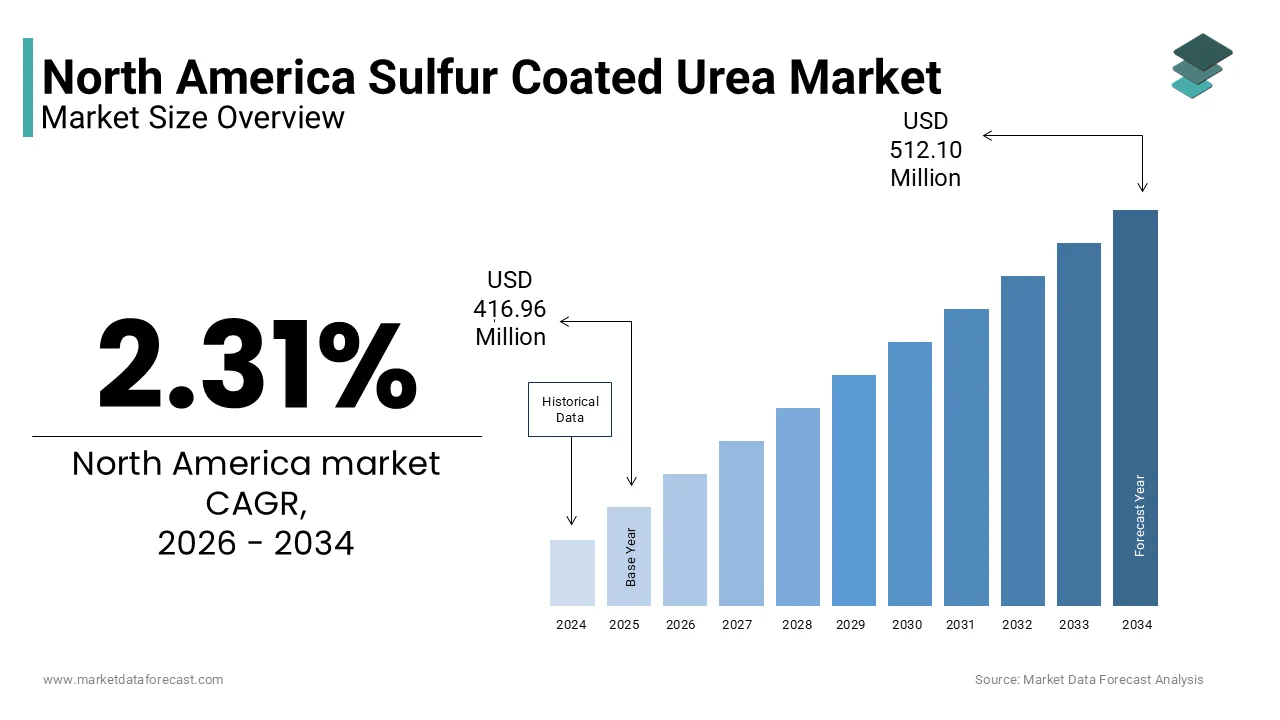
- Market Valuation: Valued at USD 416.96 million (2025), estimated at USD 426.59 million (2026), and projected to reach USD 512.10 million by 2034, registering a CAGR of 2.31% (2026–2034).
- Primary Growth Drivers: Rising demand for controlled-release fertilizers driven by sustainability and cost-minimization goals in agriculture, stringent regulations on conventional fertilizers, changing consumer preferences toward sprawling lawns, and an increasing number of golf courses and recreational turf fields.
Key Market Segment Metrics (2026–2034)
| Category | Leading Segment (2025 Position) | Fastest-Growing / Key Segment |
|---|---|---|
| By Type | Polymer-Coated Sulfur Urea (expected to dominate market share due to its superior controlled-release efficiency) | Polymer & Wax Sulfur-Coated Urea Variants (vital for balancing cost and nutrient availability) |
| By Application | Agriculture Sector (estimated to be the most prominent segment fulfilling large-scale crop nutrition needs) | Golf Courses (expected to grow at a fast pace during the forecast period driven by landscaping and turf care standards) |
| By Country | United States (dominates regional demand backed by advanced agricultural technologies and extensive turf management) | Canada (expanding steadily due to commercial farming initiatives and sustainable fertilizer adoption) |
Major Market Participants & Market Structure
Market Structure: Highly competitive landscape characterized by major global fertilizer producers, agricultural chemical corporations, and specialized turf care providers focusing on product innovation, coating durability, and environmental compliance.
Key Companies: Agrium Inc., Israel Chemicals Ltd. (ICL), Syngenta AG, Andersons Inc., Yara International ASA, Haifa Chemicals Ltd., J.R. Simplot Company, Koch Industries Inc., and Harrell’s LLC.
 Download Free Sample Report
North America Sulfur-Coated Urea Market Size
The North America sulfur coated urea market was valued at USD 416.96 million in 2025 and is estimated to reach USD 512.10 million by 2034 from USD 426.59 million in 2026, growing at a CAGR of 2.31%.
The sulfur coated urea is slow-release nitrogen product that enhance nutrient use efficiency for agricultural and turf applications. According to the United States Department of Agriculture, corn acreage in the United States reached 94 million acres in 2023 which creates substantial demand for efficient nitrogen sources that reduce leaching risks. The Environmental Protection Agency states that nitrogen runoff contributes to 60% of water quality impairments in US waterways prompting farmers to adopt controlled release technologies. These statistics illustrate the critical link between regulatory pressure and the adoption of sulfur coated urea as a sustainable alternative to conventional fertilizers. The product’s dual benefit of providing essential sulfur alongside gradual nitrogen release makes it particularly valuable for soils deficient in this secondary nutrient. Major producers focus on coating consistency and durability to ensure predictable release patterns across varying climatic conditions.
MARKET DRIVERS
Stringent Environmental Regulations and Nutrient Management
The strict environmental regulations by mandating reduced nitrogen losses in agricultural operations that is propelling the growth of the North America sulfur coated urea market. The first sentence emphasizes how legislative frameworks drive the shift toward controlled release fertilizers. According to the Environmental Protection Agency, the Total Maximum Daily Load programs have identified nitrogen as a primary pollutant in over 3000 water bodies across North America necessitating stricter farm level management practices. This regulatory landscape compels growers to adopt technologies that minimize volatilization and leaching such as sulfur coated urea which releases nutrients gradually. These mandates create a compliant market where traditional urea faces restrictions while coated variants gain preference. Farmers utilize sulfur coated urea to meet these legal requirements without sacrificing yield potential. The technology aligns with best management practices promoted by extension services which further accelerates adoption. Compliance becomes a competitive advantage for agribusinesses that can demonstrate reduced environmental footprints.
Increasing Adoption of Precision Agriculture Techniques
The rise of precision agriculture by enabling targeted nutrient application is additionally surging the growth of the North America sulfur coated urea market. The opening statement highlights how technological integration supports efficient fertilizer use. According to the study, 70% of large-scale farms in the United States utilized some form of precision agriculture technology in 2023 including variable rate application systems that optimize input usage. Sulfur coated urea complements these systems by providing a consistent release profile that matches crop uptake curves reducing waste. This synergy allows farmers to apply lower total volumes of nitrogen while maintaining or increasing yields. The data driven nature of modern farming requires reliable inputs that perform predictably under monitored conditions. Sulfur coated urea offers this reliability making it a preferred choice for tech savvy operators. Furthermore, the ability to map soil sulfur levels and adjust coatings accordingly enhances the value proposition.
MARKET RESTRAINTS
High Production Costs and Price Volatility
The elevated production costs by limiting affordability for price sensitive growers is hampering the growth of the North America sulfur coated urea market. The initial sentence underscores how economic factors hinder widespread adoption. These volatile input costs force manufacturers to raise prices which can deter farmers operating on thin margins. When conventional urea remains significantly cheaper many growers opt for the lower cost option despite potential efficiency losses. The complex coating process requires specialized equipment and energy intensive operations which add to the final retail price. Small and medium sized farms often lack the capital to invest in premium fertilizers without immediate guaranteed returns. This economic barrier restricts market penetration primarily to large commercial operations or high value crops.
Technical Limitations in Coating Durability
The technical issues related to coating integrity by causing inconsistent nutrient release that is restricting the growth of the North America sulfur coated urea market. According to the Soil Science Society of America, up to 15% of sulfur coated urea particles may experience premature rupture during handling and application leading to rapid nitrogen release rather than the intended gradual pattern. This inconsistency undermines the reliability of the product and can result in localized burning of crops or nutrient loss. The storage conditions such as high humidity can degrade the sulfur shell compromising its effectiveness before it reaches the field. Farmers who experience uneven results may revert to traditional fertilizers perceiving coated options as unreliable. The lack of standardized testing protocols across different manufacturers further complicates quality assurance for buyers. Variability in coating thickness and material quality means that performance can differ significantly between batches. This technical unpredictability creates hesitation among agronomists who prefer consistent inputs for their recommendation models.
MARKET OPPORTUNITIES
Expansion in Turf and Ornamental Horticulture
The turf and ornamental sector by demanding high aesthetic and low maintenance solutions is ascribed to level up the growth of the North America sulfur coated urea market. The first sentence illustrates how non-agricultural segments drive specialized demand. Sulfur coated urea provides the steady nitrogen supply needed for lush growth without the surge and decline cycles associated with soluble fertilizers. The commercial landscaping contracts now include sustainability clauses that favor slow release products to reduce runoff liability. This trend opens new revenue streams for manufacturers beyond traditional row crop agriculture. Homeowners and municipal parks also increasingly prefer low frequency application products that reduce labor costs and environmental impact. The premium pricing tolerance in the horticultural sector allows for higher margins compared to commodity agriculture.
Integration with Bio stimulants and Organic Amendments
Combining sulfur coated urea with bio stimulants by enhancing overall soil health is also to level up the growth of the North America sulfur coated urea market. The opening statement emphasizes how product synergies create value added offerings. Integrating sulfur coated urea with humic acids or seaweed extracts creates a holistic nutrient package that improves uptake efficiency and stress tolerance. This data supports the marketing of blended products as regenerative agriculture tools. Manufacturers can differentiate their offerings by creating proprietary blends that address specific soil deficiencies. Such innovations appeal to environmentally conscious consumers and retailers seeking sustainable solutions. The regulatory environment favors products that reduce chemical dependency while maintaining productivity. Collaborations between fertilizer producers and bio stimulant companies can accelerate product development and market entry. This strategic alignment positions sulfur coated urea as part of a broader ecological farming system.
MARKET CHALLENGES
Competition from Alternative Controlled Release Technologies
The intense competition from other slow release technologies by offering alternative efficiency solutions is a major challenge for the growth of the North America sulfur coated urea market. According to the study, polymer coated urea sales in North America increased by 8% in 2023 due to their superior control over release rates and reduced risk of dust formation. These advanced coatings offer more precise timing which appeals to precision farmers seeking maximum optimization. Sulfur coated urea faces perception issues regarding its older technology status compared to newer polymer based options. While sulfur provides a secondary nutrient benefit many growers prioritize nitrogen precision over sulfur content. The technical superiority of polymers in certain high value crops makes switching costs low for early adopters.
Supply Chain Disruptions for Raw Materials
The supply chain instability for sulfur and urea by disrupting production continuity that is additionally to decline the growth of the North America sulfur coated urea market. The opening line underscores how logistical fragility affects availability. This dependence exposes manufacturers to geopolitical risks and shipping delays that can halt production lines. Just in time inventory models leave little buffer for unexpected disruptions leading to stockouts during peak application seasons. Farmers unable to secure supply may switch to competitors or delay planting decisions affecting seasonal sales volumes. The concentration of sulfur sourcing from specific industrial processes means that any downturn in oil and gas refining impacts fertilizer availability. Diversifying supply chains is capital intensive and time consuming.
REPORT COVERAGE
| REPORT METRIC | DETAILS |
| Market Size Available | 2025 to 2034 |
| Base Year | 2025 |
| Forecast Period | 2026 to 2034 |
| CAGR | 2.31% |
| Segments Covered | By Type, Application, and Region |
| Various Analyses Covered | Regional & Country Level Analysis, Segment-Level Analysis, DROC, PESTLE Analysis, Porter’s Five Forces Analysis, Competitive Landscape, Analyst Overview on Investment Opportunities |
| Regions Covered | The United States, Canada, Mexico, and rest of North America |
| Market Leaders Profiled | Agrium Inc., Israel Chemicals Ltd., ICL Group, Syngenta AG, Andersons Inc., Yara International ASA, Haifa Group, Haifa Chemicals Ltd., J. R. Simplot Company, Koch Industries Inc., and Harrell’s LLC |
SEGMENTAL ANALYSIS
By Type Insights
The polymer coated urea segment was the largest by accounting for 33.2% of the North America Sulfur Coated Urea Market share in 2025 due to its superior precision in nutrient release and reduced environmental footprint. The enhanced control over nitrogen release rates, which aligns closely with crop uptake patterns. This efficiency translates directly into higher yields for farmers who face strict nutrient management regulations. The polymer coated products experience less than 5% physical degradation during transport and spreading whereas sulfur wax blends often suffer from higher dust and breakage rates. This reliability ensures that the intended slow-release mechanism functions as designed once applied to the field. Growers value this consistency particularly in high value crops like corn and soybeans where nutrient timing is crucial. Furthermore, polymer coatings allow for thinner layers which means more active ingredient per unit weight improving logistics efficiency. The ability to customize release profiles for specific growing seasons also appeals to agronomists designing precise fertility programs.
The wax sulfur coated urea segment is expected to grow at a fastest CAGR of 6.2% from 2026 to 2034 with the cost effectiveness of wax additives, which lower production expenses while maintaining acceptable performance levels. The economic pressure makes wax sulfur coated urea an attractive option for price sensitive growers who still desire some level of controlled release. The improved manufacturing technology that enhances the adhesion of wax to sulfur particles that is also to boost the growth of the segment. These improvements address previous concerns about uneven release and particle clumping. Additionally, wax based coatings are easier to apply using existing standard equipment without requiring specialized handling procedures.
By Application Insights
The agriculture segment was accounted in accounting for 50.1% of the North America Sulfur Coated Urea Market share in 2025 due to the vast acreage of row crops requiring efficient nitrogen management. The need to maximize yield per acre, while minimizing input costs drives the adoption of controlled release technologies in this sector. Sulfur coated urea helps farmers comply with these environmental standards without sacrificing productivity. Large scale farming operations increasingly integrate these products into their standard fertility plans to mitigate risk and ensure consistent crop performance. Government subsidies for sustainable farming practices further incentivize the switch from conventional urea.
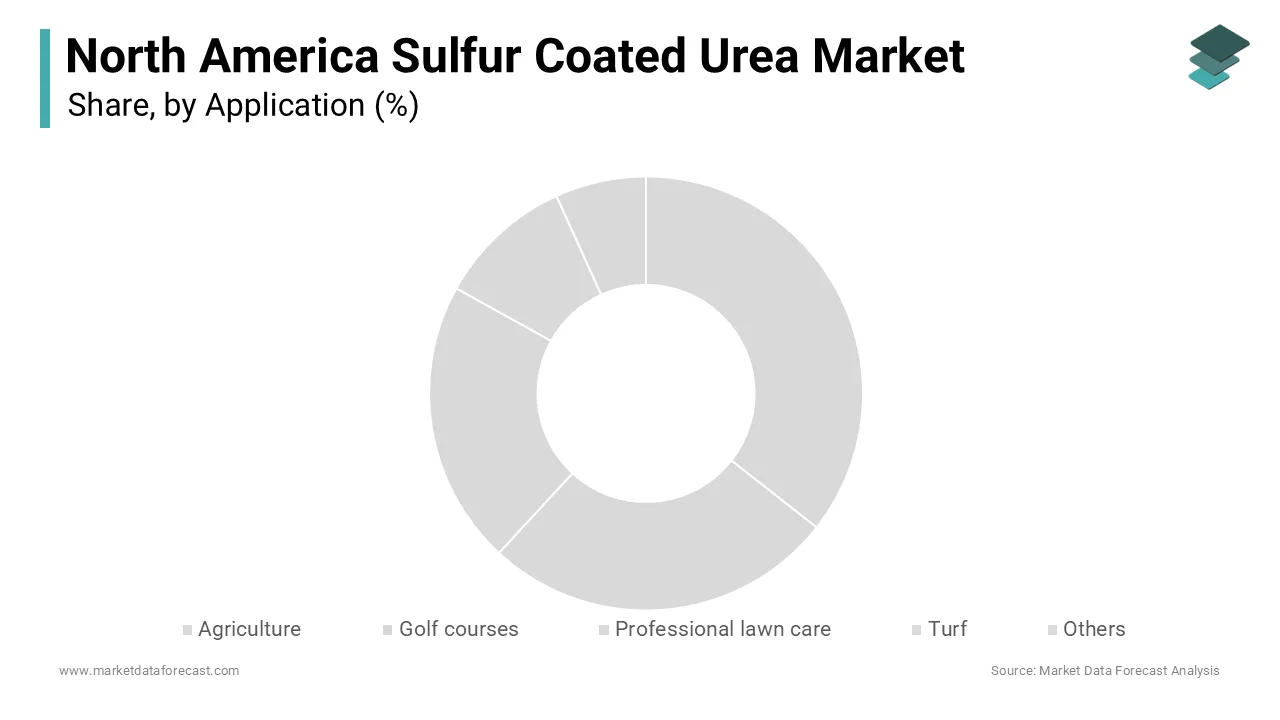
The golf courses segment is expected to grow at a CAGR of 7.8% from 2026 to 2034 owing to the increasing emphasis on aesthetic quality and environmental stewardship in turf management. Sulfur coated urea meets these criteria by providing steady nutrition that prevents burn and reduces leaching risks. The superintendents prioritize fertilizers that offer predictable release patterns to maintain playability throughout the season. Sulfur coated urea delivers this reliability by allowing for fewer applications and lower labor costs. Additionally, the sulfur component helps correct soil pH issues common in heavily managed turf systems. Premium pricing tolerance in the golf industry allows for the adoption of higher cost specialized fertilizers.
REGIONAL ANALYSIS
United States Market Analysis
The United States was the largest contributor in the North America Sulfur Coated Urea Market by holding 90.2% of the share in 2025 with its extensive agricultural base and advanced turf industry. The country serves as the primary hub for innovation and consumption of controlled release fertilizers. The presence of major fertilizer manufacturers and distributors facilitates widespread availability and competitive pricing. Large-scale corn and soybean operations in the Midwest are key consumers leveraging these products for yield optimization. The professional sports and golf sectors in urban areas also contribute significantly to demand through high maintenance turf requirements. Research institutions continuously develop new coating technologies that improve performance and reduce costs.
Canada Market Analysis
Canada sulfur coated urea market was positioned second by holding 8.2% of the share in 2025 with the strong environmental policies and expanding agricultural exports. Provincial governments actively promote best management practices that favor controlled release fertilizers to protect water resources. The increasing adoption of precision agriculture technologies among Canadian farmers is escalating the growth of the market in this country. Cold climate conditions in certain regions also benefit from slow release products that prevent early season leaching during snow melt. Trade agreements facilitate the import of raw materials and export of finished goods enhancing market liquidity.
COMPETITIVE LANDSCAPE
The competition in the North America sulfur coated urea market is characterized by a mix of established multinational corporations and specialized regional manufacturers who vie for dominance through technological superiority and service excellence. Large global players leverage their extensive research and development resources to introduce innovative coating materials that offer superior control over nutrient release. Smaller niche producers compete by offering customized solutions tailored to specific local soil conditions and crop types. Price sensitivity varies significantly between large commercial farms and smaller operations prompting companies to offer tiered product lines. Regulatory compliance serves as a key differentiator with brands that meet stringent environmental standards gaining preferential access to certain markets. Distribution networks play a crucial role as companies strive to ensure product availability during peak application seasons.
Key Market Players
Some of the key players in the North America sulfur coated urea market are
- Agrium Inc
- Israel Chemicals Ltd
- ICL Group
- Syngenta AG
- Andersons Inc
- Yara International ASA
- Haifa Group
- Haifa Chemicals Ltd
- J. R. Simplot Company
- Koch Industries Inc
- Harrell’s LLC
Top Players in the Market
- ICL Group maintains a prominent position in the North America Sulfur Coated Urea Market through its specialized fertilizer division that focuses on controlled release technologies. The company leverages its global expertise in mineral extraction to produce high quality sulfur coatings that ensure consistent nutrient delivery. Recent initiatives include the expansion of its production facilities in the United States to meet rising demand from precision agriculture sectors. ICL actively collaborates with agronomists to develop customized formulations that address specific soil deficiencies and crop requirements. The company emphasizes sustainability by promoting products that reduce nitrogen leaching and improve water quality.
- Haifa Group strengthens its North America sulfur coated urea market position by offering premium controlled release fertilizers that cater to high value crops and professional turf management. The company is renowned for its advanced polymer and sulfur coating technologies that provide precise nutrient timing. Haifa recently launched new product lines specifically designed for cold climate regions in North America to prevent early season nutrient loss. It partners with local distributors to ensure widespread availability and technical support for farmers and landscapers. The group engages in educational programs that highlight the economic and environmental benefits of slow-release nitrogen sources. Haifa also invests in digital tools that help users calculate optimal application rates based on real time data.
- Yara International contributes significantly to the North America Sulfur Coated Urea Market with its comprehensive portfolio of nitrogen-based products and agronomic services. The company focuses on innovation by integrating sulfur coated urea into its broader nutrient stewardship programs. Yara recently expanded its distribution network in Canada to serve growing agricultural markets in the Prairie provinces. It collaborates with research institutions to validate the performance of its coated products under various climatic conditions. The brand supports farmers with precision farming tools that optimize fertilizer use and minimize environmental impact. Yara also promotes sustainable practices through partnerships with environmental organizations and regulatory bodies.
Top Strategies Used by Key Market Participants
Key players in the North America sulfur coated urea market employ several strategic approaches to maintain competitiveness and drive sustainable growth. Product innovation remains a primary focus as companies develop advanced coating technologies that offer more precise nutrient release profiles and improved durability. Brands are increasingly leveraging sustainability narratives to appeal to environmentally conscious consumers and comply with strict regulatory standards. Digital transformation is another critical strategy with firms investing in precision agriculture tools that help customers optimize application rates and timing. Sustainability initiatives including reduced carbon footprints and enhanced nutrient use efficiency help build brand loyalty among large scale operators. Companies also engage in educational campaigns to demonstrate the economic benefits of controlled release fertilizers over traditional options.
MARKET SEGMENTATION
This research report on the North America sulfur coated urea market has been segmented and sub-segmented based on the following categories.
By Type
- Polymer
- Wax Sulfur-Coated Urea
By Application
- Agriculture
- Golf courses
- Professional lawn care
- Turf
- Others
By Country
- The United States
- Canada
- Rest of North America