- Product Description Description
- Table of Contents TOC
- List of Table & Figure LOT
- Get Free Sample PDF Sample PDF
Market Size, 2025
$15.64 BnMarket Estimate, 2026
$16.57 BnMarket Forecast, 2034
$26.31 BnCAGR, 2026–2034
5.95%Executive Summary: Global Natural Growth Promoters Market
- Market Scope: Comprehensive global natural growth promoters market analysis covering diverse product categories (probiotics, phytogenics, acidifiers, prebiotics, etc.), applications across livestock and aquaculture, and regional growth frameworks.
- Market Valuation: Valued at USD 15.64 billion (2025), estimated at USD 16.57 billion (2026), and projected to reach USD 26.31 billion by 2034, registering a robust CAGR of 5.95% (2026–2034).
- Primary Growth Drivers: Global regulatory pressure and bans on antibiotic growth promoters to combat antimicrobial resistance, rising consumer demand for clean-label and antibiotic-free animal products, and increasing integration of precision livestock farming. Key restraints include inconsistent efficacy data, lack of standardized evaluation protocols, and supply chain volatility for botanical ingredients.
Key Market Segment Metrics (2026–2034)
| Category | Leading Segment (2025 Position) | Fastest-Growing Segment |
|---|---|---|
| By Product | Probiotics (dominated with a 29.5% share in 2025 due to dual functionality in nutrient absorption and pathogen suppression) | Phytogenics (anticipated to witness the fastest CAGR of 18.6% driven by scientific validation of essential oils and flavonoids) |
| By Application | Poultry (captured 36.5% share in 2025 due to biological sensitivity to gut dysbiosis and widespread transition to antibiotic-free programs) | Aquaculture (projected to experience the fastest CAGR of 21.3% due to tightening antibiotic restrictions in fish and shrimp farming) |
| By Region | North America (dominated with a 31.3% share in 2025 supported by early antibiotic-free adoption and ag-biotech funding) | Asia-Pacific (lucrative region fueled by massive animal protein production scale and government antibiotic reduction initiatives) |
Major Market Players & Market Structure
Market Structure: Highly competitive global landscape featuring multinational chemical manufacturers, animal health leaders, and specialized biological formulators competing on strain-specific clinical validation, fermentation capacity, and digital nutrition tools.
Key Companies: DSM (Royal DSM N.V.), Cargill Animal Health, BASF, Alltech Inc., Yiduoli, Elanco Animal Health, Zoetis Inc., Novozymes, Kemin, and DuPont.
Global Natural Growth Promoters Market Size
The global natural growth promoters market size was valued at USD 15.64 Bn billion in 2025 and is anticipated to reach a valuation of USD 16.57 billion in 2026 and USD 26.31 billion by 2034, growing at a CAGR of 5.95%, from 2026 to 2034.
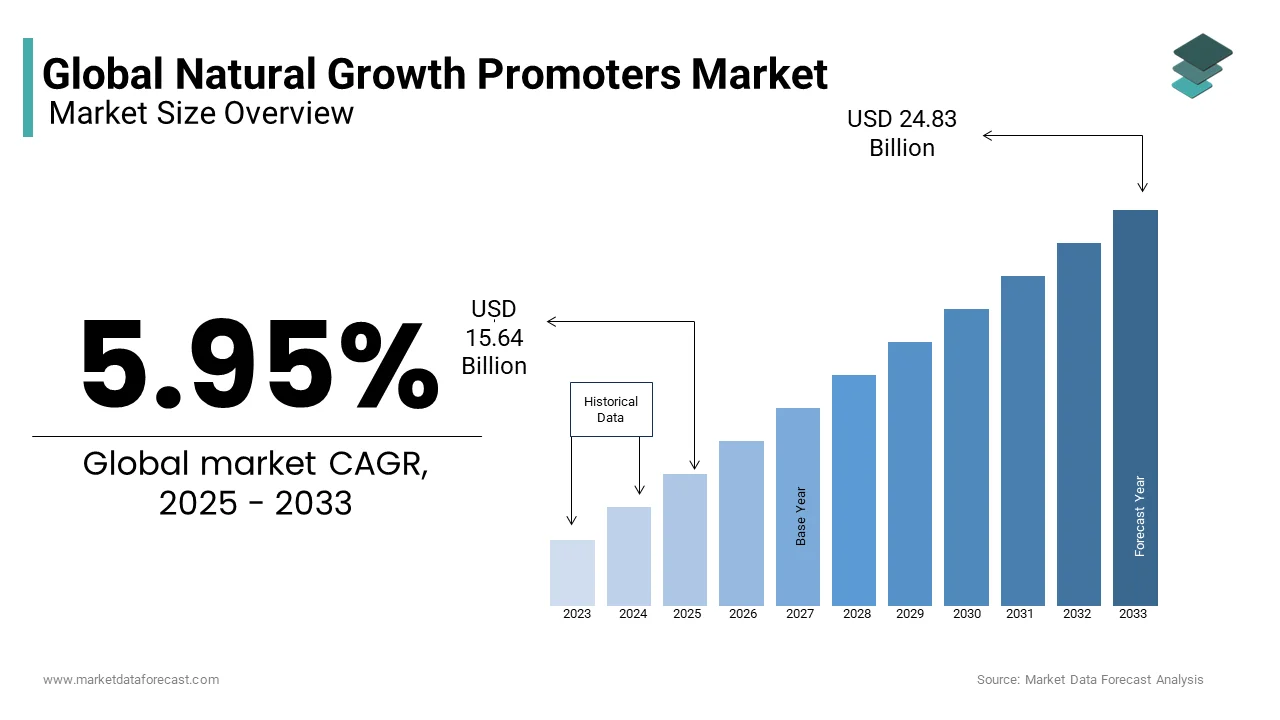
Natural growth promoters represent a class of feed additives derived from botanicals, probiotics, prebiotics, organic acids, and phytogenics designed to enhance animal health, productivity, and nutrient absorption without relying on synthetic antibiotics or hormones. A significant amount of antimicrobials sold across the world is used in the production of animals. This widespread use is intensifying concerns regarding antimicrobial resistance. Antimicrobial resistance is currently responsible for a substantial number of human deaths annually. In response, a large number of member states within Europe have completely phased out the use of antibiotic growth promoters in feed for livestock. Other major countries have also introduced strict guidelines for usage. The World Organisation for Animal Health emphasizes that natural alternatives must demonstrate measurable improvements in feed conversion ratio, immune modulation, and gut microbiota balance to gain regulatory and commercial acceptance. These substances function not merely as performance enhancers but as biological modulators that support metabolic efficiency, reduce pathogenic load, and improve stress resilience in intensive farming systems. Their adoption reflects a structural shift in global animal husbandry from chemically driven yield maximization to biologically integrated health optimization.
MARKET DRIVERS
Global Regulatory Pressure to Phase Out Antibiotic Growth Promoters
Governments and international health bodies are enforcing stringent bans and usage restrictions on medically important antibiotics in animal feed to curb the accelerating crisis of antimicrobial resistance, which accelerates the expansion of the natural growth promoters market. According to sources, Most member countries now enforce national action plans that require a decrease in dependence on preventive antibiotics for livestock, with many countries completely banning their use for promoting animal growth. The sales of medically important antibiotics for animals raised for food have decreased significantly since new regulations were implemented. A major global agricultural producer has confirmed a complete prohibition on using colistin and other last-resort antibiotics for growth promotion. A major commission's strategy dictates a substantial reduction in the overall volume of antimicrobial products sold for use in farm animals within the current decade. These regulatory imperatives are compelling feed manufacturers and integrators to reformulate diets with validated natural alternatives that meet performance benchmarks without triggering resistance mechanisms or residue violations in meat and dairy products.
Consumer Demand for Clean Label and Antibiotic-Free Animal Products
Modern consumers increasingly prioritize transparency, traceability, ty and ethical production practices when purchasing meat, dairy, and eggs, which is another major driver of the natural growth promoter market. This drives retailers and food service providers to antibiotic-free supply chains. Major retailers have publicly committed to sourcing fresh chicken and pork from antibiotic-free systems. This market pull is accelerating R and D investment in natural growth promoters that deliver consistent zootechnical outcomes while satisfying third-party certification standards such as Global Animal Partnership Certified Humane and USDA Process Verified. Natural growth promoters are moving from niche supplements to core feed formulations, as clean labeling shifts from a premium feature to an industry standard.
MARKET RESTRAINTS
Inconsistent Efficacy Data and Lack of Standardized Evaluation Protocols
Variable performance outcomes due to the absence of universally accepted testing methodologies and biological response benchmarks hinder the expansion of the natural growth promoters market. According to research, Most commercially available animal feed additives lack rigorous, replicated efficacy trials across diverse livestock species and production environments. The lack of standardized challenge models for measuring immune modulation, gut barrier integrity, or microbiome shifts makes comparative product evaluation nearly impossible for nutritionists and procurement teams. As per studies, regulatory agencies frequently reject applications for novel feed additives because the evidence provided is insufficient to consistently demonstrate how they work or the precise dosage required for effectiveness. This variability erodes buyer confidence. The absence of harmonized global protocols for in vivo validation, stability testing, and shelf-life determination threatens to fragment the market, leading to products being valued based on marketing spin rather than genuine biological merit.
Supply Chain Volatility and Sourcing Constraints for Botanical Ingredients
Reliance on plant-derived active compounds such as essential oils, saponins, and polyphenols, whose availability is subject to climatic disruptions, geopolitical instability, and seasonal yield fluctuations, impedes the growth of the natural growth promoters market. Apart from these, the absence of Good Agricultural and Collection Practice certification for wild-harvested ingredients introduces contamination risks and traceability gaps that compromise regulatory compliance. Companies investing in vertically integrated cultivation, such as controlled environment agriculture or microbial fermentation of active compounds, are gaining a competitive edge, but scaling these solutions remains capital-intensive. Mass adoption will remain challenged by persistent barriers, specifically, cost predictability and formulation consistency, until supply chains become more resilient and ingredient standardization improves.
MARKET OPPORTUNITIES
Expansion into Aquaculture and Alternative Protein Livestock Systems
The aquaculture sector offers a key growth opportunity for the natural growth promoters market. This is because global fish and shrimp production surges to meet protein demand while facing mounting antibiotic restrictions. According to sources, Global aquaculture output is substantial, with the majority of volume coming from Asia. Atlantic salmon farms have largely stopped using prophylactic antibiotics, preferring to use natural extracts like probiotic yeast and algae to improve fish survival and feeding efficiency. Phytogenic blends are increasingly used in shrimp farming regions like India and Vietnam to combat infections. Moreover, insect farming and cultured meat production are emerging as novel domains where microbial and enzymatic growth promoters can optimize biomass conversion and cell proliferation. These non-traditional livestock systems offer less regulatory friction and greater formulation flexibility, accelerating innovation cycles and commercial validation of next-generation biological enhancers.
Integration with Precision Livestock Farming and Digital Nutrition Platforms
The convergence of natural growth promoters with sensor-based monitoring and AI-driven feed formulation is opening unprecedented levels of performance personalization and outcome predictability, which is expected to drive the expansion of the natural growth promoters market. Startups deploy computer vision and rumen telemetry to detect subclinical inflammation or nutrient malabsorption, triggering automated dispensing of targeted botanical blends via smart feeders. This data-driven approach transforms natural growth promoters from static ingredients into dynamic biological interventions calibrated to metabolic state and production phase. The standard adoption of edge computing and IoT connectivity within feed mills and barns is fundamentally shifting the value away from generic solutions toward highly personalized and precision biological management.
MARKET CHALLENGES
Regulatory Fragmentation Across Export-Dependent Production Regions
Producers operating in global supply chains face mounting complexity due to divergent approval processes and permissible ingredient lists across importing jurisdictions, which challenge the expansion of the natural growth promoters market. According to research, Numerous countries maintain unique positive lists of approved natural feed additives, and there are no mutual recognition agreements among them. Regulatory disparities exist between countries regarding the approval of specific natural plant extracts as growth promoters, requiring producers to use segregated production lines for different export markets. Harmonization of maximum residue limits for botanical metabolites in animal products like meat and milk is limited across member states of international commissions, which complicates compliance for companies operating multinationally. This regulatory asymmetry forces feed manufacturers to maintain multiple formulations, increasing inventory costs and audit burdens. Market access for scientifically validated natural growth promoters will remain restricted until worldwide consistency in safety evaluation and labeling is achieved.
Scientific Validation Gap Between Lab Results and Field Performance
A disconnect persists between promising in vitro or controlled trial outcomes and inconsistent real-world efficacy under commercial farming conditions, which also constrains the growth of the natural growth promoter market. The discrepancy arises from uncontrolled variables such as stocking density, feed quality, water microbiota, stress load, and co-occurring pathogens that are absent in laboratory environments. The performance erosion undermines return on investment calculations and discourages risk-averse producers from switching from conventional additives. Bridging this gap requires long-term field validation partnerships between academia, industry, and contract research organizations using standardized outcome metrics and environmental covariates to generate commercially relevant data that withstands operational variability.
REPORT COVERAGE
| REPORT METRIC | DETAILS |
| Market Size Available | 2025 to 2034 |
| Base Year | 2025 |
| Forecast Period | 2026 to 2034 |
| CAGR | 8.5% |
| Segments Covered | By Product, Application, and Region |
| Various Analyses Covered | Global, Regional & Country Level Analysis, Segment-Level Analysis, DROC, PESTLE Analysis, Porter’s Five Forces Analysis, Competitive Landscape, Analyst Overview of Investment Opportunities |
| Regions Covered | North America, Europe, APAC, Latin America, Middle East & Africa |
| Market Leaders Profiled | Cargill Animal Health, Bayer Animal Health, Royal DSM N.V., Alltech, Inc., Yiduoli, Elanco Animal Health, Zoetis, Inc., Novozymes, Kemin, and DuPont. |
SEGMENTAL ANALYSIS
By Product Insights
The probiotics segment dominated the natural growth promoters market by accounting for a 29.5% share in 2025. The supremacy of the probiotics segment is attributed to its dual functionality in enhancing nutrient absorption and suppressing pathogenic colonization through competitive exclusion in the gastrointestinal tract. Dietary supplementation using specific Bacillus subtilis and Lactobacillus strains is a recognized strategy for enhancing feed conversion ratios in broiler production while effectively minimizing the presence of harmful pathogens like Salmonella. Commercial dairy operations increasingly incorporate probiotic yeast, such as Saccharomyces cerevisiae, into lactating cow rations to help stabilize rumen pH levels and decrease culling linked to acidosis. Consumer familiarity with probiotics in human nutrition has also accelerated acceptance in animal feed as brands leverage “gut health” messaging to justify premium pricing and meet clean label demands across retail meat and dairy categories.
The phytogenics segment is anticipated to witness the fastest CAGR of 18.6% from 2025 to 2033. The rapid expansion of the phytogenics segment is fuelled by increasing scientific validation of essential oils, flavonoids, and alkaloids in modulating inflammation, oxidative st, and digestive enzyme secretion without leaving tissue residues. Regulatory agencies, including EFSA and FDA increasingly classify standardized phytogenic extracts as Generally Recognized as Safe, enabling faster approval pathways compared to novel microbial or enzymatic additives. Their compatibility with organic certification standards further broadens market access in premium segments.
By Application Insights
The poultry segment dominated the natural growth promoters market by capturing a 36.5% share in 2025. The prominence of the poultry segment is propelled by the biological sensitivity of modern broilers and layers to gut dysbiosis h,, stress, and immune challenges, which directly impact feed efficiency, mortality, ty and egg production consistency. Intensive poultry systems are major contributors to global antimicrobial usage. Many integrators have fully transitioned to antibiotic-free programs, relying heavily on probiotics, acidifiers, and phytogenics to maintain performance. Synbiotic supplementation has been shown to improve livability and breast meat yield in fast-growing broilers under commercial conditions. Prebiotic fructooligosaccharides can reduce the incidence of necrotic enteritis, eliminating the need for certain antibiotics. Due to the large scale of global chicken meat production, sustained investment in gut health solutions will continue to anchor poultry as a primary demand driver.
The aquaculture segment is likely to experience the fastest CAGR of 21.3% from 2025 to 2033 due to intensifying regulatory restrictions on antibiotic use in fish and shrimp farming, combined with rising consumer demand for sustainably certified seafood. Atlantic salmon production in key regions now relies on probiotic yeast and beta-glucans to manage bacterial gill disease and improve feed utilization, as per studies. In major whiteleg shrimp-producing areas, farms utilizing enzyme tannin blends have improved survival rates during seasonal outbreaks of disease. The expansion of recirculating aquaculture systems in North America and Europe creates controlled environments where precise dosing and real-time microbiome monitoring enhance the efficacy and predictability of natural additives, which boosts the return on investment for aquatic species.
REGIONAL ANALYSIS
North America Market Analysis
North America dominated the global natural growth promoters market and captured a 31.3% share in 2025. The region’s dominance is driven by early adoption of antibiotic-free production, mandates strong venture funding for ag biotech innovation,n, and vertically integrated supply chains that accelerate product validation. Heavy investment in precision fermentation and synthetic biology startups such as BiomEdit and NovoNutrients is also expanding the pipeline of next-generation growth promoters derived from engineered microbes and algae tailored for specific metabolic outcomes in livestock and aquaculture species.
Europe Market Analysis
Europe was the second-largest region in the natural growth promoters market in 2025. The growth of the European market is propelled by its precautionary regulatory framework, harmonized approval processes, and consumer-driven demand for organic and welfare-certified animal products. The Nordic countries lead in aquaculture applications, with Norway’s veterinary authorities mandating probiotic supplementation in all state-supported salmon hatcheries. Europe’s emphasis on traceability, environmental impact assessment, and mode of action transparency continues to set global benchmarks for ingredient evaluation and labeling.
Asia Pacific Market Analysis
Asia Pacific is expected to be the most lucrative region in the global natural growth promoters market, and the growth is fueled by the massive scale of animal protein production, the rising middle-class protein consumption, and government-led initiatives to reduce antibiotic dependency. Japan and South Korea lead in high-tech delivery systems with microencapsulation and nanoemulsion technologies preserving bioactivity of sensitive botanicals in pelleted feeds. Fragmented distribution networks and price sensitivity remain challenges, but digital extension services and contract farming models are rapidly closing the adoption gap.
Latin America Market Analysis
Latin America expanded moderately in the global natural growth promoters market. The region is undergoing rapid transformation driven by export-oriented production, sustainabilitcertification, and multinational integrator investments. A significant portion of poultry exports to the European Union originates from farms certified as antibiotic-free, requiring strict adherence to probiotic and phytogenic protocols. Integrating natural additives has contributed to a notable reduction in mortality rates across Latin American beef cattle feedlots. Member farms within Chile's salmon industry are using yeast-derived beta-glucans and marine microalgae to replace oxytetracycline in smoltification diets. Mandatory residue testing for botanical metabolites has been introduced in Mexico, pushing formulators toward standardized extracts with validated pharmacokinetics. Rising FDI in agri biotech hubs is also accelerating local production of microbial and enzymatic additives, reducing import dependency.
Middle East And Africa Market Analysis
The Middle East and Africa are likely to expand in the global market. Though na, sc ent the region presents high strategic potential due to population growth, urban, and government initiatives to enhance food security through livestock productivity. A national program in one country has dedicated substantial funding to encourage the use of probiotics and enzymes within its dairy and poultry industries. In another country, research from a government institute indicates that local synbiotic supplements have significantly boosted egg production and improved survival rates on smallholder farms. Despite infrastructure,ure gaps c climate variability, and financing constraints, the convergence of public policy, private investment,, mobile-enabled advisory services is laying the foundation for scalable adoption across diverse agro-ecological zones.
COMPETITIVE LANDSCAPE
The gasoline fuel additives market is marked by fierce rivalry among multinational chemical manufacturers and specialty formulators competing on technical differentiation, regulatory compliance, and global supply chain agility. Competition centers on developing chemistries that simultaneously enhance octane rating and reduce engine depo, corrosion, and lower tailpipe emissions without compromising fuel stability or compatibility with modern engine designs. Major players invest heavily in proprietary catalyst technologies and collaborate with automotive OEMs to validate performance in real-world driving conditions. Regional suppliers focus on cost leadership and localized formulation adaptation, particularly in markets with evolving fuel quality mandates. Strategic acquisitions remain prevalent as firms seek to consolidate intellectual property, expand geographic reach, and absorb application expertise. Price volatility of base chemicals and feedstock availability intensifies margin pressures, forcing continuous innovation in efficiency and multifunctionality. Compliance with tightening environmental regulations, particularly in Europe and North America, further raises barriers to entry and drives consolidation among smaller players lacking R and D scale.
KEY MARKET PLAYERS
Key players in the global natural growth promoters market include
- Cargill Animal Health
- Bayer Animal Health
- BASF
- DSM
- Cargill
- Royal DSM N.V.
- Alltech, Inc.
- Yiduoli
- Elanco Animal Health
- Zoetis, Inc.
- Novozymes
- Kemin
- DuPont.
Top Players In The Market
- DSM is a global science-based company that develops advanced microbial and botanical solutions to enhance animal performance and gut health without antibiotics. In March twenty twenty four DSM launched its next-generation probiotic strain, Bacillus coagulans DSM three two zero one designed to survive pelleting temperatures and colonize the lower gut of poultry and swine. The company also expanded fermentation capacity in India to meet rising regional demand for enzyme tannin complexes. These initiatives reinforce DSM’s leadership in delivering scientifically validated natural growth promoters that align with global regulatory standards and sustainability certifications across livestock and aquaculture sectors.
- Cargill contributes significantly to the natural growth promoters market through its proprietary portfolio of phytogenic blends, microbial cultures, and organic acidifiers tailored to species-specific performance outcomes. In May twenty twenty four Cargill introduced a digital feed formulation tool that recommends optimal additive combinations based on real-time farm data and regional pathogen pressure. The company also partnered with Brazilian poultry integrators to validate a synbiotic premix that reduced mortality by twelve percent in antibiotic-free production systems. These innovations position Cargill as a strategic partner for producers transitioning to biologically driven nutrition models while maintaining cost efficiency and compliance.
- BASF strengthens the natural growth promoters ecosystem by leveraging its expertise in plant science and fermentation technology to develop standardized phytogenic extracts and probiotic yeast strains. In April twenty twenty four BASF launched its microencapsulated oregano and thyme oil complex for aquaculture applications, demonstrating aa thirty-one percent improvement in feed conversion ratio in tilapia trials. The company also initiated field validation programs across Southeast Asia to correlate specific tannin profiles with gut barrier integrity in swine. These efforts enable BASF to deliver consistent efficacy and shelf stability in challenging tropical climates while supporting producers in meeting export residue standards and organic certification requirements.
Top Strategies Used By The Key Market Participants
Key players in the natural growth promoters market prioritize investment in strain-specific clinical validation to demonstrate a consistent mode of action and performance outcomes across diverse production environments. They expand regional fermentation and extraction capacity to ensure supply chain resilience and cost competitiveness, particularly in high-growth emerging markets. Strategic partnerships with integrators and certification bodies accelerate field adoption and regulatory approval. Companies also develop digital advisory platforms that correlate farm-level data with additive efficacy, enabling precision dosing and outcome prediction. Emphasis on encapsulation and stabilization technologies preserves bioactivity during feed processing and storage. Portfolio diversification across species and application segments mitigates market volatility and captures cross-selling opportunities in adjacent biological solutions such as mycotoxin binders and vaccine adjuvants.
MARKET SEGMENTATION
This research report on the global natural growth promoters market is segmented and sub-segmented into the following categories.
By Product
- Acidifiers
- Synbiotics
- Prebiotics
- Probiotics
- Tannins
- Feed enzymes
- Phytogenic
- Immune stimulants
- Others
By Application
- Poultry
- Aquaculture
- Swine
- Ruminants
- Others
By Region
- North America
- Europe
- Asia-Pacific
- Latin America
- Middle-East & Africa