- Product Description Description
- Table of Contents TOC
- List of Table & Figure LOT
- Get Free Sample PDF Sample PDF
Market Size, 2025
$0.91 BnMarket Estimate, 2026
$1 BnMarket Forecast, 2034
$2.22 BnCAGR, 2026–2034
10.4%Global Network Probe Market Size
The size of the global network probe market was valued at USD 0.91 billion in 2025. This market is expected to grow at a CAGR of 10.4% from 2026 to 2034 and be worth USD 2.22 billion by 2034, up from USD 1 billion in 2026.
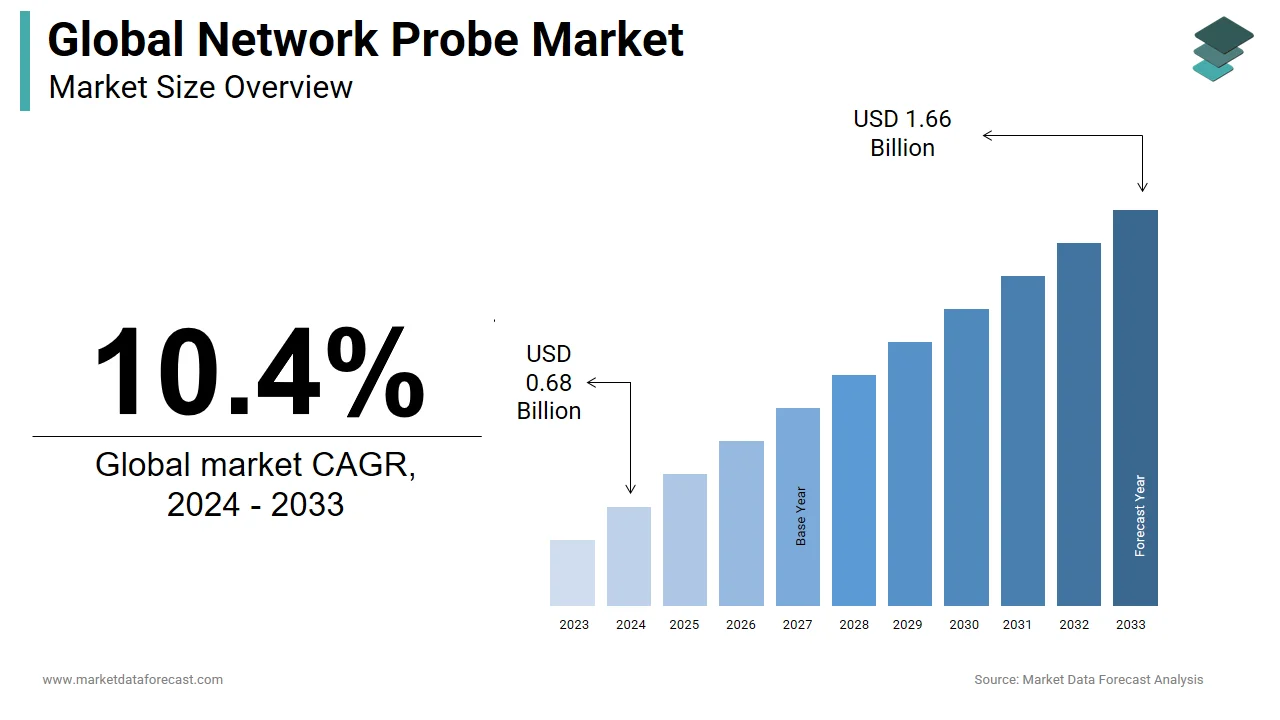
The Network Probe Market refers to the segment of IT infrastructure solutions that enable real-time monitoring, analysis, and troubleshooting of network traffic across enterprise and service provider environments. A network probe is a hardware or software-based tool that captures, filters, and analyzes data packets traversing a network, providing insights into performance, security threats, and operational inefficiencies. As digital transformation accelerates globally, enterprises are increasingly dependent on robust network visibility to ensure seamless communication, regulatory compliance, and proactive threat detection.
Also, the surge in network traffic has amplified the need for advanced monitoring tools such as network probes to maintain optimal performance and cybersecurity resilience.
Moreover, the rise in cyberattacks targeting corporate networks documented by the World Economic Forum in its Global Cybersecurity Outlook 2023 has heightened demand for real-time analytics and deep packet inspection capabilities offered by modern network probes. These tools are now integral components of next-generation security architectures, enabling organizations to detect anomalies, track unauthorized access, and optimize bandwidth utilization across distributed infrastructures.
MARKET DRIVERS
Surge in Digital Transformation Across Industries
One of the primary drivers fueling the growth of the Network Probe Market is the rapid pace of digital transformation across industries. Organizations worldwide are integrating cloud services, Internet of Things (IoT) devices, and artificial intelligence into their operations, resulting in increasingly complex network ecosystems that require continuous monitoring and optimization. This shift has significantly increased the volume and diversity of network traffic, necessitating advanced monitoring tools like network probes to ensure reliability, latency control, and performance optimization.
Moreover, Network probes provide essential visibility into these dynamic environments, allowing IT teams to identify bottlenecks, manage bandwidth allocation, and prevent service disruptions. Furthermore, government initiatives promoting smart city development and Industry 4.0 have expanded the deployment of connected systems, further reinforcing the necessity for scalable and intelligent network probing solutions.
Rising Demand for Enhanced Cybersecurity and Threat Intelligence
Another critical driver of the Network Probe Market is the growing emphasis on cybersecurity and threat intelligence. With cyber threats becoming more sophisticated and frequent, organizations are prioritizing real-time monitoring and forensic analysis to detect and mitigate breaches before they escalate.
Also, cybersecurity budgets have seen substantial increases, with Gartner reporting that global spending on information security reached USD 188 billion in 2023, up from USD 150 billion in 2021.
Network probes play a pivotal role in this landscape by capturing and analyzing network traffic at granular levels. They support deep packet inspection (DPI), anomaly detection, and protocol decoding, which are essential for identifying malicious activities such as zero-day exploits and insider threats.
Moreover, regulatory mandates such as the General Data Protection Regulation (GDPR) and the California Consumer Privacy Act (CCPA) require organizations to maintain detailed logs and demonstrate proactive threat detection. These requirements have made network probes indispensable tools for compliance and incident response planning.
MARKET RESTRAINTS
High Cost of Deployment and Maintenance
A major restraint limiting the expansion of the Network Probe Market is the high cost associated with deployment and ongoing maintenance. Enterprise-grade network probes often require significant capital investment in hardware, software licenses, and integration with existing infrastructure, making them less accessible to small and medium-sized businesses (SMBs). The disparity shows financial constraints that hinder broader market penetration.
In addition, maintaining and upgrading probe systems demands specialized technical expertise, which many organizations lack internally. These economic and operational challenges contribute to slower adoption rates, particularly in emerging markets where budget limitations and resource scarcity remain prevalent. Until pricing models become more flexible or subscription-based alternatives gain traction, cost barriers will continue to impede market growth.
Complexity in Integrating Probes with Legacy Systems
Another key constraint affecting the Network Probe Market is the complexity involved in integrating these tools with legacy network infrastructures. Many organizations still operate outdated networking equipment that lacks compatibility with modern probing technologies, leading to performance inconsistencies and incomplete data capture.
Like, as per a 2023 whitepaper published by Cisco, nearly 55% of enterprises surveyed were running at least some portion of their network on legacy hardware that was not optimized for real-time traffic analysis. This issue is especially pronounced in government agencies and industrial sectors where system upgrades are slow due to budgetary and regulatory constraints.
Furthermore, interoperability issues between different vendors’ probe systems can result in fragmented visibility and inefficient data correlation. This fragmentation not only complicates network management but also diminishes return on investment, discouraging potential buyers from fully committing to comprehensive network probing strategies.
MARKET OPPORTUNITIES
Expansion of 5G and Edge Computing Networks
An emerging opportunity driving the Network Probe Market is the widespread rollout of 5G and edge computing networks. These advancements are generating massive volumes of decentralized data traffic, increasing the need for high-performance network probes capable of capturing and analyzing traffic at the edge. The transition to ultra-fast connectivity is accompanied by an exponential rise in network complexity, requiring enhanced monitoring tools to maintain performance and security.
Moreover, edge computing deployments are shifting data processing closer to the source, reducing latency but also introducing new security and performance risks. Network probes equipped with deep packet inspection (DPI) and AI-driven analytics are uniquely positioned to support these evolving architectures, offering precise insights into application behavior, user activity, and potential vulnerabilities within distributed networks.
Adoption of Artificial Intelligence in Network Analytics
Another promising avenue for growth in the Network Probe Market is the integration of artificial intelligence (AI) into network analytics platforms. AI-powered probes can autonomously detect anomalies, predict failures, and optimize traffic flows, enhancing both efficiency and security in enterprise networks. Moreover, these capabilities make AI-integrated probes highly valuable in securing mission-critical applications and ensuring compliance with stringent data protection regulations.
With vendors like Nokia, Keysight Technologies, and VIAVI Solutions actively developing AI-enhanced probe solutions, the market is poised for substantial innovation and expansion in the coming years.
MARKET CHALLENGES
Data Privacy Concerns and Regulatory Compliance Issues
One of the most pressing challenges facing the Network Probe Market is the increasing scrutiny around data privacy and regulatory compliance. As governments worldwide enact stricter data protection laws, organizations deploying network probes must navigate complex legal frameworks governing data capture, retention, and access.
Laws such as the European Union’s GDPR and Brazil’s LGPD impose strict limitations on how network traffic can be monitored and stored, potentially limiting the scope and depth of probe-based analytics.
Furthermore, these concerns are particularly relevant in sectors like finance and healthcare, where employee and customer communications must be safeguarded.
Balancing transparency, security, and compliance remains a critical challenge for probe vendors and end-users alike, influencing product design, deployment strategies, and market acceptance.
Scalability Limitations in High-Traffic Environments
Another significant challenge impacting the Network Probe Market is the difficulty in scaling probe systems to handle high-traffic environments without compromising performance or accuracy. As enterprise networks expand to accommodate cloud-native applications, IoT devices, and real-time collaboration tools, traditional probe architectures struggle to keep pace.
According to a 2023 whitepaper by Juniper Networks, network traffic in large enterprises grew at an average rate of 28% annually over the past three years, outpacing the capacity of many legacy monitoring systems. This trend creates blind spots in traffic visibility, leaving organizations vulnerable to undetected threats and performance degradation.
Moreover, as noted by the Open Networking Foundation (ONF), conventional probe setups often experience packet loss or latency spikes when deployed in high-throughput environments, diminishing their analytical value. This limitation is particularly problematic for service providers and hyperscale data centers where uninterrupted monitoring is crucial.
To address this, vendors are exploring distributed probe architectures and virtualized monitoring solutions that offer greater flexibility and scalability. However, transitioning to these next-generation models requires additional investment and technical adaptation, posing a barrier to immediate market expansion.
REPORT COVERAGE
| REPORT METRIC | DETAILS |
| Market Size Available | 2025 to 2034 |
| Base Year | 2025 |
| Forecast Period | 2026 to 2034 |
| Segments Covered | By Component, Deployment, Enterprise Size, End-User, and Region. |
| Various Analyses Covered | Global, Regional and Country-Level Analysis, Segment-Level Analysis, Drivers, Restraints, Opportunities, Challenges; PESTLE Analysis; Porter’s Five Forces Analysis, Competitive Landscape, Analyst Overview of Investment Opportunities |
| Regions Covered
| North America, Europe, APAC, Latin America, Middle East & Africa |
| Market Leaders Profiled | Catchpoint, Accedian, Paessie AG, SolarWinds Worldwide, LLC, International Business Machines Corporation, Cisco Systems, Inc., ExtraHop Networks, Flowmon Netwoks A.S., Cubro Network Visibility, Micro Focus, Nokia Corporation, NEC Corporation, AppNeta, and others... |
SEGMENTAL ANALYSIS
By Component Insights
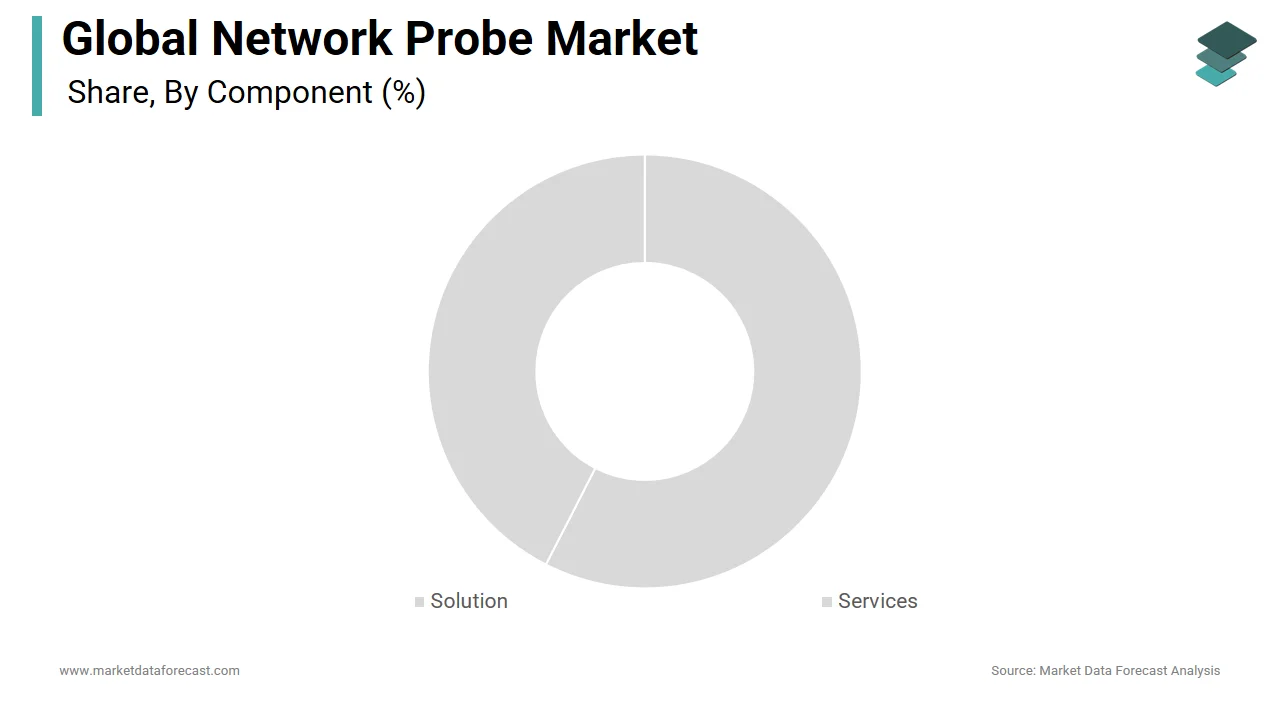
The solutions segment dominated the network probe market, capturing 68.5% of total market revenue in 2024. This dominance is primarily attributed to the increasing deployment of hardware and software-based probes as integral components of network monitoring and cybersecurity infrastructure.
According to Gartner, enterprises are prioritizing end-to-end visibility across their IT ecosystems, leading to a surge in demand for real-time analytics tools such as network probes. Also, as per the World Economic Forum via its Global Cybersecurity Outlook 2023 indicated that organizations investing in proactive threat detection have significantly higher adoption rates of probe solutions capable of deep packet inspection (DPI) and protocol analysis.
Moreover, service providers and large enterprises are increasingly deploying high-performance network probes at critical junctions such as data centers and telecom gateways to ensure compliance with regulatory mandates like GDPR and HIPAA. This growing reliance on advanced probing technologies to secure digital assets and optimize network performance reinforces the preeminence of the Solutions segment in the market.
The Services segment is projected to grow at the fastest CAGR of 9.4% during the forecast period. This rapid expansion is driven by the increasing complexity of network infrastructures and the need for continuous support in probe deployment, integration, and optimization.
In addition, vendors like Keysight Technologies and VIAVI Solutions have expanded their professional services portfolios to include AI-driven diagnostics and predictive analytics support, further accelerating market growth in this segment.
By Deployment Insights
On-premises deployment remained the prominent segment in the Network Probe Market, accounting for 59.3% of total market share in 2024. This dominance is largely due to the preference of enterprises and government agencies for localized control over network monitoring tools to ensure data sovereignty and regulatory compliance.
In addition, large enterprises operating mission-critical infrastructure such as banking networks and industrial control systems favor on-premises deployments for low-latency monitoring and immediate threat mitigation. These factors collectively reinforce the continued dominance of on-premises deployment in the network probe landscape.
Cloud deployment is emerging as the fastest-growing segment in the Network Probe Market, projected to expand at a CAGR of 11.2%. This growth is fueled by the widespread adoption of hybrid cloud environments and Software-as-a-Service (SaaS) applications, necessitating remote monitoring capabilities beyond traditional network boundaries. This shift has increased the demand for virtualized network probes that can be deployed across distributed cloud environments to provide consistent visibility and security enforcement.
Moreover, leading vendors such as Nokia and Juniper Networks have introduced cloud-native probe solutions that integrate seamlessly with Kubernetes-based microservices and containerized workloads. These innovations are driving rapid adoption among tech-forward organizations seeking scalable and flexible monitoring alternatives to traditional on-premise setups.
By Enterprise Size Insights
Large enterprises led the Network Probe Market, contributing a substantial share of total market value in 2024. This dominance is credited to their extensive IT infrastructure, complex network demands, and heightened exposure to cyber threats, necessitating robust monitoring and analytics capabilities.
According to Gartner’s 2023 CIO Agenda, 63% of large corporations have implemented or plan to implement network probes as part of their zero-trust security strategies. The report highlights that multinational firms, especially in BFSI and telecommunications, invest heavily in real-time traffic monitoring to prevent breaches and ensure regulatory compliance.
Furthermore, large-scale cloud migrations and digital transformation initiatives have intensified the need for high-capacity probes capable of handling vast volumes of encrypted and unencrypted traffic. These trends position large enterprises as the primary drivers of the network probe industry.
Small and medium-sized enterprises (SMEs) represent the quickly growing segment in the Network Probe Market, expanding at a CAGR of 10.6%. This rising is primarily driven by increasing awareness of cybersecurity risks and the availability of cost-effective, cloud-based probe solutions tailored to smaller budgets. Many of these businesses lack dedicated IT departments, making outsourced probe services and plug-and-play solutions particularly attractive.
In addition, government-backed cybersecurity programs in countries like Germany, South Korea, and Canada have provided subsidies and training to encourage SME adoption of network probes. Vendors such as NetScout and Plixer have launched simplified probe packages specifically designed for SMEs, enabling them to monitor bandwidth usage, detect anomalies, and comply with basic data protection standards without significant capital investment.
By End-User Insights
Service providers commanded the Network Probe Market, capturing 54.2% of total market share in 2024. This is driven by the critical role network probes play in ensuring seamless connectivity, managing traffic congestion, and detecting security threats in telecom and internet service provider (ISP) networks.
According to the GSMA, mobile data traffic grew by 30% year-over-year in 2023, driven by 5G expansion and increasing reliance on streaming services. To maintain quality of service (QoS) and minimize latency, service providers deploy high-performance probes at core and edge network points for real-time traffic analysis. Also, these enable granular insights into application-specific traffic patterns, supporting better resource allocation and customer experience management.
With the rise of IoT and edge computing, service providers are investing heavily in scalable probe architectures to handle exponential data growth, reinforcing their status as the largest consumer group in the network probe ecosystem.
Among enterprise verticals, the Banking, Financial Services, and Insurance (BFSI) sector is experiencing the boom in network probe adoption, registering a CAGR of 12.1%. This rapid expansion is fueled by stringent regulatory requirements, increasing cyber threats targeting financial institutions, and the need for real-time fraud detection.
According to the Basel Committee on Banking Supervision (BCBS), banks must adhere to strict risk management frameworks such as BCBS 239, which mandates comprehensive visibility into IT operations and data flows. As a result, financial institutions are deploying advanced network probes to meet audit standards and ensure secure transactions.
As per the World Economic Forum’s Global Cybersecurity Outlook 2023, financial institutions faced a 107% increase in ransomware attacks compared to the previous year, prompting greater investments in network visibility tools. In response, major banks such as HSBC and Santander have integrated deep packet inspection (DPI)-enabled probes to enhance threat intelligence and forensic capabilities.
With digitization accelerating across lending, payments, and asset management, the BFSI sector continues to drive innovation and demand in the network probe space.
REGIONAL ANALYSIS
North America Network Probe Market Insights
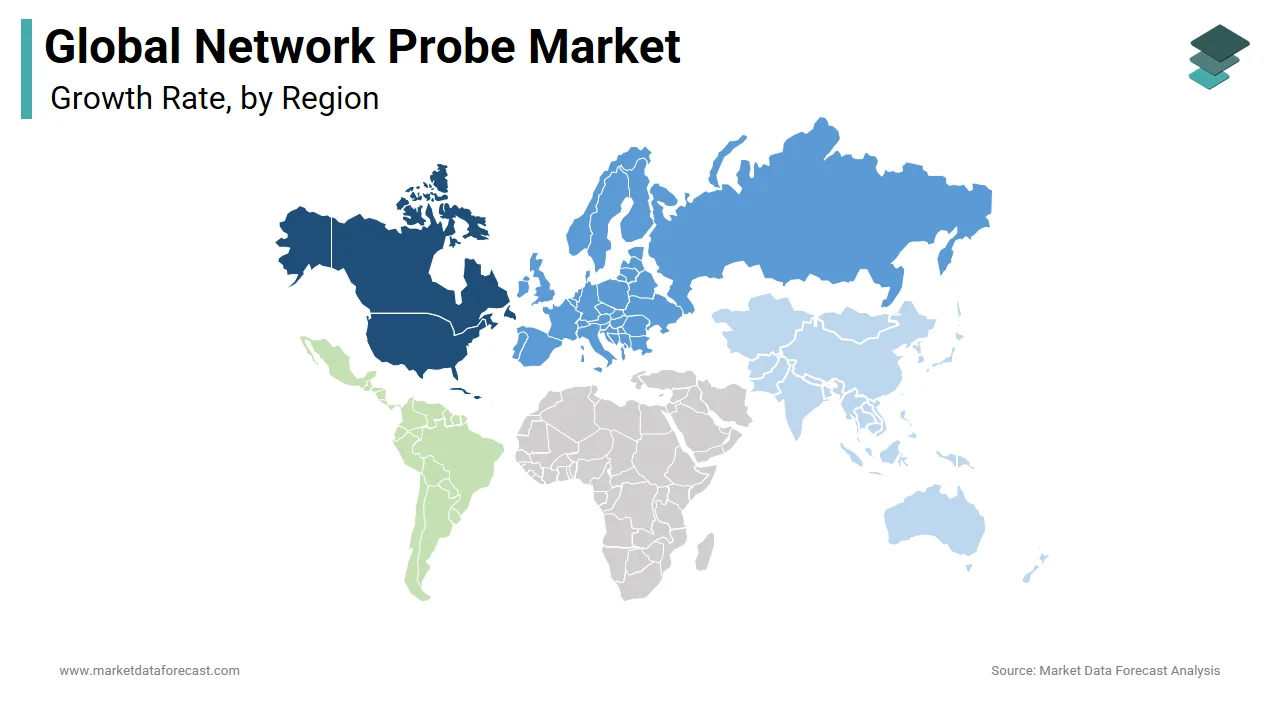
North America commanded the Network Probe Market, accounting for 38.4% of total demand in 2023. The region's position is underpinned by its advanced digital infrastructure, widespread adoption of cloud computing, and aggressive cybersecurity investments.
Moreover, Canada and Mexico are also witnessing increased probe adoption, particularly in financial services and telecom sectors. With ongoing 5G rollouts and edge computing expansion, North America remains at the forefront of technological innovation and market growth in the network probe domain.
Europe Network Probe Market Insights
Europe commands a significant share of the Network Probe Market, driven by stringent data protection regulations and a mature enterprise IT landscape. The region’s emphasis on compliance with laws such as the General Data Protection Regulation (GDPR) has spurred demand for network probes capable of detailed traffic logging and forensic analysis.
As reported by ENISA (European Union Agency for Cybersecurity), cyberattacks targeting EU institutions increased by 45% in 2023, prompting governments and private firms to enhance their monitoring capabilities. Also, the European Telecommunications Standards Institute (ETSI) has mandated network visibility requirements for telecom operators, further boosting probe adoption across mobile and fixed-line networks.
With growing investments in smart cities and Industry 4.0, Europe continues to expand its footprint in the network probe market, leveraging regulatory frameworks to drive sustainable growth.
Asia-Pacific Network Probe Market Insights
Asia-Pacific is seeing rapid expansion in the Network Probe Market, propelled by quick digital transformation, expanding telecom infrastructure, and increasing cyber threats. Countries like China, India, Japan, and South Korea are leading the charge in probe adoption, particularly in 5G and cloud-native environments.
India’s Digital India initiative has also contributed to increased probe installations in both public and private sectors. With growing government support and rising cybersecurity concerns, Asia-Pacific is emerging as a key growth engine in the global network probe landscape.
Latin America Network Probe Market Insights
Latin America is expected to rise in Network Probe Market, representing a rapidly evolving landscape with increasing investments in digital infrastructure and cybersecurity. Brazil leads the region in probe adoption, followed by Mexico and Colombia, where financial institutions and telecom providers are actively deploying monitoring tools.
Brazil’s National Cybersecurity Strategy (E-Ciber) mandates the use of real-time monitoring solutions, including network probes, across critical infrastructure sectors.
Additionally, as per the Inter-American Development Bank (IDB), regional spending on digital transformation reached USD 18 billion in 2023, with a focus on secure and resilient network architectures. Despite challenges related to economic volatility and limited technical expertise, Latin America is gradually expanding its footprint in the network probe market, supported by foreign partnerships and local vendor development.
Middle East and Africa Network Probe Market Insights
Middle East and Africa collectively hold a descent share of the global Network Probe Market, driven by strategic investments in smart city development, national cybersecurity initiatives, and digital banking infrastructure.
The Gulf Cooperation Council (GCC) nations, particularly Saudi Arabia and the UAE, are spearheading probe adoption through Vision 2030 and Centennial 70 initiatives aimed at transforming urban and digital landscapes. According to the Dubai Electronic Security Center (DESC), the UAE government deployed over 1,500 network probes in 2023 to enhance situational awareness and threat detection.
South Africa, Nigeria, and Kenya are also witnessing rising demand for network probes in financial and telecom sectors. While still in early stages compared to other regions, the MEA market is steadily gaining traction, supported by growing awareness and strategic policy interventions.
KEY PLAYERS IN THE MARKET
The major players in the global network probe market include Catchpoint, Accedian, Paessie AG, SolarWinds Worldwide, LLC, International Business Machines Corporation, Cisco Systems, Inc., ExtraHop Networks, Flowmon Networks A.S., Cubro Network Visibility, Micro Focus, Nokia Corporation, NEC Corporation, and AppNeta, and others.
RECENT MARKET DEVELOPMENTS
- In February 2023, Keysight Technologies launched an AI-powered network probe suite designed to enhance threat detection and predictive analytics for enterprise networks. This initiative aimed at improving real-time visibility and reducing manual intervention in identifying security vulnerabilities across distributed infrastructures.
- In July 2023, VIAVI Solutions expanded its global partner ecosystem by entering into a collaboration with a leading cloud service provider to integrate its probe solutions into hyperscale data centers. This move was intended to offer enhanced monitoring capabilities for multi-cloud environments and strengthen VIAVI’s presence in the enterprise segment.
- In November 2023, Nokia introduced a new line of virtualized network probes tailored for 5G core networks. These probes were designed to support service providers in maintaining performance visibility while transitioning to cloud-native and software-defined network architectures.
- In March 2024, Keysight Technologies acquired a specialized analytics startup focused on encrypted traffic analysis, aiming to enhance its probe systems' ability to inspect secure communications without compromising privacy or performance.
- In August 2024, VIAVI Solutions rolled out a regional expansion program targeting Asia-Pacific markets, partnering with local distributors to offer customized probe solutions for telecom operators and government agencies seeking improved network transparency and regulatory compliance.
MARKET SEGMENTATION
This research report on the global network probe market has been segmented and sub-segmented based on the component, deployment, enterprise size, end-user, and region.
By Component
- Solution
- Services
By Deployment
- Cloud
- On-premise
By Enterprise Size
- Large Enterprises
- SMEs
By End-User
- Service Providers
- Enterprises
By Region
- North America
- Europe
- Asia-Pacific
- Latin America
- Middle East and Africa