- Product Description Description
- Table of Contents TOC
- List of Table & Figure LOT
- Get Free Sample PDF Sample PDF
Market Size, 2025
$48.74 BnMarket Estimate, 2026
$52.35 BnMarket Forecast, 2034
$92.75 BnCAGR, 2026–2034
7.41%Global Nickel Market Summary
The global nickel market was valued at USD 48.74 billion in 2025, is estimated to reach USD 52.35 billion in 2026, and is projected to grow to USD 92.75 billion by 2034, expanding at a CAGR of 7.41% from 2026 to 2034. The growth of the global nickel market is driven by the increasing demand for stainless steel, rising adoption of nickel in electric vehicle (EV) batteries, and expanding applications in alloys, plating, and electronics. Ongoing investments in sustainable mining and recycling technologies are also contributing to long-term market growth.
Key Market Trends
- Rising demand for nickel-rich cathode batteries in the electric vehicle industry.
- Continued dominance of stainless steel production as the largest nickel consumer.
- Increasing focus on nickel recycling to ensure supply security and sustainability.
- Growth in nickel alloys for aerospace, marine, and industrial applications.
- Expanding mining and refining projects in the Asia-Pacific to meet global demand.
Segmental Insights
- By application, the stainless steel segment dominated the global nickel market in 2025, reflecting nickel’s essential role in corrosion resistance, durability, and industrial applications.
Regional Insights
- Asia-Pacific was the top-performing region, accounting for 63.1% of the global nickel market share in 2025, supported by strong stainless steel production in China and India and increasing EV battery manufacturing.
- Europe is witnessing steady demand growth, particularly from EV production and green energy projects.
- North America shows robust growth in aerospace, defense, and EV-related applications.
- Latin America and the Middle East & Africa are gradually expanding, supported by mining activities and industrial applications.
Competitive Landscape
Key players in the global nickel market include Anglo American plc, BHP, Eramet, Norilsk Nickel, Sumitomo Metal Mining Co., Ltd., Glencore, Sherritt International Corporation, Vale, Jinchuan Group International Resources Co. Ltd., and Terrafame Ltd. These companies are focusing on expanding nickel production, investing in sustainable mining practices, and strengthening their supply chains for EV and industrial markets.
Global Nickel Market Size
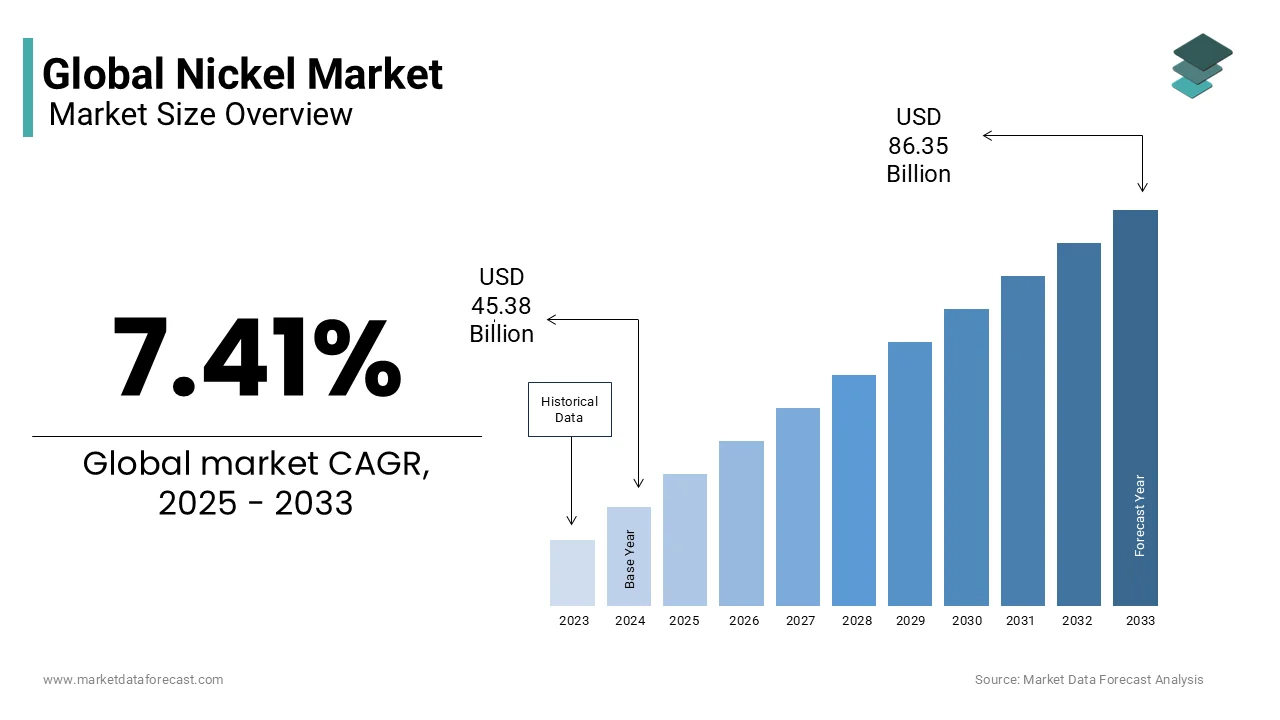
The global nickel market size was valued at USD 48.74 billion in 2025 and is expected to reach USD 92.75 billion by 2034 from USD 52.35 billion in 2026. The market is projected to grow at a CAGR of 7.41%.
Nickel is a silvery-white transition metal renowned for its corrosion resistance, thermal stability, and important role in alloy and electrochemical applications. Nickel is fundamentally embedded in modern industrial and technological systems, particularly in stainless steel production, where it enhances durability and oxidation resistance, and in rechargeable battery chemistries essential for electric mobility. The metal exists in two primary ore forms: sulfide deposits, which yield high-purity nickel suitable for batteries, and laterite deposits, which dominate global reserves but require more energy-intensive processing. According to the U.S. Geological Survey, over 3 million metric tons of nickel were mined globally in 2023, with Indonesia, the Philippines, and Russia leading production. Nickel’s indispensability in infrastructure resilience and clean technology positions it as a cornerstone of 21st-century industrial policy.
MARKET DRIVERS
Accelerated Expansion of Electric Vehicle Production
The global surge in electric vehicle (EV) manufacturing drives the growth of nickel market. The demand is particularly for high-purity Class 1 nickel used in nickel-manganese-cobalt (NMC) and nickel-cobalt-aluminum (NCA) battery cathodes. Automakers are increasingly adopting high-nickel battery formulations to extend driving range and reduce charging times. According to the International Energy Agency's (IEA) Global EV Outlook 2025, nearly 14 million electric cars were sold in 2023, which was an increase of nearly 35% from 2022. Each long-range EV battery contains up to notable kg of nickel which makes it one of the most material-intensive components after lithium. This structural shift in transportation is transforming nickel from an industrial metal into a strategic energy commodity.
Global Infrastructure Development And Stainless Steel Demand
Rising global infrastructure development and stainless steel demand propels the growth of nickel market. It remains indispensable in the production of stainless steel, which consumes a portion of global nickel usage, according to the study. The metal imparts corrosion resistance, toughness, and high-temperature stability which makes it essential for construction, industrial machinery, and urban infrastructure. According to the World Stainless Association (formerly the International Stainless Steel Forum), global stainless steel melt shop production in 2023 was 58.4 million metric ton. China alone accounts for a portion of global stainless steel output, with its Belt and Road Initiative stimulating demand for materials in transportation networks, water treatment systems, and power plants. Apart from these, the shift toward green buildings and sustainable architecture is increasing the use of stainless steel in facades, roofing, and plumbing which further drives nickel’s role in long-term industrial development.
MARKET RESTRAINTS
Environmental and Social Impacts of Laterite Nickel Mining
Severe environmental and social impact of nickel mining restricts the growth of nickel market. The extraction of nickel from laterite ores, which constitute a portion of global reserves. This poses severe environmental and social challenges, particularly in tropical regions like Indonesia and the Philippines. Open-pit mining and high-pressure acid leach (HPAL) processing generate significant deforestation, soil erosion, and toxic tailings. According to the study, nickel mining in Sulawesi, Indonesia, has led to the degradation of hectares of rainforest since 2010, threatening biodiversity and indigenous livelihoods. Acid mine drainage from HPAL facilities can contaminate waterways with heavy metals, as per the study. Communities near mining zones have reported increased respiratory illnesses and water pollution, prompting protests and regulatory scrutiny. These ecological and reputational risks are deterring investment and complicating supply chain sustainability certifications.
Geopolitical Concentration and Export Policy Volatility
The nickel supply chain is heavily concentrated in a few nations, creating systemic vulnerabilities, which hinders the growth of nickel market. Indonesia alone produced a portion of the world’s nickel, according to the research. This dominance gives the country significant leverage over global pricing and availability. In 2020, Indonesia banned raw nickel ore exports to promote domestic smelting, triggering a pNickel spike in 2022, as per the London Metal Exchange. Such policy shifts disrupt global procurement strategies and inflate costs for battery and steel manufacturers. The Philippines, another major producer, has periodically suspended mining operations due to environmental concerns which affects supply continuity. According to the study, a portion of global nickel production originates from countries with medium to high governance risks, increasing exposure to regulatory instability and trade barriers. This concentration weakens supply security, particularly for nations pursuing energy independence, and incentivizes costly diversification efforts in sourcing and recycling.
MARKET OPPORTUNITIES
Growth of Nickel Recycling from Spent Lithium-Ion Batteries
The proliferation of end-of-life electric vehicle and consumer electronics batteries is setting up a new opportunity for the growth of nickel market. Recycling can recover a portion of nickel content from spent lithium-ion batteries which reduces reliance on primary mining and lowering carbon emissions. According to the study, urban mining could supply a portion of global nickel demand by 2040 if recycling infrastructure is scaled effectively. Companies have developed hydrometallurgical processes to extract high-purity nickel with lower CO₂ emissions than primary production, as per the study. The circular economy for nickel is poised to become an important pillar of sustainable supply because millions of tons of lithium is expected to reach end of life by 2030, as per study.
Development of Low-Carbon Nickel Production Technologies
Innovations in refining and smelting are creating pathways for low-carbon nickel, aligning with net-zero goals of automakers and battery producers, is liekly to promote new opportunities for the nickel market. Traditional nickel processing, especially from laterite ores, is energy-intensive and emits a portion of CO₂ per ton of nickel. However, new technologies such as electrified rotary kilns and hydrogen-assisted reduction are reducing emissions intensity. According to the study, pilot projects have demonstrated a reduction in carbon footprint using renewable-powered electric furnaces. As per Tesla’s Impact Report, the company prioritizes nickel suppliers with verified low-carbon footprints to meet its goal of a reduction in battery production emissions by 2030. These advancements are redefining competitiveness in the nickel market, where sustainability is becoming a key differentiator.
MARKET CHALLENGES
Technological and Economic Barriers in Processing Low-Grade Ores
Complex and costly processing is challenging the growth of nickel market. A growing portion of accessible nickel reserves consists of low-grade laterite ores, which are more complex and costly to process than sulfide deposits. Laterites require high-temperature or high-pressure chemical treatments such as smelting or acid leaching, both of which demand substantial capital and energy inputs. This energy intensity increases production costs and carbon emissions, making projects economically vulnerable to nickel pNickel fluctuations. Apart from these, the use of sulfuric acid in leaching poses environmental risks and requires advanced containment systems. The sulfide reserves depleting and exploration yields are declining. The industry must overcome these technical and financial hurdles to maintain supply which requires significant R&D investment and policy support.
Supply Chain Traceability and Ethical Sourcing Burdens
Scrutiny over supply chain transparency and ethical sourcing has intensified, which degrades the growth of nickel market. Automakers and battery producers face increasing push from regulators, investors, and consumers to ensure their materials are not linked to environmental degradation or human rights abuses. According to study, a portion of global nickel production occurs in regions with documented labor and environmental governance issues. To address this, companies are adopting blockchain-based tracking systems and third-party audits. BMW and Volvo have implemented full-chain traceability programs for battery materials, including nickel, as part of their sustainability commitments. However, the lack of standardized global certification and inconsistent regulatory enforcement across producing nations continues to challenge the scalability of ethical sourcing frameworks.
REPORT COVERAGE
| REPORT METRIC | DETAILS |
| Market Size Available | 2025 to 2034 |
| Base Year | 2025 |
| Forecast Period | 2026 to 2034 |
| CAGR | 7.41% |
| Segments Covered | By Application, and Region |
| Various Analyses Covered | Global, Regional, & Country Level Analysis; Segment-Level Analysis; DROC; PESTLE Analysis; Porter’s Five Forces Analysis; Competitive Landscape; Analyst Overview of Investment Opportunities |
| Regions Covered | North America, Europe, APAC, Latin America, Middle East & Africa |
| Market Leaders Profiled | Anglo American plc, BHP, Eramet, Norilsk Nickel, Sumitomo Metal Mining Co., Ltd., Glencore, Sherritt International Corporation, Vale, Jinchuan Group International Resources Co. Ltd, and Terrafame Ltd., and others |
SEGMENTAL ANALYSIS
By Application Insights
The stainless steel segment dominated the nickel market by capturing substantial share in 2025. The growth of the stainless steel segment is driven by nickel’s essential role in enhancing the corrosion resistance, durability, and high-temperature performance of stainless alloys, particularly in the widely used 300-series grades such as 304 and 316. These alloys are fundamental to infrastructure, industrial equipment, and consumer goods. According to the research, global stainless steel production reached notable million metric tons in 2023, with China contributing significant million tons. The metal’s integration into urban development which spans water treatment systems, architectural facades, and food processing machinery ensures sustained demand. Apart from these, the European Commission identifies stainless steel as an important material for achieving circular economy targets due to its infinite recyclability which further entrenches nickel’s strategic importance in long-term industrial planning.
The batteries segment is anticipated to witness the fastest CAGR of 18.6% from 2026 to 2034. The growth of batteries segment can be attributed to the global electrification of transportation and the rising adoption of high-nickel lithium-ion battery chemistries such as NMC 811 (80% nickel) and NCA. Nickel increases energy density and extends driving range in electric vehicles (EVs) by making it an important enabler of next-generation battery performance. The International Energy Agency reports that EV sales nearley 14 million units in 2023, with nickel demand from the sector exceeding. Apart from these, CATL and LG Energy Solution are scaling production of semi-solid-state batteries that require even higher nickel content. Automakers like BMW and Ford are committing to EV lineups by 2035. The structural shift in mobility is transforming nickel into a cornerstone of the energy transition which drives unprecedented demand growth.
REGIONAL ANALYSIS
Asia Pacific Nickel Market Insights
Asia-Pacific was top performer in the global nickel market in 2025 and accounted for 63.1% of the global market share in 2025. Indonesia alone produced significant metric tons of nickel which represents more than half of world output. This is driven by aggressive investment in downstream smelting and refining infrastructure. The country’s ban on raw ore exports. China complements this with the world’s largest stainless steel and battery manufacturing base. The region’s strategic integration, from mining to electric vehicle battery production, positions it as the epicenter of both supply and demand. Vietnam and the Philippines are also expanding their roles in refining and cathode material production.
North America Nickel Market Insights
North America is the second-largest in the nickel market and accounted for 8.3% of the global market share in 2025. Canada is the region’s primary producer, with major operations in Ontario and Manitoba. The U.S., while producing minimal nickel, is an important consumer, particularly in aerospace, defense, and emerging battery manufacturing. The Department of Energy identifies nickel as a important mineral essential for national energy security, with a portion of U.S. supply imported. However, the Inflation Reduction Act (IRA) of 2022 has spurred domestic investment in battery supply chains, incentivizing automakers to source nickel from North American and allied producers. Ford and General Motors have signed long-term contracts with Canadian miners for low-carbon nickel which signals a shift toward secure and traceable supply chains.
Europe Nickel Market Insights
Europe grew steadily in the nickel market. Finland and Norway are the continent’s primary producers, with Finland’s operating one of Europe’s few integrated nickel-cobalt refineries which produces significant metric tons annually. The region’s demand is driven by its advanced stainless steel industry, high-end engineering sectors, and rapidly expanding battery gigafactories. As per the European Battery Alliance, over 50 gigafactories are under development or operation, collectively requiring more than 200,000 metric tons of nickel per year by 2030. Apart from these, the EU’s Carbon Border Adjustment Mechanism is incentivizing the use of low-emission nickel which favors producers with renewable-powered operations.
Latin America Nickel Market Insights
Latin America grew steadily in the nickel production, with Brazil and Cuba as the primary suppliers. Cuba holds the world’s major nickel reserves, estimated at significant million metric tons, as per the study. However, aging infrastructure limits output. The region’s strategic importance is growing due to its relatively stable governance and proximity to North American markets. Apart from these, Colombia is exploring nickel-cobalt deposits in the Pacific region which aiming to integrate into the EV supply chain. Production volumes remain moderate. But, Latin America’s potential for sustainable and low-carbon nickel is attracting increasing foreign investment.
Middle East and Africa Nickel Market Insights
The Middle East and Africa is likely to grow in the nickel market, with South Africa and Madagascar as key contributors. South Africa hosts the world’s largest known platinum-group element (PGE) deposits, which are often co-mined with nickel from sulfide ores. The country produced over large metric tons of nickel which is primarily as a byproduct of PGE mining. Madagascar has emerged as a significant laterite producer through the Ambatovy joint venture, which, despite operational challenges, delivered notable metric tons annually before its 2023 suspension. The African Union’s African Mining Vision emphasizes value addition, encouraging countries to move beyond raw exports. In Egypt and Saudi Arabia, new industrial zones are being developed to process imported nickel for stainless steel and battery applications.
COMPETITIVE LANDSCAPE
The nickel market is undergoing a structural transformation, shifting from a commodity-driven industry dominated by stainless steel demand to a strategically contested arena shaped by the energy transition. Competition is no longer solely based on volume and cost but increasingly on carbon footprint, ethical sourcing, and technological integration. Global miners are racing to secure partnerships with EV and battery manufacturers, turning nickel into a geopolitically sensitive resource. While traditional producers in Indonesia and Russia leverage scale and resource access, companies in Canada, Australia, and Japan are differentiating through low-emission production and advanced refining. The rise of battery-grade nickel has intensified rivalry in downstream processing, where purity, consistency, and sustainability certifications determine market access. Apart from these, the emergence of urban mining and recycling is challenging the dominance of primary producers. In this evolving landscape, agility, innovation, and ESG performance are becoming decisive factors in long-term competitiveness.
KEY MARKET PLAYERS
Anglo American plc, BHP, Eramet, Norilsk Nickel, Sumitomo Metal Mining Co., Ltd., Glencore, Sherritt International Corporation, Vale, Jinchuan Group International Resources Co. Ltd, and Terrafame Ltd. are key players in the nickel market
TOP PLAYERS IN THE MARKET
- Vale, headquartered in Brazil, is a global leader in nickel production with extensive operations across the Asia-Pacific region, particularly in Indonesia and New Caledonia. The company has strategically expanded its presence in Indonesia through joint ventures focused on high-pressure acid leach (HPAL) technology by enabling the processing of lateritic ores into battery-grade nickel intermediates. Vale also supplies ferronickel and Class 1 nickel to stainless steel manufacturers in China and Japan which strengthenes its dual-market positioning.
- Glencore maintains a significant footprint in the Asia-Pacific nickel market through its operational and trading networks, particularly in Australia, New Caledonia, and Indonesia. The company operates the Murrin Murrin mine in Western Australia, one of the world’s largest laterite nickel-cobalt operations. Glencore has intensified its engagement with Asian battery manufacturers by supplying certified low-carbon nickel sulfate, essential for EV cathodes. The company also leverages its global logistics and risk management expertise to stabilize supply for Asian refiners. Glencore is advancing its decarbonization agenda which makes its nickel products more attractive to environmentally conscious buyers across the region.
- Sumitomo Metal Mining, a Japanese industrial leader, plays a pivotal role in the Asia-Pacific nickel market through its integrated refining and advanced materials production. The company operates the Tohoku and Niihama refineries, which process imported nickel into high-purity metal and nickel sulfate for domestic and regional battery manufacturers. Recognizing the surge in EV demand, Sumitomo has expanded its nickel sulfate production capacity to meet the needs of Japan’s growing lithium-ion battery industry. Sumitomo also invests heavily in recycling technologies, recovering nickel from spent batteries through hydrometallurgical processes. These initiatives position Sumitomo as a key enabler of Japan’s and Asia’s battery ecosystem.
TOP STRATEGIES USED BY THE KEY MARKET PLAYERS
Key players in the nickel market are deploying multifaceted strategies to secure competitive advantage amid rising demand and regulatory complexity. Major approaches include vertical integration into downstream processing, particularly the development of HPAL and nickel sulfate refineries to serve the EV battery sector. Companies are forming strategic joint ventures with steel and battery manufacturers to ensure long-term off-take agreements and stabilize revenue streams. Geopolitical diversification is being pursued to reduce reliance on single-source regions, with investments in Canada, Australia, and Latin America. Decarbonization is a growing priority, with firms adopting renewable energy in smelting and refining to meet automakers’ low-carbon sourcing criteria. Apart from these, traceability and ESG compliance are being enhanced through blockchain tracking and third-party audits. Investment in recycling technologies is also accelerating which allows producers to capture value from end-of-life batteries and reduce primary mining dependence.
RECENT HAPPENINGS IN THE MARKET
- In March 2021, CMOC Group acquired the Kisanfu copper-cobalt project in the Democratic Republic of Congo, which contains significant nickel byproduct potential, positioning the company for future integration into the African battery materials supply chain.
MARKET SEGMENTATION
This research report on the global nickel market has been segmented and sub-segmented based on application and region.
By Application
- Stainless Steel
- Special Steels
- Batteries
- Electroplating
- Alloys
- Others
By Region
- North America
- Europe
- Asia-Pacific
- Latin America
- Middle East and Africa