- Product Description Description
- Table of Contents TOC
- List of Table & Figure LOT
- Get Free Sample PDF Sample PDF
Market Size, 2025
$1925 MnMarket Estimate, 2026
$1990 MnMarket Forecast, 2034
$2600 MnCAGR, 2026–2034
3.4%Executive Summary: Nitrification Inhibitors Market
- Market Scope: Comprehensive global nitrification inhibitors market analysis covering inhibitor compound types, agricultural applications, regional leadership frameworks, and emission-reduction performance metrics.
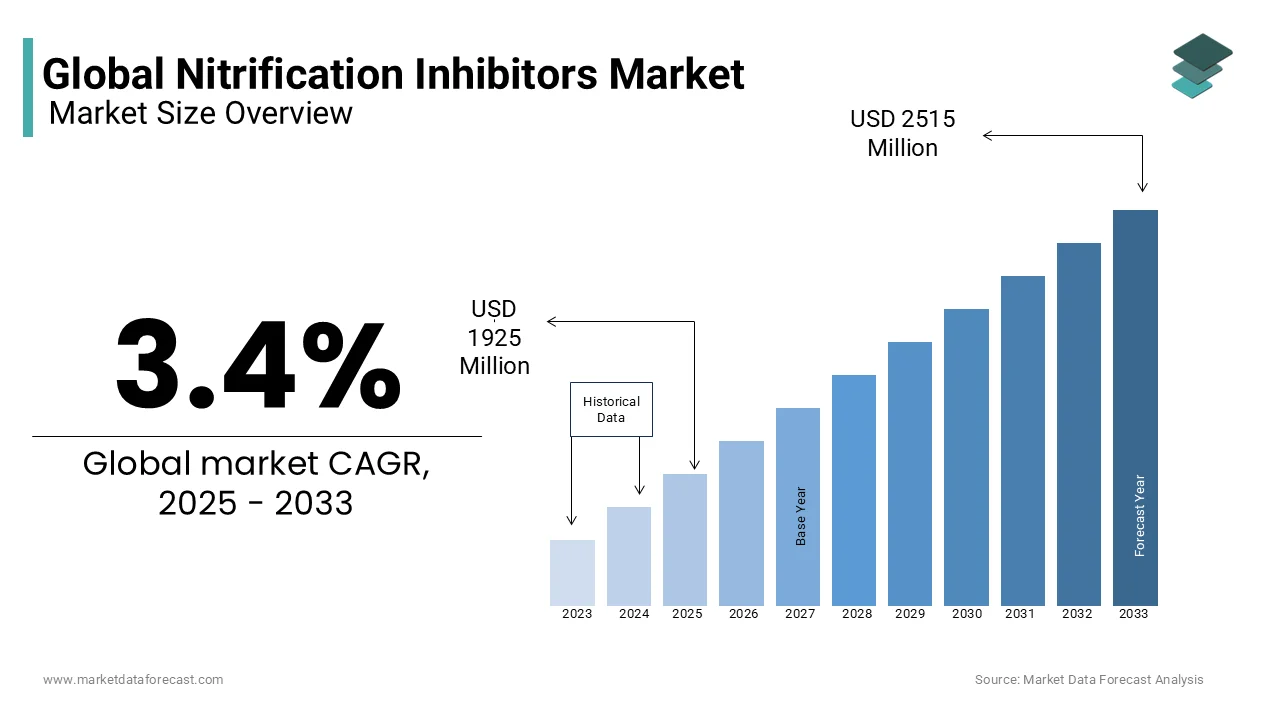
- Market Valuation: Valued at USD 1925 million (2025), estimated at USD 1990.45 million (2026), and projected to reach USD 2600.85 million by 2034, registering a steady CAGR of 3.4% (2026–2034).
- Primary Growth Drivers: Growing concerns regarding reactive nitrogen release from agricultural ecosystems, potential for nitrous oxide emission reductions, and increased adoption of nitrogen stabilizers to enhance fertilizer recovery in row crops. Key trends include extensive use of Nitrapyrin, DCD, and DMPP to mitigate environmental impacts.
Key Market Segment Metrics (2026–2034)
| Category | Leading Segment (2025 Position) | Fastest-Growing Segment |
|---|---|---|
| By Product Type | Dicyandiamide (DCD) and Nitrapyrin (dominated traditional row crop and grassland stabilization) | Advanced DMPP Formulations (proven effective in increasing soil ammonium and reducing N2O emissions) |
| By Application | Cereal and Row Crop Fertilization (held the largest share for nitrogen loss prevention) | Grassland and Pasture Management Applications |
| By Region | North America (holds the dominant share due to extensive usage of Nitrapyrin and DCD products) | European and Asia-Pacific Agricultural Sectors under strict emission mandates |
Major Market Players & Market Structure
Market Structure: Highly competitive agrochemical landscape featuring major global chemical manufacturers and fertilizer specialists competing on proprietary nitrogen stabilizer technologies, regulatory compliance, and verified emission-reduction efficacy.
Key Companies: EuroChem Group, Solvay, SKW Piesteritz, Koch Agronomic Services, Compo Expert GmbH, BASF SE, and DowDuPont.
Global Nitrification Inhibitors Market Size
The size of the global nitrification Inhibitors market was valued at USD 1925 million in 2025 and is anticipated to reach USD 1990.45 million in 2026 from USD 2600.85 million by 2034, growing at a CAGR of 3.4% from 2026 to 2034.
Current Introduction and Definition of the Nitrification Inhibitors Market
Nitrification inhibitors are chemical compounds added to fertilizers to slow down the conversion of ammonium into nitrate in the soil. These additives function by temporarily suppressing Nitrosomonas bacteria activity extending the residence time of plant available nitrogen in root zones and reducing leaching volatilization and denitrification pathways that contribute to ecosystem degradation. As per the United Nations Environment Programme, global food system transformations prioritize halving nitrogen waste to mitigate environmental pollution across aquatic ecosystems and the atmosphere. According to the Intergovernmental Panel on Climate Change, targeted agricultural soil management practices and fertilizer optimization strategies serve as important pathways to mitigate global greenhouse gas emission vectors. As per the Food and Agriculture Organization, global historical nitrogen use reached a record high level of 115 million tonnes during 2024 as demand rebounded following a period of elevated pricing.
MARKET DRIVERS
Regulatory Mandates for Nitrogen Loss Reduction
Government regulations targeting agricultural non-point source pollution create compulsory demand for these inhibitors, which fuels the growth of the nitrification inhibitors market. This is because farmers face legal requirements to document nitrogen stewardship practices or risk penalties, subsidy reductions, and market access restrictions. According to the New Zealand Ministry for Primary Industries, regional farm nutrient frameworks require dairy operations to log synthetic nitrogen fertilizer inputs to maintain water quality targets across grazing catchments. As per the Central Valley Regional Water Quality Control Board, the Irrigated Lands Regulatory Program enforces comprehensive irrigation and nitrogen management plan reporting requirements where growers document best management practices like split fertilizer applications and nitrification inhibitors to minimize nitrate discharges. Unlike voluntary sustainability initiatives these regulatory frameworks transform inhibitor adoption from discretionary investment to compliance necessity creating predictable demand floors independent of commodity price cycles or farmer sentiment. Enforcement mechanisms, including farm audits, water quality monitoring, and conditional licensing, ensure adherence to regulations. However, these strict documentation requirements favor commercially registered products with validated efficacy data over unverified alternatives, creating entry barriers that concentrate market share among established suppliers.
Economic Returns Through Enhanced Nitrogen Use Efficiency
Rising fertilizer costs and documented yield responses create compelling economic justification for the adoption of these inhibitors, which in turn expands the nitrification inhibitors market. Farmers are seeking to maximize return on nitrogen investment through improved recovery efficiency rather than increased application rates. As per the Food and Agriculture Organization, global nitrogen fertilizer pricing structures directly affect agricultural production costs, driving international demand for advanced nutrient stabilization and management technologies. According to the Food and Agriculture Organization, commercial field optimization trials evaluate biochemical stabilizers across varied cropping systems to increase plant nitrogen recovery and boost regional grain yields. As per the University of Nebraska-Lincoln Extension, corn growers utilize enhanced-efficiency fertilizers to preserve soil nitrogen reserves and sustain high grain yields during heavy early-season precipitation events. The economic value proposition resonates particularly during periods of margin compression when input optimization becomes survival strategy rather than optional enhancement. Crop insurance programs in US and Canada increasingly recognize inhibitor use as risk mitigation practice qualifying adopters for premium discounts or indemnity adjustments further improving economics through reduced financial exposure to weather related nitrogen losses.
MARKET RESTRAINTS
Variable Field Efficacy Under Diverse Environmental Conditions
Inconsistent performance across various soil types, climates, and management systems creates widespread adoption hesitation, which limits the growth of the nitrification inhibitors market. Because farmers experience unpredictable results, their confidence in the return on investment is undermined despite positive average trial outcomes. According to the Food and Agriculture Organization, commercial field optimization trials evaluate biochemical stabilizers across varied soil matrices to increase plant nitrogen recovery and boost regional agricultural output. As per research, long-term agronomic experiments monitor changing soil physical properties and textual distributions, such as varying clay content profiles, to optimize crop nutrient management systems. The context dependency forces farmers to accept uncertainty or invest in site specific calibration requiring agronomic expertise and soil testing infrastructure unavailable to many operations. Manufacturers struggle to communicate nuanced usage guidelines without overwhelming customers or risking liability from overpromising. This difficulty leads to conservative marketing that understates benefits in optimal conditions and fails to warn about marginal environments, creating a trust deficit that slows adoption among mainstream users.
High Product Costs Relative to Commodity Fertilizer Prices
High product valuation against standard commodity pricing inhibits the expansion of the nitrification inhibitors market. Nitrification inhibitors add a notable portion to base fertilizer costs, creating economic barriers, particularly for smallholder farmers and extensive cropping systems, where thin margins cannot absorb premiums without guaranteed returns. As per the International Fertilizer Development Center, public fertilizer price indicators track changing regional import variables and macro supply blockades to guide international agricultural soil nourishment operations. As per the Alliance for a Green Revolution in Africa, domestic smallholders expand overall food production margins by incorporating resilient seed cultivars and strategic chemical fertilizers to boost soil nutrient baselines. This intense price sensitivity concentrates technology adoption in high-value specialty crops and well-capitalized row crop operations. Consequently, it excludes the majority of global agricultural land, where nitrogen losses remain unaddressed due to economic inaccessibility rather than technical infeasibility.
MARKET OPPORTUNITIES
Biological Nitrification Inhibition Through Plant Breeding
Harnessing natural plant exudates that suppress soil nitrification represents a transformative opportunity to embed nitrogen stabilization directly into crop genetics, which is expected to fuel the growth of the nitrification inhibitors market. This eliminates separate product-purchase and application logistics, as well as the regulatory approval processes associated with synthetic inhibitors. According to the Japan International Research Center for Agricultural Sciences, tropical forage grass root exudates release natural biochemicals that actively suppress ammonia-oxidizing soil bacteria to reduce municipal agricultural greenhouse gas emissions. As per the Food and Agriculture Organization, international crop science consortiums develop and test nitrogen-efficient cereal cultivars across varied regional climates to increase grain yield resilience and optimize fertilizer consumption. Unlike synthetic compounds requiring annual repurchase and reapplication genetic traits provide perpetual benefit once deployed creating self sustaining adoption dynamics and reducing supply chain dependencies. Public sector breeding programs and CGIAR centers lead development ensuring accessibility for smallholders excluded from proprietary technology markets. This biological integration aligns perfectly with regenerative agriculture principles and organic certification standards. By doing so, it opens up markets that are completely inaccessible to synthetic chemicals while simultaneously addressing consumer fears about chemical residues in food systems.
Integration with Digital Precision Agriculture Platforms
Combining nitrification inhibitors with variable-rate technology, soil sensors, and decision-support software enables precise, site-specific application, which is predicted to accelerate the expansion of the nitrification inhibitors market. This integration matches inhibitor doses to localized risk factors, maximizing product efficacy while minimizing both waste and cost per hectare. As per the National Agricultural Statistics Service, digital variable-rate technology and prescription soil mapping structures enhance commercial crop management parameters by matching localized fertilizer application rates with field chemistry variances. According to the National Agricultural Statistics Service, interconnected precision telemetry platforms integrate regional weather analytics and field diagnostic metrics to optimize commercial farm input timing. Machine learning models trained on multi year field data predict optimal timing and rates based on soil type weather forecasts and crop stage improving consistency of outcomes that historically varied with operator judgment. This digital integration transforms inhibitors from standalone products to components of integrated nutrient management systems creating stickiness through data lock in and workflow dependencies. Service providers are shifting away from traditional sales volumes by bundling inhibitors with precision application services and using outcome-based pricing. This strategic alignment with farmer profitability builds crucial trust, paving the way for risk-averse operators to comfortably adopt the technology.
MARKET CHALLENGES
Regulatory Approval Complexity Across Jurisdictions
Divergent registration requirements, testing protocols, and maximum residue limits across countries fragment the competitive landscape with varied entry barriers to the nitrification inhibitors market. These regulatory hurdles ultimately delay product launches, increase overall development costs, and prevent the global harmonization of labeling claims. According to the European Chemicals Agency, chemical substances intended to serve as biochemical stabilizers or fertilizer components navigate harmonized European Union compliance pipelines to verify environmental safety profiles. The regulatory fragmentation forces manufacturers to maintain multiple product formulations labels and safety data sheets increasing complexity and inventory costs while delaying innovation diffusion to regions where nitrogen loss problems are most acute. Small and medium enterprises lacking resources for parallel submissions face exclusion from major markets concentrating industry among large multinationals able to absorb compliance costs reducing competitive diversity and potentially slowing technological advancement.
Farmer Knowledge Gaps and Misapplication Risks
An insufficient understanding of inhibitor modes of action, optimal timing, and interaction effects leads to widespread misapplication, which holds back the expansion of the nitrification inhibitors market. Consequently, this reduces realized benefits and generates negative word of mouth, eroding market credibility despite the proven potential of the technology. As per the Purdue University Extension, coordinated applied field-research trials evaluate specialized fertilizer combinations to help corn producers optimize agronomic nitrogen application rates. According to the Indian Council of Agricultural Research, regional training modules upgrade the skills of rural extension practitioners to optimize agricultural soil health baselines. Social media misinformation amplifies isolated failures while success stories lack viral appeal creating skewed perception bias against adoption. Manufacturers invest heavily in education but reach remains limited relative to grower population and message complexity resists simplification without losing critical nuance. This knowledge deficit creates vicious cycle where poor outcomes from misuse reduce willingness to retry even with corrected practices slowing adoption curves and preventing realization of aggregate environmental benefits that depend on widespread correct implementation rather than niche expert use.
REPORT COVERAGE
| REPORT METRIC | DETAILS |
| Market Size Available | 2025 to 2034 |
| Base Year | 2025 |
| Forecast Period | 2026 to 2034 |
| CAGR | 3.4% |
| Segments Covered | By Type and Region |
| Various Analyses Covered | Global, Regional, & Country Level Analysis; Segment-Level Analysis; DROC, PESTLE Analysis; Porter’s Five Forces Analysis, Competitive Landscape; Analyst Overview of Investment Opportunities |
| Regions Covered | North America, Europe, APAC, Latin America, Middle East & Africa |
| Market Leaders Profiled | Euro Chem Group, Solvay, SKW Piesteritz, Koch Agronomic Services, Compo Expert GmbH, BASF SE, DowDuPont. |
SEGMENTAL ANALYSIS
By Type Insights
Nitrapyrin
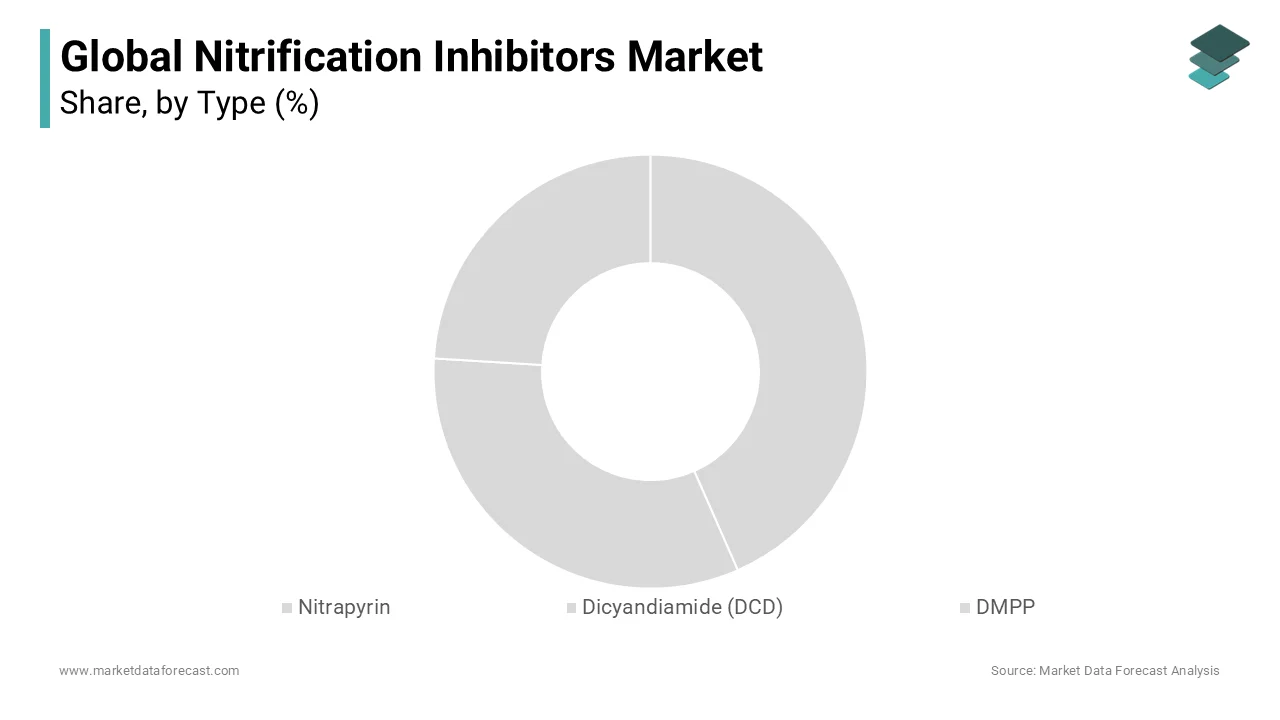
In 2025, the nitrapyrin segment held a 42.6% share in the global nitrification inhibitors market because of its established regulatory approvals, extensive field validation history, and integration with anhydrous ammonia application systems prevalent in North American row crop production. The main driver for this market dominance is the deep entrenchment of nitrapyrin in US Corn Belt fertility programs. According to the National Agricultural Statistics Service, commercial field corn operations across the US Corn Belt apply specialized chemical stabilizers alongside anhydrous ammonia applications to mitigate environmental nitrogen loss vectors. As per the Economic Research Service, federal agricultural resource management indicators monitor the regional adoption rates of enhanced-efficiency fertilizers and custom chemical inhibitors to evaluate modern nutrient conservation trends. According to the National Agricultural Statistics Service, domestic row-crop producers rely on verified chemical soil stabilizers to preserve early-season root-zone nitrogen availability across major cropping networks. This combination of regulatory maturity agronomic familiarity and cost competitiveness creates structural advantages that newer entrants must overcome through demonstrably superior performance rather than incremental improvements.
The leading position of this segment is bolstered by the proprietary formulation technology and application equipment integration that create switching costs and ecosystem lock-in beyond active ingredient chemistry alone. As per the National Agricultural Statistics Service, advanced precision injection implements integrate directly with tractor telemetry systems to deliver uniform field chemical applications during seasonal planting windows. According to the Food and Agriculture Organization, microencapsulated crop nutrient formulations optimize active ingredient release parameters to maximize fertilizer conservation in warm, humid soils. Extension recommendations in major corn producing states frequently reference nitrapyrin by trade name in publication materials reinforcing cognitive availability among advisors influencing farmer decisions. This integrated system approach transforms nitrapyrin from commodity chemical to platform solution where value derives from seamless workflow compatibility and risk reduction rather than molecular efficacy alone ensuring sustained market leadership despite patent expiration and generic competition emerging in certain jurisdictions.
DMPP (3,4-Dimethylpyrazole Phosphate)
The DMPP segment is likely to experience the fastest CAGR of 14.8% during the forecast period owing to regulatory preferences superior environmental safety profile and expanding adoption in high value specialty crops and turfgrass markets. Growth is driven primarily by a favorable regulatory status under EU Regulation 2019/1009. According to the European Parliament, the EU Fertilizing Products Regulation 2019/1009 outlines unified safety and quality rules for CE-marked fertilizing products to foster cross-border trade inside the European single landscape. As per the Food and Agriculture Organization, drip irrigation fertigation systems expand across Mediterranean specialty crop fields, accelerating demand for water-soluble enhanced-efficiency nitrogen compounds. This regulatory and application fit creates structural tailwinds in regions and segments where environmental standards and precision delivery methods favor DMPP’s physicochemical properties over legacy chemistries optimized for broadacre commodity production systems.
The swift expansion of this segment gains further momentum from the documented superiority in warm-climate performance and compatibility with diverse fertilizer carriers, enabling year-round use in tropical, subtropical, and irrigated systems where nitrapyrin degrades too rapidly or causes phytotoxicity. According to the Food and Agriculture Organization, hot-climate sugarcane and grain cropping systems deploy specialized biochemical nitrification inhibitors to maintain nutrient stability under elevated average soil temperatures. As per the Food and Agriculture Organization, stabilized fertilizer prills and coated chemical formulations expand export logistics shelf-life by ensuring product stability under high-temperature storage conditions. The technical and market expansion vectors ensure DMPP sustains above market growth rates as climate adaptation intensifies and diversified cropping systems gain share relative to temperate cereal monocultures historically dominating inhibitor demand.
REGIONAL ANALYSIS
North America Market Analysis
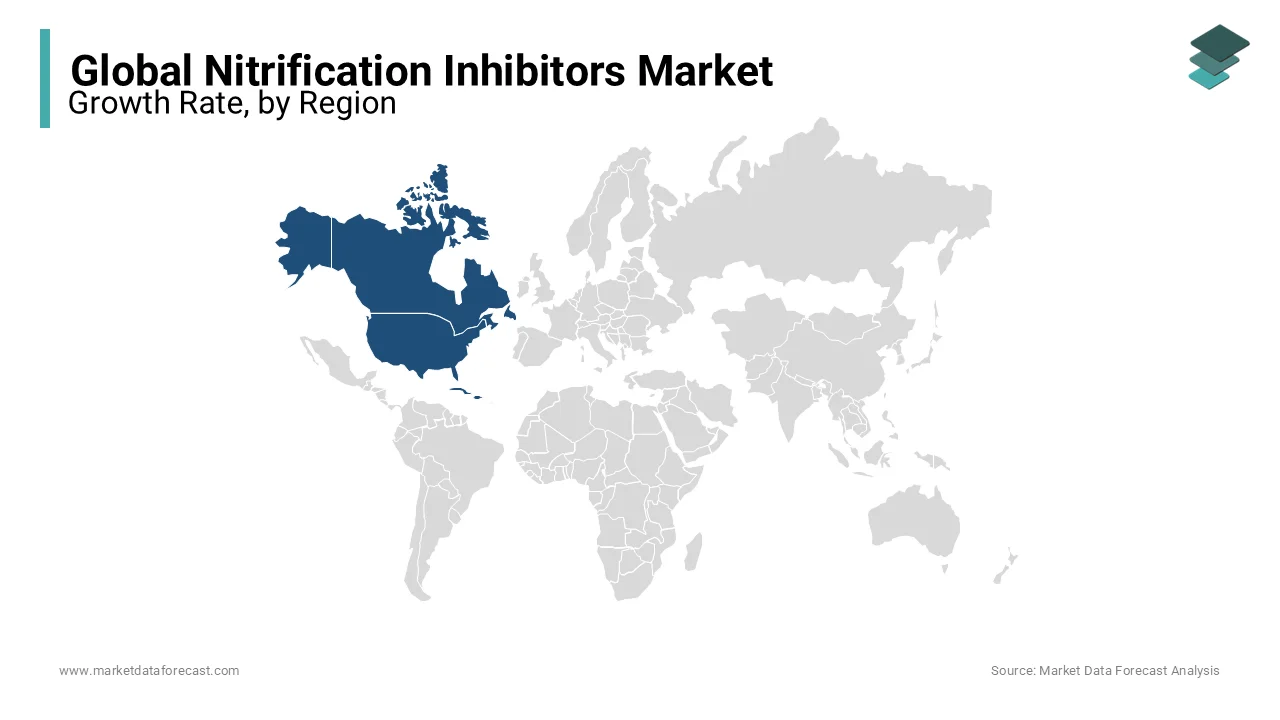
North America dominated the global nitrification inhibitors market and accounted for a 38.8% share in 2025. This dominance of the region in the global market was driven by intensive corn belt fertility management established regulatory frameworks and widespread custom application infrastructure. Reflecting deep technological maturity, nitrapyrin firmly leads the market in stabilizing anhydrous ammonia. At the same time, DMPP is capturing new ground in liquid UAN and specialty crops, giving the region a uniquely diversified product portfolio. According to the National Agricultural Statistics Service, commercial field corn operations across the US Corn Belt apply specialized chemical stabilizers alongside anhydrous ammonia applications to mitigate environmental nitrogen loss vectors. As per Agriculture and Agri-Food Canada, the federal On-Farm Climate Action Fund provides a 200 million CAD infrastructure investment to help domestic agricultural producers implement nitrogen management and beneficial crop practices that reduce greenhouse gas emissions. Region maintains leadership through combination of scale regulatory clarity and infrastructure density creating self reinforcing adoption ecosystem difficult for other regions to replicate quickly despite catching efforts elsewhere.
Europe Market Analysis
Europe followed closely behind in the nitrification inhibitors market and captured a 28.9% share in 2025. The European market is known for stringent environmental regulations, diverse cropping systems, and strong policy-driven adoption of environmentally preferred inhibitor chemistries, particularly DMPP. Strong regulatory leadership directly created the region's special market standing. Strict policies, including the EU Nitrates Directive, Water Framework Directive, and the Farm to Fork Strategy, create mandatory adoption triggers that contrast sharply with the voluntary, price-driven markets seen in other regions. As per the European Commission, the Nitrates Directive mandates member states to designate Nitrate Vulnerable Zones and implement strict fertilizer application limits to prevent water pollution from agricultural sources. According to Eurostat, the consumption of nitrogen-based fertilizers in European Union agricultural production increased to 8.9 million tonnes in 2024, with application levels reaching highest volumes in France, Germany, and Spain. As per the Food and Agriculture Organization, global nitrogen stabilization pricing trends impact seasonal farm operating margins, shifting producer demand patterns for specific commercial chemical varieties. However fragmented national implementation creates compliance complexity for cross border fertilizer trade requiring manufacturer adaptation to varying certification testing and labeling requirements. Privacy concerns around farm data collection slow digital integration versus North America limiting precision application optimization potential despite technological capability. Region trades deployment speed for systemic robustness betting that regulatory certainty provides predictable demand visibility enabling long term R&D planning absent in more volatile market driven regions.
Asia Pacific Market Analysis
Asia Pacific occupies a significant position in the global nitrification inhibitors market. Its growth is concentrated in China, India, Japan, Australia, and New Zealand, driven by government food security initiatives, environmental remediation priorities, and diverse agroecological zones requiring differentiated solutions. The state of the regional market demonstrates extreme diversity, ranging from China’s dominant manufacturing and domestic consumption to India’s subsidy-driven smallholder adoption and ANZ’s pastoral focus, creating multiple distinct submarkets within a single region. According to China's Ministry of Agriculture and Rural Affairs, standardized domestic field validation trials verify regional agronomic performance parameters for newly introduced crop chemical inputs. As per the Department of Fertilizers of India, the PM-PRANAM scheme provides financial incentives to states and union territories to promote the adoption of alternative, balanced organic and nano-fertilizers to improve overall soil health baselines. According to the Ministry of Agriculture, Forestry and Fisheries of Japan, regional clean technology initiatives scale up automated drone deployment and precision machinery to ease rural farm labor shortages. However intellectual property enforcement gaps and geopolitical tensions restrict Western technology transfer limiting premium segment participation for local manufacturers while creating parallel supply chains. Infrastructure deficits outside developed economies constrain precision application adoption despite favorable economics creating two speed market within region where advanced technologies coexist with traditional practices.
Latin America Market Analysis
Latin America is moving ahead steadfastly in the global nitrification inhibitors market, with activity heavily concentrated in Brazil, Argentina, Colombia, and Chile. This adoption is mainly driven by export-oriented commodity production, tropical soil challenges, and selective technology use among large-scale producers. A dualistic structure defines the region's market status, pitting a technologically advanced export sector against a traditional smallholder segment. This coexistence results in deeply bifurcated demand patterns, setting it apart from much more homogeneous developed markets. According to the Brazilian Agricultural Research Corporation, targeted field expansion trials evaluate specialized crop input combinations to accelerate grain output trends within competitive regional farming sectors. As per the Food and Agriculture Organization, global nitrogen stabilization pricing trends impact seasonal farm operating margins, shifting producer demand patterns for specific commercial chemical varieties. However currency volatility and import tariffs increase effective costs for foreign equipment favoring local assemblers and Chinese imports over premium Western brands in price sensitive segments. Tropical soil acidity and high organic matter content reduce inhibitor persistence requiring higher application rates or split treatments increasing costs and complexity versus temperate zone recommendations limiting adoption intensity despite proven agronomic benefits.
Middle East and Africa Market Analysis
The Middle East and Africa region is expected to grow within the global nitrification inhibitors market from 2026 to 2034. Market activity will be heavily concentrated in South Africa, Egypt, Morocco, Israel, and the Gulf States, driven by irrigation-intensive agriculture, desert reclamation projects, and selective technology adoption in export-oriented sectors. The region’s market status reflects enclave development where advanced inhibitors serve specific commercial farms and government projects rather than broad based smallholder adoption creating concentrated but limited demand pockets dependent on public investment and export revenues. According to the Food and Agriculture Organization, global agricultural financing structures and input costs directly impact farm operating budgets, driving seasonal producer behavior variations across key cropping markets. As per the Ministry of Agriculture and Land Reclamation of Egypt, national horizontal land expansion plans deploy advanced precision center-pivot irrigation infrastructure to scale sustainable cropping outcomes across reclaimed desert soils. According to the Ministry of Agriculture, Maritime Fisheries, Rural Development and Water and Forests of Morocco, regional agricultural modernization strategies optimize drip fertigation parameters to enhance orchard output benchmarks. However limited local manufacturing creates import dependency and foreign exchange vulnerability constraining adoption during currency depreciation periods. Skilled technician shortages limit extension services and proper application guidance restricting operational effectiveness and technology lifespan. Market development depends on continued government investment and export competitiveness creating uncertainty amid climate change pressures affecting irrigation water availability and regional fiscal balances dependent on hydrocarbon or commodity revenues.
COMPETITIVE LANDSCAPE
Competition in the nitrification inhibitors market features stratified rivalry between multinational agrochemical companies specialized nutrient efficiency firms and emerging biological technology startups each pursuing distinct paths toward value creation and customer loyalty. Multinationals leverage integrated R&D regulatory portfolios and global distribution networks to dominate commodity volumes and maintain brand recognition through decades of field validation and extension partnerships creating trust advantages difficult for new entrants to overcome quickly. Specialized players compete on application technology compatibility niche crop expertise and superior environmental profiles targeting premium segments where functional differentiation justifies price premiums over established chemistries. Biological and genetic innovators challenge synthetic dominance through embedded traits and natural product positioning appealing to organic regenerative and consumer sensitive markets excluded from conventional chemical channels. Competition intensifies around regulatory compliance and sustainability credentials as retailer mandates government programs and carbon markets create specification pull favoring documented low impact solutions over lowest cost alternatives. Generic entry following patent expiration pressures margins in mature nitrapyrin segments forcing originators to innovate through formulation improvements digital services and bundled offerings rather than relying solely on molecule exclusivity. Regional fragmentation due to divergent approval processes creates localized competitive dynamics where domestic players with faster registration pathways gain share against multinationals delayed by bureaucratic complexity. However biological uniqueness of nitrogen stabilization function and site specific efficacy variability prevent pure commoditization enabling multiple viable business models to coexist serving distinct agronomic economic and regulatory contexts within this evolving landscape shaped by environmental imperatives and precision agriculture adoption continuously reshaping competitive boundaries and value capture mechanisms.
KEY MARKET PLAYERS
Companies playing a major role in the global nitrification inhibitors market include
- Euro Chem Group
- Solvay
- SKW Piesteritz
- BASF Agricultural Solutions
- Corteva Agriscience
- Koch Agronomic Services
- Compo Expert GmbH
- BASF SE
- DowDuPont. Solvay and SKW Piesteritz
Top Players In The Market
- Corteva Agriscience maintains extensive involvement in the nitrification inhibitors market through its N Serve and Instinct NXT product lines based on nitrapyrin chemistry serving North American and global row crop producers. The company recently launched microencapsulated Instinct Opti formulation extending inhibition duration under high temperature conditions while improving compatibility with liquid fertilizers and reducing handling hazards for custom applicators. Corteva strengthened market position by expanding digital integration with John Deere Operations Center enabling automatic application documentation for regulatory compliance and carbon credit verification programs. These initiatives demonstrate commitment to platform innovation beyond commodity chemistry creating ecosystem lock in through equipment compatibility data integration and service bundling that transcends price competition while addressing evolving environmental documentation requirements and precision agriculture workflows shaping modern nutrient management decisions across intensive production systems worldwide.
- BASF Agricultural Solutions contributes significantly to the nitrification inhibitors market through Entec branded DMPP products dominating European specialty crop segments and expanding globally in tropical and irrigated agriculture applications. The company recently completed registration of next generation DMPP formulation in Brazil India and Australia enabling market access across key growth regions with tailored labeling claims aligned to local regulatory frameworks and cropping system requirements. BASF strengthened market position by partnering with drip irrigation equipment manufacturers including Netafim and Rain Bird integrating inhibitor dosing recommendations into fertigation design software ensuring optimal delivery and efficacy in precision water management systems. Recent actions include publishing comprehensive ecotoxicology dataset satisfying EU Fertilizing Products Regulation requirements ahead of mandatory compliance deadlines securing first mover advantage in CE marked fertilizer category. These strategies leverage regulatory expertise and application technology partnerships to differentiate DMPP as premium solution for environmentally sensitive markets where safety profile and precision compatibility justify price premiums over legacy chemistries while building technical credibility through transparent data sharing that addresses stakeholder concerns about long term soil health impacts.
- Koch Agronomic Services plays vital role in nitrification inhibitors market through SUPERU and ANVOL products combining nitrification and urease inhibition technologies serving diversified nitrogen management needs across North America Latin America and Asia Pacific. The company recently launched CENTURO NEXT generation nitrification inhibitor featuring improved solubility and tank mix compatibility enabling seamless integration with UAN solutions and foliar applications previously incompatible with older formulations. Koch strengthened market position by acquiring Brazilian distributor Nitroag expanding direct access to cerrado soybean and corn safrinha markets where dual inhibitor technology addresses multiple nitrogen loss pathways in tropical soils with high leaching and volatilization risk. These initiatives reflect integrated approach combining product innovation geographic expansion and agronomic validation to address context dependent performance challenges that historically limited adoption while building trust through evidence based positioning rather than generic marketing claims appealing to scientifically literate growers and advisors seeking predictable outcomes.
Top Strategies Used By Key Market Participants
Key players in the nitrification inhibitors market employ vertical integration strategies controlling active ingredient synthesis formulation and distribution to ensure supply security capture margin across value chain and differentiate through proprietary technologies difficult for generic competitors to replicate without substantial capital investment and regulatory approval timelines. Companies pursue strategic registrations across multiple jurisdictions simultaneously leveraging harmonized data packages where possible to accelerate global market access while adapting formulations to meet regional environmental standards and carrier compatibility requirements. Product portfolio diversification across nitrapyrin DMPP DCD and biological platforms spreads regulatory and agronomic risk while enabling cross selling to different customer segments based on crop type soil conditions and application methods. Digital integration with farm management software and precision application equipment creates workflow dependencies and data lock in increasing switching costs beyond product performance alone. Extension partnerships and third party validation studies build scientific credibility and advisor confidence essential for influencing farmer decisions in risk averse agricultural communities where word of mouth and trusted recommendations outweigh marketing claims. Sustainability positioning through carbon credit eligibility water quality trading and retailer procurement alignment transforms inhibitors from input cost to revenue enabler or compliance tool justifying premiums during margin compression periods. Manufacturing scale and long term supply agreements with fertilizer blenders secure channel preference and volume commitments creating barriers to entry for smaller players lacking capital for capacity expansion and relationship building.
MARKET SEGMENTATION
This research report on the global nitrification inhibitors market is segmented and sub-segmented based on Type and Region.
By Type
- Nitrapyrin
- Dicyandiamide (DCD)
- DMPP
- Others
By Region
- North America
- Europe
- Asia-Pacific
- Latin America
- Middle East and Africa