North America Activated Carbon Fiber Market Size, Share, Growth, Trends, And Forecasts Report, Segmented By Type, Application, And By Country (The US, Canada, And Rest of North America), Industry Analysis From (2025 to 2033)
North America Activated Carbon Fiber Market Size
The North American activated fiber market was valued at USD 22.25 billion in 2024 and is anticipated to reach USD 28.52 billion in 2025 to USD 162.29 billion by 2033, growing at a CAGR of 28.20% during the forecast period from 2025 to 2033.

Activated carbon fibers are derived from organic precursors such as polyacrylonitrile (PAN), rayon, or pitch, which undergo carbonization and activation processes to create a porous structure ideal for capturing gases, chemicals, and contaminants. Due to their superior adsorption capacity, low pressure drop, and rapid response kinetics, activated carbon fibers are increasingly preferred over conventional granular or powdered activated carbon in specialized applications.
The market is driven by rising environmental concerns, stricter industrial emission norms, and growing demand across sectors like healthcare, automotive, aerospace, and water purification. In addition, advanced filtration materials, including activated carbon fibers, have seen increased adoption in manufacturing hubs across Texas, California, and Ohio.
Apart from these, government-backed research initiatives—such as those funded by the National Science Foundation—are exploring new applications for activated carbon fibers in wearable technology and energy storage. As per the Department of Energy, advancements in material science are enabling more efficient use of these fibers in hydrogen storage and electrochemical devices, positioning North America as a hub for innovation in this niche but rapidly evolving sector.
MARKET DRIVERS
Increasing Demand from the Automotive Industry for Emission Control
The increasing demand from the automotive industry, particularly for emission control and fuel vapor recovery systems, is a primary driver of the North American activated carbon fiber market. Activated carbon fibers are widely used in canisters that capture volatile organic compounds (VOCs) emitted from vehicle fuel systems, preventing them from escaping into the atmosphere.
In 2023, over 90% of new passenger vehicles produced in the U.S. incorporated an activated carbon-based evaporative emission control system, with each vehicle requiring approximately 1.5–2.0 kg of activated carbon material.
Furthermore, the transition toward hybrid electric vehicles (HEVs) has not eliminated the need for such systems, as these vehicles still rely on internal combustion engines part of the time. With automakers like Ford, General Motors, and Stellantis investing heavily in cleaner combustion technologies and regulatory agencies tightening VOC limits, the role of activated carbon fibers in ensuring compliance remains indispensable.
Growth in Industrial Air Pollution Control Systems
The expansion of industrial air pollution control systems, particularly in chemical processing, pharmaceuticals, and power generation, is another significant driver of the North American activated carbon fiber market. Activated carbon fibers are highly effective in capturing hazardous airborne pollutants such as mercury, dioxins, and volatile organic compounds (VOCs) from industrial exhaust streams.
According to the U.S. Environmental Protection Agency (EPA), coal-fired power plants and waste incinerators are required to install advanced air pollution control equipment under the Mercury and Air Toxics Standards (MATS). As a result, many facilities have adopted activated carbon injection (ACI) systems using carbon fiber-based media to meet compliance targets. Besides, the pharmaceutical and semiconductor industries, which require ultra-clean environments, are adopting activated carbon fiber filters for solvent recovery and cleanroom air purification. This trend shows the growing reliance on activated carbon fibers as an essential component of modern industrial pollution mitigation strategies.
MARKET RESTRAINTS
High Manufacturing and Raw Material Costs
The high cost associated with both manufacturing and raw material sourcing is one of the most pressing restraints affecting the North American activated carbon fiber market. Unlike conventional activated carbon, which can be derived from inexpensive sources such as coconut shells or coal, activated carbon fibers typically originate from synthetic precursors like polyacrylonitrile (PAN) or rayon, which are significantly more expensive.
According to the American Chemical Society, the cost of PAN-based carbon fiber precursor alone accounts for over 50% of total production expense, making activated carbon fiber a premium product. Moreover, the multi-stage manufacturing process—including stabilization, carbonization, and activation—requires specialized equipment and consumes substantial amounts of energy, further driving up costs.
As per McKinsey & Company, the price of activated carbon fiber remains higher per kilogram than granular activated carbon, limiting its adoption to high-value applications. This economic disparity restricts broader market penetration, particularly in cost-sensitive sectors where alternative filtration methods remain viable.
Limited Domestic Production Capacity and Supply Chain Constraints
The limited domestic production capacity and supply chain bottlenecks are another key restraint on the North American activated carbon fiber market. While demand for these materials is growing across multiple sectors, the region relies heavily on imports from Asian manufacturers, particularly Japan and South Korea, which dominate global production.
According to the U.S. International Trade Commission (USITC), in 2023, over 70% of activated carbon fiber consumed in North America was imported, with only a handful of domestic producers capable of supplying high-grade fibers at a commercial scale. Companies such as Hexcel and BASF operate small-scale production lines in the U.S., but they lack the volume needed to meet surging demand from automotive and industrial filtration markets. Moreover, supply chain disruptions caused by geopolitical tensions and logistical delays have led to inconsistent availability of raw materials and finished products.
MARKET OPPORTUNITY
Expansion in Healthcare and Protective Wearables
The expanding applications within the healthcare and protective wearables sector present a major opportunity for the North American activated carbon fiber market. Activated carbon fibers are being increasingly integrated into medical masks, surgical gowns, and personal protective equipment (PPE) due to their ability to filter out harmful pathogens, odors, and airborne toxins.
According to the Centers for Disease Control and Prevention (CDC), the demand for high-efficiency respiratory protection surged during the pandemic and continues to remain elevated, particularly in hospital and laboratory environments. Activated carbon fiber-based respirators offer improved breathability and longer service life compared to standard N95 masks, making them ideal for extended use scenarios.
In addition, textile manufacturers are developing smart fabrics embedded with activated carbon fibers for use in military uniforms, firefighter gear, and biohazard suits. Furthermore, academic institutions such as MIT and Stanford are researching antimicrobial textiles infused with activated carbon fibers, opening new avenues for application in wound care dressings and infection control garments. As per the National Institutes of Health (NIH), clinical trials are underway to assess the efficacy of these materials in reducing bacterial contamination in hospital settings.
This growing intersection between health sciences and advanced materials presents a promising growth path for the activated carbon fiber market in North America.
Integration into Hydrogen Storage and Fuel Cell Technologies
Its integration into hydrogen storage and fuel cell technologies is another emerging opportunity for the North American activated carbon fiber market. With the push toward decarbonizing transportation and industry, hydrogen is gaining prominence as a clean energy carrier, and activated carbon fibers are playing a crucial role in enhancing its storage efficiency.
Activated carbon fibers possess a high surface area and tailored pore structures, making them suitable for physical adsorption of hydrogen molecules under moderate pressures. Compared to traditional compressed gas tanks, activated carbon fiber-based storage systems offer greater volumetric efficiency and safety, particularly in mobile applications such as buses, trucks, and drones.
According to the U.S. Department of Energy’s Hydrogen and Fuel Cell Technologies Office, activated carbon fiber composites are being tested in prototype hydrogen storage vessels that could increase storage capacity without increasing tank size. Several pilot projects in California and Texas are evaluating their feasibility in public transit and logistics fleets.
Moreover, collaborations between material science firms and hydrogen infrastructure developers are accelerating commercialization efforts. For instance, Plug Power and BASF have partnered to develop lightweight hydrogen storage modules using activated carbon fiber matrices for deployment in fuel cell-powered forklifts and delivery vehicles.
MARKET CHALLENGES
Technological Complexity in Fiber Activation Processes
The technological complexity involved in optimizing the activation process to achieve desired porosity, surface area, and mechanical strength is a major challenge facing the North American activated carbon fiber market. Unlike conventional activated carbon, which can be easily modified through steam or chemical activation, carbon fibers require precise control over temperature, dwell time, and activating agents to maintain structural integrity while maximizing adsorption capacity.
Small variations in activation conditions can lead to either excessive burn-off, weakening the fiber, or insufficient pore development, reducing filtration efficiency.
This limitation hampers the ability of manufacturers to produce activated carbon fibers with consistent specifications, especially when catering to high-performance sectors such as aerospace and defense. To address this, ongoing R&D initiatives are focused on developing advanced modeling tools and automated activation chambers that can precisely tailor fiber properties.
Competition from Alternative Filtration Technologies
The growing competition from alternative filtration technologies that offer comparable or superior performance at lower costs is another critical challenge confronting the North American activated carbon fiber market. Traditional granular activated carbon (GAC), powdered activated carbon (PAC), and newer materials such as metal-organic frameworks (MOFs) and graphene-based filters are increasingly being deployed in applications previously dominated by activated carbon fibers.
Similarly, graphene-enhanced composites are being explored for use in ultrafine particulate filtration, challenging the dominance of carbon fiber-based solutions in cleanrooms and high-purity environments. Further, in wastewater treatment and odor control applications, companies are opting for PAC due to its ease of handling and lower capital investment requirements.
REPORT COVERAGE
| REPORT METRIC | DETAILS |
| Market Size Available | 2024 to 2033 |
| Base Year | 2024 |
| Forecast Period | 2025 to 2033 |
| CAGR | 28.20% |
| Segments Covered | By Type, Application, and Country |
| Various Analyses Covered | Global, Regional, and country-level analysis; Segment-Level Analysis, DROC, PESTLE Analysis, Porter’s Five Forces Analysis, Competitive Landscape, Analyst Overview of Investment Opportunities |
| Country's Covered | The United States, Canada, and the Rest of North America |
| Market Leaders Profiled | Toyobo Co., Ltd. (Japan), Kuraray Co., Ltd. (Japan), Unitika Ltd. (Japan), Gun Ei Chemical Industry Co., Ltd. (Japan), Evertech Envisafe Ecology Co., Ltd. (Taiwan), AWA Paper & Technology Company, Inc. (Japan), Taiwan Carbon Technology Co., Ltd. (Taiwan), Daigas Group (Japan), Auro Carbon & Chemicals (India), Hangzhou Nature Technology Co., Ltd. (China), Eurocarb Products Ltd. (UK), China Beihai Fiberglass Co., Ltd. (China), Bio-Medical Carbon Technology Co., Ltd. (Taiwan), |
SEGMENTAL ANALYSIS
By Type Insights
The PAN-based activated carbon fiber segment led the North America activated carbon fiber market by accounting for 45.5% of total consumption in 2024. Its superior mechanical strength, high surface area, and excellent adsorption properties, making it ideal for advanced filtration applications, are driving the dominof the PAN-based activated carbon fiber segment. In addition, its widespread use in air purification systems, especially in industrial settings where the removal of volatile organic compounds (VOCs) and hazardous gases is critical, is another key driver behind the growth of this segment. Apart from these, the automotive industry has been a major consumer of PAN-based fibers, particularly for evaporative emission control canisters.
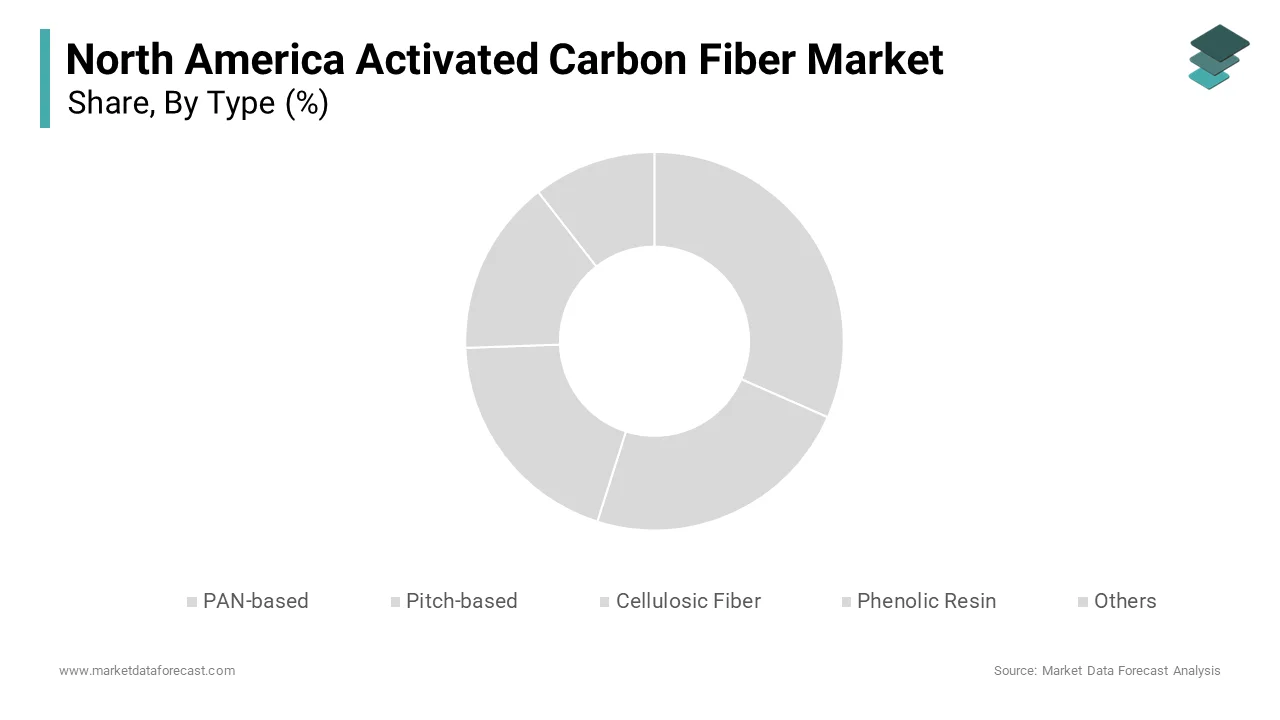
The phenolic resin-based activated carbon fiber segment is emerging as the fastest-growing type in the North America market and is projected to expand at a CAGR of 9.8% between 2025 and 2033. Rising demand for solvent recovery systems in pharmaceutical and fine chemical manufacturing is a primary factor contributing to the rise of the phenolic resin-based activated carbon fiber segment. In addition, this growth of the segment is driven by increasing adoption in high-temperature filtration and specialty chemical processing applications that require enhanced thermal stability and resistance to chemical degradation. Unlike other fiber types, phenolic resin-based activated carbon fibers maintain structural integrity under extreme conditions, enabling efficient capture and reuse of costly industrial solvents. Moreover, the aerospace and defense sectors are increasingly adopting phenolic resin-based activated carbon fibers for protective gear and filtration components due to their ability to withstand harsh environments. Companies like Honeywell and Lockheed Martin have integrated these fibers into next-generation life support systems and chemical warfare protection suits.
By Application Insights
The air purification application segment dominated the North America activated carbon fiber market by holding an estimated share of 41.5% in 2024. Stringent environmental regulations and the need for clean indoor and outdoor air in both industrial and residential settings are driving the growth of the purification application segment. Besides, the expansion of industrial air pollution control systems, particularly in power generation, waste incineration, and chemical processing facilities, is another key driver of the growth of the segment. As per the U.S. Environmental Protection Agency (EPA), coal-fired power plants must comply with the Mercury and Air Toxics Standards (MATS), which mandate the use of high-efficiency filtration systems. In 2023, over 70% of compliance solutions deployed included activated carbon fiber-based filters, owing to their superior capture rates for mercury and dioxins. An additional significant factor is the rising deployment of HVAC systems with built-in activated carbon filtration in commercial buildings, hospitals, and cleanrooms.
The catalyst carrier application segment is experiencing the fastest growth in the North America activated carbon fiber market and is projected to grow at a CAGR of 10.5% during the forecast period. The adoption of activated carbon fibers in catalytic converters for industrial emissions, particularly in petrochemical and refining operations, is one of the primary growth drivers of the catalyst carrier application segment. This surge is also attributed to the increasing use of activated carbon fibers as supports for catalytic metals in chemical synthesis, emission reduction, and fuel processing. These fibers offer a large surface area, uniform pore structure, and high thermal stability, making them ideal for hosting catalysts such as platinum, palladium, and rhodium. Furthermore, the hydrogen production sector is leveraging activated carbon fiber-based catalyst carriers for ammonia cracking and steam methane reforming processes. With the U.S. Department of Energy promoting hydrogen as a clean energy solution, companies like Plug Power and Bloom Energy are integrating these materials into fuel processing units. This growing intersection between catalysis and clean energy technologies is accelerating the adoption of activated carbon fibers in this high-potential application segment.
COUNTRY-LEVEL ANALYSIS
United States Activated Carbon Fiber Market Analysis
The United States maintained its prominent player in North America by accounting for 68.6% of regional activated carbon fiber consumption in 2024. This lead position is underpinned by the country’s advanced industrial infrastructure, stringent environmental regulations, and strong presence of end-use sectors such as automotive, healthcare, and chemical processing. A major driver behind the U.S. dominance is the expansion of emission control systems in the automotive sector, particularly for gasoline and hybrid vehicles. In addition, the U.S. Environmental Protection Agency’s (EPA) mandates on industrial air pollution have spurred demand for activated carbon fiber-based filtration in coal-fired power plants and chemical manufacturing units. With ongoing research initiatives supported by institutions like MIT and Oak Ridge National Laboratory, the U.S. continues to lead in developing next-generation activated carbon fiber applications, reinforcing its position as the innovation hub of the North American market.
Canada Activated Carbon Fiber Market Analysis
Canada is positioning itself as a strategic supplier and emerging manufacturing base, according to Natural Resources Canada. While not a major producer of activated carbon fibers itself, Canada plays a crucial role in supplying precursor materials and supporting downstream applications in environmental and industrial sectors. One of the key growth drivers in Canada is the government-backed investment in clean technology and advanced materials, including significant funds allocated under the Critical Minerals Strategy to support domestic supply chains for specialty chemicals and filtration materials. Besides, Canadian companies such as Ballard Power Systems and General Electric Canada are incorporating activated carbon fibers into emission control systems for heavy-duty transport and power generation equipment. With increasing focus on sustainability and localized sourcing, Canada is strengthening its foothold in the North American activated carbon fiber ecosystem.
Rest of North America Activated Carbon Fiber Market Analysis
The Rest of North America market is showing signs of development, particularly in Mexico, where industrialization and environmental regulations are gaining momentum. Mexico’s proximity to U.S. supply chains and its participation in the USMCA trade agreement provide access to advanced materials and manufacturing expertise. In 2023, the Mexican government introduced stricter air quality norms, prompting industrial operators in sectors such as petrochemicals and food processing to adopt activated carbon fiber-based filtration systems to meet compliance targets. Despite challenges related to raw material availability and limited domestic production capacity, the Rest of North America presents long-term opportunities for activated carbon fiber suppliers aiming to expand beyond traditional markets.
COMPETITIVE LANDSCAPE
- The competition in the North American activated carbon fiber market is characterized by a mix of established chemical giants and niche specialty material providers vying to capture growing demand from industrial, environmental, and healthcare sectors. While global players dominate due to their technological expertise and extensive distribution networks, regional firms are increasingly emerging as formidable contenders by focusing on localized production and application-specific customization.
- Market participants are differentiating themselves through innovation, with a particular emphasis on developing fibers with enhanced adsorption capacity, thermal stability, and reusability. Strategic alliances with end-users in the automotive and clean energy sectors have become a common approach to secure long-term contracts and align product development with evolving regulatory standards.
- Moreover, sustainability is becoming a key differentiator, with companies emphasizing eco-friendly activation methods and recyclable fiber options. As industries continue to prioritize clean air, water, and responsible manufacturing practices, the activated carbon fiber market remains highly dynamic, with both incumbents and new entrants striving to strengthen their positions through technological advancement and targeted expansion.
KEY MARKET PLAYERS
These are the market players that are dominating the North American carbon fiber market.
- Toyobo Co., Ltd. (Japan)
- BASF Corporation
- Cabot Corporation
- Kuraray Co., Ltd. (Japan)
- Unitika Ltd. (Japan)
- Gun Ei Chemical Industry Co., Ltd. (Japan)
- Evertech Envisafe Ecology Co., Ltd. (Taiwan)
- AWA Paper & Technology Company, Inc. (Japan)
- Taiwan Carbon Technology Co., Ltd. (Taiwan)
- Daigas Group (Japan)
- Auro Carbon & Chemicals (India)
- Hangzhou Nature Technology Co., Ltd. (China)
- Eurocarb Products Ltd. (UK)
- China Beihai Fiberglass Co., Ltd. (China)
- Bio-Medical Carbon Technology Co., Ltd. (Taiwan).
Top Players In The Market
- BASF is a leading global chemical company with a strong presence in the North American activated carbon fiber market. The company offers high-performance activated carbon fiber solutions tailored for industrial filtration, air purification, and emission control applications. With its extensive R&D capabilities and integrated supply chain, BASF supports key industries such as automotive, healthcare, and energy by delivering advanced materials that meet evolving environmental standards.
- Cabot is a major player in specialty chemicals and performance materials, including activated carbon fibers. In North America, Cabot supplies customized activated carbon fiber products used across air and water purification systems, solvent recovery, and protective textiles. The company’s focus on innovation and sustainability has positioned it as a trusted partner for manufacturers seeking high-efficiency filtration solutions aligned with regulatory compliance and environmental responsibility.
- Kuraray, through its U.S. subsidiary, plays a vital role in supplying high-quality activated carbon fiber to the North American market. Known for its proprietary production technologies, Kuraray delivers specialized fibers used in advanced air filtration, cleanroom applications, and catalysis. Its long-standing reputation for technical excellence and product reliability makes it a preferred supplier for critical industrial and healthcare applications across the region.
Top Strategies Used by Key Market Participants
Product Innovation and Customization
Leading companies are investing heavily in research and development to create advanced activated carbon fiber variants tailored for specific end-use applications. By enhancing pore structure, surface chemistry, and mechanical properties, firms can offer customized solutions that meet stringent industry requirements in sectors like healthcare, aerospace, and emissions control.
Strategic Collaborations with End-Use Industries
To ensure consistent demand and improve application-specific performance, key players are forming strategic partnerships with automotive manufacturers, industrial filter producers, and clean technology developers. These collaborations help align product development with real-world needs while securing long-term supply agreements.
Expansion of Localized Production and Technical Support
Given the logistical challenges and rising demand for fast delivery, companies are strengthening their regional footprint by expanding local manufacturing units and technical service centers. This enables quicker response times, reduced transportation costs, and better customer engagement, reinforcing their competitive edge in the North American market.
RECENT MARKET NEWS
- In February 2024, BASF Corporation launched a new line of ultra-porous activated carbon fibers designed specifically for industrial air purification, aiming to meet the increasing demand for high-efficiency filtration in chemical processing plants.
- In May 2024, Cabot Corporation announced an expanded partnership with a major HVAC equipment manufacturer to integrate its activated carbon fiber modules into next-generation commercial air filtration systems for green building projects.
- In July 2024, Kuraray initiated upgrades at its U.S. facility to enhance activated carbon fiber production capacity, supporting growing orders from the automotive sector for evaporative emission control systems.
- In October 2024, Honeywell Advanced Materials introduced a new composite using activated carbon fiber for use in firefighter protective gear, offering superior chemical resistance and breathability in extreme environments.
- In December 2024, StandaTextiletie, a leading healthcare fabric manufacturer, collaborated with a carbon fiber supplier to develop antimicrobial medical masks incorporating activated carbon fiber layers for enhanced respiratory protection.
MARKET SEGMENTATION
This research report on the North American activated carbon fiber market is segmented and sub-segmented into the following categories.
By Type
- PAN-based
- Pitch-based
- Cellulosic Fiber
- Phenolic Resin
- Others
By Application
- Solvent Recovery
- Air Purification
- Water Treatment
- Catalyst Carrier
- Others
By Country
- USA
- Canada
- Mexico
- Rest of North America
Frequently Asked Questions
What is the North America activated carbon fiber market?
The North American activated carbon fiber market focuses on the production and use of high-porosity carbon fibers used for filtration, purification, and adsorption in industries such as water treatment, air purification, chemicals, and electronics.
What is driving growth in the North America activated carbon fiber market?
Growth is driven by rising concerns about air and water quality, stricter pollution regulations, and the increasing need for advanced filtration materials in industrial and environmental applications.
Why is activated carbon fiber preferred over traditional activated carbon?
Activated carbon fiber offers faster adsorption rates, higher surface area, better regeneration capability, and a lighter, more flexible structure — making it suitable for modern, high-performance filtration systems.
Which industries use activated carbon fiber in North America?
Key users include water treatment plants, HVAC and air purification manufacturers, automotive emission control systems, chemical processing industries, and electronics and semiconductor facilities requiring ultra-clean environments.
What advantages does the North America activated carbon fiber market offer to manufacturers?
Manufacturers benefit from improved efficiency, lower maintenance cycles, and the ability to design compact, high-capacity filtration units that meet strict environmental standards.
What challenges affect the North America activated carbon fiber market?
High production costs, limited domestic manufacturing capacity, and the need for specialized raw materials can slow adoption—especially in cost-sensitive sectors.
Are sustainability trends impacting the North America activated carbon fiber market?
Yes. There is growing interest in eco-friendly purification technologies, renewable raw materials, and low-waste manufacturing processes, which increases demand for high-performance carbon-based filtration materials.
How is technology influencing the North America activated carbon fiber market?
Advances in fiber processing, carbon activation techniques, and nanomaterial integration are improving adsorption efficiency and expanding the range of industrial applications.
Which applications are expected to grow fastest in the North America activated carbon fiber market?
Air purification systems, industrial emission control, solvent recovery units, and high-purity water systems are among the fastest-growing areas due to rising environmental compliance needs.
What is the long-term outlook for the North America activated carbon fiber market?
The market is expected to grow steadily as environmental regulations strengthen, industries adopt more efficient filtration technologies, and new applications emerge in energy storage, medical devices, and advanced manufacturing.
Related Reports
Access the study in MULTIPLE FORMATS
Purchase options starting from
$ 2000
Didn’t find what you’re looking for?
TALK TO OUR ANALYST TEAM
Need something within your budget?
NO WORRIES! WE GOT YOU COVERED!
Call us on: +1 888 702 9696 (U.S Toll Free)
Write to us: sales@marketdataforecast.com