- Product Description Description
- Table of Contents TOC
- List of Table & Figure LOT
- Get Free Sample PDF Sample PDF
North America Advanced Phase Change Materials Market Size
The Advanced phase change materials market size in North America was valued at USD 1.01 billion in 2025 and is predicted to be worth USD 3.22 billion by 2034 from USD 1.15 billion in 2026, growing at a CAGR of 13.75% from 2026 to 2034.
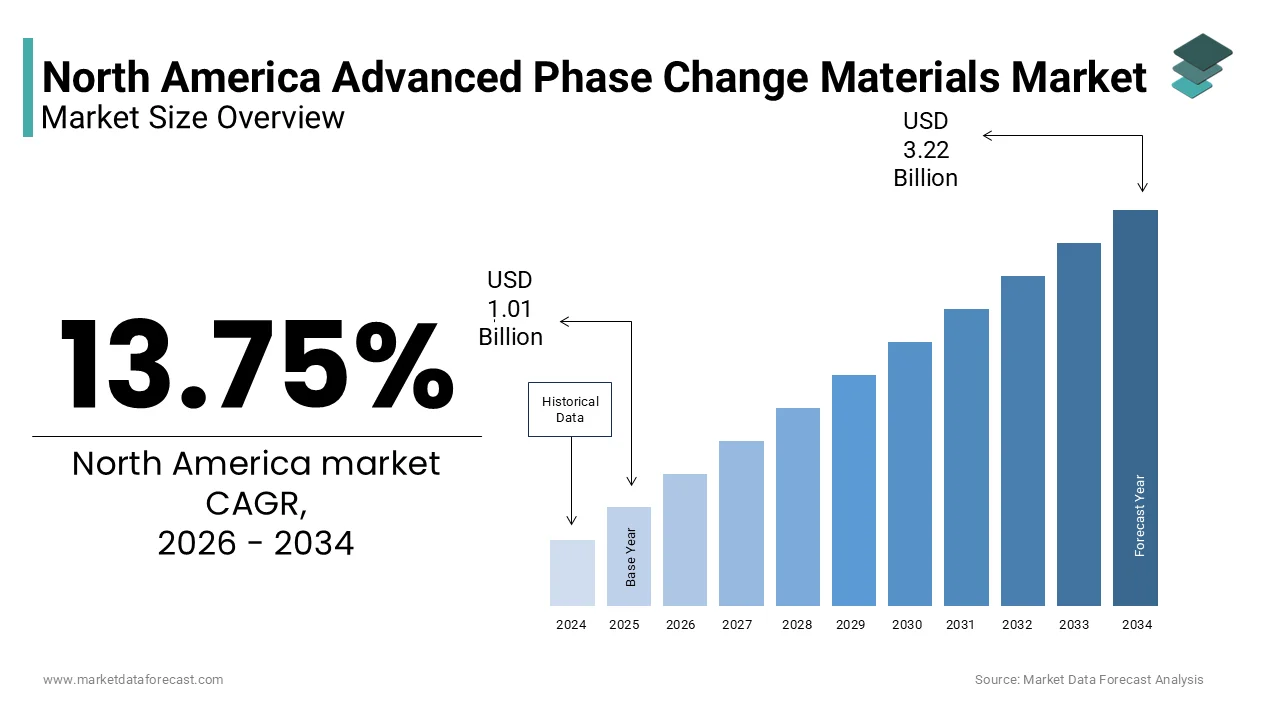
The advanced phase change materials (PCMs) market encompasses a class of high-performance materials capable of absorbing, storing, and releasing large amounts of thermal energy during phase transitions, primarily between solid and liquid states. These materials are increasingly deployed in thermal energy storage, building insulation, electronics cooling, and renewable energy systems to enhance energy efficiency and temperature regulation. Unlike conventional insulation materials, advanced PCMs offer dynamic thermal management, enabling precise control over heat fluctuations in both industrial and consumer applications.
In recent years, the region has witnessed growing adoption of PCMs in construction and HVAC systems to comply with stringent energy efficiency standards. Canada has also emerged as a key player, particularly in research and development initiatives. Natural Resources Canada has actively supported PCM integration in residential and commercial buildings through its CanmetENERGY program, which promotes energy-efficient technologies. Meanwhile, Mexico is witnessing a gradual rise in PCM adoption in industrial applications, particularly in refrigeration and cold chain logistics.
MARKET DRIVERS
Rising Demand for Energy-Efficient Building Solutions
The growing demand for energy-efficient building solutions is one of the primary drivers of the North America advanced phase change materials (PCM) market. As urbanization accelerates and energy costs rise, governments and developers are increasingly adopting PCM-integrated materials to enhance thermal regulation and reduce HVAC energy consumption in residential and commercial structures. PCM-infused wallboards, ceiling tiles, and insulation panels are being widely used to stabilize indoor temperatures by absorbing excess heat during peak hours and releasing it when ambient temperatures drop. Moreover, regulatory mandates such as Title 24 in California, which requires buildings to meet stricter energy efficiency benchmarks, are further accelerating PCM integration into construction materials.
Expansion of Renewable Energy and Thermal Storage Applications
The expanding deployment of renewable energy systems, particularly solar thermal and concentrated solar power (CSP) plants, is another critical driver of the North America advanced phase change materials (PCM) market. These systems rely on efficient thermal energy storage to maintain consistent power generation despite intermittent sunlight, making PCMs an essential component for heat retention and load management.
In Canada, Natural Resources Canada has supported several pilot projects integrating phase change materials into solar thermal collectors used in district heating systems. PCM-integrated solar storage units achieved improvement in heat retention compared to traditional water-based systems, enhancing overall system performance.
Besides, the push for grid stability and energy decentralization has led to increased adoption of PCM-based storage in industrial and microgrid applications. PCM-assisted thermal storage units are being tested in several U.S. cities to manage peak electricity demand, particularly during heatwaves when cooling loads surge.
 MARKET RESTRAINTS
High Cost and Limited Availability of High-Performance Phase Change Materials
The high cost and limited availability of high-performance materials that offer optimal thermal characteristics, stability, and durability is one of the major restraints affecting the North America advanced phase change materials (PCM) market. While organic and inorganic PCMs are available, many high-efficiency materials such as paraffin waxes with tailored melting points, salt hydrates, and composite phase change materials remain expensive to produce and integrate into end-use applications.
The cost of high-purity paraffin-based PCMs used in building applications is higher than conventional insulation materials. This cost differential significantly limits widespread adoption, particularly in price-sensitive construction markets. Moreover, supply chain constraints for raw materials used in advanced PCMs, such as specialized waxes, encapsulation polymers, and nano-enhanced additives, have led to production bottlenecks. In Canada, the National Research Council (NRC) identified a lack of standardized PCM formulations as a key challenge, leading to inconsistent performance across different suppliers and applications. This variability increases the cost of testing and integration for end users, discouraging adoption.
Technical Limitations and Compatibility Issues in Practical Applications
The presence of technical limitations and compatibility issues when integrating PCMs into existing systems and materials is another significant challenge hindering the growth of the North America advanced phase change materials (PCM) market. Despite their thermal regulation capabilities, many PCMs face issues such as leakage, phase segregation, reduced thermal conductivity, and incompatibility with surrounding construction or industrial materials.
Additionally, in industrial applications such as electronics cooling and thermal energy storage, compatibility issues between PCMs and container materials can lead to corrosion, reduced efficiency, and premature failure. Also, several PCM-based battery cooling systems had to be redesigned due to incompatibility between the phase change material and the battery casing, increasing development time and costs.
Moreover, the lack of standardized testing protocols and certification frameworks for PCM performance in real-world conditions has slowed adoption. Also, PCM integration in LEED-certified buildings remains limited due to the absence of universally accepted performance benchmarks.
MARKET OPPORTUNITIES
Integration of Phase Change Materials in Electric Vehicle Battery Thermal Management
The growing integration of PCMs in electric vehicle (EV) battery thermal management systems is one of the most promising opportunities for the North America advanced phase change materials (PCM) market. As the EV market expands, ensuring optimal battery temperature regulation has become critical to enhancing performance, longevity, and safety—areas where advanced phase change materials offer significant advantages. Also, over 1.2 million electric vehicles were sold in the United States in 2023, reflecting a 45% increase compared to the previous year. This rapid growth has intensified the demand for efficient battery cooling solutions to prevent thermal runaway and maintain consistent performance across varying climatic conditions.
Advanced PCMs, particularly paraffin-based and composite materials with tailored phase transition temperatures, are increasingly being embedded within battery packs to absorb excess heat during charging and discharging cycles. Besides, automotive manufacturers such as Tesla, General Motors, and Rivian are actively exploring PCM-based passive cooling solutions to enhance battery efficiency and reduce vehicle weight. The U.S. Department of Energy has also funded several research initiatives to develop nano-enhanced PCMs for EV applications, aiming to improve thermal conductivity and integration with existing battery designs.
Adoption of Phase Change Materials in Cold Chain and Food Logistics
The expanding cold chain and food logistics industry is another emerging opportunity for the North America advanced phase change materials (PCM) market. As demand for temperature-sensitive perishables increases, particularly in pharmaceuticals, dairy, seafood, and fresh produce, there is a growing need for passive cooling solutions that ensure product integrity without relying solely on energy-intensive refrigeration. In addition, companies are increasingly integrating phase change materials into insulated packaging, refrigerated containers, and transport pallets to maintain stable temperatures for extended periods.
In 2023, the Food and Drug Administration (FDA) updated its guidelines for pharmaceutical cold chain logistics, encouraging the use of non-electric temperature control solutions, including PCMs, to ensure vaccine and biopharmaceutical stability during transport. This regulatory shift has spurred adoption among logistics providers such as FedEx and UPS, which have begun incorporating PCM-based packaging in their temperature-controlled shipping solutions. With the cold chain logistics sector expected to grow steadily due to e-commerce expansion and increasing regulatory emphasis on food safety, the demand for advanced phase change materials in this application is poised for substantial growth.
MARKET CHALLENGES
Limited Awareness and Lack of Technical Expertise in End-User Industries
The limited awareness and lack of technical expertise among end-users regarding the benefits and integration of PCM-based solutions is a significant challenge facing the North America advanced phase change materials (PCM) market. Despite their proven thermal regulation capabilities, many industries remain hesitant to adopt these materials due to a lack of understanding of their performance characteristics, application methods, and return on investment. This knowledge gap results in underutilization of PCMs, particularly in retrofitting projects and new construction where traditional insulation remains the default choice.
Moreover, the complexity of integrating PCMs into existing systems without compromising structural integrity or thermal performance requires specialized engineering expertise. In the automotive sector, while OEMs recognize the potential of PCMs in battery thermal management, there remains a lack of industry-wide best practices for their deployment. Until educational initiatives, technical training, and industry collaboration improve awareness and facilitate broader adoption, the advanced PCM market will continue to face challenges in reaching its full potential across North America.
Regulatory and Standardization Gaps Hindering Market Growth
Lack of comprehensive regulatory frameworks and standardized performance benchmarks is another critical challenge impeding the North America advanced phase change materials (PCM) market. Unlike conventional insulation and thermal management materials, PCMs are still relatively new in mainstream industrial and construction applications, leading to inconsistencies in testing, certification, and compliance requirements. According to the National Institute of Standards and Technology (NIST), no universally accepted testing protocols exist for evaluating PCM performance under real-world conditions, making it difficult for manufacturers and end-users to compare products or ensure reliability. This inconsistency hampers procurement decisions and delays integration into large-scale projects.
In the building and construction sector, the U.S. Green Building Council has acknowledged that PCM integration into LEED certification criteria remains limited due to the absence of standardized energy performance metrics. Similarly, the International Code Council (ICC) has yet to incorporate PCM-specific guidelines into the International Energy Conservation Code (IECC), limiting their adoption in new building codes. In the transportation and logistics industry, the Food and Drug Administration (FDA) and the U.S. Department of Transportation (DOT) have not yet established formal guidelines for PCM-based passive cooling systems in food and pharmaceutical transport, creating regulatory uncertainty for logistics providers.
Furthermore, the lack of standardized labeling and performance claims has led to market confusion, with some manufacturers overstating PCM capabilities without third-party validation. The American Society for Testing and Materials (ASTM) is currently working on developing standardized PCM testing methods, but full implementation remains a work in progress.
REPORT COVERAGE
| REPORT METRIC | DETAILS |
| Market Size Available | 2025 to 2034 |
| Base Year | 2025 |
| Forecast Period | 2026 to 2034 |
| CAGR | 13.75% |
| Segments Covered | By Product Type, Application, and Region |
|
Various Analyses Covered | Regional & Country Level Analysis, Segment-Level Analysis, DROC, PESTLE Analysis, Porter’s Five Forces Analysis, Competitive Landscape, Analyst Overview on Investment Opportunities |
| Regions Covered | The United States, Canada, Mexico, and Rest of North America |
| Market Leaders Profiled | Henkel AG & Co.KGaA, Croda International Plc, Cryopak, Parker Hannifin Corp, and Pluss Advanced Technologies, and others |
SEGMENTAL ANALYSIS
By Product Type Insights
The paraffin-based phase change materials (PCM) segment dominated the North America advanced phase change materials market by accounting for 63.3% of total revenue in 2025. The superior thermal performance and reliability of paraffin PCMs , particularly in building and construction applications is one of the key drivers of this segment’s growth. Their ability to store and release heat without degradation over thousands of cycles enhances their appeal in energy-efficient building designs. The dominance of segment is primarily attributed to the favorable thermal properties, chemical stability, and widespread applicability of paraffin waxes across multiple industries.

Besides, the growing adoption of paraffin-based PCMs in HVAC systems has further fueled market growth. Moreover, the automotive industry’s increasing use of paraffin-based PCMs in electric vehicle battery thermal management has expanded their application base. The U.S. Department of Energy’s National Renewable Energy Laboratory (NREL) found that PCM-integrated battery modules demonstrated improvement in thermal stability , reinforcing their role in next-generation EVs.
The salt hydrates segment is projected to grow at the fastest CAGR of 9.1% from 2026 to 2034 in the North America advanced phase change materials (PCM) market. The use of salt hydrates in concentrated solar power (CSP) plants, where thermal energy storage is critical for continuous power generation, is one of the primary growth drivers. This rapid growth is also driven by the increasing demand for high-energy-density thermal storage solutions in industrial and renewable energy applications. Additionally, the industrial process heating sector is increasingly adopting salt hydrate PCMs for load shifting and peak shaving. Furthermore, government-funded research initiatives are accelerating the development of stabilized salt hydrate formulations to overcome common issues like supercooling and phase separation.
By Application Insights
The building & construction segment led the North America advanced phase change materials (PCM) market by capturing 52% of total revenue in 2025. The rising adoption of PCM-integrated wallboards, ceiling tiles, and insulation panels in both residential and commercial buildings is a key growth factor. This dominance is also driven by the increasing integration of PCMs into building materials to enhance energy efficiency, reduce HVAC loads, and meet stringent sustainability standards. Apart from these, the U.S. Department of Energy’s Building Technologies Office has been actively promoting the use of phase change materials as part of its energy efficiency initiatives. Also, buildings using PCM-integrated drywall experienced a 15–20% reduction in heating and cooling energy use , reinforcing their effectiveness in passive thermal regulation. In Canada, the National Research Council (NRC) has supported several pilot projects integrating PCMs into residential and institutional buildings, particularly in cold climate zones. With increasing regulatory emphasis on energy-efficient construction and growing awareness of passive cooling and heating strategies, the building & construction segment remains the cornerstone of the North America advanced PCM market.
The commercial refrigeration application segment is anticipated to grow at the fastest CAGR of 9.4% in the North America advanced phase change materials (PCM) market between 2026 and 2034. The increasing integration of PCMs into refrigerated transport containers and insulated packaging to maintain stable temperatures without continuous reliance on active refrigeration systems. This rapid growth is also driven by the expanding cold chain logistics industry and the need for energy-efficient, passive cooling solutions in food and pharmaceutical storage and transport. Besides, the pharmaceutical sector is increasingly using phase change materials in vaccine and biopharmaceutical transport to ensure product integrity. With the cold chain logistics sector expected to grow due to e-commerce expansion and rising demand for temperature-sensitive goods, the commercial refrigeration segment is poised for significant growth in the North America PCM market.
REGIONAL ANALYSIS
United States
The United States led the North America advanced phase change materials (PCM) market at 65.2% in 2025 by reflecting its dominant position as a hub for innovation, research, and industrial adoption of thermal energy storage technologies. As the largest economy in the region and a global leader in renewable energy and electric vehicle development, the U.S. drives substantial demand for advanced PCMs across multiple sectors. A key growth driver is the expanding integration of PCMs in energy-efficient building construction. Besides, the rapid growth of the electric vehicle (EV) market has spurred demand for PCM-based battery thermal management systems. Moreover, the concentrated solar power (CSP) industry is increasingly utilizing advanced phase change materials for thermal storage. With continued advancements in thermal management technologies and strong government support for energy efficiency and decarbonization, the United States remains the cornerstone of the North America advanced PCM market.
Canada
Canada is positioning it as a key player in the regional industry. While smaller in scale compared to the U.S., Canada’s market benefits from strong government support for clean energy innovation, academic research, and industrial decarbonization efforts. A major driver of PCM adoption in Canada is the government-backed initiatives focused on energy-efficient building technologies. These initiatives demonstrated an improvement in thermal stability, reinforcing the value of PCMs in reducing heating costs and enhancing occupant comfort. Additionally, the cold chain logistics sector in Canada is increasingly adopting PCM-based passive cooling solutions for food and pharmaceutical transport. Moreover, the Canadian government has been actively funding research and development in advanced thermal storage materials. In 2023, the National Research Council (NRC) collaborated with academic institutions to develop stabilized salt hydrate formulations that address common issues such as supercooling and phase separation, enhancing their commercial viability.
Mexico
Mexico is reflecting its emerging role in the regional industry. While still in the early stages of adoption compared to the U.S. and Canada, Mexico is witnessing a gradual increase in PCM utilization, particularly in industrial and logistics applications. One of the key growth drivers is the expansion of the automotive and manufacturing industries , which are increasingly adopting PCM-based thermal management solutions. Additionally, the cold chain logistics sector is growing rapidly, driven by increasing exports of perishable goods and the need for temperature-controlled transport. Moreover, the Mexican government has been promoting energy efficiency in industrial applications, particularly in food processing and pharmaceuticals.
COMPETITIVE LANDSCAPE
The North America advanced phase change materials (PCM) market is characterized by a mix of established chemical and materials science companies, niche PCM specialists, and emerging startups focused on thermal energy innovation. The competition is intense, with firms striving to differentiate themselves through material performance, sustainability, and application-specific formulations. While some companies focus on high-purity paraffin waxes for building insulation, others are pioneering salt hydrate-based solutions for industrial thermal storage and renewable energy applications. The market also sees active participation from academic and government-backed research institutions that drive innovation and help bridge the gap between laboratory-scale development and commercial deployment. Companies are increasingly aligning with end-user industries such as construction, automotive, and logistics to demonstrate the practical benefits of PCMs and overcome adoption barriers. Despite the promising growth trajectory, market participants face challenges related to cost competitiveness, integration complexity, and limited awareness among potential users. As the demand for energy-efficient and sustainable thermal management solutions continues to rise, the competitive landscape is expected to evolve with greater emphasis on standardization, scalability, and cross-sector collaboration.
KEY MARKET PLAYERS
Henkel AG & Co.KGaA, Croda International Plc, Cryopak, Parker Hannifin Corp, and Pluss Advanced Technologies are playing dominating role in the North America advance phase change materials market.
TOP PLAYERS IN THE MARKET
- CryoSolplus is a leading innovator in advanced phase change materials, offering customized PCM solutions for thermal energy storage and temperature regulation. The company plays a crucial role in developing high-performance materials tailored for building, industrial, and transportation applications. With a strong focus on research and development, CryoSolplus has established itself as a key contributor to the global PCM industry by delivering scalable and efficient thermal management technologies.
- Phase Change Energy Solutions is a U.S.-based company specializing in bio-based phase change materials designed for building and HVAC applications. The company is known for its sustainable PCM products derived from renewable feedstocks, aligning with the growing demand for eco-friendly thermal storage solutions. Its innovations have significantly influenced the adoption of passive cooling and heating systems in commercial and residential buildings across North America.
- Rubitherm is a renowned manufacturer of advanced phase change materials, offering a wide range of paraffin-based and salt hydrate-based PCMs for industrial and energy applications. The company is recognized for its high-quality, encapsulated PCM products used in thermal energy storage, refrigeration, and electric vehicle battery management. Rubitherm’s contributions to material formulation and encapsulation technology have made it a trusted name in the global PCM market.
TOP STRATEGIES USED BY KEY PLAYERS
Product Innovation and Material Customization
Leading companies prioritize continuous research and development to create advanced phase change materials tailored for specific applications. This includes developing bio-based, high-purity, and nano-enhanced PCMs that offer superior thermal performance and environmental sustainability across building, industrial, and transport sectors.
Strategic Collaborations and Industry Partnerships
To accelerate market adoption, key players engage in strategic collaborations with academic institutions, government agencies, and end-use industries. These partnerships help in co-developing application-specific PCM solutions, validating performance through pilot projects, and integrating PCMs into mainstream thermal management systems.
Expansion of Application-Specific Product Portfolios
Major market participants are expanding their product lines to cater to niche applications such as electric vehicle battery cooling, cold chain logistics, and concentrated solar power systems. By offering tailored PCM formulations for each sector, companies are enhancing their market presence and addressing the diverse needs of end users.
RECENT HAPPENINGS IN THE MARKET
- In March 2023, CryoSolplus introduced a new line of nano-enhanced phase change materials, specifically designed for use in electric vehicle battery cooling systems, aiming to improve thermal regulation and battery longevity.
- In October 2023, Phase Change Energy Solutions partnered with a leading U.S. insulation manufacturer to integrate its bio-based PCM technology into wall and ceiling panels, enhancing thermal performance in residential and commercial buildings.
- In January 2025, Rubitherm expanded its North American distribution network by collaborating with a regional materials supplier, enabling faster delivery and broader access to its encapsulated PCM products for industrial applications.
- In May 2025, a major U.S. HVAC company collaborated with an advanced PCM developer to incorporate phase change materials into next-generation air handling units, targeting energy savings in commercial buildings.
- In November 2025, a Canadian cold chain logistics provider adopted PCM-based passive cooling systems for pharmaceutical transport, aiming to reduce energy consumption and ensure product stability during long-distance deliveries.
MARKET SEGMENTATION
This research report on the North America advanced phase change materials market has been segmented and sub-segmented based on the following categories.
By Product Type
- Paraffin
- Salt Hydrates
- Others
By Application
- Building & Construction
- Commercial Refrigeration
- HVAC
- Energy Storage
- Shipping & Transportation
- Others
By Country
- The United States
- Canada
- Rest of North America