- Product Description Description
- Table of Contents TOC
- List of Table & Figure LOT
- Get Free Sample PDF Sample PDF
Market Size, 2025
$17.87 BnMarket Estimate, 2026
$19.50 BnMarket Forecast, 2034
$39.20 BnCAGR, 2026–2034
9.12%North America Aerospace Avionics Market Summary
The North America aerospace avionics market was valued at USD 17.87 billion in 2025 and is anticipated to reach USD 19.50 billion in 2026 and USD 39.20 billion by 2034, growing at a CAGR of 9.12% during the forecast period from 2026 to 2034. Commercial Aircraft Fleet Modernization and Replacement Cycles, Military Modernization Programs, and Defense Spending are the major market drivers in the market.
Key Market Trends & Insights
- United States was the top performer in the North American Market in 2025
- Canada is expected to showcase strong growth throughout the forecast period.
- Based on the System, the communications systems segment accounted for the market in 2025
- Based on Fit, the line-fit installations segment held a dominant share of the market in 2025.
Market Size & Forecast
2026 Market Size: USD 19.50 Billion
2034 projected Market Size: USD 39.20 Billion
CAGR (2026 to 2034): 9.12%
United States: Largest Market in 2026
Canada: Strongest Growth Region
North America Aerospace Avionics Market Size
The North America aerospace avionics market was valued at USD 17.87 billion in 2025 and is anticipated to reach a valuation of USD 19.50 billion in 2026 and USD 39.20 billion by 2034, growing at a CAGR of 9.12%, from 2026 to 2034.
The avionics are a portmanteau of aviation and electronics, encompassing an extensive array of systems including flight management computers, radar systems, communication equipment, navigation aids, display systems, and autopilot mechanisms that ensure safe and efficient aircraft operations. As per the Federal Aviation Administration (FAA), the North American civil aviation fleet exceeded 220,000 aircraft in 2023, with commercial airlines operating over 8,000 aircraft and general aviation accounting for approximately 210,000 registered aircraft. The Department of Defense reports that military aircraft modernization programs have accelerated, with over 15,000 military aircraft requiring avionics upgrades to maintain operational readiness and technological superiority. The implementation of NextGen air traffic management systems by the FAA has necessitated widespread avionics modernization across the commercial and general aviation sectors. Aerospace manufacturers have increasingly focused on developing integrated avionics suites that provide pilots with comprehensive situational awareness through synthetic vision systems, weather radar, and collision avoidance technologies.
MARKET DRIVERS
Commercial Aircraft Fleet Modernization and Replacement Cycles
The ongoing commercial aircraft fleet modernization initiatives and replacement cycles across North America have emerged as a primary factor propelling the aerospace avionics market. Airlines are increasingly investing in next-generation aircraft equipped with advanced avionics systems to improve fuel efficiency, enhance passenger comfort, and comply with evolving regulatory requirements. The average service life of commercial aircraft has decreased to approximately 25 years, accelerating replacement cycles and creating sustained demand for modern avionics installations. Major carriers including American Airlines, Delta Air Lines, and United Airlines have announced multi-billion-dollar fleet modernization programs that include comprehensive avionics upgrades and new aircraft acquisitions. The Boeing 737 MAX grounding incident and subsequent return to service requirements have necessitated extensive avionics modifications and pilot training programs, stimulating market activity. Regional carriers and cargo operators are also upgrading their fleets with advanced avionics systems to improve operational efficiency and safety performance. Airlines are increasingly adopting fly-by-wire systems, digital flight decks, and integrated modular avionics architectures that require sophisticated electronic systems and software solutions. Passenger expectations for in-flight connectivity and entertainment have necessitated the installation of advanced communication and information systems. The convergence of operational efficiency requirements and regulatory compliance mandates has made avionics modernization a strategic priority for commercial operators. Airlines are also investing in pilot training simulators and ground support equipment that incorporate advanced avionics technologies to ensure proper crew familiarization and system optimization.
Military Modernization Programs and Defense Spending
The military modernization programs and increased defense spending across North America have become significant drivers for the growth of the North American aerospace avionics market. According to the Stockholm International Peace Research Institute (SIPRI), North American defense expenditures reached $802 billion in 2023, representing the largest military budget globally and driving substantial investments in aerospace capabilities. The United States Department of Defense has prioritized the modernization of tactical aircraft, strategic bombers, and unmanned systems through programs such as the F-35 Lightning II, B-21 Raider, and MQ-9 Reaper platforms, each requiring sophisticated avionics systems for mission execution. The integration of fifth-generation fighter capabilities, including advanced radar systems, electronic warfare suites, and secure communication networks, has created demand for cutting-edge avionics technologies that provide tactical advantages in contested environments. The emphasis on network-centric warfare has driven demand for integrated avionics systems that enable real-time information sharing and coordinated operations across multiple platforms. Unmanned aerial vehicle programs have accelerated, with the Department of Defense allocating over $4.8 billion for UAV development and procurement in 2023, each platform requiring specialized avionics for autonomous operations and remote piloting.
MARKET RESTRAINTS
Stringent Regulatory Compliance and Certification Requirements
The increasingly stringent regulatory compliance requirements and complex certification processes that govern the development, installation, and operation of electronic systems in aircraft are significantly limiting the growth of the North American aerospace avionics market. The Federal Aviation Administration (FAA) enforces rigorous airworthiness standards under Title 14 of the Code of Federal Regulations, requiring extensive testing, validation, and documentation for all avionics equipment before certification approval. According to the FAA's Aircraft Certification Service, the average certification timeline for new avionics systems has extended to 36 months, with some complex systems requiring over five years for complete regulatory approval. The Technical Standard Orders (TSO) and Supplemental Type Certificates (STC) processes require extensive engineering documentation, environmental testing, and safety assessments that significantly increase development costs and time-to-market. Cybersecurity regulations have become increasingly important, with the FAA mandating comprehensive security assessments for all network-connected avionics systems to prevent unauthorized access and potential safety hazards. The convergence of multiple regulatory frameworks, including DO-178C for software certification and DO-254 for hardware design assurance, creates complex compliance requirements that necessitate specialized expertise and extensive resources. International cooperation agreements such as the Bilateral Aviation Safety Agreement (BASA) between the United States and the European Union have streamlined some certification processes, but significant regulatory differences remain that require separate approval procedures. The complexity of integrated modular avionics systems has intensified certification requirements, as regulators must evaluate interactions between multiple systems and ensure overall safety and reliability.
Supply Chain Disruptions and Component Shortages
The supply chain disruptions and component shortages that have constrained production capabilities and delayed project timelines are also restricting the growth of the North American aerospace avionics market. The global semiconductor shortage that began in 2020 has had profound impacts on avionics manufacturing, as electronic components, including microprocessors, memory chips, and specialized integrated circuits, are essential for modern aircraft systems. According to the Semiconductor Industry Association (SIA), North America's share of global semiconductor manufacturing capacity declined to 12% in 2023. The aerospace industry's requirement for long-term supply agreements and extended lead times has been challenged by the volatile nature of global supply chains, with manufacturers experiencing delivery delays of 12 to 18 months for components. The consolidation of semiconductor manufacturers and the closure of older fabrication facilities have reduced production capacity and increased dependency on limited suppliers. Quality assurance requirements for aerospace components necessitate extensive testing and validation processes, further extending lead times and reducing supply chain flexibility.
MARKET OPPORTUNITIES
Urban Air Mobility and Electric Aircraft Development
The emergence of urban air mobility (UAM) platforms and electric aircraft development is expected to promote new opportunities for the growth of the North American aerospace avionics market. According to the National Aeronautics and Space Administration (NASA), over 200 companies are actively developing UAM aircraft concepts in North America, with several platforms entering flight testing phases and preparing for commercial certification. The integration of electric propulsion systems requires advanced power management avionics, battery monitoring systems, and thermal management controls that differ significantly from traditional aircraft systems. The Federal Aviation Administration has established new regulatory frameworks for UAM operations, including the creation of low-altitude airspace management systems that require sophisticated avionics for traffic separation and collision avoidance. Autonomous flight capabilities are essential for UAM platforms, necessitating the development of artificial intelligence-enabled avionics systems that can make real-time decisions and respond to dynamic flight conditions. The emphasis on passenger safety and comfort has driven demand for advanced display systems, cabin environment controls, and emergency management avionics. Battery technology limitations have necessitated the development of energy-efficient avionics systems that can maximize flight range and endurance while maintaining safety and performance standards. The integration of ground infrastructure and vertiport systems requires coordinated avionics solutions that can manage aircraft arrival and departure sequences, passenger loading, and charging operations.
Satellite-Based Navigation and Space Systems Integration
The advancement of satellite-based navigation systems and the integration of space technologies will also pose new opportunities for the growth of the North American aerospace avionics market. The modernization of Global Positioning System (GPS) constellations and the deployment of next-generation navigation satellites have enabled more accurate and reliable positioning capabilities that are essential for advanced avionics applications. The integration of multiple satellite navigation systems, including GPS, GLONASS, Galileo, and BeiDou, has created opportunities for multi-constellation receivers that provide enhanced redundancy and positioning accuracy for aviation applications. Space-based communication systems have become increasingly important for aircraft operating in remote regions, oceanic airspace, and polar routes where traditional ground-based communication infrastructure is limited or unavailable. The development of low Earth orbit (LEO) satellite constellations for global internet connectivity has created new opportunities for avionics systems that can leverage high-speed satellite communications for real-time data exchange and operational efficiency improvements. Weather monitoring and atmospheric sensing capabilities provided by satellite systems have enhanced the functionality of avionics weather radar and predictive systems, enabling more accurate flight planning and safety management. The convergence of terrestrial and space-based navigation systems has enabled the development of hybrid avionics architectures that can seamlessly transition between different navigation sources based on availability and accuracy requirements. Military applications have driven demand for secure satellite communication systems and advanced electronic warfare avionics that can operate effectively in contested environments. Research and development initiatives in space technologies have created opportunities for collaboration between aerospace avionics manufacturers and space systems companies, fostering innovation in areas such as quantum sensors, advanced materials, and miniaturized electronics.
MARKET CHALLENGES
Cybersecurity Vulnerabilities and Threat Mitigation
The cybersecurity vulnerabilities and the increasing sophistication of cyber threats that target aircraft electronic systems and flight operations are acting as a barrier for the growth of the North American aerospace avionics market. According to the Department of Homeland Security's Cybersecurity and Infrastructure Security Agency (CISA), over 150 cybersecurity incidents targeting aviation systems were reported in 2023, representing a 40% increase from the previous year and highlighting the growing threat landscape. The integration of internet connectivity, wireless communication systems, and external data interfaces has created new vulnerabilities that require comprehensive security architectures and continuous monitoring capabilities. The complexity of modern avionics systems, with multiple interconnected subsystems and software components, makes vulnerability assessment and threat mitigation particularly challenging for manufacturers and operators. Supply chain security has become a concern, as components and software from multiple vendors can introduce potential security weaknesses that may not be detected through traditional testing and certification processes. The Federal Aviation Administration has issued advisory circulars emphasizing the importance of cybersecurity risk management and requiring operators to implement comprehensive security programs for network-connected avionics systems.
Technological Obsolescence and Legacy System Integration
The technological obsolescence and the integration of modern systems with legacy aircraft platforms that were designed decades ago are also hindering the growth of the North American aerospace avionics market. According to the Aerospace Industries Association (AIA), over 60% of North American commercial aircraft fleets include aircraft that are more than 15 years old and require extensive avionics modernization to maintain operational safety and regulatory compliance. Software compatibility issues arise when attempting to integrate new avionics systems with legacy flight management computers and navigation databases, which is requiring extensive software development and testing to ensure proper functionality and safety. Training requirements for pilots and maintenance personnel increase significantly when upgrading to modern avionics systems, as new interfaces, operational procedures, and system functionalities require extensive familiarization and certification. Regulatory approval processes for major avionics upgrades can be lengthy and expensive, particularly when modifications affect primary flight systems or require supplemental type certificates for structural or electrical changes. The scarcity of qualified technicians and engineers with expertise in both legacy and modern avionics systems has created workforce challenges that can delay upgrade projects and increase implementation costs.
REPORT COVERAGE
| REPORT METRIC | DETAILS |
| Market Size Available | 2025 to 2034 |
| Base Year | 2025 |
| Forecast Period | 2026 to 2034 |
| CAGR | 9.12% |
| Segments Covered | By System, Fit, and Region. |
| Various Analyses Covered | Global, Regional & Country Level Analysis, Segment-Level Analysis, DROC, PESTLE Analysis, Porter’s Five Forces Analysis, Competitive Landscape, Analyst Overview on Investment Opportunities |
| Regions Covered | The United States, Canada, Mexico, Rest of North America |
| Market Leaders Profiled | Astronautics Corporation, BAE Systems, Curtiss-Wright, Elbit Systems, Garmin, General Electric, Honeywell, L3Harris, Leonardo, Meggitt, Northrop Grumman, Raytheon, Safran. |
SEGMENTAL ANALYSIS
By Systems Insights
The communications systems segment accounted in holding 35.4% of the North American aerospace avionics market share in 2025. The Federal Aviation Administration's NextGen air traffic management modernization program has been a primary driver of communications system demand, requiring extensive upgrades to aircraft communication capabilities. The FAA's 2023 NextGen Implementation Plan indicates that over 8,000 aircraft must be equipped with advanced communication systems by 2025 to comply with new air traffic control requirements. The aviation industry's focus on passenger experience has driven massive investment in satellite-based communication systems that enable high-speed internet and entertainment services. According to the Airlines for America 2023 Passenger Experience Report, 92% of U.S. airlines now offer or plan to offer in-flight Wi-Fi services, requiring sophisticated communication systems.
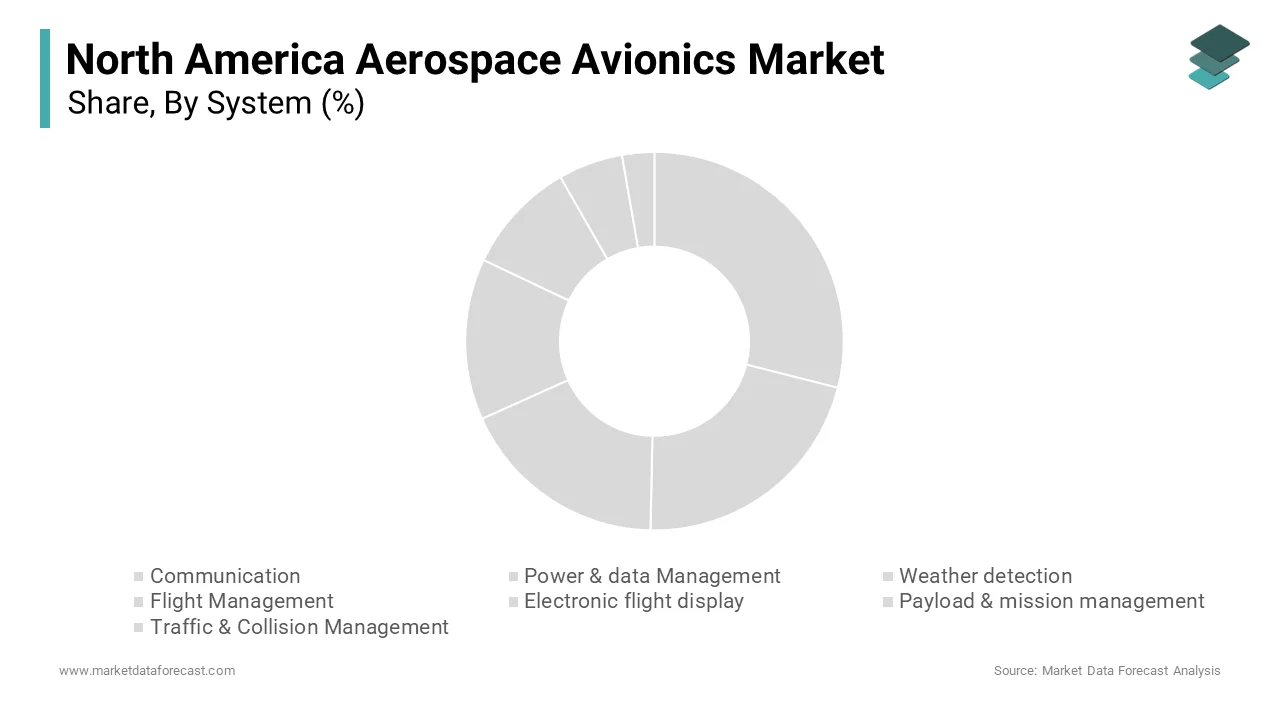
The payload and mission management systems segment is more likely to grow with an anticipated CAGR of 8.9% from 2025 to 2033. The commercial and military unmanned aircraft market has become a primary driver of payload and mission management system demand, with applications ranging from surveillance to cargo delivery. Amazon's Prime Air drone delivery program requires 10,000+ mission management systems for autonomous package delivery operations, while military programs like the MQ-9 Reaper require 200+ advanced payload management systems annually.
By Fit Insights
The line-fit installations segment held a dominant share of the North American aerospace avionics market in 2025. The unprecedented growth in commercial aircraft production is significantly enhancing the growth of the North American aerospace avionics market. Boeing's 2023 Commercial Market Outlook projects 39,000+ new aircraft deliveries over the next two decades, with North American airlines accounting for 35% of total demand. The company's 737 MAX production has reached 42 aircraft per month in 2023, each requiring $2.5-3 million in line-fit avionics systems. Airbus reports similar trends, with A320 family production at 60 aircraft per month generating demand for $3-3.5 million in avionics per aircraft. The average commercial aircraft contains 1,200-1,500 individual avionics components installed during line-fit assembly, according to aerospace industry analysis firm Aviation Week. The business aviation sector has experienced robust growth is driving demand for line-fit avionics in new aircraft deliveries.
The retrofit segment is anticipated to grow with an anticipated CAGR of 7.4% from 2025 to 2033. Aging Commercial Aircraft Fleet Modernization: The North American commercial aircraft fleet includes a significant number of aging aircraft that require avionics upgrades to maintain operational efficiency and regulatory compliance. Airlines for America reports that 35% of the North American commercial fleet is over 15 years old, with many aircraft requiring $500,000-1.5 million in retrofit upgrades. Evolving aviation regulations continue to drive retrofit avionics demand, particularly for terrain awareness, weather radar, and communication system upgrades. The FAA's 2023 Regulatory Agenda includes 15 new avionics requirements that will affect 8,000+ aircraft in the North American fleet. Enhanced Ground Proximity Warning Systems (EGPWS) and Traffic Collision Avoidance Systems (TCAS) upgrades are required for 60% of aging business aircraft, according to the National Transportation Safety Board's safety recommendations. The European Aviation Safety Agency's similar requirements for transatlantic operations have created additional retrofit demand for North American operators.
COUNTRY ANALYSIS
United States
The United States was the top performer of the North American aerospace avionics market by capturing 92.3% of the share in 2025. The United States serves as the global epicenter of aerospace manufacturing and defense aviation, home to major manufacturers like Boeing, Lockheed Martin, and Raytheon Technologies. Boeing's commercial aircraft division delivered 420 aircraft in 2023, generating demand for $1.8 billion in avionics content, while Lockheed Martin's defense programs required $2.1 billion in avionics systems. The U.S. aerospace industry employs over 500,000 workers directly in avionics manufacturing and support, according to the Aerospace Industries Association's 2023 economic impact report. The United States operates the world's largest commercial aviation fleet and most extensive air traffic system, creating massive demand for advanced avionics systems. The FAA's air traffic control system manages 25,000+ daily flights, which requires sophisticated communication, navigation, and surveillance systems worth $1.2 billion annually in avionics procurements.
Canada
Canada was positioned second with 7.1% of the North American aerospace avionics market share in 2025. Canada serves as a manufacturing hub for global aerospace companies, with major facilities for Bombardier, CAE, and numerous tier-one suppliers. Canada's vast geography and challenging northern operating environment create unique demands for advanced avionics systems that can operate in extreme conditions. Transport Canada reports that Canadian airlines operate 1,200+ commercial aircraft, with 60% requiring specialized avionics for northern and remote operations. Air Canada's fleet modernization program has invested CCAD 1.5 billion in avionics upgrades over the past three years, focusing on enhanced navigation and communication systems for Arctic operations. Canada's defense aviation sector and growing unmanned aircraft market represent significant growth opportunities for avionics vendors. The Canadian Armed Forces' upgrade of 200+ military aircraft requires CAD 800 million in avionics systems over the next decade.
KEY MARKET PLAYERS
Astronautics Corporation, BAE Systems, Curtiss-Wright, Elbit Systems, Garmin, General Electric, Honeywell, L3Harris, Leonardo, Meggitt, Northrop Grumman, Raytheon, Safran. Are the market players that are dominating the North American aerospace avionics market
Top Players In The Market
Honeywell Aerospace
Honeywell Aerospace holds a dominant position in the North American aerospace avionics market through its comprehensive portfolio of integrated flight systems, navigation equipment, and cockpit solutions. The company's expertise spans commercial aviation, defense systems, and general aviation applications, providing advanced avionics solutions that enhance flight safety and operational efficiency. Their innovative flight management systems, weather radar technologies, and synthetic vision capabilities have become industry standards across multiple aircraft platforms. Honeywell's commitment to research and development has resulted in breakthrough technologies, including quantum sensors, advanced inertial navigation systems, and integrated modular avionics architectures. Their global service network and technical support capabilities ensure comprehensive customer satisfaction and system reliability. The company's strategic acquisitions and partnerships have expanditseir technological capabilities and market reach across diverse aviation segments. Honeywell's focus on cybersecurity and digital transformation has positioned them at the forefront of next-generation avionics development. Their commitment to sustainability and fuel efficiency has driven innovation in electric propulsion systems and environmental monitoring technologies. The company's extensive certification expertise and regulatory compliance capabilities have facilitated rapid product deployment and market acceptance.
Collins Aerospace (Raytheon Technologies)
Collins Aerospace is also one of the top key players in the North American aerospace avionics market through its advanced communication, navigation, and surveillance systems that serve commercial, military, and business aviation sectors. The company's integrated avionics suites provide comprehensive flight deck solutions that combine display systems, flight management capabilities, and safety enhancement technologies. Their expertise in radar systems, electronic warfare, and mission computing has established them as a preferred supplier for military aircraft programs and defense applications. Collins Aerospace's innovation in satellite communication systems and global positioning technologies has enabled enhanced connectivity and navigation accuracy for aircraft operations worldwide. Their commitment to miniaturization and weight reduction has resulted in advanced avionics systems that improve aircraft performance and fuel efficiency. The company's extensive engineering capabilities and manufacturing facilities support large-scale production requirements for major aircraft programs. Collins Aerospace's focus on artificial intelligence and machine learning integration has accelerated the development of autonomous flight systems and predictive maintenance capabilities. Their global supply chain network and quality assurance processes ensure consistent product delivery and performance standards. The company's strategic investments in emerging technologies, including urban air mobility and electric propulsion systems, have positioned them for future market growth opportunities.
Garmin Ltd.
Garmin Ltd. has established itself as a key player in the North American aerospace avionics market through its innovative portable and panel-mounted navigation systems, communication equipment, and flight management solutions. The company's expertise in consumer electronics and outdoor navigation has translated into advanced avionics products that combine user-friendly interfaces with sophisticated functionality. Their integrated flight decks and glass cockpit solutions have revolutionized general aviation and business aircraft operations through affordable yet comprehensive avionics packages. Garmin's commitment to continuous innovation has resulted in advanced weather radar systems, terrain awareness technologies, and automatic dependent surveillance-broadcast capabilities that enhance flight safety. Their extensive dealer network and customer support infrastructure ensure widespread market penetration and user satisfaction. The company's focus on software updates and system upgrades has maintained product relevance and extended service life for aircraft operators. Garmin's expansion into commercial aviation and helicopter markets has broadened its market presence and technological capabilities. Their emphasis on pilot training and certification support has facilitated successful avionics installations and user adoption. The company's strategic partnerships with aircraft manufacturers and completion centers have integrated their avionics solutions into new aircraft production programs.
Top Strategies Used By Key Market Participants
Vertical Integration and Supply Chain Control
Leading players in the North American aerospace avionics market are pursuing vertical integration strategies to gain greater control over their supply chains and reduce dependency on external suppliers for components. Companies are acquiring semiconductor manufacturers, specialized electronics producers, and software development firms to ensure component availability and maintain competitive advantages. This approach enables manufacturers to secure long-term supply agreements, reduce lead times, and maintain quality standards for aerospace-grade components. Market participants are also investing in domestic manufacturing capabilities to mitigate international supply chain risks and comply with national security requirements. The emphasis on supply chain resilience has become particularly important following recent global disruptions and geopolitical tensions that have affected component availability and pricing. Organizations are developing backup suppliers and alternative sourcing strategies to ensure continuity of supply for mission-avionics systems. The integration of manufacturing capabilities with research and development facilities has accelerated product development cycles and improved innovation outcomes.
Digital Transformation and Software-Defined Avionics
Key market participants are heavily investing in digital transformation initiatives that focus on software-defined avionics architectures and cloud-based development platforms. Companies are developing modular avionics systems that can be easily upgraded through software updates rather than hardware replacements, reducing lifecycle costs and improving system flexibility. This strategy involves creating open architecture platforms that enable third-party developers to create applications and enhancements for avionics systems. Market leaders are also investing in artificial intelligence and machine learning capabilities to enhance autonomous flight systems, predictive maintenance, and operational efficiency optimization. The focus on cybersecurity and data protection has become integral to digital transformation strategies, with companies implementing robust security frameworks and continuous monitoring capabilities. Cloud-based simulation and testing environments are being utilized to accelerate development cycles and reduce certification timelines. The convergence of operational technology and information technology systems has enabled new business models, including avionics-as-a-service and subscription-based software licensing.
Strategic Partnerships and Ecosystem Development
Market participants are increasingly forming strategic partnerships with technology companies, research institutions, and industry consortia to accelerate innovation and expand market reach. Companies are collaborating with semiconductor manufacturers to develop custom chips and integrated circuits optimized for aerospace applications. Partnerships with software companies and artificial intelligence developers have enabled the integration of advanced analytics and autonomous capabilities into avionics systems. Market leaders are also engaging with startups and emerging technology companies to access innovative solutions and maintain competitive advantages in rapidly evolving market segments. The emphasis on ecosystem development has included participation in industry standards organizations and regulatory working groups to influence technology development and certification requirements. Joint development programs with aircraft manufacturers have facilitated the integration of avionics systems into new aircraft designs and reduced development risks. International cooperation agreements and technology sharing arrangements have enabled market participants to access global markets and leverage complementary capabilities across different regions.
COMPETITION OVERVIEW
The North American aerospace avionics market exhibits highly competitive dynamics characterized by the presence of established aerospace primes, specialized avionics vendors, and emerging technology companies. Market competition is intensifying as aircraft manufacturers, airlines, and defense organizations recognize the strategic importance of advanced avionics for safety, efficiency, and operational capabilities. Large aerospace companies leverage their existing customer relationships, certification expertise, and integrated system capabilities to offer comprehensive avionics solutions as part of broader aircraft programs. Specialized avionics vendors compete through technological innovation, cost-effectiveness, and focused functionality that addresses specific market requirements and application needs. The competitive landscape is further complicated by the entry of technology companies and software developers offering innovative solutions for autonomous systems, artificial intelligence, and connectivity applications. Organizations are differentiating themselves through technological advancement, customer service quality, and industry-specific expertise rather than competing solely on price. The market is experiencing consolidation through strategic acquisitions as larger players seek to expand their technological capabilities and market reach. Partnerships between traditional avionics manufacturers and technology companies have become common strategies for addressing complex system integration requirements. Regional variations in regulatory requirements and customer preferences create additional competitive complexities, requiring companies to tailor their approaches to specific market segments. The convergence of commercial and military aviation requirements has created new competitive dimensions and collaboration opportunities.
RECENT HAPPENINGS IN THE MARKET
- In February 2025, Honeywell Aerospace announced the acquisition of Quantum Lifecycle Partners, a leading provider of aerospace maintenance and repair services, to enhance its avionics support capabilities and expand its service network across North America.
- In June 2025, Collins Aerospace launched the Athena integrated avionics suite for business aviation applications, featuring advanced flight management capabilities and synthetic vision technology designed to improve pilot situational awareness and operational safety.
- In April 2025, Garmin Ltd. partnered with Textron Aviation to integrate its G3000 flight deck system into the Cessna Citation Hemisphere aircraft program, which is marking a significant advancement in business jet avionics integration.
- In October 2023, Honeywell Aerospace introduced the Anthem flight deck system with advanced connectivity features and artificial intelligence capabilities that are designed to support next-generation commercial aircraft operations and urban air mobility platforms.
- In August 2023, Collins Aerospace acquired Mercury Systems' commercial cybersecurity division to strengthen its avionics security capabilities and enhance protection against cyber threats in networked aircraft systems.
MARKET SEGMENTATION
This research report on the North American aerospace Avionics market is segmented and sub-segmented into the following categories.
By Systems Type
- Communications
- Transponders
- Transceivers
- Antennas
- Transmitters
- Receivers
- Others
- Power & data management
- Power conversion devices
- Cockpit voice recorders
- Flight data recorders
- Data transfer systems
- Weather detection
- Weather radar
- Lighting detection sensors
- Flight management
- Flight management computers
- Autopilot computers
- I/o and interface controllers
- Analog attitude indicators
- Analog vertical speed indicators
- Electronic flight display
- Primary flight display
- Multi-function flight display
- Navigation display
- Others
- Payload & mission management
- Payload management computers
- Mission computers
- Electro-optics
- Sonar
- Radar
- Traffic & collision management
- Aircraft communications addressing & reporting systems
- Collision avoidance systems
By Fit Type
- Line-fit
- Retro-fit
By Country
- The United States
- Canada
- Mexico
- Rest of North America