- Product Description Description
- Table of Contents TOC
- List of Table & Figure LOT
- Get Free Sample PDF Sample PDF
Market Size, 2025
$4.48 BnMarket Estimate, 2026
$4.84 BnMarket Forecast, 2034
$8.96 BnCAGR, 2026–2034
8%Executive Summary: North America Agricultural Micronutrients Market
- Market Scope: Comprehensive regional assessment of the North American agricultural micronutrients market spanning nutrient types (zinc, boron, copper, iron, manganese, etc.), application modes, chemical forms (chelated vs. non-chelated), crop categories, and country distribution frameworks across the United States, Canada, and Mexico.
- Market Valuation & Forecast: Valued at USD 4.48 billion in 2025, estimated at USD 4.84 billion in 2026, and projected to reach USD 8.96 billion by 2034, expanding at a compound annual growth rate (CAGR) of 8.0% during the forecast period from 2026 to 2034.
- Primary Growth Drivers: Rising global food demand coupled with shrinking arable land, pressing need for high-yielding crops meeting export standards, and heightened awareness regarding plant immunity, root strength, and balanced crop protection. Counterbalancing restraints include high input costs, complex soil-application dosing requirements, and variable farmer awareness in developing sub-regions.
Key North America Agricultural Micronutrients Market Segment Metrics (2026–2034)
| Category | Leading Segment Focus | Strategic Growth Vectors |
|---|---|---|
| By Nutrient Type | Zinc & Boron (zinc leads growth momentum due to vital metabolic functions and rising nutritional food standards) | Iron, Copper, & Manganese (essential secondary micro-elements expanding across specialized fertilizer formulations) |
| By Crop Type | Cereals, Fruits, & Vegetables (cereals represent the highest volume growth segment driven by large-scale staple cultivation) | Oilseeds & Pulses (experiencing steady adoption to correct micronutrient deficiencies in intensive farming soils) |
| By Country / Region | The United States (dominates regional consumption powered by high-tech precision agriculture and strict export produce standards) | Canada & Mexico (high-growth agricultural hubs optimizing fertilizer efficiency and modern crop management techniques) |
Major North America Agricultural Micronutrients Market Players & Competitive Landscape
Market Structure: Competitive global agrochemical landscape populated by leading fertilizer manufacturers and specialty nutrient providers focusing on chelated formulations, advanced delivery systems, and robust distributor partnerships.
Key Industry Companies: BASF SE, The Mosaic Company (Mosaic), Cheminova, Agrium Inc., Aries Agro Ltd., Coromandel International Ltd., Yara International, Valagro, Gujarat State Fertilizers & Chemicals (GSFC), Tradecorp International, and AkzoNobel.
North America Agricultural Micronutrients Market Size
The North America agricultural micronutrients market size was valued at USD 4.48 billion in 2025 and is anticipated to reach a valuation of USD 4.84 billion in 2026 to reach USD 8.96 billion by 2034, growing with a CAGR of 8.0% during the forecast period from 2026 to 2034.
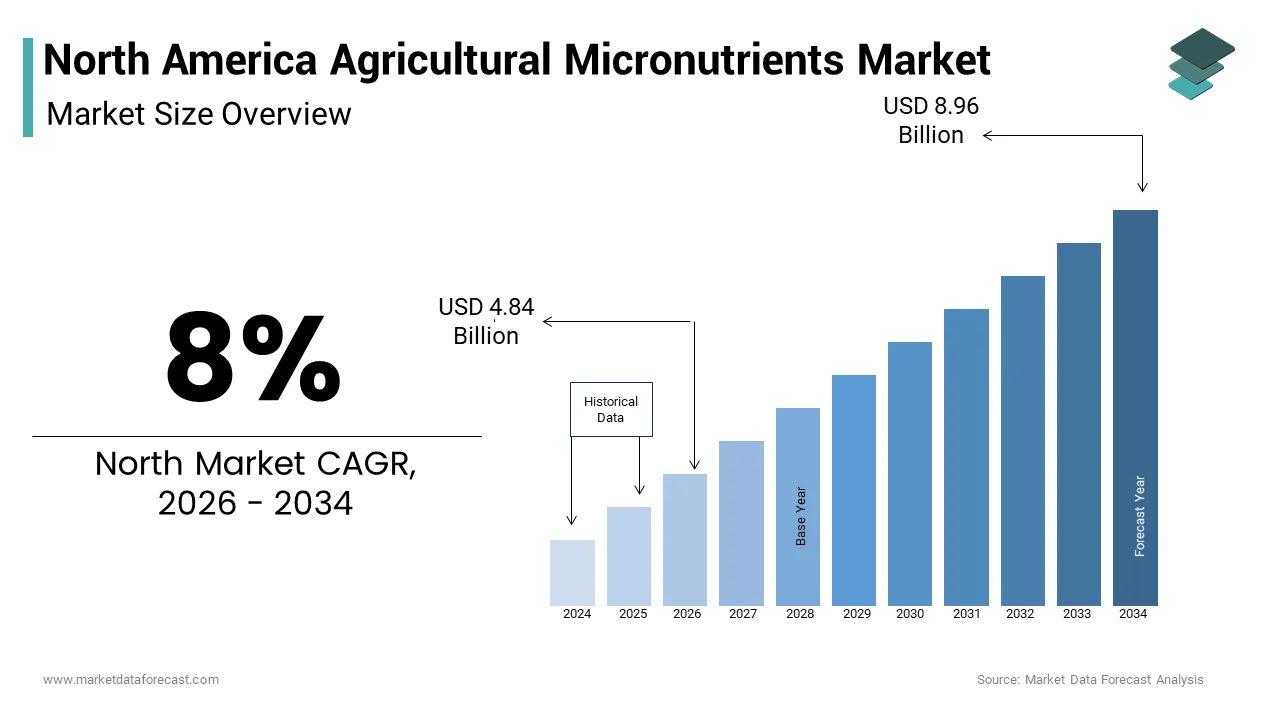
Micronutrients are used to grow crops that meet the export quality standard. Micronutrients are a crucial part in maintaining balanced crop protection and are also essential for the growth of the plants. These micro-nutrients are also important in facilitating plant functions and also in enhancing root strength, sugar translocation, and overall plant immunity. Deficiency of Micronutrients results in withering of buds in crops, yellowing of leaves, health hazards, and eventually results in the decline of crop productivity.
Rising demand for food and increasing demand for standard quality and continuous yield because of ga growing population, depleting arable land are the major factors strengthening the market. Lack of awareness among farmers in developing regions, lack of awareness about an appropriate quantity to be injected into the soil due to lack of standardized levels established by regulatory agencies, and high cost are the major factors hindering the growth of the market.
REPORT COVERAGE
| REPORT METRIC | DETAILS |
| Market Size Available | 2025 to 2034 |
| Base Year | 2025 |
| Forecast Period | 2026 to 2034 |
| CAGR | 8% |
| Segments Covered | By Type, Mode of Application, Form, Crop Type, And Country |
| Various Analyses Covered | Global, Regional, and country-level analysis; Segment-Level Analysis, DROC, PESTLE Analysis, Porter’s Five Forces Analysis, Competitive Landscape, Analyst Overview of Investment Opportunities |
| Country's Covered | The United States, Canada, and the Rest of North America |
| Market Leaders Profiled | BASF SE, Mosaic and Cheminova, Agrium Inc., Aries Agro Ltd., Coromandel International Ltd., Yara International, Valagro, Gujarat State Fertilizers & Chemicals, Tradecorp International, AkzoNobel. |
SEGMENT ANALYSIS
By Crop Type Insights
The zinc segment is expected to grow at the highest CAGR because of the growing demand for zinc in food. Cereals are the highest growing segment around the world, owing to continuous technological advancements and growing demand for cereals.
COUNTRY ANALYSIS
Geographically, this market is further segmented into to US and Canada. The U.S. and Canada use advanced agricultural techniques, which help them deliver quality agricultural produce that meets international export standards.
KEY MARKET PLAYERS
This report also provides detailed marketing and development strategies used by key players such as
- BASF SE
- Mosaic and Cheminova
- Agrium Inc.
- Aries Agro Ltd.
- Coromandel International Ltd.
- Yara International,
- Valagro
- Gujarat State Fertilizers & Chemicals
- Tradecorp International,
- AkzoNobel.
MARKET SEGMENTATION
The North American agricultural micronutrients market is segmented and sub-segmented into the following categories.
By Type
- Zinc
- Boron
- Copper
- Manganese
- Molybdenum
- Iron
- Cobalt
- others
By Mode of Application
- Soil, Fertigation
- Seed treatment
- Foliar
- Agricultural Micronutrients
By Form
- Chelated
- Ethylenediaminetetraacetic Acid (EDTA)
- Diethylene Triamine Pentaacetic Acid (DTPA)
- Ethylenediamine Di-2-Hydroxyphenyl Acetate (EDDHA)
- D,L-Aspartic Acid N-(1,2-Dicarboxyethyl) Tetrasodium Salt (IDHA)
- Hydroxybenzyl Ethylenediamine Diacetic Acid(HBED)
- Non-Chelated Agricultural Micronutrients
By Crop Type
- Fruits and Vegetables
- Cereals
- Pulses
- Oilseeds and others
By Country
- The United States
- Canada
- Mexico