- Product Description Description
- Table of Contents TOC
- List of Table & Figure LOT
- Get Free Sample PDF Sample PDF
North America Artificial Intelligence (AI) Market Size
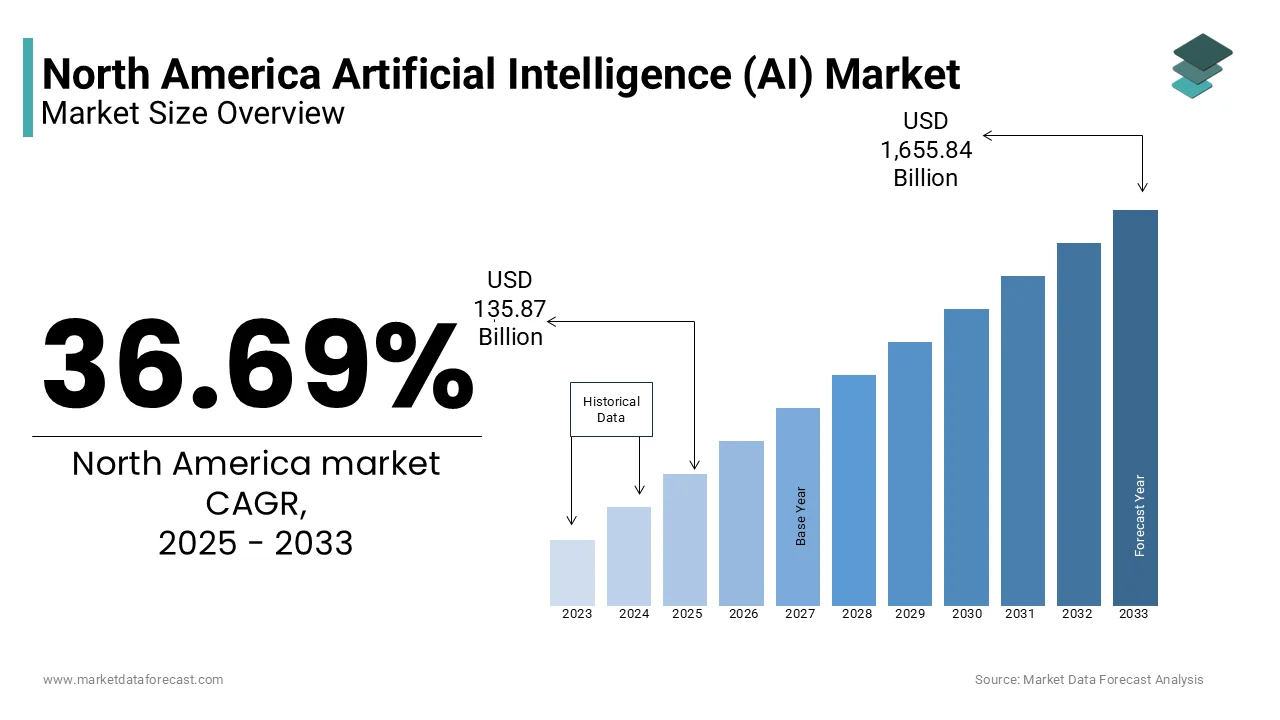
The North America artificial intelligence (AI) market was valued at USD 99.40 billion in 2024. The North America market is expected to be worth USD 1,655.84 billion by 2033 from USD 135.87 billion in 2025, growing at a CAGR of 36.69% from during the forecast period 2025 to 2033.
MARKET DRIVERS
The rising popularity of standalone artificial intelligence is propelling North American artificial intelligence market growth.
This is because it can completely transform multiple sectors including healthcare, banking, education and more. AI has already raised accuracy, decreased prices and increased efficiency in several industries. It has significantly contributed to the digitalization of society by providing rapid data collection, processing, and analysis. This has driven various industries to become more efficient and also resulted in the development of new technology and better business procedures. AI has greatly influenced many media formats, including text, video, and 3D. The way we engage with and consume media has been completely transformed by AI-powered technologies like computer vision, image and audio recognition, and natural language processing.
The increased internet usage and implementation of digital technologies are also boosting the growth of the North American artificial intelligence market. The high research and development expenditure is elevating the current technological improvements across different industries. The market is expected to experience significant growth due to the increasing demand from end-user sectors. Most sectors have always heavily relied on technological developments for growth.
MARKET RESTRAINTS
The lack of openness in decision-making has significantly affected the growth.
Algorithmic system’s secret activities are presenting major data privacy issues. There is a higher chance of misuse if the AI system interpretation and usage of personal data stays mysterious. Decisions based on wrong or deceptive data analysis can arise from this along with unapproved data sharing. The lack of transparency in AI further confuses public perceptions about the governance and moral consequences of these technologies, specifically in light of the growing prevalence of surveillance systems based on AI.
MARKET OPPORTUNITIES
Growing recognition among researchers in science is presenting new prospects in the research and development field.
Growing recognition among researchers in science is presenting new prospects in the research and development field which will further drive the growth of the North American artificial intelligence market. Artificial intelligence technology is becoming more popular among research scientists because of its disruptive potential. It is anticipated that this trend will continue in the future and provide an avenue for the North American artificial intelligence market to grow. Repetitive processes are streamlined by AI-powered technologies, allowing experts to concentrate on innovation. Research scientists are finally recognising the value of artificial intelligence (AI) and its ability to forecast results, discover hidden patterns, and improve experimentation in a variety of domains.
MARKET CHALLENGES
The absence of qualified professionals is one of the primary challenges.
The lack of qualified candidates in the employment market for AI is a critical issue that is reflected by a substantial gap between the growing demand for AI specialists and the supply of professionals. It hinders innovation and causes delays in the completion of projects. Companies that fail to leverage AI face the risk of dropping revenue to rivals that thrive in doing so. This could make it difficult for businesses to meet shifting industry standards and client expectations.
Impact of COVID-19
COVID-19 has shifted research focus to AI-centered techniques for virus alleviation and transforming the direction of studies. The Covid-19 pandemic both raised demand for AI technology and highlighted the possibilities of these advanced systems. Healthcare systems have widely adopted these technologies to facilitate rapid diagnosis and identification of diverse viral strains. Additionally, they have leveraged customized data to improve the management of outbreaks. AI/ML algorithms were employed in the diagnosis field to swiftly and precisely diagnose patients who tested positive for Covid-19. These cutting-edge modules were trained with datasets that included exposure history, pathological findings, symptoms, and chest CT scans.
REPORT COVERAGE
| REPORT METRIC | DETAILS |
| Market Size Available | 2024 to 2033 |
| Base Year | 2024 |
| Forecast Period | 2025 to 2033 |
| CAGR | 36.69% |
| Segments Covered | By Offering, Technology, Business Function, End Use and Country |
|
Various Analyses Covered | Regional & Country Level Analysis, Segment-Level Analysis, DROC, PESTLE Analysis, Porter’s Five Forces Analysis, Competitive Landscape, Analyst Overview on Investment Opportunities |
| Countries Covered | The United States, Canada, Mexico, and Rest of North America |
| Market Leaders Profiled | Microsoft Corporation, Google Inc., IBM, Oracle Corporation, Apple Inc., Amazon Web Services, SAP, Salesforce, Cisco, Meta (Facebook), Intel Corp, H2O.ai., Hewlett Packard Enterprise, Siemens AG, Huawei, NVIDIA, OpenAI, SAS Institute, Baidu, Alibaba Cloud, AIBrain, Lumen5, Advanced Micro Devices, Iris.ai AS, Lifegraph, Sensely, Inc., DiDi Global, and others. |
SEGMENTAL ANALYSIS
By Offering Insights
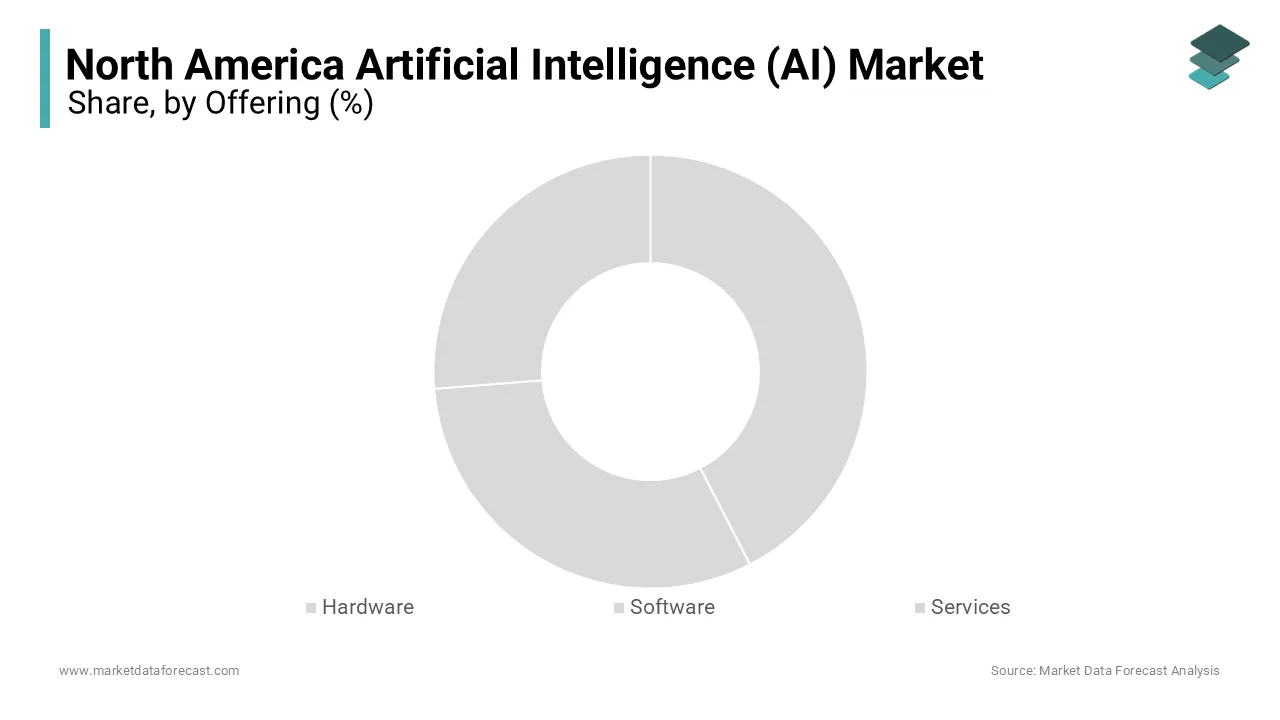
Based on the offering, the services segment is the dominant segment and held around 40% share of the North American market in 2024. Artificial intelligence as a service offers convenience and scalability when installing AI applications which accounts for its dominance in the market. AI projects are complex and require multidisciplinary expertise in computer vision, natural language processing and machine learning. Services are utilized to effectively manage these diverse skills and resources.
By Technology Insights
Based on technology, the computer vision segment is anticipated to expand at the highest CAGR during the forecast period. It lowers expenses, improves customer experiences, and fortifies security. Manufacturers identify flaws, insurance assessors assess car damage, doctors examine medical photographs, and banks use computer vision software to confirm the identity of their customers. Its significant role in propelling technical developments is demonstrated by its wide-ranging impact across industries.
By Business Function Insights
Based on business function, the finance segment is expected to grow at the highest CAGR during the forecast period. This is mainly because artificial intelligence (AI) offers the ability to significantly improve user experience and decision-making. It is frequently used in the banking sector for algorithmic trading, fraud detection, risk assessment and customer support. AI-powered chatbots and virtual assistants are enhancing consumer relations, automating interactions and analyzing customer data for marketing, sales, segmentation, predictive analytics, lead scoring and customer support.
By End Use Insights
Based on end-use, the BFSI segment is predicted to account for the major share of the North American market during the forecast period. In the banking and financial industry, artificial intelligence solutions are increasingly utilized for various tasks, such as monitoring credit scores, applying for loans, checking accounts, and detecting fraud. The BFSI sector benefits from AI applications due to daily data generation and demand for 24/7 customer service, promoting growth through reliable outcomes.
REGIONAL ANALYSIS
The United States is dominating the North American artificial intelligence market. The country’s advanced AI research and development which is backed by top universities and tech giants like Google, Microsoft and Apple is driving the market innovation and growth. Companies in the information sector stated employing AI at higher rates than the national average which was 13.8 percent of enterprises indicating they were using the technology at the time. US companies and researchers are raising growth in various industries by actively developing AI applications and creating diverse market opportunities.

Canada is anticipated to witness significant growth with a higher growth rate in the forecast period. In the last five years, the supply of AI talent increased at an average rate of 38 percent surpassing the US, the UK, Germany, France and Sweden. In 2022–2023, the country had more than 29 percent active AI professionals. About 50 percent of AI employment in the studied organizations with AI responsibilities were categorized as well-paying with yearly salaries of at least 82,000 dollars.
KEY MARKET PARTICIPANTS
Companies playing a major role in the North American Artificial Intelligence market include Microsoft Corporation, Google Inc., IBM, Oracle Corporation, Apple Inc., Amazon Web Services, SAP, Salesforce, Cisco, Meta (Facebook), Intel Corp, H2O.ai., Hewlett Packard Enterprise, Siemens AG, Huawei, NVIDIA, OpenAI, SAS Institute, Baidu, Alibaba Cloud, AIBrain, Lumen5, Advanced Micro Devices, Iris.ai AS, Lifegraph, Sensely, Inc., DiDi Global, and others.
RECENT HAPPENINGS IN THE MARKET
-
In January 2023, LaMDA 3, a factual language model was launched by Google AI which improves reasoning and factual correctness. In October 2023, it revealed PaLM 4, a huge language model with more than 540 billion parameters that demonstrates advances in logic and efficiency.
-
In March 2023, Azure Cognitive Services for Text Mining which offers pre-trained models for deriving insights from text data, was launched by Microsoft AI.
MARKET SEGMENTATION
This research report on the North American artificial intelligence (AI) market has been segmented and sub-segmented into the following categories.
By Offering
-
Hardware
-
Software
-
Services
By Technology
-
Machine Learning
-
Natural Language Processing
-
Computer Vision
-
Context Awareness
By Business Function
-
Supply Chain Management
-
Finance
-
Law
-
Human Resources
-
Marketing & Sales
-
Service & Operations
-
Security
By End Use
-
Information Technology
-
BFSI
-
Healthcare
-
Automotive
-
Retail & E-commerce
-
Advertising & Media
-
Manufacturing
-
Transportation & Logistics
-
Military & Defense
-
Agriculture
-
Energy & Utilities
-
Telecommunication
-
Others
By Country
-
The United States
-
Canada
-
Rest of North America