- Product Description Description
- Table of Contents TOC
- List of Table & Figure LOT
- Get Free Sample PDF Sample PDF
Market Size, 2025
$5.21 BnMarket Estimate, 2026
$5.45 BnMarket Forecast, 2034
$7.76 BnCAGR, 2026–2034
4.52%North America Air Duct Market Size, Growth, Trends & Forecast (2026–2034)
The North America Air Duct Market size was calculated to be USD 5.21 billion in 2025, is anticipated to be worth USD 5.45 billion in 2026, and is expected to reach USD 7.76 billion by 2034, growing at a compound annual growth rate (CAGR) of 4.52% during the forecast period from 2026 to 2034. Growth is primarily propelled by rising commercial and residential construction activities, stringent energy efficiency regulations, and the expanding need for retrofitting aging infrastructure.
Key Executive Metrics (At-a-Glance)
- 2025 Base Valuation: USD 5.21 billion
- 2026 Current Valuation: USD 5.45 billion
- 2034 Forecast Valuation: USD 7.76 billion
- Compound Annual Growth Rate (CAGR): 4.52% (2026–2034)
- Dominant Material Segment: Metallic material segment (accounting for 62.4% of total revenue in 2025)
- Fastest-Growing Material Segment: Non-metallic air duct segment (projected to grow at a CAGR of 6.9% from 2026 to 2034)
- Dominant Installation Segment: New installation segment (capturing 64.2% of total revenue in 2025)
- Fastest-Growing Installation Segment: Retrofit installation segment (anticipated to grow at a CAGR of 7.3% from 2026 to 2034)
- Dominant End-User Segment: Residential segment (accounting for 44.2% of total revenue)
- Fastest-Growing End-User Segment: Commercial sector (projected to grow at a CAGR of 7.1%)
- Dominant Country Hub: United States (spearheading the market at 66%)
- Key Growth Regions: Canada and Mexico (driven by green building codes and industrial modernization)
Core Market Drivers
- Construction Surge: Sustained growth in commercial and residential developments creating constant demand for integrated HVAC and air distribution networks.
- Green Building Standards: Implementation of stringent energy efficiency regulations and certifications like LEED, ENERGY STAR, and ASHRAE standards.
Primary Market Restraints & Challenges
- High Costs & Volatility: High installation and maintenance expenses alongside supply chain disruptions and raw material price fluctuations (galvanized steel, aluminum, copper).
- Labor Shortages: Ongoing shortage of skilled labor and technical expertise for advanced HVAC installation and maintenance.
North America Air Duct Market Segmentation Breakdown
| Segment Category | Leading Sub-Segment | Fastest-Growing Sub-Segment |
|---|---|---|
| By Material | Metallic (62.4% share in 2025) | Non-Metallic (CAGR of 6.9%) |
| By Installation Type | New Installation (64.2% share in 2025) | Retrofits (CAGR of 7.3% from 2026–2034) |
| By End User Industry | Residential (44.2% share) | Commercial (CAGR of 7.1%) |
| By Region | United States (Dominant hub) | Canada & Mexico (Driven by modernization and green retrofits) |
Major Industry Players Profiled
Key manufacturing leaders shaping the North American air duct market include Lindab Group, Tolco Products Co., Carrier Global Corporation, Ductmate Industries Inc., ATCO Rubber Products, Inc., Spiral Manufacturing Co., Inc., Thermaflex, KAD Air Conditioning, Imperial Manufacturing Group, FabricAir, Hennemuth Metal Fabricators, LLC, CMS Group of Companies, Aldes North America, and Hercules Industries.
North America Air Duct Market Size
The North America Air Duct Market Size was calculated to be USD 5.21 billion in 2025 and is anticipated to be worth USD 7.76 billion by 2034, from USD 5.45 billion in 2026, growing at a CAGR of 4.52% during the forecast period.
An air duct is a system used for the distribution of heated or cooled air throughout commercial, residential, and industrial buildings. Air ducts are integral components of heating, ventilation, and air conditioning (HVAC) systems, ensuring energy-efficient climate control and improved indoor air quality. These ducts are typically fabricated from materials such as galvanized steel, aluminum, fiberglass, and flexible polymers, each offering distinct advantages in terms of durability, insulation, and ease of installation.
North America represents a mature HVAC market, with the United States being the largest consumer due to its extensive construction activity and high standards for building ventilation. According to the U.S. Department of Energy, buildings account for over 40% of total energy consumption in the United States, making efficient air distribution a critical factor in reducing energy waste and operational costs.
In Canada, increasing investments in green building certifications and retrofits have led to greater adoption of high-performance ducting solutions that align with environmental regulations. The Canadian Standards Association (CSA) has also played a role in setting performance benchmarks for ductwork efficiency and sealing standards.
Mexico is witnessing steady growth in air duct demand, driven by expanding urbanization and the modernization of commercial infrastructure.
MARKET DRIVERS
Rising Construction Activity in Commercial and Residential Sectors
The sustained growth in both commercial and residential construction activities is one of the primary drivers of the North American air duct market. As new buildings continue to be developed across the region, the demand for integrated HVAC systems, along with associated components like air ducts, has seen a corresponding increase. Moreover, the commercial construction sector experienced a year-over-year growth in 2023, particularly in office spaces, healthcare facilities, and educational institutions, all of which depend heavily on advanced air distribution systems. With ongoing urban development and increasing emphasis on indoor comfort and ventilation, the construction-driven demand for air duct systems remains a key growth catalyst across North America.
Stringent Energy Efficiency Regulations and Green Building Standards
A further significant driver influencing the North America air duct market is the implementation of stringent energy efficiency regulations and the rising adoption of green building certification programs such as LEED (Leadership in Energy and Environmental Design), ENERGY STAR, and ASHRAE standards. These initiatives mandate higher performance levels for HVAC systems, including enhanced insulation, reduced leakage, and improved airflow management—factors directly linked to air duct design and installation quality.
According to the U.S. Department of Energy (DOE), heating and cooling account for approximately 48% of energy use in the average American home, reinforcing the importance of well-sealed and properly insulated duct systems in minimizing energy losses.
Additionally, provinces such as Ontario and British Columbia have adopted stricter building codes mandating the use of sealed and insulated ductwork in both residential and commercial developments.
Furthermore, the U.S. Green Building Council reported that 1.36 billion gross square feet of building space were LEED-certified in 2023, with many of these structures incorporating high-efficiency ducting systems to meet sustainability benchmarks. These regulatory and certification trends are compelling manufacturers and contractors to adopt superior air duct designs, driving market expansion across North America.
MARKET RESTRAINTS
High Installation and Maintenance Costs
The relatively high cost of installation and maintenance, particularly for premium materials such as insulated flexible ducts, rigid sheet metal ducts, and custom-designed layouts, is one of the most notable restraints affecting the North American air duct market. These expenses can deter smaller developers and homeowners from investing in high-quality air duct systems, limiting market penetration in certain segments.
This financial burden often leads builders and property owners to opt for lower-cost alternatives, compromising system efficiency and longevity.
Additionally, as per the estimates by the U.S. Environmental Protection Agency (EPA), poorly sealed or leaky ducts can result in energy losses of up to 30%, prompting calls for regular inspections and maintenance. However, the complexity and labor intensity involved in duct sealing and cleaning services often discourage routine upkeep, especially among budget-conscious consumers.
These economic constraints continue to hinder the broader adoption of high-performance air duct solutions across the region.
Supply Chain Disruptions and Material Cost Volatility
The persistent disruption in global supply chains and fluctuating raw material prices is another critical restraint impacting the North American air duct market. The production of air ducts relies heavily on metals such as galvanized steel, aluminum, and copper, as well as polymer-based insulating materials, all of which have been subject to volatility in availability and pricing. This surge in material costs has placed pressure on manufacturers to either absorb additional expenses or pass them on to end users, potentially dampening demand. Moreover, the shortage of skilled labor for fabrication and installation has further compounded delivery timelines and service costs. These challenges have constrained market expansion, particularly among small and medium-sized enterprises lacking robust supplier contracts or inventory buffers.
MARKET OPPORTUNITIES
Growth in Retrofitting and Renovation Projects
The growing number of retrofitting and renovation projects aimed at improving indoor air quality and energy efficiency in aging buildings is an emerging opportunity in the North American air duct market. With millions of residential and commercial structures built before the implementation of modern HVAC standards, there is a vast potential for upgrading outdated or poorly performing duct systems.
Many older homes suffer from leaky or improperly installed ducts, leading to significant energy losses and compromised indoor comfort. Additionally, the U.S. Department of Energy (DOE) has supported several incentive programs aimed at promoting energy-efficient HVAC retrofits. In Canada, the Canadian Standards Association (CSA) also emphasized the need for improved duct sealing practices in its 2023 building code updates. As awareness of indoor air quality and energy conservation grows, the retrofitting segment presents a substantial growth avenue for air duct manufacturers and service providers across North America.
Increasing Demand for Smart Ventilation and IAQ Solutions
The rising demand for smart ventilation systems and indoor air quality (IAQ) solutions, particularly in response to heightened health awareness post-pandemic, is a promising opportunity for the North American air duct market. Consumers and businesses are increasingly seeking HVAC upgrades that incorporate intelligent air filtration, real-time monitoring, and automated airflow adjustments to enhance occupant well-being.
Additionally, these systems often feature variable speed fans, zoning capabilities, and digital sensors that adjust airflow based on occupancy and air quality metrics.
In Canada, Health Canada has emphasized the importance of proper ventilation in schools and public buildings, prompting municipalities to upgrade aging HVAC infrastructure. With increasing focus on healthier indoor environments and technological advancements in HVAC controls, the integration of smart ventilation systems is expected to drive long-term demand for advanced air duct solutions in North America.
MARKET CHALLENGES
Complexity of Compliance with Evolving Building Codes and Standards
The increasing complexity of compliance with evolving building codes and ventilation standards is a major challenge facing the North American air duct market. As governments and regulatory bodies push for higher energy efficiency and indoor air quality, air duct manufacturers and installers must continuously adapt to new requirements, which vary significantly between states and provinces.
Like, the California Energy Commission (CEC) mandated even more rigorous duct tightness testing under Title 24, increasing the burden on HVAC contractors to meet these specifications.
Similarly, in Canada, the National Research Council (NRC) revised the National Building Code of Canada (NBC) in 2023, placing greater emphasis on duct leakage prevention and thermal performance. The Canadian Standards Association (CSA) also issued updated guidelines for residential duct installation, requiring more precise sealing methods and third-party verification.
These evolving regulations, while beneficial for energy conservation and occupant health, create added complexity for manufacturers and contractors. Smaller firms, in particular, face difficulties in keeping pace with compliance demands, leading to higher training, certification, and product redesign costs.
Shortage of Skilled Labor and Technical Expertise
The ongoing shortage of skilled labor and technical expertise in HVAC installation and maintenance is another critical challenge confronting the North American air duct market. The complexity of modern duct design, coupled with tightening industry standards, has created a growing gap between demand for qualified professionals and available workforce capacity. These workforce limitations hinder the widespread adoption of high-performance ducting solutions, despite growing demand for energy-efficient and compliant HVAC systems.
REPORT COVERAGE
| REPORT METRIC | DETAILS |
| Market Size Available | 2025 to 2034 |
| Base Year | 2025 |
| Forecast Period | 2026 to 2034 |
| CAGR | 4.52% |
| Segments Covered | By Material, Installation Type, End User Industry, And Region |
| Various Analyses Covered | Global, Regional & Country Level Analysis; Segment-Level Analysis; DROC, PESTLE Analysis; Porter’s Five Forces Analysis; Competitive Landscape; Analyst Overview of Investment Opportunities |
| Regions Covered | Us, Canada, and the Rest of North America |
| Market Leaders Profiled | Lindab, US Duct, Ductmate Industries Inc., ATCO Rubber Products, Inc., Spiral Manufacturing Co., Inc., Thermaflex, KAD Air Conditioning, Imperial Manufacturing Group, FabricAir, Hennemuth Metal Fabricators, LLC, CMS Group of Companies, Aldes North America, Hercules Industries |
SEGMENTAL ANALYSIS
By Material Insights
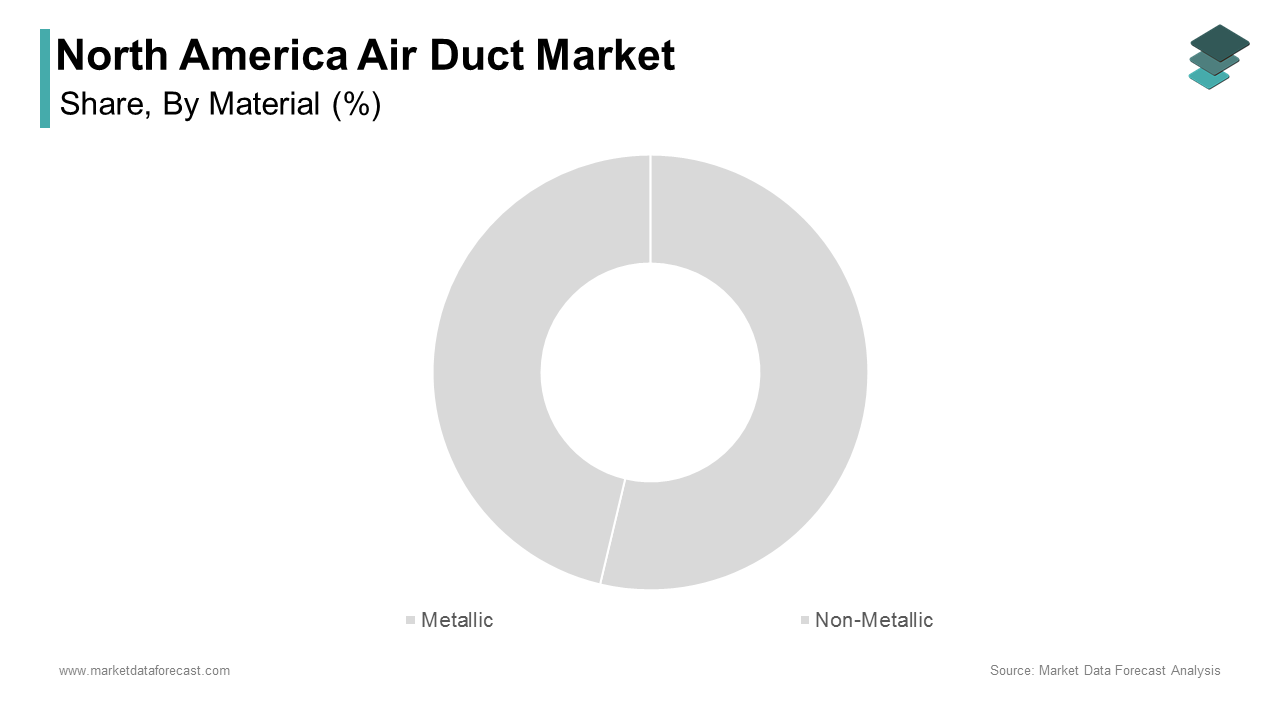
The metallic material segment dominated the North America air duct market by accounting for 62.4% of total revenue in 2025, which is reflecting its widespread use across residential, commercial, and industrial applications. The dominance of this segment is primarily attributed to the superior durability, fire resistance, and structural integrity offered by metallic ducting materials such as galvanized steel, aluminum, and stainless steel. The continued reliance on metallic ducts in commercial and industrial HVAC systems, where high-performance standards are essential, is also a key driver of this segment’s lead position. Besides, the longevity and recyclability of metallic ducts contribute to their sustained demand in large-scale infrastructure projects. In the USA, many LEED-certified buildings incorporated galvanized steel ducting to meet sustainability goals while ensuring system efficiency and durability. Moreover, industrial applications such as manufacturing plants, data centers, and cleanrooms require robust ventilation solutions, further reinforcing the preference for metallic duct systems. With strong performance characteristics and regulatory backing, the metallic air duct segment remains the cornerstone of the North American market.
The non-metallic air duct segment is projected to grow at the fastest CAGR of 6.9% from 2026 to 2034 in the North American air duct market. The rapid expansion of this segment is driven by increasing adoption of flexible ducts, fiber-reinforced polymers, and insulated plastic-based systems that offer cost-effective, lightweight, and easy-to-install alternatives to traditional metallic ducting. The rising demand for flexible non-metallic ducts in residential construction, particularly in single-family homes and multi-unit developments, is also a growth enabler. According to the National Association of Home Builders (NAHB), over 1.4 million new housing units were started in 2023, many of which opted for flexible plastic-insulated ducting due to faster installation times and lower labor costs. In addition, the growing emphasis on energy-efficient building retrofits has boosted the use of non-metallic duct materials, especially in attic and crawl space applications, where thermal insulation and ease of retrofitting are critical. Furthermore, technological advancements in polymer-based and composite ducting materials have improved performance characteristics, allowing non-metallic options to compete with metallic ducts in terms of airflow efficiency and acoustic control. With continued innovation and rising cost sensitivity among end users, the non-metallic air duct segment is poised for significant growth in North America.
By Installation Type Insights
The new installation segment led the North America air duct market by capturing 64.2% of the total revenue in 2025. The growth of this segment is largely driven by the ongoing expansion of both residential and commercial construction activities, which necessitate the integration of modern HVAC systems equipped with high-efficiency ducting solutions. The resilient growth of the U.S. construction industry, particularly in residential development, is a further key contributor to this segment’s growth. Additionally, commercial construction activity remains a major driver, with office buildings, hospitals, schools, and retail centers mandating comprehensive ducted ventilation systems. Moreover, government-backed green building initiatives are influencing new installation practices, encouraging builders to adopt high-performance duct materials that minimize leakage and improve indoor air quality. These factors reinforce the new installation segment as the dominant force in the North American air duct market.
The retrofit installation segment is anticipated to grow at the fastest CAGR of 7.3% in the North American air duct market between 2026 and 2034. The growth of this category is mainly fueled by the increasing number of aging buildings undergoing HVAC upgrades to enhance energy efficiency, indoor air quality, and compliance with updated building codes. The expansion of government-sponsored energy efficiency programs aimed at improving existing building stock also contributes to the rise of this segment. These retrofits significantly reduce energy waste and improve occupant comfort. Furthermore, as per the estimates by the American Society of Heating, Refrigerating and Air-Conditioning Engineers (ASHRAE), nearly 40% of commercial buildings in North America were constructed before 1980, many of which feature outdated or poorly maintained duct systems. Also, the Environmental Protection Agency (EPA) pointed out that leaky ducts can lead to energy losses of up to 30%, prompting facility managers to invest in retrofitting solutions. Moreover, health and safety concerns post-pandemic have spurred interest in upgrading ventilation systems in schools, offices, and public buildings. With increasing awareness of energy savings and indoor environmental quality, the retrofit segment is positioned for accelerated growth across North America.
By End-User Industry Insights
The residential segment commanded the North America air duct market by accounting for 44.2% of total revenue in 2023. The lead position of this segment is largely attributed to the vast volume of new home constructions and the need for effective HVAC systems to ensure indoor climate control and air quality. Nearly all of these new builds incorporate central HVAC systems with ducted air distribution networks, reinforcing the demand for both metallic and non-metallic duct materials. Apart from these, growing consumer awareness regarding indoor air quality and energy efficiency has led to increased investments in well-sealed and insulated duct systems. Moreover, energy conservation programs such as ENERGY STAR and local utility incentives have encouraged homeowners to upgrade inefficient duct systems. As per the estimates by the U.S. Department of Energy (DOE), duct sealing alone can save homeowners up to 20% on heating and cooling bills, further driving adoption in both new and existing homes. With continuous urban development and evolving consumer expectations, the residential end-user segment remains the largest contributor to the North American air duct market.
The commercial sector is projected to grow at the fastest CAGR of 7.1% in the North American air duct market during the forecast period. The rapid expansion of this segment is driven by increasing investments in commercial real estate, stricter indoor air quality (IAQ) regulations, and the modernization of office spaces, educational institutions, and healthcare facilities. Among the key growth enablers is the resurgence in commercial construction and renovation projects, particularly in office and mixed-use developments. According to the American Institute of Architects (AIA), non-residential construction was projected to grow by 5.5% in 2023. Also, heightened focus on indoor air quality following the pandemic has prompted building owners to upgrade HVAC systems with high-efficiency ducting solutions. The Centers for Disease Control and Prevention (CDC) recommended enhanced ventilation in commercial buildings, leading to increased deployment of sealed and filtered duct systems in schools, hospitals, and office complexes. Moreover, green building certification programs such as LEED and WELL have reinforced the importance of efficient duct design in commercial structures. In Canada, the Canada Green Building Council (CaGBC) supported several retrofit initiatives in 2023 targeting aging office towers and institutional buildings, aiming to improve ventilation efficiency and reduce carbon footprints. With ongoing urbanization and evolving workplace environments, the commercial air duct market is expected to experience substantial growth in the coming years.
REGIONAL ANALYSIS
United States Air Duct Market Insights
The United States spearheaded the North American air duct market at 66% in 2023 and is reflecting its dominant position as the region’s largest economy and construction hub. As the leading consumer of HVAC systems, the U.S. drives demand for air duct products across residential, commercial, and industrial sectors. This consistent pipeline of new buildings directly fuels demand for air duct systems, particularly in single-family homes and multi-unit residential developments. Additionally, the commercial construction sector experienced steady growth, supported by federal and state-level incentives promoting energy-efficient building upgrades. Moreover, government-backed retrofitting programs have contributed to market expansion. The U.S. Department of Energy (DOE) supported numerous HVAC upgrades through the Weatherization Assistance Program (WAP), benefiting both residential and small business segments. With strong construction momentum, evolving building codes, and heightened focus on indoor air quality, the United States continues to be the core driver of the North American air duct market.
Canada Air Duct Market Insights
Canada holds a significant share of the North American air duct market, which is positioning it as a key player in the regional industry. While smaller in scale compared to the U.S., Canada’s market benefits from strong urban development, increasing emphasis on energy efficiency, and proactive government support for sustainable building practices. A major growth driver is the steady increase in housing starts and commercial construction projects, particularly in urban centers such as Toronto, Montreal, and Vancouver. Additionally, provincial energy efficiency mandates and green building incentives have influenced the selection of high-performance air duct materials. Moreover, the Canadian Standards Association (CSA) revised national duct installation guidelines, emphasizing tighter sealing and better insulation standards to comply with updated building codes. With increasing regulatory alignment and growing awareness of indoor air quality, Canada’s air duct market is expected to maintain steady growth, supported by both new construction and retrofitting initiatives.
Mexico Air Duct Market Insights
Mexico is emerging as but steadily growing presence in the regional industry. While still developing compared to the U.S. and Canada, Mexico is witnessing increasing demand for modern HVAC systems driven by expanding urbanization, industrial development, and infrastructure modernization efforts. One of the key growth drivers is the expansion of commercial and industrial construction, particularly in logistics hubs, manufacturing zones, and hospitality developments. Additionally, urban housing developments are increasingly adopting centralized HVAC systems, particularly in northern and central states where extreme temperatures necessitate year-round climate control. Moreover, government initiatives to improve indoor air quality in public buildings and schools have contributed to increased procurement of standardized air duct products. While still in an early growth phase, Mexico’s air duct market is gaining momentum, supported by economic expansion and increasing adoption of modern building practices that align with North American HVAC standards.
LEADING PLAYERS IN THE NORTH AMERICA AIR DUCT MARKET
Lindab Group
Lindab is a leading manufacturer of ventilation products and air duct systems, with a strong presence in North America. The company specializes in lightweight, pre-insulated duct solutions that enhance energy efficiency and indoor air quality. Lindab contributes to the global market by promoting sustainable HVAC practices through innovative design, reduced material usage, and faster installation times, making it a preferred choice for green building projects.
Tolco Products Co.
Tolco Products Co. is a key player in the U.S. air duct market, known for its high-quality metal ducting systems used in residential and commercial applications. With decades of industry experience, Tolco has built a reputation for reliability and performance. Its contribution to the global market lies in its commitment to durable, code-compliant duct manufacturing and continuous improvements in sealing and insulation technologies tailored for North American climate zones.
Carrier Global Corporation
Carrier is a global leader in HVAC technology and plays a pivotal role in shaping air duct system standards across North America. Through its comprehensive portfolio of integrated HVAC solutions, Carrier influences the global market by integrating smart ducting technologies, improving airflow management, and enhancing indoor environmental control. Its focus on digitalization and energy-efficient ventilation supports evolving sustainability goals in both new construction and retrofit markets.
TOP STRATEGIES USED BY KEY MARKET PARTICIPANTS
Product Innovation and Material Advancement
Leading companies are investing heavily in R&D to develop advanced air duct materials that offer superior thermal performance, acoustic insulation, and ease of installation. Innovations such as pre-insulated flexible ducts, antimicrobial linings, and aerodynamic designs are helping manufacturers meet evolving energy codes and indoor air quality expectations.
Expansion into Retrofit and Green Building Markets
To capture growing demand from aging infrastructure and energy-conscious consumers, key players are expanding their offerings to include retrofit-friendly duct solutions and products aligned with LEED, ENERGY STAR, and other green certification programs. This strategy allows them to tap into both residential and commercial segments, seeking improved efficiency and compliance.
Strategic Partnerships and Distribution Network Enhancement
Major market participants are strengthening their regional presence through strategic partnerships with HVAC contractors, distributors, and building developers. By expanding their distribution channels and offering technical support services, companies ensure broader product availability and quicker response to customer needs, reinforcing their competitive edge in the North American market.
KEY MARKET PLAYERS AND COMPETITIVE OVERVIEW
Major Players of the North America Air Duct Market include Lindab, US Duct, Ductmate Industries Inc., ATCO Rubber Products, Inc., Spiral Manufacturing Co., Inc., Thermaflex, KAD Air Conditioning, Imperial Manufacturing Group, FabricAir, Hennemuth Metal Fabricators, LLC, CMS Group of Companies, Aldes North America, and Hercules Industries.
The North American air duct market is highly fragmented, featuring a mix of large multinational corporations, regional manufacturers, and local fabricators catering to niche applications. Competition is primarily based on product innovation, material quality, compliance with evolving building codes, and cost-effectiveness. While established players dominate large-scale commercial and industrial projects, smaller firms often excel in localized installations and retrofitting services.
In the residential sector, competition revolves around affordability, ease of installation, and compatibility with standard HVAC systems. Companies are increasingly focusing on developing user-friendly, energy-efficient ducting solutions that align with government-backed weatherization initiatives and consumer preferences for healthier indoor environments.
In the commercial and industrial segments, differentiation comes from engineering expertise, fire safety compliance, and integration with smart ventilation systems. As building codes become more stringent, particularly regarding duct leakage and insulation standards, manufacturers are under pressure to innovate while maintaining cost competitiveness.
Moreover, the ongoing labor shortage in HVAC installation and maintenance is pushing companies to simplify duct design and improve prefabrication techniques. This shift is influencing how air duct providers position their products in the market—favoring modular, standardized, and easy-to-install options.
With increasing emphasis on sustainability, indoor air quality, and energy conservation, the air duct market is witnessing a transition toward smarter, greener, and more efficient solutions. To remain competitive, companies must continuously adapt to regulatory changes, technological advancements, and shifting end-user demands across North America.
RECENT HAPPENINGS IN THE MARKET
- In March 2023, Lindab introduced a new line of pre-insulated, lightweight ducting panels designed specifically for rapid installation in commercial buildings, aiming to reduce labor costs and improve energy efficiency in HVAC systems.
- In September 2023, Tolco Products Co. expanded its production facility in Ohio, enhancing its capacity to supply high-performance galvanized steel duct components to major construction hubs across the eastern United States.
- In January 2025, Carrier Global Corporation launched an integrated smart ventilation platform combining advanced air duct design with real-time indoor air quality monitoring, positioning itself at the forefront of intelligent HVAC solutions.
- In June 2025, a leading Canadian air duct manufacturer partnered with a U.S.-based insulation supplier to co-develop high-efficiency composite duct systems aimed at meeting stricter provincial energy codes and reducing heat loss in residential applications.
- In November 2025, Trane Technologies acquired a regional duct fabrication firm, strengthening its presence in the Southwest U.S. and enabling faster delivery and customization for large-scale commercial HVAC projects.
MARKET SEGMENTATION
This research report on the North America Air Duct Market has been segmented and sub-segmented based on material, installation type, end user industry, and region.
By Material
- Metallic
- Non-metallic
By Installation Type
- New Installation
- Retrofits
By End User
- Residential
- Commercial
By Region
- US
- Canada
- Rest of North America