- Product Description Description
- Table of Contents TOC
- List of Table & Figure LOT
- Get Free Sample PDF Sample PDF
Market Size, 2025
$3.72 BnMarket Estimate, 2026
$3.95 BnMarket Forecast, 2034
$6.40 BnCAGR, 2026–2034
6.21%Executive Summary: North America Airborne ISR Market
- Market Scope: Comprehensive regional market analysis covering platform types, application sectors, country-level leadership frameworks, and defense modernization/real-time intelligence metrics for the North American airborne ISR sector.
- Market Valuation: Valued at USD 3.72 billion (2025), estimated at USD 3.95 billion (2026), and projected to reach USD 6.40 billion by 2034, registering a robust CAGR of 6.21% (2026–2034).
- Primary Growth Drivers: Sustained defense spending, technological modernization, real-time battlefield intelligence demand, AI/machine learning integration for data processing, and UAV fleet expansion for persistent surveillance and border security. Market challenges include regulatory compliance and cybersecurity threats, while opportunities lie in unmanned system adoption, smart city infrastructure, and renewable energy monitoring.
Key Market Segment Metrics (2026–2034)
| Category | Leading Segment Position | Fastest-Growing Segment |
|---|---|---|
| By Type / Application | Manned airborne ISR segment (held largest share with 58.5% total revenue in 2025) & Construction sector / application baseline (64.6% share in 2025 as noted in text) | Unmanned airborne ISR segment (fastest CAGR of 9.8% due to contested environment advantages) & Industrial applications segment (fastest-growing with a CAGR of 9.3%) |
| By Region / Country | United States (dominant force accounting for majority regional share in 2025 supported by military budget and aerospace industry) | Canada (maintains significant position driven by Arctic surveillance and NORAD commitments) |
Major Market Players & Market Structure
Market Structure: Highly competitive North American airborne ISR landscape centering on strategic technology-enhancing acquisitions, heavy R&D investments for AI-driven sensor fusion, multi-intelligence payload upgrades, and government defense contract collaborations.
Key Companies: Lockheed Martin Corporation, Northrop Grumman Corporation, Raytheon Technologies (RTX Corporation), Boeing, General Atomics Aeronautical Systems, Textron Inc., and AeroVironment.
North America Airborne ISR Market Size
The North America airborne ISR market was valued at USD 3.72 billion in 2025 and is anticipated to reach a valuation of USD 3.95 billion in 2026 and USD 6.40 billion by 2034, growing at a CAGR of 6.21%, from 2026 to 2034.
The North America airborne intelligence, surveillance, and reconnaissance (ISR) market encompasses the development, deployment, and integration of airborne platforms equipped with advanced sensor technologies to support military, homeland security, and law enforcement operations. These systems include manned aircraft, unmanned aerial vehicles (UAVs), and specialized sensor payloads such as electro-optical/infrared (EO/IR) cameras, synthetic aperture radar (SAR), signals intelligence (SIGINT), and electronic warfare (EW) systems.
The United States dominates the regional market, driven by sustained defense spending, technological leadership, and a strategic emphasis on maintaining global situational awareness. Canada also plays a growing role in the airborne ISR domain, particularly in Arctic surveillance and border security. The expansion of UAV programs and the integration of AI-enabled data processing systems are further shaping the evolution of the North American airborne ISR landscape.
Additionally, the increasing reliance on real-time battlefield intelligence and the need for persistent monitoring in asymmetric warfare environments are driving continuous investment in next-generation ISR platforms and technologies across the region.
MARKET DRIVERS
Increasing Defense Budgets and Strategic Modernization Programs
The sustained increase in defense spending, particularly in the United States, which remains the world’s largest military spender, is a key driver of the North American airborne ISR market. Additionally, the Pentagon’s Joint All-Domain Command and Control (JADC2) initiative is accelerating the integration of airborne ISR data into a unified battlefield network, enhancing real-time decision-making. Canada has also increased its defense investments. These strategic investments are fueling demand for advanced airborne ISR systems across North America.
Expansion of UAV-Based ISR Capabilities
The growing reliance on unmanned aerial vehicles (UAVs) for intelligence, surveillance, and reconnaissance missions is another key driver of the North American airborne ISR market. UAVs offer distinct advantages over traditional manned ISR platforms, including longer endurance, lower operational risk, and reduced costs.
The Department of Defense (DoD) has prioritized UAV-based ISR to support persistent surveillance in conflict zones, counterterrorism operations, and maritime patrol missions. Programs such as the MQ-Next and the Next-Generation Overhead ISR System are aimed at developing next-generation UAVs with advanced AI-enabled sensors and autonomous capabilities.
Canada is also expanding its UAV fleet, with the Department of National Defence (DND) initiating procurement under the Remotely Piloted Aircraft System (RPAS) project. The Canadian Armed Forces (CAF) plan to acquire MQ-9B SkyGuardian drones to enhance Arctic and maritime surveillance. As UAV adoption continues to rise, the airborne ISR market is experiencing a transformation driven by increased flexibility, scalability, and mission adaptability.
MARKET RESTRAINTS
Budgetary Constraints and Cost Overruns in ISR Programs
The occurrence of budgetary constraints and cost overruns in major ISR programs is a major restraint affecting the North American airborne ISR market. While defense spending remains high, several ISR modernization initiatives have faced delays and increased expenditures due to complex system integration, regulatory hurdles, and supply chain disruptions. According to the Government Accountability Office (GAO), in its 2023 Defense Acquisitions Report, nearly 30% of major U.S. defense programs, including several ISR platforms, exceeded their original cost estimates by over 25%.
Additionally, the U.S. Congress has imposed stricter oversight on defense procurement, particularly for high-cost ISR systems. These financial pressures are prompting defense planners to reevaluate investment strategies and prioritize cost-effective solutions.
Regulatory and Export Control Challenges
The complexity of regulatory and export control frameworks that govern the sale and deployment of advanced ISR technologies is another significant restraint on the North American airborne ISR market. The U.S. International Traffic in Arms Regulations (ITAR) impose strict controls on the export of sensitive military equipment, including airborne ISR systems and sensor payloads.
These restrictions impact not only international sales but also domestic collaboration between defense contractors and foreign partners. As per the Center for Strategic and International Studies (CSIS) in 2023, export controls had delayed several joint ISR development projects with allied nations, limiting opportunities for co-investment and technology sharing. Additionally, the Canadian Department of National Defence (DND) has faced challenges in acquiring certain U.S.-made ISR components due to ITAR restrictions, affecting the timeline of its UAV modernization efforts.
Furthermore, evolving cybersecurity regulations and data-sharing policies are adding layers of complexity to airborne ISR operations, particularly for multinational missions. As governments continue to tighten oversight of defense technology transfers, manufacturers must navigate a more complex compliance landscape, which could slow market expansion and limit export opportunities.
MARKET OPPORTUNITY
Integration of AI and Machine Learning into ISR Systems
A major opportunity for growth in the NAmericanerica airborne ISR market lies in the integration of artificial intelligence (AI) and machine learning (ML) into ISR platforms to enhance data processing, real-time analytics, and autonomous decision-making. According to the Defense Advanced Research Projects Agency (DARPA), in 2023, over 20 AI-driven ISR programs were in active development, aimed at improving target recognition, threat detection, and mission planning.
AI-enabled ISR systems can process vast amounts of sensor data collected from electro-optical/infrared (EO/IR) cameras, synthetic aperture radar (SAR), and signals intelligence (SIGINT) payloads in near real-time. The U.S. Air Force’s Skyborg program, for instance, is developing AI-piloted drones that can operate alongside manned ISR aircraft, improving mission efficiency and reducing pilot workload. As per the Center for Strategic and Budgetary Assessments (CSBA), AI-enhanced ISR platforms could reduce data analysis time by up to 50%, enabling faster battlefield decisions.
Additionally, the U.S. Department of Defense (DoD) has been investing in Project Maven, which applies AI to analyze full-motion video from UAVs, significantly improving target identification accuracy. The Canadian Department of National Defence (DND) is also exploring AI-integrated ISR capabilities for Arctic surveillance and maritime patrol. As AI and ML technologies mature, they are expected to become a cornerstone of next-generation airborne ISR systems.
Expansion of Maritime and Border Surveillance Programs
The expansion of maritime and border surveillance programs presents a significant opportunity for the Americanmerica airborne ISR market. With increasing concerns over illegal immigration, smuggling, and maritime security threats, both the United States and Canada have intensified their aerial surveillance operations. According to the U.S. Customs and Border Protection (CBP), in 2023, over 120,000 flight hours were logged by ISR-equipped aircraft along the U.S.-Mexico and U.S.-Canada borders.
The U.S. Coast Guard (USCG) has also expanded its use of airborne ISR for maritime domain awareness, deploying MQ-9 Reaper drones equipped with maritime radar and electro-optical sensors.
Canada has similarly prioritized Arctic and coastal surveillance, with the Department of National Defence (DND) launching the Arctic and Offshore Patrol Ship (AOPS) program, which integrates airborne ISR for extended maritime monitoring. The Canadian Armed Forces (CAF) have also deployed UAVs to support NORAD missions, enhancing real-time situational awareness in the Arctic region. As border and maritime security concerns grow, airborne ISR platforms are becoming increasingly essential to national defense and homeland security strategies.
MARKET CHALLENGES
Technological Complexity and Integration Challenges
The increasing technological complexity of modern ISR systems and the difficulties associated with their integration into existing platforms are a major challenge facing the American airborne ISR market. As sensor capabilities evolve to include high-resolution imaging, real-time signal interception, and multi-spectral analysis, the demand for advanced processing power, data transmission bandwidth, and compatibility with command-and-control (C2) networks has surged. According to the U.S. Air Force Research Laboratory (AFRL), in 2023, nearly 35% of ISR modernization programs encountered integration issues due to incompatible software architectures and legacy avionics systems.
Additionally, the integration of AI and machine learning algorithms into ISR platforms requires robust onboard computing infrastructure and secure data links, which can be difficult to retrofit into older aircraft. As per the Government Accountability Office’s (GAO) 2023 Defense Systems Report, the modernization of the RC-135 Rivet Joint fleet faced delays due to challenges in integrating new SIGINT payloads with existing mission computing systems.
Moreover, the rapid pace of technological advancement often outpaces acquisition timelines, leading to instances where newly deployed systems become obsolete before full operational capability is achieved.
Cybersecurity Threats to ISR Data Transmission
The growing threat of cyberattacks targeting the data transmission and communication networks of ISR platforms is another significant challenge in the American airborne ISR market. As airborne ISR systems increasingly rely on digital data links, satellite communications, and cloud-based processing, they become more vulnerable to hacking, jamming, and electronic warfare attacks.
The U.S. Department of Defense (DoD) has acknowledged the risks associated with adversarial cyber operations aimed at disrupting ISR data flows, particularly in contested environments. The Defense Science Board (DSB) warned in its 2023 report that adversaries were actively developing capabilities to intercept, spoof, or degrade the signals used by airborne ISR platforms, potentially compromising mission integrity and real-time intelligence.
To mitigate these risks, defense agencies are investing in secure communication protocols, quantum-resistant encryption, and anti-jamming technologies. The Air Force’s Advanced Battle Management System (ABMS) is incorporating hardened data links and AI-driven threat detection mechanisms to enhance cybersecurity resilience. Despite these efforts, ensuring the integrity and confidentiality of airborne ISR data remains a pressing challenge that requires continuous innovation and investment.
REPORT COVERAGE
| REPORT METRIC | DETAILS |
| Market Size Available | 2025 to 2034 |
| Base Year | 2025 |
| Forecast Period | 2026 to 2034 |
| CAGR | 6.21% |
| Segments Covered | By Type, Application, and Region. |
| Various Analyses Covered | Global, Regional, & Country Level Analysis, Segment-Level Analysis, DROC, PESTLE Analysis, Porter’s Five Forces Analysis, Competitive Landscape, Analyst Overview on Investment Opportunities |
| Regions Covered | The United States, Canada, Mexico, And By Country |
| Market Leaders Profiled | BAE Systems plc, RTX Corporation, Northrop Grumman Corporation, Thales Group, Saab AB, Airbus SE, HENSOLDT AG, Elbit Systems Ltd., Teledyne Technologies Incorporated, Leidos Holdings, Inc., Leonardo S.p.A, Textron Inc., Curtiss-Wright Corporation. |
SEGMENTAL ANALYSIS
By Type Insights
Manned Airborne ISR Platforms
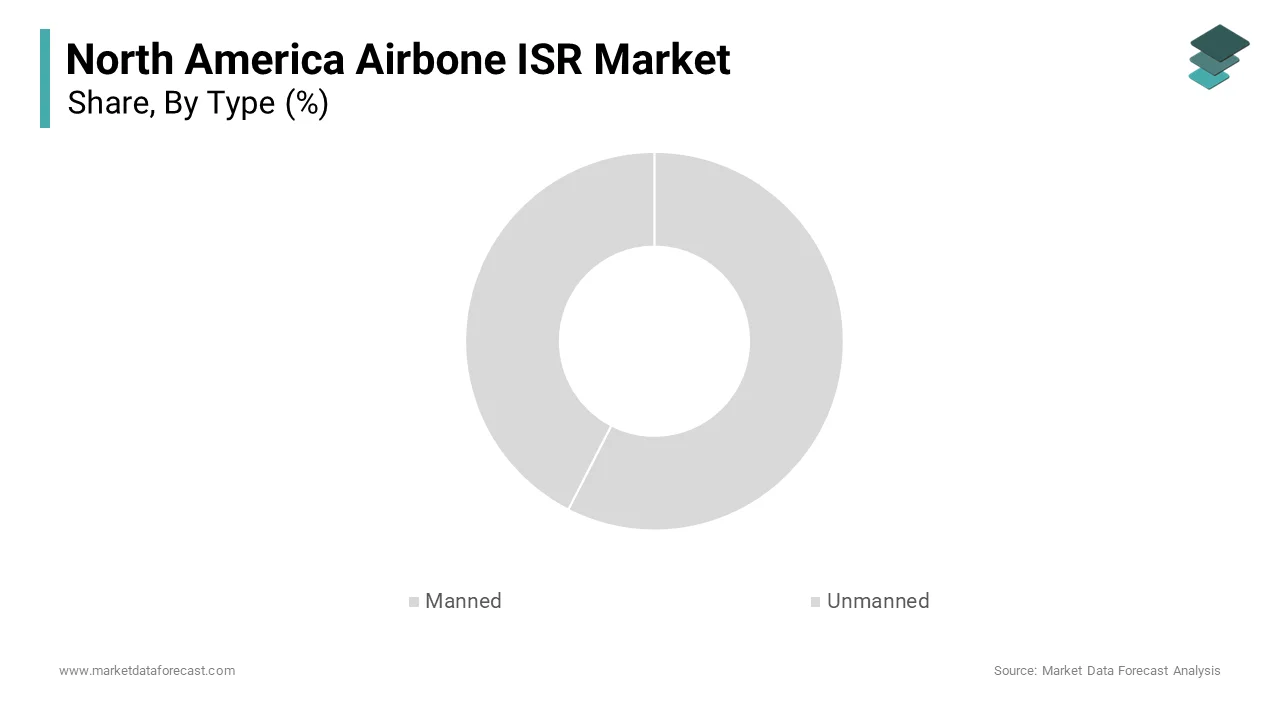
The manned airborne ISR segment held the largest share of the North America airborne ISR market, with 58.5% of total revenue in 2025. The continued reliance on high-altitude, long-endurance manned platforms for strategic reconnaissance missions is one of the key drivers of this segment’s dominance. This segment includes traditional ISR aircraft such as the U-2 Dragon Lady, E-3 Sentry, E-8C JSTARS, and RC-135 Rivet Joint, which continue to play a critical role in intelligence gathering, battlefield surveillance, and command and control operations. Additionally, the integration of advanced sensor suites and data fusion technologies into existing manned platforms has extended their operational relevance. As the U.S. and Canadian militaries modernize their fleets, manned ISR platforms remain a cornerstone of national defense and intelligence operations.
Unmanned Airborne ISR Platforms
The unmanned airborne ISR segment is projected to grow at the fastest CAGR of 9.8%. This rapid growth is driven by the increasing deployment of UAVs for persistent surveillance, reconnaissance, and target acquisition missions, particularly in asymmetric warfare and border security operations. A further major growth factor is the cost-effectiveness and reduced risk associated with UAV-based ISR operations. Like, several MQ-9 Reaper drones were in active service, with additional procurements planned in the coming years. The MQ-9’s ability to conduct long-endurance missions while carrying a wide range of electro-optical/infrared (EO/IR), radar, and SIGINT payloads has made it a preferred platform for intelligence gathering in conflict zones. Another key driver is the expansion of AI-enabled autonomous ISR capabilities. Additionally, the Canadian Department of National Defence (DND) launched the Remotely Piloted Aircraft System (RPAS) project to acquire MQ-9B SkyGuardian drones for Arctic and maritime surveillance. As UAV technology advances, the unmanned segment is expected to see continued expansion.
By Application Insights
Airborne Ground Surveillance (AGS)
The Airborne Ground Surveillance (AGS) segment led the North America airborne ISR market by capturing 32.5% of total revenue in 2023. The increasing deployment of AGS-equipped aircraft in counterinsurgency and counterterrorism operations is a key driver of this segment’s dominance. Like, the E-8C JSTARS and MQ-9 Reaper are among the primary platforms used for AGS, providing real-time battlefield mapping and target acquisition capabilities. AGS systems are primarily used for real-time monitoring of land-based activities, including troop movements, infrastructure developments, and insurgent operations, making them a critical asset in modern warfare and border security. Additionally, the modernization of the U.S. Army’s intelligence capabilities has led to increased investment in AGS technologies. As the demand for persistent land surveillance grows, AGS remains a central component of the airborne ISR landscape.
Signals Intelligence (SIGINT)
The Signals Intelligence (SIGINT) application segment is projected to grow at the fastest CAGR of 10.2%. A major growth factor is the increasing reliance on SIGINT for counterterrorism, cyber defense, and strategic intelligence operations. The U.S. Air Force’s RC-135 Rivet Joint and EP-3 Aries aircraft are among the primary platforms used for SIGINT missions. SIGINT involves the interception and analysis of electronic signals for intelligence gathering, including communications, radar emissions, and cyber transmissions. Another key driver is the expansion of SIGINT capabilities to counter emerging threats from near-peer adversaries. Additionally, the Canadian Department of National Defence (DND) has been integrating SIGINT payloads into its maritime patrol aircraft to support NORAD and NATO missions. As electronic warfare becomes more central to military strategy, SIGINT is expected to experience sustained growth.
COUNTRY ANALYSIS
United States
The United States held the dominant position in the North American airborne ISR market, capturing 86% of the total market revenue in 2025. This leadership is driven by the country’s strategic focus on maintaining global situational awareness, advanced defense spending, and a robust industrial base for aerospace and defense technologies. A key factor behind the U.S. market’s dominance is the sustained investment in ISR modernization programs. The U.S. Air Force’s 2023 ISR Modernization Plan emphasized the need for persistent surveillance, AI-enabled data processing, and enhanced sensor integration. Additionally, the expansion of the Joint All-Domain Command and Control (JADC2) initiative has reinforced the importance of airborne ISR in connecting battlefield assets across air, land, sea, space, and cyber domains.
Canada
Canada holds a notable share of the North American airborne ISR market. The market is primarily driven by the country’s strategic emphasis on Arctic surveillance, maritime domain awareness, and NORAD commitments. A key contributor to Canada’s market position is the modernization of its aerial surveillance capabilities under the Arctic and Offshore Patrol Ship (AOPS) program and the Remotely Piloted Aircraft System (RPAS) initiative. Additionally, the Canadian Armed Forces (CAF) have expanded their SIGINT and airborne early warning capabilities to monitor foreign naval activity in the North Atlantic and Pacific regions. As geopolitical tensions in the Arctic increase, Canada’s investment in airborne ISR is expected to grow, reinforcing its position in the regional market.
Rest of North America
The Rest of North America, primarily consisting of Mexico and select Caribbean territories, holds a smaller but steadily growing share of the regional airborne ISR market. The market is driven by increasing investments in border security, counter-narcotics operations, and aerial surveillance capabilities. Mexico is the primary contributor to this segment, with growing demand for airborne ISR to support law enforcement and national security missions. The Mexican Navy has also deployed ISR-equipped aircraft to patrol the Gulf of Mexico and Caribbean waters, targeting illicit maritime activities. Additionally, the government has been upgrading its aerial surveillance infrastructure through partnerships with U.S. defense contractors. As regional security challenges evolve, the Rest of North America is expected to experience sustained growth in airborne ISR capabilities.
KEY MARKET PLAYERS
BAE Systems plc, RTX Corporation, Northrop Grumman Corporation, Thales Group, Saab AB, Airbus SE, HENSOLDT AG, Elbit Systems Ltd., Teledyne Technologies Incorporated, Leidos Holdings, Inc., Leonardo S.p.A, Textron Inc., Curtiss-Wright Corporation. Are the market players that are dominating the North American airborne ISR market?
Top Players In The Market
Lockheed Martin Corporation
Lockheed Martin is a leading player in the North American airborne ISR market, known for its advanced surveillance and reconnaissance systems integrated into both manned and unmanned platforms. The company plays a critical role in developing next-generation ISR capabilities, including high-altitude reconnaissance aircraft, radar systems, and AI-enabled data processing solutions. Its global presence and long-standing partnerships with defense agencies make it a key contributor to the evolution of airborne ISR technologies worldwide.
Northrop Grumman Corporation
Northrop Grumman is a major force in the airborne ISR domain, particularly in the development of unmanned reconnaissance platforms and advanced sensor systems. The company is best known for the RQ-4 Global Hawk, one of the most capable high-altitude, long-endurance UAVs used for strategic surveillance. Northrop Grumman also leads in the integration of synthetic aperture radar (SAR), signals intelligence (SIGINT), and electronic warfare (EW) systems. Its commitment to innovation and system interoperability has positioned it as a key enabler of modern battlefield awareness and intelligence gathering across global operations.
Raytheon Technologies (a segment of RTX Corporation)
Raytheon Technologies, now part of RTX Corporation, plays a pivotal role in the airborne ISR market through its development of cutting-edge sensor technologies, radar systems, and electronic warfare solutions. The company’s contributions include advanced electro-optical/infrared (EO/IR) sensors, signals intelligence payloads, and mission systems integration for both manned and unmanned platforms. Raytheon’s expertise in data fusion and real-time intelligence processing has made it a preferred supplier for U.S. military and allied forces. Its strategic focus on AI-driven ISR capabilities and open-system architectures ensures continued leadership in the evolving global ISR landscape.
Top Strategies Used By Key Market Participants
Investment in Advanced Sensor and AI Integration
Leading companies are prioritizing the development of next-generation sensor technologies and integrating artificial intelligence (AI) to enhance real-time data analysis and autonomous decision-making. These advancements improve the effectiveness of airborne ISR platforms in complex operational environments and reduce reliance on manual interpretation.
Expansion of UAV and Autonomous ISR Platforms
Major players are focusing on the design and deployment of unmanned and optionally piloted ISR systems to meet the growing demand for persistent surveillance and reduced operational risk. These platforms offer extended endurance, multi-mission flexibility, and cost-effectiveness, making them central to future ISR strategies.
Strategic Collaborations and System Integration with Defense Agencies
To strengthen their market position, companies are forming strategic partnerships with government agencies, aerospace primes, and technology firms. These collaborations facilitate the integration of ISR systems into broader command-and-control networks and ensure alignment with evolving defense requirements and joint operations frameworks.
COMPETITION OVERVIEW
The North America airborne ISR market is characterized by a high degree of competition, dominated by a few large defense contractors with deep technological expertise and strong government relationships. Companies like Lockheed Martin, Northrop Grumman, and Raytheon Technologies lead the market with advanced sensor systems, UAV platforms, and AI-enabled data processing solutions. These firms continuously invest in research and development to maintain a technological edge, particularly in areas such as synthetic aperture radar, signals intelligence, and autonomous reconnaissance capabilities.
New entrants and niche players are emerging with specialized offerings in AI analytics, modular payloads, and smaller UAVs tailored for tactical missions. However, the high entry barriers, including regulatory constraints, complex procurement processes, and the need for extensive R&D investment, limit the number of competitive players. Strategic acquisitions, joint ventures, and system integration partnerships are common tactics used by established firms to expand their capabilities and secure long-term defense contracts.
Additionally, the increasing emphasis on interoperability across joint military operations is driving companies to develop open architecture systems that can seamlessly integrate with existing command and control networks. As the demand for real-time intelligence and autonomous surveillance grows, the competitive landscape is expected to evolve further, with innovation and strategic alliances playing a key role in shaping market dynamics.
RECENT HAPPENINGS IN THE MARKET
- In March 2023, Lockheed Martin unveiled a next-generation AI-enabled mission processing system designed to enhance the data analysis capabilities of its U-2 Dragon Lady reconnaissance aircraft. This advancement was aimed at improving real-time intelligence delivery and reducing pilot workload during high-altitude surveillance missions.
- In July 2023, Northrop Grumman announced a major upgrade to its RQ-4 Global Hawk UAV fleet, incorporating multi-intelligence (Multi-INT) payload integration that allows simultaneous collection of signals intelligence (SIGINT), synthetic aperture radar (SAR), and electro-optical data. The enhancement was intended to provide military users with a more comprehensive battlefield picture.
- In November 2023, Raytheon Technologies launched a new family of compact, high-resolution EO/IR sensors tailored for integration into smaller UAVs and tactical reconnaissance platforms. This move was designed to expand Raytheon’s reach into the rapidly growing segment of tactical airborne ISR.
- In February 2025, Lockheed Martin partnered with a leading AI software firm to develop autonomous mission planning tools for airborne ISR platforms. The collaboration was aimed at accelerating the deployment of AI-driven surveillance capabilities across both manned and unmanned aircraft.
- In June 2025, Northrop Grumman completed a successful test of its next-generation active electronically scanned array (AESA) radar system for airborne early warning applications. This technology was intended to support future upgrades to the U.S. Navy’s E-2D Advanced Hawkeye fleet and enhance long-range threat detection capabilities.
MARKET SEGMENTATION
This research report on the North American airborne ISR market is segmented and sub-segmented into the following categories.
By Type
- Manned
- Unmanned
By Application
- Maritime Patrol
- Airborne Ground Surveillance (AGS)
- Airborne Early Warnings (AEW)
- Signals Intelligence (SIGINT)
By Country
- The United States
- Canada
- Mexico