- Product Description Description
- Table of Contents TOC
- List of Table & Figure LOT
- Get Free Sample PDF Sample PDF
Market Size, 2025
$0.77 BnMarket Estimate, 2026
$0.82 BnMarket Forecast, 2034
$1.36 BnCAGR, 2026–2034
6.53%Executive Summary: North America Aircraft Fairings Market
- Market Scope: Comprehensive North America aircraft fairings market analysis covering application types, material categories, aircraft types, distribution and sales channels, and regional leadership frameworks in the United States and Canada.
- Market Valuation: Valued at USD 0.77 billion (2025), estimated at USD 0.82 billion (2026), and projected to reach USD 1.36 billion by 2034, registering a steady CAGR of 6.53% (2026–2034).
- Primary Growth Drivers: Increasing demand for fuel-efficient aircraft, stringent environmental regulations, and rising commercial and military aircraft production. Key technological and strategic trends include the adoption of lightweight composite materials, advancements in additive manufacturing, and the expanding application of unmanned aerial vehicles (UAVs).
Key Market Segment Metrics (2026–2034)
| Category | Leading Segment (2025 Position) | Fastest-Growing Segment |
|---|---|---|
| By Application | Fuselage fairings (held the largest application share at 35.4% in 2025) | Engine fairings (expected to grow at the fastest CAGR of 9.3%) |
| By Material | Glass-fiber composites (dominated with a 38.4% share) | Thermoplastic composites (projected to grow at the highest CAGR of 11.3%) |
| By Aircraft Type | Commercial aircraft (accounted for the largest type share at 50.3%) | Military aircraft (anticipated to grow at a CAGR of 10.3%) |
| By Distribution Channel | Original Equipment Manufacturer (OEM) channel (led sales) | Aftermarket MRO segment (expected to grow at a CAGR of 8.3%) |
| By Region | United States (dominated with a 75.3% market share, followed by Canada at 18.2%) | Canadian aerospace sector and emerging regional supply chains |
Major Market Players & Market Structure
Market Structure: Highly competitive North American aerospace landscape driven by strategic partnerships, R&D facility expansions, and advanced contract agreements focused on lightweight composite fairings and next-generation defense programs.
Key Companies: Spirit AeroSystems, Triumph Group, GKN Aerospace, Airbus Aerostructures, Boeing Aerostructures Australia, Collins Aerospace, FACC AG, Saab AB, and Kaman Corporation.
North America Aircraft Fairings Market Size
The North America aircraft fairings market was valued at USD 0.77 billion in 2025 and is anticipated to reach a valuation of USD 0.782 billion in 2026 and USD 1.36 billion by 2034, growing at a CAGR of 6.53%, from 2026 to 2034.
Aircraft fairings are important in optimizing performance across commercial aviation, defense, and general aviation sectors. These components are used in various parts of an aircraft, including wing-body junctions, landing gear, engine nacelles, and fuselage seams. North America remains a dominant region in global aerospace manufacturing, with the U.S. alone accounting for over 40% of the world’s commercial aircraft production. In addition, environmental regulations and rising fuel costs have prompted airlines and defense agencies to invest in lightweight and aerodynamically efficient components. Universities and research institutions like MIT and NASA have been actively involved in developing next-generation fairing materials and designs.
MARKET DRIVERS
Increasing Demand for Fuel-Efficient Aircraft
The growing demand for fuel-efficient aircraft with rising fuel costs and stricter environmental regulations is promoting the growth of the North American aircraft fairings market. Airlines and defense operators are increasingly seeking aerodynamic enhancements to reduce operational expenses and carbon emissions. According to the International Air Transport Association (IATA), fuel constitutes nearly 25–30% of airline operating costs, which is making efficiency improvements a top priority for fleet operators. Aircraft fairings play a crucial role in minimizing drag and improving overall aerodynamic performance. Leading manufacturers such as Boeing and Airbus have incorporated advanced fairing systems into their latest aircraft models, including the 787 Dreamliner and A350 XWB, which feature optimized wing-body and landing gear fairings. Moreover, retrofitting older aircraft with modern fairings is gaining traction among regional carriers and cargo operators. Companies like Spirit AeroSystems and Triumph Group are supplying upgraded fairing solutions to improve fuel economy without requiring full-scale airframe replacements.
Growth in Commercial and Military Aircraft Production
The steady increase in commercial and military aircraft production in the United States and Canada is fuelling the growth of the North American aircraft fairings market. As per the Aerospace Industries Association (AIA), the U.S. aerospace sector produced over 900 commercial aircraft in 2023, with a substantial portion being delivered to domestic and international airlines. In the military domain, the U.S. Department of Defense continues to invest heavily in next-generation fighter jets, transport aircraft, and unmanned aerial vehicles (UAVs). Programs such as the F-35 Lightning II and B-21 Raider incorporate advanced fairing technologies to enhance stealth capabilities and aerodynamic performance. Canada’s aerospace industry, led by companies like Bombardier and CAE, also contributes to regional demand through regional jet manufacturing and helicopter production. Additionally, the expansion of MRO (maintenance, repair, and overhaul) services at facilities like Winnipeg Richardson International Airport ensures continued demand for replacement fairings.
MARKET RESTRAINTS
High Cost of Advanced Composite Materials
The high cost associated with advanced composite materials used in fairing production is inhibiting the growth of the North American aircraft fairings market. Modern fairings are often made from carbon fiber-reinforced polymers (CFRPs), aramid fibers, and other lightweight composites that offer superior strength-to-weight ratios and durability. However, these materials come at a premium, increasing the overall manufacturing and procurement costs for aircraft manufacturers and operators. According to the American Composites Manufacturers Association (ACMA), the price of aerospace-grade carbon fiber can be up to three times higher than traditional aluminum alloys, making it a significant financial consideration for budget-conscious buyers. Additionally, the fabrication and finishing processes required for composite fairings involve specialized labor and equipment, further adding to production expenses.
Stringent Regulatory and Certification Requirements
The stringent regulatory and certification requirements are hindering the growth of the North American aircraft fairings market. According to the U.S. Federal Aviation Administration (FAA), all aircraft components, including fairings, must meet specific airworthiness standards under Part 21 and Part 25 regulations, ensuring compliance with structural integrity, fire resistance, and performance criteria. These certification processes can be time-consuming and costly, particularly for new materials or innovative fairing designs. For smaller manufacturers and startups entering the market, navigating this complex regulatory landscape can be a major barrier to entry. In Canada, Transport Canada enforces similar certification protocols, aligning with international aviation standards set by organizations like EASA and ICAO.
MARKET OPPORTUNITIES
Adoption of Additive Manufacturing and Lightweight Material Innovations
The adoption of additive manufacturing (AM) and lightweight material innovations that enable faster production, reduced waste, and improved performance is setting up new opportunities for the growth of the North American aircraft fairings market. Additive manufacturing, commonly known as 3D printing, allows for the creation of complex fairing geometries that were previously difficult or expensive to produce using traditional methods. According to the U.S. Department of Defense, AM has already demonstrated its potential in producing durable, lightweight fairings for military aircraft, which offer weight reductions of up to 30% compared to conventionally manufactured components. Leading aerospace firms such as GE Aviation and Lockheed Martin are investing in AM-based fairing development, supported by government-funded research initiatives like those conducted by NASA and the Federal Aviation Administration (FAA). Additionally, the use of novel composite resins and hybrid materials is enabling manufacturers to create fairings that are not only lighter but also more resistant to extreme temperatures and mechanical stress.
Expansion of Unmanned Aerial Vehicle (UAV) Applications
The growing utilization of unmanned aerial vehicles (UAVs) across commercial, defense, and scientific domains is another factor promoting the growth of the North American aircraft fairings market. UAVs, including drones and remotely piloted aircraft, rely heavily on aerodynamic efficiency to maximize endurance, payload capacity, and mission effectiveness. Aircraft fairings tailored for UAVs are designed to minimize drag while maintaining structural integrity, allowing for extended flight durations and improved maneuverability. Companies such as General Atomics and Northrop Grumman are integrating customized fairing solutions into next-generation drone platforms like the MQ-9 Reaper and RQ-4 Global Hawk. Furthermore, academic institutions like Stanford University and the Georgia Institute of Technology are collaborating with aerospace firms to develop adaptive fairing systems that adjust dynamically based on flight conditions. These advancements are opening new avenues for fairing manufacturers to cater to the rapidly evolving UAV ecosystem in North America.
MARKET CHALLENGES
Supply Chain Disruptions and Raw Material Shortages
The ongoing impact of supply chain disruptions and raw material shortages is slowly declining the growth of the North American aircraft fairings market. The aerospace industry relies heavily on a global network of suppliers for high-performance composites, resins, and specialty metals essential for fairing production. However, geopolitical tensions, trade restrictions, and logistical bottlenecks have led to delays in material sourcing and increased costs. Carbon fiber, a key material used in modern fairings, has experienced periodic shortages due to limited global production capacity and export controls. The U.S. Department of Commerce notes that a handful of suppliers dominate the aerospace-grade carbon fiber market, limiting flexibility for manufacturers seeking alternatives. Additionally, semiconductor shortages have impacted electronic fairing control systems, particularly in advanced UAV and commercial aircraft applications.
Complexity in Integrating Fairings with Next-Generation Aircraft Designs
Integrating aircraft fairings with next-generation aircraft designs poses a significant technical challenge for manufacturers in North America. According to the National Aeronautics and Space Administration (NASA), next-generation aircraft concepts such as blended-wing bodies and supersonic business jets demand highly customized fairing configurations that deviate from conventional shapes. This complexity increases design iteration cycles and necessitates advanced computational modeling and wind tunnel testing to ensure optimal performance. The U.S. Federal Aviation Administration (FAA) requires extensive validation of new fairing designs to guarantee compliance with airworthiness standards, further extending development timelines. Manufacturers like Boeing and Bombardier are investing in digital twin technology and AI-driven simulation tools to streamline the integration process.
REPORT COVERAGE
| REPORT METRIC | DETAILS |
| Market Size Available | 2025 to 2034 |
| Base Year | 2025 |
| Forecast Period | 2026 to 2034 |
| CAGR | 6.53% |
| Segments Covered | By Application, Material Type, Aircraft Type, Sales Channel, and Region. |
| Various Analyses Covered | Global, Regional, & Country Level Analysis, Segment-Level Analysis, DROC, PESTLE Analysis, Porter’s Five Forces Analysis, Competitive Landscape, Analyst Overview on Investment Opportunities |
| Regions Covered | India, China, Japan, South Korea, Australia, New Zealand, Thailand, Malaysia, Vietnam, Philippines, Indonesia, Singapore, and the Rest of APAC |
| Market Leaders Profiled | Airbus Aerostructures (Airbus SE), Boeing Aerostructures Australia (The Boeing Company), Collins Aerospace (RTX Corporation), FACC AG, GKN Aerospace, Spirit AeroSystems, Inc., Saab AB, Strata Manufacturing PJSC, LATECOERE S.A., Kaman Corporation, CTRM Sdn. Bhd, ShinMaywa Industries, Ltd., Royal Engineered Composites, FDC Composites Inc. |
SEGMENTAL ANALYSIS
By Application Insights
The fuselage fairings segment was accounted for n the holding 35.4% of the North America aircraft fairings market share in 2025 due to the increasing production of commercial aircraft that prioritize weight reduction and streamlined fuselage design. Additionally, the retrofitting and upgrading of aging fleets, particularly Boeing 737NG and Airbus A320ceo models, are contributing to sustained demand. Airlines seeking to improve fuel performance without purchasing new aircraft often invest in updated fuselage fairings to reduce operational costs. Moreover, defense programs such as the B-21 Raider and KC-46 Pegasus tanker incorporate advanced fuselage fairings for stealth optimization and structural integration.
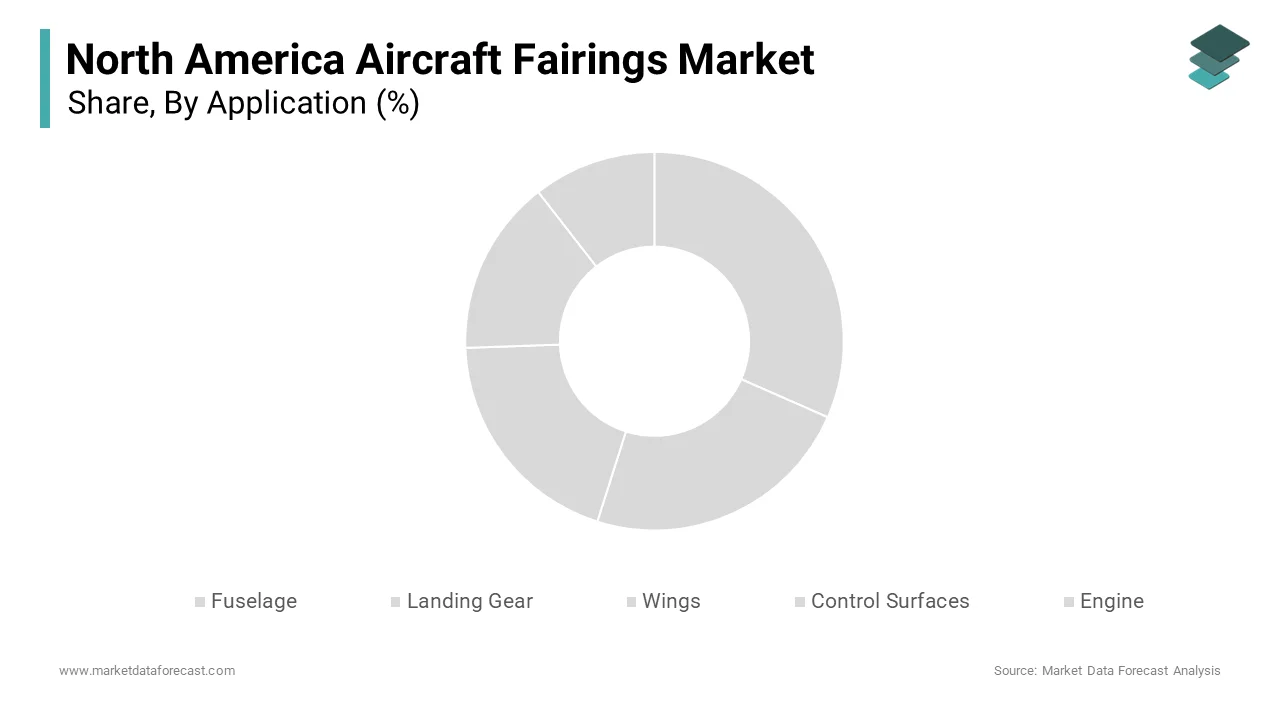
The engine fairings segment is likely to grow with a CAGR of 9.3% throughout the forecast period, with the widespread adoption of high-bypass turbofan engines in commercial and military aircraft. These engines require specialized fairings to streamline airflow around the nacelle, improving thrust efficiency and minimizing turbulence. As per the Federal Aviation Administration (FAA), modern engines like the LEAP-1B and GE9X incorporate optimized nacelle fairings that contribute to up to 5% improvement in fuel efficiency compared to older models. Furthermore, regulatory agencies such as the International Civil Aviation Organization (ICAO) have introduced stricter noise emission standards under the Chapter 14 framework, prompting airlines and manufacturers to invest in acoustic-engineered fairings. Companies like Spirit AeroSystems and Safran are developing composite-based engine fairings with integrated sound-dampening features to comply with these requirements.
By Material Insights
The glass-fiber composites dominated the North American aircraft fairings market with 38.4% of the share in 2025 due to their widespread use in regional aircraft and business jets, where budget constraints limit the adoption of more expensive carbon fiber alternatives. Additionally, their compatibility with existing manufacturing processes and ease of repair make them ideal for mid-sized aircraft operators seeking long-term serviceability. Programs such as the Bombardier CRJ series and Embraer E-Jets extensively utilize GFRP-based fairings for wing-body junctions and landing gear covers. The U.S. Department of Defense also continues to specify glass-fiber composites for certain UAV and transport aircraft fairings due to their radar transparency and resistance to corrosion in maritime environments.
The thermoplastic composites segment is likely to grow with an expected CAGR of 11.3 % next coming years, with the aerospace industry's push for faster, more energy-efficient manufacturing methods. Unlike thermoset resins, which require lengthy curing cycles, thermoplastics can be molded rapidly using automated techniques such as automated fiber placement (AFP) and robotic welding. Additionally, their ability to withstand extreme temperatures and moisture makes them suitable for external fairing applications exposed to harsh operating conditions. Leading manufacturers like Solvay and Toray Industries are collaborating with OEMs such as Boeing and Lockheed Martin to develop thermoplastic fairings for next-generation fighter jets and commercial aircraft. Moreover, growing emphasis on sustainable aviation has boosted interest in recyclable thermoplastic solutions. NASA and MIT researchers have been exploring bio-based thermoplastics that maintain aerospace-grade performance while supporting circular economy principles.
By Aircraft Type Insights
The commercial aircraft was the largest and held 50.3% of the North America aircraft fairings market share in 2025, with the continuous delivery of next-generation aircraft from manufacturers such as Boeing and Airbus. Additionally, the retrofitting of older aircraft with upgraded fairing systems is gaining traction among carriers seeking to comply with emissions regulations and reduce operating costs. The International Air Transport Association (IATA) estimates that even minor aerodynamic improvements can yield annual fuel savings of millions of dollars per aircraft, which is incentivizing fleet-wide upgrades. Major MRO facilities at Dallas/Fort Worth, Atlanta Hartsfield, and Winnipeg Richardson International Airport play a crucial role in maintaining and replacing fairings on active fleets.
The military aircraft segment is likely to grow with an expected CAGR of 10.3% throughout the forecast period due to the U.S. Department of Defense’s multi-billion-dollar procurement programs aimed at modernizing its air force capabilities. Initiatives such as the F-35 Lightning II, B-21 Raider bomber, and MQ-9 Reaper drone fleet require highly engineered fairings to optimize radar cross-section reduction and aerodynamic performance. Moreover, Canada’s Royal Canadian Air Force is investing in CF-18 Hornet upgrades and future fighter acquisitions, incorporating advanced fairing designs for enhanced mission effectiveness. Additionally, unmanned combat aerial vehicles (UCAVs) and stealth drones are increasingly utilizing custom fairing configurations to minimize detectability and improve maneuverability.
By Sales Channel Insights
The Original Equipment Manufacturer (OEM) segment was the largest by accounting for a dominant share of the North America aircraft fairings market in 2025, with the surge in commercial aircraft deliveries. According to the Aerospace Industries Association (AIA), U.S.-based OEMs produced over 800 commercial aircraft in 2023, all of which required customized fairing components tailored to specific airframe configurations. Major manufacturers like Boeing, Airbus, and Bombardier work closely with fairing suppliers such as Spirit AeroSystems and Triumph Group to ensure seamless integration during production. Additionally, defense contracts for next-generation fighter jets and transport aircraft mandate OEM-level fairing installation to meet strict performance and stealth requirements. The U.S. Government Accountability Office (GAO) notes that programs such as the F-35 Joint Strike Fighter and KC-46 Pegasus rely heavily on OEM-sourced fairings to maintain design integrity and mission readiness.
The Aftermarket MRO (Maintenance, Repair, and Overhaul) segment is likely to grow with an expected CAGR of 8.3% throughout the forecast period, with the continued operation of legacy aircraft such as the Boeing 737NG and Airbus A320ceo, which require periodic fairing inspections, repairs, and replacements. According to the Federal Aviation Administration (FAA), aircraft over 20 years old now constitute over 30% of the active commercial fleet, with frequent MRO interventions to maintain airworthiness and efficiency. Moreover, airlines are increasingly opting for retrofitted fairings to enhance fuel efficiency and comply with environmental regulations without investing in new aircraft. MRO hubs such as those in Dallas, Atlanta, and Winnipeg are expanding their fairing refurbishment capabilities, supported by partnerships with OEMs and composite specialists.
COUNTRY-LEVEL ANALYSIS
United States
The United States was the top performer in the North American aircraft fairings market with 75.3% of the share in 2025, with a asubstantiall investment in next-generation aircraft programs. Additionally, the U.S. commercial aviation sector remains robust, with airlines placing large orders for fuel-efficient aircraft such as the Boeing 787 and MAX series. The Federal Aviation Administration (FAA) reports that over 800 commercial aircraft were delivered in 2023 by requiring extensive fairing integration during production and subsequent MRO cycles.
Canada
The Canadian aircraft fairings market held 18.2% of the share in 2025. The country plays a vital role in aerospace manufacturing, particularly in regional aircraft and helicopter production, which drives consistent demand for fairing components. The presence of Bombardier’s CSeries/Airbus A220 program is one of the most successful regional jet platforms globally. According to Innovation, Science and Economic Development Canada, over 200 A220 aircraft were delivered between 2020 and 2023. Additionally, Canada’s growing participation in defense and UAV programs is boosting fairing demand. The Royal Canadian Air Force is modernizing its CF-18 Hornet fleet and evaluating next-generation fighter acquisitions, all of which require precision-engineered fairings for stealth and aerodynamic optimization. Toronto, Montreal, and Vancouver serve as key aerospace hubs, hosting world-class MRO centers such as those operated by L3Harris Technologies and CAE.
KEY MARKET PLAYERS
Airbus Aerostructures (Airbus SE), Boeing Aerostructures Australia (The Boeing Company), Collins Aerospace (RTX Corporation), FACC AG, GKN Aerospace, Spirit AeroSystems, Inc., Saab AB, Strata Manufacturing PJSC, LATECOERE S.A., Kaman Corporation, CTRM Sdn. Bhd, ShinMaywa Industries, Ltd., Royal Engineered Composites, FDC Composites Inc. are the market players that are dominating the North America aircraft fairings market.
Top Players In The Market
Spirit AeroSystems
Spirit AeroSystems is a leading manufacturer of aerospace structures and plays a pivotal role in the North American aircraft fairings market. The company's supplies are components for major commercial aircraft platforms, including Boeing’s 737, 787, and MAX series. Spirit's expertise in composite manufacturing and aerodynamic design has made it an essential partner for OEMs seeking lightweight, high-performance fairing solutions.
Triumph Group
Triumph Group is a key contributor to the North America aircraft fairings sector, providing engineered components for both commercial and military aircraft. The company specializes in precision-machined and composite fairings tailored for engine nacelles, landing gear, and fuselage integration. Triumph’s long-standing relationships with defense contractors and commercial aviation firms position it as a trusted supplier in the region’s aerospace ecosystem.
GKN Aerospace
GKN Aerospace plays a significant role in the development and production of advanced fairing systems across North America. As part of Melrose Industries, GKN supports major aircraft programs with innovative composite fairings that enhance aerodynamic efficiency and reduce weight. Its partnerships with Boeing, Airbus, and emerging UAV manufacturers reinforce its influence in shaping next-generation fairing technologies globally.
Top Strategies Used By Key Market Participants In The Market
Expansion into Advanced Composite Manufacturing
Leading players are investing heavily in advanced composite materials such as carbon fiber-reinforced polymers and thermoplastic composites to meet evolving performance and fuel efficiency demands. Companies are enhancing their product portfolios and securing contracts for next-generation aircraft programs by developing proprietary composite fabrication techniques.
Strategic Partnerships with OEMs and Defense Contractors
Key players are forming long-term partnerships with original equipment manufacturers (OEMs) and defense agencies. These collaborations ensure early involvement in aircraft design phases, allowing fairing suppliers to tailor products to specific platform requirements and maintain supply chain stability. Enhanced R&D Focus on Aerodynamic Optimization and Additive Manufacturing
Major market participants are prioritizing research and development initiatives aimed at improving aerodynamic efficiency and integrating additive manufacturing techniques. These efforts support faster prototyping, reduced material waste, and customized fairing designs that align with modern aviation trends, which reinforces competitive differentiation in the North American market.
COMPETITION OVERVIEW
The competition in the North American aircraft fairings market is characterized by a blend of established aerospace giants, specialized component manufacturers, and emerging composite technology firms striving to capture strategic positions in a high-precision industry. Traditional Tier 1 suppliers like Spirit AeroSystems and GKN Aerospace maintain strong dominance due to their deep integration with major aircraft OEMs and extensive engineering capabilities. However, niche players and regional manufacturers are increasingly challenging this hierarchy by offering cost-effective, high-performance alternatives tailored for specific applications.
Market participants are differentiating themselves through innovation in material science, particularly in the development of lightweight composites and thermoplastics that offer superior strength-to-weight ratios. Additionally, advancements in additive manufacturing and digital twin modeling are enabling more agile product development cycles by allowing companies to respond rapidly to evolving aircraft design specifications.
Collaborations between fairing manufacturers and defense primes are also intensifying, especially as stealth optimization and unmanned aerial vehicle (UAV) programs gain momentum. Meanwhile, aftermarket MRO providers are expanding their fairing retrofitting services to cater to aging fleets seeking aerodynamic upgrades without full-scale replacements.
RECENT HAPPENINGS IN THE MARKET
- In January 2025, Spirit AeroSystems announced a new partnership with Boeing to develop next-generation composite fairings for the 777X program, which is aiming to improve aerodynamic efficiency and reduce overall aircraft weight while maintaining structural integrity.
- In March 2025, GKN Aerospace launched a dedicated R&D facility in San Antonio, Texas, focusing on thermoplastic fairing development and automated manufacturing processes designed to accelerate production timelines for commercial and military aircraft applications.
- In June 2025, Triumph Group secured a multi-year contract with Lockheed Martin to supply custom-engineered fairings for the F-35 Lightning II fighter jet, emphasizing radar-absorbing materials and integrated stealth features tailored for advanced combat missions.
- In September 2025, Collins Aerospace introduced a new line of modular fairing systems compatible with regional and business jets, which offers airlines greater flexibility in aerodynamic customization and easier maintenance during scheduled aircraft servicing.
- In November 2025, Safran Landing Systems collaborated with a Canadian composite manufacturer to co-develop lightweight landing gear fairings for next-gen narrow-body aircraft by targeting improved fuel efficiency and lower lifecycle maintenance costs for global operators.
MARKET SEGMENTATION
This research report on the North American aircraft fairings market is segmented and sub-segmented into the following categories.
By Application Insights
- Fuselage
- Landing Gear
- Wings
- Control Surfaces
- Engine
By Material Insights
- Carbon-Fiber Reinforced Polymer (CFRP)
- Glass-Fiber Composites
- Metal Alloys
- Thermoplastic Composites
- Additively-Manufactured Thermoplastics
By Aircraft Type
- Commercial
- Narrow-Body Commercial Aircraft
- Wide-Body Commercial Aircraft
- Military
- Combat
- Non-Combat
- General Aviation
- Unmanned Systems
By Sales Channel
- OEM Production
- Aftermarket MRO
By Country
- The United States
- Canada
- Mexico