- Product Description Description
- Table of Contents TOC
- List of Table & Figure LOT
- Get Free Sample PDF Sample PDF
Market Size, 2025
$2.71 BnMarket Estimate, 2026
$2.85 BnMarket Forecast, 2034
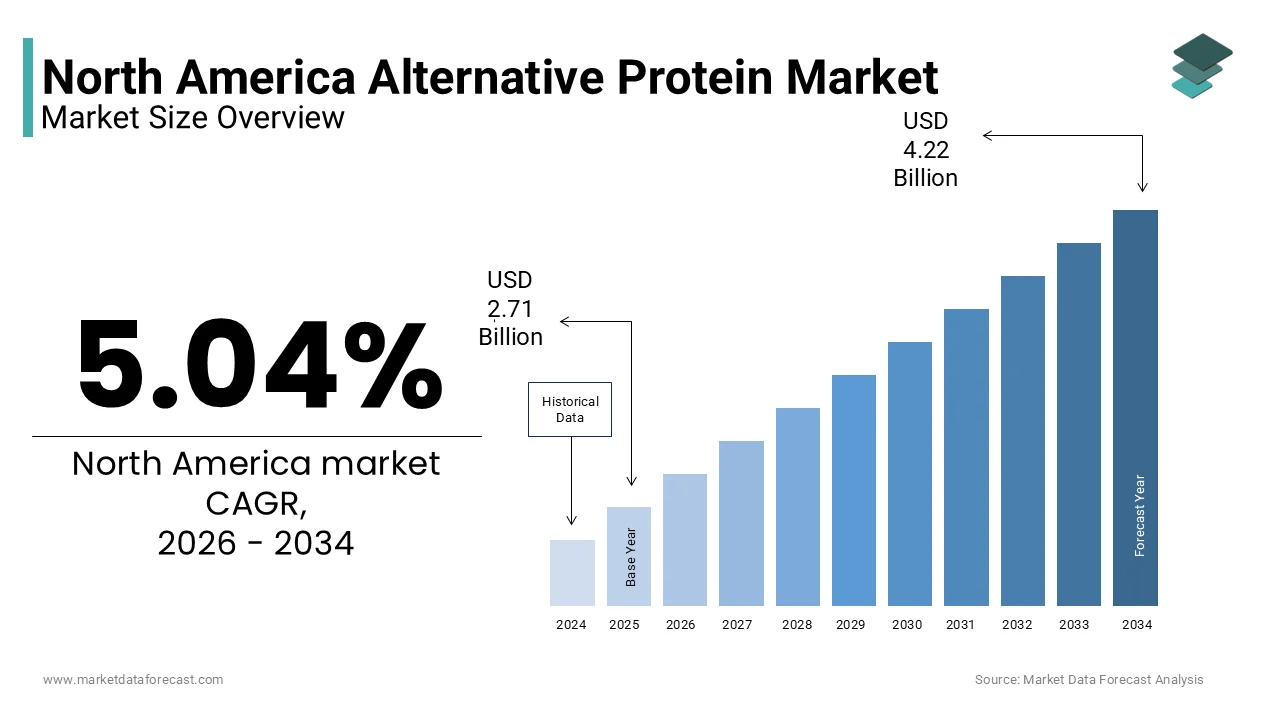
$4.22 BnCAGR, 2026–2034
5.04%North America Alternative Protein Market Size
The alternative protein market size in North America was valued at USD 2.71 billion in 2025 and is predicted to be worth USD 4.22 billion by 2034 from USD 2.85 billion in 2026 and grow at a CAGR of 5.04% from 2026 to 2034.
The alternative protein for animal feed is a rapidly evolving with the growing need to reduce dependency on traditional protein sources like fishmeal and soybean meal. According to the Food and Agriculture Organization (FAO), approximately 70% of global agricultural land is used for livestock production, with nearly 33% of arable land dedicated to cultivating feed crops. In North America, over 60% of agricultural inputs go toward animal feed production, highlighting the region's reliance on protein-rich feed ingredients. Innovations in biotechnology and increasing investments in sustainable feed solutions have accelerated the adoption of alternative proteins, particularly in poultry and aquaculture sectors. The U.S. alone accounts for more than 40% of global soybean production, much of which is processed into high-protein animal feed. Meanwhile, Canada has emerged as a key player in canola-based protein alternatives, contributing significantly to regional feed diversification strategies.
MARKET DRIVERS
Escalating Environmental Concerns Surrounding Traditional Feed Ingredients
The environmental degradation linked to conventional feed ingredients is a primary factor driving the growth of the North America alternative protein market. Soybean cultivation, which dominates the regional feed landscape, contributes significantly to deforestation and greenhouse gas emissions. The World Resources Institute estimates that agriculture accounts for nearly 24% of global greenhouse gas emissions, with livestock feed production representing a major share. In North America, over 90 million acres of land are used for soybean cultivation, primarily for animal feed purposes, exacerbating soil depletion and water usage concerns. The United Nations Environment Programme reports that 34% of global fish stocks are overfished, largely due to industrial demand for aquaculture feeds. This environmental toll has prompted regulatory bodies and producers to seek sustainable alternatives.
Rising Demand for Animal Protein and Feed Efficiency Optimization
The growing demand for feed efficiency optimization is another factor that is enhancing the growth of the North America alternative protein market. Traditional feed ingredients often exhibit variability in nutritional consistency and cost by prompting producers to explore alternatives that offer higher digestibility and growth performance. Single-cell proteins derived from yeast and bacteria, for example, demonstrate crude protein levels exceeding 60%, compared to 40–45% in conventional soybean meal. Furthermore, the expansion of intensive livestock farming systems necessitates consistent, high-quality feed inputs to maintain productivity.
MARKET RESTRAINTS
Regulatory Hurdles and Approval Delays for Novel Feed Ingredients
The regulatory complexities due to delay in the approval of the new launch products is hindering the growth of the North America alternative protein market. The approval process for novel feed ingredients, particularly those derived from insects, algae, or genetically modified microorganisms, involves rigorous safety assessments and compliance with stringent guidelines set by the U.S. Food and Drug Administration (FDA) and the Association of American Feed Control Officials (AAFCO). These evaluations can span several years, delaying market entry and increasing development costs for manufacturers. The European Food Safety Authority (EFSA) has similarly approved just a handful of insect-based feed products, reflecting the cautious approach taken by regulators. Additionally, inconsistent labeling standards and varying state-level regulations further complicate commercialization efforts.
High Production Costs and Limited Economies of Scale
The economic viability especially in undeveloped countries is limiting the growth of the North America alternative protein market. The production of novel protein sources such as insect meal, single-cell proteins, and microbial biomass requires substantial capital investment in specialized infrastructure, fermentation systems, and downstream processing technologies. These elevated costs stem from low production volumes, energy-intensive cultivation methods, and immature supply chains. Many alternative protein startups operate at pilot or small-scale levels, unable to achieve the economies of scale necessary to compete with established feed ingredients. A study conducted by the University of Guelph found that microbial protein production facilities must reach a minimum capacity of 50,000 tons annually to reduce unit costs by 30%. However, most North American producers currently operate below 10,000 tons per year. Moreover, feed manufacturers often hesitate to adopt alternative proteins due to price volatility and uncertain return on investment. The lack of standardized pricing mechanisms and limited long-term supply agreements further exacerbate financial risks.
MARKET OPPORTUNITIES
Technological Advancements in Fermentation and Bioprocessing
The technological innovations in fermentation and bioprocessing is greatly influencing the growth of the North America alternative protein market. Advances in precision fermentation, where microorganisms are engineered to produce specific proteins, have enabled scalable and efficient production of high-quality feed ingredients. Companies like Calysta and Novozymes are leveraging microbial fermentation to produce FeedKind protein, a single-cell protein with a protein content exceeding 70%. This method reduces land and water usage by over 90% compared to traditional crop-based proteins, according to a 2023 report by the Good Food Institute. Additionally, developments in solid-state fermentation for insect protein production have enhanced yield efficiency and reduced processing time by up to 40%. Automation and AI-driven monitoring systems are also improving consistency and reducing labor costs in alternative protein manufacturing.
Strategic Partnerships and Vertical Integration by Major Agri-Corporations
The strategic collaborations and vertical integration initiatives by leading agri-corporations are also to elevate the growth of the North America alternative protein market. Major players such as Cargill, ADM, and Bunge are investing in partnerships with alternative protein startups and biotech firms to diversify their feed portfolios and secure long-term supply chains. In 2023, Cargill announced a joint venture with InnovaFeed to establish a 120,000-ton-per-year insect protein facility in the U.S., marking one of the largest investments in the sector. Similarly, ADM acquired a stake in U.K.-based biotech company Nourish, aiming to expand its microbial protein capabilities. These alliances leverage the financial resources and distribution networks of established firms while providing startups with access to industrial-scale production and regulatory expertise.
MARKET CHALLENGES
Consumer and Producer reluctance Toward Novel Feed Ingredients
The consumer and producer reluctance toward novel feed ingredients is a significant challenge to the North America alternative protein market. As per a 2022 survey by the International Food Information Council, only 38% of U.S. consumers are comfortable with the use of insect-based ingredients in animal feed, citing concerns over food safety and ethical implications. According to the National Pork Board, over 60% of U.S. pig farmers express reluctance to switch to alternative proteins without long-term feeding trials and proven results. This resistance is compounded by limited awareness and education regarding the benefits of novel feed ingredients. Extension programs and agricultural universities have begun addressing this gap, but adoption rates remain slow.
Supply Chain Fragmentation and Logistical Constraints
The supply chain fragmentation and logistical inefficiencies are acting as a barrier for the growth of the North America alternative protein market. Unlike traditional feed ingredients, which benefit from well-established sourcing and distribution networks, alternative proteins often rely on fragmented and geographically dispersed suppliers. A 2023 logistics analysis by the North American Millers’ Association found that transportation costs for alternative proteins are 25–40% higher than those for conventional ingredients due to shorter supply runs and specialized handling requirements. Cold chain logistics are particularly for perishable microbial proteins, adding further complexity and cost. Storage infrastructure for alternative feed ingredients is also underdeveloped, with many facilities lacking the equipment to handle novel materials without cross-contamination risks. As per the USDA, less than 20% of feed mills in North America are equipped to process insect or microbial proteins.
REPORT COVERAGE
| REPORT METRIC | DETAILS |
| Market Size Available | 2025 to 2034 |
| Base Year | 2025 |
| Forecast Period | 2026 to 2034 |
| CAGR | 5.04% |
| Segments Covered | By Type, Form, Application, Distribution Channel, and Region |
| Various Analyses Covered | Regional & Country Level Analysis, Segment-Level Analysis, DROC, PESTLE Analysis, Porter’s Five Forces Analysis, Competitive Landscape, Analyst Overview on Investment Opportunities |
| Regions Covered | The United States, Canada, Mexico, and Rest of North America |
| Market Leaders Profiled | ADM, Cargill, Lightlife Foods, Impossible Foods, International Flavors & Fragrances Inc, Ingredion Inc, Kerry Group PLC Class A, Glanbia PLC, Bunge Global SA, Axiom Foods, Tate & Lyle PLC, SunOpta Inc, AGT Food, Ingredients, Emsland Group, and others |
REGIONAL ANALYSIS
United States Alternative Protein Market
The United States was the top performer of the North America's alternative protein market with 85.3% of the share in 2025. The United States is the world's leading producer of animal protein, with over 9.6 billion broiler chickens, 120 million cattle, and 75 million pigs requiring substantial feed inputs annually, according to the National Agricultural Statistics Service. The country's feed industry represents the largest in North America, with over 40 million tons of feed produced annually, which is creating extensive opportunities for alternative protein integration. Federal government support through research funding and regulatory streamlining has accelerated market development, with the USDA allocating $350 million specifically for alternative protein research since 2020.
Canada Alternative Protein Market
Canada alternative protein market held 14.6% of the share in 2025. The country's aquaculture industry has been particularly progressive in adopting alternative proteins, with 70% of salmon farms incorporating insect meal or microbial proteins into feed formulations by 2023, according to industry surveys conducted by the Canadian Aquaculture Industry Alliance. Canadian regulatory authorities have established streamlined approval processes for novel feed ingredients, reducing review periods from 30 months to 15 months for qualified alternative proteins, as reported by the Canadian Food Inspection Agency. The country's agricultural research institutions have contributed significantly to alternative protein innovation, with universities such as the University of Guelph and McGill University conducting pioneering research in insect protein production and microbial fermentation technologies.
COMPETITIVE LANDSCAPE
The North America alternative protein market for animal feed represents a highly dynamic and rapidly evolving competitive landscape characterized by intense innovation and strategic positioning among diverse market participants. Traditional agricultural giants such as Cargill, ADM, and Bunge compete alongside emerging biotechnology companies and specialized alternative protein producers for market dominance. The competitive environment is marked by significant capital investments in research and development activities, with companies seeking technological differentiation and product innovation to establish competitive advantages. Strategic partnerships and acquisitions have become common tactics as established players seek to rapidly expand their alternative protein capabilities while emerging companies leverage corporate expertise and distribution networks. Market competition is further intensified by regulatory developments and evolving consumer preferences for sustainable animal protein production systems. Price competition remains moderate due to the premium positioning of many alternative protein products, though economies of scale and production efficiency improvements are gradually reducing cost barriers to adoption. Geographic expansion strategies and vertical integration initiatives characterize the competitive approaches of leading market participants seeking to secure supply chain control and market access. The presence of numerous small and medium-sized enterprises alongside large multinational corporations creates a fragmented yet rapidly consolidating market structure where innovation and strategic positioning determine competitive success.
KEY MARKET PLAYERS
Some of the key players in the alternative protein market are
- ADM
- Cargill
- Lightlife Foods
- Impossible Foods
- International Flavors & Fragrances Inc.
- Ingredion Inc.
- Kerry Group PLC Class A
- Glanbia PLC
- Bunge Global SA
- Axiom Foods
- Tate & Lyle PLC
- SunOpta Inc.
- AGT Food and Ingredients
- Emsland Group
TOP PLAYERS IN THE MARKET
- Cargill is the top most key player in North America's alternative protein market through its comprehensive approach to sustainable nutrition solutions. The company has strategically invested in multiple alternative protein technologies, including partnerships with insect protein producers and microbial fermentation specialists. Cargill's extensive distribution network and deep understanding of animal nutrition requirements have enabled seamless integration of alternative proteins into existing feed formulations. Their research and development capabilities focus on optimizing protein digestibility and nutritional profiles while maintaining cost competitiveness. The company's commitment to sustainability aligns with growing consumer demands for environmentally responsible feed ingredients. Through strategic acquisitions and joint ventures, Cargill has established itself as a market leader capable of scaling alternative protein solutions across diverse livestock sectors.
- Archer Daniels Midland is also positioned as the top key players in North America's alternative protein market through aggressive innovation and strategic partnerships. The company leverages its extensive agricultural processing capabilities to develop novel protein sources from plant-based materials and fermentation processes. ADM's integrated approach combines ingredient sourcing, processing technology, and nutritional expertise to create comprehensive alternative protein solutions for animal feed applications. Their research facilities focus on enhancing protein functionality and bioavailability while reducing environmental impact. The company has invested significantly in biotechnology capabilities to develop customized protein profiles for specific animal species and production systems. ADM's global supply chain infrastructure enables consistent delivery of high-quality alternative proteins to feed manufacturers across North America.
- Calysta is an innovator in North America's alternative protein market through its revolutionary FeedKind protein technology. The company specializes in producing high-quality microbial proteins using proprietary fermentation processes that deliver consistent nutritional profiles and superior sustainability metrics. Calysta's precision fermentation approach enables scalable production of protein ingredients without reliance on traditional agricultural resources or marine ecosystems. Their technology platform addresses challenges in feed ingredient consistency and supply chain reliability while offering enhanced digestibility characteristics for livestock applications. The company has established strategic partnerships with major feed manufacturers and agricultural corporations to accelerate market adoption of their alternative protein solutions. Calysta's commitment to scientific rigor and regulatory excellence has facilitated rapid approval processes for their products across multiple jurisdictions. Their innovative approach to protein production represents a paradigm shift toward more sustainable and efficient animal nutrition solutions in North America's feed industry.
TOP STRATEGIES USED BY KEY MARKET PARTICIPANTS
Strategic Partnerships and Joint Ventures
Leading companies in North America alternative protein market actively pursue strategic partnerships and joint ventures to accelerate market penetration and technology development. These collaborations enable resource sharing, risk mitigation, and access to complementary capabilities across the value chain. Major feed manufacturers partner with alternative protein startups to leverage innovative technologies while providing scale and distribution expertise. Technology licensing agreements facilitate rapid deployment of proven production methods across multiple facilities. Joint research initiatives between corporations and academic institutions drive innovation in protein optimization and processing efficiency. These partnership strategies create synergistic relationships that enhance competitive positioning while reducing individual investment risks. Collaborative ventures also enable market participants to access new customer segments and geographic markets through established partner networks. The strategic alliance approach has proven particularly effective in navigating complex regulatory environments and accelerating product development timelines.
Vertical Integration and Supply Chain Control
Market participants increasingly adopt vertical integration strategies to maintain quality control and ensure supply chain reliability in North America alternative protein market. Companies invest in upstream production facilities to secure raw material sourcing and downstream processing capabilities to optimize final product characteristics. This approach enables greater control over production costs, quality standards, and delivery timelines while reducing dependency on external suppliers. Integrated operations facilitate real-time adjustments to production parameters based on market demands and nutritional requirements. Vertical integration strategies also provide opportunities for waste stream utilization and circular economy implementation. Companies establish dedicated research facilities within their integrated operations to accelerate product development and customization. This comprehensive approach to supply chain management enhances competitive differentiation while ensuring consistent product availability for feed manufacturers.
Product Diversification and Specialization
Key players in North America alternative protein market pursue product diversification and specialization strategies to address varying customer requirements and market segments. Companies develop specialized protein formulations tailored to specific animal species, production systems, and nutritional objectives. This approach enables premium pricing for customized solutions while expanding market reach across diverse application areas. Product portfolios include various protein concentrations, particle sizes, and functional characteristics to meet specific feed formulation requirements. Specialization strategies focus on developing expertise in particular protein sources such as insect meal, microbial proteins, or plant-based alternatives. Companies invest in processing technologies that enable product differentiation and enhanced functionality. Geographic specialization allows market participants to optimize distribution networks and regulatory compliance for specific regional markets. These diversification efforts create multiple revenue streams while reducing dependency on single product categories.
RECENT HAPPENINGS IN THE MARKET
- In March 2025, Cargill Incorporated announced a strategic partnership with Enterra Feed Corporation to expand insect protein production capacity in the Pacific Northwest region. This collaboration is anticipated to enhance Cargill's alternative protein supply chain capabilities and strengthen their market position in sustainable animal feed solutions.
- In November 2023, Archer Daniels Midland Company acquired a majority stake in Nourish Ingredients, a UK-based biotechnology firm specializing in precision fermentation proteins. This acquisition is expected to accelerate ADM's development of microbial protein solutions for North American animal feed markets.
- In August 2023, Calysta Inc. completed the construction of their second commercial-scale FeedKind production facility in the Gulf Coast region. This expansion is projected to increase the company's alternative protein production capacity and improve supply reliability for feed manufacturers.
- In June 2023, Bunge Limited established a joint venture with InnovaFeed to develop insect protein production capabilities at their existing oilseed processing facilities. This strategic initiative is designed to integrate alternative protein production within Bunge's existing agricultural processing operations.
- In January 2025, Darling Ingredients Inc. launched their proprietary insect protein brand ProtaLine for animal feed applications across North American markets. This product launch is expected to diversify Darling's ingredient portfolio and capture growing demand for sustainable feed protein sources.
MARKET SEGMENTATION
This research report on the North America alternative protein market has been segmented and sub-segmented based on the following categories.
By Type
- Plant-Based Proteins
- Microbial-Based Proteins
- Insect-Based Proteins
- Others
By Form
- Dry
- Liquid
- Others
By Application
- Meat Alternatives
- Dairy Alternatives
- Protein Supplements
- Functional Food
- Animal Feed
- Pet Food
- Others
By Distribution Channel
- Online Retail
- Supermarkets/Hypermarkets
- Specialty Stores
- Others
By Country
- The United States
- Canada
- Rest of North America