North America AMI Water Meter Market Size, Share, Trends & Growth Forecast Report, By Technology ( Ultrasonic, Electromagnetic, Mechanical, Smart, Hybrid), End Use, Communication Technology, And Country (US, Canada, Mexico & Rest of North America) - Industry Analysis From (2026 To 2034)
North America AMI Water Meter Market Size
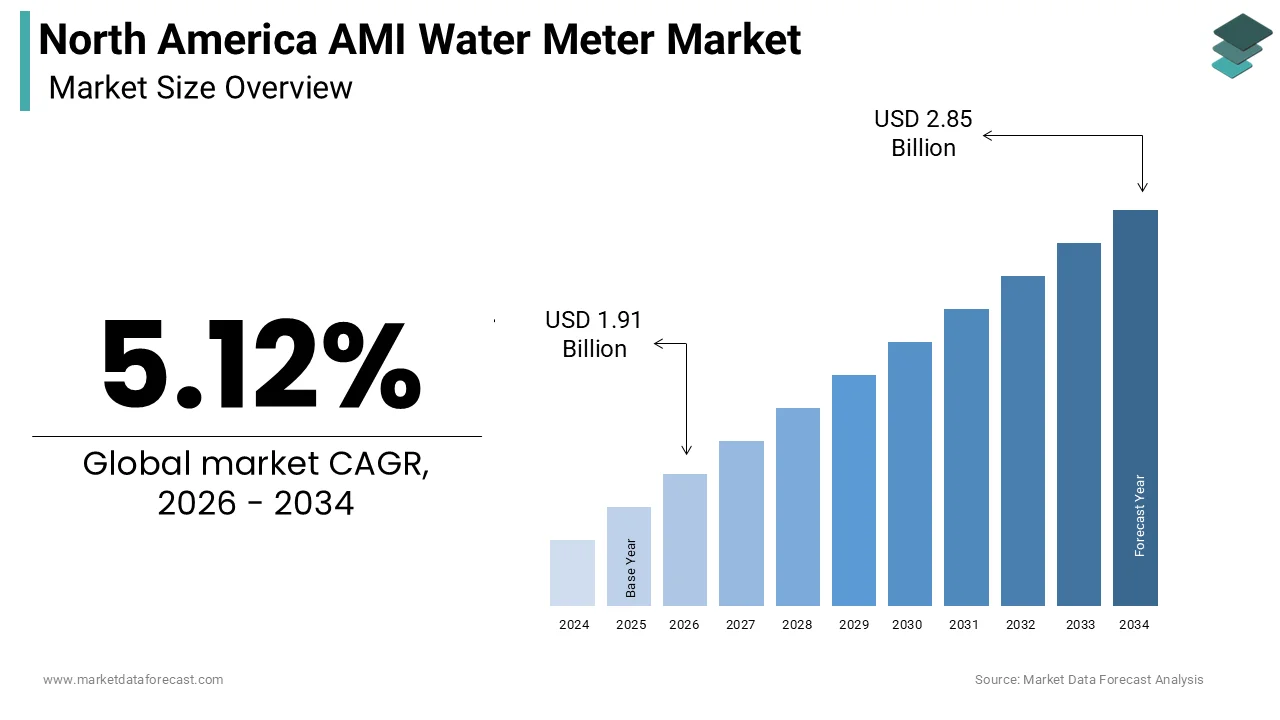
The North American AMI water meter market size was calculated to be USD 1.82 billion in 2025 and is anticipated to be worth USD 2.85 billion by 2034, growing from USD 1.91 billion in 2026 at a CAGR of 5.12% during the forecast period.
An Advanced Metering Infrastructure (AMI) water meter is a smart device in a larger system that automatically sends detailed, real-time water usage data (and status alerts like leaks) to utilities via a two-way communication network, replacing manual reads. As per multiple sources, the American Water Works Association encourages the water industry to transition toward comprehensive metering practices, including the adoption of advanced metering infrastructure (AMI) technology over traditional manual methods. In addition, according to research, the Federation of Canadian Municipalities, along with other Canadian water organizations, supports a growing trend in the adoption of advanced water metering infrastructure among municipalities to enhance water conservation, improve billing accuracy, and support efficient system planning. These systems typically consist of electronic water meters equipped with radio frequency transmitters, data concentrators, and centralized software platforms that process consumption information. The technology enables utilities to detect leaks, monitor consumption patterns, and implement dynamic pricing strategies while reducing manual meter reading costs. According to various studies, industry professionals widely acknowledge that substantial volumes of water are lost daily due to aging infrastructure and leaks, and the Environmental Protection Agency promotes advanced metering systems as a critical tool in reducing these system losses and improving overall water management. The integration of Internet of Things connectivity and cloud-based analytics has further enhanced system capabilities, supporting predictive maintenance and demand forecasting applications that optimize water distribution networks.
MARKET DRIVERS
Increasing Water Conservation Requirements and Regulatory Mandates
Water scarcity concerns and evolving regulatory frameworks act as primary drivers for the North America AMI water meter market. According to sources, North America and other regions face growing water stress, driving increased investment in water management and efficiency technologies. The EPA WaterSense program supports water efficiency initiatives and provides resources and funding opportunities for municipalities to implement advanced metering systems. In California, the Water Conservation Act of 2009 established a goal for urban water suppliers to achieve a 20% reduction in per-capita water use by the year 2020. The Pacific Institute has published reports highlighting that smart metering, when combined with effective pricing, can reduce water use. Canada's Water Security Strategy mandates that large municipalities adopt systems for monitoring consumption and detecting leaks. Municipalities such as Toronto have implemented large-scale deployments of smart meters to manage water resources. States within the Colorado River Basin have instituted mandatory water auditing requirements. These auditing mandates necessitate the use of systems capable of tracking water consumption in real time. These regulatory imperatives, combined with drought emergency declarations in regions like the Southwest, create sustained demand for AMI water metering solutions. Utilities increasingly recognize that advanced metering infrastructure provides essential data for compliance reporting while supporting operational efficiency improvements that justify investment costs.
Aging Water Infrastructure and Replacement Cycles
The deteriorating condition of the regional water infrastructure creates substantial demand for AMI water meter installations as utilities modernize their distribution networks, which in turn fuels the expansion of the North American AMI water meter market. Water utilities across the United States are facing a significant need for investments in their infrastructure to meet long-term demands. A key part of maintaining these systems involves the regular replacement of aging water meters. The average lifespan of mechanical water meters is a primary factor in this continuous need for upgrades. This natural cycle of replacement is encouraging the adoption of advanced metering infrastructure (AMI) systems by many water providers. A considerable number of utilities throughout North America are currently operating with metering systems that have been in place for several decades, making systematic upgrades necessary. In Canada, water system rehabilitation is a major part of municipal capital spending, and smart metering components are frequently included in new improvement projects. Various cities are undertaking large-scale initiatives to modernize their water systems. For example, programs in major metropolitan areas have involved replacing hundreds of thousands of older meters with AMI technology to improve efficiency and ensure accurate billing. These large-scale replacement initiatives, supported by federal and state funding programs, create sustained market opportunities. Utilities recognize that AMI installations during infrastructure upgrades provide enhanced functionality while avoiding future retrofit costs, making advanced metering economically attractive during replacement cycles.
MARKET RESTRAINTS
High Implementation Costs and Financial Barriers
The substantial capital investment required for advanced metering infrastructure (AMI) water meter deployment is a serious barrier to the North American AMI water meter market. This is particularly challenging for smaller utilities and municipalities with limited financial resources. Implementing comprehensive AMI systems generally involves high costs per connection, encompassing essential meters, the necessary communication infrastructure, and supporting software platforms. This investment presents particular challenges for certain utilities, especially those serving smaller populations, where insufficient economies of scale make it difficult to justify the initial expenditure. For many small water systems, a primary barrier is the limited access to the required capital financing needed for extensive AMI deployments. The upfront costs include not only meter hardware but also network infrastructure, data management systems, and staff training programs that strain municipal budgets. Besides, ongoing maintenance and software licensing fees add to initial capital expenditures annually. Many utilities must secure municipal bonds or federal grants to proceed with implementations, creating dependency on external funding sources. The complexity of cost-benefit analyses and lengthy procurement processes further delays project initiation, particularly in budget-constrained environments where competing infrastructure priorities exist.
Cybersecurity Concerns and Data Privacy Issues
Growing cybersecurity threats and data privacy concerns restrain the growth of the North America AMI water meter market expansion. Utilities and consumers express apprehension about connected infrastructure vulnerabilities. According to multiple sources, Trends indicate a growing frequency of cyber incidents within the water sector, which is increasing awareness of potential risks associated with networked metering systems. Consumer advocacy groups have raised concerns about personal consumption data collection. Reports suggest numerous privacy complaints related to utility data sharing practices have emerged in recent years. The complexity of securing communication networks, managing encryption protocols, and protecting consumer data creates additional implementation burdens for utilities. As per research, a significant number of utilities across North America do not have personnel dedicated solely to managing security requirements for metering systems. Regulatory compliance adds further complexity, with varying state and provincial data protection laws requiring specific security measures and breach notification procedures. Legislation about consumer privacy is establishing legal frameworks that require utilities to develop extensive data governance policies and mechanisms for consumer consent. These security and privacy concerns have led to public resistance in some communities, with several municipalities delaying or modifying AMI deployment plans following resident opposition. Utilities must invest in comprehensive security frameworks and public education campaigns to address these concerns, adding both cost and timeline pressures to implementation efforts.
MARKET OPPORTUNITIES
Integration with Smart City Initiatives and IoT Platforms
The convergence of AMI water meter technology with broader smart city development programs creates potential growth opportunities for the North American AMI water meter market. According to research, Numerous North American cities are implementing smart city initiatives that incorporate the modernization of water infrastructure. These programs typically integrate water metering systems with traffic management, energy distribution, and waste management platforms to create comprehensive urban intelligence networks. The City of Barcelona's smart city model, which has been replicated in North American contexts, demonstrates potential revenue generation through data analytics services that can be applied to water consumption patterns. As per sources, investment in smart city technology across North America includes significant allocations for the development of water management systems. Microsoft's Azure-based smart city platforms and IBM's Intelligent Operations Centers increasingly incorporate water metering data to optimize resource allocation and emergency response capabilities. The integration opportunities extend to utility billing systems, where real-time consumption data enables dynamic pricing models that can generate additional revenue streams. Cities have successfully implemented integrated platforms that combine AMI water meters with other municipal services, demonstrating scalable models for broader adoption. These integration capabilities not only enhance system value propositions but also create opportunities for recurring revenue through data analytics and consulting services.
Expansion into Non-Residential and Industrial Applications
The extension of AMI water meter technology into commercial, industrial, and institutional sectors offers major prospects beyond traditional residential applications, which is predicted to propel the expansion of the North American AMI water meter market. According to sources, commercial and industrial water users represent a noteworthy segment of total water consumption in the United States, indicating considerable potential for the implementation of advanced metering infrastructure. Large manufacturing facilities, healthcare systems, and educational institutions increasingly require detailed water usage monitoring to comply with environmental regulations and sustainability reporting requirements. Implementing advanced metering infrastructure (AMI) water metering systems in industrial facilities often leads to measurable reductions in water costs, achieved through enhanced leak detection and consumption optimization practices. The healthcare sector shows particular interest, with hospital systems requiring continuous monitoring to maintain operational efficiency and regulatory compliance. Universities and school districts represent another growing segment. Canada's industrial sector, particularly in resource extraction and processing industries, demonstrates strong demand for sophisticated metering solutions that support environmental stewardship initiatives. These non-residential applications typically involve higher-value contracts and longer equipment lifecycles, which create attractive revenue opportunities for AMI system providers seeking to diversify beyond residential markets.
MARKET CHALLENGES
Technical Complexity and Interoperability Issues
The high level of technical expertise necessary for AMI water meters poses significant hurdles during deployment, which impedes the growth of the North American AMI water meter market. This is particularly challenging when integrating systems seamlessly, ensuring different parts work together effectively, and managing continuous upkeep. According to multiple sources, implementing Advanced Metering Infrastructure (AMI) can pose technical challenges during initial phases. Common issues may involve difficulties with communication protocols and software integration processes. The diversity of existing utility infrastructure, ranging from legacy mechanical systems to partial electronic metering networks, complicates standardization efforts and increases deployment complexity. Water utilities often manage multiple types of metering technologies concurrently, which necessitates extensive integration efforts to create unified platforms for data collection. Communication network reliability presents ongoing challenges, particularly in rural areas where cellular coverage may be insufficient to support continuous data transmission. Radio frequency interference from other municipal systems and environmental factors can degrade signal quality, affecting data accuracy and system performance. The complexity of data management platforms creates additional burdens, as utilities must integrate AMI data with existing customer information systems, billing platforms, and operational technology networks. These technical complexities require specialized expertise and extended implementation timelines, which increase project costs and create barriers to adoption for smaller utilities lacking technical resources.
Consumer Acceptance and Behavioral Resistance
Consumer resistance to AMI water meter installation and data collection practices degrades the growth of the North American AMI water meter market. This is particularly true in communities where privacy concerns and billing transparency issues create opposition. Concerns about electromagnetic radiation exposure, despite scientific evidence indicating safety compliance, continue to generate public resistance in some communities. The visibility of consumption data and potential for usage-based pricing creates anxiety among consumers accustomed to flat-rate billing structures. Educational barriers contribute to resistance, as many consumers lack understanding of AMI benefits and perceive the technology as intrusive rather than beneficial. Utilities must invest in extensive public education campaigns and community engagement programs to overcome these acceptance challenges, adding both time and cost to deployment initiatives while potentially limiting market penetration in resistant areas.
REPORT COVERAGE
| REPORT METRIC | DETAILS |
| Market Size Available | 2025 to 2034 |
| Base Year | 2025 |
| Forecast Period | 2026 to 2034 |
| CAGR | 5.12% |
| Segments Covered | By Technology, End Use, Communication Technology, And Region |
| Various Analyses Covered | Global, Regional & Country Level Analysis; Segment-Level Analysis; DROC, PESTLE Analysis; Porter’s Five Forces Analysis; Competitive Landscape; Analyst Overview of Investment Opportunities |
| Regions Covered | US, Canada, and the rest of North America |
| Market Leaders Profiled | Itron, Sensus (Xylem), Badger Meter, Neptune Technology Group, Aclara Technologies, Honeywell, Landis+Gyr, Mueller Systems, Diehl Metering, Kamstrup, Arad Group, Zenner USA, Census Instruments, Master Meter, Metron-Farnier |
SEGMENTAL ANALYSIS
By Technology Insights
The mechanical technology segment led the North America AMI water meter market by capturing a 45.1% share in 2025. The supremacy of the mechanical technology segment is attributed to the extensive existing installed base of mechanical meters and ongoing replacement cycles that continue to drive demand for upgraded mechanical AMI systems. Mechanical meters remain prevalent due to their proven reliability, lower initial costs, and familiarity among utilities and consumers. The ongoing replacement of aging mechanical water meters creates substantial demand within this segment, as utilities systematically upgrade their metering infrastructure to incorporate AMI capabilities. Numerous mechanical water meters across North America are approaching the end of their operational lifespan and will require replacement. The limited-service life of mechanical meters establishes a recurring replacement cycle that maintains consistent market demand. Utilities allocate significant annual funding toward meter replacement activities throughout the region. Large municipal utilities are transitioning from mechanical meters to advanced metering infrastructure to modernize their systems. Rural utilities, which constitute a portion of North American water systems, predominantly rely on mechanical metering technology due to cost considerations and simpler installation requirements. These systematic replacement initiatives, supported by federal funding programs and utility capital improvement plans, ensure the continued dominance of mechanical technology in the AMI water meter market. The economic advantages of mechanical AMI water meters make them particularly attractive for large-scale utility deployments where budget constraints influence technology selection. Mechanical Advanced Metering Infrastructure (AMI) meters can be a more affordable alternative to electromagnetic or ultrasonic options, making them a potential choice for utilities with restricted capital budgets. Many water utilities in North America serve a limited number of connections and may prioritize cost-effective solutions over advanced functionality. Bulk purchasing agreements enable utilities to achieve additional cost savings. The simplicity of mechanical meter installation and maintenance reduces the total cost of ownership, particularly in rural areas where specialized technical expertise may be limited. These cost advantages, combined with adequate performance for basic metering functions, ensure continued preference for mechanical technology among budget-conscious utilities seeking AMI capabilities.
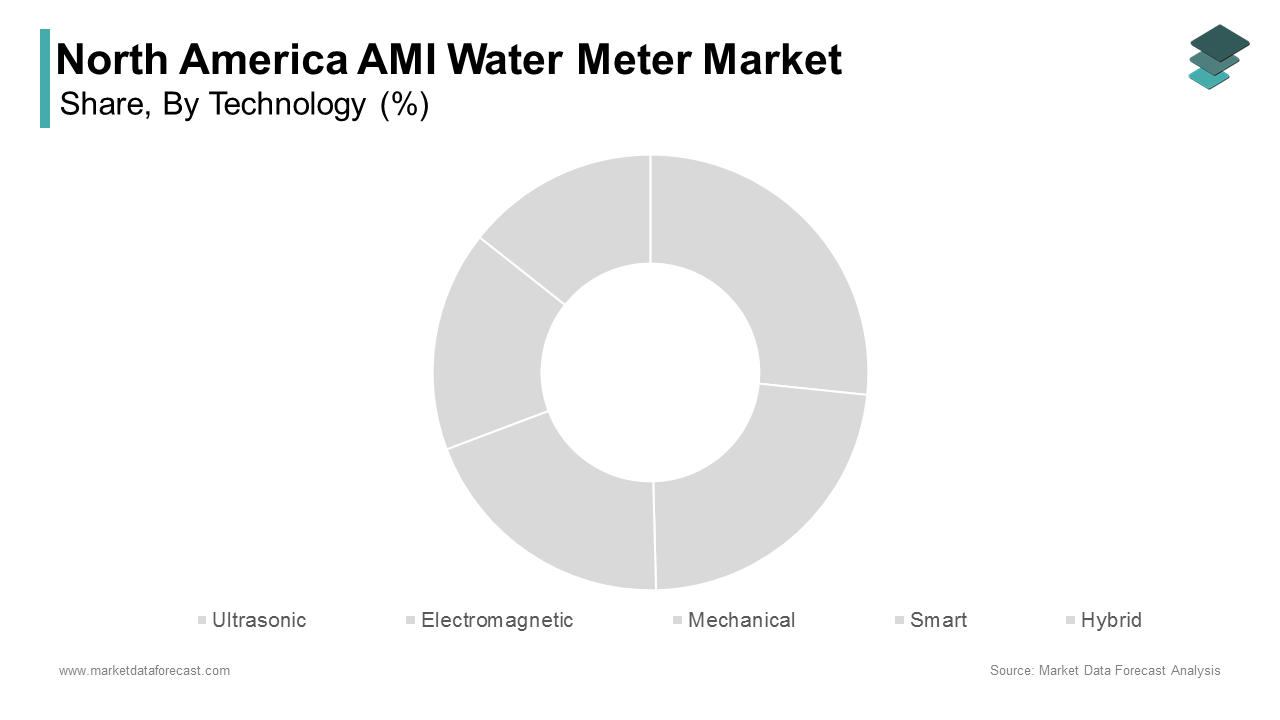
The smart technology segment is estimated to register the fastest CAGR of 12.4% from 2026 to 2034 due to increasing demand for advanced analytics, real-time monitoring capabilities, and integration with broader smart infrastructure initiatives that characterize next-generation water management systems. Smart city initiatives across North America are driving rapid adoption of advanced water metering technologies that provide real-time data collection and integration capabilities with broader municipal systems. According to research, numerous North American cities have active smart city programs that include water infrastructure modernization as core components. These initiatives typically require sophisticated metering systems that can communicate with traffic management, energy distribution, and waste management platforms to create comprehensive urban intelligence networks. The City of Barcelona's smart city model, which has been replicated in North American contexts, demonstrates potential revenue generation through data analytics services that can be applied to water consumption patterns. The integration opportunities extend to utility billing systems, where real-time consumption data enables dynamic pricing models that can generate additional revenue streams. Cities like Columbus, Ohio, and Vancouver, British Columbia, have successfully implemented integrated platforms that combine smart water meters with other municipal services, demonstrating scalable models for broader adoption. The sophisticated data processing and analytical capabilities of smart water meter technology are driving rapid market adoption as utilities seek to optimize operations and reduce maintenance costs through predictive analytics. According to sources, smart metering systems can reduce water loss through enhanced leak detection and consumption monitoring capabilities. These systems utilize artificial intelligence and machine learning algorithms to identify abnormal consumption patterns, predict equipment failures, and optimize distribution network performance. The integration of weather data, seasonal consumption patterns, and historical usage trends enables sophisticated demand forecasting that supports infrastructure planning and resource allocation decisions. The ability to detect and locate leaks within hours rather than days or weeks creates substantial cost savings. These advanced capabilities, combined with automated reporting and compliance monitoring features, make smart technology increasingly attractive for forward-thinking utilities seeking operational excellence.
By End Use Insights
The municipal end-use segment dominated the North America AMI water meter market by holding a 60.6% share in 2025. The leading position of the municipal end-use segment is credited to the extensive infrastructure requirements of municipal water utilities and their role as primary implementers of large-scale AMI water meter deployments. Municipal utilities serve as the backbone of water distribution systems, managing vast networks that require sophisticated metering solutions to ensure efficient operations and regulatory compliance. Municipal utilities across North America are implementing extensive infrastructure modernization programs that include large-scale AMI water meter deployments to improve operational efficiency and regulatory compliance. According to sources, the United States requires substantial investment in water infrastructure over the coming decades, with the modernization of metering systems comprising a notable share of these projected costs. These comprehensive programs typically involve replacing aging mechanical meters with advanced systems that provide real-time data collection and remote monitoring capabilities. Many utilities operate with aging metering systems, necessitating systematic upgrades to ensure continued functionality and standards. One major city's smart water meter initiative is replacing numerous aging meters with advanced metering infrastructure (AMI) systems. Another large-scale water meter replacement program targets extensive meter installations over several years to modernize local infrastructure and enhance billing processes. These large-scale initiatives, supported by federal and state funding programs, create sustained market opportunities. Municipal utilities recognize that AMI installations during infrastructure upgrades provide enhanced functionality while avoiding future retrofit costs, making advanced metering economically attractive during replacement cycles. Regulatory requirements and water conservation mandates at federal, state, and local levels are compelling municipal utilities to implement AMI water metering systems to achieve compliance objectives and demonstrate environmental stewardship. Water supply in various regions of North America is subject to periodic stress conditions, impacting a significant number of people and indicating a need for advanced management approaches. Regulatory bodies have established guidelines for utilities to improve efficiency and meet conservation objectives. Specific regional legislation encourages a reduction in per-capita consumption, which in turn leads to the implementation of modern metering infrastructure. Water utilities are increasingly adopting advanced monitoring technologies to support these conservation efforts. Municipalities are similarly implementing advanced detection and consumption monitoring systems to enhance water security strategies. These regulatory imperatives, combined with drought emergency declarations in regions like the Southwest, create sustained demand for AMI water metering solutions that enable municipalities to meet compliance requirements while supporting operational efficiency improvements.
The industrial end-use segment is anticipated to witness the fastest CAGR of 11.8% over the forecast period, owing to increasing corporate sustainability commitments, regulatory compliance requirements, and the economic benefits of precise water consumption monitoring in industrial operations. Industrial facilities are increasingly adopting AMI water metering technology to meet corporate sustainability commitments and comply with environmental reporting requirements that demand precise water consumption tracking and management. Several major corporations have begun incorporating water stewardship metrics into their sustainability reports, which focus on the detailed consumption data needed to monitor progress toward targets. These corporate initiatives are driven by stakeholder expectations, regulatory requirements, and the recognition that water efficiency improvements can generate substantial cost savings. As per sources, industrial facilities implementing AMI water metering systems achieve average water cost reductions through improved leak detection and consumption optimization. The healthcare sector shows particular interest, with hospital systems requiring continuous monitoring to maintain operational efficiency and regulatory compliance. Manufacturing industries, particularly those in resource-intensive sectors like chemicals, food processing, and pharmaceuticals, face increasing pressure to demonstrate water stewardship through transparent reporting and continuous improvement initiatives. The Global Reporting Initiative standards require companies to disclose water usage data at the facility level, making advanced metering systems essential for compliance. Universities and school districts represent another growing segment. These sustainability drivers create substantial demand for industrial AMI water metering solutions that provide the precision and data analytics capabilities required for comprehensive environmental reporting. Advanced water metering technology enables industrial facilities to optimize processes and improve operational efficiency through real-time consumption monitoring and data-driven decision-making that directly impacts bottom-line performance. These systems provide granular consumption data that enables facility managers to identify inefficiencies, optimize equipment operation, and reduce waste throughout manufacturing processes. The integration of AMI water meters with supervisory control and data acquisition systems enables automated process optimization that responds to real-time consumption patterns and operational demands. Chemical processing facilities, which require precise water quality and quantity control for product consistency, demonstrate particularly strong adoption rates for advanced metering technology. The ability to track consumption by specific process lines or equipment enables targeted efficiency improvements that can generate substantial cost savings. Food and beverage manufacturers benefit from enhanced traceability and quality control capabilities that support food safety compliance while optimizing water usage. Pharmaceutical companies require continuous monitoring to maintain sterile conditions and comply with regulatory standards, making advanced metering systems essential for operational excellence.
By Communication Technology Insights
The cellular communication technology segment was the largest in the North America AMI water meter market by accounting for a 38.3% share in 2025. The dominance of the cellular communication technology segment is driven by the widespread availability of cellular networks, established infrastructure, and proven reliability that make cellular communication attractive for utility applications requiring consistent data transmission and remote monitoring capabilities. The widespread availability of cellular network coverage across North America makes cellular communication technology the preferred choice for AMI water meter deployments, particularly in urban and suburban areas where network infrastructure is well-established. According to sources, cellular networks cover a significant share of the U.S. population, providing reliable connectivity for metering applications in densely populated regions. This extensive coverage eliminates the need for utilities to invest in proprietary communication infrastructure, reducing implementation costs and complexity. Rural areas, which previously faced connectivity challenges, now benefit from expanded 4G LTE coverage and emerging 5G networks that extend service to previously underserved locations. The reliability of cellular networks, combined with redundant coverage from multiple carriers, ensures continuous data transmission that is critical for utility operations. The infrastructure advantages, combined with the scalability of cellular networks that can accommodate growing numbers of connected meters, make cellular technology the dominant communication choice for North American utilities seeking reliable and cost-effective AMI solutions. The compatibility of cellular communication technology with existing utility information technology infrastructure and operational systems creates significant advantages that drive widespread adoption of cellular-based AMI water meter solutions. According to research, a notable share of North American utilities already utilize cellular networks for various operational applications, which makes integration with AMI systems straightforward and cost-effective. These utilities have established security protocols, network management procedures, and technical expertise that support cellular communication deployments without requiring extensive additional training or system modifications. The ability to leverage existing cellular data plans and network contracts enables utilities to achieve cost savings while maintaining service quality. Integration with enterprise resource planning systems, customer information systems, and billing platforms is simplified through standard cellular communication protocols that support seamless data exchange. The integration advantages, combined with reduced implementation complexity and faster deployment timelines, make cellular communication technology particularly attractive for utilities seeking to modernize their metering infrastructure while minimizing operational disruption.
The Low Power Wide Area Network (LPWAN) communication technology segment is likely to experience the fastest CAGR of 15.2% during the forecast period. The rapid growth of the LPWAN segment is propelled by the unique advantages of LPWAN technology, including extended battery life, long-range communication capabilities, and cost-effective deployment that address key challenges faced by utilities in diverse geographic environments. The exceptional battery life and minimal maintenance requirements of LPWAN communication technology make it particularly attractive for AMI water meter applications in remote locations and challenging environments where frequent battery replacements are impractical or costly. LPWAN-enabled water meters have a long battery life, often operating for many years on a single charge. This can be considerably longer than the battery life typical of cellular-based systems, which often require more frequent battery replacements. It extends operational lifespan, reduces maintenance costs, and eliminates the need for frequent site visits that are particularly challenging in rural or hard-to-reach locations. The reduced power consumption of LPWAN technology, which operates at 1/100th the power requirements of cellular systems, enables deployment in areas where solar or battery power is the only available option. Remote monitoring capabilities allow utilities to detect and address maintenance issues proactively, reducing system downtime and improving customer satisfaction. Canada's northern territories, where extreme weather conditions and limited accessibility create maintenance challenges, demonstrate particularly strong adoption rates for LPWAN-based AMI systems. These operational advantages, combined with reduced total cost of ownership over the system lifecycle, make LPWAN technology increasingly attractive for utilities seeking sustainable and cost-effective communication solutions. The cost-effectiveness of LPWAN communication technology for deployments in challenging geographic environments, including rural areas, mountainous regions, and underground installations, drives rapid market adoption among utilities seeking reliable connectivity solutions without extensive infrastructure investment. According to research, LPWAN systems can achieve awidere coverage range than traditional wireless technologies, enabling single base station coverage of up to several kilometers in rural environments. This extended range capability reduces the number of required infrastructure components, including data concentrators and repeaters, which significantly increases deployment costs for other communication technologies. LPWAN technology addresses these cost challenges by requiring minimal infrastructure investment while providing reliable connectivity across large geographic areas. Underground installations, which present particular challenges for cellular and radio frequency communication systems, benefit from LPWAN's superior penetration capabilities that maintain signal integrity in challenging environments. Municipalities with aging infrastructure and limited capital budgets find LPWAN solutions particularly attractive due to their low implementation costs and simplified deployment requirements. These economic advantages, combined with reliable performance in diverse geographic conditions, position LPWAN technology as the fastest-growing communication solution for North American AMI water meter deployments.
REGIONAL ANALYSIS
United States AMI Water Meter Market Analysis
The United States outperformed other countries in the North American AMI water meter market and captured a 88.6% share in 2025. The country's vast water infrastructure network, extensive regulatory framework, and substantial investment in smart water management technologies continue to contribute to the dominance of the US market. Moreover, the U.S. market is characterized by diverse regional adoption patterns, with western states showing particularly strong growth due to water scarcity concerns and progressive utility management practices. The American market benefits from substantial federal and state-level support mechanisms that drive widespread adoption of advanced metering infrastructure. State-level initiatives play a crucial role, with California leading through its Water Conservation Act requirements and comprehensive rebate programs for utility modernization projects. Water meters with advanced metering infrastructure have been installed widely in the state. The state's water meter deployment represents a significant implementation in the region. Federal initiatives have offered substantial funding to improve water systems across various locations. These financing efforts support enhancements to water infrastructure nationally. The convergence of supportive policies, technological advancement, and consumer education continues to solidify the United States' leadership position in the regional market. Major metropolitan areas, including New York, Chicago, and Los Angeles, have implemented comprehensive AMI deployment programs that serve as models for smaller utilities across the country.
Canada AMI Water Meter Market Analysis
Canada followed closely in North America for AMI water meter systems. It shows some of the highest adoption rates in the region, driven by strong government support and increasing awareness of water conservation benefits. The Canadian market is characterized by concentrated adoption in provinces like British Columbia, Quebec, and Ontario, where supportive policies and water management initiatives favor advanced metering technology. Canadian adoption patterns reflect strong policy support and utility engagement with advanced water management technologies. The number of Canadian households utilizing AMI water meters has grown. Moreover, the federal government supports water infrastructure improvements through the Investing in Canada Infrastructure Program. Funding from this program facilitates the implementation of smart metering systems across the country. Provincial initiatives further amplify this support. These factors, combined with rising water rates and environmental awareness, position Canada as a rapidly growing segment within the North American market.
COMPETITION OVERVIEW
The North America AMI water meter market exhibits intense competition characterized by the presence of established global manufacturers alongside emerging regional players and technology specialists. Market dynamics are shaped by technological innovation, pricing strategies, and brand recognition, with competition intensifying as utilities increasingly recognize the value of advanced metering infrastructure. Established players leverage extensive distribution networks, comprehensive product portfolios, and strong brand equity to maintain market positions, while newer entrants focus on disruptive technologies and competitive pricing strategies. The competitive landscape is influenced by varying regional preferences, with different manufacturers achieving stronger positions in specific geographic areas based on local partnerships and market understanding. Utility relationships play a crucial role in market competition, as installation expertise and ongoing service capabilities significantly influence purchasing decisions. Companies compete through product differentiation, warranty offerings, and customer support services. The market also experiences competition from alternative metering technologies and communication solutions, requiring manufacturers to continuously demonstrate value propositions. Brand loyalty remains important, though changing utility requirements and evolving technology preferences create opportunities for market share shifts. Competition extends beyond product features to include financing options, implementation support, and digital integration capabilities that address comprehensive utility operational needs.
KEY MARKET PLAYERS
A few major players of the North American AMI water meter market include
- Itron
- Sensus (Xylem)
- Badger Meter
- Neptune Technology Group
- Aclara Technologies
- Honeywell
- Landis+Gyr
- Mueller Systems
- Diehl Metering
- Kamstrup
- Arad Group
- Zenner USA
- Census Instruments
- Master Meter
- Metron-Farnier
Top Strategies Used by Key Market Participants
Strategic Acquisitions and Technology Integration Leading manufacturers in the North American AMI water meter market actively pursue strategic acquisitions to expand their technology portfolios and enhance system capabilities. These acquisition strategies focus on complementary technologies, including communication networks, data analytics platforms, and specialized metering components that strengthen overall solution offerings. Companies target innovative startups and established technology providers to accelerate product development timelines and gain access to emerging market segments. Integration strategies also include acquiring regional distributors and service providers to expand market reach and improve customer support capabilities. These strategic moves enable manufacturers to offer comprehensive end-to-end solutions while reducing dependency on third-party components and technologies. The consolidation trend allows larger players to achieve economies of scale and develop competitive advantages through proprietary technology integration.
Partnership Development with Utilities and Technology Providers Key players continuously develop strategic partnerships with utilities, technology providers, and system integrators to strengthen market positions and expand solution capabilities. Partnership strategies focus on collaborative development initiatives that combine utility operational expertise with manufacturer technological capabilities to create innovative solutions. Companies work closely with major utilities to develop pilot programs and demonstration projects that validate new technologies and build market acceptance. Technology partnerships with communication providers, cloud service companies, and cybersecurity firms enable manufacturers to offer comprehensive solutions that address evolving utility requirements. These collaborative approaches also include working with government agencies and regulatory bodies to ensure compliance with emerging standards and requirements. Partnership development strategies enable manufacturers to leverage existing market relationships while expanding their reach into previously untapped geographic regions and customer segments.
Product Innovation and Customization for Regional Requirements Market leaders invest significantly in research and development to advance AMI water meter technology and address specific regional requirements and operating conditions. Innovation strategies focus on improving measurement accuracy, enhancing communication reliability, and integrating advanced analytics capabilities that optimize utility operations. Companies develop customized solutions for different climate conditions, water quality characteristics, and regulatory requirements that vary across North American regions. Product development efforts also emphasize reducing installation complexity and improving user interface experiences for utility operators and customers. Manufacturers invest in testing facilities and certification programs to validate performance claims and ensure regulatory compliance across different jurisdictions. These innovation strategies enable companies to differentiate their offerings while addressing evolving customer requirements for precision measurement and smart water management capabilities.
Leading Players in the North America AMI Water Meter Market
- Itron Inc. maintains a prominent position in the North America AMI water meter market through its comprehensive portfolio of smart metering solutions and advanced analytics platforms that support utility operational excellence. The company's contribution to the global market includes pioneering radio frequency mesh networking technology and sophisticated data management systems that enable utilities to optimize resource allocation and improve customer engagement. Their OpenWay Riva platform represents a significant advancement in AMI technology, providing utilities with flexible communication options and real-time data processing capabilities. Itron's commitment to innovation drives continuous development of new features and functionalities that address evolving utility requirements for water management and conservation. The company's extensive service network and training programs support utility partnerships throughout North America, ensuring successful implementation and ongoing system optimization. Their research initiatives in artificial intelligence and machine learning position them at the forefront of digital transformation in water utility operations. Itron's global technology development centers enable continuous innovation, with North American operations benefiting from worldwide research initiatives and product development efforts.
- Badger Meter Inc. holds a significant position in the North America AMI water meter market through its innovative magnetic flow measurement technology and comprehensive software solutions that provide utilities with precise consumption data and advanced analytics capabilities. The company's contribution to the global market stems from decades of expertise in water measurement technology, particularly in magnetic flow meter applications that offer superior accuracy and reliability in diverse operating conditions. Their ORION system represents a breakthrough in AMI communication technology, providing long-range connectivity and extended battery life that reduces maintenance requirements and operational costs. Badger Meter's focus on customer-centric solutions has established strong relationships with utilities seeking tailored approaches to water management challenges. The company's commitment to quality manufacturing and reliability has established strong brand loyalty among utilities and end-users. The extensive training programs and technical support infrastructure support widespread adoption of their solutions. Badger Meter's global technology development enables continuous innovation, with North American operations benefiting from international research initiatives and product development efforts that enhance system performance and functionality.
MARKET SEGMENTATION
This research report on the North American AMI water meter market has been segmented and sub-segmented based on technology, end use, communication technology, and region.
By Technology
- Ultrasonic
- Electromagnetic
- Mechanical
- Smart
- Hybrid
By End Use
- Residential
- Commercial
- Industrial
- Municipal
By Communication Technology
- Cellular
- RF Mesh
- LPWAN
- Wired
By Region
- US
- Canada
- Mexico
- Rest of North America
Frequently Asked Questions
1. Which countries are included in the North American AMI water meter market?
The market includes the United States and Canada, with the United States representing the largest share due to extensive smart water infrastructure investments.
2. What does AMI mean in water metering?
AMI stands for Advanced Metering Infrastructure, a system that enables remote meter reading, real-time data transmission, and utility network optimization.
3. Why are AMI water meters important for utilities?
AMI water meters help utilities improve billing accuracy, detect leaks early, reduce non-revenue water, and enhance operational efficiency.
4. What types of AMI water meters are used in North America?
Common types include ultrasonic meters, electromagnetic meters, and mechanical meters integrated with AMI communication modules.
5. Which AMI water meter type dominates the North American market?
Ultrasonic AMI water meters dominate due to their high accuracy, long lifespan, and minimal maintenance requirements.
6. What are the key growth drivers of the North American AMI water meter market?
Key drivers include aging water infrastructure, water conservation initiatives, smart city programs, and increasing adoption of digital utility solutions.
7. What communication technologies are used in AMI water metering systems?
Technologies include RF mesh networks, cellular communication, fixed network AMI systems, and IoT-based networks such as LoRaWAN.
8. Who are the primary end users in this market?
Municipal water utilities are the primary end users, followed by commercial and industrial facilities.
9. How does AMI help reduce non-revenue water?
AMI enables continuous monitoring, rapid leak detection, pressure management, and accurate consumption measurement, reducing water losses.
10. What challenges does the North American AMI water meter market face?
Challenges include high initial deployment costs, data security concerns, system integration issues, and long approval cycles.
11. What role does data analytics play in AMI water metering?
Data analytics supports usage forecasting, customer insights, leak detection, and informed infrastructure investment decisions.
12. What is the future outlook for the North American AMI water meter market?
The market is expected to grow steadily, driven by digital transformation of utilities, sustainability goals, and ongoing smart water investments.
Related Reports
Access the study in MULTIPLE FORMATS
Purchase options starting from
$ 2000
Didn’t find what you’re looking for?
TALK TO OUR ANALYST TEAM
Need something within your budget?
NO WORRIES! WE GOT YOU COVERED!
Call us on: +1 888 702 9696 (U.S Toll Free)
Write to us: sales@marketdataforecast.com