- Product Description Description
- Table of Contents TOC
- List of Table & Figure LOT
- Get Free Sample PDF Sample PDF
Market Size, 2025
$6.97 BnMarket Estimate, 2026
$7.23 BnMarket Forecast, 2034
$9.67 BnCAGR, 2026–2034
3.70%Executive Summary: North America Automotive Headliners Market
- Market Scope: Regional North American automotive headliners market analysis covering vehicle categories, material types, country leadership frameworks, and interior technology adoption metrics.
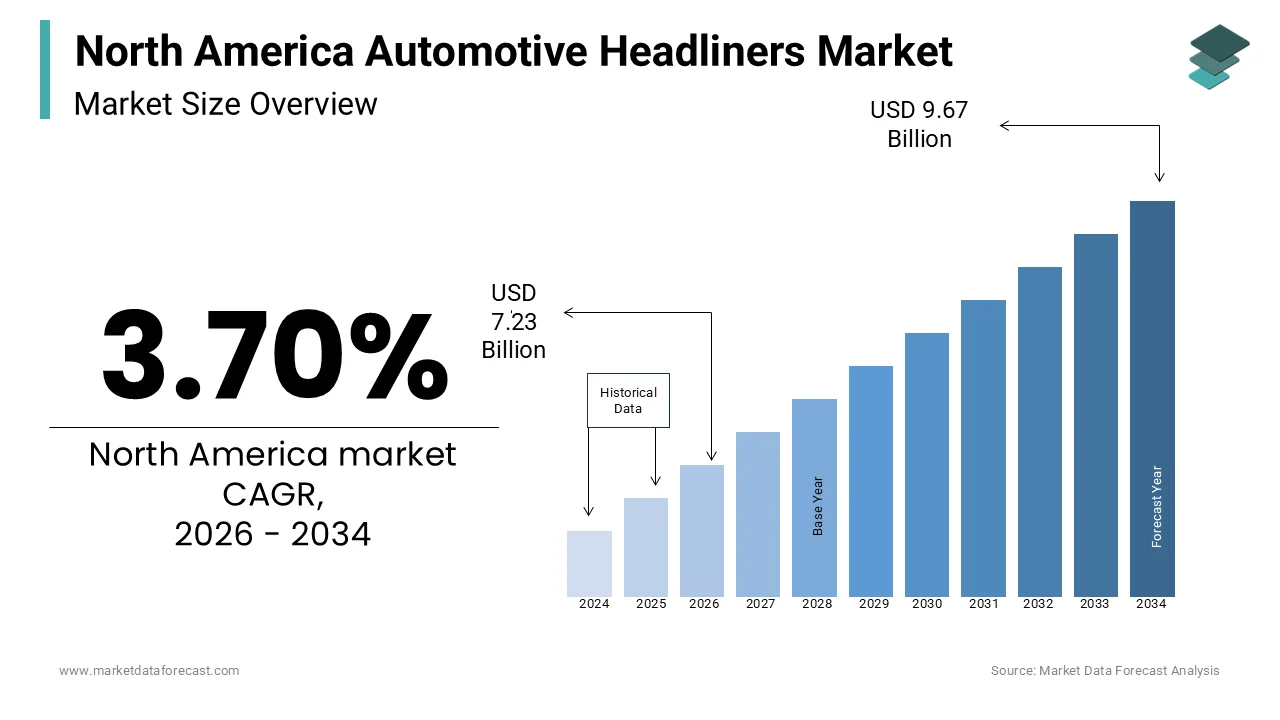
- Market Valuation: Valued at USD 6.97 billion in 2025, estimated at USD 7.23 billion in 2026, and projected to reach USD 9.67 billion by 2034, registering a CAGR of 3.70% from 2026 to 2034.
- Primary Growth Drivers: Increasing vehicle production and light vehicle sales across North America, growing integration of smart interior technologies and connected vehicle features, rising demand for premium interior comfort, acoustic insulation, lightweight materials, and expanding EV production requiring advanced headliner designs.
Key Market Segment Metrics (2026–2034)
| Category | Leading Segment (Position) | Fastest-Growing / Key Growth Segment |
|---|---|---|
| By Vehicle Segment & Material | Passenger Vehicles (largest vehicle segment) & Fabric Materials (largest material) | Commercial Vehicles (fastest-growing vehicle segment) & Plastic Materials (fastest-growing material) |
| By Technology & Innovation | Standard textile-based headliners and conventional vehicle interior assemblies | Smart lighting, integrated sensors, acoustic insulation, and sustainable recyclable materials |
| By Region / Country | United States (leading country with 82.2% market share in 2025) | Mexico (fastest-growing country market) |
Major Market Players & Market Structure
Market Structure: Highly competitive North American automotive interior components sector characterized by lightweight and sustainable material investments, smart lighting and acoustic tech integration, OEM partnerships, and automated manufacturing capability expansions.
Key Companies: Grupo Antolin-Irausa S.A., Motus Integrated Technologies, Toyota Boshoku Corporation, Kasai North America, Inc., International Automotive Components (IAC) Group, Howa Co., Ltd., UGN, Inc., SA Automotive, Hayashi Telempu Corporation, Freudenberg Performance Materials, Inteva Products, LLC, IMR-Industrialesud Spa, and Lear Corporation.
North America Automotive Headliners Market Size
The North American automotive headlines market size was valued at USD 6.97 billion in 2025 and is anticipated to reach a valuation of USD 7.23 billion in 2026 and USD 9.67 billion by 2034, growing at a CAGR of 3.70%, from 2026 to 2034.
The automotive headliners are the production and installation of ceiling covering systems in passenger vehicles, light commercial vehicles, and heavy-duty trucks. Automotive headliners serve multiple functional purposes, including noise dampening, aesthetic enhancement, and structural support for overhead components such as lighting systems, sunroofs, and wiring harnesses. According to the Society of Automotive Engineers, modern headliners incorporate up to seven distinct material layers, including foam backing, fabric covering, and acoustic insulation components that collectively contribute to vehicle interior comfort and performance. The North American automotive industry, which produced approximately 11.5 million vehicles in 2023 as per the International Organization of Motor Vehicle Manufacturers, drives consistent demand for headliner systems across original equipment manufacturer installations and aftermarket replacement segments. Manufacturing processes have evolved significantly, with automated cutting and sewing technologies now employed across 65% of North American headliner production facilities, according to the Automotive Parts Manufacturers' Association. The market's complexity is further influenced by stringent safety regulations requiring headliners to meet specific flammability standards outlined by the Federal Motor Vehicle Safety Standards, which mandate that all interior materials pass rigorous fire resistance testing.
MARKET DRIVERS
Increasing Vehicle Production and Light Vehicle Sales Volume
The robust vehicle production rates and expanding light vehicle sales volumes are propelling the growth of the North American automotive headliners market. According to the International Organization of Motor Vehicle Manufacturers, North American vehicle production reached 11.5 million units in 2023, representing a 15% increase from 2022 levels and establishing the region as one of the world's largest automotive manufacturing hubs. Furthermore, the increasing average vehicle content value has enhanced headliner specifications, with luxury vehicle manufacturers incorporating advanced materials such as Alcantara suede and carbon fiber accents that command premium pricing. The North American automotive industry's shift toward SUV and crossover dominance, representing 68% of total light vehicle sales in 2023 according to IHS Markit, has amplified demand for larger headliner assemblies that require more material inputs and complex manufacturing processes.
Technological Integration and Smart Interior Features
The evolution of automotive headliners toward sophisticated technological integration is additionally propelling the growth of the North American automotive headliners market. Modern vehicle interiors increasingly incorporate smart features within headliner assemblies, including embedded lighting systems, wireless charging pads, and acoustic enhancement technologies that require specialized manufacturing capabilities and premium material compositions. According to the Consumer Technology Association, 78% of new vehicle models launched in North America during 2023 featured advanced headliner-integrated technologies such as LED ambient lighting, overhead display systems, and noise-canceling components. The proliferation of electric vehicles, which accounted for 12% of North American vehicle sales in 2023 per J.D. Power, has accelerated demand for technologically advanced headliners that can accommodate additional wiring harnesses and electronic components while maintaining lightweight construction requirements. Electric vehicle manufacturers particularly emphasize headliner design to optimize interior space utilization and integrate panoramic sunroof systems that require specialized headliner configurations. Additionally, the automotive industry's focus on enhanced user experience has driven innovation in headliner materials and functionalities, with 45% of premium vehicle manufacturers incorporating gesture-controlled lighting systems within headliner assemblies, according to the Center for Automotive Research. The integration of health monitoring sensors and air quality management systems within headliner structures represents an emerging trend that requires collaboration between traditional automotive suppliers and technology companies, which is creating new revenue streams and market opportunities for headliner manufacturers.
MARKET RESTRAINTS
Supply Chain Disruptions and Raw Material Volatility
The persistent supply chain disruptions and volatile raw material pricing directly impact production costs and delivery schedules. Headliner manufacturing relies heavily on specialized materials, including polyurethane foam, polyester fabrics, and acoustic insulation components, many of which experienced price fluctuations of 25-40% between 2022 and 20,23, according to the Chemical Economics Handbook. The automotive supply chain's complexity is further compounded by the multi-tier supplier structure, where headliner manufacturers depend on upstream suppliers for components such as foam backing materials and fabric coverings. Additionally, the concentration of certain raw material suppliers in specific geographic regions creates vulnerability to geopolitical tensions and natural disasters. Approximately 60% of global polyurethane foam production originates from Asia-Pacific markets, making North American headliner manufacturers susceptible to shipping delays and cost increases, as documented by the International Trade Administration.
Stringent Environmental Regulations and Sustainability Requirements
The increasingly stringent environmental regulations and sustainability will hinder the growth of the NoAmericanrica automotive headliners market. Federal and state environmental agencies have implemented comprehensive regulations governing the use of volatile organic compounds, recyclability requirements, and end-of-life disposal protocols for automotive interior components. The Environmental Protection Agency's automotive emissions standards now require headliner materials to meet specific VOC emission limits of less than 100 micrograms per cubic meter, which is affecting 85% of current material formulations according to the National Highway Traffic Safety Administration. The European Union's influence on North American automotive standards through trade agreements has introduced additional sustainability requirements, including restrictions on flame-retardant chemicals and heavy metal content that affect material sourcing decisions. Compliance with these regulations requires significant investment in research and development, with headliner manufacturers allocating approximately 15% of annual revenue to sustainability initiatives according to the Automotive Aftermarket Industry Association.
MARKET OPPORTUNITIES
Electric Vehicle Market Expansion and Design Innovation
The rapid expansion of electric vehicles is expected to increase the demand for the development of specialized products that accommodate unique design requirements and technological integration needs, which is solely to escalate the growth of the North American automotive headliners market. According to J.D. Power, electric vehicle sales in North America reached 1.4 million units in 2023, representing a 45% increase from the previous year and establishing a clear trajectory toward 25% market penetration by 2030. Electric vehicles require distinct headliner configurations to optimize interior space utilization, accommodate panoramic sunroof systems, and integrate advanced wiring harnesses for battery management and autonomous driving technologies. The absence of traditional engine noise in electric vehicles places greater emphasis on acoustic performance, creating demand for headliners with enhanced sound-dampening capabilities that can reduce road noise and HVAC system operation sounds. Premium electric vehicle manufacturers particularly emphasize headliner aesthetics and functionality, incorporating features such as fiber optic lighting systems, wireless charging pads, and integrated climate control vents that command premium pricing. The average electric vehicle headliner contains 40% more electronic components compared to traditional internal combustion engine vehicles, according to the Electric Drive Transportation Association. Additionally, the minimalist design philosophy prevalent in electric vehicle interiors creates opportunities for headliner manufacturers to develop innovative materials and textures that complement modern aesthetic preferences.
Aftermarket Replacement and Customization Market Growth
The expanding aftermarket replacement and customization is also expected to enhance the growth of the North American automotive headliners market. According to the Bureau of Transportation Statistics, the average vehicle age in North America reached 12.2 years in 2023, with 42% of vehicles operating beyond their original warranty periods, creating sustained demand for replacement headliner components and repair services. Performance vehicle enthusiasts and commercial fleet operators represent specialized market segments with unique headliner requirements, including fire-resistant materials for racing applications and heavy-duty fabrics for commercial vehicle interiors. The customization market has expanded significantly, with 35% of vehicle owners expressing interest in interior modifications according to the Specialty Equipment Market Association. Digital printing technologies have revolutionized headliner customization possibilities, enabling manufacturers to offer personalized designs, brand logos, and unique color combinations that command premium pricing. The recreational vehicle and marine markets also present growth opportunities, as these applications require specialized headliner materials that can withstand environmental exposure and provide enhanced durability.
REPORT COVERAGE
| REPORT METRIC | DETAILS |
| Market Size Available | 2025 to 2034 |
| Base Year | 2025 |
| Forecast Period | 2026 to 2034 |
| CAGR | 3.70% |
| Segments Covered | By Vehicle, Material, And By Country |
| Various Analyses Covered | Global, Regional & Country Level Analysis; Segment-Level Analysis, DROC, PESTLE Analysis, Porter’s Five Forces Analysis, Competitive Landscape, Analyst Overview of Investment Opportunities |
| Regions Covered | The United States, Canada, Mexico, Rest of North America |
| Market Leaders Profiled | Grupo Antolin-Irausa, S.A. (Spain), Motus Integrated Technologies (US), Toyota Boshoku Corporation (Japan), Kasai North America, Inc. (US), International Automotive Components Group SA (Luxembourg), Howa Co., Ltd. (Japan), UGN, Inc. (US), SA Automotive (US), Hayashi Telempu Corporation (Japan), Freudenberg Performance Materials (France), Inteva Products, LLC (US), and IMR-Industrialesud Spa (Italy). |
SEGMENTAL ANALYSIS
By Vehicle Insights
The passenger vehicles segment accounted in holding a prominent share of the North America automotive headliners market in 2025, with the volume of passenger vehicle production and the higher frequency of headliner replacement requirements in consumer vehicles. Each passenger vehicle requires at least one headliner assembly, with premium models incorporating multiple specialized headliner components for different cabin zones, which is effectively multiplying material and labor inputs per vehicle. The increasing consumer preference for SUVs and crossovers, which represented 68% of total light vehicle sales in 2023 per IHS Markit, has particularly benefited the headliner market as these vehicle types require larger headliner assemblies with enhanced acoustic properties and aesthetic features. Additionally, the passenger vehicle segment experiences higher replacement demand due to consumer sensitivity to interior appearance and comfort. The Bureau of Transportation Statistics reports that 42% of North American vehicles operate beyond their original warranty periods, with passenger vehicle owners more likely to invest in interior refurbishment compared to commercial fleet operators.
The commercial vehicles segment is anticipated to register a CAGR of 8.9% from 2025 to 2033 by expanding commercial vehicle production and the increasing emphasis on driver comfort and safety in professional transportation applications. The Federal Motor Carrier Safety Administration's enhanced driver safety regulations have mandated improved interior comfort standards for commercial vehicles, requiring headliners with superior acoustic dampening and fire resistance properties. Additionally, the electrification trend in commercial transportation has created new opportunities for headliner innovation, as electric delivery vans and trucks require specialized headliner configurations to accommodate battery management systems and enhanced interior technologies. The National Renewable Energy Laboratory reports that electric commercial vehicle adoption increased by 120% in 2023, with these vehicles requiring 60% more headliner material due to expanded interior space optimization requirements. The commercial vehicle aftermarket also presents significant growth potential, as fleet operators increasingly invest in interior upgrades to improve driver retention and reduce fatigue-related incidents.
By Material Insights
The fabric materials segment was the largest by accounting for 15.3% of the North America automotive headliners market share in 202,4, with the widespread consumer preference for fabric headliners due to their superior aesthetic appeal, acoustic performance, and customization capabilities. The fundamental driver sustaining fabric material dominance is the premium positioning of fabric headliners in vehicle interior design, with 78% of new vehicle models launched in North America during 2023 featuring fabric headliner options, according to the Automotive Design Network. Fabric headliners offer superior sound absorption properties compared to alternative materials, reducing interior noise levels by up to 25% as documented by the Acoustical Society of America. The versatility of fabric materials enables manufacturers to create diverse textures, colors, and patterns that align with vehicle brand identity and consumer preferences. Luxury vehicle manufacturers particularly emphasize fabric headliners, with premium brands such as Mercedes-Benz and BMW incorporating specialized fabric compositions that command price premiums of 150% compared to standard options. Additionally, fabric headliners demonstrate superior compatibility with integrated technologies, accommodating embedded lighting systems, wireless charging components, and acoustic enhancement devices without compromising material integrity.
The plastic materials segment is likely to grow with an expected CAGR of 11.2% during the forecast period, owing to the increasing adoption of plastic headliners in cost-sensitive applications and the development of advanced plastic formulations that address traditional performance limitations. The primary catalyst driving plastic headliner growth is the automotive industry's focus on lightweight vehicle construction and cost optimization, with plastic headliners weighing 30% less than fabric alternatives, according to the Society of Plastics Engineers. The expanding electric vehicle market has particularly embraced plastic headliners due to their compatibility with advanced manufacturing processes and integration capabilities for electronic components. Electric vehicle manufacturers favor plastic headliners for their uniform surface properties that facilitate the installation of embedded sensors and wiring harnesses, with 85% of electric vehicle headliners utilizing plastic materials as reported by the Electric Drive Transportation Association.
COUNTRY LEVEL ANALYSIS
North America United States Automotive Headliners Market Insights
The United States was the top performer in the North American automotive headliners market with 82.2% of the share in 2025. The extensive automotive production infrastructure, which manufactured 10.2 million vehicles in 2023 according to the International Organization of Motor Vehicle Manufacturers, is primarily propelling the growth of the North American automotive headliners market. The United States' robust automotive supply chain ecosystem with over 3,000 headliner manufacturing facilities and suppliers concentrated primarily in Michigan, Ohio, and Indiana. The American automotive industry's emphasis on innovation and technology integration has driven demand for advanced headliner systems, with 65% of new vehicle models featuring technologically enhanced headliners according to the Automotive Parts Manufacturers' Association. Additionally, the United States represents the largest automotive aftermarket market globally, with vehicle owners investing significantly in interior upgrades and replacements.
North America Canada Automotive Headliners Market Insights
Canada's automotive headliners market held 18.2% of the share in 2025, with the presence of integrated automotive manufacturing capabilities and proximity to major U.S. automotive production centers. The automotive industry accounts for 12% of Canada's manufacturing GDP, with headliner production representing a component of vehicle interior supply chains. Additionally, Canada's cold climate conditions have driven demand for enhanced acoustic performance in vehicle interiors, creating opportunities for premium headliner systems that command higher pricing. The Canadian government's investments in automotive innovation, including $200 million allocated through Sustainable Development Technology Canada for advanced automotive materials research, have supported the development of next-generation headliner technologies.
KEY MARKET PLAYERS
Grupo Antolin-Irausa, S.A. (Spain), Motus Integrated Technologies (US), Toyota Boshoku Corporation (Japan), Kasai North America, Inc. (US), International Automotive Components Group SA (Luxembourg), Howa Co., Ltd. (Japan), UGN, Inc. (US), SA Automotive (US), Hayashi Telempu Corporation (Japan), Freudenberg Performance Materials (France), Inteva Products, LLC (US), and IMR-Industrialesud Spa (Italy). are the market players that are dominating the North America automotive headliners market.
Top Players In the Market
Lear Corporation
Lear Corporation stands as a prominent leader in the North American automotive headliners market through its comprehensive interior systems expertise and global manufacturing footprint. The company's headliner division specializes in developing advanced acoustic solutions and integrated technologies that enhance vehicle interior comfort and performance. Lear's commitment to innovation has resulted in breakthrough materials and manufacturing processes that address evolving automotive design requirements. Their strategic partnerships with major automotive manufacturers have established long-term supply agreements and collaborative development programs. The company's focus on sustainable materials and environmentally responsible manufacturing practices aligns with industry trends toward eco-friendly automotive components. Lear's global presence enables it to serve diverse market segments while maintaining consistent quality standards across production facilities. Their investment in automation and digital manufacturing technologies has enhanced production efficiency and product consistency. The company's extensive research and development capabilities continue to drive advancement in headliner performance characteristics and integration possibilities.
Grupo Antolin
Grupo Antolin has established itself as a major competitor in the North American automotive headliners market through its specialized focus on interior components and advanced materials development. The company's headliner systems division emphasizes lightweight construction and enhanced acoustic performance to meet modern vehicle requirements. Their manufacturing facilities utilize cutting-edge technology, including automated cutting systems and precision molding processes, to ensure consistent product quality. Grupo Antolin's commitment to innovation has led to the development of smart headliner systems that integrate lighting, sensors, and connectivity features. The company's strong relationships with European automotive manufacturers have facilitated technology transfer and market expansion into North American markets. Their focus on sustainable manufacturing practices includes the development of recyclable materials and energy-efficient production processes. Grupo Antolin's global supply chain management capabilities ensure reliable delivery and cost-effective solutions for automotive manufacturers. The company's investment in research and development centers has accelerated product development cycles and enhanced competitive positioning.
IAC Group
IAC Group has emerged as a significant player in the North American automotive headliners market through its specialized expertise in acoustic and climate control systems integration. The company's headliner solutions focus on optimizing vehicle interior environments through advanced materials and innovative design approaches. Their manufacturing capabilities encompass both traditional fabric headliners and advanced plastic composite systems that meet diverse application requirements. IAC Group's commitment to technological advancement has resulted in the development of lightweight headliner systems that contribute to vehicle fuel efficiency goals. The company's strategic acquisitions have expanded its product portfolio and manufacturing capabilities across North American markets. Their focus on customer collaboration has established strong partnerships with automotive manufacturers seeking customized headliner solutions. IAC Group's investment in sustainable materials development addresses growing environmental concerns while maintaining superior performance characteristics. The company's global engineering network enables rapid response to customer requirements and market opportunities.
Top Strategies Used By Key Market Participants
Strategic Acquisitions and Partnerships
Leading companies in the North American automotive headliners market actively pursue strategic acquisitions and partnerships to expand their technological capabilities and market reach. These initiatives enable manufacturers to access new materials, manufacturing technologies, and customer relationships that enhance competitive positioning. Strategic partnerships with automotive manufacturers facilitate collaborative development programs that align product development with evolving vehicle design requirements. Acquisition strategies focus on integrating specialized capabilities such as advanced materials development, automation technologies, and sustainable manufacturing processes. These strategic moves also enable companies to expand their geographic presence and serve diverse market segments effectively. Partnerships with technology companies provide access to emerging innovations in smart materials and integrated systems that enhance headliner functionality and performance characteristics.
Innovation and Technology Development
Market participants heavily invest in research and development to create advanced headliner technologies that offer superior performance, sustainability, and integration capabilities. This strategy involves developing new material formulations, manufacturing processes, and design approaches that address evolving automotive industry requirements. Companies focus on lightweight construction methods that contribute to vehicle fuel efficiency while maintaining acoustic performance and durability standards. Innovation efforts also target smart headliner systems that integrate lighting, sensors, and connectivity features to enhance user experience. Sustainable materials development represents a key focus area, with companies investing in recyclable and bio-based materials that meet environmental regulations. Advanced manufacturing technologies, including automation and digital production systems, enhance quality consistency and production efficiency while reducing environmental impact.
Vertical Integration and Supply Chain Optimization
Key players pursue vertical integration strategies by expanding manufacturing capabilities and securing raw material supply chains to ensure consistent production and cost control. This approach involves establishing regional manufacturing facilities to reduce dependency on external suppliers and improve response times to customer demands. Companies invest in automated production systems to enhance efficiency and quality control while reducing labor costs. Vertical integration also enables better inventory management and strategic stockpiling capabilities for emergency preparedness. Supply chain optimization efforts focus on reducing lead times, improving quality control, and enhancing flexibility to accommodate customer requirements. These strategies provide competitive advantages through improved supply chain resilience and enhanced ability to meet large-volume procurement requirements while maintaining cost competitiveness.
COMPETITION OVERVIEW
The North American automotive headliners market exhibits moderately concentrated competition characterized by the presence of established multinational corporations alongside specialized regional manufacturers. Market dynamics are shaped by stringent quality requirements and technological advancement demands that favor companies with robust research and development capabilities and regulatory compliance expertise. Competition intensifies around product differentiation, with manufacturers focusing on advanced acoustic performance, lightweight construction, and integrated technology features to distinguish their offerings. Price competition remains significant in standard product segments, while premium segments command higher margins based on technological superiority and brand reputation. The market landscape is influenced by supply chain considerations, with companies investing in regional manufacturing capabilities to ensure reliable delivery and reduce logistical complexities. Strategic acquisitions and partnerships have become common as larger players seek to expand their product portfolios and distribution networks. Innovation cycles drive competitive positioning, with companies investing heavily in research and development to introduce next-generation headliner technologies. Customer relationships play a crucial role, particularly in original equipment manufacturer markets where long-term contracts and service reliability determine market share retention.
RECENT HAPPENINGS IN THE MARKET
- In February 2025, Lear Corporation acquired Soundown Corporation's automotive acoustics division to enhance its headliner acoustic performance capabilities and expand its materials portfolio for premium vehicle applications.
- In May 2025, Grupo Antolin completed the acquisition of German textile specialist Mayer & Cie's automotive interior materials division to strengthen their sustainable materials development capabilities and expand its European market presence.
- In July 2025, IAC Group announced a strategic partnership with Ford Motor Company to develop next-generation smart headliner systems incorporating advanced lighting and sensor integration technologies for electric vehicle platforms.
- In October 2025, Lear Corporation opened a new $75 million automated headliner manufacturing facility in Tennessee dedicated to producing lightweight composite headliner systems for North American automotive manufacturers.
- In January 2025, Grupo Antolin launched their advanced materials research center in Michigan, focused on developing recyclable headliner materials and sustainable manufacturing processes to meet growing environmental regulations.
MARKET SEGMENTATION
This research report on the North American automotive headliners market is segmented and sub-segmented into the following categories.
By Vehicle Type
- Passenger Vehicle
- Commercial Vehicle
By Material Type
- Fabric
- Polyester
- Plastic
By Country
- The United States
- Canada
- Mexico
- Rest of North America