North America Automotive Speaker Market Size, Share, Trends, COVID-19 Impact & Growth Forecast Report, Segmented By Type, Vehicle, Installation, Technology, And By Country (The United States, Canada, Mexico), Industry Analysis From 2026 to 20334
Market Size, 2025
$3.50 BnMarket Estimate, 2026
$3.71 BnMarket Forecast, 2034
$5.85 BnCAGR, 2026–2034
5.88%North America Automotive Speaker Market Summary
The North America automotive speaker market was valued at USD 3.50 billion in 2025 and is anticipated to reach a valuation of USD 3.71 billion in 2026 and USD 585 billion by 2034, growing at a CAGR of 5.88%, from 2026 to 2034.
Key Market Trends & Insights
- United States commanded the largest share the North American Market in 2025.
- Canada is expect to showcase a strong growth throughout the forecast period.
- Based on Type, the coaxial speakers segment dominated the market in 2025
- Based on Vehicle, the passenger vehicles segment leading the market in 2025.
- Based on Installation, the door-mounted speakers segment led the market in 2025
- Based on Technology, the bluetooth and wireless connectivity segment commanded the market in 2025
Market Size & Forecast
2026 Market Size: USD 3.71 Billion
2034 projected Market Size: USD 5.85 Billion
CAGR (2026 to 2034): 5.88%
United States: Largest Market in 2026
Canada: Strongest Growth Region
North America Automotive Speaker Market Size
The North America automotive speaker market was valued at USD 3.50 billion in 2025 and is anticipated to reach a valuation of USD 3.71 billion in 2026 and USD 5.85 billion by 2034, growing at a CAGR of 5.88%, from 2026 to 2034.
Automotive speaker is audio transducer engineered specifically for in-vehicle sound reproduction, ranging from factory-installed units in original equipment manufacturer (OEM) vehicles to high-performance aftermarket systems. These components are critical elements of modern infotainment ecosystems, tasked with delivering immersive audio experiences amid the acoustic challenges of vehicular environments. As consumer expectations for in-cabin experiences rise, speakers are no longer viewed as mere accessories but as integral components of vehicle comfort, brand identity, and technological sophistication. The evolution of vehicle interiors into multimedia hubs has been accelerated by the growing average time spent in automobiles. In parallel, the integration of advanced driver assistance systems (ADAS) and voice-activated interfaces has elevated the role of audio clarity, as spoken alerts and navigation prompts must be intelligible across ambient noise conditions. Moreover, the proliferation of electric vehicles (EVs), which operate with significantly reduced mechanical noise, has heightened sensitivity to audio quality, as cabin silence amplifies both music fidelity and system deficiencies. This confluence of behavioral, technological, and acoustic shifts is redefining the functional scope of automotive speakers, positioning them at the intersection of sensory experience, safety communication, and brand differentiation across the North American automotive landscape.
MARKET DRIVERS
Proliferation of Electric Vehicles and the Demand for Premium In-Cabin Audio Experiences
The rapid expansion of the electric vehicle (EV) market across North America is fundamentally reshaping acoustic expectations within vehicle interiors, serving as a primary catalyst for advanced automotive speaker adoption. Unlike internal combustion engine (ICE) vehicles, EVs generate minimal drivetrain noise, resulting in a quieter cabin environment that exposes imperfections in audio reproduction and amplifies the listener’s sensitivity to sound quality. As a result, automakers are investing heavily in premium audio systems as a key differentiator in a competitive EV marketplace. Tesla, Rivian, and Lucid Motors now offer studio-grade sound systems developed in collaboration with high-end audio brands such as KEF, Meridian, and Dirac, integrating 18 to 26 speakers per vehicle to create spatial, concert-like acoustics. This shift is accompanied by longer dwell times in vehicles due to home charging routines and software updates, during which occupants engage with media, further elevating demand for superior audio. Automakers are also leveraging sound design to enhance brand identity. With silence becoming a hallmark of electric mobility, the automotive speaker has transitioned from a utility component to a central pillar of the premium driving experience.
Rising Consumer Expectations for In-Vehicle Connectivity and Multimedia Integration
Evolving consumer behavior and digital immersion habits are driving unprecedented demand for sophisticated audio systems within North American vehicles. The modern driver expects seamless integration of music streaming, podcast playback, hands-free calling, and navigation alerts, all of which rely on high-performance speaker arrays to deliver clarity and spatial accuracy. This behavioral shift is amplified by the widespread adoption of smartphones and subscription-based audio platforms such as Spotify, Apple Music, and SiriusXM, which offer high-bitrate and spatial audio formats that demand capable speaker systems for optimal reproduction. Automakers are responding by partnering with premium audio brands. Additionally, the integration of active noise cancellation and beamforming speaker technology allows automakers to tailor sound zones for drivers and passengers, enhancing personalization. As vehicles become mobile entertainment centers, the speaker system’s role extends beyond sound reproduction to encompass user experience, brand loyalty, and technological credibility, making it a strategic focus in vehicle design and marketing.
MARKET RESTRAINTS
Integration Complexity with Advanced Vehicle Electronics and Space Constraints
The growing complexity of integration within modern vehicle architectures is a significant barrier to the advancement and widespread deployment of high-performance automotive speaker systems. Contemporary vehicles are equipped with dense electronic networks, including advanced driver assistance systems (ADAS), digital instrument clusters, and over-the-air (OTA) update capabilities, all of which compete for physical space and electrical bandwidth. Speaker installations must avoid disrupting radar, camera, and ultrasonic sensor operations, particularly in door panels and rear compartments where speakers are traditionally mounted. Also, the trend toward lightweight materials and aerodynamic design reduces available cavity space for speaker enclosures, limiting acoustic performance. Electric vehicles further compound this challenge—battery packs and power electronics occupy underfloor areas, restricting subwoofer placement and requiring compact, high-efficiency drivers. Moreover, automakers face difficulties in achieving optimal speaker alignment for sound staging in vehicles with asymmetric interiors or panoramic roofs that eliminate traditional headliner mounting points. These engineering constraints increase development time and cost, discouraging rapid innovation and limiting the scalability of premium audio solutions across vehicle segments.
High Costs of Premium Audio Systems and Limited Aftermarket Penetration in Mass-Market Segments
The financial burden associated with high-fidelity automotive speaker systems remains a critical impediment to broader market penetration, particularly in the mass-market and budget vehicle segments. Premium OEM-installed audio packages, often branded in collaboration with luxury audio manufacturers. This premium pricing restricts access to affluent buyers, leaving a significant portion of the North American market reliant on basic, low-wattage speaker configurations that compromise sound quality. In the aftermarket, while companies like Alpine, Pioneer, and Kenwood offer upgrade kits, installation complexity and compatibility issues deter mainstream consumers. Like, only limited number of vehicles in the U.S. receive aftermarket audio upgrades within the first five years of ownership, with cost and perceived value being the primary deterrents. Additionally, modern vehicles with integrated infotainment systems often use proprietary connectors and software locks, preventing easy replacement of factory speakers without compromising touchscreen functionality or warranty coverage. The economic sensitivity is further exacerbated by inflationary pressures and rising vehicle ownership costs, reducing discretionary spending on non-essential enhancements. As a result, the gap between premium and standard audio experiences continues to widen, constraining overall market growth and limiting innovation diffusion to lower-tier models.
MARKET OPPORTUNITY
Expansion of Immersive Audio Technologies and Spatial Sound Integration
The emergence of immersive audio formats such as Dolby Atmos, DTS:X, and Sony 360 Reality Audio presents a transformative opportunity for the North American automotive speaker market, enabling a new dimension of in-cabin auditory engagement. These technologies utilize object-based audio rendering and multi-layered speaker arrays to create a three-dimensional sound field, simulating the spatial experience of live concerts or cinematic environments. Automakers are increasingly adopting these systems to differentiate their vehicles in a saturated market. The rise of autonomous driving prototypes also amplifies this opportunity—vehicles in Level 3 and Level 4 testing phases are being designed with entertainment-centric interiors where immersive audio complements augmented reality displays. Furthermore, content platforms like Amazon Music HD and Tidal now offer spatial audio libraries, creating demand for compatible playback systems. So, the integration of advanced speaker topologies and signal processing is poised to redefine the acoustic standard in automotive design.
Strategic Partnerships Between Automakers and High-End Audio Brands
Collaborations between automotive manufacturers and renowned audio engineering firms represent a pivotal growth avenue for the North America automotive speaker market, elevating both technical performance and brand equity. These partnerships enable automakers to leverage decades of acoustic expertise, proprietary materials, and psychoacoustic research to deliver sound systems that align with vehicle character—whether sporty, luxurious, or family-oriented. Harman International, a subsidiary of Samsung, maintains active development agreements with multiple OEMs, including General Motors, Toyota, and Stellantis, tailoring systems to each brand’s acoustic signature, as detailed by Harman’s Global OEM Solutions Division. The co-branded systems serve as powerful marketing tools—vehicles featuring “Bang & Olufsen,” “Bose,” or “Mark Levinson” badges command higher perceived value and customer satisfaction. Moreover, such alliances facilitate early integration during vehicle design cycles, allowing for optimized speaker placement, enclosure tuning, and noise cancellation algorithms. As the battle for in-cabin experience intensifies, these strategic alliances are becoming essential differentiators, transforming the speaker from a commodity component into a signature element of automotive identity.
MARKET CHALLENGES
Balancing Acoustic Performance with Vehicle Weight and Energy Efficiency
Reconciling high-fidelity sound reproduction with the industry’s overarching goals of weight reduction and energy conservation is one of the most pressing challenges in the North America automotive speaker market. High-performance audio systems, particularly those with multiple drivers, subwoofers, and external amplifiers, contribute significantly to overall vehicle mass. A premium sound system can add several more pounds to a vehicle’s curb weight, which directly impacts fuel economy in internal combustion vehicles and reduces driving range in electric models. For EVs, where every kilogram affects battery efficiency, automakers face difficult trade-offs between acoustic richness and sustainability targets. Moroever, high-power audio systems draw substantial electrical current, premium setups can consume over 500 watts during peak operation, placing strain on 12-volt auxiliary systems and reducing energy available for climate control or ADAS functions. The use of advanced materials like graphene-reinforced diaphragms and Class D amplifiers helps mitigate these issues, but cost and scalability remain barriers. As regulatory pressure mounts for lower emissions and longer range, the acoustic performance of speakers must evolve not only in quality but in efficiency, demanding innovation at the material, electrical, and software levels.
Rapid Technological Obsolescence Due to Software-Centric Infotainment Evolution
The accelerating pace of software-driven infotainment development poses a critical challenge to the longevity and relevance of automotive speaker hardware. As vehicles adopt over-the-air (OTA) update capabilities, digital signal processing (DSP) algorithms, and AI-powered audio enhancement, the performance of speaker systems is increasingly dictated by software rather than physical components. This shift renders hardware-centric upgrades less impactful, as future improvements may come through firmware rather than new drivers or enclosures. The software dependency creates uncertainty for consumers and aftermarket providers, who may hesitate to invest in premium speaker installations if future performance gains are software-locked or proprietary. Besides, automakers are consolidating audio control within closed ecosystems, limiting third-party integration and customization. Also, a significant share of new vehicles shipped in 2023 featured infotainment systems with restricted access to audio settings, hindering user modification. For speaker manufacturers, this trend necessitates a strategic pivot from component supply to embedded software collaboration, requiring new competencies in algorithm development and system integration. The risk of hardware obsolescence is thus not merely technical but structural, reshaping the value chain and forcing the industry to redefine what constitutes a “high-performance” speaker in a software-defined era.
REPORT COVERAGE
| REPORT METRIC | DETAILS |
| Market Size Available | 2025 to 2034 |
| Base Year | 2025 |
| Forecast Period | 2026 to 2034 |
| CAGR | 5.88% |
| Segments Covered | By Type, vehicle, Installation, Technology and Region. |
| Various Analyses Covered | Global, Regional & Country Level Analysis, Segment-Level Analysis, DROC, PESTLE Analysis, Porter’s Five Forces Analysis, Competitive Landscape, Analyst Overview on Investment Opportunities |
| Regions Covered | The United States, Canada, Mexico, Rest of North America |
| Market Leaders Profiled | Panasonic Holdings Corporation, Bose Corporation, Samsung Electronics Co., Ltd., Alps Alpine Co., Ltd., Pioneer Corporation, Sony Group Corporation, Masimo Corporation, Clarion, Focal. |
SEGMENTAL ANALYSIS
By Type Insights
Coaxial Speakers
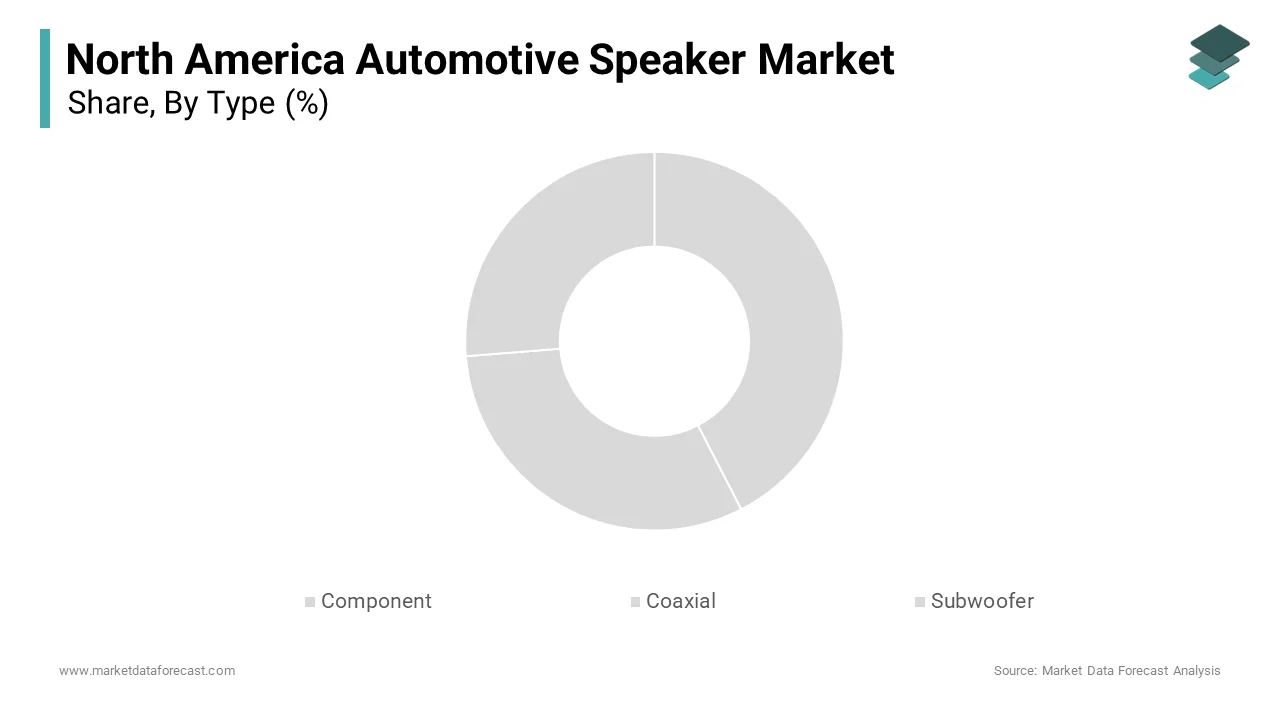
The coaxial speakers segment dominated the North America automotive speaker market by capturing an estimated 56.4% of total unit installations in 2025. Their widespread dominance is because of their cost-effective, space-efficient design that integrates a woofer and tweeter into a single mounting frame, making them ideal for factory installations and budget-conscious aftermarket upgrades. A further driver of their market growth is their compatibility with existing vehicle architectures—automakers favor coaxial units for base and mid-tier trims due to simplified wiring, reduced assembly time, and minimal need for additional mounting modifications. Like, a notable of new passenger vehicles produced in the U.S. in 2023 were equipped with coaxial speakers as standard audio components. Their ease of retrofitting also makes them a preferred choice in the aftermarket, where consumers seek improved sound without complex modifications. Additionally, advancements in materials, such as polypropylene cones and ferrofluid-cooled tweeters, have enhanced their acoustic performance, narrowing the quality gap with higher-end systems. Their adaptability across vehicle classes, from compact sedans to full-size trucks, ensures sustained demand. In Canada, where winter conditions accelerate speaker degradation due to thermal cycling, replacement rates for coaxial units are particularly high. This combination of affordability, compatibility, and durability solidifies coaxial speakers as the foundational element of the region’s automotive audio ecosystem.
Subwoofer Systems
The subwoofer systems segment is emerging as the fastest-growing segment in the North America automotive speaker market and is projected to expand at a CAGR of 9.8% from 2025 to 2034. This surge is fueled by the rising consumer demand for immersive, high-impact audio experiences, particularly in conjunction with the popularity of bass-heavy music genres such as hip-hop, EDM, and trap. Streaming platforms like Spotify and Apple Music report that a portion of North American users regularly listen to music with strong low-frequency content, necessitating dedicated subwoofers for accurate reproduction. Automakers are responding by offering factory-installed subwoofers in premium trims. The aftermarket remains a major growth engine. Additionally, the integration of digital signal processors (DSPs) and compact, powered enclosures has made subwoofers easier to install in diverse vehicle types, including SUVs and sedans with limited trunk space. As in-vehicle entertainment evolves, the subwoofer’s role in delivering emotional and physical engagement with sound ensures its accelerated adoption.
By Vehicle Insights
Passenger Vehicles
The passenger vehicles segment represented the biggest category of the North America automotive speaker market by accounting for a substantial share of total speaker installations in 2025. This dominance is underpinned by the sheer volume of light-duty vehicle sales and the deep integration of audio systems into consumer expectations for comfort and connectivity. Automakers prioritize audio quality in these vehicles as a key differentiator. Factory-installed systems typically include 6 to 12 speakers, while high-end trims may feature up to 28, creating substantial demand for both OEM and aftermarket components. The shift toward electric passenger vehicles further amplifies this trend, Tesla, Rivian, and Lucid Motors equip their models with advanced speaker arrays to enhance the quiet cabin experience. Besides, the rise of rideshare and subscription-based mobility services has increased vehicle utilization, prompting fleet operators to upgrade audio systems to improve rider satisfaction. With long commutes, seasonal isolation, and cultural emphasis on personal mobility, the passenger vehicle remains the primary canvas for automotive audio innovation and deployment.
Commercial Vehicles
The commercial vehicles segment is experiencing the most rapid growth in automotive speaker adoption and is projected to grow at a CAGR of 8.3% from 2025 to 2033. This acceleration is driven by the transformation of work vehicles into mobile command centers, where drivers spend extended hours on the road and require reliable audio for communication, navigation, and mental well-being. To combat fatigue and isolation, fleet managers and owner-operators are investing in upgraded audio systems that support Bluetooth connectivity, podcast streaming, and hands-free calling. Companies like Amazon and UPS have also begun outfitting delivery vans with improved sound systems to support driver training modules and real-time dispatch alerts. Moreover, the electrification of commercial fleets, such as Ford’s E-Transit and Rivian’s EDV, creates quieter cabins that demand higher-fidelity audio for clear voice reproduction. As work vehicles evolve into connected, human-centric spaces, the speaker’s role in productivity, safety, and morale is elevating its importance in commercial vehicle design.
By Installation Insights
Door-Mounted Speakers
The door-mounted speakers segment led the North America automotive speaker market by representing a 65.3% of all speaker placements in 2025. This dominance is because of the door’s structural suitability for speaker integration—its cavity acts as a natural acoustic enclosure, enhancing bass response and sound projection toward occupants. Automakers have standardized door mounting for front and rear full-range speakers due to ergonomic alignment with ear level and minimal interference with interior design. The design also facilitates scalability—coaxial or component systems can be installed without altering dashboard architecture or compromising cargo space. Aftermarket demand remains robust. Besides, the door’s accessibility simplifies maintenance and replacement, a critical factor given exposure to moisture and mechanical stress from frequent opening. The convergence of acoustic efficiency, design compatibility, and serviceability ensures door-mounted systems remain the cornerstone of in-vehicle audio configuration.
Rear Deck Speakers
The rear deck speakers segment is witnessing the fastest growth in installation frequency and is projected to expand at a CAGR of 7.9% during the forecast period. This growth is driven by the increasing demand for balanced, immersive sound fields that cater to rear passengers, particularly in SUVs, minivans, and luxury sedans. With the rise of family-oriented and rideshare travel, automakers are prioritizing rear-seat experience vehicles like the Kia Telluride and Toyota Grand Highlander now include dedicated rear deck speakers to ensure audio clarity for back-row occupants. The integration of rear seat entertainment systems, including wireless headphones and screen-based content, further necessitates localized audio output. Additionally, electric vehicles with flat underfloor battery packs have eliminated traditional trunk-mounted subwoofer enclosures, prompting engineers to repurpose the rear deck for compact, high-output drivers. As vehicle interiors evolve into shared multimedia spaces, the rear deck is transitioning from a passive surface to an active acoustic platform, accelerating its adoption across vehicle segments.
By Technology Insights
Bluetooth & Wireless Connectivity
The bluetooth and wireless connectivity segment commanded the North America automotive speaker market by securing a substantial portion in 2025. This dominance is driven by the universal consumer expectation for seamless smartphone integration, enabling hands-free calling, music streaming, and voice assistant access. Automakers have standardized Bluetooth as a base infotainment capability even entry-level trims in models like the Honda Civic and Chevrolet Spark include Bluetooth-enabled speakers. The technology’s reliability has improved significantly, with aptX HD and LDAC codecs now supporting high-resolution audio transmission, enhancing sound quality over wireless links. Aftermarket demand remains strong. With minimal hardware overhead and broad compatibility, Bluetooth has become the de facto bridge between personal devices and in-vehicle acoustics, ensuring its entrenched position as the foundational technology in automotive audio.
Multi-zone Audio Systems
The multi-zone audio systems segment is the fastest-growing technology in the North America automotive speaker market and is projected to grow at a CAGR of 10.2% from 2025 to 2033. This surge is fueled by the demand for personalized in-cabin experiences, particularly in large SUVs, minivans, and premium sedans where occupants have divergent audio preferences. These systems allow independent volume and source control for front and rear zones, enabling drivers to receive navigation alerts while rear passengers stream music or watch videos without interference. The rise of autonomous driving prototypes and family travel further amplifies demand—vehicles like the Mercedes-Benz S-Class and BMW 7 Series offer four-zone audio with noise-cancelling headphones integration. Additionally, rideshare platforms like Uber and Lyft are adopting vehicles with rear audio isolation to improve passenger privacy and satisfaction. Automakers are leveraging digital signal processors and beamforming speaker technology to deliver zone-specific sound without physical barriers. As vehicles transform into mobile living spaces, multi-zone audio is becoming essential for harmonizing shared mobility with individual comfort.
COUNTRY-LEVEL ANALYSIS
United States
The United States commanded the largest share of the North America automotive speaker market, with 88.5% of regional revenue in 2025. The country’s lead position is anchored in its massive vehicle production and ownership base. American consumer culture places a high value on personalization and in-car entertainment, driving demand for both factory-installed premium systems and aftermarket upgrades. The U.S. is home to the world’s largest aftermarket audio industry, with companies like Rockford Fosgate, JL Audio, and Kicker leading innovation in high-performance components. Also, the rapid adoption of electric vehicles has spurred investment in advanced audio systems to enhance the quiet EV cabin experience. States like California and Texas host major auto audio expos and tuning competitions, fostering a culture of acoustic excellence. With Detroit, Silicon Valley, and Nashville emerging as hubs for automotive acoustics R&D, the U.S. continues to set the technological and cultural direction for the regional market.
Canada
Canada holds a smaller but strategically significant share of the North America automotive speaker market. Despite its lower population, the country exhibits strong demand for durable, high-performance audio systems suited to extreme climatic conditions. With winter temperatures in provinces like Alberta and Quebec frequently dropping below -25°C, speakers must withstand thermal stress and moisture exposure, driving preference for robust materials and sealed enclosures. Additionally, bilingual audio requirements, supporting both English and French voice prompts, have led to specialized speaker tuning for clarity in dual-language environments. As Canadian consumers increasingly view vehicles as year-round personal spaces, the speaker market is evolving beyond functionality to encompass emotional and experiential value, positioning Canada as a high-potential growth market within North America.
KEY MARKET PLAYERS
Panasonic Holdings Corporation, Bose Corporation, Samsung Electronics Co., Ltd., Alps Alpine Co., Ltd., Pioneer Corporation, Sony Group Corporation, Masimo Corporation, Clarion, Focal. Are the market players that are dominating the North America automotive speaker market.
Top Players In The Market
Harman International (a Samsung Company)
Harman International stands as a dominant force in the North America automotive speaker market, renowned for its deep integration with original equipment manufacturers and its portfolio of premium audio brands, including JBL, AKG, Mark Levinson, and Revel. The company excels in delivering engineered sound solutions tailored to the acoustic signature of each vehicle, working closely with automakers during the design phase to optimize speaker placement, cabin acoustics, and digital signal processing. Harman’s influence extends globally through its partnerships with luxury and electric vehicle brands, where its systems serve as key differentiators in performance and comfort. Its expertise in software-defined audio, noise cancellation, and immersive sound environments has positioned it at the forefront of next-generation in-cabin experiences, making it a strategic technology partner rather than just a component supplier.
Bose Corporation
Bose Corporation has long been synonymous with high-fidelity audio engineering, and its automotive division continues to set benchmarks in sound clarity, spatial imaging, and psychoacoustic tuning. The company collaborates with leading automakers to develop proprietary speaker systems that adapt to vehicle-specific noise profiles, ensuring consistent audio performance across driving conditions. Bose’s strength lies in its research-driven approach, leveraging decades of acoustic science to create systems that deliver balanced sound without excessive power or component count. Its focus on driver-centric audio zones and voice enhancement technologies has made its solutions integral to both safety and comfort in modern vehicles. Globally, Bose is recognized for pushing the boundaries of what speakers can achieve within the constraints of automotive design, influencing both OEM standards and consumer expectations.
Alpine Electronics, Inc.
Alpine Electronics, Inc. is a pioneering innovator in automotive audio, particularly within the premium aftermarket and high-performance OEM segments. Known for its precision engineering and sleek integration, Alpine delivers advanced speaker systems that emphasize dynamic range, low distortion, and seamless connectivity with modern infotainment platforms. The company has been instrumental in popularizing digital amplification, multi-zone audio, and wireless streaming capabilities in aftermarket solutions, bridging the gap between factory-grade and enthusiast-level sound. Alpine’s influence extends beyond hardware—its software interfaces and user-centric design philosophy have shaped how drivers interact with in-vehicle audio. With a strong presence in North America and deep roots in motorsport and car audio culture, Alpine continues to drive innovation by aligning technical excellence with real-world usability, maintaining its reputation as a leader in acoustic authenticity and performance.
Top Strategies Used By Key Market Participants
One major strategy employed by leading companies is deep OEM collaboration during the vehicle development lifecycle. By engaging automakers at the design stage, audio manufacturers ensure optimal speaker placement, acoustic tuning, and integration with digital platforms, resulting in systems that are not only high-performing but also seamlessly embedded into the vehicle’s identity. This early involvement enhances brand visibility and locks in long-term supply agreements.
Another key approach is brand differentiation through acoustic signature development. Companies are no longer selling generic speakers but engineered soundscapes that reflect a vehicle’s character—sporty, luxurious, or family-oriented. By creating unique audio profiles in partnership with automakers, they elevate the speaker from a functional component to a sensory hallmark of brand experience.
A third strategy is vertical integration of hardware and software ecosystems. Leading players are combining physical speaker design with proprietary digital signal processing, noise cancellation algorithms, and over-the-air update capabilities. This holistic approach ensures sustained performance improvement, future-proofs audio systems, and strengthens customer loyalty by offering a unified, evolving in-cabin experience.
COMPETITION OVERVIEW
The competitive landscape of the North America automotive speaker market is defined by a dynamic interplay between technological innovation, brand perception, and strategic positioning across OEM and aftermarket channels. While a few dominant players control significant market influence, competition is increasingly shaped by specialization, integration depth, and the ability to deliver differentiated auditory experiences. Original equipment manufacturers rely on partnerships with elite audio firms to enhance vehicle desirability, turning sound systems into premium upgrade options that influence purchasing decisions. At the same time, aftermarket brands maintain strong consumer loyalty through performance credibility, customization, and alignment with enthusiast cultures such as car audio competitions and mobile integration. The rise of electric and autonomous vehicles has intensified competition, as silence amplifies the importance of sound quality and voice interface clarity. Companies are no longer competing solely on wattage or speaker count but on the sophistication of acoustic tuning, software intelligence, and user personalization. Smaller innovators are emerging with niche offerings in smart audio zones and immersive formats, challenging established players to evolve beyond hardware. Ultimately, the market is shifting from component-based rivalry to ecosystem-based competition, where success depends on seamless integration, brand trust, and the ability to transform the vehicle cabin into a responsive, emotionally engaging environment.
RECENT HAPPENINGS IN THE MARKET
- In February 2023, Harman International launched its HALOsonic Active Sound Design platform across multiple General Motors EV models, enabling customizable cabin acoustics and synthetic sound profiles to enhance driver engagement and brand identity.
- In June 2023, Bose Corporation partnered with Volvo Cars to co-develop a next-generation 3D audio system featuring ceiling-integrated speakers and head-tracking technology, setting a new benchmark for immersive in-vehicle sound.
- In October 2023, Alpine Electronics introduced its V-Zone audio technology, allowing independent sound zones within the cabin, giving front and rear passengers control over their audio sources without interference.
- In January 2025, Harman expanded its manufacturing and R&D facility in Farmington Hills, Michigan, to accelerate development of software-defined audio systems for autonomous and electric vehicles.
- In May 2025, Bose unveiled a new line of compact, corrosion-resistant speakers specifically designed for off-road and truck applications, targeting the growing North American adventure vehicle market.
MARKET SEGMENTATION
This research report on the automotive speaker market is segmented and sub-segmented into the following categories.
By Type
- Component
- Coaxial
- Subwoofer
By Vehicle
- Passenger
- Commercial
- Two-wheeler
By Installation
- Door
- Dashboard
- Rear Deck
By Technology
- Bluetooth & Wireless Connectivity
- Smart Speakers
- Multi-zone
By Country
- The United States
- Canada
- Mexico
- Rest of North America
Frequently Asked Questions
What are automotive speakers?
Automotive speakers are audio components installed in vehicles to deliver sound from infotainment systems, including music, navigation prompts, and phone calls. They come in various types like coaxial, component, subwoofers, and full-range systems.
Why is the automotive speaker market growing in North America?
Demand is rising due to increasing consumer preference for premium in-car audio experiences and the growing number of vehicles equipped with advanced infotainment systems. SUVs and pickup trucks, popular in the U.S. and Canada, often include upgraded sound packages.
Are factory-installed speakers different from aftermarket ones?
Yes, factory speakers are typically designed for cost-efficiency and basic performance, while aftermarket options focus on higher sound quality, durability, and customization. Enthusiasts often upgrade to enhance bass, clarity, and volume.
What role do electric vehicles play in speaker demand?
EVs offer quieter cabins due to the absence of engine noise, making high-fidelity audio more noticeable and desirable. Automakers are partnering with premium audio brands to create immersive sound experiences as a selling point.
Which brands are popular in this market?
Recognizable names like Bose, Harman (including JBL and Revel), Sony, and Pioneer dominate both OEM and aftermarket segments. Their reputation for quality and innovation keeps them in high demand across the region.
How do consumers choose automotive speakers?
Buyers consider sound quality, compatibility with their vehicle, power requirements, and budget. Online reviews, audio demonstrations, and recommendations from car audio specialists also influence decisions.
Is there a trend toward connected or smart speakers in cars?
While not standalone like home smart speakers, modern car audio systems integrate with smartphones via Apple CarPlay and Android Auto, enabling voice-controlled music and calls. Some systems also support over-the-air updates for audio software.
How important is speaker placement in sound performance?
Placement affects stereo imaging, bass response, and overall clarity—component systems often separate tweeters and woofers for better sound staging. Proper installation and acoustics tuning can significantly improve listening experience.
Are premium audio systems standard or optional?
Most premium speaker systems are optional upgrades offered in higher trim levels or as part of technology or luxury packages. Some luxury brands include them as standard to enhance brand appeal.
What’s driving innovation in this market?
Advancements in materials, digital signal processing (DSP), and spatial audio technologies are pushing the boundaries of in-car sound. The focus is on creating concert-like experiences while minimizing distortion and cabin resonance.
Related Reports
Access the study in MULTIPLE FORMATS
Purchase options starting from
$ 2000
Didn’t find what you’re looking for?
TALK TO OUR ANALYST TEAM
Need something within your budget?
NO WORRIES! WE GOT YOU COVERED!
Call us on: +1 888 702 9696 (U.S Toll Free)
Write to us: sales@marketdataforecast.com