- Product Description Description
- Table of Contents TOC
- List of Table & Figure LOT
- Get Free Sample PDF Sample PDF
Market Size, 2025
$7.82 BnMarket Estimate, 2026
$8.20 BnMarket Forecast, 2034
$11.95 BnCAGR, 2026–2034
4.82%North America Avocado Processing Market Size
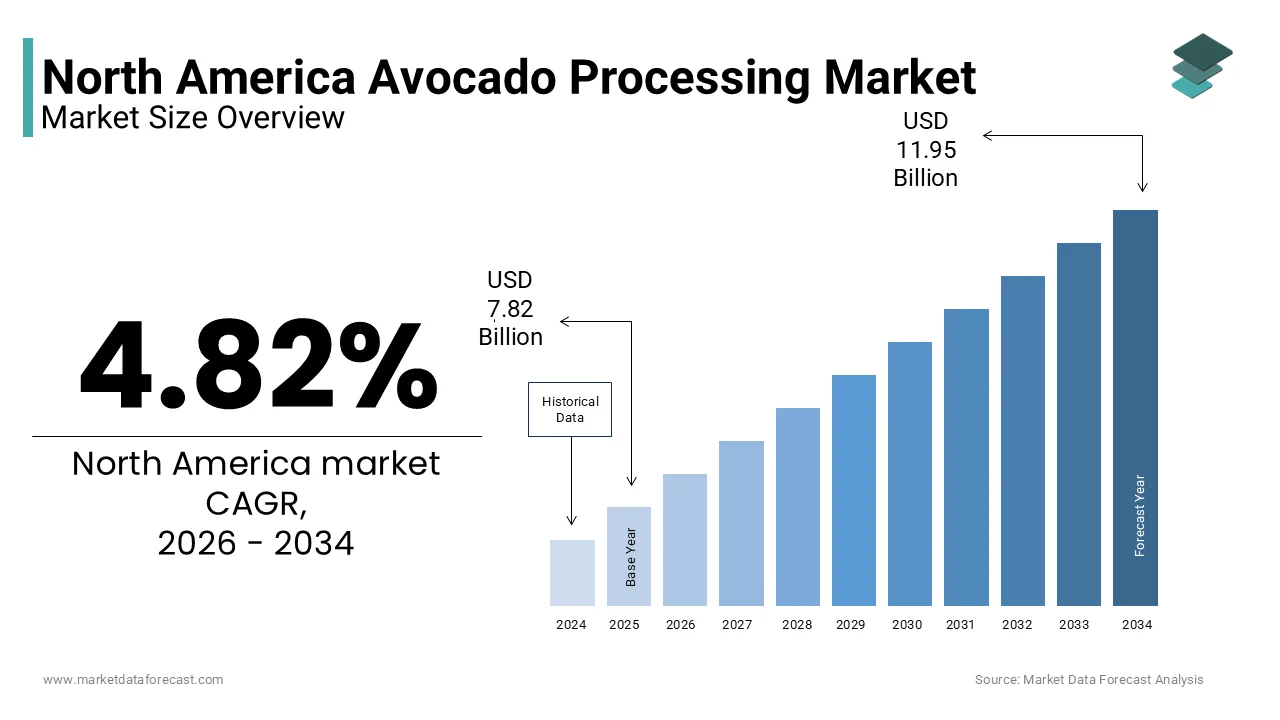
The avocado processing market size in North America was valued at USD 7.82 billion in 2025 and is predicted to be worth USD 11.95 billion by 2034 from USD 8.20 billion in 2026 and grow at a CAGR of 4.82% from 2026 to 2034.
The avocado processing is the transformation of fresh avocados into value-added products such as guacamole, frozen pulp, dehydrated powders, oils, and functional ingredients used in food, beverage, and personal care applications. According to the U.S. Department of Agriculture, over 2.8 million metric tons of avocados were consumed in the United States in 2023, with processed forms accounting for a growing share due to demand from restaurants, meal kits, and ready-to-eat product lines. The Food and Drug Administration regulates processed avocado products under strict food safety standards, including mandatory pasteurization for shelf-stable guacamole to prevent microbial contamination.
MARKET DRIVERS
Expansion of the Foodservice and Ready-to-Eat Food Industry
The rapid growth of the foodservice and convenience food sector is primarily leveraging the growth of North America avocado processing market. Restaurants, fast-casual chains, and catering services increasingly rely on pre-processed avocado products to ensure consistency, reduce labor costs, and minimize waste. Chains such as Chipotle and Qdoba consume over 100 million pounds of processed avocado annually, sourced in the form of flash-frozen pulp and stabilized dips to maintain uniform flavor and texture across thousands of locations. Meal kit providers like HelloFresh and Blue Apron now feature avocado-based dishes in over 25% of their weekly offerings, which is relying exclusively on processed avocado to ensure freshness upon delivery.
Rising Consumer Demand for Plant-Based and Clean-Label Foods
The surge in consumer preference for plant-based, minimally processed, and nutrient-dense foods is significantly accelerating the growth of the North America avocado processing market. Avocados are rich in monounsaturated fats, dietary fiber, potassium, and antioxidants by aligning with dietary guidelines. As per the International Food Information Council’s 2023 Food & Health Survey, 64% of American consumers actively seek out foods with heart-healthy fats, and avocados are the most frequently cited source. Clean-label trends further favor avocado derivatives, as they can serve as natural emulsifiers and fat replacers without requiring synthetic additives. For instance, avocado oil is increasingly used in organic salad dressings and baked goods to replace palm or soybean oil. In Canada, the number of food products labeled “avocado-based” grew by 41% from 2020 to 2023, as tracked by Label Insight. Additionally, the popularity of keto, paleo, and Mediterranean diets diets that emphasize healthy fats has driven retail demand for ready-to-eat guacamole and avocado snacks. Retailers like Whole Foods and Kroger have expanded their refrigerated avocado product
MARKET RESTRAINTS
High Post-Harvest Loss and Perishability of Raw Avocados
The extreme perishability of raw avocados, which leads to significant post-harvest losses and supply chain inefficiencies is limiting the growth of the North America avocado processing market. Avocados are climacteric fruits, meaning they ripen rapidly after harvest and are highly susceptible to bruising, oxidation, and microbial spoilage. According to the U.S. Department of Agriculture, approximately 30% of harvested avocados in the U.S. and Mexico are lost before reaching processing facilities due to improper handling, temperature fluctuations, or delayed transportation. Once ripe, avocados have a shelf life of only 2–4 days at room temperature with immediate processing to preserve quality. The enzymatic browning caused by polyphenol oxidase activity begins within minutes of cutting, requiring rapid intervention with antioxidants or modified atmosphere packaging. This sensitivity increases operational costs, as processors must coordinate closely with growers and logistics providers to ensure a continuous, time-sensitive supply.
Water Scarcity in Key Avocado-Producing Regions
The water scarcity environmental and operational challenge to the sustainability of avocado cultivation, which is directly impacting the raw material supply for the processing industry. Avocado trees are highly water-intensive, which requires approximately 700 liters of water to produce one kilogram of fruit, as per the Water Footprint Network. The U.S. Drought Monitor reported that 98% of Southern California experienced severe to extreme drought in 2023, forcing growers to fallow orchards or switch to less water-demanding crops. In 2023, the state suspended new avocado farming permits in four municipalities due to unsustainable water use. These constraints increase production costs and limit yield expansion, directly affecting the volume and consistency of supply for processors. Additionally, consumer and retail backlash against “water-greedy” crops has prompted major U.S. retailers to demand sustainability certifications from suppliers.
MARKET OPPORTUNITIES
Development of Avocado-Derived Functional Ingredients
The extraction and commercialization of high-value functional ingredients from avocado pulp, seed, and oil is solely elevating the growth of the North America avocado processing market. According to the American Oil Chemists’ Society, avocado oil contains up to 70% oleic acid, a monounsaturated fat linked to improved cardiovascular health, which is making it a sought-after ingredient in dietary supplements. The seed, once discarded as waste, is being repurposed into antioxidant-rich extracts; research from the University of California, Davis found that avocado seed powder contains 70% of the fruit’s total polyphenols, with potential applications in natural preservatives and functional beverages. In 2023, the U.S. Food and Drug Administration granted Generally Recognized as Safe (GRAS) status to a new avocado seed extract for use in dietary supplements, opening a new revenue stream.
Adoption of Automation and AI in Avocado Processing
The integration of automation, artificial intelligence, and real-time quality monitoring systems is likely to promote new opportunities for the growth of the North America avocado processing market. Traditional processing relies heavily on manual sorting and cutting, leading to variability in yield and increased labor costs. However, advancements in computer vision and robotic sorting are enabling processors to assess ripeness, detect defects, and optimize cutting patterns with precision. According to the Agricultural Research Service of the U.S. Department of Agriculture, AI-powered sorting systems can identify bruising and overripeness with 95% accuracy by reducing waste by up to 20%. Companies like AgroFresh and Compac have deployed optical grading systems that analyze color, firmness, and size in milliseconds, allowing for dynamic routing to different processing lines—fresh cut, guacamole, or oil extraction. Additionally, blockchain-enabled traceability platforms are being adopted to track avocados from orchard to package, ensuring compliance with food safety and sustainability standards. These technologies not only improve throughput but also support clean-label claims by minimizing the need for chemical preservatives through precise handling.
MARKET CHALLENGES
Seasonal Fluctuations in Avocado Supply and Pricing
The seasonality of avocado production leads to volatile supply volumes and price instability, which is a significant challenging factor for the growth of the North America avocado processing market. According to the U.S. Department of Agriculture, domestic avocado production in California drops by over 60% during winter months, forcing processors to rely entirely on imported fruit. This dependency creates exposure to geopolitical, logistical, and tariff-related disruptions. In 2023, the U.S. temporarily suspended avocado imports from Michoacán due to safety concerns for USDA inspectors, causing a 40% spike in wholesale prices within days, as reported by the Agricultural Marketing Service. Seasonal gluts during peak harvest also depress prices, compressing processor margins despite higher volumes. Furthermore, weather anomalies such as unseasonal rains or frosts can delay harvests or damage crops, as seen in 2022 when a late freeze in Florida reduced the state’s avocado yield by 35%.
Regulatory and Trade Barriers in Cross-Border Avocado Trade
The cross-border avocado trade between the U.S., and Canada faces complex regulatory and phytosanitary barriers that disrupt supply continuity and increase compliance costs for processors that pose negative impact on the growth of the North America avocado processing market. In 2023, over 1,200 shipments were delayed at the border due to incomplete documentation or failed inspections, according to U.S. Customs and Border Protection. Canada, while less restrictive, requires detailed labeling and country-of-origin declarations for processed avocado products, complicating blended sourcing strategies. These regulatory hurdles increase lead times and administrative burdens for small and mid-sized processors lacking dedicated compliance teams.
REPORT COVERAGE
| REPORT METRIC | DETAILS |
| Market Size Available | 2025 to 2034 |
| Base Year | 2025 |
| Forecast Period | 2026 to 2034 |
| CAGR | 4.82% |
| Segments Covered | By Product Type, Application, Distribution Channel, and Region |
| Various Analyses Covered | Regional & Country Level Analysis, Segment-Level Analysis, DROC, PESTLE Analysis, Porter’s Five Forces Analysis, Competitive Landscape, Analyst Overview on Investment Opportunities |
| Regions Covered | The United States, Canada, Mexico, and Rest of North America |
| Market Leaders Profiled | Calavo Growers Inc, Mission Produce Inc Ordinary Shares, Simpson Manufacturing Co Inc, West Pak Avocado, Westfalia Fruit, EMPACADORA DE AGUACATES SAN LORENZO S.A. DE C.V., Propal, Duclos Farms, AustChilli Group, and others |
SEGMENTAL ANALYSIS
By Product Type Insights
The guacamole segment held 52.3% of the North America avocado processing market share in 2025. Guacamole has transitioned from a regional specialty to a national staple, with over 80% of U.S. households purchasing it at least once a year, according to the National Restaurant Association. The product’s popularity is amplified by its presence in fast-casual dining chains such as Chipotle, Qdoba, and Taco Bell, which collectively serve over 300 million guacamole-laced meals annually. Retailers like Walmart and Kroger now dedicate permanent refrigerated sections to branded and private-label guacamole, often fortified with lime juice and natural preservatives to extend shelf life.
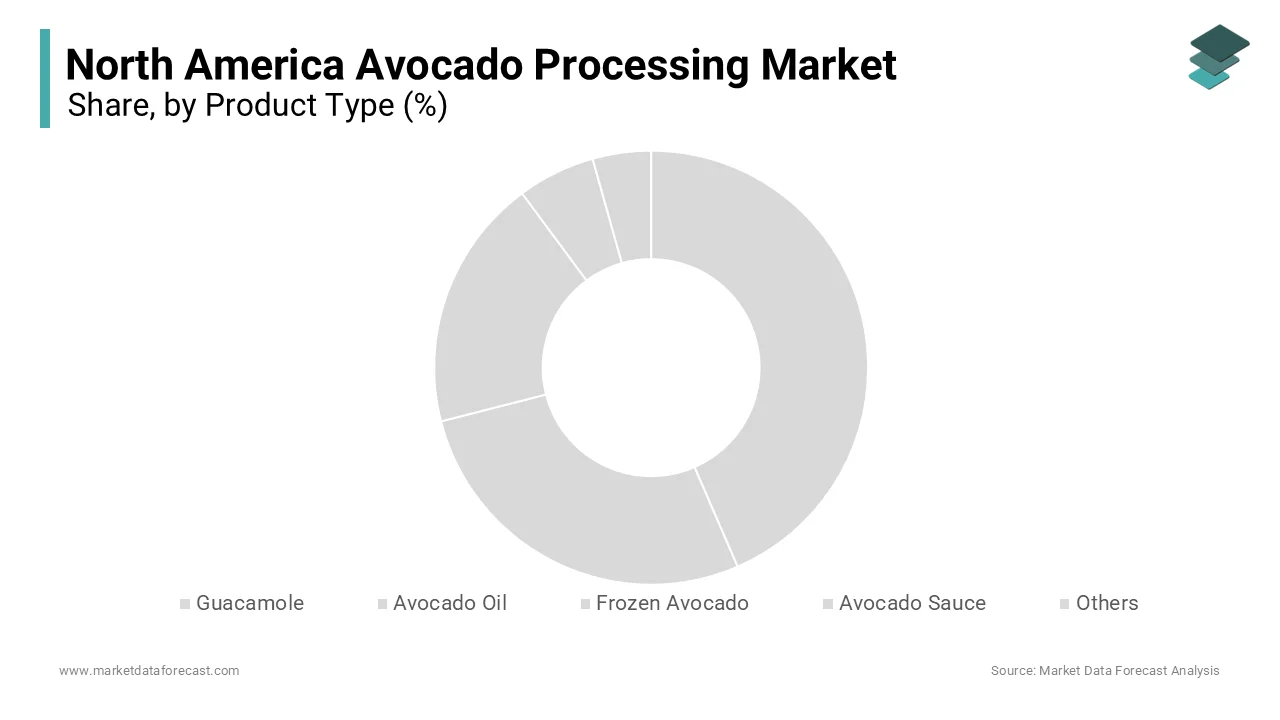
The avocado oil segment is expectd to grow at a CAGR of 11.6% from 2026 to 2034 with its rising adoption in culinary, cosmetic, and wellness applications. In the food sector, avocado oil is increasingly used as a premium cooking oil due to its high smoke point (over 500°F) and heart-healthy monounsaturated fat content. According to the Academy of Nutrition and Dietetics, 68% of health-conscious consumers prefer avocado oil over olive oil for high-heat cooking, citing better stability and neutral flavor. Its use in natural and organic formulations aligns with clean-label trends, particularly in vegan and cruelty-free brands. Additionally, the U.S. Food and Drug Administration has recognized avocado oil as Generally Recognized as Safe (GRAS) for dietary supplements by enabling its inclusion in cholesterol-lowering and joint health products.
By Application Insights
The food and beverages segment held prominent share of the North America avocado processing market in 2025 with the incorporation of avocado derivatives into mainstream culinary products. Processed avocado in the form of pulp, guacamole, and oil is a key ingredient in ready-to-eat meals, dips, dressings, plant-based dairy alternatives, and bakery items. The rise of health-oriented diets such as keto, paleo, and Mediterranean has accelerated demand for avocado-based fats as substitutes for dairy and hydrogenated oils. According to the International Food Information Council, 61% of American consumers consider the fat source in their food, with avocados being the most trusted plant-based option. Additionally, food manufacturers are leveraging avocado oil’s neutral taste and high oxidative stability in shelf-stable products, including snack bars and packaged sauces. The growing popularity of plant-based butter, with brands like Earth Balance and Miyoko’s incorporating avocado oil, reflects its functional versatility.
The cosmetics segment is swiftly emerging with an expected CAGR of 10.8% from 2026 to 2034 with the increasing use of avocado oil and extracts in skincare, haircare, and personal wellness formulations due to their moisturizing, anti-inflammatory, and antioxidant properties. Avocado oil is rich in oleic acid, phytosterols, and vitamins A, D, and E, which is making it highly effective in repairing dry skin, improving elasticity, and supporting barrier function. According to clinical research published in Dermatologic Therapy, topical application of avocado oil enhances collagen synthesis and reduces transepidermal water loss by up to 25% in mature skin. The natural and organic cosmetics market has embraced avocado derivatives as non-comedogenic, biodegradable alternatives to synthetic emollients. The Organic Trade Association notes that sales of skincare products labeled “avocado-based” grew by 37% between 2020 and 2023, with major brands like Kiehl’s, Burt’s Bees, and First Aid Beauty incorporating it into serums, masks, and conditioners. Additionally, the U.S. Food and Drug Administration’s recognition of avocado oil as a safe and stable ingredient has encouraged formulation innovation.
By Distribution Channel Insights
The supermarkets and hypermarkets segment was accounted in holding a prominent share of the North America avocado processing market in 2025. This dominance is rooted in consumer reliance on brick-and-mortar grocery stores for fresh and refrigerated processed foods, particularly perishable items like guacamole and avocado oil. Major chains such as Kroger, Safeway, Publix, and Walmart maintain dedicated refrigerated sections for ready-to-eat dips, spreads, and healthy oils, often featuring prominent shelf placement and promotional bundling with tortilla chips or meal kits. According to the U.S. Department of Commerce, over 78% of household food purchases in the U.S. are made in physical supermarkets, with fresh and chilled categories experiencing the highest foot traffic. Supermarkets also serve as key launch platforms for new avocado-based products by offering sampling programs and in-store demonstrations that drive trial and brand loyalty. Private-label expansion is another factor; retailers like Costco and Albertsons have introduced their own guacamole and avocado oil lines by capturing price-sensitive consumers while maintaining quality control.
The online segment is anticipated to grow at a CAGR of 14.3% from 2026 to 2034 with the increasing adoption of digital grocery shopping, subscription meal services, and direct-to-consumer (DTC) brand models. The pandemic accelerated the shift toward online food retail, and post-pandemic behavior has cemented its place in consumer routines. According to the Food Industry Association, 42% of U.S. shoppers now purchase groceries online at least once a month, with refrigerated and specialty health foods among the fastest-growing categories. E-commerce platforms like Amazon Fresh, Instacart, and Thrive Market offer extensive selections of processed avocado products, including organic, keto-friendly, and single-serve guacamole packs. DTC brands such as Partake Foods and Wholly Guacamole have leveraged social media and targeted advertising to build direct customer relationships, bypassing traditional retail markups.
REGIONAL ANALYSIS
United States Avocado Processing Market Insights
The United States was the top performer in the North America avocado processing market by capturing 82.3% of the share in 2025. As per the Hass Avocado Board, over 1.2 billion pounds of avocados were consumed in the U.S. in 2022, with nearly 30% used in processed forms. The rise of ready-to-eat meals, fast-casual Mexican cuisine, and health-focused snacking has driven demand for value-added avocado products. Companies like Calavo Growers and Mission Foods operate large-scale processing facilities, supported by cold-chain logistics and strong distribution networks. Additionally, the Food and Drug Administration’s classification of avocado oil as a healthy fat has spurred innovation in functional foods, that is further escalating the U.S. as the central hub for avocado processing innovation and volume in North America.
Canada Avocado Processing Market Insights
Canada avocado processing market was ranked second by accounting for 18.2% of the share in 2025. While domestic avocado cultivation remains limited due to climatic constraints, Canada has developed a specialized niche in premium processed avocado products, particularly flash-frozen guacamole and cold-pressed avocado oil for health and cosmetic applications. Imports of fresh avocados surged to 240,000 metric tons in 2022, up from 180,000 in 2019, as per Global Affairs Canada, enabling local processors to meet rising consumer demand. Urban centers like Toronto, Vancouver, and Montreal are witnessing increased adoption of plant-based and clean-label foods, with avocado-based dips and spreads gaining traction in organic grocery chains such as Farm Boy and Thrifty Foods.
KEY MARKET PLAYERS AND COMPETITIVE LANDSCAPE
Calavo Growers Inc, Mission Produce Inc Ordinary Shares, Simpson Manufacturing Co Inc, West Pak Avocado, Westfalia Fruit, EMPACADORA DE AGUACATES SAN LORENZO S.A. DE C.V., Propal, Duclos Farms, AustChilli Group are the key players in the North America avocado processing market.
The competitive landscape of the North America avocado processing market is characterized by a blend of established agribusinesses, innovative specialty brands, and emerging private-label players, all vying for dominance in a rapidly evolving category. Unlike traditional commodity markets, competition here is not solely price-driven but revolves around differentiation in quality, freshness, sustainability, and consumer experience. Market leaders distinguish themselves through technological sophistication, such as high-pressure processing and cold-chain mastery, which enable them to deliver preservative-free products with extended shelf life. Brand equity plays a crucial role, with companies investing heavily in clean-label positioning, eco-friendly packaging, and culinary authenticity to appeal to health-conscious and environmentally aware consumers. Strategic partnerships with retailers, restaurants, and meal kit providers further amplify reach and influence.
TOP PLAYERS IN THE MARKET
Calavo Growers, Inc.
Calavo Growers, Inc. stands as a cornerstone in the North America avocado processing market, renowned for its vertically integrated operations that span sourcing, processing, and distribution. The company pioneered the commercialization of fresh-cut and refrigerated guacamole, setting industry benchmarks for food safety and shelf-life extension. Calavo’s expertise in high-pressure processing (HPP) and cold-chain logistics has enabled it to supply major retail and foodservice chains with consistent, preservative-free products. Beyond guacamole, the company has expanded into avocado oil and dehydrated powders to evolve consumer demands for functional ingredients.
Mission Produce
Mission Produce is a dominant player in the avocado industry, leveraging its extensive supply chain network to lead in both fresh and processed avocado solutions. While historically known for fresh distribution, the company has strategically expanded its processing capabilities to meet rising demand for value-added products. Mission’s innovation centers in California and Mexico focus on optimizing ripening, cutting, and preservation technologies, enabling the production of frozen pulp, ready-to-eat guacamole, and customized avocado blends for food manufacturers. The company’s proprietary SmartBatch processing system ensures uniform quality and minimal waste. Mission’s global reach allows it to influence avocado consumption trends worldwide, supplying retailers, restaurants, and co-manufacturers across continents. Its emphasis on traceability, sustainability, and culinary versatility has positioned it as a key enabler of avocado integration into mainstream food systems, both in North America and beyond.
Wholly Guacamole
Wholly Guacamole, a brand under the Losen Foods umbrella, has redefined consumer access to processed avocado through its focus on convenience, flavor, and clean-label positioning. Known for its single-serve packaging and refrigerated retail presence, Wholly has made guacamole a pantry staple in millions of households. The brand emphasizes minimal processing, using only avocados, lime juice, and natural ingredients, which resonates with health-conscious and time-constrained consumers. Wholly’s product innovations include plant-based dips, keto-friendly lines, and microwaveable guacamole, reflecting a deep understanding of shifting dietary preferences. Its strong retail partnerships and vibrant branding have made it a leader in the grocery refrigerated aisle.
TOP STRATEGIES USED BY KEY MARKET PLAYERS
One of the most impactful strategies employed by leading players in the North America avocado processing market is vertical integration, encompassing control from orchard sourcing to final product delivery. Companies are securing long-term contracts with growers, investing in ripening facilities, and operating proprietary processing plants to ensure quality consistency, reduce spoilage, and respond swiftly to market fluctuations. This end-to-end oversight enhances traceability and supports premium branding, particularly in organic and sustainably sourced segments.
Another strategy is product diversification beyond traditional guacamole into high-margin specialty formats such as avocado oil, frozen pulp, dehydrated powders, and functional ingredients for cosmetics and supplements. Firms are reformulating to meet clean-label, keto, vegan, and allergen-free trends, enabling penetration into health-focused and premium retail channels. This expansion allows companies to capture value across multiple industries and reduce dependency on a single product category.
RECENT HAPPENINGS IN THE MARKET
- In March 2023, Calavo Growers launched a new innovation center in Oxnard, California, dedicated to developing next-generation avocado-based ingredients, which is including cold-pressed oil and functional powders for use in food and wellness applications.
- In August 2023, Mission Produce inaugurated an advanced processing facility in Uruapan, Mexico, equipped with automated sorting and HPP technology by enabling year-round production of shelf-stable guacamole and frozen avocado pulp for North American markets.
- In January 2025, Wholly Guacamole introduced a microwaveable guacamole product line, designed for instant preparation and targeted at convenience-driven consumers, which is marking a significant shift in product format and usage occasion.
- In May 2025, Losen Foods, parent company of Wholly, partnered with a major U.S. grocery retailer to co-develop a private-label line of organic avocado dips by expanding its footprint in the clean-label refrigerated segment.
- In September 2025, Calavo announced a strategic alliance with a Canadian functional food manufacturer to supply avocado oil for use in plant-based butter and dietary supplements, which is extending its reach into the health and wellness sector.
MARKET SEGMENTATION
This research report on the North America avocado processing market has been segmented and sub-segmented based on the following categories.
By Product Type
- Guacamole
- Avocado Oil
- Frozen Avocado
- Avocado Sauce
- Others
By Application
- Food and Beverages
- Cosmetics
- Pharmaceuticals
- Others
By Distribution Channel
- Supermarkets and Hypermarkets
- Convenience Stores
- Online
- Others
By Country
- The United States
- Canada
- Rest of North America