North America Biocatalysts Market Size, Share, Growth, Trends, And Forecast Research Report, Segmented By Source, Type, End-User And Country (The United States, Canada, Mexico, Rest of North America), Industry Analysis From (2026 to 2034)
Market Size, 2025
$0.51 BnMarket Estimate, 2026
$0.54 BnMarket Forecast, 2034
$0.87 BnCAGR, 2026–2034
6.18%Executive Summary: North America Biocatalysts Market
- Market Scope: Regional North American biocatalysts market analysis covering source categories, enzyme types, end-user industry segments, country leadership frameworks, and green manufacturing adoption metrics.
- Market Valuation: Valued at USD 0.51 billion in 2025, estimated at USD 0.54 billion in 2026, and projected to reach USD 0.87 billion by 2034, registering a CAGR of 6.18% from 2026 to 2034.
- Primary Growth Drivers: Rising demand for sustainable and green manufacturing practices, expansion of biopharmaceutical and precision medicine development, alongside increasing industrial biotechnology adoption across pharmaceuticals, food processing, and specialty chemicals.
Key Market Segment Metrics (2026–2034)
| Category | Leading Segment (Position) | Fastest-Growing / Key Growth Segment |
|---|---|---|
| By Source & Enzyme Type | Micro-organisms (largest source) & Hydrolases (largest type with 48.3% share in 2025) | Plant-based Biocatalysts (fastest source) & Transferases (fastest-growing type) |
| By End-User Industry | Pharmaceutical Industry (largest end-user with 42.3% share in 2025) | Biofuel (fastest-growing end-user segment) |
| By Technology & Innovation | Traditional chemical synthesis and standard industrial enzyme applications | Synthetic biology, enzyme engineering, and AI-driven discovery platforms |
| By Region / Country | United States (leading country with 82.3% market share in 2025) | Canada (fastest-growing country market) |
Major Market Players & Market Structure
Market Structure: Highly competitive North American biocatalysts sector characterized by enzyme engineering investments, synthetic biology innovations, pharmaceutical and biotech partnerships, and digital process monitoring solutions.
Key Companies: DuPont de Nemours, Inc. (IFF Biosciences), Biocatalysts Ltd., BASF SE, Amano Enzyme Inc., Codexis, Inc., AB Enzymes, Lonza, Novonesis (formerly Novozymes), Prozomix Limited, and DSM.
North America Biocatalysts Market Size
The North America Biocatalyst market size was valued at USD 0.51 billion in 2025 and is anticipated to reach a valuation of USD 0.54 billion in 2026 and USD 0.87 billion by 2034, growing at a CAGR of 6.18%, from 2026 to 2034.
The biocatalyst, enzymes, and whole-cell systems ms utilized to accelerate and streamline chemical transformations in industrial processes across pharmaceuticals, biofuels, food and beverage, and specialty chemicals. Predominantly composed of hydrolases, oxidoreductases, transferases, and lyases, these biological agents are engineered through advanced biotechnology to enhance stability, selectivity, and catalytic efficiency. As per the U.S. Department of Energy, industrial biotechnology, including biocatalysis, contributes to a 20–60% reduction in energy consumption across targeted manufacturing processes. The integration of biocatalysts aligns with the U.S. Environmental Protection Agency’s Green Chemistry Program, which promotes sustainable synthesis methods to minimize waste and environmental impact.
MARKET DRIVERS
Rising Demand for Sustainable and Green Manufacturing Practices
The transition toward environmentally responsible industrial processes has become a primary factor for biocatalyst adoption across North America in regulated sectors such as pharmaceuticals, food processing, and fine chemicals. Companies are under increasing pressure to comply with sustainability mandates and reduce their environmental footprint, prompting a shift from petrochemical-based catalysts to bio-based alternatives. According to the U.S. Environmental Protection Agency, industrial facilities adopting green chemistry principles have reported an average 45% reduction in volatile organic compound (VOC) emissions and a 30% decrease in wastewater toxicity. Biocatalysts operate under ambient temperature and neutral pH, with significantly lower energy consumption, and eliminate the need for hazardous reagents. In the pharmaceutical industry, biocatalysis is now employed in over 50% of active pharmaceutical ingredient (API) synthesis routes, as per the Pharmaceutical Research and Manufacturers of America, due to its precision in stereoselective reactions and reduced solvent use. Furthermore, consumer-facing brands such as PepsiCo and General Mills have committed to net-zero supply chains by 2050, driving upstream suppliers to adopt biocatalytic processes in sweetener and flavorant production.
Expansion of Biopharmaceutical and Precision Medicine Development
The rapid advancement of biopharmaceuticals and personalized therapeutics is additionally to further enhance the growth of the North America biocatalysts market. These biological catalysts are essential in synthesizing complex molecules such as monoclonal antibodies, peptide-based drugs, and nucleotide analogs, where traditional chemical methods often fail to achieve the required specificity. For example, transaminases and ketoreductases are routinely used in the synthesis of diabetes and antiviral medications, including sitagliptin and remdesivir, as documented by Merck & Co. in its 2023 process chemistry review. Academic and industrial collaboration, such as the NIH’s Enzyme Alliance, has accelerated the discovery of novel enzymes tailored for pharmaceutical applications. In Canada, the Michael Smith Laboratories at the University of British Columbia have engineered lipases capable of catalyzing multi-step reactions in antibiotic synthesis.
MARKET RESTRAINTS
High Development and Optimization Costs for Industrial-Scale Applications
The substantial financial and technical investment required to engineer enzymes for industrial robustness is limiting the growth of the North American biocatalysts market. Natural enzymes often lack the thermal stability, solvent tolerance, or catalytic longevity needed for large-scale manufacturing, necessitating extensive protein engineering through directed evolution or rational design. According to the National Science Foundation, the average cost to develop and optimize a single industrial enzyme can exceed $5 million, with timelines extending beyond three years. This barrier is particularly acute for small and mid-sized enterprises that lack in-house biotechnology expertise or access to high-throughput screening platforms. The U.S. Department of Energy estimates that enzyme development accounts for nearly 40% of the total capital expenditure in new bioprocessing facilities. Additionally, scaling from lab to production introduces unpredictable variables such as substrate inhibition, pH drift, and microbial contamination, requiring iterative refinement. In the biofuel sector, for instance, Novozymes reported in 2022 that achieving cost-competitive cellulase performance for lignocellulosic ethanol required over a decade of R&D and multiple generations of enzyme redesign.
Limited Operational Stability Under Harsh Industrial Conditions
The manufacturing is their susceptibility to deactivation under non-physiological process conditions, which is hampering the growth of the North America biocatalysts market. Unlike conventional chemical catalysts, which function reliably at high temperatures and extreme pH levels, most enzymes denature or lose activity when exposed to industrial environments involving organic solvents, elevated temperatures, or high shear forces. In the production of bio-based plastics, for example, polyhydroxyalkanoate (PHA) synthesis requires prolonged fermentation at 37–42°C, leading to rapid enzyme degradation unless costly stabilization methods are employed. The U.S. Department of Agriculture notes that enzyme half-life in industrial reactors averages between 48 and 72 hours, necessitating frequent replenishment and increasing operational costs.
MARKET OPPORTUNITIES
Advancements in Synthetic Biology and Enzyme Engineering Technologies
Breakthroughs in synthetic biology and computational enzyme design are gearing up to promote new opportunities for the North American biocatalysts market. The integration of artificial intelligence, machine learning, and high-throughput screening has dramatically accelerated the discovery and optimization of enzymes for specific industrial functions. As per the Joint BioEnergy Institute, AI-driven platforms can now predict enzyme stability and activity with over 85% accuracy, reducing development cycles from years to months. Companies like Ginkgo Bioworks and Zymergen are leveraging automated strain engineering to design microbial hosts that produce novel biocatalysts for applications ranging from fragrance synthesis to carbon fixation. In 2023, Ginkgo announced a partnership with Bayer to develop nitrogen-fixing enzymes for sustainable agriculture, showcasing the cross-sector potential of engineered biocatalysts. The U.S. Department of Energy’s Bioenergy Technologies Office has funded over 30 enzyme innovation projects since 2020, focusing on lignin depolymerization and plastic degradation. Additionally, CRISPR-based genome editing allows precise modifications to enzyme active sites, enhancing catalytic efficiency and substrate range. At MIT, researchers engineered a cytochrome P450 variant capable of performing C–H activation at room temperature, a reaction previously requiring toxic metal catalysts. The National Science Foundation reports that over 1,200 new enzyme variants were patented in the U.S. in 2023 alone, reflecting the pace of innovation.
Increasing Government Support for Bio-Based Industrial Transformation
Public sector initiatives across the United States and Canada are creating a fertile environment for biocatalyst adoption by funding research, incentivizing commercialization, and establishing regulatory frameworks that favor bio-based manufacturing. The U.S. government has positioned industrial biotechnology as a strategic priority under the National Bioeconomy Blueprint, which promotes biocatalysis as a key enabler of sustainable production. The Inflation Reduction Act includes tax credits for companies utilizing renewable feedstocks and low-carbon processes, many of which rely on biocatalytic conversion. Additionally, the U.S. Department of Agriculture’s BioPreferred Program mandates federal agencies to purchase bio-based products, stimulating demand for biocatalytically derived materials. In Canada, the Strategic Innovation Fund awarded $300 million to biomanufacturing projects in 2023 by including enzyme development for green chemicals. Environment and Climate Change Canada has introduced emissions pricing that penalizes high-carbon processes, while indirectly favoring biocatalytic alternatives.
MARKET CHALLENGES
Fragmented Supply Chain and Limited Enzyme Production Capacity
The fragmented and capacity-constrained supply chain in the production of high-purity, application-specific enzymes is expected to fuel the growth of the North American biocatalysts market. While demand is rising across pharmaceuticals, agrochemicals, and bio-based materials, the number of large-scale enzyme manufacturing facilities remains limited, creating bottlenecks in availability and consistency. According to the Biotechnology Innovation Organization, North America has fewer than 15 commercial-scale fermentation plants capable of producing multi-ton enzyme batches under cGMP standards. In 2022, a fire at a Lonza biomanufacturing site in Switzerland disrupted the global supply of a key lipase used in antibiotic synthesis, affecting North American pharmaceutical producers for over six months, as reported by the FDA. Additionally, microbial strain contamination and batch variability remain persistent issues; the U.S. Pharmacopeia documented that 18% of enzyme lots rejected in 2023 failed purity or activity specifications.
Regulatory Hurdles in Enzyme Approval and Cross-Sector Application
The complex and inconsistent regulatory pathways that vary by application sector and jurisdiction inhibit the growth of the North American biocatalysts market. As per the U.S. Food and Drug Administration, the approval process for a novel enzyme in pharmaceutical manufacturing can take up to five years by involving extensive toxicology studies and process validation. In the food industry, enzymes must comply with the GRAS (Generally Recognized as Safe) designation, a process that demands substantial scientific evidence and third-party review. The U.S. Department of Agriculture regulates enzymes used in biofuel production under the Renewable Fuel Standard, requiring lifecycle emissions analysis and feedstock traceability. Additionally, cross-border discrepancies—such as differing definitions of “non-GMO” or acceptable expression hosts that hinder harmonized commercialization. The absence of a unified regulatory framework for industrial biocatalysts increases compliance costs and discourages innovation.
REPORT COVERAGE
| REPORT METRIC | DETAILS |
| Market Size Available | 2025 to 2034 |
| Base Year | 2025 |
| Forecast Period | 2026 to 2034 |
| CAGR | 6.18% |
| Segments Covered | By Source, Type, End-User Country |
| Various Analyses Covered | Global, Regional, and Country Level Analysis; Segment-Level Analysis; DROC; PESTLE Analysis; Porter’s Five Forces Analysis; Competitive Landscape; Analyst Overview of Investment Opportunities |
| Regions Covered | The United States, Canada, Mexico, Rest of North America |
| Market Leaders Profiled | DuPont de Nemours, Inc., Biocatalysts, BASF SE, Amano Enzyme Inc., Codexis, Inc., AB Enzymes, Lonza, Novozymes, Prozomix Limited, DSM. |
SEGMENTAL ANALYSIS
By Source Insights
The micro-organism segment dominated the North American biocatalysts market with a significant share in 2025, owing to the unparalleled versatility and scalability of microbial systems in enzyme production. Bacteria such as Escherichia coli and fungi like Aspergillus niger are extensively used as host organisms due to their rapid growth, well-characterized genetics, and compatibility with industrial fermentation. According to the American Society for Microbiology, over 80% of commercially produced industrial enzymes—including proteases, amylases, and lipases—are derived from microbial sources. Their ability to be genetically modified using CRISPR and synthetic biology platforms enables precise optimization for catalytic efficiency and stability under industrial conditions.
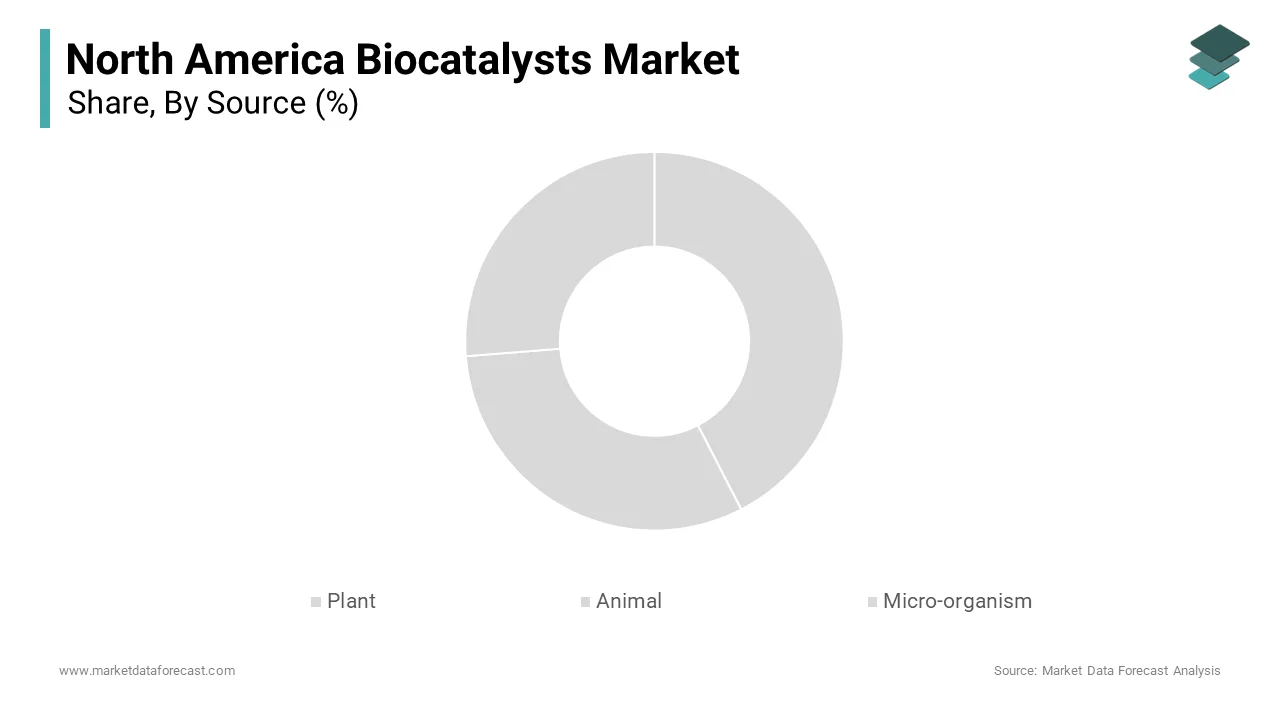
The plant-based biocatalysts segment is projected to expand at a CAGR of 9.3% from 2025 to 2033, owing to the rising consumer and regulatory preference for non-animal, non-GMO, and allergen-free enzymes in food, cosmetics, and pharmaceuticals. Plant-derived enzymes such as papain from papaya and bromelain from pineapple are increasingly favored in meat tenderization, dietary supplements, and wound debridement products due to their natural origin and biocompatibility. As per the Plant Science Research Network, North America cultivated over 12,000 acres of enzyme-producing crops in 2023, including transgenic tobacco engineered to express human-compatible glycosyltransferases. A second key driver is the advancement in molecular farming—using plants as bioreactors to produce high-value enzymes. The U.S. Department of Agriculture reports that a single acre of genetically modified tobacco can yield up to 2 kilograms of purified pharmaceutical-grade enzyme, surpassing microbial systems in cost-efficiency for certain applications.
By Type Insights
The hydrolases segment accounted in holding 48.3% of the North America biocatalysts market share in 2025, with the widespread applicability of hydrolase enzymes that catalyze bond cleavage using water in industrial processes. Proteases, lipases, and amylases, all subcategories of hydrolases, are indispensable in food processing, detergent formulation, and biofuel production. According to the Institute of Food Technologists, over 70% of enzymatic reactions in food manufacturing involve hydrolases, including lactase for lactose-free dairy and pectinase in juice clarification. Procter & Gamble and Church & Dwight incorporate proteases and lipases in over 80% of their liquid laundry formulations to enhance stain removal at low wash temperatures, reducing energy consumption. As per the U.S. Environmental Protection Agency, enzyme-enhanced detergents have contributed to a 15% reduction in residential water heating energy use since 2015.
The transferases segment is projected to grow with an expected CAGR of 8.7% throughout the forecast period, with the synthesis of complex biomolecules for pharmaceutical and biotech applications. Transferases catalyze the transfer of functional groups such as methyl, phosphate, or glycosyl units, which is making them essential in the production of nucleotide analogs, glycoproteins, and chiral intermediates. For example, transferases are used in the synthesis of mRNA vaccines to cap the 5' end of RNA strands, a step vital for stability and translation efficiency. The second key driver is the rise of precision medicine and oligonucleotide-based therapies, including antisense drugs and CRISPR components. According to the FDA’s Office of Biotechnology Products, the number of approved nucleic acid therapeutics increased from 12 in 2020 to 28 in 2023, each requiring enzymatic phosphorylation and methylation during synthesis. Companies like Merck and Aldevron are investing in enzymatic oligonucleotide manufacturing to replace chemical methods, which generate toxic byproducts.
By End-Use Industry insights
The pharmaceutical industry segment was the largest by accounting for 42.3% of the North America biocatalysts market share in 2025, with the sector’s reliance on biocatalysis for synthesizing complex, stereochemically pure molecules essential to modern drug development. Biocatalysts such as ketoreductases and transaminases enable highly selective reactions under mild conditions, reducing the need for hazardous reagents and costly purification processes. For instance, Merck’s biocatalytic route to sitagliptin, a diabetes medication, improved yield by 56% and reduced waste by 80%, as documented in a 2022 Green Chemistry case study. As per the Biotechnology Innovation Organization, biologics accounted for 62% of new drug approvals between 2020 and 2023. Academic hubs like the Cambridge biotech cluster and the Toronto Innovation Zone are advancing enzyme engineering for targeted drug delivery and prodrug activation.
The biofuel sector is projected to expand at a CAGR of 9.1% from 2025 to 2033, owing to the policy mandates and technological advancements in the enzymatic conversion of biomass into renewable fuels. Cellulases and hemicellulases are breaking down lignocellulosic feedstocks such as corn stover, switchgrass, and forestry residues into fermentable sugars for ethanol production. The Inflation Reduction Act includes tax credits of up to $1.00 per gallon for advanced biofuels, significantly improving the economic viability of enzymatic biorefining. Additionally, synthetic biology is enabling the development of consolidated bioprocessing (CBP) organisms that both produce enzymes and ferment sugars, streamlining operations. In Canada, the federal government’s Clean Fuel Standard mandates a 15% reduction in carbon intensity by 2030, accelerating investment in enzyme-driven biodiesel and renewable diesel. Companies like LanzaTech are using engineered carbon-fixing microbes to convert industrial waste gases into ethanol via biocatalytic pathways.
COUNTRY-LEVEL ANALYSIS
United States
The United States was the top performer of the North American biocatalysts market with 82.3% of the share in 2025, with a confluence of advanced biotechnology infrastructure, robust R&D investment, and a highly concentrated pharmaceutical and industrial biotech sector. The nation hosts over 70% of North America’s commercial-scale fermentation facilities, including major sites operated by Novozymes, DuPont, and Genencor, enabling large-volume enzyme production. As per the National Science Foundation, U.S. institutions received over $2.1 billion in federal funding for synthetic biology and enzyme engineering in 2023, fueling breakthroughs in directed evolution and metabolic pathway design. The presence of biotech hubs in Massachusetts, California, and North Carolina fosters collaboration between academia, startups, and multinational corporations. The U.S. Food and Drug Administration’s support for continuous manufacturing and green chemistry has accelerated the adoption of biocatalytic processes in drug synthesis. Additionally, the Renewable Fuel Standard and Inflation Reduction Act provide strong policy incentives for bio-based fuel production, driving demand for cellulases and lipases. Consumer preference for clean-label food products has also expanded the use of plant and microbial enzymes in processing.
Canada
The Canadian biocatalysts market held 11.2% of the share in 2025. The country’s market is distinguished by its focus on sustainable biomanufacturing and public-private collaboration in enzyme innovation. Environment and Climate Change Canada’s Clean Fuel Standard mandates a 15% reduction in carbon intensity by 2030, driving investment in biocatalytic biofuel and chemical production. The Strategic Innovation Fund has allocated over CAD 400 million to biomanufacturing projects since 2021, including enzyme development for green plastics and carbon capture.
KEY MARKET PLAYERS
DuPont de Nemours, Inc., Biocatalysts, BASF SE, Amano Enzyme Inc., Codexis, Inc., AB Enzymes, Lonza, Novozymes, Prozomix Limited, DSM. Are the market players that are dominating the North American biocatalysts market?
Top Players In The Market
Novozymes A/S (now part of Novonesis)
Novozymes, recently rebranded as Novonesis, stands as a global pioneer in industrial biocatalysis, with a profound influence on the North American market through its relentless focus on innovation and sustainability. The company has redefined enzyme applications across sectors, from biofuels and detergents to pharmaceuticals and food processing, by leveraging advanced fermentation and protein engineering. Its North American operations serve as a nexus for R&D collaboration with academic institutions and industrial partners, driving the commercialization of next-generation biocatalysts. Novonesis emphasizes end-to-end solutions, offering tailored enzyme formulations and technical support that enable clients to optimize efficiency and reduce environmental impact. Its commitment to green chemistry has positioned it as a strategic ally for companies aiming to meet ESG goals.
DuPont Nutrition & Biosciences (now part of International Flavors & Fragrances Inc.)
DuPont Nutrition & Biosciences has long been a cornerstone in the development and deployment of high-performance biocatalysts in food, health, and industrial applications. Through its deep expertise in microbial strain development and enzyme optimization, the company has delivered robust solutions that enhance process efficiency and product quality across North America. Its biocatalyst portfolio supports functions such as starch conversion, dairy processing, and sustainable chemical synthesis, serving major food manufacturers and biorefineries. Following its integration into International Flavors & Fragrances (IFF), the biosciences arm continues to drive innovation by merging biocatalysis with flavor and functional ingredient platforms. The company’s strength lies in its ability to scale laboratory breakthroughs into industrial reality, supported by a vast technical service network and regulatory expertise. Its focus on clean-label ingredients and waste reduction aligns with evolving consumer and corporate sustainability demands.
Codexis, Inc.
Codexis has emerged as a trailblazer in the field of engineered enzymes, specializing in the design of high-precision biocatalysts for pharmaceutical and industrial applications. The company distinguishes itself through its proprietary CodeEvolver platform, a directed evolution technology that accelerates the development of enzymes with enhanced activity, stability, and selectivity. Its North American presence is pivotal in advancing green chemistry within the life sciences sector, where its biocatalysts enable more efficient and sustainable drug manufacturing processes. Codexis collaborates closely with leading pharmaceutical companies to replace traditional chemical synthesis with enzymatic routes, reducing toxic byproducts and energy consumption. Beyond pharma, the company is expanding into sustainable manufacturing and carbon capture, leveraging its platform to develop enzymes for novel industrial transformations. Its agile, innovation-driven model allows rapid response to emerging market needs, which is positioning it at the forefront of next-generation biocatalysis.
Top Strategies Used by Key Market Participants
A defining strategy among leading biocatalyst companies is the vertical integration of enzyme design, production, and application support, enabling seamless customization and faster time-to-market. Firms are investing in proprietary platforms that combine synthetic biology, machine learning, and high-throughput screening to engineer superior enzymes, reducing dependency on external R&D. This in-house innovation capacity allows for rapid iteration and protection of intellectual property, giving companies a competitive edge in high-value sectors like pharmaceuticals and specialty chemicals.
Another pivotal approach is strategic collaboration with end-users, academic institutions, and government agencies to co-develop application-specific biocatalytic solutions. These partnerships facilitate early-stage validation, de-risk commercialization, and align product development with real-world industrial challenges. By embedding technical experts within client operations, companies ensure optimal integration and performance, fostering long-term relationships and recurring revenue streams.
COMPETITION OVERVIEW
The competitive landscape of the North America biocatalysts market is defined by a dynamic interplay between technological dominance, application specialization, and sustainability-driven innovation. Established players leverage decades of expertise in fermentation and enzyme engineering to maintain dominance, while nimble biotech firms disrupt the space with cutting-edge platforms in synthetic biology and AI-driven protein design. Competition is less about price and more about performance, reliability, and regulatory readiness, particularly in highly scrutinized sectors like pharmaceuticals and food. Differentiation emerges through proprietary enzyme libraries, advanced stabilization techniques, and integrated service models that include process optimization and lifecycle support. The market is also witnessing a shift from commoditized enzyme supply to solution-oriented partnerships, where providers co-engineer processes with clients to maximize efficiency and sustainability. Geographic clustering in biotech hubs fosters intense knowledge exchange and talent competition, accelerating innovation cycles. Intellectual property plays a role, with patent portfolios serving as both barriers to entry and catalysts for licensing alliances. As biocatalysis expands beyond traditional industries into carbon capture, biomanufacturing, and personalized medicine, the competitive frontier is moving toward adaptability and cross-sector applicability. Success increasingly depends on the ability to anticipate regulatory shifts, align with ESG mandates, and deliver enzymes that are not only effective but also environmentally and economically transformative.
RECENT HAPPENINGS IN THE MARKET
- In February 2025, Novonesis launched a new enzyme innovation center in Davis, California, dedicated to advancing biocatalysts for sustainable agriculture and carbon-negative manufacturing, reinforcing its commitment to next-generation bio-based solutions.
- In January 2025, Codexis entered into a strategic collaboration with a leading pharmaceutical company to develop a novel enzymatic pathway for the synthesis of a high-potency oncology drug, expanding its footprint in precision medicine manufacturing.
- In March 2025, IFF (formerly DuPont Nutrition & Biosciences) introduced a new suite of digital enzyme performance monitoring tools for food and beverage manufacturers, enabling real-time optimization of bioprocessing parameters across North American production facilities.
- In May 2023, Ginkgo Bioworks partnered with a major enzyme distributor to commercialize a portfolio of custom-engineered biocatalysts for industrial cleaning and textile processing, broadening access to advanced synthetic biology platforms.
- In July 2023, the U.S. Department of Energy awarded a multi-year grant to a consortium led by the Joint BioEnergy Institute to develop extremophile-derived enzymes for lignin valorization, supporting domestic innovation in renewable chemicals and biofuels.
MARKET SEGMENTATION
This research report on the North American biocatalyst market is segmented and sub-segmented into the following categories.
By Source
- Plant
- Animal
- Micro-organism
By Type
- Oxidoreductases
- Transferases
- Hydrolases
- Others
By End-User
- Pharmaceutical
- Food and beverage
- Water Treatment
- Biofuel
- Others
By Country
- The USA
- Canada
- Mexico
Frequently Asked Questions
What is the current market size of the biocatalysts industry in North America?
As of 2024, the North America biocatalysts market is estimated at USD 0.48 billion, driven by rising demand for sustainable chemical processes in pharmaceuticals, biofuels, and specialty chemicals.
What is the projected growth rate for the biocatalysts market from 2025 to 2033?
The market is expected to grow at a CAGR of 6.18% between 2025 and 2033, reaching an estimated value of USD 0.83 billion by 2033. Growth is supported by green chemistry initiatives and regulatory support for bio-based manufacturing.
Which countries dominate the North American biocatalysts market?
The United States accounts for over 85% of the regional market due to its advanced biotech infrastructure and strong R&D investments. Canada is emerging as a secondary hub, particularly in enzyme development for agro-industrial applications.
What are the most widely used types of biocatalysts in this region?
Hydrolases (especially lipases and proteases) are the most commonly used, representing nearly 45% of demand. Oxidoreductases and transferases are gaining traction in pharmaceutical synthesis and fine chemical production.
Which industries are the primary consumers of biocatalysts?
The pharmaceutical sector leads consumption, using biocatalysts for chiral synthesis and API manufacturing. Other key users include the biofuels industry, food & beverage processors, and specialty chemical manufacturers.
How are government regulations influencing the biocatalysts market?
Regulatory bodies like the EPA and FDA are promoting bio-based processes through incentives and reduced approval timelines for green manufacturing. The U.S. BioPreferred Program has encouraged adoption in industrial applications.
Are biocatalysts replacing traditional chemical catalysts?
Yes, in many applications. Biocatalysts offer higher specificity, lower energy consumption, and reduced toxic byproducts. In API manufacturing, over 60% of new processes now incorporate at least one enzymatic step.
What role does R&D play in the biocatalysts market?
R&D is a core growth driver. Universities, biotech startups, and large pharma companies are investing in enzyme engineering, directed evolution, and immobilization technologies to enhance stability and reusability.
How is the shift toward sustainable manufacturing impacting demand?
Corporate ESG commitments are accelerating adoption. Major chemical and pharmaceutical firms are setting targets to reduce carbon intensity, and biocatalysis is a key strategy to meet these goals by 2030.
What are the main challenges in scaling biocatalyst applications?
Key challenges include enzyme instability under industrial conditions, high initial development costs, and limited shelf life. Additionally, scaling up from lab to production requires significant process optimization.
Access the study in MULTIPLE FORMATS
Purchase options starting from
$ 2000
Didn’t find what you’re looking for?
TALK TO OUR ANALYST TEAM
Need something within your budget?
NO WORRIES! WE GOT YOU COVERED!
Call us on: +1 888 702 9696 (U.S Toll Free)
Write to us: sales@marketdataforecast.com