- Product Description Description
- Table of Contents TOC
- List of Table & Figure LOT
- Get Free Sample PDF Sample PDF
Market Size, 2025
$6.29 BnMarket Estimate, 2026
$7.72 BnMarket Forecast, 2034
$39.49 BnCAGR, 2026–2034
22.64%North America Biochips Market Report: Size, Share, Trends & Forecast (2026–2034)
- Market Scope: Comprehensive regional industry evaluation covering DNA chips, lab-on-a-chip technologies, protein chips, end-user segments (hospitals, biopharma, research institutes), and country-level developments across the U.S. and Canada.
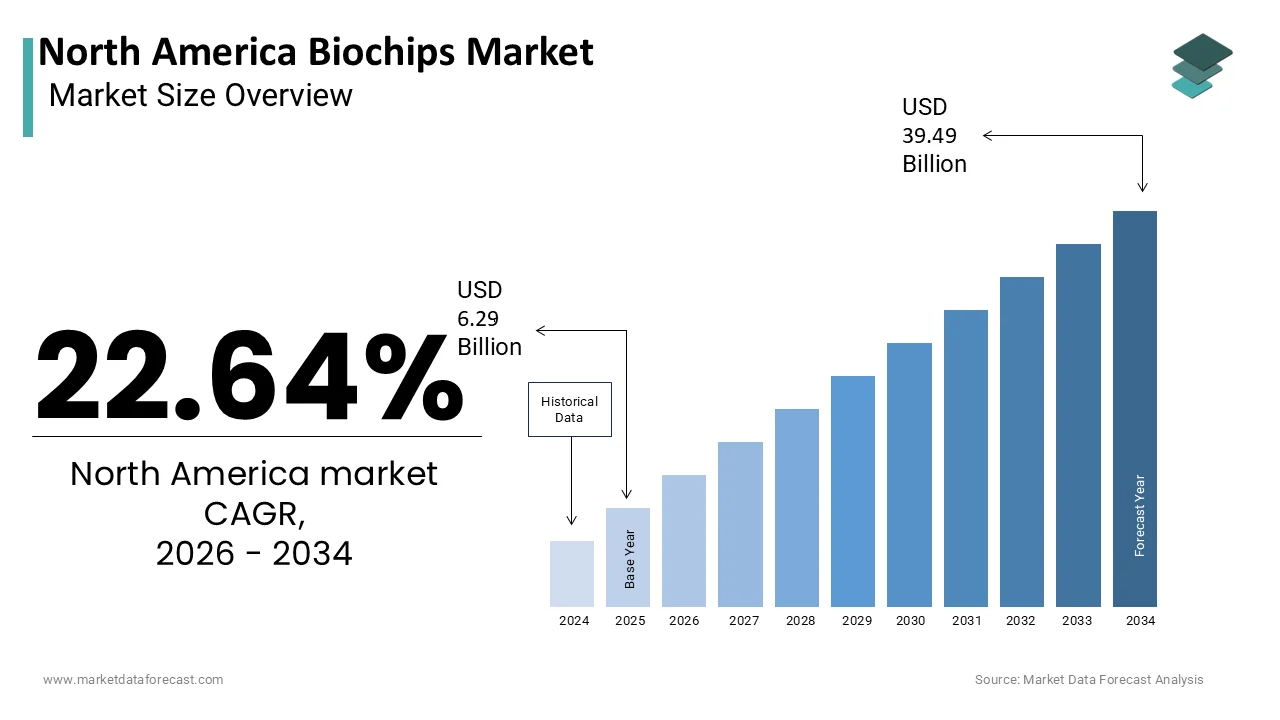
- Market Valuation: Valued at USD 6.29 billion in 2025, estimated at USD 7.72 billion in 2026, and projected to reach USD 39.49 billion by 2034, registering a rapid compound annual growth rate (CAGR) of 22.64% from 2026 to 2034.
- Primary Growth Drivers: A rising geriatric demographic necessitating rapid diagnostic tools, high volumes of local drug discovery pipelines, increasing cancer research initiatives, and strong government funding supporting genomic innovations.
North America Biochips Market Segment Metrics (2026–2034)
| Category | Leading Segment / Position | Fastest-Growing Segment |
|---|---|---|
| By Product / Technology | DNA Chips (dominates through extensive SNP genotyping, genomics, and gene expression workflows) | Lab-On-A-Chip & Proteomics (expanding via point-of-care diagnostics and high-throughput screening needs) |
| By End User | Biotechnology & Pharmaceutical Companies (major buyers deploying biochips for large-scale drug development) | Hospitals & Diagnostic Centers (accelerating adoption due to rising oncology and clinical screening demands) |
| By Country | The United States (leads the regional market through advanced R&D infrastructure, MIT research, and federal funding) | Canada (securing steady growth driven by government-backed cancer research and precision medicine initiatives) |
Major North American Biochips Market Players & Industry Structure
Market Structure: A highly modern, innovation-focused ecosystem characterized by high product costs offset by robust venture capital, federal grants, and fierce corporate competition centered around cost-effective chip design.
Key Companies: Agilent Technologies Inc., Fluidigm Corporation, PerkinElmer Inc., Bio-Rad Laboratories Inc., GE Healthcare, Cepheid Inc., Illumina Inc., and Thermo Fisher Scientific Inc.
 Download Free Sample Report
North America Biochips Market Size
The North America Biochips Market is projected to grow from USD 6.29 billion in 2025 to USD 7.72 billion in 2026 and reach USD 39.49 billion by 2034, registering a CAGR of 22.64% during the forecast period from 2026 to 2034.
The biochips are array of miniaturized analytical devices designed to perform high throughput biological assays including genomics proteomics and metabolomics. These microarrays and lab on a chip systems are integral to advancing precision medicine drug discovery and clinical diagnostics across the region. The National Institutes of Health states that the All of Us Research Program aims to gather data from 1 million or more people living in the United States to accelerate research breakthroughs, creating an unprecedented demand for biochip technologies capable of processing massive biological datasets. This large scale initiative directly correlates with increased procurement of high density microarrays and sequencing chips. Furthermore, the Centers for Disease Control and Prevention reports that chronic diseases such as heart disease and cancer account for 6 in 10 deaths in the United States, necessitating advanced diagnostic tools for early detection and personalized treatment strategies. Biochips enable the simultaneous analysis of thousands of biomarkers, facilitating rapid and accurate diagnosis. As healthcare providers shift toward value based care models, the adoption of these efficient and cost effective diagnostic platforms continues to expand. The market supports various applications ranging from infectious disease testing to genetic profiling. Technological advancements in surface chemistry and signal detection further enhance the sensitivity and reliability of biochip assays.
MARKET DRIVERS
Rising Prevalence of Chronic Diseases and Genetic Disorders
The escalating burden of chronic and genetic conditions is fuelling the growth of the North America Biochips Market. The cardiovascular diseases affect nearly half of all adults in the United States, creating a vast population requiring regular monitoring and personalized therapeutic interventions. This widespread prevalence drives the demand for biochips that can analyze multiple cardiac biomarkers simultaneously from small sample volumes. Additionally, the National Organization for Rare Disorders indicates that approximately 25 million Americans suffer from rare diseases, many of which have a genetic basis. Biochips facilitate the identification of specific genetic mutations associated with these conditions, enabling targeted therapy development. The ability to process large numbers of samples quickly makes biochips indispensable for population screening programs. Healthcare systems are increasingly integrating biochip based diagnostics into routine care to improve patient outcomes and reduce hospital readmissions. Pharmaceutical companies utilize these platforms to identify patient subgroups for clinical trials, enhancing drug efficacy. The direct correlation between disease complexity and the need for multi parameter analysis ensures sustained demand for advanced biochip technologies.
Advancements in Microfluidics and Lab on a Chip Technologies
The technological innovations in microfluidics and lab on a chip designs by enhancing assay speed and reducing reagent consumption is greatly influencing the growth of the North America biochips market. As per the Journal of Laboratory Automation, modern microfluidic biochips can reduce sample volume requirements by up to 90% compared to traditional methods, making them ideal for pediatric and neonatal testing. This efficiency gain allows for less invasive sampling procedures and lower operational costs for laboratories. Furthermore, the integration of automated fluid handling systems has improved assay reproducibility by addressing quality control concerns in clinical settings. These improvements encourage wider adoption among diagnostic laboratories seeking reliable and standardized testing platforms. Manufacturers are developing portable biochip devices that enable point of care testing in remote or resource limited settings. The miniaturization of components allows for multiplexing, where multiple tests are performed on a single chip simultaneously. This capability accelerates diagnosis and treatment decisions in emergency situations. Hospitals are prioritizing the procurement of these advanced systems to streamline workflow and improve turnaround times.
MARKET RESTRAINTS
High Cost of Development and Manufacturing
The substantial financial investment required for designing and manufacturing complex systems is attributed in hindering the growth of North America Biochips Market. The high upfront costs limit the number of new entrants and slow the pace of innovation in the sector. This inefficiency increases the per unit cost and reduces profit margins for manufacturers. The need for clean room facilities and specialized equipment further escalates production expenses. Smaller laboratories may struggle to afford the latest biochip technologies, leading to disparities in access to advanced diagnostics. Insurance reimbursement rates for biochip based tests do not always cover the full development and production costs, affecting commercial viability. Consequently, some companies delay product launches or focus on niche markets with higher pricing power.
Regulatory Hurdles and Validation Requirements
The stringent regulatory oversight and rigorous validation requirements is also declining the growth of the North America Biochips Market. The Food and Drug Administration mandates extensive clinical validation data for biochip based diagnostic tests, particularly those used for guiding treatment decisions in oncology and infectious diseases. Meeting these standards requires prolonged clinical trials and substantial documentation, delaying time to market. These delays hinder manufacturers from quickly capitalizing on emerging clinical needs and technological advancements. The complexity of validating multiplex assays adds another layer of difficulty, as each marker must demonstrate individual performance characteristics. Regulatory bodies often update guidelines for software algorithms used in biochip data analysis, requiring continuous compliance efforts. Smaller firms may lack the resources to navigate these complex regulatory landscapes effectively. This environment can discourage investment in novel biochip designs due to uncertainty regarding approval timelines. Companies must dedicate significant resources to regulatory affairs, diverting funds from research and development.
MARKET OPPORTUNITIES
Integration of Artificial Intelligence and Big Data Analytics
The incorporation of artificial intelligence and big data analytics is solely to promote new opportunities for the growth of the North America Biochips Market. The AI algorithms can interpret complex biochip data patterns with greater accuracy than traditional statistical methods by improving diagnostic precision. This technological enhancement attracts healthcare institutions aiming to leverage data driven insights for personalized medicine. These improvements build trust among clinicians and encourage broader adoption of biochip technologies. Manufacturers are developing cloud-based platforms that aggregate data from multiple biochip runs to identify population level trends. This connectivity facilitates collaborative research and accelerates biomarker discovery. The ability to integrate biochip data with electronic health records creates a comprehensive view of patient health. Hospitals are increasingly willing to invest in smart biochip systems that offer predictive analytics capabilities.
Expansion into Point of Care and Home Diagnostics
The growing demand for decentralized testing and home-based diagnostics is also to amplify the growth of the North America Biochips Market. As per the American Association for Clinical Chemistry, the point of care testing market is expanding rapidly, driven by the need for immediate results in urgent care and home settings. Biochips are ideally suited for this application due to their compact size and ease of use. The trend encourages manufacturers to develop user friendly biochip kits for conditions such as diabetes and infectious diseases. The convenience of home testing reduces the burden on healthcare facilities and improves patient compliance with monitoring protocols. Regulatory agencies are streamlining approval processes for over the counter diagnostic tests, facilitating market entry. Partnerships between biochip manufacturers and telehealth providers enable remote interpretation of results. This integration supports continuous care management and early intervention.
MARKET CHALLENGES
Complexity of Data Interpretation and Standardization
The intricate nature of data generated by high density biochips is a primary challenge for the growth of the North America Biochips Market. The variability in data analysis pipelines can lead to discrepancies in result interpretation across different laboratories. This inconsistency undermines confidence in biochip-based diagnostics and hinders widespread clinical adoption. This lack of transparency complicates the validation process for new assays. Researchers and clinicians often struggle to distinguish signal from noise in complex datasets without specialized bioinformatics expertise. The absence of universal standards for data formatting and reporting further exacerbates the problem. Healthcare providers face difficulties in integrating biochip data into existing clinical workflows due to incompatible software systems. Manufacturers must invest heavily in developing user friendly analysis tools to bridge this gap. Without standardized protocols, the comparability of results remains limited.
Shortage of Skilled Professionals and Technical Expertise
The limited availability of trained professionals proficient in biochip technology and bioinformatics is also to limit the growth of the North America Biochips Market. The growing deficit of scientists skilled in microarray analysis and molecular diagnostics, limiting the capacity of research institutions. This workforce gap restricts the ability of laboratories to fully utilize advanced biochip platforms. Furthermore, the Journal of Laboratory Medicine notes that training programs for specialized biochip techniques are limited in number and duration. The steep learning curve associated with complex instrumentation discourages new entrants into the field. Laboratories struggle to retain skilled staff due to high demand from industry and academia. The scarcity of experts means that many biochip systems operate below their optimal potential. Healthcare systems face difficulties in implementing biochip services without adequate technical support. This limitation affects the speed of innovation and the translation of research into clinical practice. Educational institutions are slowly expanding curricula to address this gap, but the pipeline remains insufficient.
REPORT COVERAGE
| REPORT METRIC | DETAILS |
| Market Size Available | 2025 to 2034 |
| Base Year | 2025 |
| Forecast Period | 2026 to 2034 |
| Segments Covered | By Product Type, End-user, and Region |
| Various Analyses Covered | Global, Regional, and Country-Level Analysis, Segment-Level Analysis, Drivers, Restraints, Opportunities, Challenges; PESTLE Analysis; Porter’s Five Forces Analysis, Competitive Landscape, Analyst Overview of Investment Opportunities |
| Countries Covered | The U.S., Canada, Rest of North America |
| Market Leaders Profiled |
|
SEGMENTAL ANALYSIS
By End User Insights
The hospitals and diagnostic centers segment was the largest by accounting for 44.2% of the North America Biochips Market share in 2025 due to their central role in patient care and the high volume of clinical testing performed daily. According to the American Hospital Association, there are registered hospitals in the United States, each requiring efficient diagnostic tools to manage patient flow and ensure accurate treatment plans. This extensive network drives consistent demand for biochip based diagnostic kits for infectious diseases cancer screening and genetic disorders. Biochips offer the advantage of multiplexing allowing multiple biomarkers to be analyzed from a single sample which reduces costs and turnaround time. Healthcare providers prioritize these technologies to improve diagnostic accuracy and reduce the need for repeat testing. The integration of biochips into routine clinical workflows supports value based care initiatives by enabling early detection and personalized treatment strategies. The need for rapid results in emergency settings further amplifies the adoption of point of care biochip devices.
The biotechnology and pharmaceutical companies segment is expected to grow at a fastest CAGR of 14.5% from 2026 to 2034 due to the role of biochips in drug discovery and development. Biochips enable high throughput screening of potential drug candidates accelerating the identification of promising compounds. Additionally, the precision medicine initiatives require detailed molecular profiling of patient populations to stratify participants for clinical trials. Biochips provide the necessary data granularity to identify specific genetic markers associated with drug response. This capability reduces the risk of clinical trial failure and enhances the efficiency of drug development pipelines. Pharmaceutical companies are increasingly adopting lab on a chip-technologies for organ on a chip models which simulate human physiology more accurately than traditional cell cultures. These innovations allow for better prediction of drug toxicity and efficacy before human trials. The shift toward targeted therapies drives demand for specialized biochips that can analyze complex biological interactions.
By Product Type Insights
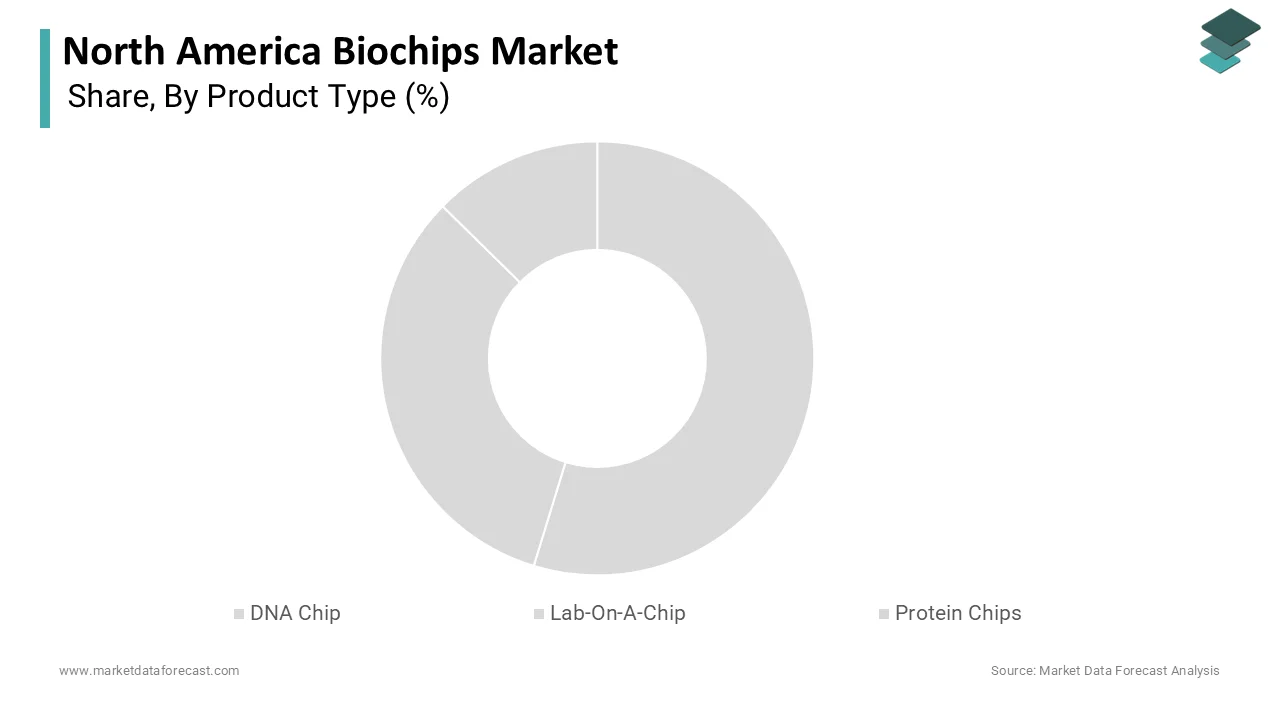
The DNA chips segment held a prominent share of the North America Biochips Market in 2026 with the widespread application in genomics research and clinical diagnostics. DNA chips are essential for SNP genotyping gene expression profiling and mutation detection which are critical for understanding disease mechanisms. Furthermore, the genetic testing has become a standard part of care for many conditions, including hereditary cancers and cardiovascular diseases. This clinical integration drives steady demand for high density DNA chips capable of analyzing thousands of genetic variants simultaneously. Researchers utilize these tools to map genetic associations with complex traits providing insights into disease susceptibility. Pharmaceutical companies rely on DNA chips for pharmacogenomics studies to optimize drug dosing based on individual genetic profiles. The robustness and reliability of DNA chip technology make it a preferred choice for both academic and industrial applications. Regulatory approvals for genetic diagnostic tests further support market growth.
The lab on a chip technology segment is lucratively growing at a fastest CAGR of 16.2% during the forecast period due to its versatility and miniaturization capabilities. The lab on a chip devices integrate multiple laboratory functions onto a single chip reducing sample volume reagent consumption and analysis time. Additionally, the Food and Drug Administration has approved several lab on a chip devices for infectious disease testing reflecting their growing clinical acceptance. These devices enable decentralized testing allowing for diagnosis in remote or resource limited settings. The ability to perform complex assays such as PCR and immunoassays on a portable platform enhances accessibility to healthcare. Manufacturers are developing disposable lab on a chip cartridges for various applications including environmental monitoring and food safety. The integration of microfluidics with electronic sensors allows for real time data acquisition and analysis. This technological convergence appeals to healthcare providers seeking innovative solutions for patient management.
COUNTRY LEVEL ANALYSIS
United States Biochips Market Analysis
The United States was the top performer in the North America Biochips Market by capturing 86.4% of the share in 2025 due to its advanced healthcare infrastructure substantial research funding and strong presence of key industry players. This financial support fosters a vibrant ecosystem of academic institutions biotechnology firms and pharmaceutical companies that actively adopt and develop biochip solutions. Furthermore, the Centers for Disease Control and Prevention emphasizes the importance of advanced diagnostics in public health surveillance particularly for infectious diseases and chronic conditions. This focus drives procurement of biochip-based testing platforms in hospitals and public health laboratories. The Food and Drug Administration provides a clear regulatory pathway for biochip based diagnostics encouraging commercialization of new products. High prevalence of chronic diseases such as cancer and diabetes creates sustained demand for personalized diagnostic tools. The presence of major technology hubs in regions like Silicon Valley and Boston facilitates collaboration between tech and life sciences sectors. Strong intellectual property protection encourages investment in novel biochip designs.
Canada Biochips Market Analysis
Canada biochips market was next with 9.8% of the North America biochips market share in 2025 with the robust public healthcare system and strong government support for life sciences research. The Canadian Institutes of Health Research reports that federal funding for health research has increased steadily supporting projects in genomics and personalized medicine. This investment enables universities and research hospitals to acquire advanced biochip technologies for clinical and basic research. The country has a strong biotechnology sector with clusters in Montreal Toronto and Vancouver driving demand for research tools. The universal healthcare coverage ensures equitable access to diagnostic services although adoption of newer technologies may vary by province. Collaborations between Canadian researchers and international partners enhance knowledge exchange and technology transfer. The aging population increases the burden of chronic diseases driving demand for efficient diagnostic solutions. Government initiatives promoting digital health and precision medicine further support market growth.
COMPETITIVE LANDSCAPE
The competition in the North America Biochips Market is characterized by intense rivalry among established life sciences giants and emerging technology specialists. Major players compete on the basis of platform performance, data accuracy, and comprehensive service ecosystems. The market features a mix of large multinational corporations and niche manufacturers focusing on specific applications such as pharmacogenomics or infectious disease diagnostics. Continuous innovation drives competitive dynamics as companies strive to launch biochips with improved sensitivity and faster turnaround times. Regulatory hurdles create barriers to entry but also encourage high standards of quality and reproducibility essential for clinical adoption. Price competition remains moderate due to the specialized nature of the equipment and the need for proven reliability in diagnostic settings. Collaborative efforts between manufacturers and research institutions shape product development priorities and validation strategies. Intellectual property disputes occasionally arise as firms protect their proprietary probe designs and manufacturing processes.
KEY MARKET PLAYERS
Some of the companies that are playing a dominating role in the North America Biochips Market include:
- Agilent Technologies Inc.
- Fluidigm Corporation
- PerkinElmer Inc.
- Bio-Rad Laboratories Inc.
- GE Healthcare
- Cepheid Inc.
- Illumina Inc.
- Thermo Fisher Scientific Inc.
TOP LEADING PLAYERS IN THE MARKET
- Thermo Fisher Scientific Inc maintains a prominent position in the North America Biochips Market through its extensive portfolio of microarray and sequencing technologies. The company provides comprehensive solutions ranging from gene expression arrays to targeted genotyping chips that support diverse research and clinical applications. Thermo Fisher recently expanded its biochip manufacturing capacity to meet rising demand for high throughput diagnostic tools. This strategic expansion ensures reliable supply chains for academic and pharmaceutical clients across the region. The company actively collaborates with research institutions to validate new biomarker panels on its platforms. Its strong distribution network facilitates rapid access to advanced biochip products throughout North America. The company continues to invest in next generation surface chemistry to improve assay sensitivity.
- Agilent Technologies Inc contributes significantly to the market by offering high density DNA microarrays and SurePrint technology for customized genomic analysis. The company leverages its expertise in inkjet printing to produce biochips with superior probe uniformity and reproducibility. Agilent recently launched updated sure select target enrichment kits compatible with its biochip platforms to streamline library preparation. These innovations reduce hands on time and improve data quality for researchers conducting large scale studies. The company engages in strategic partnerships with contract research organizations to expand service offerings for biochip based assays. Agilent focuses on developing user friendly design tools that allow scientists to create custom arrays easily. Its commitment to quality control ensures consistent performance across different production batches. The company supports clinicians with validated protocols for diagnostic applications.
- Illumina Inc plays a vital role in the market by integrating biochip technology with next generation sequencing workflows for comprehensive genomic profiling. The company utilizes bead chip arrays for genotyping and methylation analysis enabling cost-effective large-scale population studies. Illumina recently introduced enhanced array content covering diverse global populations to improve variant detection accuracy. These updates address health disparities and support inclusive precision medicine initiatives across North America. The company participates in major biobank projects to generate reference datasets using its biochip platforms. Illumina also focuses on automating sample processing to increase laboratory throughput and reduce errors.
TOP STRATEGIES USED BY KEY MARKET PARTICIPANTS
Key players in the North America Biochips Market, primarily focus on technological innovation and strategic collaborations to maintain competitive advantage. Companies invest heavily in research and development to create biochips with higher probe density and improved signal to noise ratios. Launching integrated software solutions allows firms to address complex data analysis challenges and enhance user experience. Strategic partnerships with academic medical centers facilitate clinical validation and generate robust evidence supporting diagnostic utility. Mergers and acquisitions serve as another critical strategy enabling companies to expand their product portfolios and enter adjacent markets like proteomics or metabolomics. Regulatory compliance is pursued through rigorous analytical validation and engagement with health authorities to secure approvals for clinical use. Companies also prioritize scientist education and training programs to ensure proper platform utilization and build brand loyalty.
MARKET SEGMENTATION
This research report on the North American biochips market has been segmented and sub-segmented into the following categories.
By Product Type
-
DNA Chips
-
SNP Genotyping
- Genomics
- Agricultural Biotechnology
- Gene Expression
- Cancer Diagnosis & Treatment
- Drug Discovery
- Others
-
- Lab-On-A-Chip
- Clinical Diagnostics
- IVD & POC
- Drug Discovery
- Genomics
- Proteomics
- Protein Chips
- Expression Profiling
- High-Throughput Screening
- Proteomics
- Diagnostics
- Drug Discovery
By End User
- Hospitals and Diagnostic Centers
- Biotechnology and Pharmaceutical Companies
- Academic & Research Institutes
By Country
- The U.S.
- Canada
- Rest of North America