- Product Description Description
- Table of Contents TOC
- List of Table & Figure LOT
- Get Free Sample PDF Sample PDF
Market Size, 2025
$0.48 BnMarket Estimate, 2026
$0.50 BnMarket Forecast, 2034
$0.69 BnCAGR, 2026–2034
4.09%Executive Summary: North America Automatic Carton Erector Market
- Market Scope: Regional North American automatic carton erector market analysis covering machine types, end-user segments, operation modes, country leadership frameworks, and packaging automation adoption metrics.
- Market Valuation: Valued at USD 0.48 billion in 2025, estimated at USD 0.50 billion in 2026, and projected to reach USD 0.69 billion by 2034, registering a CAGR of 4.09% from 2026 to 2034.
- Primary Growth Drivers: Rapid growth of e-commerce and fulfillment centers, labor shortages accelerating packaging automation, rising labor costs and operational efficiency demands, increasing automated packaging adoption across manufacturing, and the need for high-speed carton handling systems.
Key Market Segment Metrics (2026–2034)
| Category | Leading Segment (Position) | Fastest-Growing / Key Growth Segment |
|---|---|---|
| By Type & Operation | Vertical (largest type) & Fully Automatic (largest operation) | Horizontal (fastest-growing type) & Semi-Automatic (fastest-growing operation) |
| By End User Segment | Food & Beverage (largest end user) | E-commerce (fastest-growing end user) |
| By Technology & Innovation | Standard mechanical carton forming and conventional packaging lines | Industry 4.0 smart manufacturing, AI, IoT, and cloud-connected packaging systems |
| By Region / Country | United States (leading country with 88.3% market share in 2025) | Mexico (fastest-growing country market) |
Major Market Players & Market Structure
Market Structure: Highly competitive North American packaging machinery sector characterized by AI/IoT integration, servo-driven high-speed erector development, sustainable packaging alignment, and enhanced digital after-sales support frameworks.
Key Companies: Bosch Packaging Technology, Smurfit Kappa, Fischbein, KHS GmbH, A-B-C Packaging Machine Corporation, Wexxar Packaging, Duravant, Star Packaging, FANUC Corporation, ProMach, Inc., Tetra Pak, SACMI Group, and Schneider Packaging Equipment Co., Inc.
 Download Free Sample Report
North America Automatic Carton Erector Market Size
The North America Automatic carton erectors market size was valued at USD 0.48 billion in 2025 and is anticipated to reach a valuation of USD 0.50 billion in 2026 and USD 0.69 billion by 2034, growing at a CAGR of 4.09% from 2026 to 2034.
Automatic carton erectors are modern packaging automation systems that are designed to autonomously form, erect, and prepare cardboard boxes for product loading without manual intervention. These sophisticated machines utilize pneumatic, mechanical, and increasingly servo-driven technologies to handle various carton sizes and configurations at high speeds, typically ranging from 50 to 600 cartons per minute depending on complexity and application requirements. According to the Packaging Machinery Manufacturers Institute, over 75% of North American packaging lines now incorporate some form of automated carton handling equipment, reflecting the widespread adoption of these systems across diverse industries. The technology encompasses various configurations, including top-load, side-load, and robotic carton erectors, each designed to address specific production requirements and integration challenges. Manufacturing facilities across the United States and Canada have increasingly embraced these systems to address labor shortages and enhance operational efficiency. The Food Marketing Institute reports that food processing facilities alone account for approximately 45% of all automatic carton erector installations in North America.
MARKET DRIVERS
E-commerce Growth and Fulfillment Center Expansion
The explosive growth of e-commerce is driving the growth of the North American automotive casting market. The fundamental shift toward online shopping has necessitated the rapid expansion of fulfillment and distribution centers, each requiring sophisticated packaging automation to meet escalating order volumes and customer expectations for rapid delivery. According to the U.S. Department of Commerce, e-commerce sales in the United States reached $1.1 trillion in 2023, representing a 9.5% increase from the previous year and continuing the long-term growth trajectory that has averaged 15% annually over the past five years. This expansion has directly translated into increased demand for automated packaging solutions, with carton erectors being essential components of modern fulfillment operations. The National Retail Federation indicates that the average e-commerce order requires 1.8 separate packages, significantly amplifying carton consumption compared to traditional retail models. Amazon's fulfillment network alone operates over 1,200 facilities across North America, each incorporating multiple automated packaging lines equipped with carton erectors to handle peak seasonal demands exceeding 1.5 million packages daily during holiday periods.
Labor Shortage and Workforce Automation Requirements
The persistent labor shortage is additionally prompting the growth of the North American automotive casting market. Traditional manual carton erection processes require significant human intervention, creating operational bottlenecks and increasing costs as labor availability continues to decline across the region. The Bureau of Labor Statistics reports that the manufacturing sector experienced a 2.1% workforce decline in 2023, with packaging and materials handling positions being particularly affected by the shortage. This labor scarcity has forced companies to reconsider their operational models and invest in automation technologies to maintain productivity levels and reduce dependency on manual labor. According to the Association for Packaging and Processing Technologies, over 60% of North American packaging operations cite labor availability as their primary operational challenge, directly correlating with increased carton erector procurement activities. The average hourly wage for packaging line workers has increased by 8.3% annually over the past three years, as reported by the Bureau of Labor Statistics, which is making automated solutions increasingly cost-competitive compared to traditional manual operations. Companies such as Procter & Gamble and Unilever have implemented comprehensive automation strategies, with automatic carton erectors representing essential components of their packaging line modernization initiatives. The Occupational Safety and Health Administration has also emphasized workplace safety improvements, with repetitive motion injuries in packaging operations leading to increased workers' compensation claims and insurance costs.
MARKET RESTRAINTS
High Initial Capital Investment and Implementation Costs
The substantial initial capital requirements associated with automatic carton erector systems present a significant barrier to the adoption for small and medium-sized enterprises, which is hindering the growth of the North American automotive casting market. These sophisticated machines typically require considerable upfront investment not only for equipment procurement but also for system integration, facility modifications, and operator training programs. The total cost of ownership extends beyond initial procurement, encompassing ongoing maintenance, spare parts inventory, and periodic system upgrades necessary to maintain optimal performance. The International Society of Automation reports that maintenance and operational costs for automatic carton erectors typically account for 15-20% of initial equipment investment annually, creating additional financial pressures for operators. Small packaging operations, which constitute over 70% of North American packaging facilities according to the Packaging Machinery Manufacturers Institute, often lack the financial resources to justify such substantial capital expenditures. The payback period for these investments, while typically ranging from 18 to 24 months in high-volume applications, may extend significantly for operations with lower throughput requirements.
Technical Complexity and Maintenance Requirements
The nature of automatic carton erector systems can create operational challenges and maintenance burdens for end-users lacking specialized technical expertise, which is also a factor restricting the growth of the North American automotive casting market. These machines incorporate advanced sensors, programmable logic controllers, pneumatic systems, and increasingly servo-driven mechanisms that require skilled technicians for proper operation and maintenance. According to the International Maintenance Institute, over 45% of automatic carton erector downtime incidents result from operator errors or inadequate maintenance procedures rather than equipment failures. The complexity of troubleshooting modern carton erectors often requires manufacturer support or specialized third-party service providers, leading to extended downtime periods and increased operational costs. The average mean time between failures for automatic carton erectors is approximately 1,200 operating hours, as reported by the Reliability Information Analysis Center, necessitating regular preventive maintenance activities that require skilled technical personnel.
MARKET OPPORTUNITIES
Technological Advancement and Smart Manufacturing Integration
Technological innovation in design, presented through enhanced capabilities, improved efficiency, and integration with Industry 4.0 manufacturing concepts, is to create substantial opportunities for the growth of the North American automotive casting market. Modern carton erectors increasingly incorporate artificial intelligence, machine learning algorithms, and Internet of Things connectivity to optimize performance and provide valuable operational insights. According to the Smart Manufacturing Leadership Coalition, over 35% of North American manufacturers are actively investing in smart manufacturing technologies, creating demand for intelligent packaging automation systems that can communicate with broader production networks. Advanced servo-driven systems now offer unprecedented precision and flexibility, enabling automatic carton erectors to handle complex carton geometries and perform rapid size changeovers without manual intervention. The integration of vision systems and quality control sensors allows these machines to detect and reject defective cartons, improving overall packaging quality and reducing waste. Major manufacturers such as Bosch and Adept have introduced cloud-connected carton erectors that provide real-time performance data, predictive maintenance alerts, and remote diagnostic capabilities. The Industrial Internet Consortium reports that connected packaging equipment can improve overall equipment effectiveness by 15-25% through optimized scheduling and maintenance planning. Additionally, the development of collaborative robotics has enabled hybrid manual-automatic operations, allowing smaller facilities to gradually transition to full automation while maintaining human oversight. The emergence of modular carton erector designs enables scalable deployment and easier integration with existing packaging lines.
Sustainable Packaging and Environmental Compliance Requirements
The growing emphasis on environmental sustainability and packaging waste reduction for automatic carton erector manufacturers can adapt their technologies to support eco-friendly packaging initiatives, which will enhance the growth of the North American automotive casting market. According to the Environmental Protection Agency, packaging waste accounts for approximately 30% of municipal solid waste in the United States, driving regulatory pressure for waste reduction initiatives that directly impact packaging operations. California's new packaging regulations, effective in 2025, mandate 50% recycled content in packaging materials, necessitating equipment modifications and new system capabilities. The Sustainable Packaging Coalition reports that over 60% of North American consumer goods companies have committed to 100% recyclable or compostable packaging by 2025, creating opportunities for carton erector manufacturers who can adapt their technologies to handle these new materials. Additionally, the development of water-based adhesives and alternative sealing methods requires compatible automatic carton erector designs that can accommodate these sustainable technologies. Major retailers, including Walmart and Target, have established sustainable packaging scorecards that evaluate supplier capabilities, creating market incentives for packaging automation that supports environmental objectives.
MARKET CHALLENGES
Integration Complexity with Existing Packaging Lines
The integration of advanced technologies with existing packaging infrastructure presents significant technical and operational challenges for the growth of the North American automotive casting market. Many North American manufacturing facilities operate with legacy packaging equipment from multiple manufacturers, which is creating compatibility issues and integration complexities that require extensive engineering resources and customization efforts. According to the Packaging Research Institute, over 55% of packaging line upgrades involving automatic carton erectors require significant modifications to upstream and downstream equipment to ensure proper synchronization and material flow. The variation in control system architectures, communication protocols, and operational speeds between different equipment manufacturers creates synchronization challenges that can limit overall line efficiency and throughput optimization. The average integration project for automatic carton erectors requires 8-12 weeks of engineering time and system testing, as reported by leading system integrators, representing significant operational disruption and cost implications for manufacturers. Additionally, the physical integration of new carton erectors often requires facility modifications, including conveyor system upgrades, compressed air capacity expansion, and electrical infrastructure improvements that add complexity and cost to implementation projects. The lack of standardized interfaces and communication protocols across different equipment manufacturers creates additional integration challenges, often requiring custom programming and specialized interface development. Many small and medium-sized manufacturers lack the internal engineering resources necessary to successfully integrate complex automated systems, which is forcing them to rely on external system integrators whose services can add 25-40% to overall project costs.
Customization Requirements and Product Variation Handling
The diverse range of product types, packaging configurations, and operational requirements across North American industries creates significant challenges for the growth of the North American automotive casting market. According to the Flexible Packaging Association, the average North American packaging operation handles 15-20 different carton configurations regularly, requiring automatic carton erectors with rapid changeover capabilities and extensive size range accommodation. The food and beverage industry alone utilizes over 500 different carton styles and sizes, as reported by the Institute of Food Technologists, creating complex specification requirements for equipment manufacturers. The requirement for handling both standard corrugated materials and specialized substrates, including recycled content, coated materials, and sustainable alternatives, adds complexity to equipment design and operation. E-commerce fulfillment operations present unique challenges with their requirement for variable carton sizing and rapid SKU changes, often necessitating custom engineering solutions that increase equipment costs and delivery times.
REPORT COVERAGE
| REPORT METRIC | DETAILS |
| Market Size Available | 2025 to 2034 |
| Base Year | 2025 |
| Forecast Period | 2026 to 2034 |
| CAGR | 4.09% |
| Segments Covered | By Type, End-User, Operation, Country |
| Various Analyses Covered | Global, Regional, and Country Level Analysis; Segment-Level Analysis; DROC; PESTLE Analysis; Porter’s Five Forces Analysis; Competitive Landscape; Analyst Overview of Investment Opportunities |
| Regions Covered | The United States, Canada, Mexico, Rest of North America |
| Market Leaders Profiled | Bosch Packaging Technology, Smurfit Kappa, Fischbein, KHS GmbH, A-B-C Packaging Machine Corporation, Wexxar Packaging, Duravant, Star Packaging, FANUC Corporation, ProMachInc.c ., Tetra Pak, SACMI Group, Schneider Packaging Equipment Co., Inc. |
SEGMENTAL ANALYSIS
By Type Insights
The vertical segment was the largest and held a prominent share of the North American automotive casting market in 2025 its superior space efficiency compared to horizontal alternatives, a consideration for modern manufacturing facilities operating within constrained environments. Vertical carton erectors typically require 40-50% less floor space than equivalent horizontal systems, enabling manufacturers to maximize production capacity within existing facility footprints. According to the Facility Management Institute, over 70% of North American manufacturing facilities cite space optimization as a primary operational challenge, directly correlating with the preference for vertical carton erection systems. The compact footprint of vertical erectors, averaging 6-8 feet in length compared to 12-15 feet for horizontal systems, allows for easier integration into existing production lines without requiring facility expansions or reconfigurations.
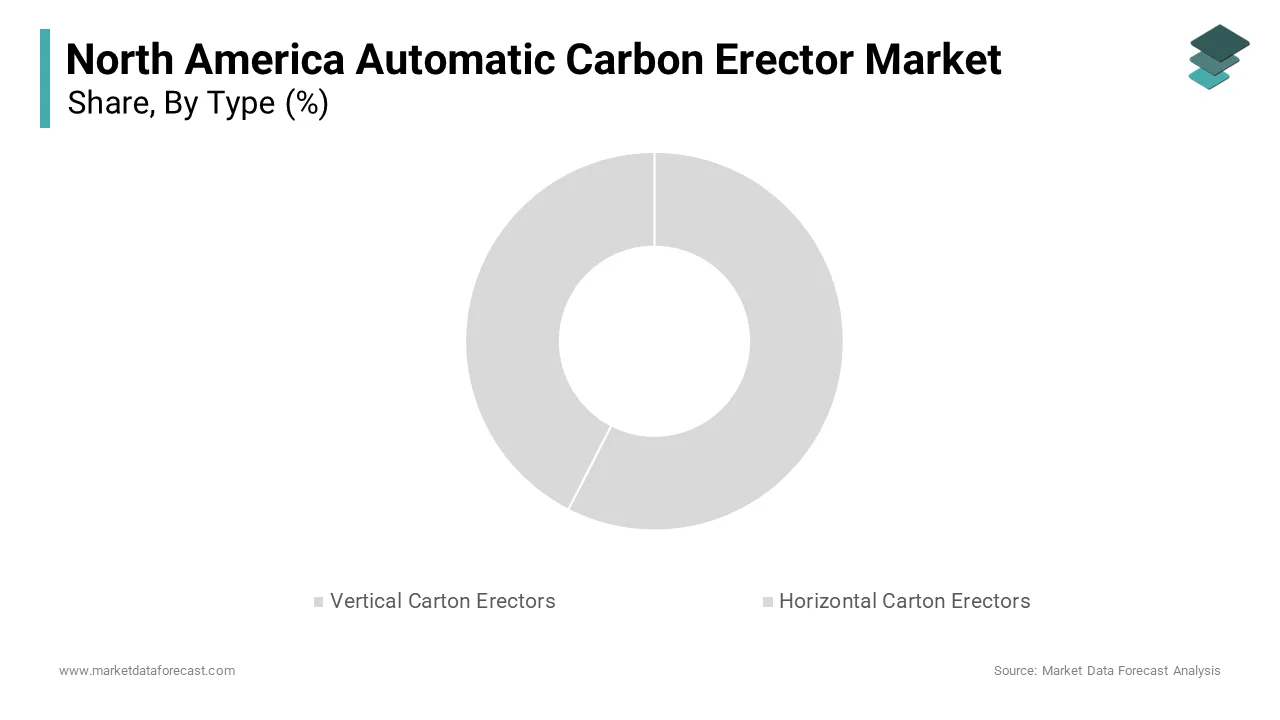
The horizontal segment is likely to grow with an expected CAGR of 8.4% from 2025 to 2033, owing to its superior high-speed performance capabilities compared to vertical alternatives, making it ideal for high-volume production environments requiring maximum throughput efficiency. Horizontal systems typically achieve processing speeds 25-40% higher than equivalent vertical erectors, with capabilities exceeding 600 cartons per minute in advanced configurations. According to the Production Efficiency Institute, high-volume packaging operations in North America increasingly prioritize throughput optimization, with over 55% of facilities processing more than 10,000 units hourly requiring horizontal carton erection systems to meet production targets. The automotive and electronics industries, which demand continuous high-speed packaging operations, have particularly embraced horizontal systems for their consistent performance and reliability under demanding conditions.
By End-User Industry Insights
The food and beverage industry segment was the largest by capturing 38.4% of the North American automatic carton erector market share in 2025. Food and beverage manufacturers process millions of units daily, necessitating high-speed, reliable carton erection systems capable of maintaining consistent performance under continuous operation conditions. According to the Food Processing Association, the average North American food processing facility operates packaging lines for 18-20 hours daily, requiring equipment uptime exceeding 95% to meet production targets and minimize waste. The perishable nature of food products creates additional pressure for efficient packaging operations, as delays can result in significant product loss and financial consequences. The beverage sector alone accounts for over 200 billion packaged units annually in North America, as reported by the Beverage Marketing Institute, creating substantial demand for automatic carton erectors capable of handling high-volume production requirements. Seasonal variations in food production, particularly during harvest periods and holiday seasons, require flexible packaging systems that can accommodate peak demand periods while maintaining consistent quality standards. The integration of automatic carton erectors with filling and sealing equipment enables streamlined production processes that reduce labor requirements and improve overall operational efficiency.
The e-commerce industry segment is likely to grow with an expected CAGR of 12.8% from 2025 to 203,3, with the e-commerce industry's rapid growth in automatic carton erector adoption, on is the unprecedented expansion of fulfillment and distribution centers across North America to support escalating online retail volumes. The exponential growth in e-commerce sales has necessitated the construction of new fulfillment facilities at an unprecedented rate, each requiring sophisticated packaging automation to achieve operational efficiency and customer satisfaction targets. According to the National Retail Federation, over 1,500 new fulfillment centers have been established across North America since 2020, with each facility incorporating multiple automatic packaging lines equipped with carton erectors to handle peak seasonal demands. The average e-commerce fulfillment center now operates 15-20 packaging stations, each typically incorporating at least one automatic carton erector system to achieve target throughput requirements of 1,000-2,000 packages hourly. Amazon's fulfillment network alone operates over 1,200 facilities across North America, with each location incorporating advanced carton erector systems capable of handling variable carton sizes and rapid changeover requirements.
By Operation Insights
The fully automatic segment in the North American automatic carton erector market accounts for a significant share in 2025. The significant labor cost reduction and workforce optimization capabilities, which have become increasingly valuable as manufacturers face persistent labor shortages and rising wage pressures, are significantly enhancing the growth of the segment. These systems eliminate the need for dedicated operators to perform manual carton formation tasks, allowing workforce redeployment to higher-value activities while reducing overall operational costs. According to the Bureau of Labor Statistics, average hourly wages for packaging line workers in North America have increased by 8.7% annually over the past three years, making automated solutions increasingly cost-competitive compared to manual operations. The Occupational Safety and Health Administration reports that repetitive motion injuries in packaging operations account for over 30% of workplace compensation claims, with automatic carton erectors significantly reducing these risks through the elimination of manual handling requirements. The average fully automatic carton erector can replace 2-3 manual operators while maintaining consistent performance 24 hours a day, as documented by the Association for Packaging and Processing Technologies.
The semi-automatic segment is anticipated to register a CAGR of 9.1% from 2025 to 2033 due to its cost-effectiveness and significantly lower initial investment requirements compared to fully automatic alternatives, which is making automation accessible to small and medium-sized enterprises operating within constrained budgetary parameters. These systems typically cost 40-60% less than fully automatic erectors while still providing substantial operational benefits, including reduced labor requirements and improved consistency. According to the Small Business Administration, over 75% of North American packaging operations employ fewer than 100 employees, with budget constraints limiting their ability to invest in expensive, fully automatic systems. The average semi-automatic carton erector costs between $75,000-$150,000 compared to $200,000-$500,000 for fully automatic alternatives, as reported by the Packaging Equipment Manufacturers Institute, making them financially viable for smaller operations. Additionally, the simplified design and reduced complexity of semi-automatic systems result in lower installation and integration costs, with typical implementation projects requiring 2-4 weeks compared to 6-12 weeks for fully automatic systems.
COUNTRY LEVEL ANALYSIS
United States Automatic Carbon Erector Market Insights
The United States was the largest contributor in the North American automatic carton erector market with 88.3% of the share in 2025. The country's diverse manufacturing landscape, encompassing food and beverage, pharmaceuticals, consumer goods, and automotive industries, creates substantial demand for advanced packaging automation solutions. According to the U.S. Census Bureau, the nation's manufacturing sector accounts for over 12% of GDP, requiring continuous investment in productivity-enhancing technologies, including automatic carton erectors. The American Recovery and Reinvestment Act, along with subsequent infrastructure legislation, has allocated over $200 billion for manufacturing modernization through 2030, directly supporting packaging automation market growth. Additionally, the Federal Reserve reports that manufacturing productivity has increased by 3.2% annually over the past five years, largely attributed to automation investments, including packaging equipment. The presence of major carton erector manufacturers such as Bosch, Adept, and Standard-Knapp within domestic borders further strengthens the market ecosystem. The Edison Manufacturing Institute data indicates that discrete manufacturers alone plan to invest $85 billion in automation technologies over the next decade, ensuring sustained demand for automatic carton erector systems.
Canada Automatic Carbon Erector Market Insights
Canada's automatic carton erectors market was ranked second by holding 12.3% of the share in 2025, with the country's strong food and beverage processing industry, expanding e-commerce sector, and ongoing manufacturing modernization efforts. Statistics Canada reports that the nation's manufacturing sector encompasses over 15,000 establishments, with packaging automation representing a growing investment priority for operational efficiency improvement. The Pan-Canadian Framework on Clean Growth and Climate Change has accelerated investments in manufacturing efficiency technologies, with over CAD 15 billion allocated for industrial modernization through 2030. Canada's food processing industry, which accounts for over 2% of GDP, requires extensive packaging automation to maintain a competitive advantage and food safety compliance standards. The Canadian Manufacturers & Exporters association indicates that over 40% of Canadian manufacturers plan to increase automation investments over the next five years, directly supporting carton erector market growth. Provincial initiatives, particularly in Ontario and Quebec, focus on manufacturing competitiveness and productivity enhancement, necessitating new packaging automation installations.
KEY MARKET PLAYERS
Bosch Packaging Technology, Smurfit Kappa, Fischbein, KHS GmbH, A-B-C Packaging Machine Corporation, Wexxar Packaging, Duravant, Star Packaging, FANUC Corporation, ProMach, Inc., Tetra Pak, SACMI Group, Schneider Packaging Equipment Co., Inc. are the market players that are dominating the North America automatic carton erector market.
Top Players In The Market
Bosch Packaging Technology
Bosch Packaging Technology maintains a prominent position in the North American automatic carton erector market through its comprehensive portfolio of high-speed packaging solutions and commitment to technological innovation. The company's extensive product range encompasses both vertical and horizontal carton erectors designed for diverse industry applications, including food and beverage, pharmaceuticals, and consumer goods. Their advanced servo-driven systems incorporate intelligent control technologies that provide precise carton formation and rapid size changeover capabilities. Bosch has consistently invested in research and development to create sustainable packaging solutions that align with environmental regulations and customer sustainability objectives. The company's strong global presence and localized service network enable rapid response to customer requirements and technical support needs. Their focus on digital integration and Industry 4.0 connectivity has positioned them as a leader in smart packaging automation solutions that provide real-time performance data and predictive maintenance capabilities.
Adept Technology
Adept Technology has established itself as a key player in the North American automatic carton erector market through innovative robotic packaging solutions and flexible automation systems. The company specializes in developing customizable carton erector solutions that accommodate diverse packaging requirements and variable production demands. Their expertise in robotic integration has enabled the creation of hybrid manual-automatic systems that provide operational flexibility while maintaining automation benefits. Adept's commitment to developing user-friendly interfaces and intuitive control systems made its equipment accessible to operators with varying skill levels. The company's strong focus on customer collaboration and application-specific development has resulted in successful deployments across diverse industry sectors. Their modular design approach enables scalable solutions that can adapt to changing production requirements and facility constraints. Adept's comprehensive service network and training programs support customer success and long-term equipment performance optimization.
Standard-Knapp
Standard-Knapp holds a significant position in the North American automatic carton erector market through decades of expertise in packaging automation and comprehensive product offerings. The company's extensive portfolio includes high-speed carton erectors designed for demanding applications in food and beverage, pharmaceutical, and consumer goods industries. Their innovative engineering approach has resulted in robust, reliable systems that deliver consistent performance in continuous operation environments. Standard-Knapp's focus on developing sustainable packaging solutions has aligned with growing environmental concerns and regulatory requirements across North America. The company's strong customer relationships and deep industry knowledge have enabled successful project implementations and long-term partnerships with major manufacturers. Their commitment to after-sales service and technical support has established them as a trusted partner for packaging automation requirements. Standard-Knapp's continuous investment in research and development has resulted in advanced technologies that improve operational efficiency and reduce environmental impact.
Top Strategies Used by Key Market Participants
- Technological Innovation and Digital Integration Leading players in the North American automatic carton erector market actively pursue technological innovation strategies focused on developing advanced digital solutions and smart manufacturing capabilities. These initiatives encompass the integration of artificial intelligence, machine learning algorithms, and Internet of Things connectivity to enhance equipment performance and provide valuable operational insights. Companies invest heavily in developing servo-driven systems, vision-based quality control, and predictive maintenance capabilities that improve overall equipment effectiveness and reduce downtime. The focus on Industry 4.0 integration enables seamless communication between carton erectors and broader manufacturing systems, supporting data-driven decision making and operational optimization. Digital twin technologies and simulation capabilities allow for virtual commissioning and performance optimization before physical installation.
- Customer-Centric Solution Development Major market participants emphasize customer-centric strategies that focus on developing application-specific solutions and collaborative development partnerships with end-users. These approaches involve extensive customer engagement to understand unique operational requirements and develop customized equipment configurations that address specific challenges. Companies establish dedicated application engineering teams that work closely with customers to optimize packaging line integration and performance. The development of modular and scalable solutions enables flexible deployment options that accommodate varying production requirements and facility constraints. Customer training programs and comprehensive support services ensure successful implementation and long-term operational success. Regional customization capabilities allow manufacturers to adapt equipment specifications to local market requirements and regulatory standards.
- Strategic Partnerships and Alliance Development. Key players pursue strategic partnership strategies that involve collaboration with technology companies, system integrators, and complementary equipment manufacturers to enhance product capabilities and market reach. These partnerships enable access to advanced technologies, expanded service networks, and new customer segments. Collaborations with software companies facilitate the development of sophisticated control systems and data management capabilities. Strategic alliances with distributors and channel partners extend market coverage and improve customer accessibility. Joint development initiatives with research institutions and technology providers accelerate innovation and product development cycles. Geographic partnerships and licensing agreements enable market expansion into new regions while maintaining local presence and support capabilities.
COMPETITION OVERVIEW
The North American automatic carton erector market exhibits dynamic competition characterized by the presence of established global players alongside regional manufacturers and emerging technology companies. Market leaders compete primarily on technological innovation, product reliability, and comprehensive service offerings rather than solely on price. The competitive landscape is shaped by continuous technological advancement, with digitalization and environmental sustainability becoming key differentiators. Companies invest heavily in developing smart packaging solutions and environmentally friendly alternatives to traditional technologies. Customer relationships play a crucial role, with long-term contracts and strategic partnerships being common. The market also experiences competition from new entrants focusing on niche applications and innovative technologies.
RECENT HAPPENINGS IN THE MARKET
- In February 2025, Bosch Packaging Technology launched its new EcoTronic series of servo-driven carton erectors featuring integrated artificial intelligence capabilities for predictive maintenance and energy optimization in North American markets.
- In November 2023, Adept Technology acquired RoboPack Solutions, a specialized robotics integration company, to enhance its capabilities in developing hybrid manual-automatic carton erector systems for small and medium-sized manufacturers.
- In September 2023, Standard-Knapp partnered with Microsoft to integrate cloud-based analytics and digital twin technologies into their next-generation carton erector platforms, enabling real-time performance monitoring and optimization.
- In June 2023, Bosch Packaging Technology established an innovation center in Toronto, Canada, focused on developing sustainable packaging solutions and right-sized carton erector technologies for e-commerce applications.
- In March 2023, Adept Technology introduced its modular FlexiCart system, a scalable carton erector solution designed for rapid deployment and easy integration with existing packaging lines in North American manufacturing facilities.
MARKET SEGMENTATION
This research report on the North American automatic carton erector market is segmented and sub-segmented into the following categories.
By Type
- Vertical Carton Erectors
- Horizontal Carton Erectors
By End-User Industry
- Food & Beverage
- Pharmaceuticals
- Consumer Goods
- Electronics
- Automotive
- E-commerce
By Operation Type
- Fully Automatic
- Semi-Automatic
By Country
- The United States
- Canada
- Mexico
- Rest of North America