- Product Description Description
- Table of Contents TOC
- List of Table & Figure LOT
- Get Free Sample PDF Sample PDF
Market Size, 2025
$539.9 MnMarket Estimate, 2026
$573.7 MnMarket Forecast, 2034
$932.4 MnCAGR, 2026–2034
6.26%Executive Summary: North America Ceramic Ball Bearings Market
- Market Scope: Regional North American ceramic ball bearings market analysis covering raw material compositions, product categories, application sectors, country leadership frameworks, and high-performance component adoption metrics.
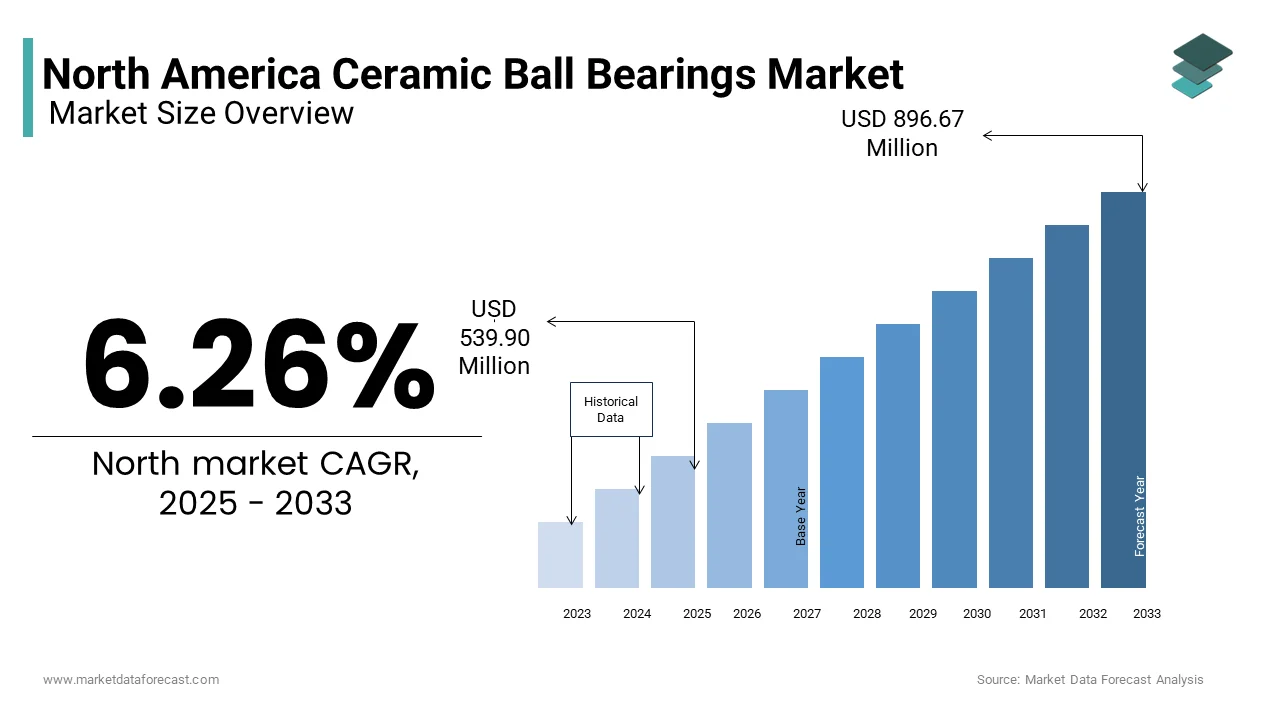
- Market Valuation: Valued at USD 539.90 million in 2025, estimated at USD 573.70 million in 2026, and projected to reach USD 932.48 million by 2034, registering a CAGR of 6.26% from 2026 to 2034.
- Primary Growth Drivers: Rising adoption of ceramic ball bearings in electric vehicle powertrain systems, expansion of aerospace and defense applications requiring high-reliability components, growing demand for lightweight, high-speed, and corrosion-resistant bearings, and increased deployment in semiconductor manufacturing, precision equipment, medical imaging, and industrial automation.
Key Market Segment Metrics (2026–2034)
| Category | Leading Segment (Position) | Fastest-Growing / Key Growth Segment |
|---|---|---|
| By Raw Material & Product | Silicon Nitride (Si&sub3;N&sub4;) (largest raw material) & Hybrid Ceramic Ball Bearings (largest product) | Zirconia (ZrO&sub2;) (fastest-growing raw material) & Full Ceramic Ball Bearings (fastest-growing product) |
| By Application Area | Electric Vehicles (EVs) (largest application) | Medical Devices (fastest-growing application) |
| By Technology & Innovation | Standard hybrid ceramic designs for conventional industrial machinery | Advanced full-ceramic bearing tech, precision manufacturing, and high-temperature corrosion-resistant engineering |
| By Region / Country | United States (leading country with 79.3% market share in 2025) | Mexico (fastest-growing country market) |
Major Market Players & Market Structure
Market Structure: Highly competitive North American ceramic bearing industry characterized by advanced hybrid and full-ceramic technology development, precision manufacturing investments, specialized EV and aerospace product innovation, and strategic capability expansions.
Key Companies: SKF, NSK Ltd., NTN Corporation, Ortech Incorporated, CeramicSpeed, Shanghai Lily Bearing Manufacturing Co., Ltd., Boca Bearings, Inc., GMN Bearing USA Ltd., and JTEKT Corporation.
 Download Free Sample Report
North America Ceramic Ball Bearings Market Size
The North America ceramic ball bearings market size was valued at USD 539.90 million in 2025 and is anticipated to reach USD 573.70 million in 2026 and USD 932.48 million by 2034, growing at a CAGR of 6.26% from 2026 to 2034.
The ceramic ball bearings utilize silicon nitride (Si₃N₄) or zirconia (ZrO₂) balls instead of traditional steel, which offers superior resistance to heat, corrosion, and electrical conductivity. These hybrid or full-ceramic bearings are engineered for applications where conventional steel bearings fail due to extreme operational conditions, including high-speed rotation, exposure to corrosive environments, or the need for electrical insulation. They are increasingly deployed in precision industries such as aerospace, medical devices, electric vehicles (EVs), and semiconductor manufacturing. Their non-magnetic and corrosion-resistant properties make them indispensable in MRI machines and chemical processing equipment. According to the National Institute of Standards and Technology (NIST), ceramic bearings demonstrate thermal expansion rates nearly 30% lower than steel, minimizing dimensional instability under temperature fluctuations.
MARKET DRIVERS
Rising Adoption in Electric Vehicle Powertrain Systems
The integration of ceramic ball bearings into electric vehicle (EV) powertrain components is propelling the growth of the North American ceramic ball bearings market. According to the U.S. Department of Energy, over 1.2 million electric vehicles were sold in the United States in 2023, reflecting a sustained push toward electrified transportation infrastructure. Tesla, one of the leading adopters, utilizes hybrid ceramic bearings in its Model 3 and Model Y rear-wheel-drive units to mitigate electric current-induced fluting damage, which is a common failure mode in steel bearings exposed to high-frequency inverters.
The expansion of aerospace and defense applications requiring high-reliability components
The growing need for lightweight, thermally stable, and maintenance-efficient components in aircraft engines, avionics, and satellite systems is additionally fuelling the growth of the North American ceramic ball bearings market. Modern jet engines operate at rotational speeds exceeding 20,000 RPM, where conventional steel bearings face limitations due to heat generation and fatigue. According to the Federal Aviation Administration (FAA), ceramic hybrid bearings are now standard in auxiliary power units (APUs) and environmental control systems across Boeing and Airbus fleets operated in North America. Additionally, NASA’s Jet Propulsion Laboratory (JPL) employs full-ceramic bearings in satellite reaction wheels due to their non-magnetic properties and resistance to vacuum-induced lubricant degradation. The growing reliance on unmanned aerial vehicles (UAVs) and hypersonic test platforms further amplifies demand, as these systems require components that combine durability with reduced weight.
MARKET RESTRAINTS
High Manufacturing Costs and Complex Production Processes
The high costs and technical complexities associated with production and manufacturing are hindering the growth of the North American ceramic ball bearings market. According to the American Ceramic Society, producing a single high-grade silicon nitride ball involves over 15 processing steps by including hot isostatic pressing and laser metrology inspection, which increases production time by nearly 300% compared to steel counterparts. The U.S. Department of Commerce notes that raw material costs for high-purity ceramic powders are 5 to 7 times higher than those for bearing-grade steel, further inflating final product prices. Additionally, the lack of standardized manufacturing equipment tailored for ceramics forces producers to rely on customized machinery, limiting scalability. These inefficiencies make ceramic bearings economically unviable for cost-sensitive applications, particularly in consumer-grade industrial motors.
Limited Availability of Skilled Workforce in Advanced Materials Engineering
The scarcity of engineers and technicians proficient in advanced ceramics and precision manufacturing is also hampering the growth of the North American ceramic ball bearings market. The production and quality assurance of ceramic bearings demand expertise in materials science, thermodynamics, and microstructural analysis skills that are not widely cultivated in mainstream engineering curricula. According to the American Society of Mechanical Engineers (ASME), fewer than 12% of U.S. mechanical engineering programs offer specialized courses in ceramic materials processing, creating a significant talent gap. Companies like SKF and NSK Americas have reported delays in production scaling due to difficulties in recruiting personnel capable of operating high-precision grinding and inspection systems. According to the National Science Foundation (NSF), over 70% of ceramic bearing manufacturers rely on on-the-job training programs lasting 12 to 18 months to develop in-house expertise.
MARKET OPPORTUNITIES
Integration into Medical Devices Requiring Sterility and Precision
The medical technology sector in surgical robotics, imaging systems, and implantable devices, where sterility, non-magnetic properties, and long-term reliability are ascribed to elevate the growth of the North America ceramic ball bearings market. Magnetic resonance imaging (MRI) machines, for instance, require components that do not interfere with powerful magnetic fields, making full-ceramic bearings the only viable option for rotating gantry systems. According to the Association for the Advancement of Medical Instrumentation (AAMI), over 90% of new MRI installations in North America since 2022 have incorporated ceramic bearings in motion components. Additionally, robotic surgical platforms such as the da Vinci system utilize ceramic bearings in wrist joints and articulating arms to ensure smooth, backlash-free movement during minimally invasive procedures.
Growth in Renewable Energy Systems, Particularly Wind Turbines
The expansion of wind energy infrastructure is creating substantial growth opportunities for the North American ceramic ball bearings market. Wind turbines operate under extreme conditions, high rotational loads, variable wind stresses, and remote locations where bearing failure can lead to costly downtime and maintenance. According to the U.S. Department of Energy’s Wind Energy Technologies Office, the average offshore wind turbine requires over 200 bearings, with main shaft and generator bearings being particularly vulnerable to electrical pitting caused by stray currents. Ceramic hybrid bearings, being electrically insulating, prevent this damage and extend service life by up to 40%, as validated by Sandia National Laboratories. The American Wind Energy Association (AWEA) reports that over 14,000 MW of new wind capacity was installed in the U.S. in 2023, with turbines increasingly adopting larger, more efficient designs that place greater stress on rotating components. GE Renewable Energy has integrated silicon nitride bearings into its Haliade-X offshore platform to reduce maintenance intervals from 18 to 36 months.
MARKET CHALLENGES
Susceptibility to Brittle Fracture Under Impact Loading
The inherent brittleness makes them vulnerable to fracture under sudden impact or misalignment loads, which is likely to hinder the growth of the North American ceramic ball bearings market. According to the National Institute of Standards and Technology (NIST), ceramic balls can fail catastrophically when exposed to impact energies exceeding 0.5 joules, a threshold easily surpassed in industrial environments with unbalanced rotors or abrupt startups. Field data from the Electric Power Research Institute (EPRI) indicates that 22% of ceramic bearing failures in wind turbines between 2020 and 2023 were attributed to shock-induced fracture rather than wear. This fragility necessitates stricter installation protocols and enhanced system monitoring, increasing operational complexity. Manufacturers must implement rigorous non-destructive testing, including ultrasonic and X-ray inspection, to detect subsurface flaws, as recommended by the International Organization for Standardization (ISO).
Standardization Gaps in Performance Testing and Certification Protocols
The absence of universally accepted performance benchmarks and certification standards for ceramic ball bearings is additionally to impede the growth of the North America ceramic ball bearings market. According to the American National Standards Institute (ANSI), only 30% of ceramic bearing suppliers in North America follow consistent test protocols for dynamic load capacity, leading to variability in performance claims. This inconsistency undermines procurement decisions, particularly in aerospace and medical sectors where traceability and reliability are non-negotiable. The National Institute of Aerospace (NIA) emphasizes that without standardized validation frameworks, original equipment manufacturers (OEMs) hesitate to specify ceramic bearings in systems. While organizations like ASTM International are developing new standards for advanced ceramics, implementation remains fragmented.
REPORT COVERAGE
| REPORT METRIC | DETAILS |
| Market Size Available | 2025 to 2034 |
| Base Year | 2025 |
| Forecast Period | 2026 to 2034 |
| CAGR | 6.26% |
| Segments Covered | By Raw Material, Product, Application, and By Country |
| Various Analyses Covered | Global, Regional & Country Level Analysis; Segment-Level Analysis, DROC, PESTLE Analysis, Porter’s Five Forces Analysis, Competitive Landscape, Analyst Overview of Investment Opportunities |
| Regions Covered | The United States, Canada, Mexico, Rest of North America |
| Market Leaders Profiled | B SKF, NSK Ltd., NTN Corporation, Ortech Incorporated, CeramicSpeed, Shanghai Lily Bearing Manufacturing Co., Ltd., Boca Bearings, Inc., GMN Bearing USA Ltd., JTEKT Corporation. |
SEGMENTAL ANALYSIS
By Raw Material Insights
The silicon nitride segment accounted in holding a dominant share of the North America ceramic ball bearings market in 2025, with its superior mechanical and thermal properties, which make it the material of choice for high-performance applications. Silicon nitride exhibits exceptional hardness, with a Vickers hardness rating of approximately 1,700 HV, nearly three times that of bearing steel by enabling it to resist wear under extreme loads, as documented by the National Institute of Standards and Technology (NIST). Additionally, its high fracture toughness and electrical insulation properties make it ideal for mitigating electrical arcing in variable-frequency drive motors, a growing concern in industrial automation. According to Sandia National Laboratories, over 90% of hybrid ceramic bearings used in aerospace and defense applications are manufactured with silicon nitride balls due to their fatigue resistance and lightweight nature.

The Zirconium Oxide (ZrO₂) segment is lucratively growing with an expected CAGR of 10.8% from 2025 to 2033, with its unique combination of biocompatibility, corrosion resistance, and moderate mechanical strength by making it increasingly favored in medical and chemical processing applications. Zirconia’s inertness to bodily fluids and resistance to sterilization-induced degradation have led to its widespread adoption in surgical instruments and implantable devices. According to the U.S. Food and Drug Administration (FDA), over 75% of newly approved implantable drug pumps since 2021 incorporate zirconia-based bearings due to their non-toxic and non-magnetic characteristics.
By Product Insights
The hybrid segment held a significant share of the North America ceramic ball bearings market in 2025, with outer and inner rings constructed from high-grade stainless or chrome steel by offering an optimal balance between performance and cost. The widespread adoption of hybrid bearings is primarily driven by their ability to deliver near-full ceramic performance at a significantly lower price point than full ceramic alternatives. Their electrical insulation properties are particularly valuable in electric motors and generators, where stray currents from variable frequency drives can cause fluting and premature failure of steel bearings. According to the Electric Power Research Institute (EPRI), hybrid ceramic bearings reduce electrical erosion damage by up to 90% in motors operating under pulse-width modulation (PWM) inverters. According to the U.S. Department of Energy, hybrid bearings can extend motor service life by 3 to 5 times compared to all-steel units. Industries such as HVAC, machine tools, and electric vehicles have embraced hybrid models for their reliability and compatibility with existing bearing housings.
The full ceramic ball bearings segment is emerging at a CAGR of 12.3% from 2025 to 2033, owing to the increasing demand in environments where a complete non-metallic composition is essential. Full ceramic bearings, constructed entirely from materials such as silicon nitride or zirconia, offer total resistance to corrosion, magnetism, and electrical conductivity, which is making them indispensable in specialized applications. In medical imaging, particularly magnetic resonance imaging (MRI) systems, any ferromagnetic component can distort magnetic fields and compromise image quality. According to the Association for the Advancement of Medical Instrumentation (AAMI), all major MRI manufacturers, including GE Healthcare and Siemens Healthineers, now use full ceramic bearings in rotating gantry assemblies to ensure diagnostic accuracy. Additionally, their ability to operate without lubrication in vacuum environments has led to adoption in space satellites and scientific instrumentation.
By Application Insights
The Electric Motor segment was the largest and held 37.4% of the North America ceramic ball bearings market share in 2025, owing to the widespread deployment of ceramic bearings in high-efficiency motors used across industrial automation, electric vehicles, and HVAC systems. The rise of variable frequency drives (VFDs) in motor control has introduced new challenges, including electrical arcing caused by high-frequency switching that leads to bearing fluting and early failure. The DOE confirms that ceramic bearings can withstand voltage differentials up to 5,000 volts without degradation, making them essential for VFD-driven motors. Additionally, their low friction and reduced mass enable higher rotational speeds and lower operating temperatures by improving energy efficiency by 10–15%, as validated by the National Renewable Energy Laboratory (NREL).
The aerospace application segment is expected to witness a CAGR of 13.1% from 2025 to 2033 owing to the increasing reliance on high-reliability, lightweight components in commercial and military aircraft propulsion and auxiliary systems. Modern jet engines and unmanned aerial vehicles (UAVs) operate under extreme conditions, high rotational speeds, elevated temperatures, and limited maintenance access, where traditional steel bearings face performance limitations. According to the Federal Aviation Administration (FAA), ceramic hybrid bearings are now standard in auxiliary power units (APUs), environmental control systems, and bleed air valves across Boeing 787 and Airbus A350 fleets operated in North America. Additionally, their reduced weight contributes to fuel efficiency; NASA estimates that replacing steel with ceramic bearings in a single engine can save up to 5 kg, translating into significant fuel savings over an aircraft’s lifecycle.
COUNTRY-LEVEL ANALYSIS
The United States was the top performer of the North American ceramic ball bearings market with 79.3% of share in 2024 with its advanced manufacturing ecosystem, robust defense sector, and pioneering role in electric mobility and aerospace innovation. According to the National Science Foundation (NSF), over 80% of federally funded materials science research related to advanced ceramics is conducted at U.S. universities and national laboratories, including Oak Ridge and Sandia. The Department of Energy’s Advanced Research Projects Agency-Energy (ARPA-E) has funded multiple initiatives to develop next-generation ceramic bearings for wind turbines and EV motors. According to the Bureau of Industry and Security (BIS), over 90% of ceramic bearing imports and exports are routed through U.S. facilities with its logistical dominance. Additionally, stringent energy efficiency regulations and federal incentives for clean technology are accelerating adoption across industrial and transportation sectors. Canada's ceramic ball bearings market held 12.2% of the share in 2025, owing to the strong integration with U.S. supply chains and a growing focus on high-value industrial and aerospace applications. Canadian manufacturers, particularly in Ontario and Quebec, serve as suppliers to the North American automotive and aerospace sectors, which are primary consumers of hybrid ceramic bearings. According to Natural Resources Canada, over 60% of the country’s advanced manufacturing firms have adopted energy-efficient motor systems incorporating ceramic components to meet federal sustainability targets.
KEY MARKET PLAYERS
B SKF, NSK Ltd., NTN Corporation, Ortech Incorporated, CeramicSpeed, Shanghai Lily Bearing Manufacturing Co., Ltd., Boca Bearings, Inc., GMN Bearing USA Ltd., and JTEKT Corporation are the market players that are dominating the North America ceramic ball bearings market.
Top Players In The Market
SKF is s global leader in advanced bearing technologies, with its North American operations serving as a hub for innovation in ceramic ball bearing solutions. The company has pioneered the integration of silicon nitride balls into hybrid designs tailored for electric motors, aerospace systems, and industrial automation. SKF’s expertise lies in combining materials science with application engineering, delivering customized solutions that enhance equipment reliability and efficiency. Its collaboration with OEMs across the automotive and renewable energy sectors has positioned it as a trusted partner in high-performance motion systems. The company’s investment in R&D, particularly in tribology and thermal dynamics, enables continuous refinement of ceramic bearing performance under extreme conditions. Its global influence is evident in the widespread adoption of its hybrid ceramic bearings in applications, which is setting industry benchmarks for durability and precision.
NSK Ltd. Americas has established a prominent presence in the North American ceramic ball bearings market through its focus on high-speed and electric vehicle applications. The company leverages its Japanese engineering heritage to deliver ultra-precision hybrid ceramic bearings optimized for EV traction motors and spindle systems in machine tools. NSK’s design philosophy emphasizes minimizing electrical erosion, reducing friction, and extending service life in demanding environments. Its bearings are widely integrated into North American EV platforms and industrial automation systems, where reliability under high RPM and variable loads is essential. The company actively collaborates with research institutions and automotive manufacturers to anticipate emerging performance requirements. NSK Americas supports its product portfolio with advanced simulation tools and application-specific testing, ensuring optimal performance integration.
Schaeffler Group USA is a key innovator in the ceramic ball bearings sector, which is known for its engineering-driven approach and deep integration into automotive and aerospace supply chains. Through its INA and FAG brands, Schaeffler delivers high-performance hybrid ceramic bearings designed for extreme operational conditions, including high-speed rotation and electrical stress environments. The company’s expertise in system integration allows it to co-develop solutions with OEMs, particularly in electric mobility and aerospace propulsion systems. Schaeffler’s focus on durability, thermal stability, and resistance to electrical arcing has made its ceramic bearings integral to next-generation EV motors and industrial drives. Its North American technical centers work closely with customers to optimize bearing performance within complete drivetrain architectures. The company also invests heavily in digital twin modeling and predictive maintenance technologies to enhance lifecycle management.
Top Strategies Used By Key Market Participants
A primary strategy employed by leading manufacturers is the development of application-specific ceramic bearing solutions tailored to emerging technologies such as electric vehicles, wind turbines, and aerospace systems. Companies are moving beyond standardized products to co-engineer components with OEMs, ensuring optimal performance within complex mechanical environments. This collaborative engineering approach enhances integration, reliability, and customer loyalty.
Another strategy is vertical integration of materials research and precision manufacturing. Firms are investing in in-house ceramic synthesis, grinding, and metrology capabilities to maintain control over quality, consistency, and intellectual property. This enables faster innovation cycles and differentiation in a technically demanding market.
COMPETITION OVERVIEW
The competitive landscape of the North American ceramic ball bearings market is defined by technological differentiation, engineering expertise, and strategic alignment with high-growth industries. Unlike commoditized bearing segments, competition here revolves around precision, reliability, and the ability to solve complex engineering challenges rather than price alone. Market leaders distinguish themselves through deep materials science knowledge, proprietary manufacturing processes, and close collaboration with original equipment manufacturers in aerospace, electric mobility, and industrial automation. The barrier to entry remains high due to the need for advanced R&D infrastructure, stringent quality certifications, and specialized workforce capabilities. While global players dominate, niche innovators are emerging with focused solutions for medical devices, semiconductor equipment, and clean energy systems. Intellectual property, particularly in ceramic formulation and surface treatment technologies that plays a crucial role in maintaining market position. Companies are increasingly competing on lifecycle performance, offering predictive analytics and condition monitoring to extend service intervals. The absence of standardized performance metrics creates both challenges and opportunities by allowing firms to establish proprietary benchmarks.
RECENT HAPPENINGS IN THE MARKET
- In February 2023, SKF launched a new line of hybrid ceramic ball bearings specifically engineered for electric vehicle traction motors by featuring enhanced electrical insulation and reduced friction to improve efficiency and longevity in high-speed applications.
- In July 2023, NSK Americas opened a dedicated application engineering center in Ann Arbor, Michigan, that focused on optimizing ceramic bearing performance in electric drivetrains and industrial automation systems through real-time testing and simulation.
- In November 2023, Schaeffler Group USA announced a strategic collaboration with a major U.S. aerospace manufacturer to co-develop ceramic bearings for next-generation hypersonic propulsion systems, which emphasize thermal stability and lightweight design.
- In January 2025, SKF partnered with a leading wind turbine OEM to integrate its hybrid ceramic bearings into offshore generator systems by targeting extended maintenance intervals and improved reliability in corrosive marine environments.
- In April 2025, NSK introduced a new ceramic bearing series with advanced surface coating technology to minimize micro-pitting in high-frequency inverter-driven motors, which addresses a failure mode in industrial automation equipment.
MARKET SEGMENTATION
This research report on the North American ceramic ball bearing market is segmented and sub-segmented into the following categories.
By Raw Material
- Zirconium Oxide
- Silicon Nitride
- Others
By Product Type
- Hybrid Ceramic Ball Bearings
- Full Ceramic Ball Bearings
By Application
- Electric Motor
- Automobile
- Underwater Equipment
- Laboratory Equipment
- Aerospace
- Others
By Country
- The United States
- Canada
- Mexico
- Rest of North America