North America Connector Market Size, Share, Trends & Growth Forecast Report By Product (PCB Connectors, Fiber Optic Connectors), End User, Material, And Country (US, Canada, And Rest Of North America), Industry Analysis From 2025 To 2033
North America Connector Market Size
The North America Connector Market Size was calculated to be USD 25.83 billion in 2024 and is anticipated to be worth USD 43.71 billion by 2033, from USD 27.39 billion in 2025, growing at a CAGR of 6.02% during the forecast period.
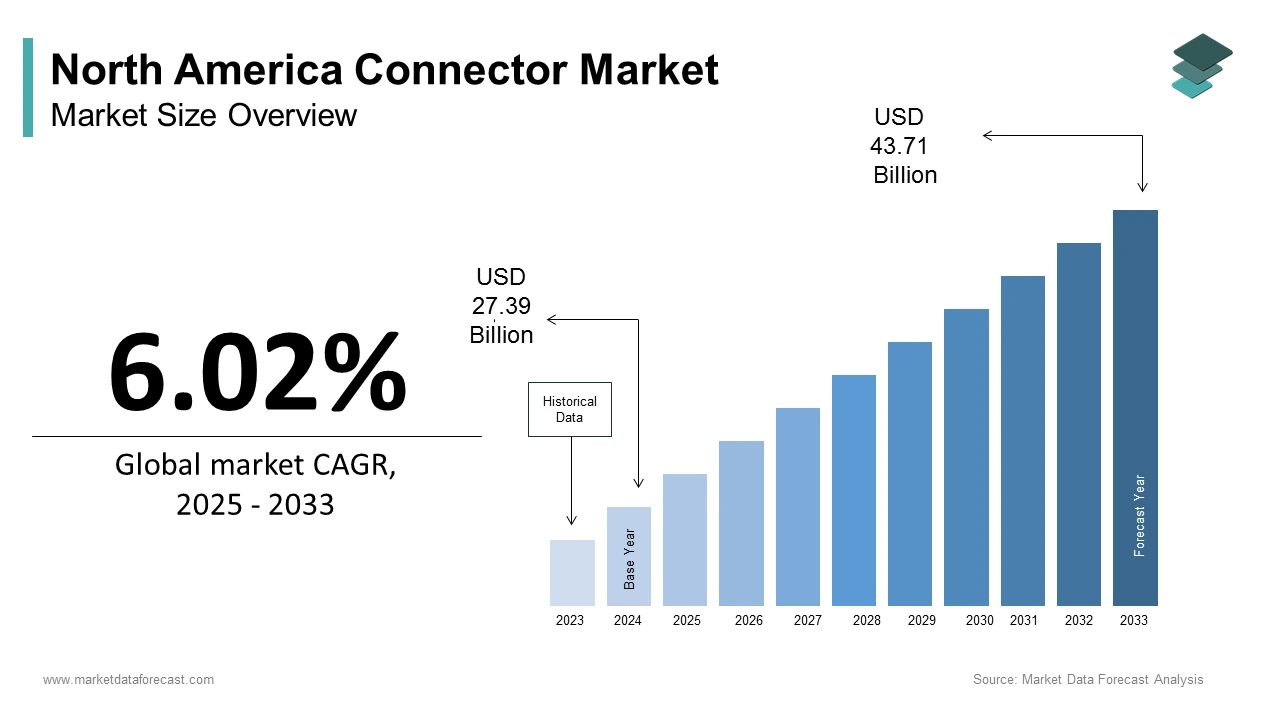
Connector are electrical and electronic components designed to establish reliable interconnections between devices, systems, and circuits across various industries. Connectors are essential in ensuring seamless data transmission, power distribution, and signal integrity in applications spanning automotive, aerospace, industrial automation, telecommunications, consumer electronics, and healthcare. The United States is the dominant contributor to this market, supported by a strong manufacturing base and advanced technological infrastructure. Canada and Mexico also play significant roles, particularly in automotive and industrial electronics. The region has seen increased demand for high-speed, high-density connectors due to the proliferation of 5G networks and the Internet of Things (IoT).
MARKET DRIVERS
Expansion of 5G and Telecommunications Infrastructure
The rapid deployment of 5G infrastructure, which has significantly increased demand for high-speed, high-frequency connectors is one of the primary drivers of the North America connector market. As per the Federal Communications Commission (FCC), over 300 million Americans now have access to 5G networks, with major carriers investing billions in expanding coverage and enhancing network capacity. This expansion necessitates a vast array of connectors in base stations, antennas, fiber optic systems, and data centers to support high-speed data transmission and low latency communication. According to Bishop & Associates, the telecommunications segment accounted for nearly 22% of total connector demand in North America in 2023, with 5G rollout being the primary growth catalyst. The deployment of small cells, edge computing nodes, and distributed antenna systems has further amplified the need for compact, durable, and high-performance connectors. Apart from these, the integration of AI-driven network management and the growing adoption of cloud-based services are increasing the complexity of telecom infrastructure, thereby driving connector demand. Companies such as Amphenol, TE Connectivity, and Molex have expanded their product lines to include RF, coaxial, and fiber optic connectors tailored for 5G applications.
Growth in Electric Vehicle and Automotive Electronics
The increasing adoption of electric vehicles (EVs) and advanced automotive electronics is another major driver of the North America connector market. As per the U.S. Department of Energy, EV sales in the U.S. surpassed 1.2 million units in 2023, representing a 50% increase from the previous year. This surge in demand has led to a corresponding rise in the number of high-current, high-voltage connectors required for battery packs, charging systems, and onboard electronics. According to the Motor & Equipment Manufacturers Association (MEMA), the average modern vehicle now contains over 1,500 connectors, with EVs requiring significantly more due to their complex powertrain and infotainment systems. In addition to power connectors, there is growing demand for high-speed data connectors to support advanced driver-assistance systems (ADAS), vehicle-to-everything (V2X) communication, and in-vehicle networking. The National Highway Traffic Safety Administration (NHTSA) has mandated increased use of safety and automation technologies, further boosting connector demand in the automotive sector. Companies such as Delphi Technologies, Yazaki, and Samtec have expanded their EV connector portfolios to meet stringent performance and safety standards.
MARKET RESTRAINTS
Supply Chain Disruptions and Raw Material Shortages
The ongoing volatility in global supply chains and raw material availability is a potential restraint affecting the North America connector market. The connector industry relies heavily on metals such as copper, aluminum, and gold, as well as polymers and rare earth elements for plating and insulation. Additionally, geopolitical tensions and logistical bottlenecks have led to extended lead times for critical components, impacting production schedules and increasing costs for manufacturers. As per the Institute for Supply Management (ISM), over 60% of U.S. electronics manufacturers reported supply chain delays in 2023, directly affecting connector production and availability. The semiconductor shortage, which has persisted since 2021, has also impacted connector demand in sectors such as automotive and industrial automation, where integrated electronics rely on complex connector systems. Companies have had to re-engineer products, source alternative materials, and increase inventory buffers to mitigate these disruptions. These challenges have constrained growth and profitability, particularly for smaller manufacturers unable to absorb the rising input costs and logistical inefficiencies.
Regulatory Compliance and Standardization Challenges
Regulatory compliance and standardization challenges pose a major restraint on the North America connector market, particularly as industries face increasingly stringent safety, environmental, and performance requirements. Connector manufacturers must adhere to a variety of standards set by organizations such as the International Electrotechnical Commission (IEC), Underwriters Laboratories (UL), and the Society of Automotive Engineers (SAE). Additionally, the Restriction of Hazardous Substances (RoHS) directive and the Registration, Evaluation, Authorization, and Restriction of Chemicals (REACH) regulation have led to increased scrutiny of materials used in connector manufacturing. The U.S. Environmental Protection Agency (EPA) has also introduced new guidelines for electronic waste management, pushing manufacturers toward recyclable and eco-friendly materials, which often come at a higher cost. These regulatory pressures, while essential for safety and sustainability, present a significant barrier to market expansion, particularly for smaller firms with limited resources to navigate compliance requirements.
MARKET OPPORTUNITIES
Growth of Industrial Automation and Smart Manufacturing
The rapid expansion of industrial automation and smart manufacturing technologies is a significant opportunity emerging in the North America connector market. The adoption of Industry 4.0 principles, including robotics, IoT-enabled sensors, and real-time data analytics, has led to an increased demand for high-precision, high-reliability connectors in manufacturing environments. These systems rely heavily on connectors for power distribution, signal transmission, and machine-to-machine communication, driving demand for ruggedized and miniaturized connector solutions. Additionally, the push for energy-efficient manufacturing processes has led to the integration of smart sensors and wireless connectivity, further expanding the need for specialized connectors. Companies such as TE Connectivity, Amphenol, and Samtec have introduced industrial-grade connectors designed for high durability, electromagnetic interference (EMI) resistance, and compatibility with industrial IoT systems.
Expansion of Renewable Energy and Smart Grid Infrastructure
The transition toward renewable energy sources and the modernization of power grids are creating substantial growth opportunities for the North America connector market. The increasing deployment of solar and wind energy systems, coupled with the development of smart grid technologies, has heightened the demand for high-voltage, high-current connectors capable of handling intermittent power generation and distribution. These energy systems require a wide range of connectors for photovoltaic panels, wind turbines, battery storage units, and grid interconnection points. As per the National Renewable Energy Laboratory (NREL), the average utility-scale solar plant contains over 10,000 connectors, emphasizing their critical role in system reliability and efficiency. Additionally, the rollout of smart grid infrastructure, which integrates digital communication and real-time monitoring, has increased the need for fiber optic and data connectors to support grid automation and remote diagnostics. Companies such as Tyco Electronics, Molex, and LEMO have expanded their product lines to include connectors designed for extreme environmental conditions and long-term durability.
MARKET CHALLENGES
Increasing Complexity in Connector Design and Miniaturization
Increasing complexity and miniaturization of connectors driven by advancements in electronics and the demand for compact, high-performance devices is one of the major challenges facing the North America connector market. As consumer electronics, medical devices, and industrial equipment become smaller and more feature-rich, connector manufacturers must develop solutions that maintain reliability while fitting into tighter spaces. This trend is particularly evident in the semiconductor and mobile device sectors, where micro and nano connectors are required to support high-speed data transfer and power delivery in ultra-thin form factors. However, achieving high performance in smaller sizes often requires the use of exotic materials and complex manufacturing processes, which can increase production costs and lead times. Besides, miniaturized connectors face challenges related to durability, thermal management, and signal integrity, particularly in high-frequency applications.
Intensifying Global Competition and Pricing Pressures
Intensifying global competition and pricing pressures represent a significant challenge for North American connector manufacturers, particularly as Asian suppliers gain market share through cost-effective production strategies. Countries such as China, Japan, and South Korea have established robust manufacturing ecosystems that enable them to produce connectors at lower costs, often undercutting North American firms in both domestic and international markets. According to the U.S. International Trade Commission (USITC), imports of electronic connectors into the U.S. increased by 12% in 2023, with Chinese manufacturers accounting for over 40% of total imports. This influx of lower-cost alternatives has placed downward pressure on prices, squeezing profit margins for North American companies that must contend with higher labor, regulatory, and compliance costs. Further, the consolidation of global electronics supply chains has led to greater bargaining power for large OEMs, further pressuring connector suppliers to reduce costs while maintaining quality and performance standards. As per the National Association of Manufacturers (NAM), over 35% of U.S.-based connector manufacturers reported declining profitability in 2023 due to competitive pricing pressures. To counter this challenge, North American firms are focusing on differentiation through innovation, high-reliability applications, and value-added services such as customized engineering support and rapid prototyping. However, sustaining profitability in the face of global competition remains a persistent challenge for the regional connector industry.
REPORT COVERAGE
| REPORT METRIC | DETAILS |
| Market Size Available | 2024 to 2033 |
| Base Year | 2024 |
| Forecast Period | 2025 to 2033 |
| CAGR | 6.02% |
| Segments Covered | By Product, End User, Material, And Region |
| Various Analyses Covered | Global, Regional & Country Level Analysis; Segment-Level Analysis; DROC, PESTLE Analysis; Porter’s Five Forces Analysis; Competitive Landscape; Analyst Overview of Investment Opportunities |
| Regions Covered | Us, Canada, and the Rest of North America |
| Market Leaders Profiled | TE Connectivity, Amphenol Corporation, Molex LLC, Aptiv PLC, 3M Company, Hirose Electric Co. Ltd., J.S.T. Mfg. Co. Ltd., Bel Fuse Inc., Samtec Inc., Phoenix Contact, Radiall USA Inc., ITT Inc., Souriau-Sunbank (Eaton) |
SEGMENTAL ANALYSIS
By Product Insights
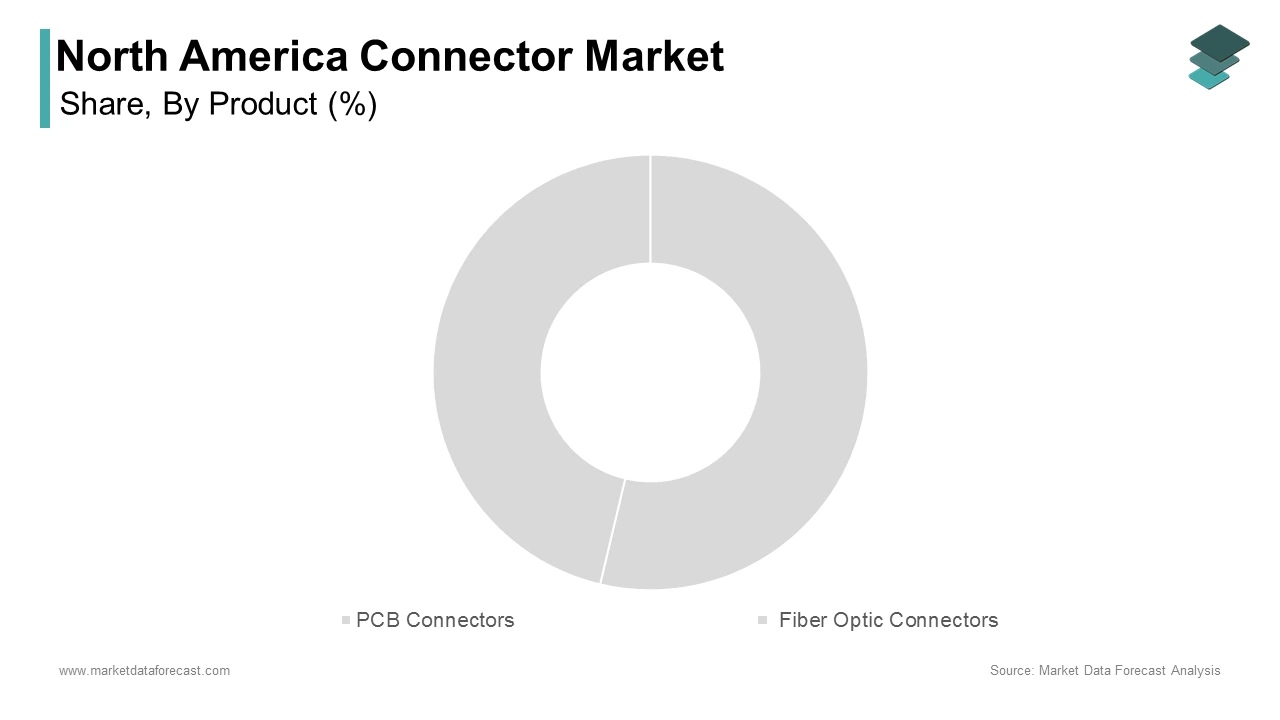
The PCB connectors segment dominated the North America connector market by accounting for a 27.5% of total market revenue in 2024. The widespread adoption of PCB connectors is primarily driven by their critical role in enabling compact, high-density interconnections in electronic devices. The rapid growth of smart devices, IoT-enabled systems, and automation equipment has further intensified demand for miniaturized and high-performance PCB connectors. Additionally, the automotive sector has become a major consumer, with the increasing electrification of vehicles requiring more PCB connectors for ECUs, sensors, and infotainment systems.
The fiber optic connectors segment the fastest-growing in the North America connector market and is projected to expand at a CAGR of 9.4% from 2025 to 2033. According to the Fiber Optic Association (FOA), the demand for fiber optic connectors in North America increased by 11% in 2023, driven by the expansion of high-speed data networks and the deployment of 5G infrastructure. As per the Federal Communications Commission (FCC), over 300 million Americans now have access to 5G networks, which heavily rely on fiber optic backhaul and fronthaul connectivity. This has significantly increased the need for reliable and high-bandwidth connectors such as LC, SC, and MPO types. Additionally, the rise of cloud computing and data center modernization has further fueled demand, as enterprises invest in fiber-based networking solutions to support high-speed data transfer and low latency. Moreover, the healthcare and defense sectors are increasingly adopting fiber optics for secure communication and real-time diagnostics.
By End User Insights
The consumer electronics segment was the largest end-user in the North America connector market by capturing a 31.5% of total revenue in 2024. According to the Consumer Technology Association (CTA), the U.S. consumer electronics industry generated over $400 billion in revenue in 2023, driven by strong demand for smartphones, laptops, wearables, and home automation devices. Each of these products relies on a wide array of connectors for power delivery, data transfer, and internal circuitry interconnection. As per the IPC Association Connecting Electronics Industries, the average smartphone contains over 100 micro-connectors, highlighting the sector’s extensive reliance on connector technology. Apart from these, the growing adoption of IoT-enabled devices and smart home systems has further increased connector demand. Manufacturers such as Apple, Dell, and Samsung have also pushed for thinner, lighter, and more powerful devices, necessitating the development of miniaturized connectors with enhanced performance characteristics.
The telecom segment is the fastest-growing end-user segment in the North America connector market, projected to expand at a compound annual growth rate (CAGR) of 9.1% from 2025 to 2033. This investment has driven demand for RF coaxial, fiber optic, and high-speed data connectors, which are essential for base stations, antennas, and data centers. Also, the shift toward edge computing and distributed network architectures has increased the need for ruggedized connectors capable of withstanding outdoor and industrial environments. Companies such as Verizon, AT&T, and T-Mobile have accelerated their 5G deployments, further boosting connector demand. Moreover, the integration of AI-driven network management and satellite communications is creating new applications for high-performance connectors.
By Material Insights
The Copper segment remained the prominent material in the North America connector market by holding approximately 39% of total material usage in 2023. According to the Copper Development Association (CDA), copper is the preferred material for electrical connectors due to its excellent conductivity, durability, and corrosion resistance. As per the U.S. Geological Survey, copper consumption in the electronics and electrical industries in North America increased by 6% in 2023, driven by rising demand in automotive, telecom, and consumer electronics sectors. Copper connectors are widely used in power transmission, signal integrity applications, and high-frequency circuits, where performance and reliability are paramount. As per the National Electrical Manufacturers Association (NEMA), over 75% of industrial and commercial connectors in North America are made from copper or copper alloys due to their superior electrical properties. Additionally, the growth of electric vehicles has significantly increased copper demand.
The plastic segment is emerging as the fastest-growing material segment in the North America connector market, projected to expand at a CAGR of 7.8% from 2025 to 2033. The automotive and consumer electronics sectors are the primary adopters, with plastic connectors being widely used in wiring harnesses, sensor modules, and portable devices. As per the U.S. Environmental Protection Agency (EPA), the push for fuel-efficient vehicles and reduced vehicle weight has led to a significant increase in plastic component usage, including connectors. Besides, the growing emphasis on recyclability and environmental sustainability has encouraged manufacturers to adopt thermoplastic materials that can be reused or repurposed. Furthermore, the medical and aerospace industries are adopting plastic connectors for sterile and non-conductive applications, where metal alternatives may pose risks.
REGIONAL ANALYSIS
United States Connector Market Insights
The United States held the dominant position in the North America connector market by accounting for a 85.5% of regional market revenue in 2024. The country is home to a vast ecosystem of connector manufacturers, including global leaders such as TE Connectivity, Amphenol, and Molex, which supply connectors to both domestic and international markets. Additionally, the U.S. automotive industry has seen a surge in electric vehicle production, with over 1.2 million EVs sold in 2023, further boosting connector demand for powertrain and battery systems. The U.S. also leads in aerospace and defense electronics, where connectors play a critical role in avionics, radar systems, and military communications.
Canada Connector Market Insights
Canada is seeing steady growth in the North America connector market. According to Statistics Canada, the country’s electronics manufacturing sector grew by 4.5% in 2023, supported by investments in industrial automation, telecommunications, and renewable energy. The Canadian government’s focus on digital infrastructure has led to increased deployment of 5G networks and fiber optic systems, boosting demand for high-speed connectors. As per the Innovation, Science and Economic Development Canada, over 85% of Canadian households now have access to high-speed internet, driving growth in telecom equipment manufacturing. Additionally, the automotive industry in Canada, particularly in Ontario, remains a key consumer of connectors, with major OEMs and Tier-1 suppliers producing both traditional and electric vehicles. The aerospace and defense sectors are also expanding, with companies like Bombardier and CAE investing in next-generation avionics and flight control systems that rely on high-reliability connectors. As Canada continues to modernize its industrial and communication infrastructure, the connector market is expected to maintain steady growth.
Rest of North America Connector Market Insights
The Rest of North America, including Mexico and Central American territories, holds a smaller but growing share of the regional connector market. According to the Mexican Association of the Electronics Industry (AMIE), the electronics manufacturing sector in Mexico expanded by 5.8% in 2023, driven by automotive and industrial exports. Mexico’s proximity to the U.S. makes it a strategic manufacturing hub for connectors used in automotive assembly, consumer electronics, and telecom equipment. As per the National Institute of Statistics and Geography (INEGI), Mexico exported over $10 billion worth of electronic components in 2023, with a significant portion going to North American markets. Additionally, the automotive industry in Mexico remains a key consumer, with major OEMs such as Ford, General Motors, and Nissan maintaining production facilities that rely on connectors for power and data systems. In Central America, countries like Costa Rica and El Salvador have developed electronics assembly clusters, attracting foreign investment in connector manufacturing and packaging.
LEADING PLAYERS IN THE NORTH AMERICA CONNECTOR MARKET
TE Connectivity
TE Connectivity is a global leader in connectivity and sensor solutions, with a strong presence in the North America connector market. The company offers a broad portfolio of connectors used across automotive, industrial, telecom, and consumer electronics sectors. Known for its innovation and reliability, TE Connectivity consistently invests in R&D to develop high-performance connectors tailored for emerging technologies such as electric vehicles, 5G, and industrial automation. Its strategic acquisitions and partnerships have enabled the company to expand its capabilities and maintain a competitive edge in the region.
Amphenol Corporation
Amphenol is one of the largest manufacturers of connectors and interconnect systems in North America. The company serves a diverse range of industries including military, aerospace, telecommunications, automotive, and medical. Amphenol's success lies in its ability to deliver customized, high-reliability connector solutions that meet stringent performance standards. The firm has a strong focus on global expansion and continuous product innovation, which has allowed it to maintain a dominant position in both domestic and international markets.
Molex Connector Market Insights
Molex, a subsidiary of Koch Industries, is a key player in the North America connector market, known for its extensive product line and engineering expertise. The company provides connectors for applications ranging from consumer electronics and automotive to data communications and industrial systems. Molex emphasizes technological advancement and customer collaboration to develop next-generation connectivity solutions. Its commitment to sustainability and digital transformation has further strengthened its market position in the region.
TOP STRATEGIES USED BY KEY MARKET PARTICIPANTS
Innovation and Product Development
Leading connector manufacturers prioritize continuous innovation to meet evolving industry demands. Companies are investing heavily in R&D to develop high-speed, miniaturized, and high-reliability connectors that support emerging technologies such as 5G, IoT, and electric vehicles.
Strategic Acquisitions and Partnerships
To enhance their technological capabilities and expand market reach, key players are engaging in strategic acquisitions and forming partnerships with complementary firms. These moves allow companies to integrate new product lines, enter niche markets, and strengthen their supply chain networks.
Expansion into High-Growth Applications
Manufacturers are focusing on expanding into high-growth sectors such as renewable energy, aerospace, and smart manufacturing. By aligning their product offerings with industry trends, companies are positioning themselves to capture emerging opportunities and sustain long-term growth in the North American connector market.
KEY MARKET PLAYERS AND COMPETITION OVERVIEW
Major Players of the North America Connector Market include TE Connectivity, Amphenol Corporation, Molex LLC, Aptiv PLC, 3M Company, Hirose Electric Co. Ltd., J.S.T. Mfg. Co. Ltd., Bel Fuse Inc., Samtec Inc., Phoenix Contact, Radiall USA Inc., ITT Inc., Souriau-Sunbank (Eaton)
The competition in the North America connector market is characterized by a blend of global giants, regional specialists, and emerging players, all striving to meet the rising demand for advanced connectivity solutions. Established firms dominate the market due to their strong brand presence, extensive product portfolios, and well-developed distribution networks. However, smaller and mid-sized companies are gaining traction by focusing on niche applications and offering customized solutions tailored to specific industry needs. Innovation is a key battleground, with manufacturers investing heavily in R&D to develop next-generation connectors that support high-speed data transmission, miniaturization, and improved durability. The growing emphasis on sustainability is also influencing competitive strategies, as companies seek to develop eco-friendly materials and energy-efficient manufacturing processes. Additionally, digital transformation initiatives, such as smart manufacturing and online sales platforms, are reshaping how companies engage with customers and manage supply chains. As industries across North America continue to modernize and adopt new technologies, the connector market remains highly dynamic, with competition intensifying across product performance, pricing, and service capabilities.
RECENT HAPPENINGS IN THE MARKET
- In February 2023, TE Connectivity announced the launch of a new line of high-speed data connectors designed for next-generation data centers and cloud infrastructure, enhancing its portfolio for the expanding digital infrastructure market in North America.
- In July 2023, Amphenol Corporation acquired a specialized connector manufacturer focused on medical and aerospace applications, strengthening its presence in high-reliability sectors and expanding its custom interconnect capabilities.
- In November 2023, Molex introduced a new suite of automotive connectors tailored for electric vehicles, focusing on high-current, fast-charging solutions to support the growing North American EV market and meet evolving performance requirements.
- In March 2024, LEMO, a leading manufacturer of precision connectors, expanded its North American operations by opening a new engineering and distribution center in Texas, aimed at improving customer service and accelerating product delivery in key industrial markets.
- In September 2023, Samtec launched a new line of ultra-low-profile connectors for mobile and wearable electronics, targeting the consumer electronics sector with compact, high-performance interconnect solutions designed to meet the demand for miniaturization.
MARKET SEGMENTATION
This research report on the North America connector market has been segmented and sub-segmented based on product, end user, material, and region.
By Product
- PCB Connectors
- Fiber Optic Connectors
By End User
- Consumer Electronics
- Telecom
By Material
- Copper
- Plastic
By Region
- US
- Canada
- Rest of North America
Frequently Asked Questions
1. What factors are driving the growth of the North America connector market?
Key drivers include increasing adoption of consumer electronics, growth in automotive electronics, rising demand for high-speed data transmission, and expansion of 5G infrastructure.
2. Which industries are the major end-users of connectors in North America?
Major end-use industries include automotive, telecommunications, consumer electronics, aerospace & defense, industrial automation, and healthcare.
3. What are the different types of connectors available in the market?
Common types include PCB connectors, fiber optic connectors, RF coaxial connectors, I/O connectors, and rectangular/circular connectors.
4. Which country dominates the connector market in North America?
The United States leads the market due to its strong electronics manufacturing base and technological advancements.
5. What are the emerging trends in the North America connector market?
Trends include miniaturization of connectors, increasing use of fiber optics, smart connectivity solutions, and environmentally sustainable connector designs.
6. How is the rise in electric vehicles (EVs) impacting the connector market?
The growth of EVs has significantly boosted demand for high-power and high-speed data connectors in battery systems and charging infrastructure.
7. What challenges does the North America connector market face?
Challenges include high cost of advanced connectors, design complexities, and fluctuating raw material prices.
8. Who are the key players in the North America connector market?
Major players include TE Connectivity, Amphenol Corporation, Molex LLC, Aptiv PLC, 3M Company, and Hirose Electric Co. Ltd.
9. What role does 5G deployment play in shaping the connector market?
5G deployment is accelerating demand for high-frequency and low-loss connectors in telecom infrastructure and devices.
10. How are connectors used in data centers and cloud computing?
Connectors are crucial for high-speed data transfer, power supply, and network reliability in data center and server infrastructure.
Related Reports
Access the study in MULTIPLE FORMATS
Purchase options starting from
$ 2000
Didn’t find what you’re looking for?
TALK TO OUR ANALYST TEAM
Need something within your budget?
NO WORRIES! WE GOT YOU COVERED!
Call us on: +1 888 702 9696 (U.S Toll Free)
Write to us: sales@marketdataforecast.com