- Product Description Description
- Table of Contents TOC
- List of Table & Figure LOT
- Get Free Sample PDF Sample PDF
Market Size, 2025
$256.56 BnMarket Estimate, 2026
$268.54 BnMarket Forecast, 2034
$386.89 BnCAGR, 2026–2034
4.67%Executive Summary: North America Consumer Electronics Market
- Market Scope: Regional North American consumer electronics market analysis covering product categories, distribution channels, price segments, country leadership frameworks, and 5G/IoT adoption metrics.
- Market Valuation: Valued at USD 256.56 billion in 2025, estimated at USD 268.54 billion in 2026, and projected to reach USD 386.89 billion by 2034, registering a CAGR of 4.67% from 2026 to 2034.
- Primary Growth Drivers: Rising disposable incomes, urbanization, rapid deployment of 5G and IoT technologies, and increasing adoption of connected devices. Key industry trends include smart home ecosystem expansion, connected living solutions, and remote work/learning technology demand.
Key Market Segment Metrics (2026–2034)
| Category | Leading Segment (Position) | Fastest-Growing / Key Growth Segment |
|---|---|---|
| By Product & Price Range | Smartphones (largest share) & Mid-range price segment (leading market share) | Tablets (hybrid work/digital education) & Budget segment (value-conscious consumers) |
| By Distribution Channel | Retail Stores (remained the dominant sales channel) | E-commerce Platforms (highest growth due to online shopping and omnichannel adoption) |
| By Technology & Innovation | Standard consumer electronics hardware and conventional retail models | AI-enabled smart devices, 5G-enabled ecosystems, and connected living solutions |
| By Region / Country | United States (dominated with 78.8% market share in 2025) | Canada and regional technology hubs supported by CHIPS and Science Act initiatives |
Major Market Players & Market Structure
Market Structure: Highly competitive North American consumer technology landscape characterized by continuous product innovation, AI-enabled smart devices, ecosystem integration, 5G investments, direct-to-consumer channel expansion, and supply chain resilience initiatives.
Key Companies: Apple Inc., Asustek Computer Inc., BlackBerry Ltd., Canon Inc., Dell Technologies Inc., Google LLC, HP Inc., Intel Corporation, LG Electronics, Lenovo Group Ltd., Microsoft Corporation, Samsung Electronics Co., Ltd., Sony Group Corporation, TCL Technology Group Corporation, and Xiaomi Corporation.
North America Consumer Electronics Market Size
The North America Consumer Electronics Market is projected to grow from USD 256.56 billion in 2025 to USD 268.54 billion in 2026 and reach USD 386.89 billion by 2034, registering a CAGR of 4.67% from 2026 to 2034.
The North America consumer electronics market includes a wide range of electronic devices intended for everyday use by individuals, including smartphones, televisions, laptops, wearables, and home audio systems. As one of the most technologically advanced regions globally, North America has consistently demonstrated robust demand for high-performance, connected, and smart consumer electronics.
Also, the average American household with access to internet owns 17 connected devices, reflecting deep integration of electronics into daily life. These figures underscore the region’s entrenched dependency on consumer electronics.
Technological innovation along with strong retail infrastructure and e-commerce growth, continues to shape the market. Amazon and Best Buy remain leading distribution channels, while companies like Apple, Samsung, and Google maintain a significant presence. Government support through initiatives such as the CHIPS and Science Act has also begun influencing domestic manufacturing trends which is signalling a strategic shift in how electronics are produced and distributed across the continent.
MARKET DRIVERS
Rising Disposable Incomes and Urbanization
Among the top accelerators of the North America consumer electronics market is the rise in disposable incomes, particularly in urban centers where purchasing power is concentrated.
According to the U.S. Bureau of Economic Analysis, personal disposable income in the United States reached an all-time high of $20.9 trillion in 2023, representing a year-over-year increase of approximately 5.2%. This financial flexibility enables consumers to invest in premium electronics such as foldable smartphones, ultra-HD TVs, and AI-powered smart home systems.
Urbanization further amplifies this trend. Also, urban dwellers typically have higher exposure to new product launches, better access to retail outlets, and greater reliance on digital infrastructure, all of which contribute to increased consumption of electronics. Moreover, densely populated cities like New York, Los Angeles, and Chicago serve as early adopter hubs for cutting-edge technology, influencing broader market trends.
In Canada, similar patterns are evident. This upward trajectory indicates that rising affluence and urban-centric lifestyles are major catalysts behind sustained market expansion.
Advancements in 5G and IoT Technologies
Another critical aspect of the North America consumer electronics market is the rapid deployment and adoption of 5G networks and the Internet of Things (IoT). These technologies are enabling a new generation of connected devices that require faster speeds, lower latency, and seamless integration across platforms.
As per Ookla’s Speedtest Global Index Q4 2023 report, average 5G download speeds in the U.S. reached 215 Mbps, significantly enhancing user experience for streaming, gaming, and cloud-based applications.
Verizon and AT&T have been aggressively expanding their 5G footprints, covering a significant portion of the U.S. population by early 2024. This widespread connectivity is directly fueling demand for 5G-enabled smartphones, smartwatches, and automotive infotainment systems.
Simultaneously, IoT adoption is reshaping the smart home ecosystem. Parks Associates estimates that in 2023, nearly 55% of U.S. broadband households owned at least one smart home device, such as doorbells, thermostats, or security cameras. With IoT platforms improving interoperability between devices, consumers are increasingly investing in bundled ecosystems offered by companies like Google, Amazon, and Apple.
MARKET RESTRAINTS
Supply Chain Disruptions and Component Shortages
The North America consumer electronics market faces persistent challenges stemming from supply chain disruptions and semiconductor shortages. Although global chip production has improved since the peak of the pandemic, bottlenecks continue to impact lead times and product availability.
The geopolitical tensions between the U.S. and China have further complicated sourcing strategies. Export controls imposed by the U.S. Department of Commerce have limited access to certain advanced semiconductors, forcing companies like Apple and Intel to reconfigure product designs or delay launches. For example, in 2023, Apple reportedly delayed the release of some iPhone models due to unavailability of specific camera sensors sourced from Chinese suppliers.
Besides, logistics constraints persist. The Drewry World Container Index recorded a 15% increase in shipping costs from Asia to North America in late 2023, driven by port congestion and labor disputes along the West Coast. These cost escalations are passed on to consumers, making electronics more expensive and potentially dampening demand.
Environmental Regulations and E-Waste Management Pressures
Environmental regulations and growing concerns over electronic waste (e-waste) are increasingly shaping the operational landscape of the North America consumer electronics market. Governments and regulatory bodies are imposing stricter compliance standards on manufacturers regarding product recyclability, energy efficiency, and responsible disposal practices. As per the U.S. Environmental Protection Agency (EPA), approximately 6.9 million tons of e-waste were generated in the U.S. in 2022, with only 15% being properly recycled.
To address this, states like California, New York, and Washington have enacted extended producer responsibility (EPR) laws, mandating electronics manufacturers to fund and manage recycling programs. These policies increase compliance costs for companies, especially those producing short-life-cycle gadgets such as smartphones and wearables. According to the Institute for Local Self-Reliance, compliance expenses for electronics firms rose by an estimated 7% in 2023 due to expanded e-waste management obligations.
Moreover, the European Union’s Circular Economy Action Plan has influenced policy discussions in North America, pushing for longer product lifecycles and repairability mandates. Apple faced scrutiny in 2023 when it introduced proprietary screws in some MacBook models, complicating third-party repairs—a move criticized by environmental advocacy groups like iFixit and Greenpeace.
MARKET OPPORTUNITIES
Expansion of Smart Home and Connected Living Ecosystems
The proliferation of smart home technologies represents a significant opportunity for the North America consumer electronics market. With advancements in artificial intelligence, voice recognition, and home automation, consumers are increasingly adopting interconnected devices that enhance convenience, security, and energy efficiency.
Major players such as Amazon, Google, and Apple are expanding their smart ecosystems, offering integrated solutions that include smart speakers, lighting, thermostats, and security systems. Amazon reported in early 2024 that Alexa-enabled devices surpassed 500 million units worldwide, with North America accounting for over 40% of that figure. This growing penetration underscores the increasing role of voice-controlled interfaces in everyday life.
Beyond individual devices, the concept of "connected living" is gaining traction. Smart appliances equipped with Wi-Fi and IoT capabilities—such as refrigerators that track food expiration dates and washing machines that optimize energy usage—are becoming mainstream.
This shift is not only driving hardware sales but also fostering ancillary revenue streams through subscription services, cloud storage, and predictive maintenance features.
Growth in Remote Work and Learning Devices
The sustained shift toward remote work and online education has created a lasting demand for productivity-oriented consumer electronics in North America. Even as hybrid work models become standard post-pandemic, the need for laptops, tablets, docking stations, and collaboration tools remains strong.
Chromebook shipments in North America saw a resurgence in 2023 after a brief dip in 2022, primarily driven by K-12 educational institutions upgrading their digital infrastructure.
Similarly, the demand for premium laptops and 2-in-1 devices surged among professionals seeking performance and mobility. In 2023, Apple sold a large number of MacBooks across North America, aided by the M2 chip’s popularity in both enterprise and creative sectors. Microsoft Surface and Dell XPS lines also gained traction in corporate environments requiring secure, business-ready devices.
Beyond hardware, peripherals such as webcams, noise-canceling headsets, and external monitors experienced heightened demand.
MARKET CHALLENGES
Rapid Technological Obsolescence and Short Product Lifecycles
One of the foremost challenges facing the North America consumer electronics market is the accelerating pace of technological obsolescence, which results in shorter product lifecycles and increased pressure on manufacturers to continuously innovate. Consumers are frequently encouraged to upgrade to newer models due to incremental improvements in performance, design, and features. However, this rapid churn can lead to diminished return on investment for both producers and end users.
According to a report by Gartner, the average replacement cycle for smartphones in North America has dropped to 3.1 years, down from 3.6 years in 2021. Similarly, laptops are being replaced every 3.5 years on average, compared to 4.2 years in 2020. This compressed lifecycle creates a dilemma for manufacturers: they must balance innovation with profitability while managing inventory and ensuring backward compatibility.
The issue is exacerbated by software-driven updates that often render older hardware incompatible with new operating systems or applications. For instance, Apple’s iOS 17 update excluded several iPhone models dating back to 2017, effectively reducing their functional lifespan.
From an environmental standpoint, shortened product lifespans contribute to rising e-waste levels. These dynamics challenge manufacturers to rethink product durability, modular design, and after-sales support strategies in order to align with evolving consumer expectations and sustainability goals.
Intensifying Competition from Private Label and Budget Brands
The North America consumer electronics market is witnessing intensified competition from private label and budget brands, which are capturing market share by offering cost-effective alternatives to established players. Retail giants such as Amazon, Walmart, and Target have expanded their own-brand electronics portfolios, leveraging economies of scale and direct-to-consumer distribution to undercut traditional brands.
Similarly, Chinese budget brands such as TCL, OnePlus, and Anker have gained traction in North America by focusing on feature-rich yet affordable devices. Anker’s PowerLine cables and portable chargers have carved a niche in the accessories market by combining reliability with competitive pricing.
This growing competition puts pressure on legacy brands like Apple, Samsung, and Sony to justify their premium pricing through differentiated innovation and superior customer experience. It also forces mid-tier brands to either reduce margins or risk losing relevance.
REPORT COVERAGE
| REPORT METRIC | DETAILS |
| Market Size Available | 2025 to 2034 |
| Base Year | 2025 |
| Forecast Period | 2026 to 2034 |
| Segments Covered | By Product ,Distribution Channel , Price Range and Country. |
| Various Analyses Covered | Global, Regional & Country Level Analysis, Segment-Level Analysis; DROC, PESTLE Analysis, Porter's Five Forces Analysis, Competitive Landscape, Analyst Overview of Investment Opportunities |
| Country Covered | The U.S., Canada and Rest of North America |
| Market Leader Profiled | Apple Inc, Asustek Computer Inc DR, BlackBerry Ltd, Canon Inc, Dell Technologies Inc |
SEGMENTAL ANALYSIS
By Product Insights
Smartphones dominated the North America consumer electronics market by product type, accounting for 42.6% of total market revenue in 2025. This segment’s stronghold is primarily driven by high penetration rates, frequent upgrades, and the increasing integration of smartphones into daily life beyond communication—serving as personal assistants, entertainment hubs, and productivity tools.
One major factor fueling this dominance is the widespread adoption of 5G technology. Consumers are increasingly opting for premium models that support faster connectivity, augmented reality, and AI-driven features.
Another key driver is brand loyalty and ecosystem expansion. Apple, for instance, maintained a substantial market share in the U.S. smartphone sector in Q4 2023. The company's seamless integration with services like iCloud, AirPods, and MacBook devices encourages repeat purchases. Similarly, Samsung continues to attract Android users through its Galaxy ecosystem, including smartwatches and tablets.
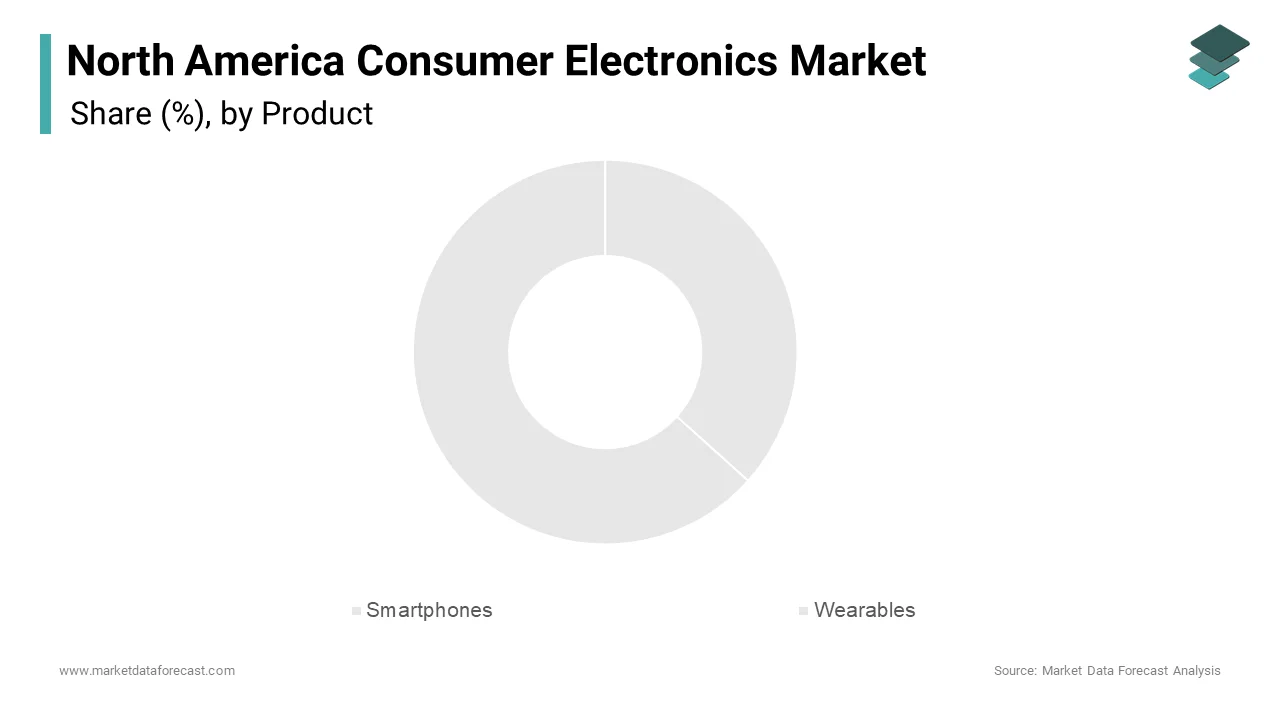
The tablet segment is projected to grow at the fastest CAG of 6.8% between 2023 and 2028 within the North America consumer electronics market, as noted by Statista. This accelerated growth stems from shifting usage patterns, particularly in education, remote work, and content consumption.
A significant contributor to this trend is the growing reliance on tablets for digital learning. Additionally, hybrid work environments have increased demand for lightweight, portable computing alternatives. Tablets equipped with styluses and detachable keyboards—such as Microsoft’s Surface Go and Samsung’s Galaxy Tab S9—are gaining traction among professionals seeking flexible productivity solutions. This evolving utility beyond leisure use is positioning tablets as one of the most dynamic segments in the regional electronics landscape.
By Distribution Channel Insights
Retail stores remained the biggest distribution channel in the North America consumer electronics market, capturing an estimated 57.7% of total sales volume in 2024. Despite the rise of online shopping, physical retail continues to play a crucial role due to consumer preference for hands-on experiences before purchasing high-value electronics.
One of the primary drivers behind the dominance of retail stores is the continued strength of big-box retailers such as Best Buy, Walmart, and Target. These retailers offer immersive in-store experiences, including demo units, expert consultations, and same-day availability, which are difficult to replicate online.
Moreover, rural and older demographics tend to favor physical shopping for electronics. Also, supply chain disruptions affecting e-commerce delivery times have reinforced consumer reliance on local retail options for immediate access.
Lastly, in-store promotions, bundled offers, and trade-in programs—such as Apple’s in-store upgrade initiatives—continue to attract customers.
E-commerce platforms are expanding at the fastest pace within the North America consumer electronics distribution landscape, registering a CAGR of 9.2%. This rapid growth is fueled by evolving consumer behavior, technological advancements in online retail, and the convenience offered by digital marketplaces.
One key driver is the proliferation of mobile commerce and personalized shopping experiences. Simultaneously, fulfillment infrastructure has significantly improved.
Walmart and Target also expanded same-day delivery partnerships with DoorDash and Shipt, bridging the gap between online convenience and local availability.
Furthermore, younger consumers are driving this shift. These dynamics position e-commerce as the fastest-growing distribution channel in the market.
By Price Range Insights
The budget segment held the largest share of the North America consumer electronics market, accounting for 48.9% of total unit sales in 2025. This dominance can be attributed to the rising affordability concerns among consumers amid economic pressures and inflationary trends.
One major factor propelling the budget segment is the increasing popularity of private-label and Chinese brands offering cost-effective alternatives. AmazonBasics, TCL, and OnePlus have successfully captured market share by delivering feature-rich devices at competitive prices.
Apart from these, value-conscious consumers, especially in lower-income households and among younger demographics, are prioritizing functionality over premium branding.
School districts and small businesses are also leaning toward budget electronics for large-scale procurement. Chromebooks, entry-level tablets, and affordable smart speakers are commonly chosen for cost efficiency.
The mid-range electronics segment is emerging as the quickest growing category in the North America consumer electronics market, projected to expand at a CAGR of 7.5%. This growth is driven by consumers seeking a balance between performance and affordability, especially amid declining interest in ultra-premium devices.
A key contributing factor is the rising disposable income among middle-class households, particularly in urban areas. Devices like Samsung’s Galaxy A-series smartphones, Google Pixel 7a, and Dell XPS 13 laptops fall within this sweet spot of value and performance.
Moreover, manufacturers are aggressively innovating within the mid-tier space to capture market share. Motorola’s Edge series and OnePlus Nord line have gained traction by offering flagship-like features—such as high refresh rate displays and advanced cameras—at mid-range pricing.
Besides, telecom operators and retailers are bundling financing options that make mid-range electronics more accessible. These developments collectively drive the segment’s rapid ascent in the regional market.
Country Level Analysis
The United States led the North America consumer electronics market, holding a dominant market share of 78.8% in 2025. As the world’s largest single economy and a hub for technological innovation, the U.S. remains the epicenter of consumer electronics demand and development.
A major driver of this leadership position is the country’s robust tech ecosystem, anchored by companies like Apple, Google, and Intel. These firms not only develop cutting-edge hardware but also influence global trends in software integration, artificial intelligence, and wearable technology.
Additionally, the U.S. benefits from high broadband penetration and digital literacy. Moreover, the rise of remote work and digital education further boosted demand for laptops, tablets, and peripherals.
Government initiatives such as the CHIPS and Science Act also played a pivotal role in reshaping domestic manufacturing capabilities.
Canada presents a stable and affluent consumer base with strong adoption rates for modern electronic devices.
One of the key growth enablers is Canada’s high standard of living and well-developed digital infrastructure. Additionally, the average Canadian household owns over eight connected devices, reflecting deep digital integration.
Urban centers like Toronto, Vancouver, and Montreal serve as early adopter zones for new technologies, including foldable smartphones and AI-powered wearables.
Moreover, government incentives for green technology and energy-efficient appliances are shaping consumer preferences. Environment and Climate Change Canada’s rebate programs for smart thermostats and electric vehicle chargers have spurred ancillary electronics demand.
Mexico holds a smaller but steadily growing share of the North America consumer electronics market. Though still developing compared to the U.S. and Canada, Mexico is witnessing a surge in electronics adoption driven by urbanization, youth demographics, and improving economic conditions.
A critical factor underpinning growth is the expansion of the middle class. This demographic shift has led to increased purchases of smartphones, televisions, and audio equipment, particularly in cities like Mexico City, Monterrey, and Guadalajara.
E-commerce is another catalyst. Also, major global brands like Samsung and LG are expanding their presence through localized marketing campaigns and after-sales service networks.
Moreover, Mexico serves as a manufacturing and assembly hub for several electronics firms. Companies including Foxconn and Jabil have established operations in northern states, leveraging proximity to the U.S. market and lower labor costs.
KEY MARKET PLAYERS AND COMPETITIVE LANDSCAPE
Companies playing a prominent role in the North America consumer electronics market are Apple Inc, Asustek Computer Inc DR, BlackBerry Ltd, Canon Inc, Dell Technologies Inc Ordinary Shares - Class C, Alphabet Inc Class A, HP Inc, HTC Corp DR, Huawei Technologies, Lenovo Group Ltd, LG Electronics Inc ADR, Motorola Solutions Inc, Nikon Corp, Panasonic Holdings Corp, Samsung Electronics Co Ltd, Seagate Technology Holdings PLC, Sony Group Corp, Toshiba Corporation, ZTE Corp Class H
The competition in the North America consumer electronics market is characterized by intense rivalry among established global brands and emerging local players. Companies continuously strive to differentiate themselves through innovation, design, performance, and ecosystem integration. While legacy firms like Apple and Samsung maintain strong footholds due to brand equity and extensive distribution networks, challenger brands are gaining traction by offering cost-effective alternatives with competitive features. The market sees frequent product launches, aggressive marketing campaigns, and evolving pricing strategies aimed at capturing diverse consumer segments. Additionally, advancements in technologies such as 5G, artificial intelligence, and the Internet of Things have intensified the race for superior user experiences. Retailers and e-commerce platforms also play a pivotal role, influencing purchasing behaviors and enabling direct-to-consumer engagement. As consumer preferences shift toward sustainability, durability, and multi-device compatibility, companies must adapt swiftly or risk losing relevance. This dynamic environment fosters constant evolution, requiring firms to balance short-term gains with long-term strategic investments to sustain their market positions.
Top 3 Players in the market
Apple Inc.
Apple remains a dominant force in the North America consumer electronics market, known for its innovation-driven product lineup including iPhones, iPads, MacBooks, and wearables. The company sets industry benchmarks through seamless hardware-software integration and ecosystem loyalty. Its brand strength, premium positioning, and continuous R&D efforts contribute significantly to global market trends. Apple’s influence extends beyond device sales, shaping app development, digital services, and retail experiences worldwide.
Samsung Electronics Co., Ltd.
Samsung is a key player with a diverse portfolio spanning smartphones, TVs, home appliances, and semiconductors. In North America, it competes strongly across multiple categories, offering both high-end and mid-range products. The company invests heavily in display technology, AI, and smart home integration, maintaining relevance across varied consumer segments. Samsung’s manufacturing capabilities and global supply chain further reinforce its leadership position in the regional and international markets.
Sony Corporation
Sony holds a prominent place in the North America market through its expertise in audio-visual technology and gaming. Its PlayStation consoles, BRAVIA TVs, and professional-grade imaging equipment are highly regarded. Sony blends entertainment and electronics seamlessly, appealing to both consumers and content creators. The company continues to innovate in areas such as immersive audio, camera sensors, and virtual reality, contributing to sustained growth and influence in the global electronics landscape.
Top strategies used by the key market participants
Product Innovation and Ecosystem Expansion
Leading companies prioritize continuous innovation to differentiate their offerings and enhance user experience. They develop integrated ecosystems that encourage customer retention and cross-product usage. By ensuring compatibility between devices—such as smartphones, wearables, and home automation systems—they create added value that strengthens brand loyalty and repeat purchases.
Strategic Partnerships and Acquisitions
Major players frequently engage in strategic alliances, joint ventures, and acquisitions to expand their technological capabilities and market reach. These collaborations help integrate advanced features like AI, voice recognition, and cloud computing into consumer products, while also strengthening supply chains and service infrastructures to maintain competitive advantage.
Sustainability and Brand Positioning
With growing consumer awareness around environmental impact, companies are embedding sustainability into their business models. Initiatives include eco-friendly packaging, recyclable materials, energy-efficient manufacturing, and repairability programs. These efforts not only align with regulatory expectations but also enhance brand image and attract environmentally conscious consumers.
RECENT HAPPENINGS IN THE MARKET
In January 2024, Apple launched its M3-powered MacBook Pro lineup, introducing enhanced performance and energy efficiency for creative professionals and enterprise users. This move reinforced Apple’s dominance in the premium laptop segment and strengthened its appeal within the education and corporate markets across North America.
In March 2024, Samsung introduced its new SmartThings Energy platform in the U.S. and Canada, allowing consumers to monitor and optimize home energy consumption through connected devices. This initiative expanded Samsung’s smart home ecosystem and positioned the company as a leader in sustainable consumer technology solutions.
In June 2024, Google announced a partnership with Best Buy to expand its presence in physical retail stores across the United States. This collaboration enabled greater visibility for Pixel smartphones, Nest devices, and Fitbit wearables, helping Google compete more effectively against Apple and Samsung.
In September 2024, LG Electronics unveiled its new line of ultra-slim OLED televisions tailored for the North American market. With an emphasis on design and visual performance, this product launch targeted premium home entertainment consumers and helped LG regain some lost ground in the TV segment.
In November 2024, Amazon refreshed its Fire tablet lineup with improved processors and longer battery life, targeting budget-conscious families and students. This update reinforced Amazon’s stronghold in the entry-level tablet space and supported its broader ecosystem of Prime Video and Alexa-integrated services.
MARKET SEGMENTATION
This research report on the north america consumer electronics market has been segmented and sub-segmented into the following categories.
By Product
- Smartphones
- Wearables
By Distribution Channel
- Retail stores
- E-commerce platforms
- Direct-to-consumer channels
By Price Range
- Budget
- Mid-range
- Premium
By Country
- The U.S.
- Canada
- Rest of North America.