- Product Description Description
- Table of Contents TOC
- List of Table & Figure LOT
- Get Free Sample PDF Sample PDF
Market Size, 2025
$522 MnMarket Estimate, 2026
$549 MnMarket Forecast, 2034
$826 MnCAGR, 2026–2034
5.23%North America Copper Sulphate Market Size
The copper sulphate market size in North America was valued at USD 522.46 million in 2025 and is predicted to be worth USD 826.62 million by 2034 from USD 549.78 million in 2026 and grow at a CAGR of 5.23% from 2026 to 2034.
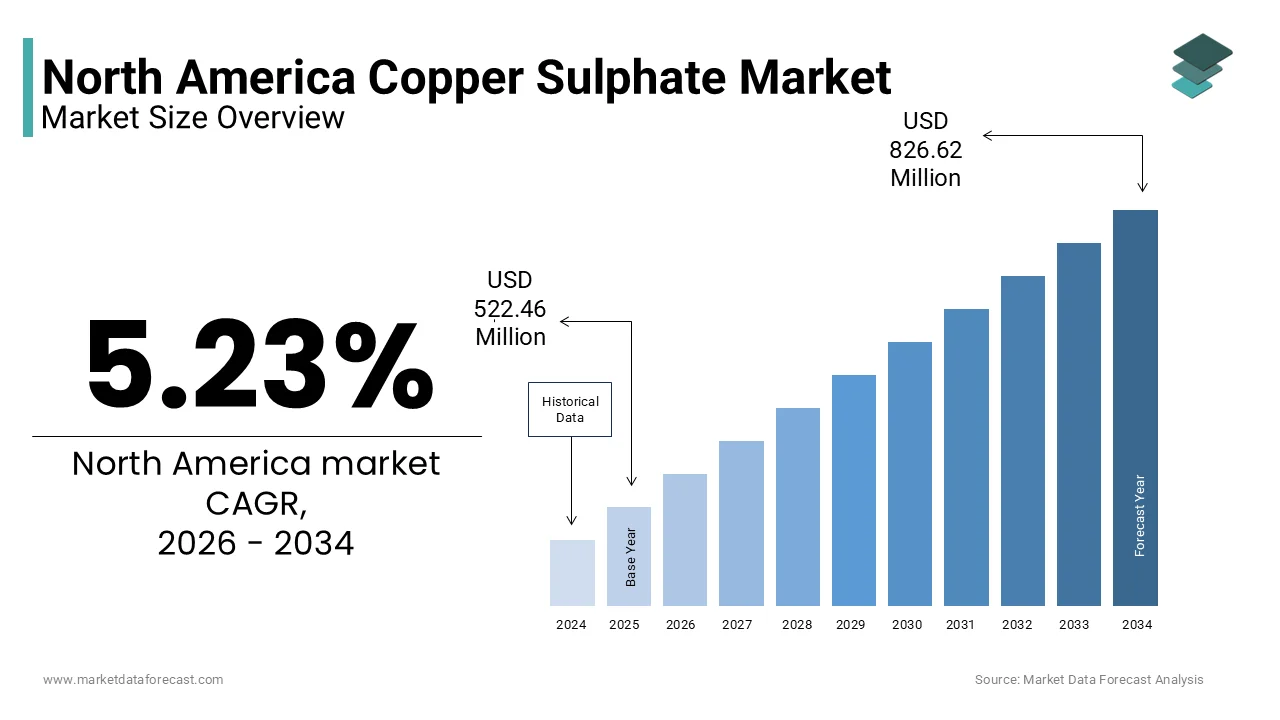
The copper sulphate plays an essential role in crop protection, particularly in vineyards and orchards, where it is a foundational component of Bordeaux mixture, a time-tested fungicide. Beyond agriculture, the compound is employed in water treatment facilities to control algal blooms in reservoirs and recreational ponds, and in metallurgical processes such as electroplating and mineral flotation. According to the U.S. Geological Survey, domestic consumption of copper compounds, including copper sulphate, has remained consistent over the past five years, supported by steady demand from regulated industrial sectors
MARKET DRIVERS
Expanding Demand for Organic and Integrated Pest Management in Agriculture
The growing adoption of organic farming and integrated pest management (IPM) systems, which rely on copper-based compounds as approved fungicides is fuelling the growth of the North America copper sulphate market. Copper sulphate is one of the few synthetic substances permitted under the National Organic Program, making it indispensable for controlling fungal pathogens such as downy mildew in high-value crops like grapes, potatoes, and tomatoes. This reliance is further reinforced by the lack of equally effective organic-compliant alternatives, particularly in humid growing regions where fungal pressure is high. Additionally, the U.S. Environmental Protection Agency has maintained copper sulphate’s registration under strict usage guidelines, affirming its role in sustainable agriculture when applied responsibly.
Increasing Use in Water Quality Management and Algae Control
The widespread application in aquatic ecosystem management for controlling harmful algal blooms in freshwater bodies is boosting the growth of the North America copper sulphate market. According to the U.S. Environmental Protection Agency, over 1,100 public water systems in the United States reported using copper sulphate for algae mitigation in 2023. The Florida Department of Environmental Protection conducted 43 algal treatment operations using copper sulphate in Lake Okeechobee during 2023, highlighting its operational importance in large-scale environmental management. Municipalities also use it in wastewater stabilization ponds and decorative water features to maintain aesthetic and sanitary standards. In Canada, Environment and Climate Change Canada documented the use of copper sulphate in over 200 lake management programs across Ontario and Manitoba in 2022 to combat seasonal blooms. While regulatory scrutiny exists due to potential aquatic toxicity, its cost-effectiveness and rapid action ensure continued deployment under controlled conditions.
MARKET RESTRAINTS
Environmental and Ecotoxicological Concerns Limiting Application Scope
The increasing regulatory and environmental scrutiny surrounding its ecotoxicological impact, particularly on aquatic life is likely to degrade the growth of the North America copper sulphate market. Copper sulphate, while effective as a fungicide and algaecide, can accumulate in sediments and pose risks to non-target organisms such as fish, invertebrates, and beneficial microorganisms. According to the U.S. Environmental Protection Agency’s Aquatic Life Benchmarks, the acute toxicity threshold for copper in freshwater is as low as 3.8 micrograms per liter for sensitive species like fathead minnows, prompting strict application limits. In 2023, the agency revised its copper criteria under the Clean Water Act, requiring states to implement site-specific water quality standards that account for local hardness and pH levels, thereby complicating permitting processes. Additionally, the State of Washington suspended several copper-based pesticide registrations in 2022 due to concerns over shellfish bed contamination, as reported by the Washington Department of Ecology.
Stringent Regulatory Compliance and Permitting Requirements
The significant operational hurdles due to complex and divergent regulatory frameworks governing its use across jurisdictions is limiting the growth of the North America copper sulphate market. In the United States, copper sulphate is regulated under the Federal Insecticide, Fungicide, and Rodenticide Act (FIFRA), requiring registration and labeling compliance for each application type. As per the U.S. Environmental Protection Agency, over 80% of copper sulphate formulations used in agriculture and water treatment require restricted-use certification, limiting application to licensed professionals. This increases operational costs and reduces accessibility for small-scale farmers and municipal operators. Additionally, state-level regulations vary widely; for example, California’s Proposition 65 mandates warning labels for copper sulphate due to its potential reproductive toxicity, creating consumer perception challenges. In 2023, the California Department of Pesticide Regulation enforced a 30% reduction in copper application rates for vineyards under its Groundwater Protection Program.
MARKET OPPORTUNITIES
Advancement in Precision Agriculture and Controlled-Release Formulations
The integration of the compound into precision agriculture systems and the development of controlled-release formulations that minimize environmental impact while maintaining efficacy is setting up new opportunities for the growth of the North America copper sulphate market. According to the American Society of Agronomy, over 45% of specialty crop farms in California utilized variable-rate application technology in 2023, enabling targeted copper sulphate delivery only where fungal pressure is detected, reducing overall usage. Furthermore, research institutions such as the University of Florida are developing encapsulated copper sulphate formulations that release ions gradually, lowering leaching potential and extending protection duration. These innovations align with the U.S. Department of Agriculture’s Conservation Stewardship Program, which incentivizes reduced chemical inputs through precision practices. These advancements not only enhance agronomic efficiency but also address regulatory and environmental concerns by demonstrating responsible use.
Growing Role in Renewable Energy and Electrochemical Applications
The expanding footprint of copper sulphate in electrochemical and renewable energy technologies is also propelling the growth of the North America copper sulphate market. The compound serves as an essential electrolyte in electrowinning and electrorefining processes, which are producing high-purity copper used in solar panels, wind turbines, and electric vehicle components. According to the U.S. Department of Energy, domestic copper demand for clean energy technologies is projected to triple by 2035, driving parallel demand for process chemicals like copper sulphate. In hydrometallurgical operations, particularly in Arizona and Utah, copper sulphate solutions are used to leach copper from low-grade ores, a method that accounts for nearly 20% of U.S. primary copper production, as reported by the U.S. Geological Survey. Additionally, copper sulphate is employed in educational and industrial electroplating setups, where it facilitates the deposition of conductive copper layers on substrates for electronic components. These applications benefit from the compound’s high solubility and redox activity, making it a versatile reagent in next-generation energy systems.
MARKET CHALLENGES
Supply Chain Vulnerability Due to Dependence on Primary Copper Production
The structural challenge rooted in its dependency on primary copper mining and refining, sectors subject to geopolitical, environmental, and logistical disruptions is ascribed to hinder the growth of the North America copper sulphate market. Copper sulphate is predominantly produced as a byproduct of copper ore processing or through the reaction of sulphuric acid with copper scrap or oxide ores, making its availability sensitive to fluctuations in upstream operations. Domestically, environmental opposition has delayed expansions at key U.S. mines, including the Resolution Copper project in Arizona, which faced a federal moratorium in 2022 due to cultural and ecological concerns, as documented by the U.S. Forest Service. Additionally, transportation bottlenecks, such as rail delays in western Canada, have disrupted the movement of copper concentrates to processing facilities. According to the Canadian Transportation Agency, rail service reliability for bulk commodities declined by 12% in 2023 compared to the previous year. These supply-side pressures are compounded by the limited number of specialized copper sulphate manufacturers in North America, creating concentration risk.
Public and Institutional Resistance to Copper-Based Chemicals in Sensitive Ecosystems
The increasing resistance from environmental groups, regulatory bodies, and local communities to the use of copper-based chemicals in ecologically sensitive areas is likely to impede the growth of the North America copper sulphate market. In 2023, the Monterey Bay National Marine Sanctuary prohibited the use of copper-based treatments within its jurisdiction, which is citing risks to benthic organisms and marine food webs, as announced by the National Oceanic and Atmospheric Administration. Educational institutions are also reevaluating its use; the University of California system restricted copper sulphate in campus landscaping in 2022 under its Sustainable Practices Policy. This shift in perception is influencing procurement decisions at municipal and state levels, where sustainability scoring systems now penalize copper-based inputs. Moreover, organic certification bodies are debating stricter limits on copper use, with the National Organic Standards Board recommending a cap on cumulative applications in 2023.
REPORT COVERAGE
| REPORT METRIC | DETAILS |
| Market Size Available | 2025 to 2034 |
| Base Year | 2025 |
| Forecast Period | 2026 to 2034 |
| CAGR | 5.23 % |
| Segments Covered | By End Use and Region |
| Various Analyses Covered | Regional & Country Level Analysis, Segment-Level Analysis, DROC, PESTLE Analysis, Porter’s Five Forces Analysis, Competitive Landscape, Analyst Overview on Investment Opportunities |
| Regions Covered | The United States, Canada, Mexico, and Rest of North America |
| Market Leaders Profiled | Beneut Enterprise, Highnic Group, JX Metals Corporation (Eneos Holdings), NOAH Technologies Corp., Sumitomo Metal Mining Co., Ltd., Univertical Corp. (ALCONIX CORPORATION), Jost Chemical Co., LAFFORT, and others |
SEGMENTAL ANALYSIS
By End Use Insights
The Agriculture segment dominated the North America copper sulphate market by accounting for 58.3% of share in 2025, with the copper sulphate’s irreplaceable role as a fungicide and micronutrient supplement in both conventional and certified organic farming systems. According to the California Department of Pesticide Regulation, over 1.3 million pounds of copper-based pesticides predominantly copper sulphate were applied in 2023 across the state’s grape and almond farms, where downy mildew and bacterial spot pose persistent threats. The National Organic Program permits copper sulphate under strict limits, making it one of the few synthetic compounds allowed in organic agriculture. The Organic Trade Association notes that 89% of certified organic fruit and vegetable farms in the U.S. utilize copper-based treatments, underscoring its embedded role in sustainable farming. Additionally, soil copper deficiency in intensively farmed regions further amplifies demand.
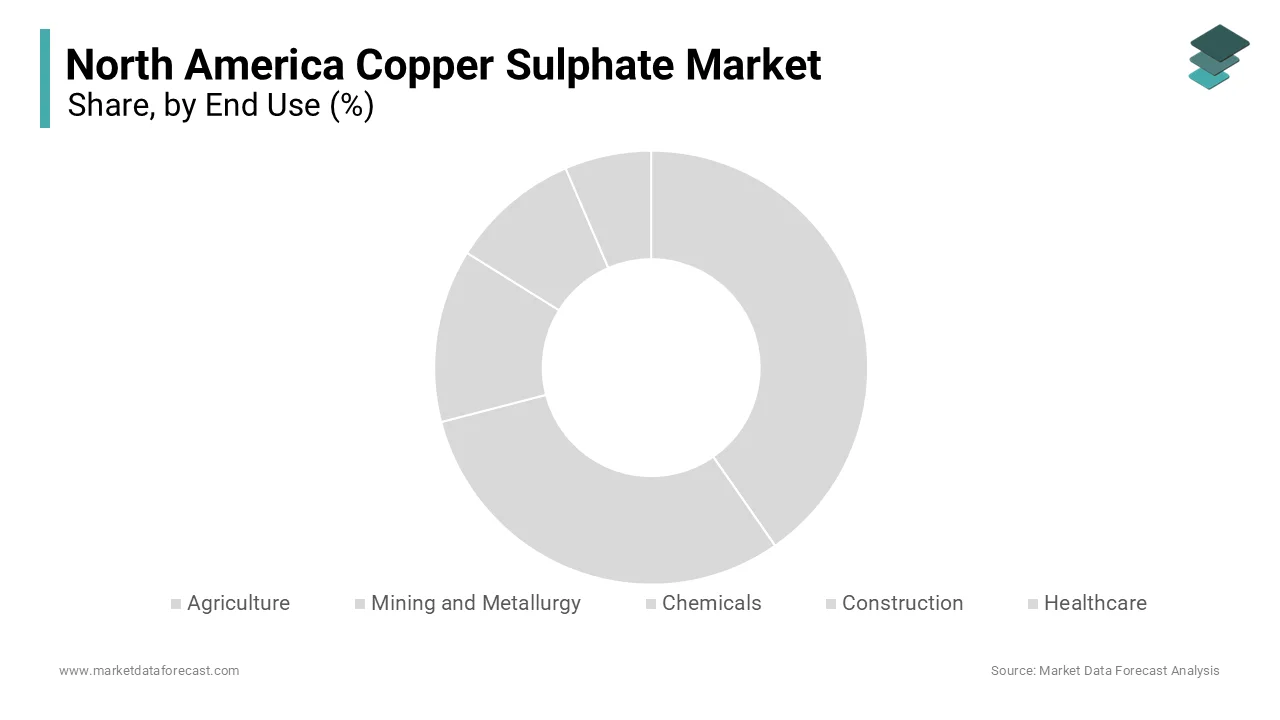
The Mining and Metallurgy segment is lucratively growing with a projected CAGR of 7.2% from 2026 to 2034 owing to the compound’s essential role in hydrometallurgical extraction processes, particularly in solvent extraction and electrowinning (SX-EW), which are increasingly favored for processing low-grade copper ores. According to the U.S. Geological Survey, approximately 22% of primary copper produced in the United States in 2023 was extracted via SX-EW methods, a figure that has steadily risen due to declining ore grades and the need for cost-effective recovery techniques. Copper sulphate serves as the electrolyte medium in electrowinning cells by enabling the deposition of high-purity copper cathodes used in electrical and renewable energy applications. The expansion of in-situ leaching operations in Arizona, New Mexico, and Nevada has further intensified demand. The Arizona Geological Survey reported that SX-EW production in the state increased by 18% between 2021 and 2023, supported by investments from major miners like Freeport-McMoRan. A second pivotal factor is the growing emphasis on domestic mineral security and supply chain resilience. The U.S. Department of the Interior designated copper as a mineral in 2022. Additionally, recycling operations in Canada’s metallurgical sector are integrating copper sulphate into recovery circuits for electronic waste, as noted in Natural Resources Canada’s 2023 Circular Economy Strategy.
REGIONAL ANALYSIS
United States
The United States was the top performer of the North America copper sulphate market by capturing an 76.3% of the share in 2025. The country’s dominance is anchored in its vast agricultural demand, particularly in specialty crop regions such as California’s Central Valley and the Pacific Northwest, where copper sulphate is routinely applied to combat fungal diseases in vineyards, orchards, and potato fields. The California Department of Food and Agriculture recorded over 1.1 million acres under copper-based fungicide treatment in 2023, reflecting its entrenched role in high-value farming. Additionally, the U.S. leads in copper mining and hydrometallurgical processing, with Arizona alone contributing nearly two-thirds of domestic copper output. The presence of major chemical manufacturers like Brenntag and Univar Solutions ensures steady supply and formulation expertise.
Canada
Canada positioned second by capturing 25.1% of the North America copper sulphate market share in 2025. The Pest Management Regulatory Agency permits copper sulphate use under strict environmental guidelines, ensuring responsible application in organic farming and aquatic management. According to Agriculture and Agri-Food Canada, copper sulphate is approved for use on over 60 crop types, with notable application in potato farming in Prince Edward Island and apple orchards in British Columbia. Canada processes significant volumes of electronic waste and industrial scrap, where copper sulphate is employed in electrorefining circuits to recover high-purity metal. The Canadian Institute of Mining reported that 17% of refined copper in 2023 was recovered through hydrometallurgical methods using copper sulphate-based electrolytes. Furthermore, provincial water management agencies, such as Ontario’s Ministry of the Environment, utilize copper sulphate in lake restoration projects to control invasive algae, with 89 treatment operations recorded in 2023.
COMPETITIVE LANDSCAPE
The competitive environment in the North America copper sulphate market is defined by a blend of technical specialization, regulatory navigation, and customer-centric innovation. While the market does not exhibit extreme concentration, a select group of multinational chemical companies and niche specialty suppliers dominate through their ability to deliver consistent quality, regulatory compliance, and technical expertise. Competition extends beyond price, centering on product reliability, formulation sophistication, and alignment with environmental and agricultural best practices. Manufacturers differentiate themselves by offering tailored solutions for specific applications, such as low-residue formulations for organic farming or high-stability variants for industrial electrolysis. The increasing scrutiny from environmental agencies and public stakeholders has elevated the importance of sustainable practices, pushing companies to invest in cleaner production methods and transparent supply chains. Regional differences in regulatory enforcement, particularly between U.S. states and Canadian provinces, require localized strategies, fostering a fragmented yet dynamic competitive landscape.
KEY MARKET PLAYERS
Some of the key players in the North America copper sulphate market are
- Beneut Enterprise
- Highnic Group
- JX Metals Corporation (Eneos Holdings)
- NOAH Technologies Corp.
- Sumitomo Metal Mining Co., Ltd.
- Univertical Corp. (ALCONIX CORPORATION)
- Jost Chemical Co.
- LAFFORT
TOP PLAYERS IN THE MARKET
- BASF SE is a leading chemical manufacturer with a significant presence in the North America copper sulphate market, where it supplies high-purity formulations for agricultural, industrial, and water treatment applications. The company leverages its global research network and advanced formulation expertise to deliver customized solutions that align with regulatory and sustainability standards. BASF’s integration within its broader portfolio of crop protection and industrial chemicals enables it to offer comprehensive technical support and value-added services to end users. On the global stage, BASF contributes to the development of precision agriculture technologies, incorporating copper sulphate into integrated nutrient and disease management systems.
- K+S AG operates as a key player through its subsidiary K+S Minerals and Agriculture, which specializes in specialty nutrients and industrial salts, including copper sulphate. The company serves a diverse clientele across farming, mining, and environmental management sectors, emphasizing product consistency and technical reliability. In North America, K+S has established strong distribution networks and partnerships with agricultural cooperatives, enabling widespread access to micronutrient solutions. Globally, the company plays a role in advancing micronutrient efficiency in crop production, promoting the balanced use of trace elements like copper to enhance soil health and yield stability. Its focus on scientific agronomy and environmental stewardship positions K+S as a trusted advisor in sustainable nutrient management, influencing best practices in both developed and emerging agricultural economies.
- Elemental Minerals Limited has emerged as a dedicated supplier of specialty inorganic compounds, including copper sulphate, with a strategic focus on high-purity products for industrial and agricultural use. The company distinguishes itself through agile manufacturing, technical customization, and responsive customer engagement, catering to niche applications in metallurgy, water treatment, and organic farming. In North America, Elemental Minerals has built a reputation for reliability and regulatory compliance, serving clients who require consistent quality and traceability. Internationally, the company supports resource recovery initiatives and sustainable mining operations by providing process reagents tailored to modern extraction technologies. Its emphasis on innovation and environmental accountability aligns with evolving global standards, enabling it to contribute meaningfully to the responsible use of essential minerals in industrial ecosystems.
TOP STRATEGIES USED BY KEY MARKET PLAYERS
One of the principal strategies employed by leading players in the North America copper sulphate market is the development of value-added formulations that enhance efficacy while reducing environmental impact. Companies are engineering stabilized, chelated, or slow-release variants of copper sulphate to improve bioavailability in soils and minimize leaching, addressing both regulatory concerns and agronomic efficiency. These advanced formulations allow for lower application rates and greater compatibility with integrated farming systems, which is strengthening customer loyalty and differentiation in a competitive landscape.
Another approach involves vertical integration and secure sourcing of raw materials to ensure supply chain resilience. Given the dependency on copper feedstocks and sulphuric acid, manufacturers are strengthening ties with mining operations and chemical producers to stabilize input availability. This integration not only mitigates price volatility but also enhances traceability and quality control, which are increasingly demanded by industrial and agricultural clients operating under strict compliance frameworks.
Another strategy is the expansion of technical service and advisory capabilities to support end users in regulatory compliance and optimal application. Companies are deploying agronomists, environmental consultants, and field engineers to provide on-the-ground support, ensuring proper usage and minimizing ecological risks. This consultative model builds long-term relationships, enhances brand credibility, and positions suppliers as strategic partners rather than mere commodity vendors.
RECENT HAPPENINGS IN THE MARKET
- In February 2023, BASF launched a new chelated copper sulphate formulation designed for precision agriculture, offering improved soil uptake and reduced leaching in high-pH environments. This innovation targeted organic and specialty crop farmers seeking compliant, efficient nutrient solutions.
- In May 2023, K+S AG expanded its distribution partnership with a major agricultural cooperative in the Midwest, enhancing its reach to family-owned farms and regional agribusinesses requiring reliable micronutrient supply.
- In August 2023, Elemental Minerals initiated a technical support program deploying field agronomists across key farming regions in California and Washington to guide optimal copper sulphate application and regulatory adherence.
- In January 2025, BASF collaborated with a leading water treatment consortium in Florida to pilot a controlled-release copper sulphate system for algae management in freshwater reservoirs, which is aiming to reduce reapplication frequency.
- In March 2025, K+S AG introduced a digital traceability platform for its copper sulphate products, enabling customers to verify origin, purity, and environmental compliance throughout the supply chain.
MARKET SEGMENTATION
This research report on the North America copper sulphate market has been segmented and sub-segmented based on the following categories.
By End Use
- Agriculture
- Mining and Metallurgy
- Chemicals
- Construction
- Healthcare
By Country
- The United States
- Canada
- Rest of North America