- Product Description Description
- Table of Contents TOC
- List of Table & Figure LOT
- Get Free Sample PDF Sample PDF
Market Size, 2025
$41.48 BnMarket Estimate, 2026
$42.36 BnMarket Forecast, 2034
$50.10 BnCAGR, 2026–2034
2.12%Executive Summary: North America Corrugated Boxes Market
- Market Scope: Comprehensive North America corrugated boxes market analysis covering board types, application sectors, regional leadership frameworks, and sustainable packaging evolution trends.
- Market Valuation: Valued at USD 41.48 billion (2025), estimated at USD 42.36 billion (2026), and projected to reach USD 50.10 billion by 2034, registering a robust CAGR of 2.12% (2026–2034).
- Primary Growth Drivers: E-commerce expansion, sustainability mandates favoring recyclable materials, supply chain evolution, rising demand from food, beverage, and pharmaceutical sectors, and lightweight renewable packaging adoption. Key challenges include raw material price volatility and labor shortages.
Key Market Segment Metrics (2026–2034)
| Category | Leading Segment (2025 Position) | Fastest-Growing Segment |
|---|---|---|
| By Board Type | Single-Wall Boards (dominated the market with a 60.1% share in 2025) | Triple-Wall Boards (projected to grow at a CAGR of 7.8%) |
| By Application | Food and Beverages (led applications with a 35.4% share in 2025) | E-commerce (anticipated to witness the fastest CAGR of 8.5%) |
| By Region / Country | United States (held an 85.1% regional market share in 2025) | Canada (expected to grow at a prominent CAGR of 6.2%) |
Major Market Players & Market Structure
Market Structure: Highly consolidated packaging landscape featuring major industry mergers, vertical integration, and strategic facility upgrades aimed at improving production capabilities and meeting recycling demands.
Key Companies: Georgia-Pacific, Smurfit Westrock (Smurfit Kappa / WestRock), DS Smith, International Paper, Oji Holdings Corporation, Lee & Man Paper Manufacturing Ltd., and Packaging Corporation of America.
 Download Free Sample Report
North America Corrugated Boxes Market Size
The North America Corrugated Boxes Market is projected to grow from USD 41.48 billion in 2025 to USD 42.36 billion in 2026 and reach USD 50.10 billion by 2034, registering a CAGR of 2.12% from 2026 to 2034.
Corrugated boxes are their fluted inner layer sandwiched between two outer liners that are prized for their durability, recyclability, and versatility in safeguarding goods during transit. In 2023, the demand for these boxes has been driven not only by traditional industries but also by the unprecedented surge in online shopping, which has necessitated robust and sustainable packaging solutions. According to the U.S. Census Bureau, e-commerce sales in the United States alone reached approximately $1 trillion in 2022 with the corrugated packaging in ensuring product safety and customer satisfaction.
Beyond e-commerce, the growing emphasis on sustainability has bolstered the appeal of corrugated boxes, as they are predominantly made from renewable resources and boast high recycling rates. The Environmental Protection Agency (EPA) reports that corrugated cardboard is recycled at a rate exceeding 90% in the U.S. by making it one of the most recycled materials nationwide. This environmental advantage aligns with consumer preferences for eco-friendly products, as per Nielsen study indicating that 73% of global consumers are willing to alter their consumption habits to reduce environmental impact. The demand for efficient, lightweight, and sustainable packaging solutions like corrugated boxes continues to grow by reinforcing their indispensable role in modern commerce.
MARKET DRIVERS
E-Commerce Expansion and Supply Chain Evolution
The exponential growth of e-commerce has emerged as a pivotal driver for the North American corrugated boxes market. The U.S. Department of Commerce reveals that e-commerce sales accounted for 14.3% of total retail sales in the first quarter of 2023 by reflecting a steady increase from previous years. This shift has intensified the need for durable and customizable packaging solutions to protect goods during transit and enhance unboxing experiences. Corrugated boxes, being lightweight yet sturdy, meet these demands effectively. According to the National Retail Federation, nearly 80% of consumers prefer eco-friendly packaging is aligning with the recyclable nature of corrugated materials. The demand for corrugated boxes is expected to rise in tandem with supply chain expansions across the continent as online shopping continues to replace traditional retail models.
Sustainability Mandates and Environmental Awareness
Stringent environmental regulations and heightened consumer awareness about sustainability are propelling the adoption of corrugated boxes in North America. The Environmental Protection Agency (EPA) states that paper and cardboard recycling rates in the U.S. reached 68% in 2021, underscoring the material's role in circular economies. Governments across the region are implementing policies to reduce plastic usage, such as Canada’s Single-Use Plastics Ban, which came into effect in 2022. Additionally, a report by the U.S. Energy Information Administration indicates that industries are increasingly adopting sustainable practices to meet carbon neutrality goals. Corrugated boxes, made from renewable resources and boasting high recyclability, align perfectly with these objectives. This regulatory push, coupled with consumer demand for greener alternatives that ensures a sustained preference for corrugated packaging solutions across diverse sectors.
MARKET RESTRAINTS
Fluctuating Raw Material Costs
The volatility in raw material prices, particularly for paper pulp and recycled fibers, poses a significant challenge to the North American corrugated boxes market. The U.S. Bureau of Labor Statistics reports that the Producer Price Index (PPI) for paper manufacturing increased by 15% between 2021 and 2022 due to supply chain disruptions and rising energy costs. These fluctuations directly impact the cost of producing corrugated boxes, squeezing profit margins for manufacturers. According to the U.S. Forest Service, global demand for wood pulp has surged, driven by increased packaging needs in emerging markets, further exacerbating price instability. Manufacturers are forced to pass these costs onto consumers, which could dampen demand in price-sensitive sectors.
Environmental Regulations on Deforestation
Stringent environmental regulations aimed at curbing deforestation and promoting sustainable forestry practices present another restraint for the corrugated boxes market. The Food and Agriculture Organization (FAO) estimates that North America loses approximately 3.7 million hectares of forest annually due to logging and land-use changes. In response, governments have introduced measures such as the Lacey Act in the U.S., which prohibits the trade of illegally sourced wood products. While these policies are essential for preserving ecosystems, they limit the availability of virgin fiber, a key raw material for high-quality corrugated boxes. The Canadian Forest Service notes that stricter compliance requirements increase operational complexities and costs for manufacturers. This regulatory environment forces the industry to rely more heavily on recycled materials, which may not always meet the performance standards required for specialized packaging applications.
MARKET OPPORTUNITIES
Innovations in Sustainable Packaging Solutions
The growing emphasis on sustainability presents a significant opportunity for the North American corrugated boxes market to innovate and capture new demand. According to the U.S. Environmental Protection Agency, packaging waste constitutes approximately 30% of total municipal solid waste, creating a pressing need for eco-friendly alternatives. Corrugated boxes, with their high recyclability and biodegradability, are well-positioned to meet this demand. The U.S. Department of Agriculture supports initiatives like the BioPreferred Program, which encourages the use of renewable materials, including those used in corrugated packaging. Additionally, advancements in water-based inks and adhesives enable manufacturers to produce fully compostable boxes, appealing to environmentally conscious consumers.
Expansion into Emerging End-Use Industries
The diversification of corrugated box applications into emerging industries such as pharmaceuticals and electronics offers another promising opportunity. This growth necessitates reliable, tamper-proof packaging solutions, where corrugated boxes excel due to their protective and customizable nature. Furthermore, the U.S. International Trade Administration reports that the electronics sector, valued at over $300 billion in exports in 2022, requires packaging that safeguards sensitive components during transit. Corrugated boxes, with their ability to be tailored for specific dimensions and cushioning needs, cater effectively to these industries.
MARKET CHALLENGES
Rising Competition from Alternative Packaging Materials
The North American corrugated boxes market faces stiff competition from alternative packaging materials, such as plastic and flexible packaging, which are gaining traction due to their lightweight and cost-effective properties. The U.S. Environmental Protection Agency reports that plastic packaging accounts for nearly 16% of total municipal solid waste, reflecting its widespread use despite environmental concerns. Flexible packaging, in particular, has seen a surge in adoption, with the Flexible Packaging Association estimating its market value at $35 billion in 2022. These alternatives often offer superior barrier properties and moisture resistance compared to traditional corrugated boxes by making them attractive for industries like food and beverages. However, this competition pressures corrugated box manufacturers to innovate and justify their higher costs in scenarios where durability is not the primary concern.
Labor Shortages and Workforce Constraints
Labor shortages and workforce challenges pose another significant hurdle for the North American corrugated boxes market. As per U.S. Bureau of Labor Statistics, the manufacturing sector faced a labor gap of approximately 800,000 workers in 2022, driven by an aging workforce and a lack of skilled personnel. This shortage impacts production efficiency and increases operational costs, as companies are forced to invest in automation or offer higher wages to attract talent. Additionally, the National Association of Manufacturers notes that 82% of manufacturers consider attracting and retaining a quality workforce a top challenge. For the corrugated box market, which relies heavily on manual operations for customization and assembly, these workforce constraints can lead to delays and reduced output, ultimately affecting market growth and competitiveness.
REPORT COVERAGE
| REPORT METRIC | DETAILS |
| Market Size Available | 2025 to 2034 |
| Base Year | 2025 |
| Forecast Period | 2026 to 2034 |
| Segments Covered | By Package Type,Application and Country. |
| Various Analyses Covered | Global, Regional & Country Level Analysis, Segment-Level Analysis; DROC, PESTLE Analysis, Porter's Five Forces Analysis, Competitive Landscape, Analyst Overview of Investment Opportunities |
| Country Covered | The U.S., Canada and Rest of North America |
| Market Leader Profiled | Georgia-Pacific,Oji Holdings Corporation,Lee & Man Paper Manufacturing Ltd.,Smurfit Kappa,DS Smith,WestRock Company |
SEGMENTAL ANALYSIS
By Package Type Insights
The Single Wall Boards segment was the largest and held 60.1% of the North American corrugated boxes market share in 2025. Their widespread adoption stems from their cost-effectiveness, lightweight nature, and versatility in protecting a variety of products during transit. According to the Environmental Protection Agency, single wall boards are highly recyclable that is aligning with sustainability goals. Their importance lies in their ability to cater to industries like e-commerce and food packaging, where moderate durability is sufficient. The U.S. Census Bureau notes that e-commerce sales exceeded $1 trillion in 2022, driving demand for affordable yet reliable packaging solutions like single wall boards.
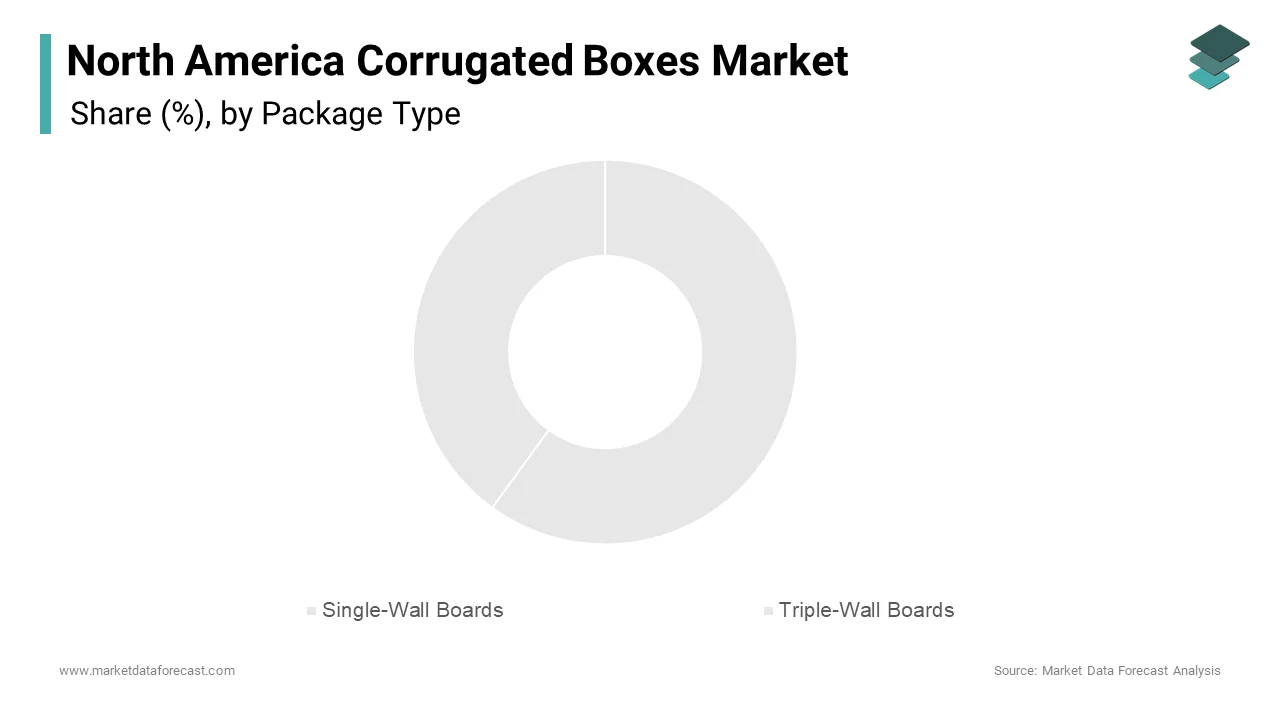
The triple Wall Boards segment is likely to register a CAGR of 7.8% during the forecast period. This growth is fueled by increasing demand for heavy-duty packaging in industries such as electronics, automotive, and industrial goods. The National Highway Traffic Safety Administration emphasizes that the transportation of fragile and high-value goods requires robust packaging to prevent damage by making triple wall boards indispensable. These boards offer superior strength and stacking capabilities, reducing product loss during transit. Additionally, the U.S. Energy Information Administration notes that industries are prioritizing durable packaging to minimize waste and enhance supply chain efficiency.
By Application Insights
The food and beverages segment dominated the North American corrugated boxes market with 35.4% of share in 2025 with the reliance on corrugated packaging for its durability, moisture resistance, and compliance with food safety standards. The U.S. Food and Drug Administration emphasizes that corrugated boxes are ideal for transporting perishable goods, which constitute over 40% of all food shipments in North America. This segment remains critical to the supply chain by ensuring safe and efficient delivery while minimizing product damage with the growing demand for fresh produce and packaged foods.
The e-commerce segment is anticipated to witness a fastest CAGR of 8.5% in the next coming years. This growth is fueled by the rapid expansion of online retail, where corrugated boxes are indispensable for secure packaging and branding. The National Retail Federation states that e-commerce sales grew by 14.3% in 2022 alone by reflecting shifting consumer preferences toward online shopping. According to the Environmental Protection Agency, recyclable packaging like corrugated boxes aligns with eco-conscious consumer demands, further propelling adoption.
Country Level Analysis
The United States dominated the North American corrugated boxes market by holding 85.1% of the regional market share in 2025 due to its robust manufacturing base, extensive logistics networks, and high demand from sectors like e-commerce and food packaging. According to the U.S. Census Bureau, the country’s e-commerce sales reached $1 trillion in 2022 is significantly boosting corrugated box usage. According to the Environmental Protection Agency, the U.S. recycles over 90% of its corrugated cardboard with the material’s sustainability appeal.
Canada is lucratively to grow with a prominent CAGR of 6.2% during the forecast period. This growth is fueled by rising e-commerce adoption and stringent environmental regulations promoting sustainable packaging. The Canadian government’s Single-Use Plastics Ban, implemented in 2022, has accelerated the shift toward recyclable materials like corrugated boxes. Natural Resources Canada reports that the country’s forest products industry contributes over $24 billion annually to the economy, supporting the availability of raw materials for corrugated packaging. As Canada strengthens its focus on green initiatives and expands its logistics infrastructure, the demand for corrugated boxes is expected to surge, making it a key growth driver in the region.
Top 3 Players in the market
International Paper
International Paper stands as one of the largest and most influential players in the North American corrugated boxes market, renowned for its extensive portfolio of sustainable packaging solutions. With a strong emphasis on innovation, the company has consistently invested in research and development to create high-performance corrugated products tailored to diverse industries, including e-commerce, food, and logistics. International Paper’s commitment to sustainability is evident in its efforts to source raw materials responsibly and promote recycling initiatives across its supply chain.
WestRock Company
WestRock Company is another dominant player in the North American corrugated boxes market, distinguished by its vertically integrated operations and comprehensive product offerings. The company leverages its expertise in paper manufacturing and packaging design to deliver innovative solutions that cater to the evolving needs of customers. WestRock’s focus on customization and efficiency has enabled it to serve a wide range of industries, from consumer goods to industrial applications. By prioritizing sustainability, the company actively supports circular economy initiatives, utilizing recycled fibers and promoting waste reduction. Its ability to provide end-to-end packaging solutions strengthens its competitive edge and solidifies its position as a key contributor to the global corrugated boxes market.
Smurfit Kappa
Smurfit Kappa is a leading player in the North American corrugated boxes market, recognized for its customer-centric approach and cutting-edge packaging technologies. The company excels in designing lightweight yet durable corrugated solutions that enhance supply chain efficiency while minimizing environmental impact. Smurfit Kappa’s dedication to sustainability is reflected in its use of renewable resources and commitment to carbon neutrality, aligning with the growing demand for greener packaging alternatives. With a strong emphasis on innovation, the company continuously develops advanced designs that meet the unique requirements of industries such as e-commerce and food and beverage. Smurfit Kappa’s global reach and localized expertise enable it to maintain a significant influence on both regional and international markets.
Top strategies used by the key market participants
Key players in the North American corrugated boxes market have embraced sustainability-driven innovation as a cornerstone of their strategies. Companies like International Paper and WestRock Company are prioritizing the development of eco-friendly packaging solutions to meet the growing demand for sustainable materials. By focusing on recyclable, biodegradable, and lightweight designs, these players align their offerings with stringent environmental regulations and consumer preferences for greener alternatives. Their commitment to reducing environmental impact not only enhances brand reputation but also positions them as leaders in promoting circular economy initiatives within the marketplace.
Vertical integration has emerged as another critical strategy to strengthen market positions. Companies such as Smurfit Kappa ensure consistent quality, cost efficiency, and timely delivery of their products by controlling the entire supply chain from raw material sourcing to manufacturing and distribution. This approach minimizes dependency on external suppliers, reduces operational risks, and allows for greater flexibility in meeting customer demands. Vertical integration also enables these players to optimize resource utilization and maintain a competitive edge in an increasingly dynamic market environment.
Strategic acquisitions and partnerships have been widely adopted to expand geographic reach and diversify product portfolios. For instance, DS Smith and Packaging Corporation of America have engaged in mergers and collaborations to tap into emerging industries like e-commerce and pharmaceuticals. These strategic moves allow companies to enter new markets, access advanced technologies, and cater to evolving customer needs.
Digital transformation and automation have become pivotal in streamlining operations and improving efficiency. Leading players like Georgia-Pacific and Oji Holdings Corporation have invested in cutting-edge technologies such as AI, IoT, and robotics to modernize their production processes. These innovations not only reduce costs but also enhance precision, minimize waste, and enable faster response times to customer demands. By adopting digital tools, these companies can scale their operations effectively, maintain high-quality standards, and remain agile in a rapidly changing market landscape.
Brand differentiation through customer-centric approaches has also played a significant role in strengthening market positions. Key players are investing in design capabilities and offering tailored packaging solutions that enhance brand identity and unboxing experiences for end consumers. By focusing on customization, durability, and aesthetic appeal, companies like Smurfit Kappa and WestRock Company build strong relationships with clients across diverse industries. This emphasis on delivering value-added services ensures customer loyalty and reinforces their leadership in the competitive corrugated boxes market.
KEY MARKET PLAYERS AND COMPETITIVE LANDSCAPE
Companies playing a prominent role in the North America Corrugated Boxes Market are Georgia-Pacific,Oji Holdings Corporation,Lee & Man Paper Manufacturing Ltd.,Smurfit Kappa,DS Smith,WestRock Company,International Paper,Packaging Corporation of America,
The North American corrugated boxes market is characterized by intense competition, driven by the presence of several key players striving to maintain and expand their market share. The industry is highly fragmented, with major companies such as International Paper, WestRock Company, and Smurfit Kappa dominating the landscape through their extensive product portfolios, advanced manufacturing capabilities, and strategic initiatives. These companies leverage economies of scale, vertical integration, and technological advancements to optimize costs and enhance operational efficiency, enabling them to offer competitive pricing while maintaining quality standards.
A significant aspect of the competition lies in sustainability and innovation. Players are increasingly focusing on developing eco-friendly packaging solutions to align with stringent environmental regulations and growing consumer demand for sustainable materials. Investments in research and development have led to the creation of lightweight, recyclable, and biodegradable corrugated boxes, which cater to industries like e-commerce, food and beverages, and logistics. Additionally, strategic acquisitions and partnerships have become vital tools for expanding geographic reach and accessing emerging markets, further intensifying rivalry.
The competitive environment is also shaped by the need for customization and customer-centric approaches. Companies differentiate themselves by offering tailored packaging solutions that enhance brand identity and improve unboxing experiences. This focus on value-added services fosters customer loyalty and strengthens market positions.
RECENT HAPPENINGS IN THE MARKET
- In July 2024, Smurfit Kappa completed its acquisition of WestRock, forming Smurfit WestRock, one of the world's largest packaging companies. This merger is expected to enhance their market presence in North America.
- In January 2025, International Paper finalized its acquisition of DS Smith, a London-based multinational paper and packaging company, in a deal valued at approximately $7.2 billion. This move strengthens International Paper’s footprint in the North American corrugated boxes market.
- In July 2024, Oji Holdings Corporation acquired plantations through its subsidiary, Oji Uruguay Forest Company S.A.S. This acquisition helps secure raw material sources for packaging production, bolstering Oji Holdings' supply chain in North America.
- In October 2024, Packaging Corporation of America reported increased net sales of $2.2 billion in the third quarter, reflecting its ongoing investments in facility expansions. This expansion aims to meet the growing demand for corrugated packaging in North America.
- In October 2024, Georgia-Pacific invested in new facilities and upgrades to enhance its production capabilities in the North American corrugated packaging market. This investment is expected to strengthen its supply chain and operational efficiency.
- In January 2025, International Paper announced plans to increase fiber prices to improve margins and strengthen its position in the containerboard market. This pricing strategy is expected to drive profitability in the North American market.
- In February 2024, Oji Holdings Corporation completed an equity buyback, repurchasing 8,697,800 shares for ¥4,797.71 million. This move demonstrates financial strength and commitment to shareholder value, reinforcing its position in the market.
- In November 2024, Smurfit WestRock focused on expanding its corrugated packaging division in North America following its merger. This strategic expansion aims to leverage combined resources for enhanced market presence.
- In March 2025, International Paper announced the closure of five box plants and a pulp mill, along with the potential sale of its diaper pulp unit for $2 billion. This strategic realignment aims to focus on core packaging operations in North America.
- In October 2024, Packaging Corporation of America implemented higher pricing in its paper and packaging segments, resulting in a 13% revenue increase to $2.18 billion in the third quarter. This pricing strategy is expected to drive higher margins and competitiveness in the market.
MARKET SEGMENTATION
This research report on the North America Corrugated Boxes Market has been segmented and sub-segmented into the following categories.
By Package Type
- Single-Wall Boards
- Triple-Wall Boards
By Application
- Food and Beverages
- E-commerce
By Country
- The U.S.
- Canada
- Rest of North America.