- Product Description Description
- Table of Contents TOC
- List of Table & Figure LOT
- Get Free Sample PDF Sample PDF
Market Size, 2025
$0.95 BnMarket Estimate, 2026
$1.05 BnMarket Forecast, 2034
$2.26 BnCAGR, 2026–2034
10.04%North America Dental Practice Management Software Market Size
The North America dental practice management software market size was valued at USD 0.95 billion in 2025 and is anticipated to reach USD 1.05 billion in 2026 from USD 2.26 billion by 2034, growing at a CAGR of 10.04% during the forecast period from 2026 to 2034.
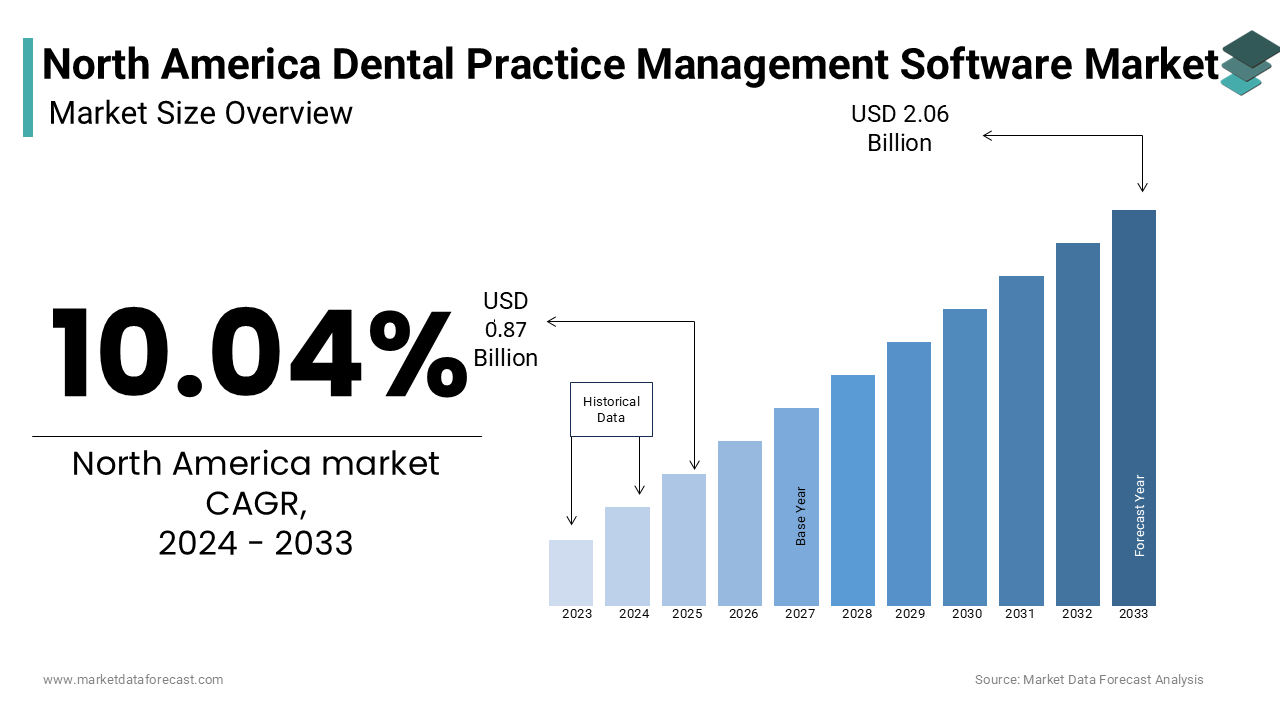
Modern dental practice management software integrates artificial intelligence, cloud computing, mobile technologies, and interoperability standards that enable seamless data exchange, real-time collaboration, and enhanced decision-making capabilities for dental professionals. According to the American Dental Association, North American dental practices average 1,850 patient visits annually, necessitating sophisticated management systems that coordinate complex scheduling, treatment coordination, and financial management requirements. The Healthcare Information and Management Systems Society reports that over 85% of North American dental practices now utilize electronic health records, reflecting the critical importance of digital data management for modern dental care delivery. As per the Canadian Dental Association, Canadian dental practices manage an average of 1,200 patient records per practitioner, requiring robust software solutions that ensure data security, regulatory compliance, and operational efficiency.
MARKET DRIVERS
Digital Transformation and Technology Adoption in Dental Practices
The accelerating digital transformation and technology adoption trends throughout North American dental practices create substantial demand for sophisticated practice management software solutions that integrate advanced features, enhance operational efficiency, and support modern patient care delivery requirements. The American Dental Association reports that over 75% of dental practices have implemented comprehensive digital workflows including electronic health records, digital imaging, and automated scheduling systems that require integrated software solutions to coordinate complex operational requirements and ensure seamless data exchange between different technology platforms. This digital transformation is particularly pronounced among younger dentists and group practices that prioritize technology integration to enhance patient experience and operational efficiency.
Cloud computing adoption and remote access capabilities have become essential requirements for modern dental practices that need flexible, scalable, and accessible software solutions that support distributed work environments and mobile practice management requirements. The Healthcare Information Management Research Institute indicates that cloud-based dental practice management software adoption has increased by 180% over the past five years, reflecting the critical importance of remote access, data backup, and collaborative capabilities that support modern practice operations and business continuity requirements. These cloud-based solutions enable dental practices to access patient information, schedule appointments, and manage financial operations from any location while ensuring data security and regulatory compliance.
Furthermore, artificial intelligence and machine learning integration create opportunities for dental practice management software to provide predictive analytics, automated scheduling optimization, and intelligent patient communication systems that enhance operational efficiency and patient satisfaction. The Journal of Dental Informatics reports that AI-enhanced practice management systems can reduce administrative time by 35% while improving appointment scheduling efficiency and patient retention rates through intelligent automation and personalized communication capabilities. These advanced features create sustained demand for sophisticated software solutions that leverage emerging technologies to address evolving practice management requirements and competitive market pressures.
Regulatory Compliance and Data Security Requirements
Stringent regulatory compliance requirements and data security mandates create substantial demand for professional dental practice management software solutions that ensure regulatory adherence while protecting sensitive patient information and maintaining operational integrity. The Health Insurance Portability and Accountability Act mandates comprehensive data protection measures for dental practices handling patient health information, requiring sophisticated software solutions that provide encryption, access controls, audit trails, and compliance monitoring capabilities that protect practices from regulatory violations and data breaches. The Office for Civil Rights reports that dental practices account for 12% of all healthcare data breach incidents, creating pressure on practices to invest in secure, compliant software solutions that protect patient information and maintain regulatory compliance.
Electronic health record mandates and interoperability requirements necessitate sophisticated dental practice management software that can integrate with insurance systems, referral networks, and healthcare information exchanges while maintaining data accuracy and regulatory compliance throughout complex data exchange processes. The Centers for Medicare and Medicaid Services indicates that over 200 different data exchange requirements affect dental practices, requiring software solutions that can navigate complex regulatory environments while ensuring accurate data transmission and compliance with multiple regulatory frameworks. These requirements create sustained demand for professional software solutions that can manage complex regulatory requirements while supporting efficient practice operations.
Additionally, payment card industry compliance and financial data protection requirements create opportunities for dental practice management software providers to develop comprehensive financial management systems that ensure secure payment processing, fraud prevention, and financial data protection that support practice financial operations while maintaining regulatory compliance. The Payment Card Industry Security Standards Council reports that dental practices processing over $1 million annually in credit card transactions must implement comprehensive security measures that require specialized software capabilities and ongoing compliance monitoring that create sustained demand for professional practice management solutions that address these complex requirements.
MARKET RESTRAINTS
High Implementation Costs and Return on Investment Concerns
Significant implementation costs and return on investment uncertainties create substantial barriers to dental practice management software adoption, particularly for smaller practices and solo practitioners who may lack the financial resources or technical expertise to justify comprehensive software investments. The Dental Economics Research Institute reports that average dental practice management software implementation costs range from $15,000 to $50,000 , including software licensing, hardware upgrades, training, and ongoing support costs that may exceed the annual technology budgets of many small dental practices. These substantial upfront investments create hesitation among practice owners who are uncertain about achieving measurable returns on their technology investments within reasonable timeframes.
Training and staff adaptation requirements create additional cost barriers that increase total implementation expenses while potentially disrupting practice operations during transition periods. The American Association of Dental Office Managers indicates that staff training for new practice management software requires 40-60 hours per employee , creating significant opportunity costs and productivity losses during implementation periods that small practices may struggle to absorb while maintaining patient care quality and operational efficiency. These training requirements are particularly challenging for practices with limited staff resources or older employees who may resist technology changes and require extensive support during transition periods.
Furthermore, ongoing maintenance and support costs create long-term financial commitments that may strain practice budgets and create dependency relationships with software vendors that limit flexibility and increase total cost of ownership. The Healthcare Technology Research Consortium reports that annual maintenance and support costs average 20-25% of initial software investment , creating substantial ongoing expenses that practices must budget for while managing other operational costs and competing priorities. These ongoing costs are particularly burdensome for smaller practices that may lack dedicated IT resources or technical expertise to manage software maintenance and support requirements effectively.
Integration Complexity and Legacy System Compatibility Issues
Integration complexity and legacy system compatibility challenges create significant barriers to dental practice management software adoption, particularly for established practices with existing technology investments that may not easily integrate with new software solutions. The Healthcare Information and Management Systems Society reports that over 60% of dental practices operate multiple legacy systems including older practice management software, imaging systems, and financial management tools that create integration challenges and data migration complexities that increase implementation costs and timeline requirements. These compatibility issues are particularly problematic for practices that have invested heavily in existing technology infrastructure and are reluctant to abandon functional systems for uncertain improvements.
Data migration and system conversion challenges create additional implementation barriers that increase project complexity, timeline requirements, and potential for operational disruptions during transition periods. The Dental Technology Integration Association indicates that data migration projects fail in 35% of dental practice implementations due to incompatible data formats, missing information, or corrupted records that require extensive manual correction and verification processes that increase costs and delay system go-live dates. These migration challenges are particularly pronounced for practices with extensive patient records, complex financial histories, or specialized treatment documentation requirements that may not translate effectively to new software platforms.
Additionally, vendor lock-in and proprietary system limitations create long-term operational constraints that limit practice flexibility and create dependency relationships that may restrict future technology choices or increase costs for system modifications and enhancements. The Software Freedom Conservancy reports that 70% of dental practices using proprietary practice management software experience difficulties when attempting to switch vendors or integrate third-party applications due to closed system architectures and data format restrictions that limit interoperability and create long-term operational dependencies that practices may struggle to overcome.
MARKET OPPORTUNITIES
Artificial Intelligence and Machine Learning Integration
Artificial intelligence and machine learning integration create substantial opportunities for dental practice management software providers to develop sophisticated solutions that enhance operational efficiency, improve patient care delivery, and provide predictive analytics that support practice growth and optimization. The Journal of Dental Informatics reports that AI-enhanced scheduling systems can reduce no-show rates by 25% while optimizing appointment utilization and improving patient satisfaction through intelligent appointment management and personalized communication capabilities. These advanced features create opportunities for software providers to differentiate their offerings and command premium pricing while addressing critical practice management challenges that affect operational efficiency and financial performance.
Predictive analytics and patient behavior modeling capabilities enable dental practice management software to provide insights into treatment planning, patient retention, and revenue optimization that help practices make data-driven decisions and improve overall performance outcomes. The Healthcare Analytics Research Institute indicates that practices using AI-powered analytics achieve 20% higher patient retention rates and 15% increased revenue per patient through optimized treatment recommendations and personalized care delivery approaches that enhance patient satisfaction and practice profitability. These analytical capabilities create opportunities for software providers to develop comprehensive business intelligence solutions that support practice growth and operational optimization.
Furthermore, automated clinical documentation and treatment planning assistance create opportunities for dental practice management software to reduce administrative burden, improve clinical quality, and enhance regulatory compliance through intelligent automation and decision support capabilities. The American Dental Informatics Association reports that AI-assisted documentation can reduce clinical documentation time by 40% while improving accuracy and completeness of patient records that support better care delivery and regulatory compliance. These automation capabilities create sustained demand for sophisticated software solutions that leverage artificial intelligence to address evolving practice requirements and competitive pressures.
Telehealth and Remote Patient Management Solutions
The expansion of telehealth and remote patient management capabilities creates substantial opportunities for dental practice management software providers to develop comprehensive virtual care solutions that support remote consultations, treatment monitoring, and patient communication during periods when in-person visits may be limited or inconvenient. The American Telemedicine Association reports that telehealth adoption in dental practices increased by 300% during recent health crisis periods, creating sustained demand for software solutions that support virtual consultations, remote monitoring, and digital patient communication that enhance practice flexibility and patient access to care. These capabilities are particularly valuable for practices serving rural communities, elderly patients, or individuals with mobility limitations that benefit from remote care options.
Remote patient monitoring and home care coordination capabilities enable dental practices to extend their care delivery beyond traditional office visits while maintaining patient engagement and treatment compliance through digital communication and monitoring tools. The Healthcare Technology Assessment Center indicates that remote monitoring solutions can improve treatment compliance by 35% while reducing emergency visits and enhancing patient satisfaction through continuous care coordination and personalized communication that support better health outcomes and practice efficiency. These monitoring capabilities create opportunities for software providers to develop comprehensive patient engagement platforms that support ongoing care delivery and practice growth.
Additionally, mobile health applications and patient portal integration create opportunities for dental practice management software to provide comprehensive patient engagement solutions that support appointment scheduling, treatment education, payment processing, and communication through convenient mobile platforms that enhance patient satisfaction and practice efficiency. The Mobile Health Research Institute reports that patients using mobile dental practice management applications show 50% higher appointment compliance and 30% increased treatment acceptance rates through convenient access to practice services and personalized communication that support better patient outcomes and practice performance. These mobile capabilities create sustained demand for sophisticated software solutions that leverage mobile technology to address evolving patient expectations and competitive requirements.
MARKET CHALLENGES
Cybersecurity Risks and Data Privacy Concerns
The increasing integration of digital technologies and cloud-based systems creates significant cybersecurity challenges for dental practice management software providers that must protect sensitive patient health information and financial data from cyber threats and security breaches. The Department of Health and Human Services reports that healthcare data breaches increased by 55% over the past three years, with dental practices representing a significant portion of incidents due to inadequate security measures and insufficient cybersecurity expertise among practice staff. These security vulnerabilities create substantial liability exposure and operational risks for software providers and dental practices that must invest heavily in security infrastructure and ongoing monitoring capabilities.
Data privacy regulations and compliance requirements create additional challenges for dental practice management software providers that must ensure their solutions meet stringent regulatory requirements while providing adequate security measures and compliance monitoring capabilities. The California Consumer Privacy Act and similar regulations across North American jurisdictions require extensive data protection measures and compliance monitoring that increase development complexity and costs throughout the software industry. These regulatory requirements often conflict with state and local regulations, creating confusion and potential compliance gaps that expose providers and practices to significant financial and legal risks.
Furthermore, emerging threat landscapes and evolving cyberattack methods create ongoing security challenges that require continuous adaptation and investment in new security measures and procedures. Ransomware attacks, network intrusions, and data breaches targeting healthcare systems have increased by 65% over the past two years according to the Cybersecurity and Infrastructure Security Agency, creating substantial operational disruptions and financial losses that dental practices and software providers must address through comprehensive security strategies and incident response capabilities that require significant ongoing investment.
User Experience and Interface Design Complexity
Evolving user experience expectations and interface design complexity create significant challenges for dental practice management software providers seeking to balance functionality with usability while meeting diverse user requirements and technical capabilities. The Human Factors and Ergonomics Society reports that 45% of dental practice staff report difficulty using current practice management software due to complex interfaces, inconsistent navigation, and inadequate user training that reduce productivity and increase frustration among practice staff. These usability issues are particularly problematic for older staff members or practices with limited technical expertise that may struggle to adapt to sophisticated software interfaces and workflows.
Customization and personalization requirements create additional challenges for software providers seeking to develop solutions that meet diverse practice requirements while maintaining consistent user experiences and operational efficiency across different user types and practice configurations. The Dental Practice Management Association indicates that over 70% of dental practices require customized workflows and reporting capabilities that may conflict with standardized software approaches and create implementation challenges that increase costs and reduce system effectiveness. These customization requirements create operational complexity and support challenges that software providers must address while maintaining competitive pricing and development efficiency.
Additionally, mobile device compatibility and cross-platform integration requirements create ongoing challenges for dental practice management software providers seeking to deliver consistent user experiences across different devices, operating systems, and network environments while maintaining security and performance standards. The Mobile Computing Research Institute reports that 65% of dental practice staff access practice management systems through mobile devices, creating requirements for responsive design, offline functionality, and seamless data synchronization that increase development complexity and testing requirements while potentially compromising system performance and security in mobile environments.
SEGMENTAL ANALYSIS
By Deployment mode Insights
The on-premise segment was the largest and held 45.3% of the North American dental practice management software market share in 2025 with the infrastructure investments and sunk cost considerations that compel many established dental practices to maintain on-premise deployments rather than migrate to cloud-based alternatives that may require substantial additional investments in new hardware, software licenses, and implementation services. Additionally, customization and integration requirements favor on-premise deployments for practices requiring extensive system modifications, specialized hardware integration, or unique workflow configurations that may be difficult to achieve through standardized cloud-based solutions. The Dental Practice Management Association reports that practices requiring specialized imaging integration, laboratory communication systems, or custom reporting capabilities often prefer on-premise solutions that provide greater flexibility for system modifications and third-party integrations.
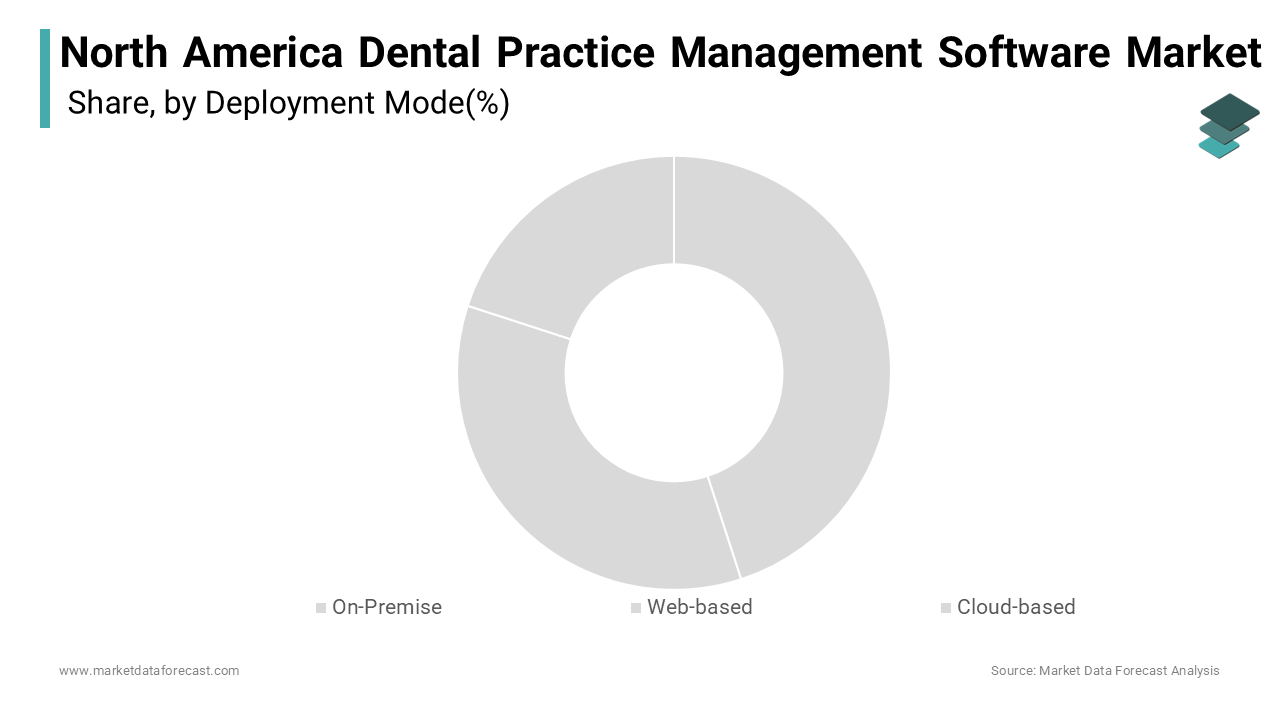
The cloud-based deployment segment is likely to grow with an anticipated CAGR of 15.8% from 2026 to 2034 with the flexibility and accessibility advantages that cloud-based solutions provide through remote access capabilities, mobile device compatibility, and multi-location support that enable modern dental practices to operate efficiently in distributed environments and support flexible work arrangements. The reduced infrastructure costs and simplified maintenance requirements that cloud-based deployments offer through elimination of server hardware investments, reduced IT staffing requirements, and automated software updates that reduce total cost of ownership and operational complexity for dental practices. These cost advantages are particularly compelling for solo practitioners and small group practices that operate on tight budgets.
By Application Insights
The invoice and billing applications segment held a dominant share of the North American dental practice management software market in 2025. This segment's overwhelming prevalence reflects the critical importance of financial management, insurance processing, and revenue optimization for dental practices that must maintain profitability while delivering quality patient care in increasingly competitive healthcare markets. Another significant driver is the revenue optimization and cash flow management requirements that compel dental practices to invest in sophisticated billing systems that maximize reimbursement rates, reduce claim denials, and accelerate payment collection through automated follow-up systems and integrated payment processing capabilities.
The patient communication segment is lucratively to grow with a CAGR of 18.4% from 2026 to 2034 with the increasing patient expectations for digital communication and convenient appointment management that require sophisticated software solutions to support online scheduling, automated reminders, mobile communication, and personalized patient engagement that enhance satisfaction and retention rates. The appointment optimization and no-show reduction capabilities that sophisticated patient communication systems provide through automated reminders, confirmation systems, and rescheduling capabilities that reduce revenue losses and improve practice efficiency through better appointment utilization and patient compliance. Furthermore, telehealth integration and remote patient management capabilities create opportunities for patient communication software to support virtual consultations, treatment monitoring, and ongoing patient engagement that extend care delivery beyond traditional office visits while maintaining patient relationships and practice revenue.
By End Use Insights
The dental clinics segment held a prominent share of the North America dental practice management software market in 2025 with the extensive network of private dental practices and group practices that create substantial demand for practice management software solutions to coordinate appointment scheduling, patient records management, financial operations, and clinical documentation requirements. The Specialty Dental Association indicates that over 60% of dental practices offer specialized services that require customized software capabilities and integrated treatment planning tools that support complex procedures and specialized care delivery approaches. Additionally, practice growth and expansion requirements drive sustained demand for scalable practice management software solutions that can accommodate increasing patient volumes, additional practitioners, multiple locations, and expanding service offerings while maintaining operational efficiency and data integrity. The Dental Practice Growth Institute reports that 65% of dental practices plan to expand services or locations within the next three years, creating demand for software solutions that can scale effectively and support complex multi-location operations while maintaining consistent data management and operational standards.
The hospital segment is anticipated to grow with a CAGR of 12.6% from 2026 to 2034 with the integrated healthcare delivery and electronic health record integration requirements that necessitate sophisticated dental practice management software solutions capable of interfacing with hospital information systems, sharing patient data, and coordinating care delivery across multiple healthcare disciplines. The Healthcare Information and Management Systems Society reports that over 85% of hospital dental departments require integration with electronic health records and patient management systems, creating demand for specialized software solutions that can navigate complex hospital IT environments while maintaining data security and regulatory compliance.
Furthermore, quality metrics and performance reporting requirements create opportunities for hospital dental practice management software to provide comprehensive analytics, outcome tracking, and performance reporting capabilities that support hospital quality initiatives and regulatory compliance requirements. The Healthcare Quality Research Institute reports that hospital dental departments must report on 25+ quality metrics annually, requiring sophisticated software solutions that can collect, analyze, and report on treatment outcomes, patient satisfaction, and operational performance that support hospital accreditation and quality improvement initiatives. These reporting requirements create sustained demand for comprehensive software solutions that support data-driven decision making and performance optimization.
REGIONAL ANALYSIS
United States Dental Practice Management Software Market Insights
The United States was the largest contributor of the North American dental practice management software market with 85.2% of the share in 2025 due to the extensive dental care infrastructure and diverse practice management requirements that characterize the U.S. dental market, including over 190,000 dental practices, 200,000+ dentists, and extensive specialty care delivery that creates substantial demand for sophisticated practice management software solutions. The American Dental Association reports that U.S. dental practices average 1,850 patient visits annually, requiring comprehensive software solutions that can coordinate complex scheduling, treatment coordination, and financial management requirements while supporting diverse practice types and operational needs. The sophisticated healthcare technology adoption and digital transformation trends that characterize U.S. dental practices, with extensive implementation of electronic health records, digital imaging, and automated practice management systems that require integrated software solutions and advanced technology capabilities. The Healthcare Information and Management Systems Society indicates that over 85% of U.S. dental practices utilize electronic health records, reflecting the critical importance of digital data management and integrated technology solutions for modern dental care delivery and practice operations. Additionally, regulatory complexity and compliance requirements across multiple federal, state, and insurance regulations create substantial demand for professional dental practice management software solutions that ensure regulatory adherence, maintain data security, and support compliance monitoring while protecting practices from regulatory violations and data breaches.
Canada Dental Practice Management Software Market Insights
Canada dental practice management software market by capturing 12.3% of the share in 2025. The Canadian market's substantial size reflects the country's strong dental care system, comprehensive healthcare technology adoption, and growing emphasis on integrated practice management solutions that support modern dental care delivery and operational efficiency. Furthermore, regulatory harmonization and privacy protection requirements create opportunities for dental practice management software providers to develop comprehensive solutions that support Canadian privacy laws, provincial healthcare regulations, and insurance requirements that ensure regulatory compliance and data protection throughout diverse provincial jurisdictions.
COMPETITIVE LANDSCAPE
The North American dental practice management software market presents a highly competitive landscape dominated by several large established players alongside numerous specialized software providers and emerging technology companies. Major vendors compete primarily on functionality, integration capabilities, user experience, and customer support rather than price alone, as dental practices increasingly prioritize comprehensive solutions that enhance operational efficiency and patient care delivery over basic cost considerations. The market dynamics are influenced by factors such as technological advancement, regulatory compliance requirements, and evolving practice management needs that drive continuous innovation and product development throughout the industry.
Competition intensifies across different market segments, with large enterprise solutions dominating multi-location practices and hospital systems while specialized solutions cater to specific dental specialties and practice types. The industry also witnesses ongoing consolidation as larger players acquire smaller competitors to expand functionality, geographic reach, and customer base. Market participants continuously adapt their business models to address changing regulatory environments, emerging technological trends, and shifting practice requirements while maintaining competitive positioning in an evolving marketplace that increasingly values innovation, integration, and user experience excellence.
KEY MARKET PLAYERS
Some of the key market players in the dental practice management software market include
- Henry Schein, Inc.
- Patterson Companies, Inc.
- Carestream Dental LLC
- CareStack
- Planet DDS, Inc.
- Curve Dental
- NextGen Healthcare, Inc.
- DentiMax LLC
- ACE Dental Software
- Datacon Dental Systems, Inc.
- Open Dental Software
- Practice-Web, Inc.
- Dental Intelligence, Inc.
- Jarvis Analytics
- iDentalSoft
- tab32
- Oryx Dental Software LLC
- ABELDent Inc.
- ClearDent
- Exan Software Inc. (axiUm)
Top Players in the Middle East And Africa Tragacanth Market
Royal Barksdale Company
Royal Barksdale Company has established itself as a leading supplier in the Middle East and Africa tragacanth market through decades of specialized trading experience and extensive regional distribution networks. The company's commitment to quality assurance and sustainable sourcing practices has enabled them to serve diverse industries including pharmaceuticals, food processing, and cosmetics across multiple countries. Their strategic partnerships with Iranian suppliers ensure consistent supply chain reliability while maintaining competitive pricing structures. The company's investment in processing facilities and quality control systems has enhanced product purity and customization capabilities by allowing them to meet specific customer requirements across different industrial applications and geographic markets.
Golnar Tragacanth Company
Golnar Tragacanth Company has gained significant market presence in the African tragacanth sector through innovative processing techniques and comprehensive regional coverage. The company specializes in producing pharmaceutical-grade tragacanth with enhanced solubility properties that cater to the growing healthcare manufacturing demand across the continent. Their integrated approach from raw material procurement to final product development ensures consistent quality control throughout the supply chain. Golnar's research and development initiatives have led to the creation of specialized formulations for specific industrial applications, which is positioning them as a preferred supplier among cosmetic and food processing companies seeking reliable and high-quality tragacanth solutions.
Persian Tragacanth Industries
Persian Tragacanth Industries represents a significant force in the regional market through their comprehensive product portfolio and strategic market expansion initiatives. The company has successfully penetrated both traditional and emerging markets by offering customized tragacanth solutions tailored to specific customer requirements and regional preferences. Their vertically integrated operations from raw material harvesting to finished product manufacturing ensure quality standards while maintaining competitive pricing. The company's focus on sustainable harvesting practices and community engagement programs has strengthened their reputation among environmentally conscious buyers by enabling them to capture substantial market share across diverse geographical territories and industrial sectors.
Top Strategies Used by Key Players in North America Dental Practice Management Software Market
Cloud Migration and SaaS Model Adoption
Leading companies in the North American dental practice management software market are aggressively transitioning from traditional on-premise solutions to cloud-based Software as a Service models that offer greater flexibility, scalability, and accessibility for dental practices of all sizes. This strategic shift involves developing robust cloud infrastructure, implementing advanced security protocols, and creating seamless migration pathways that enable existing customers to transition smoothly while attracting new users who prefer subscription-based pricing and reduced infrastructure requirements. Companies are also investing in mobile optimization, remote access capabilities, and multi-device compatibility that support modern dental practice workflows and telehealth requirements
Artificial Intelligence and Automation Integration
Market participants are incorporating artificial intelligence, machine learning, and automation technologies into their dental practice management software solutions to enhance operational efficiency, improve patient care delivery, and provide predictive analytics that support practice growth and optimization. These innovation initiatives include developing intelligent scheduling systems, automated billing and insurance processing capabilities, predictive patient behavior modeling, and clinical decision support tools that reduce administrative burden while improving practice performance outcomes. Companies are also implementing natural language processing for voice-activated commands, automated appointment reminders, and intelligent data entry systems that streamline daily operations.
Integration Ecosystem and Partnership Development
Major players are building comprehensive integration ecosystems and strategic partnerships with electronic health record systems, imaging equipment manufacturers, insurance companies, and other healthcare technology providers to create seamless workflows and enhanced value propositions for dental practices. These collaboration efforts enable software providers to offer comprehensive solutions that integrate with existing practice technologies, streamline data exchange processes, and reduce operational complexity for dental practices managing multiple technology platforms. Companies are also partnering with dental schools, professional associations, and continuing education providers to ensure their solutions meet evolving practice requirements and support professional development initiatives.
RECENT MARKET DEVELOPMENTS
- In February 2024, Henry Schein acquired Practice Solutions Group to expand their dental practice management software portfolio and strengthen their position in the cloud-based practice management market.
- In May 2024, Patterson Companies launched their new AI-powered patient communication platform integrated with their existing dental practice management software to enhance patient engagement and appointment scheduling capabilities.
- In July 2024, Carestream Dental acquired eAssist Solutions to enhance their revenue cycle management capabilities and expand their insurance processing and billing automation features.
- In October 2024, Planet DDS partnered with Microsoft Azure to migrate their dental practice management software to cloud infrastructure and improve data security and scalability for their customers.
- In December 2024, Dentrix acquired AppointmentPlus to integrate advanced scheduling and patient communication features into their comprehensive dental practice management platform.
MARKET SEGMENTATION
This research report on the North America Dental Practice Management Software Market is segmented and sub-segmented based on categories.
By Deployment Mode
- On-Premise
- Web-based
- Cloud-based
By Application
- Patient Communication
- Invoice/Billing
- Payment Processing
- Insurance Management
- Others
By End Use
- Dental Clinics
- Hospitals
- Others
By Country
- U.S.
- Canada
- Rest of North America