- Product Description Description
- Table of Contents TOC
- List of Table & Figure LOT
- Get Free Sample PDF Sample PDF
Market Size, 2025
$3.59 BnMarket Estimate, 2026
$3.88 BnMarket Forecast, 2034
$7.18 BnCAGR, 2026–2034
8.01%North America Ducted Heat Pump Market Summary
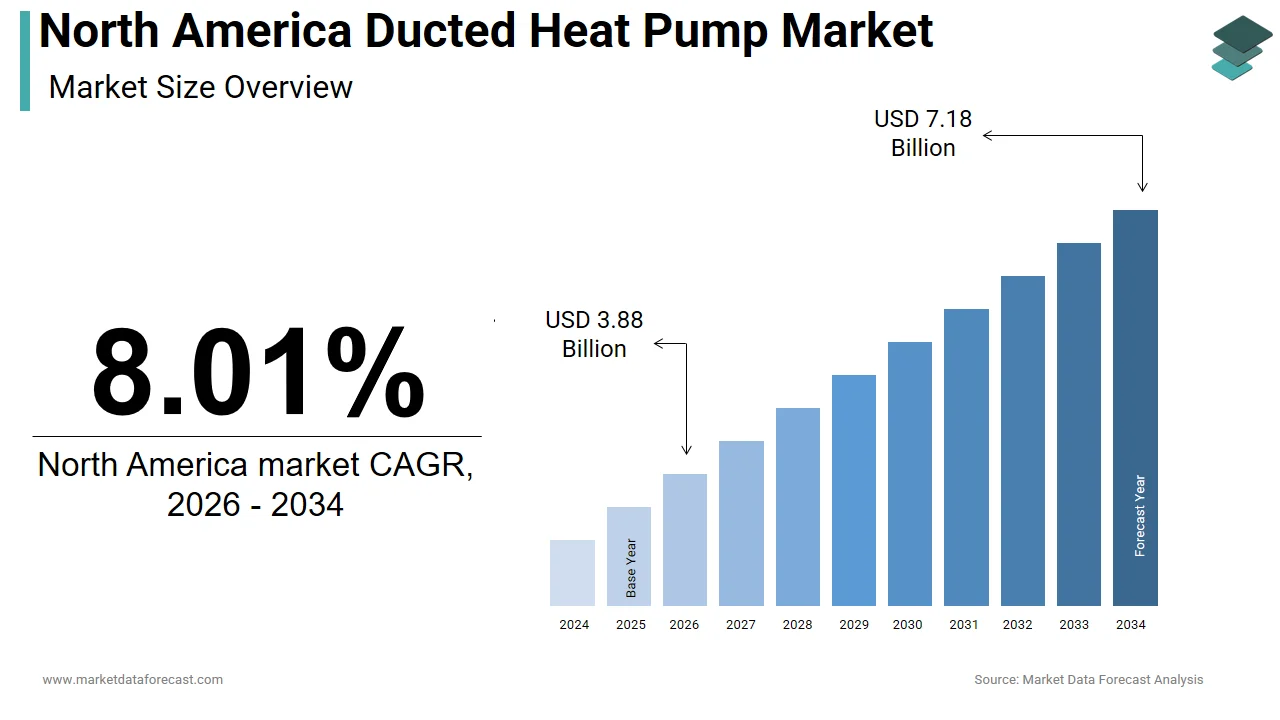
The North America ducted heat pump market is expanding rapidly, projected to grow from USD 3.88 billion in 2026 to USD 7.18 billion by 2034, driven by strong government incentives and a push for energy efficiency.
Market Snapshot (2026 to 2034)
- Base Year Value (2025): USD 3.59 Billion
- Current Valuation (2026): USD 3.88 Billion
- Projected Value (2034): USD 7.18 Billion
- CAGR: 8.01% (2026–2034)
- Primary Application: Residential segment
- Fastest Growth Segment: Commercial segment (8.9% CAGR projected)
Segmental Insights
The market is primarily defined by residential applications and air-source technology due to established duct infrastructure
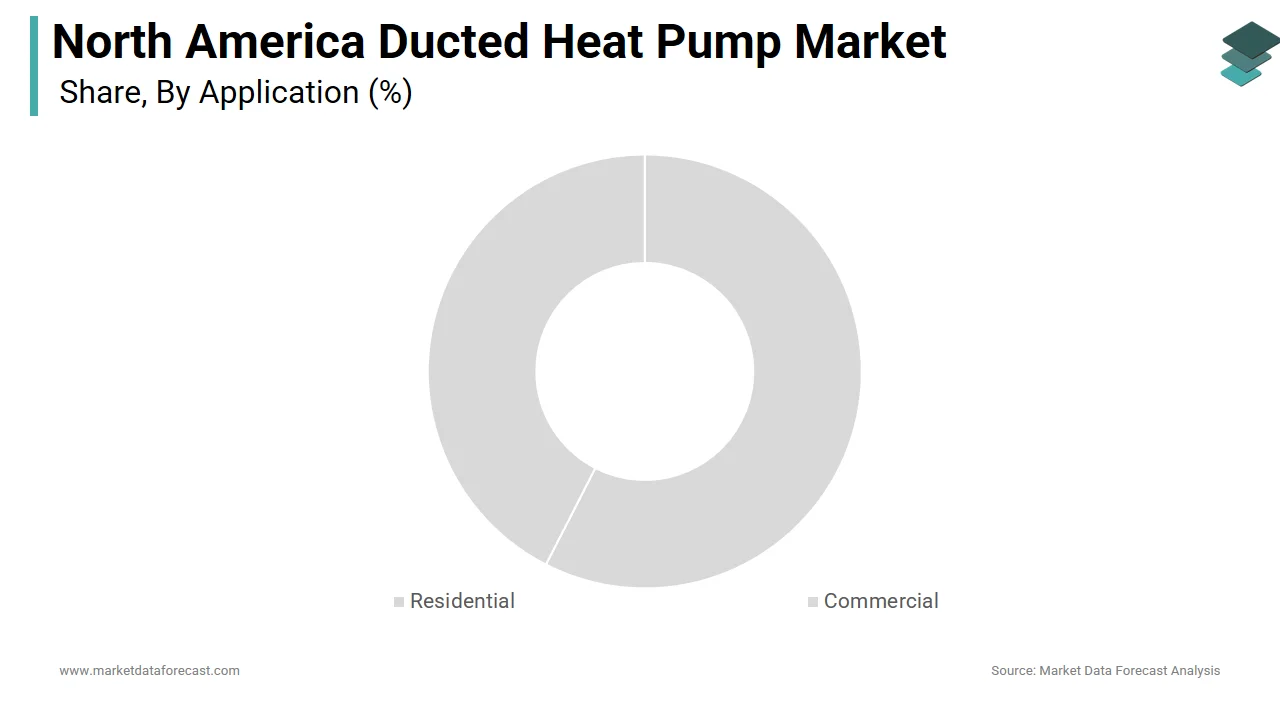
- Residential Segment: Dominated the market, accounting for over 80.3% of the market share in 2024. The demand is driven by homeowners seeking cost-effective, sustainable heating/cooling solutions.
- Commercial Segment: Expected to grow at a faster CAGR of 8.9% (2025-2033), driven by the need for efficient systems in offices, retail, and data centers.
Country-Level Performance
The United States is the dominant force in the regional market, with Canada as a significant and growing player.
- United States: Accounted for 88.8% of the North American heat pump market share in 2024. Growth is driven by strict energy-efficiency regulations and significant federal and state-level incentives for adopting cleaner technology.
- Canada: The second-largest market, exhibiting strong growth due to robust government support, such as the Oil to Heat Pump Affordability Program, which offers significant rebates to homeowners switching from oil-burning furnaces.
Leading Market Players
Competition is intense among global manufacturers, leveraging strong brand recognition and contractor relationships. Key players include Bard HVAC, Bosch Thermotechnology Corp., Carrier, Colmac Industries, DAIKIN INDUSTRIES Ltd., Glen Dimplex Group, Gree Electric Appliances, Inc., Johnson Controls, Lennox International Inc., LG Electronics, Lochinvar, Mitsubishi Electric Corporation, Rheem Manufacturing Company, SAMSUNG, and Trane.
North America Ducted Heat Pump Market Size
The North America ducted heat pump market was valued at USD 3.59 billion in 2025. The regional market is projected to grow from USD 3.88 billion in 2026 to reach USD 7.18 billion by 2034, registering a CAGR of 8.01% from 2026 to 2034.
A ducted heat pump is defined as an energy-efficient, central HVAC system that uses an outdoor unit and an indoor air handler connected by ductwork to distribute both heating and cooling throughout an entire home or building, offering uniform temperature control and acting as an eco-friendly alternative to combustion-based heating. According to the U.S. Energy Information Administration (EIA), the adoption of heat pumps for space conditioning in American households has been growing steadily in recent years, a trend supported by increasing sales that surpassed those of gas furnaces in 2022. Prompted by incentives and a push for energy efficiency, the adoption of heat pumps in Canadian homes is a growing trend, as per sources. Technological advancements have enabled these systems to function effectively even in colder climates, expanding their applicability across regions like the northern United States and much of Canada, where previously they were considered less viable. The integration of smart controls and variable-speed compressors has further enhanced performance, aligning with the rising demand for high-efficiency HVAC systems. Additionally, supportive government incentives and updated building codes emphasizing reduced carbon emissions are shaping the deployment landscape of ducted heat pumps in North America.
MARKET DRIVERS
Rising Demand for Energy-Efficient HVAC Systems
The growing emphasis on energy conservation is a key driver of the expansion of the North America ducted heat pump market. Ducted heat pumps offer coefficients of performance (COP) often exceeding 3.0, meaning they produce three times more energy output than electrical input, which significantly outperforms traditional electric resistance heaters. As per research, modern ducted systems can reduce heating costs compared to conventional furnaces when powered by electricity. Furthermore, federal initiatives such as the U.S. Department of Energy’s Heat Pump Challenge aim to accelerate deployment by supporting research into cold-climate heat pump technologies. This focus on decarbonization through electrification is particularly evident in states like California and provinces like British Columbia, where updated building codes now favor or mandate low-emission HVAC systems. These regulatory shifts, combined with utility rebate programs and tax incentives, are compelling homeowners and businesses to adopt ducted heat pump systems, thereby fueling market growth.
Technological Advancements Enhancing Performance in Cold Climates
Advancements in heat pump technology, particularly in cold-climate performance, are enabling broader adoption across the region, which is among the key accelerators of the North America ducted heat pump market. Historically, heat pumps were less effective in sub-freezing temperatures, limiting their use in northern regions. However, innovations such as variable refrigerant flow (VRF) systems, inverter-driven compressors, and enhanced defrost cycles have improved operational efficiency even at temperatures below -15°C. Manufacturers like Mitsubishi Electric and Carrier have introduced models specifically engineered for harsher conditions, contributing to increased consumer confidence. Besides, dual-fuel systems, which integrate heat pumps with gas furnaces, offer hybrid solutions that optimize efficiency while maintaining comfort during extreme weather. These developments are not only extending the geographic reach of ducted systems but also improving long-term economic viability, which encourages further market penetration.
MARKET RESTRAINTS
High Initial Installation Costs and Infrastructure Requirements
The high upfront cost of installing these systems remains a major barrier to the North America ducted heat pump market. A complete ducted system installation can involve substantial costs. The total expense for a new installation is influenced by factors such as the size of the building and the complexity of the project. The financial outlay for a complete ducted system installation is generally higher when compared to installing more conventional systems. Modifying older residences that do not have existing ductwork may result in additional expenses. The increased costs associated with retrofitting may influence an individual's decision to proceed with a system upgrade. Moreover, the requirement for properly sized ducting and adequate insulation adds to the complexity and expense, especially in older residential structures that dominate much of the housing stock in cities like Toronto and Boston. Labor costs also contribute significantly, as certified technicians are required to ensure optimal system performance and compliance with updated HVAC standards. The substantial initial investment continues to impede widespread acceptance, especially among middle-income households seeking value-driven climate control, even with operational savings and incentives designed to soften the financial impact.
Limited Awareness and Misconceptions Regarding Efficiency in Cold Climates
The lingering perception that these systems underperform in cold climates restrains the expansion of the North American ducted heat pump market. Many consumers remain skeptical about the ability of heat pumps to deliver adequate warmth during harsh winters, despite technological improvements. According to a study, a portion of respondents in colder regions expressed concerns about heat pump reliability during freezing temperatures. This misconception is compounded by outdated information and a lack of targeted consumer education campaigns. Furthermore, HVAC contractors themselves may be hesitant to recommend heat pumps in colder zones due to past performance issues, leading to inconsistent market messaging. As per research, only a portion of HVAC professionals in northern states actively promote heat pumps as primary heating systems. This knowledge gap hampers demand, particularly in rural and suburban markets where traditional heating methods like oil or propane furnaces remain prevalent. Building trust and overcoming skepticism requires a unified front from manufacturers, utilities, and regulators, using pilot programs and verified results to showcase tangible benefits.
MARKET OPPORTUNITIES
Government Incentives and Rebate Programs Driving Adoption
Government-led initiatives and financial incentives are generating new opportunities for growth in the North American ducted heat pump market. The United States government is providing substantial support for clean energy investments. Incentives are available for the installation of residential heat pumps. These incentives may lower the overall expense of owning such systems. The availability of these programs could encourage an increase in the number of heat pumps adopted by homeowners. A similar initiative in Canada also offers financial assistance for making homes more energy-efficient. This Canadian program includes support for the installation of specific types of heat pump systems. Many individuals have already participated in this Canadian program. Provincial programs in Quebec and Ontario further amplify this support through additional provincial rebates and low-interest financing options. These measures not only make systems more financially accessible but also align with broader climate objectives. Utilities are also playing a role by offering time-of-use rate structures that benefit heat pump users, enhancing long-term economic appeal. The convergence of federal, state, and utility-level incentives is creating a conducive environment for sustained market expansion.
Expansion of Smart HVAC Technologies and IoT Integration
The integration of smart technologies and Internet of Things (IoT) capabilities offers a fresh prospect for the expansion of the North American ducted heat pump market. Modern systems now feature Wi-Fi-enabled thermostats, remote monitoring, and predictive maintenance capabilities that enhance user experience and system efficiency. Leading manufacturers such as Lennox and Trane have introduced smart ducted systems that learn user preferences and adjust operations based on occupancy and weather forecasts. Apart from these, utility companies are leveraging smart controls to implement demand response programs, allowing consumers to reduce peak energy usage while maintaining comfort. The proliferation of voice-activated assistants and home automation platforms further supports seamless integration. These advancements not only improve usability but also provide valuable data analytics for optimizing performance, which creates new value propositions for both consumers and service providers.
MARKET CHALLENGES
Skilled Labor Shortage and Installation Complexity
The shortage of qualified technicians capable of handling complex installations and maintenance tasks is one of the key challenges facing the North American ducted heat pump market. As per sources, a notable portion of HVAC contractors report difficulties in hiring certified professionals, particularly in regions experiencing rapid market growth. Ducted systems require specialized knowledge in refrigerant handling, duct design, load calculations, and zoning strategies, which are not universally understood by general HVAC installers. Compounding the issue is the increasing sophistication of modern systems, which incorporate variable-speed compressors, smart controls, and advanced diagnostics that demand higher technical expertise. Training programs for heat pump and HVAC technicians offered by various vocational and trade schools can often be completed in a relatively short timeframe, which contrasts with the significant and ongoing demand for skilled professionals across the industry, contributing to a persistent labor shortage. This shortage not only delays project timelines but also increases labor costs, affecting overall affordability and customer satisfaction. In markets like the Pacific Northwest and Atlantic Canada, where demand is surging due to policy incentives, the lack of a skilled workforce is becoming a bottleneck. Insufficient investment in workforce training and certification could hinder the expansion of the ducted heat pump market.
Regulatory Variability and Compliance Complexity Across Jurisdictions
The fragmented regulatory landscape across the regional jurisdictions poses a major challenge for manufacturers and installers in the North America ducted heat pump market. Each state and province has distinct building codes, energy efficiency standards, and permitting requirements, complicating product development and market entry strategies. Regulatory landscapes for HVAC equipment across North America are highly fragmented, with distinct energy efficiency standards and installation mandates varying significantly between different states, provinces, and local jurisdictions. This regulatory diversity, which includes unique requirements in places like California compared to other regions, necessitates that manufacturers produce specialized products and documentation to comply with each specific market's code requirements. This regulatory heterogeneity also affects incentive eligibility, as programs and regional utility rebates often have varying criteria. Installers must navigate differing permit processes, inspection protocols, and labeling requirements, which can increase administrative burden and project costs. The lack of harmonization also hinders scalability for smaller contractors operating across multiple jurisdictions. Organizations are attempting to standardize, but these efforts are advancing slowly. A lack of regulatory unification will persistently hinder efficient market expansion and the rollout of innovations.
REPORT COVERAGE
| REPORT METRIC | DETAILS |
| Market Size Available | 2025 to 2034 |
| Base Year | 2025 |
| Forecast Period | 2026 to 2033 |
| Segments Covered | By Application and County. |
| Various Analyses Covered | Global, Regional, and Country-Level Analysis, Segment-Level Analysis, Drivers, Restraints, Opportunities, Challenges; PESTLE Analysis; Porter’s Five Forces Analysis, Competitive Landscape, Analyst Overview of Investment Opportunities |
| Countries Covered | United States, Canada, Mexico, Rest of North America |
| Market Leaders Profiled | Bard HVAC, Bosch Thermotechnology Corp., Carrier, Colmac Industries, DAIKIN INDUSTRIES Ltd., Glen Dimplex Group, Gree Electric Appliances, Inc., Johnson Controls, Lennox International Inc., LG Electronics, Lochinvar, Mitsubishi Electric Corporation, Rheem Manufacturing Company, SAMSUNG, Trane, and Others. |
SEGMENTAL ANALYSIS
By Application Insights
The residential segment dominated the North America ducted heat pump market by accounting for a substantial share in 2026. The dominance of the residential segment is primarily driven by the substantial housing stock and ongoing residential construction activities across the region. Single-family homes represent the majority within this segment, comprising about a portion of residential installations, while multi-family units account for the remaining. The continuous growth in single-family housing construction serves as the primary catalyst for residential ducted heat pump adoption. Canada's housing market shows similar momentum. These construction activities create substantial demand for new HVAC systems, with ducted heat pumps gaining preference due to their energy efficiency and compatibility with forced-air distribution systems. New residential constructions in energy-efficient communities are increasingly specifying heat pump installations as standard equipment. The lifecycle of residential heating and cooling systems necessitates a consistent market for equipment replacements. A substantial number of existing homes require system upgrades, which provide opportunities for the installation of ducted heat pumps. Government initiatives and financial incentives at both federal and state/provincial levels significantly drive residential adoption of ducted heat pump systems. Government programs in North America provide financial support, often as rebates, for energy-efficient home heating and cooling systems. These initiatives exist at national and sub-national levels, with many regional jurisdictions offering additional incentives that can be combined for single installations, encouraging the adoption of efficient energy solutions in residential buildings. These financial supports substantially reduce the payback period for homeowners, making ducted systems economically attractive. Utility companies further amplify this effect through time-of-use rate structures that benefit heat pump users, with numerous utilities across North America offering special tariffs. The convergence of federal tax credits, state rebates, and utility programs creates a compelling value proposition that drives residential market dominance.
The commercial segment is anticipated to witness the fastest CAGR of 8.9% from 2025 to 2033. The rapid growth of the commercial segment is fuelled by increasing corporate sustainability commitments, evolving building codes, and the economic advantages of centralized climate control systems in commercial facilities. Corporate environmental responsibility commitments are propelling commercial ducted heat pump adoption across North America. Companies are increasingly mandating energy-efficient HVAC systems to meet Environmental, Social, and Governance criteria, with a portion of Fortune 500 companies setting net-zero carbon targets by 2050. Commercial buildings consume a notable portion of energy in North America. HVAC optimization is a primary focus for individuals overseeing these facilities. Ducted heat pump systems serve as a method for meeting energy reduction objectives. Variable refrigerant flow systems offer energy savings when utilized as an alternative to traditional rooftop units. Besides, the International Finance Corporation indicates that green building certifications can increase property values, incentivizing commercial property owners to invest in advanced HVAC technologies. These sustainability drivers are particularly prominent in sectors like healthcare, education, and retail, where continuous climate control is essential. Innovations in commercial-scale ducted heat pump technology are enabling broader adoption across diverse building types and applications. Modern commercial systems feature advanced controls, multi-zone capabilities, and enhanced part-load performance that address previous limitations in large-scale applications. Variable-speed compressors and intelligent defrost cycles have resolved concerns about performance in cold climates, expanding applicability to northern commercial facilities. Apart from these, the integration of building management systems allows for centralized monitoring and optimization, appealing to facility managers seeking operational efficiency. These technological improvements, combined with reduced maintenance requirements and extended equipment lifespans, are making commercial ducted systems increasingly attractive for new construction and retrofit projects.
COUNTRY-LEVEL ANALYSIS
United States Ducted Heat Pump Market Analysis
The United States led the North American ducted heat pump market by capturing a substantial share in 2025. The leading position of the United States is supported by the country's vast housing stock, robust construction industry, and comprehensive policy framework supporting energy-efficient technologies. The U.S. market is characterized by diverse regional adoption patterns, with the Pacific Northwest and Southeast showing particularly strong growth due to favorable climate conditions and progressive energy policies. The American market benefits from substantial federal and state-level support mechanisms that drive widespread adoption. Many households currently use heat pumps for controlling indoor temperature, with the number of homes using this technology anticipated to grow. This increase is influenced by supportive policies and a rise in public knowledge, alongside regional government efforts and state-level initiatives. Reports indicate a general upward trend in residential heat pump installations over a recent period. Additionally, the Northeast region demonstrates growing adoption rates, with Vermont achieving the highest per-capita heat pump installation rate in the nation. Market dynamics are further influenced by utility programs. The convergence of supportive policies, technological advancement, and consumer education continues to solidify the United States' commanding position in the regional market.
Canada Ducted Heat Pump Market Analysis
Canada was the second-largest player in the North America ducted heat pump market due to strong government support and increasing awareness of energy efficiency benefits. The Canadian market is characterized by concentrated adoption in provinces like British Columbia, Quebec, and Nova Scotia, where supportive policies and climate conditions favor heat pump technology. Canadian adoption patterns reflect strong policy support and consumer engagement with energy-efficient technologies. A growing number of households in Canada are installing heat pumps. Government incentives appear to be a key driver for heat pump installations. Federal and provincial initiatives support homeowners in adopting heat pump technology. Various provincial programs are in place to encourage the transition to heat pumps. Across different provinces, there is significant interest in heat pump technology. Builders are increasingly incorporating heat pump systems into new home construction. Energy-efficient housing developments frequently feature heat pump technology as a standard option. Cold-climate technology improvements have addressed previous performance concerns, enabling broader geographic adoption. These factors, combined with rising electricity rates and carbon pricing mechanisms, position Canada as a rapidly growing segment within the North American market.
COMPETITIVE LANDSCAPE
The North American ducted heat pump market exhibits intense competition characterized by the presence of established global manufacturers alongside emerging regional players. Market dynamics are shaped by technological innovation, pricing strategies, and brand recognition, with competition intensifying as adoption rates accelerate. Established players leverage extensive distribution networks, comprehensive product portfolios, and strong brand equity to maintain market positions, while newer entrants focus on disruptive technologies and competitive pricing. The competitive landscape is influenced by varying regional preferences, with different manufacturers achieving stronger positions in specific geographic areas based on local partnerships and market understanding. Contractor relationships play a crucial role in market competition, as installation expertise and service capabilities significantly influence purchasing decisions. Companies compete through product differentiation, warranty offerings, and customer support services. The market also experiences competition from alternative HVAC technologies, requiring manufacturers to continuously demonstrate value propositions. Brand loyalty remains important, though incentive programs and changing consumer preferences create opportunities for market share shifts. Competition extends beyond product features to include financing options, installation support, and digital integration capabilities.
KEY MARKET PLAYERS
The leading companies operating in the North America ducted heat pump market include:
- Bard HVAC
- Bosch Thermotechnology Corp.
- Carrier
- Colmac Industries
- DAIKIN INDUSTRIES Ltd.
- Glen Dimplex Group
- Gree Electric Appliances, Inc.
- Johnson Controls
- Lennox International Inc.
- LG Electronics
- Lochinvar
- Mitsubishi Electric Corporation
- Rheem Manufacturing Company
- SAMSUNG
- Trane
TOP PLAYERS IN THE MARKET
- Carrier stands as a dominant force in the North American ducted heat pump market, leveraging its extensive manufacturing capabilities and innovative product portfolio. The company's Bryant and Carrier brand systems are widely recognized for their reliability and energy efficiency. Their contribution to the global market extends through advanced inverter technology and smart controls integration. Carrier's extensive distribution network spans across residential and commercial sectors, supported by comprehensive dealer partnerships. The company's focus on cold-climate performance solutions has positioned it as a leader in expanding heat pump adoption in traditionally challenging regions. Their commitment to research and development has resulted in breakthrough technologies, including variable-speed compressors and advanced defrost systems. Carrier's global presence enables technology transfer from international markets, incorporating best practices and innovations from worldwide operations into North American product offerings.
- Trane Technologies maintains a strong market position through its dual-brand strategy featuring Trane and American Standard products. The company's emphasis on premium residential and commercial solutions has established it as a preferred choice for high-efficiency applications. Their contribution to the global market includes pioneering variable refrigerant flow systems and advanced building automation integration. Trane's commitment to sustainability drives continuous innovation in heat pump technology, with a focus on reducing environmental impact while maximizing performance. The company's extensive service network and training programs support contractor partnerships throughout North America. Their research initiatives in smart building technologies and IoT integration position them at the forefront of digital transformation in HVAC systems. Trane's global manufacturing footprint enables cost-effective production while maintaining quality standards, supporting competitive pricing strategies in the North American market.
- Mitsubishi Electric holds a significant position in the North American ducted heat pump market through its innovative Zoned Comfort Solutions and commercial VRF systems. The company's contribution to the global market stems from decades of heat pump technology development, particularly in mini-split and ducted applications. Their Hyper-Heating INVERTER technology has revolutionized cold-climate performance, enabling effective operation in extreme temperatures. Mitsubishi's focus on precision climate control and energy efficiency has made it a preferred choice for discerning consumers and commercial applications. The company's commitment to quality manufacturing and reliability has established strong brand loyalty among contractors and end-users. Their extensive training programs and technical support infrastructure support widespread adoption. Mitsubishi's global technology development centers enable continuous innovation, with North American operations benefiting from worldwide research initiatives and product development efforts.
TOP STRATEGIES USED BY KEY MARKET PARTICIPANTS
Strategic Partnerships and Distribution Network Expansion Leading manufacturers in the North American ducted heat pump market actively pursue strategic partnerships with contractors, distributors, and utility companies to strengthen market penetration. These collaborations focus on training programs, joint marketing initiatives, and exclusive distribution agreements that enhance product availability and technical support. Companies invest significantly in developing comprehensive dealer networks that provide installation expertise and ongoing service capabilities. Partnership strategies also include working with home builders and renovation contractors to integrate ducted systems into new construction projects. These alliances enable manufacturers to leverage existing market relationships while expanding their reach into previously untapped geographic regions and customer segments.
Technology Innovation and Product Development Key players continuously invest in research and development to advance heat pump technology and differentiate their offerings. Innovation strategies focus on improving energy efficiency, enhancing cold-climate performance, and integrating smart building technologies. Companies develop proprietary inverter technologies, advanced control systems, and improved heat exchanger designs to optimize system performance. Product development efforts also emphasize reducing installation complexity and improving user interface experiences. Manufacturers invest in testing facilities and certification programs to validate performance claims and ensure regulatory compliance. These innovation strategies enable companies to command premium pricing while addressing evolving customer requirements for energy efficiency and smart home integration.
Government Program Participation and Incentive Alignment Market leaders actively engage with government agencies and utility programs to maximize the impact of incentive initiatives on market adoption. These strategies involve participating in rebate programs, contributing to policy development discussions, and aligning product offerings with energy efficiency standards. Companies develop specialized product lines that meet specific program requirements and collaborate with utilities to design effective consumer outreach campaigns. Participation strategies also include supporting contractor training programs funded through government initiatives and contributing technical expertise to standards development organizations. These approaches enable manufacturers to capture increased market share during periods of heightened incentive activity while building long-term relationships with key stakeholders.
NORTH AMERICA DUCTED HEAT PUMP MARKET NEWS
- In March 2024, Carrier Global Corporation launched its new Infinity Series ducted heat pump systems featuring advanced variable-speed technology and smart home integration capabilities. This product launch expanded their premium residential offerings and strengthened their position in the high-efficiency segment.
- In July 2024, Trane Technologies announced a strategic partnership with Home Depot to expand retail availability of American Standard ducted heat pump systems through select store locations. This collaboration aimed to increase consumer accessibility and contractor support services.
- In September 2024, Mitsubishi Electric Corporation acquired a controlling interest in a regional HVAC distribution company to enhance its supply chain capabilities and improve product availability across the Pacific Northwest market.
- In January 2024, Lennox International introduced its new Davey brand ducted heat pump systems specifically designed for cold climate applications, targeting the growing Northeastern U.S. market segment.
- In November 2023, Goodman Global Group launched an expanded contractor training program focused on ducted heat pump installation and service, partnering with HVAC technical schools across multiple states to address skilled labor shortages.
MARKET SEGMENTATION
This research report on the North America ducted heat pump market has been segmented and sub-segmented into the following categories.
By Application
- Residential
- Single Family
- Multi Family
- Commercial
By Country
- United States
- Canada
- Mexico
- Rest of North America