- Product Description Description
- Table of Contents TOC
- List of Table & Figure LOT
- Get Free Sample PDF Sample PDF
Market Size, 2025
$2.95 BnMarket Estimate, 2026
$5.06 BnMarket Forecast, 2034
$375.84 BnCAGR, 2026–2034
71.36%North America Electric Truck Market Size, Share & Growth Analysis (2026–2034)
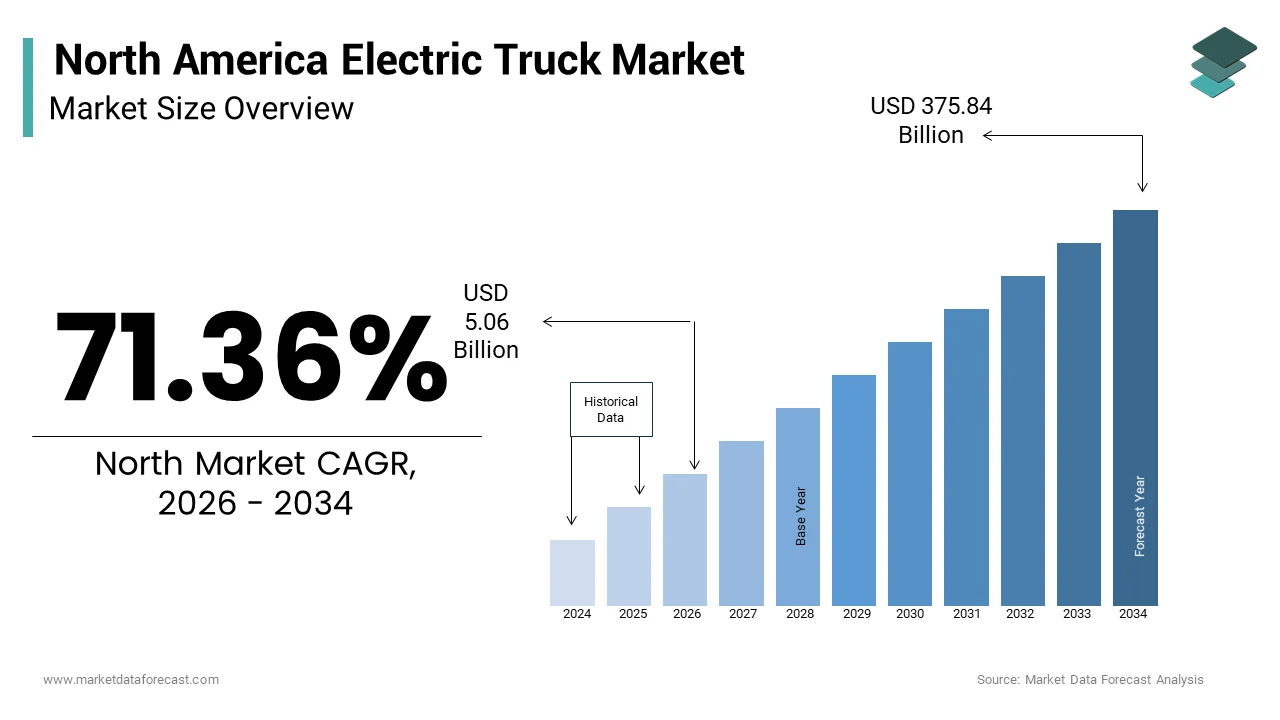
The North American electric truck market was valued at USD 2.95 billion in 2025, reaching USD 5.06 billion in 2026, and is projected to expand to USD 375.84 billion by 2034, registering an explosive compound annual growth rate (CAGR) of 71.36% during the forecast period from 2026 to 2034.
- Market Scope: Comprehensive regional assessment covering vehicle classes (light, medium, and heavy-duty), axle configurations, applications, propulsion types, superstructures, battery capacities, range categories, and key country markets across the United States, Canada, and Mexico.
- Primary Growth Drivers: Proliferation of e-commerce and last-mile delivery demands, lucrative federal and state-level incentive programs (such as the U.S. Inflation Reduction Act and California’s HVIP), and stringent greenhouse gas emission mandates.
Key Market Segment Metrics
| Category | Leading Segment | Fastest-Growing / Promising Segment |
|---|---|---|
| By Vehicle Type & Axle | Light-Duty Trucks (45.3% share in 2024 for urban logistics/delivery vans) & 2-Axle Configuration (dominant for short-haul use) | Heavy-Duty Electric Trucks (Growing at a 58.3% CAGR) & 4-Axle Trucks (Expanding at a 62.1% CAGR for industrial/port applications) |
| By Application & Country | On-Road Applications (holding prominent share due to e-commerce expansion) & United States (Dominant regional market holding 80.3% share in 2024) | Off-Road Electric Trucks (Projected at a 56.3% CAGR) & Canada (Scaling rapidly via ZEV mandates and federal funding) |
Major Market Players & Industry Landscape
Competitive Structure: A fast-evolving landscape characterized by traditional commercial truck manufacturing giants and innovative EV pure-plays competing through vertical integration, charging infrastructure partnerships, and custom fleet deployment.
Leading Companies: Tesla, Inc., Rivian Automotive, Freightliner (Daimler Truck North America), Volvo Trucks, Nikola Corporation, PACCAR, BYD, Hino, Isuzu, and Traton.
 Download Free Sample Report
North America Electric Truck Market Size
The North America Electric Truck Market Size will reach USD 2.95 billion in 2025 and is anticipated to reach USD 5.06 billion in 2026, to reach USD 375.84 billion by 2034, growing at a CAGR of 71.36% during the forecast period from 2026 to 2034.
The electric truck vehicles range from light-duty delivery vans to heavy-duty semi-trucks, all operating on electric propulsion systems to replace or supplement traditional internal combustion engines. The market has gained significant traction in recent years due to increasing environmental awareness, government incentives, and advancements in battery technology.
MARKET DRIVERS
Expansion of E-commerce and Last-Mile Delivery Demand
The rapid growth of e-commerce has significantly increased the demand for last-mile delivery services is escalating the growth of the North America Electric Truck Market. This surge has placed immense pressure on logistics companies to enhance delivery efficiency while reducing emissions in urban centers. Electric trucks, particularly light- and medium-duty models, are well-suited for frequent stop-and-go urban routes due to their energy efficiency and lower operating costs. For instance, Amazon has committed to deploying 100,000 electric delivery vans by 2030, with Rivian supplying a major portion of this fleet. As per the Edison Electric Institute, electric delivery trucks can reduce fuel costs by up to 60% compared to diesel counterparts, making them an economically viable solution for high-frequency logistics operations.
Federal and State-Level Incentive Programs
The government incentives at both the federal and state levels are additionally to fuel the growth of the North American Electric Truck Market. The U.S. Inflation Reduction Act (IRA), passed in 2022, allocates over $370 billion toward clean energy and transportation initiatives, including tax credits for commercial electric vehicle purchases. Under the IRA, businesses can receive up to $40,000 in tax credits per electric truck, significantly lowering the total cost of ownership. As per the U.S. Department of the Treasury, more than 800 companies applied for these credits within the first year of the program's implementation. At the state level, California’s Hybrid and Zero-Emission Truck and Bus Voucher Incentive Project (HVIP) has disbursed over $1.2 billion in incentives since 2018, directly supporting the purchase of over 18,000 zero-emission commercial vehicles. These financial incentives, combined with emission mandates such as California’s Advanced Clean Trucks (ACT) rule, are encouraging fleet operators to transition to electric alternatives.
MARKET RESTRAINTS
High Upfront Costs and Total Cost of Ownership Barriers
The high upfront cost of electric trucks is restricting the growth of the North American electric Truck Market. According to the North American Council for Freight Efficiency (NACFE), the average price of an electric Class 8 truck is approximately $200,000–$250,000, compared to around $130,000 for a diesel-powered equivalent. While long-term operational savings can offset this initial investment, many small and mid-sized fleet operators lack the capital to make such large upfront expenditures. Additionally, the total cost of ownership (TCO) for electric trucks is still higher in certain use cases, especially for long-haul applications where battery weight and charging infrastructure limitations increase costs.
Limited Charging Infrastructure for Heavy-Duty Applications
The lack of a robust and standardized charging infrastructure tailored for heavy-duty electric trucks is also hampering the growth of the North American electric truck market. As per the Alternative Fuels Data Center, the U.S. had fewer than 500 public high-power charging stations dedicated to commercial vehicles as of 2023. This scarcity is particularly acute in rural and long-haul freight corridors, where diesel trucks currently dominate due to the widespread availability of refueling stations. Moreover, the lack of standardization in charging connectors and protocols complicates fleet operations. Companies like Tesla and Daimler Truck North America have called for federal investment in a national charging network, similar to the European Union’s TEN-T initiative.
MARKET OPPORTUNITIES
Growth of Urban Freight Electrification Initiatives
The urban freight electrification is expected to boost the growth of the North American electric truck market. Many metropolitan areas are implementing clean air zones and zero-emission delivery mandates to combat urban pollution. For example, the City of Los Angeles has set a target to achieve 100% zero-emission freight movement at its ports by 2035 under the Clean Air Action Plan. The rise of micro-fulfillment centers in city outskirts is also boosting demand for short-range electric trucks, as retailers seek to reduce last-mile emissions.
Development of Domestic Battery Manufacturing and Supply Chain Localization
The expansion of domestic battery manufacturing will additionally feature growth opportunities for the North American electric truck market. The U.S. Department of Energy has identified battery production as a strategic priority under the Inflation Reduction Act, with over $7.5 billion allocated for building a domestic battery materials supply chain. This localized production is reducing battery costs, which account for approximately 30–40% of an electric truck’s total cost. For instance, Tesla’s 4680 battery cells, produced at its Gigafactory in Texas, are projected to cut battery costs by 14% per kWh by 2025.
MARKET CHALLENGES
Battery Performance Limitations in Cold Climates
The reduced battery performance and efficiency in cold climates in northern U.S. states and Canadian provinces will slow the growth of the North American electric truck market. Lithium-ion batteries, which power most electric trucks, experience significant degradation in performance when exposed to low temperatures. According to the U.S. Department of Energy’s National Renewable Energy Laboratory (NREL), battery efficiency can drop by up to 40% in sub-zero temperatures, leading to reduced range and increased charging frequency. This poses a major operational challenge for fleets operating in regions like Minnesota, Michigan, and Alberta, where winter temperatures frequently fall below freezing. As per a 2023 study by the International Council on Clean Transportation (ICCT), electric trucks in cold climates may require up to 30% more energy per mile compared to those operating in temperate conditions. Additionally, cold weather can prolong charging times, further complicating logistics planning. Companies like Nikola and Daimler Truck North America are investing in battery thermal management systems to mitigate these effects, but widespread adoption of such technologies remains limited.
Workforce Training and Technical Skill Gaps in EV Maintenance
The shortage of skilled technicians trained in electric vehicle (EV) maintenance and repair is challenging the growth of the North American electric truck market. According to the National Institute for Automotive Service Excellence (ASE), fewer than 15% of certified automotive technicians in the U.S. are trained in high-voltage EV systems. This skills gap is delaying fleet operators' ability to service and maintain their electric truck fleets efficiently. Additionally, vocational training programs have been slow to adapt to the rising demand for EV-specific education. The U.S. Department of Labor estimates that over 100,000 new EV-trained technicians will be needed by 2030 to support the growing electric commercial vehicle market.
REPORT COVERAGE
| REPORT METRIC | DETAILS |
| Market Size Available | 2025 to 2034 |
| Base Year | 2025 |
| Forecast Period | 2026 to 2034 |
| CAGR | 71.36% |
| Segments Covered | By Vehicle, Axel, Application, Propulsion, Super Structure, Battery Capacity, Range Capacity, and Region. |
| Various Analyses Covered | Global, Regional, & Country Level Analysis, Segment-Level Analysis, DROC, PESTLE Analysis, Porter’s Five Forces Analysis, Competitive Landscape, Analyst Overview on Investment Opportunities |
| Regions Covered | The United States, Canada, Mexico, And By Country |
| Market Leaders Profiled | BYD, DAF Trucks, Daimler, Hino, Isuzu, Nikola Corporation, PACCAR, Renault, Traton, Volvo. |
SEGMENTAL ANALYSIS
By Vehicle Insights
The light-duty trucks segment accounted in holding 45.3% of the North America electric truck market share in 2024, with the electric vans and pickup trucks used primarily for urban delivery, logistics, and fleet-based commercial operations. Additionally, light-duty electric trucks benefit from shorter payback periods due to lower battery requirements and favorable incentive programs. The U.S. Inflation Reduction Act offers up to $7,500 in tax credits per vehicle, while state-level programs such as California’s HVIP provide direct purchase incentives.
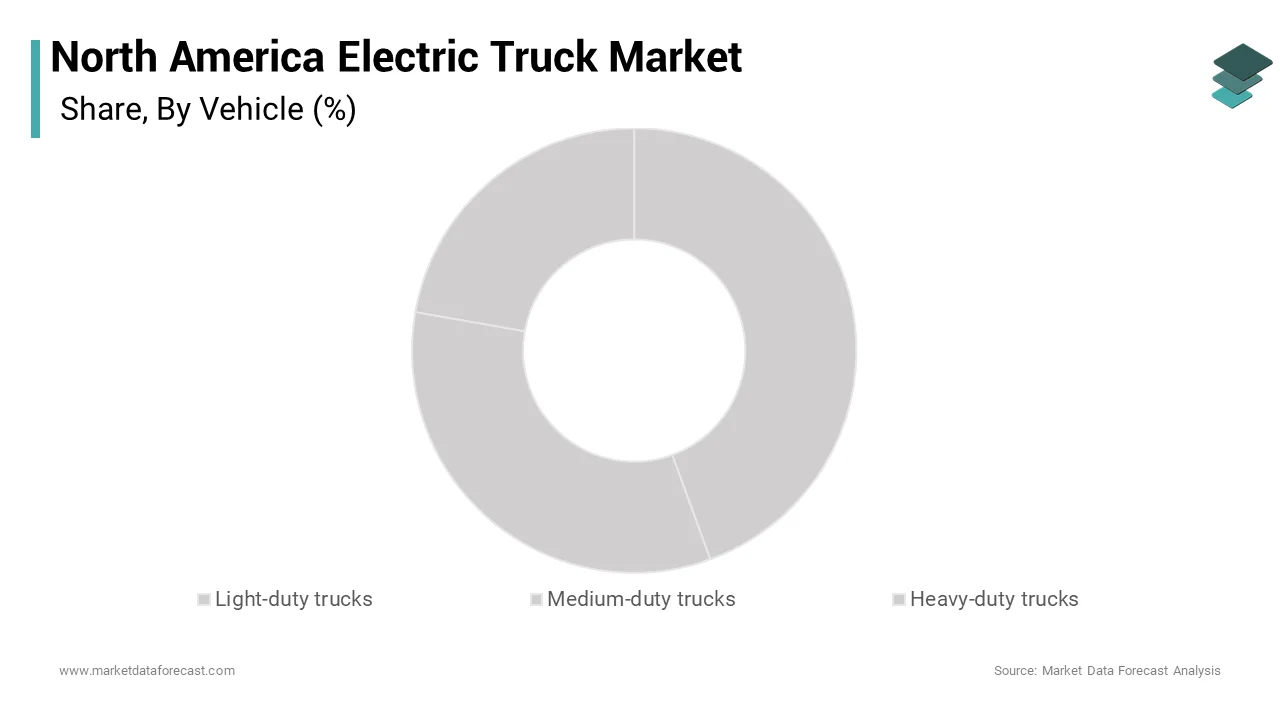
The heavy-duty electric truck segment is projected to grow with a CAGR of 58.3% during the forecast period, with the advancements in battery technology, increased investment in long-haul charging infrastructure, and regulatory mandates pushing for freight decarbonization. The U.S. Environmental Protection Agency (EPA) has introduced stricter emissions standards under the Clean Trucks Plan, which requires a 25% reduction in nitrogen oxide emissions from heavy-duty vehicles by 2027. Companies like Tesla, with its Semi model, and Daimler Truck North America, with the Freightliner eCascadia, are leading the charge in commercializing electric Class 8 trucks. Tesla has already secured over 3,000 pre-orders from major logistics firms, including PepsiCo and JB Hunt.
By Axle Configuration Insights
The 2-axle configuration segment held a dominant share of the North America electric truck market in 2024, with the electric light- and medium-duty trucks used in urban delivery, logistics, and municipal services. The dominance of 2-axle trucks is attributed to their suitability for short-haul operations, where frequent stops, lower payload demands, and predictable route patterns align well with the current capabilities of electric powertrains. For instance, electric delivery vans such as the Ford E-Transit and Rivian EDV are widely adopted by logistics companies like Amazon and FedEx, which together have deployed over 15,000 electric vans across North America. Additionally, 2-axle trucks benefit from lower acquisition costs compared to heavier configurations, with the average price of an electric light-duty truck dropping below $60,000 after federal tax credits under the Inflation Reduction Act. Cities like Los Angeles and New York are also accelerating adoption through local procurement initiatives and emissions-based access restrictions, encouraging fleet operators to prioritize 2-axle electric vehicles.
The 4-axle electric truck segment is projected to grow with a CAGR of 62.1% in the coming years, with the electric trucks used in heavy-haul, construction, and port operations, where high payload capacity and stability are important. The rapid growth of this segment is driven by increasing demand for zero-emission solutions in industrial and port logistics in regions like California and British Columbia, which have introduced stringent emissions regulations for freight and construction equipment. The Port of Los Angeles, for example, has committed to achieving a fully zero-emission drayage fleet by 2035 under its Clean Air Action Plan. Companies such as Orange EV and Lion Electric are supplying electric 4-axle terminal tractors and refuse trucks to major ports and municipalities. According to the International Council on Clean Transportation (ICCT), electric 4-axle trucks can reduce operating costs by up to 50% over their lifetime due to lower fuel and maintenance expenses. Additionally, the U.S. Department of Energy is supporting the deployment of electric terminal tractors through its Clean Cities Coalition, which has funded over 200 electric freight vehicles at major ports.
By Application Insights
The on-road application segment is expected to hold a prominent share of the North America electric truck market in 2024 due to the expansion of e-commerce, government mandates for fleet electrification, and the growing availability of charging infrastructure. Companies like Tesla, Rivian, and Volvo Trucks have launched electric models tailored for on-road use, with Tesla’s Semi securing over 3,000 pre-orders from major logistics firms. In addition, California’s Advanced Clean Trucks (ACT) regulation mandates that 40% of all new truck sales must be zero-emission by 2035, further accelerating on-road adoption.
The off-road electric truck segment is anticipated to grow with a CAGR of 56.3% from 2025 to 2033. The rapid growth of this segment is fueled by increasing environmental regulations and the need for cleaner alternatives in heavy industrial applications. Companies like Komatsu and Caterpillar are introducing electric haul trucks for mining operations, while Lion Electric and Orange EV are supplying electric dump trucks and terminal tractors for construction and port use. According to Natural Resources Canada, off-road electrification could reduce greenhouse gas emissions by up to 1.2 million metric tons annually by 2030. Additionally, off-road electric trucks offer significant operational benefits, including lower noise levels, reduced maintenance costs, and improved performance in enclosed environments.
COUNTRY-LEVEL ANALYSIS
United States
The United States was the largest contributor in the North American electric truck market with 80.3% of the share in 2024, with a combination of federal incentives, aggressive state-level policies, and strong private-sector commitments. The Inflation Reduction Act (IRA) provides tax credits of up to $40,000 per electric truck, significantly reducing the total cost of ownership for fleet operators. Additionally, California’s Advanced Clean Trucks (ACT) regulation mandates that 55% of new Class 2b–8 truck sales must be zero-emission by 2035, setting a strong regulatory foundation for electrification. Major logistics companies such as Amazon, UPS, and FedEx have placed large-scale orders for electric delivery vans, with Amazon deploying over 10,000 Rivian vans across the country. The Department of Transportation’s National Electric Vehicle Infrastructure (NEVI) Fund is also accelerating the deployment of high-power charging stations along major freight corridors.
Canada
Canadian electric truck market is anticipated to have a significant CAGR in the coming years. The Canadian government has committed over CAD 1.8 billion in funding for zero-emission transportation under its Zero Emission Vehicle (ZEV) program, including direct incentives for commercial electric vehicle purchases. Quebec and British Columbia are leading the charge, with Quebec’s ZEV mandate requiring 30% of new commercial vehicle sales to be zero-emission by 2030. The Port of Vancouver has also launched a Green Truck Program, offering subsidies for electric terminal tractors and drayage trucks. Additionally, Canadian battery manufacturers such as Lithion and Electra are strengthening the domestic supply chain, reducing costs for local fleet operators. According to the International Council on Clean Transportation (ICCT), Canada’s electric commercial vehicle adoption is expected to grow at a CAGR of 45% through 2030.
COMPETITIVE LANDSCAPE
The competitive landscape of the North American electric truck market is rapidly evolving as traditional truck manufacturers, new-age electric vehicle startups, and technology-driven firms vie for market share. Established players are leveraging their manufacturing capabilities, extensive dealer networks, and industry expertise to scale electric offerings, while new entrants are disrupting the market with innovative designs and advanced battery technologies. The presence of strong government incentives, regulatory mandates, and increasing corporate sustainability commitments is intensifying competition across all vehicle segments. Companies are not only focusing on product development but also on building robust charging ecosystems and offering comprehensive fleet management solutions. Strategic alliances, mergers, and acquisitions are becoming common as firms aim to strengthen their supply chains and expand their technological capabilities. Additionally, customer-centric approaches, such as customized electric truck configurations and after-sales support, are playing a crucial role in differentiating market leaders.
KEY MARKET PLAYERS
These are the market players that are dominating the North American electric truck market.
- BYD
- Tesla, Inc
- Rivian Automotive, LLC
- Freightliner (Daimler Truck North America)
- DAF Trucks
- Daimler
- Hino
- Isuzu
- Nikola Corporation
- PACCAR
- Renault
- Traton
- Volvo.
Top Players In The Market
- Tesla has emerged as a leading innovator in the North American electric truck market with the introduction of its Tesla Semi, a high-performance electric Class 8 truck. The company’s expertise in battery technology and autonomous driving features positions it as a key disruptor in the commercial vehicle space. Tesla’s vertical integration model enables it to control production quality and supply chain efficiency, enhancing its competitive edge. Its entry into the heavy-duty segment has accelerated industry-wide electrification and attracted major fleet operators seeking sustainable freight solutions.
- Rivian is a pioneering force in the electric delivery van segment, primarily through its partnership with Amazon to supply 100,000 electric delivery vehicles. The company’s focus on purpose-built electric platforms tailored for commercial use has garnered strong demand from logistics and urban delivery operators. Rivian’s scalable vehicle architecture and emphasis on driver comfort and safety have made its vehicles a preferred choice among fleet managers. Its presence in both consumer and commercial markets strengthens its long-term positioning in the North American electric truck industry.
- As a subsidiary of Daimler Truck AG, Freightliner plays a pivotal role in advancing electric heavy-duty transportation through its eCascadia and medium-duty eM2 models. With a strong dealer network and decades of experience in commercial truck manufacturing, Freightliner is well-positioned to support large-scale fleet electrification. The company has been actively collaborating with utilities and charging infrastructure providers to ensure seamless integration of electric trucks into existing logistics networks, which is making it a cornerstone player in the transition toward zero-emission freight.
Top Strategies Used By Key Market Participants
Strategic Partnerships and Collaborations
Major players are forging alliances with logistics companies, charging infrastructure providers, and energy suppliers to accelerate adoption. These partnerships help integrate electric trucks into existing supply chains and ensure the availability of supporting infrastructure.
Product Innovation and Customization
Companies are investing heavily in R&D to develop purpose-built electric trucks tailored for specific applications such as urban delivery, port operations, and long-haul freight. Customization enhances performance, efficiency, and usability by making electric trucks more attractive to fleet operators.
Vertical Integration and Supply Chain Control
Leading manufacturers are securing control over components like batteries and electric drivetrains to reduce costs, improve scalability, and ensure reliability. This strategy enhances production efficiency and reduces dependency on external suppliers, which strengthens the market position.
RECENT MARKET NEWS
- In January 2024, Tesla began commercial deliveries of the Tesla Semi to PepsiCo by marking a major milestone in the adoption of electric trucks for long-haul freight operations.
- In March 2024, Rivian announced an expansion of its Normal, Illinois production facility to double the manufacturing capacity of its electric delivery vans, which is aiming to meet growing demand from Amazon and other logistics partners.
- In May 2024, Daimler Truck North America partnered with Pilot Company to deploy high-power charging stations across major freight corridors by supporting the adoption of Freightliner’s electric truck models.
- In July 2024, Nikola Corporation launched its hydrogen-electric hybrid truck pilot program in California by aiming to offer an alternative to battery-electric models in long-haul applications.
MARKET SEGMENTATION
This research report on the North American electric truck market is segmented and sub-segmented into the following categories.
By Vehicle
- Light-duty trucks
- Medium-duty trucks
- Heavy-duty trucks
By Axle
- 2-axle
- 3-axle
- 4-axle
By Application
- On-road
- Off-road
By Propulsion
- Battery electric trucks (BEV)
- Hybrid electric trucks (PHEV)
- Plug-in hybrid electric trucks (FCEV)
- Fuel cell electric trucks (ICE)
By Superstructure
- Box body
- Refrigerated body
- Flatbed body
- Curtainside body
- Tanker body
- Tipper body
- Crane body
- Skip loader body
- Fire engine body
- Hooklift body
- Spreading
- Ploughing
- Concrete mixer
- Refuse collector
- Sweeper
- Recovery vehicle
By Battery Capacity
- Below 100 kWh
- 100-300 kWh
- Above 300 kWh
By Range Capacity
- Short range (up to 150 miles)
- Medium range (150 to 250 miles)
- Long range (over 250 miles)
By Country
- The United States
- Canada
- Mexico