- Product Description Description
- Table of Contents TOC
- List of Table & Figure LOT
- Get Free Sample PDF Sample PDF
Market Size, 2025
$77.28 BnMarket Estimate, 2026
$81 BnMarket Forecast, 2034
$118.05 BnCAGR, 2026–2034
4.82%North America Enterprise Networking Market Size
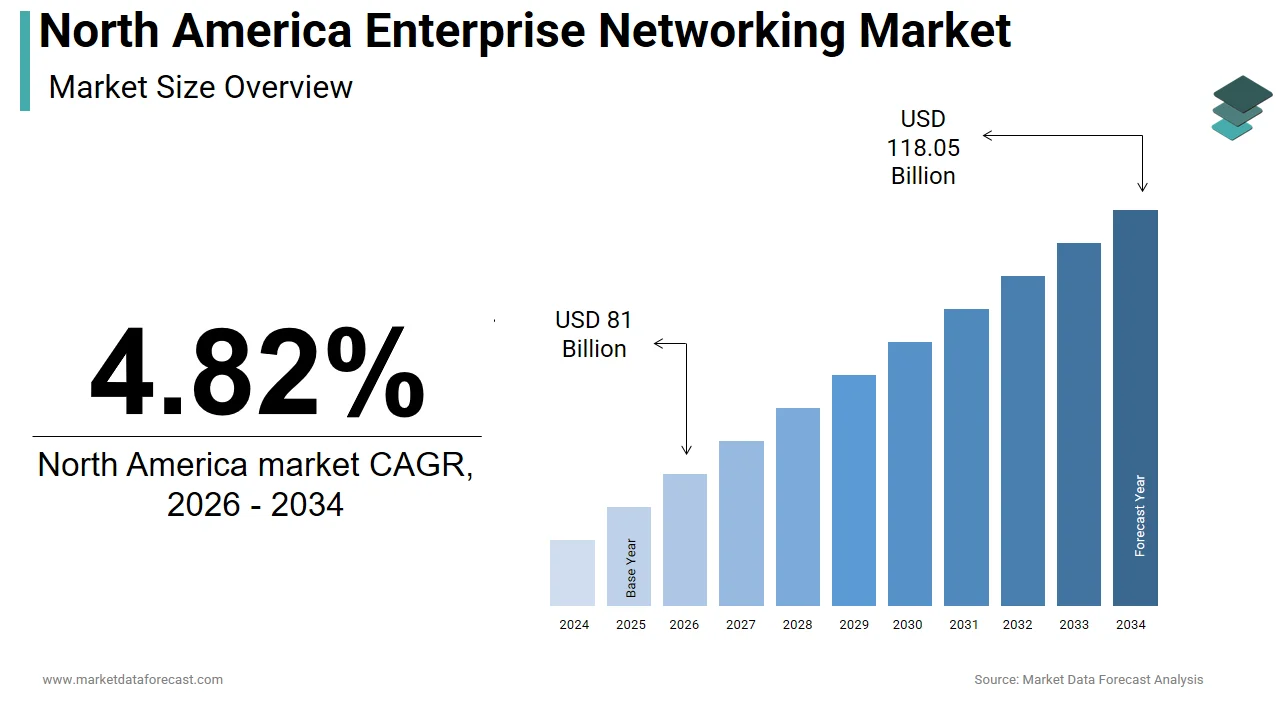
The size of the North America enterprise networking market was valued at USD 77.28 billion in 2025. This market is expected to grow at a CAGR of 4.82% from 2026 to 2034 and be worth USD 118.05 billion by 2034 from USD 81 billion in 2026.
Enterprise networking refers to the deployment of communication infrastructure, hardware, and software solutions that enable seamless data exchange, connectivity, and security across business environments. In North America, this market encompasses a broad spectrum of technologies including wired and wireless local area networks (LANs), wide area networks (WANs), Software-Defined Networking (SDN), Network Function Virtualization (NFV), and cloud-managed services. These systems are integral to supporting digital transformation, remote collaboration, and real-time data analytics in organizations ranging from small businesses to multinational corporations. Additionally, government initiatives such as the Broadband Equity, Access, and Deployment (BEAD) program under the National Telecommunications and Information Administration have been instrumental in expanding high-speed internet access across rural and underserved regions, further strengthening the foundation for enterprise-grade networking deployments.
MARKET DRIVERS
Accelerated Digital Transformation Across Industries
Digital transformation has become a cornerstone of modern enterprise strategy, significantly driving the growth of the North America enterprise networking market. Organizations across finance, healthcare, manufacturing, and retail are investing heavily in network upgrades to support cloud migration, artificial intelligence, and automation. In the financial sector, banks and fintech firms are adopting hybrid cloud architectures that require secure and low-latency connectivity, prompting upgrades to SD-WAN and zero-trust security frameworks. The Federal Reserve reported that over 70% of U.S. banks had implemented or planned to implement SDN-based infrastructures by mid-2024 to enhance scalability and cybersecurity. Similarly, in healthcare, telemedicine adoption has surged, necessitating high-bandwidth networks capable of handling real-time video consultations and remote diagnostics. Manufacturing and logistics sectors are also embracing Industry 4.0, integrating IoT-enabled sensors and edge computing into production lines. This shift demands resilient networking backbones to support real-time monitoring and predictive maintenance.
Surge in Remote Work and Hybrid Work Models
The widespread adoption of remote and hybrid work models has dramatically reshaped enterprise networking requirements, making it one of the key drivers of market growth. According to the U.S. Bureau of Labor Statistics, approximately 35% of employed Americans were working remotely at least one day per week in 2024, up from just 5% before the pandemic. This shift has placed immense pressure on IT departments to ensure secure, high-performance connectivity for distributed workforces. Enterprises are increasingly deploying cloud-based networking solutions, virtual private networks (VPNs), and Secure Access Service Edge (SASE) architectures to accommodate mobile employees while maintaining data integrity. Moreover, the rise of collaboration tools like Microsoft Teams, Zoom, and Slack has increased reliance on stable and scalable enterprise networks.
MARKET RESTRAINTS
Cybersecurity Threats and Network Vulnerabilities
The growing frequency and sophistication of cyberattacks targeting corporate networks is limiting the growth of the North America enterprise networking market. They expose themselves to an increasing array of threats, including ransomware, phishing, and zero-day exploits, as enterprises expand their digital footprints through cloud integration IoT deployment, and remote access solutions. These incidents have led to heightened caution among enterprises when deploying new networking technologies, particularly those involving third-party vendors or public cloud infrastructures. Furthermore, regulatory scrutiny around data protection such as the California Consumer Privacy Act (CCPA) and evolving SEC cybersecurity disclosure rules, has added complexity to network planning and implementation. Companies must now incorporate encryption, identity verification, and endpoint security measures into their networking architecture, often requiring additional investments and specialized expertise.
High Capital and Operational Expenditure
Another significant challenge impeding the growth of the North America enterprise networking market is the high capital and operational expenditure associated with deploying and maintaining advanced networking infrastructure. Enterprises must invest not only in hardware such as routers, switches, and firewalls but also in software licenses, cloud subscriptions, and ongoing technical support. For mid-sized and smaller organizations, these expenses can be prohibitive. A survey conducted by the National Small Business Association found that only 28% of small businesses had budgets sufficient to implement comprehensive SD-WAN or cloud-managed networking solutions in 2024. Additionally, the rapid pace of technological innovation requires frequent upgrades to maintain performance and security standards, leading to continuous spending. Cloud-based networking solutions, while offering scalability, often come with subscription fees and data transfer charges that accumulate over time. Operational costs are further exacerbated by the shortage of skilled IT professionals needed to manage complex networks.
MARKET OPPORTUNITIES
Expansion of Edge Computing and Real-Time Data Processing
The growing adoption of edge computing presents a transformative opportunity for the North America enterprise networking market. As enterprises seek faster data processing and reduced latency, there is a rising shift toward decentralized computing architectures that bring processing power closer to end-users and IoT devices. According to the U.S. Department of Energy, industrial IoT deployments in manufacturing and logistics increased by 35% in 2024, which is necessitating robust edge networking infrastructure to support real-time analytics and automation. Edge computing relies on high-capacity, low-latency networks to function effectively, driving demand for next-generation switches, routers, and 5G-integrated networking gear. Moreover, financial services firms are leveraging edge-enabled networks to execute high-frequency trading algorithms with minimal delay, while retailers are using them to enhance in-store customer experiences through AI-driven personalization and inventory tracking.
Increasing Adoption of Artificial Intelligence in Network Management
Artificial Intelligence (AI) is rapidly transforming enterprise networking by enabling smarter, self-optimizing infrastructures that enhance performance, security, and operational efficiency. AI-driven networking solutions leverage machine learning algorithms to predict traffic patterns, detect anomalies, and automate troubleshooting, reducing downtime and improving user experience. According to the National Institute of Standards and Technology, AI-powered network analytics tools helped reduce unplanned outages by 40% in 2024, making them a compelling value proposition for enterprises. Major technology firms such as Cisco, Juniper Networks, and Aruba (a Hewlett-Packard Enterprise company) have introduced AI-infused network controllers that dynamically adjust bandwidth allocation and optimize routing based on real-time conditions. The U.S. Patent and Trademark Office recorded a 65% increase in AI-related networking patent filings between 2022 and 2024, indicating strong R&D momentum in this domain. In addition to performance benefits, AI-enhanced networking plays a crucial role in cybersecurity. As per the Cybersecurity and Infrastructure Security Agency, AI-assisted intrusion detection systems prevented over 1.2 million cyber incidents in North American enterprises during 2023.
MARKET CHALLENGES
Complexity in Managing Multi-Vendor and Hybrid Network Environments
One of the foremost challenges facing the North America enterprise networking market is the increasing complexity of managing multi-vendor and hybrid network environments. Enterprises today often deploy a mix of legacy systems, proprietary hardware, cloud-based services, and vendor-specific software, resulting in fragmented infrastructures that are difficult to integrate and maintain. According to the Uptime Institute, over 60% of North American enterprises reported interoperability issues between different networking components in 2024, leading to inefficiencies and increased operational overhead. This complexity is further compounded by the proliferation of edge computing, IoT devices, and Bring Your Own Device (BYOD) policies, which expand the attack surface and strain existing network architectures. Additionally, managing service-level agreements (SLAs) across multiple vendors introduces coordination challenges, particularly when troubleshooting cross-platform issues.
Talent Shortage and Skills Gap in Networking Technologies
A persistent challenge in the North America enterprise networking market is the shortage of skilled professionals capable of designing, implementing, and securing advanced networking solutions. As technologies evolve with the integration of AI, SD-WAN, and cloud-native architectures, the demand for experts in these domains has outpaced the supply of qualified personnel. Educational institutions have struggled to keep pace with the rapid advancements in networking technologies, resulting in a skills gap that hinders enterprise readiness. Additionally, the retirement of experienced IT professionals has exacerbated the issue, with over 35% of current network administrators aged 55 or older, as reported by CompTIA. This demographic trend threatens knowledge continuity, particularly in mission-critical industries such as finance and healthcare, where network reliability is paramount.
REPORT COVERAGE
| REPORT METRIC | DETAILS |
| Market Size Available | 2025 to 2034 |
| Base Year | 2025 |
| Forecast Period | 2026 to 2034 |
| Segments Covered | By Equipment, Infrastructure Type, and Region. |
| Various Analyses Covered | Global, Regional and Country-Level Analysis, Segment-Level Analysis, Drivers, Restraints, Opportunities, Challenges; PESTLE Analysis; Porter’s Five Forces Analysis, Competitive Landscape, Analyst Overview of Investment Opportunities |
| Countries Covered | United States, Canada, Mexico, Rest of North America |
| Market Leaders Profiled | BlackBerry Limited, Microsoft Corporation, Alphabet Inc., Apple Inc., Wind River Systems, Inc., Hitex GmbH, Bayerische Motoren Werke AG (BMW), Baidu, Inc., NVIDIA Corporation, and Green Hills Software. |
SEGMENTAL ANALYSIS
By Equipment Insights
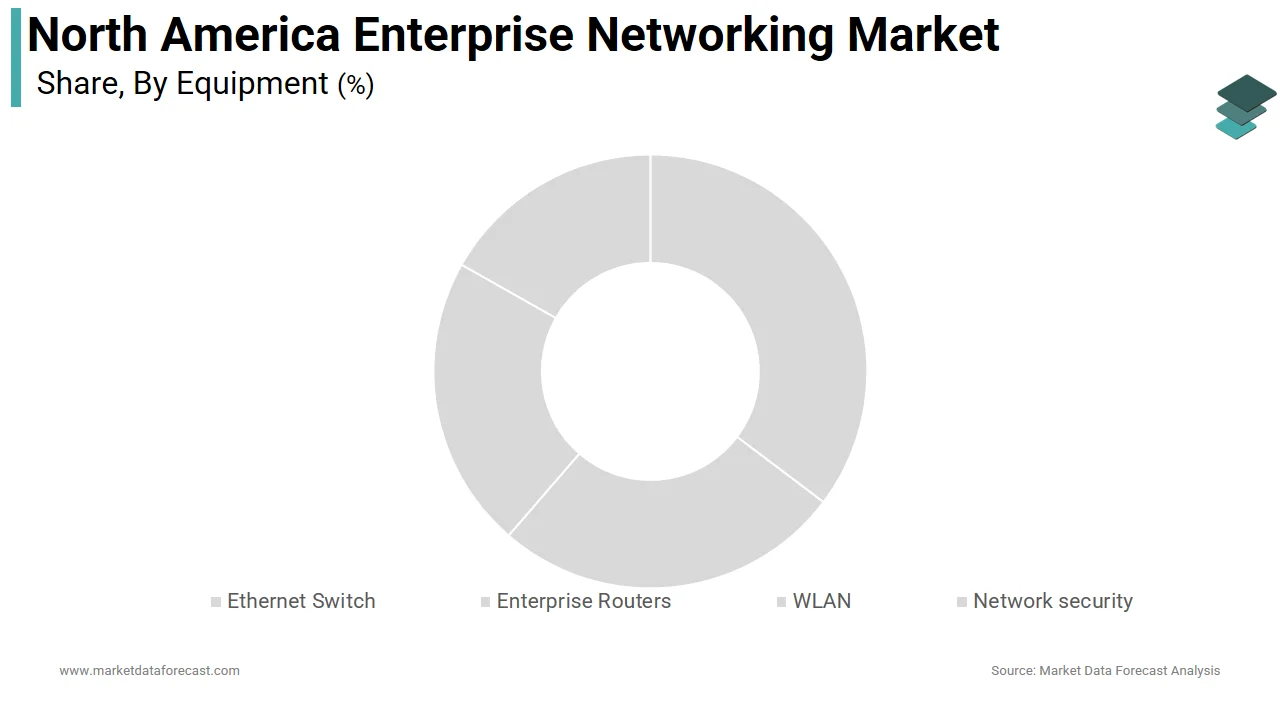
The Ethernet switches segment was the largest and held 34.5% of the North America enterprise networking market share in 2024, with the foundational role these devices play in connecting and managing data traffic across enterprise local area networks (LANs). According to IDC, over 15 million Ethernet switch ports were deployed across North American enterprises in 2024 alone, with a significant portion supporting 10GbE and higher-speed connectivity. In addition, educational institutions and government agencies have ramped up investments in smart campuses and e-governance initiatives, requiring robust network backbones built around next-generation Ethernet switches. The U.S. Department of Education reported that K-12 and higher education institutions allocated over $6 billion toward IT modernization in fiscal year 2024, with network infrastructure upgrades being a key component. Moreover, as hybrid work models persist, enterprises are deploying stacking and modular switches to enhance scalability and redundancy across distributed offices.
The network security equipment segment is lucratively growing with a CAGR of 9.8% throughout the forecast period. This rapid expansion is fueled by rising cyber threats, stricter regulatory compliance requirements, and increased awareness of zero-trust security frameworks across industries.
According to the FBI’s Internet Crime Complaint Center, losses from cyberattacks in the U.S. exceeded $10.3 billion in 2023, prompting enterprises to invest heavily in firewalls, intrusion detection systems (IDS), Secure Access Service Edge (SASE) solutions, and encrypted network gateways. The Cybersecurity and Infrastructure Security Agency (CISA) reported that over 70% of surveyed companies had upgraded their network security hardware or services in 2024, in the healthcare and finance sectors. Additionally, the increasing adoption of remote access technologies such as virtual private networks (VPNs) and cloud-based collaboration tools has expanded the attack surface, necessitating stronger endpoint protection and real-time threat monitoring. Furthermore, evolving regulations such as the SEC’s cybersecurity disclosure rules and the California Consumer Privacy Act (CCPA) have mandated more rigorous data protection measures, pushing enterprises to deploy next-generation firewalls and secure SD-WAN appliances.
By Infrastructure Type Insights
The in-house networking infrastructure segment accounted in holding a dominant share of the North America enterprise networking market in 2024. According to the U.S. Department of Commerce, over 80% of Fortune 500 companies maintained in-house data centers in 2024, particularly in sectors such as banking, defense, and healthcare, where data sovereignty and latency sensitivity are paramount. Financial institutions, for instance, rely on localized network infrastructures to ensure ultra-low latency for algorithmic trading operations and secure transaction processing. The healthcare industry also plays a major role in sustaining this segment, with hospitals and research institutions investing in on-premises networking gear to comply with HIPAA mandates and maintain patient data confidentiality. Moreover, manufacturing enterprises adopting Industry 4.0 technologies such as edge computing and robotic automation prefer in-house setups to ensure deterministic performance and minimal network disruptions.
The outsourced networking infrastructure segment is lucratively growing with an expected CAGR of 8.9% in the next coming years. One of the primary drivers is the shift toward hybrid and multi-cloud environments, which require scalable and flexible networking solutions beyond traditional on-premises capabilities. Small and mid-sized businesses (SMBs) are increasingly turning to outsourced models due to limited in-house IT expertise and budget constraints. The National Small Business Association reported that 68% of SMBs had adopted some form of outsourced network management in 2024, citing benefits such as reduced downtime, proactive monitoring, and automated updates. Additionally, large enterprises are leveraging outsourcing to streamline operations and focus on core competencies while relying on third-party experts for network optimization and cybersecurity. The Uptime Institute noted that companies using outsourced network service providers experienced 20% fewer outages compared to those managing infrastructure internally.
COUNTRY-WISE ANALYSIS
United States Enterprise Networking Market Insights
The United States was the top performer in the North America enterprise networking market by capturing 78.3% of share in 2024. The U.S. Department of Commerce reported that private sector investment in digital infrastructure surpassed $180 billion in 2023, with a significant portion allocated to enterprise-grade networking solutions. Companies across sectors such as finance, healthcare, manufacturing, and retail are rapidly upgrading their network architectures to support hybrid work, AI-driven analytics, and real-time customer engagement. Additionally, federal initiatives such as the Broadband Equity, Access, and Deployment (BEAD) program and the CHIPS and Science Act have spurred investments in high-speed internet infrastructure and semiconductor development, both of which underpin next-generation networking hardware. The Federal Communications Commission recorded over 30 million fixed wireless broadband connections established in 2023, further expanding the reach of enterprise networking into rural and underserved regions.
Canada Enterprise Networking Market Insights
Canada enterprise networking market was ranked second with the growing investments in digital transformation, public sector modernization, and cross-border business integration with the U.S. The Canadian government has prioritized technology-enabled economic development, offering incentives for cloud migration, cybersecurity enhancements, and smart city initiatives. Additionally, Canada’s Innovation and Skills Plan, backed by federal funding of over CAD $20 billion since 2017, has supported the growth of AI research hubs and tech startups that require high-capacity networking infrastructure. The Digital Technology Supercluster, based in British Columbia, has facilitated numerous enterprise networking collaborations between academia, industry, and government. Moreover, as U.S. enterprises seek nearshoring alternatives for data centers and IT operations, Canada has emerged as a preferred location due to its stable regulatory environment and bilingual workforce.
COMPETITIVE LANDSCAPE
The competition in the North America enterprise networking market is intense and continuously evolving, driven by rapid technological advancements, shifting enterprise demands, and the growing convergence of networking with security and cloud infrastructure. Dominated by global leaders such as Cisco, Juniper, and Aruba (HPE), the market also sees increasing influence from emerging players offering specialized or cloud-native solutions tailored to modern business needs.
Large vendors leverage their extensive ecosystem, brand reputation, and deep integration capabilities to maintain dominance, particularly in sectors requiring mission-critical connectivity and high levels of customization. However, smaller and mid-tier companies are gaining traction by focusing on agility, cost-effectiveness, and niche capabilities in areas like AI-driven network analytics, secure SD-WAN, and edge computing.
A major battleground is the ability to deliver seamless hybrid networking experiences that bridge on-premises infrastructure with multi-cloud environments. As enterprises prioritize flexibility, scalability, and security, vendors are differentiating themselves through innovative architectures, AI-powered automation, and managed service offerings.
Additionally, competition extends beyond technology to include customer engagement strategies, with an increasing emphasis on outcome-based pricing, subscription models, and value-added services. The landscape remains highly dynamic, with constant shifts in market positioning as companies adapt to new digital realities and regulatory landscapes.
KEY MARKET PLAYERS
Noteworthy Companies dominating the North America enterprise networking market profiled in the report are
- BlackBerry Limited
- Microsoft Corporation
- Alphabet Inc.
- Apple Inc.
- Wind River Systems, Inc.
- Hitex GmbH
- Bayerische Motoren Werke AG (BMW)
- Baidu, Inc.
- NVIDIA Corporation
- Green Hills Software
TOP LEADING PLAYERS IN THE MARKET
Cisco Systems is a global leader in enterprise networking and has been instrumental in shaping the evolution of modern digital infrastructure. In North America, Cisco continues to be the preferred provider for large enterprises, government agencies, and educational institutions due to its comprehensive portfolio that spans routers, switches, wireless solutions, and network security platforms. The company’s strategic focus on intent-based networking, cloud-managed services, and AI-driven automation has positioned it at the forefront of digital transformation. Cisco’s innovations in SD-WAN, zero-trust security, and collaboration tools have significantly influenced how organizations design and manage their networks globally.
Juniper Networks is a key player in the North American enterprise networking market, known for its high-performance routing, switching, and security solutions tailored for service providers and large-scale enterprises. The company emphasizes open, scalable architectures that support automation, cloud integration, and operational efficiency. Juniper's commitment to AI-driven networking through its Mist AI platform has redefined user experience monitoring and proactive network management. Its strong R&D focus and partnerships with leading cloud providers have enabled enterprises to deploy agile, secure, and intelligent networking infrastructures. Juniper’s contributions extend beyond hardware, influencing industry standards in network virtualization and policy-driven automation.
Aruba, part of HPE, plays a pivotal role in advancing secure and intelligent edge networking across North America. With a strong emphasis on hybrid IT environments, Aruba offers end-to-end networking solutions that integrate wired, wireless, and WAN capabilities under a unified management framework. Its an AIOps-driven platform that enhances visibility, performance, and security for distributed enterprises. Aruba’s dominance in campus networking, SD-Branch, and IoT-ready infrastructures has made it a trusted partner for industries ranging from healthcare to manufacturing.
TOP STRATEGIES USED BY KEY MARKET PARTICIPANTS
One of the primary strategies adopted by leading players in the North America enterprise networking market is technology innovation and product differentiation. Companies are investing heavily in research and development to introduce next-generation networking solutions that incorporate artificial intelligence, machine learning, and intent-based automation. These advancements allow enterprises to optimize performance, enhance security, and reduce manual intervention in network operations.
Another critical approach is strategic acquisitions and partnerships. Major vendors are acquiring niche firms specializing in cybersecurity, cloud networking, and edge computing to expand their solution portfolios and accelerate time-to-market. Collaborations with cloud service providers and system integrators also help them offer more integrated, end-to-end networking experiences tailored to specific verticals.
Companies are focusing on customer-centric deployment models by including managed services, subscription-based licensing, and as-a-service offerings. This shift enables businesses to adopt advanced networking capabilities without significant upfront costs, which is making solutions more accessible while strengthening long-term vendor-client relationships and ensuring continuous service enhancements.
RECENT MARKET DEVELOPMENTS
- In February 2024, Cisco announced the expansion of its SD-WAN orchestration platform with enhanced AI-driven analytics aimed at improving network performance and threat detection, which is reinforcing its dominance in secure, cloud-integrated networking solutions.
- In May 2024, Juniper Networks introduced a new line of cloud-managed access points designed specifically for mid-sized businesses, enabling simplified deployment and centralized control through its Mist AI engine to improve user experience and operational efficiency.
- In August 2024, Aruba (HPE) launched a comprehensive zero-trust security architecture for enterprise campuses, integrating identity-based access controls, real-time threat intelligence, and automated policy enforcement across wired and wireless networks.
- In October 2024, Extreme Networks acquired a privately held AI-based network optimization startup to strengthen its portfolio of self-driving networking solutions by allowing enterprises to proactively manage traffic and reduce downtime.
- In December 2024, Fortinet expanded its Secure Networking-as-a-Service offering in North America, introducing flexible consumption models that enable businesses to scale firewall, SD-WAN, and cloud security capabilities on demand without upfront investment.
MARKET SEGMENTATION
This North America enterprise networking market research report is segmented and sub-segmented into the following categories.
By Equipment
- Ethernet Switch
- Enterprise Routers
- WLAN
- Network security
By Infrastructure Type
- In-House
- Outsourced
By Country
- United States
- Canada
- Mexico
- Rest of North America