- Product Description Description
- Table of Contents TOC
- List of Table & Figure LOT
- Get Free Sample PDF Sample PDF
Market Size, 2025
$40.04 BnMarket Estimate, 2026
$41.61 BnMarket Forecast, 2034
$56.65 BnCAGR, 2026–2034
3.93%Executive Summary: North America Farm Mechanization Market
- Market Scope: In-depth assessment of the North American farm mechanization ecosystem covering product segments, technology integrations, and country-level dynamics across the United States, Canada, and the rest of the region.
- Market Valuation: Valued at USD 40.04 billion in 2025, estimated at USD 41.61 billion in 2026, and projected to reach USD 56.65 billion by 2034, growing at a compound annual growth rate (CAGR) of 3.93% from 2026 to 2034.
- Primary Growth Drivers: Persistent agricultural labor shortages, rising adoption of precision agriculture tools (IoT, drones, AI analytics), government subsidies, and the shift toward sustainable, high-efficiency farming practices.
Key Market Segment Metrics (2026–2034)
| Category | Leading Segment Focus | High-Impact Focus |
|---|---|---|
| By Product Type | Tractors (dominant share at 38.5% of total revenue) | Combine Harvesters (fastest-growing CAGR at 7.2%), Rice Transplanters, Power Tillers, & Land Levelers |
| By Country Focus | The United States (dominant share at 73.2% of regional revenue) | Canada & Rest of North America (Mexico & smaller agricultural economies) |
Regional Insights & Market Dynamics
United States: Commands the largest regional market share, driven by extensive precision technology adoption, federal support (e.g., Farm Bill), and the presence of major equipment manufacturers.
Canada: Leverages advanced smart farming investments and robust funding programs to counter rural labor shortages across expansive agricultural lands.
Rest of North America (Mexico): Experiencing a gradual transition toward mechanization in high-value crop sectors supported by foreign direct investment and government assistance programs.
Market Challenges & Restraints: High upfront investment costs, limited rural internet connectivity and infrastructure (digital divide), operator training complexities, and stringent environmental/emissions regulations.
Key Market Leaders Profiled: John Deere, CNH Global (Case IH, New Holland), AGCO Corporation (Fendt, Massey Ferguson, Challenger), Alamo Group, Kubota, International Harvester, TAFE, CLAAS, and Mitsubishi.
 Download Free Sample Report
North America Farm Mechanization Market Size
The North America farm mechanization market size was valued at USD 40.04 billion in 2025 and is anticipated to reach a valuation of USD 41.61 billion in 2026 and USD 56.65 billion by 2034, growing at a CAGR of 3.93%, from 2026 to 2034.
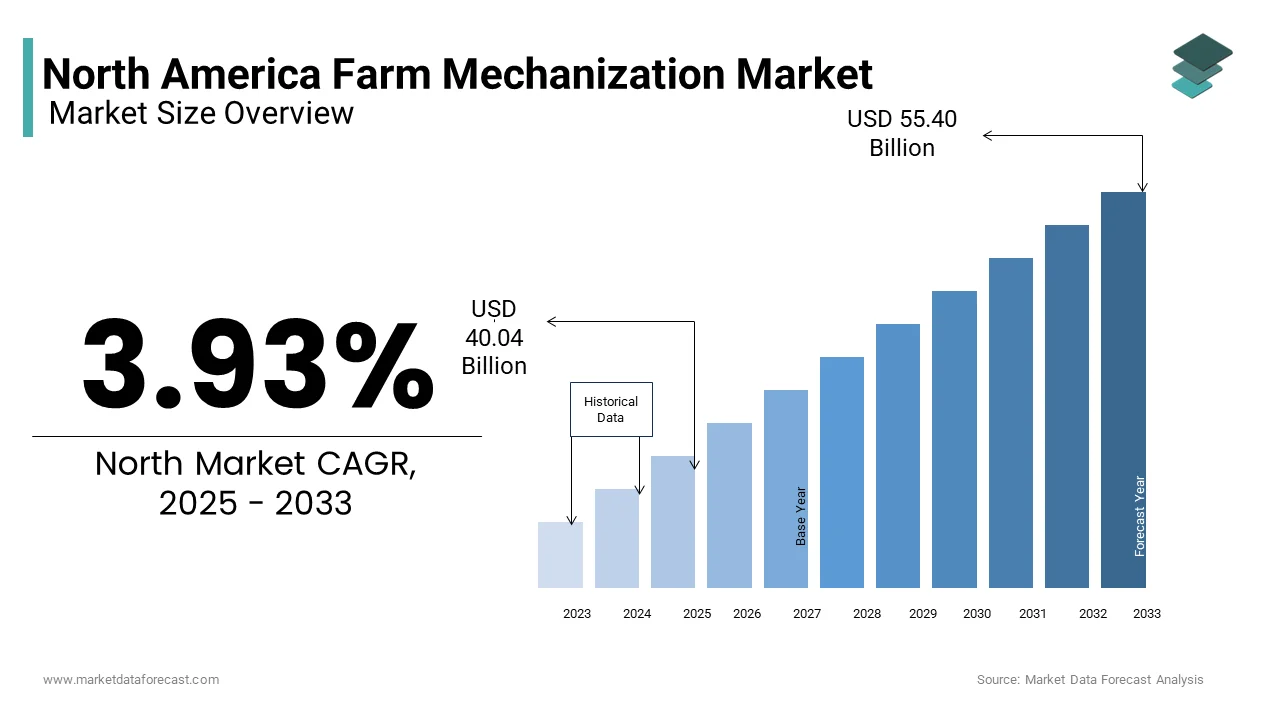
Farm mechanization refers to the integration of advanced machinery and automated systems into agricultural operations to enhance productivity, efficiency, and precision in farming. In North America, this transformation has become a cornerstone of modern agriculture, driven by technological advancements, labor shortages, and the need for sustainable practices. The region, particularly the United States and Canada, has witnessed a significant shift from traditional manual farming to technologically enabled mechanized solutions. As per Statistics Canada, in 2023, nearly 87% of Canadian farms employed mechanized tools, with an average investment of CAD 145,000 per farm in machinery and automation technologies.
The adoption of precision agriculture tools—such as drones, IoT-enabled sensors, and AI-based analytics—has further accelerated the growth trajectory of the North American farm mechanization market. The increasing focus on optimizing yield per acre, reducing dependency on manual labor, and complying with environmental regulations is shaping the demand landscape. Further, government subsidies and private sector investments are fueling innovation and deployment of next-generation farming technologies across the continent.
MARKET DRIVERS
Labor Shortages in Agriculture
The persistent shortage of agricultural labour is one of the most compelling drivers of the North American farm mechanization market. According to the U.S. Bureau of Labor Statistics, employment in the agricultural sector declined by approximately 12% between 2018 and 2023, with seasonal worker availability falling sharply due to stricter immigration policies and demographic shifts. As per StatsCan, Canada reported a 20% increase in unfilled agricultural job vacancies in 2023 compared to the previous year. This trend has compelled farm operators to seek alternatives that can maintain productivity without relying heavily on human labor.
In addition, farmers are increasingly investing in automated harvesting machines, robotic milkers, and autonomous tractors. For instance, John Deere’s fully autonomous tractor, launched in 2022, is being adopted at scale in Midwest farms where labor scarcity is acute. These innovations not only reduce reliance on temporary labor but also ensure consistent output quality and operational continuity. The rising costs of hiring seasonal workers, which increased by 15% in the U.S. according to the USDA Economic Research Service in 2023, further incentivize the shift toward mechanization.
Technological Advancements in Precision Agriculture
Technological innovation remains a pivotal force behind the rapid evolution of the North American farm mechanization market. The integration of artificial intelligence (AI), machine learning, and Internet of Things (IoT) into agricultural equipment has transformed how farms operate. These tools enable real-time data collection and analysis, allowing farmers to optimize input usage, improve yields, and reduce waste.
Moreover, the development of autonomous vehicles and robotics is gaining traction. Companies like AGCO Corporation and CNH Industrial are launching smart farming solutions that integrate seamlessly with existing farm management software. In Canada, the Smart Agriculture Program funded by the federal government has encouraged the adoption of these technologies through grants and pilot projects.
The increasing affordability of high-tech farming tools, combined with enhanced connectivity in rural areas, has made it easier for mid-sized and even small farms to adopt mechanized solutions. These advancements are not only enhancing productivity but also reshaping the future of agriculture across North America.
MARKET RESTRAINTS
High Initial Investment Costs
The high upfront costs associated with acquiring advanced machinery remain a major barrier, especially for small and medium-sized farms, to farm mechanization in North America. Similarly, precision agriculture systems include GPS guidance, drone mapping, and soil sensors.
As per a 2023 report by Farm Credit Canada, nearly 60% of Canadian farmers cited capital constraints as a primary factor limiting their ability to adopt mechanized systems. Many smaller farms struggle to secure financing or justify the return on investment within a short time frame. While larger agribusinesses can absorb these costs, family-owned and independent farms often find themselves at a disadvantage.
Moreover, maintenance and training expenses add to the financial burden. Consequently, despite long-term benefits, the prohibitive entry-level investment continues to hinder widespread adoption, particularly among resource-limited farmers across North America.
Limited Rural Connectivity and Infrastructure
Inadequate rural internet connectivity and infrastructure are another critical constraint impeding the growth of the North American farm mechanization market. Many advanced agricultural technologies, such as cloud-based farm management systems, remote sensing devices, and autonomous machinery, rely heavily on stable and high-speed internet access. However, as per the Federal Communications Commission (FCC), nearly 14.5 million Americans living in rural areas still lack access to broadband internet services as of 2023. In Canada, the Canadian Radio-television and Telecommunications Commission (CRTC) reported that approximately 46% of rural households remained underserved by high-speed internet in the same year.
This digital divide limits the functionality of precision agriculture tools that depend on real-time data transmission and processing. Without reliable connectivity, farmers cannot effectively utilize IoT-enabled equipment or update software on smart machinery. According to a 2023 survey by the American Farm Bureau Federation, 40% of surveyed farmers noted that poor internet access restricted their ability to implement new digital farming solutions.
Furthermore, limited infrastructure in remote agricultural regions hampers the distribution and servicing of high-tech equipment. Spare parts availability and technical support centers are often concentrated in urban hubs, making maintenance more challenging for rural users.
MARKET OPPORTUNITY
Expansion of Government Support and Subsidy Programs
Government initiatives aimed at promoting agricultural modernization present a substantial opportunity for the North American farm mechanization market. Both the U.S. and Canadian governments have introduced various subsidy programs and funding mechanisms to encourage farmers to adopt mechanized and precision farming technologies. Similarly, the Canadian Agricultural Partnership (CAP), extended through 2028, offers financial assistance covering up to 50% of eligible costs for adopting innovative farming technologies.
These incentives significantly lower the financial barriers for farmers considering mechanization. Moreover, state-level initiatives, such as California’s Healthy Soils Program and Ontario’s On-Farm Climate Action Fund, provide targeted funding for climate-smart mechanization projects, aligning economic and environmental objectives.
The increasing alignment between policy frameworks and technological advancement is fostering a conducive environment for farm mechanization.
Integration of Renewable Energy in Farm Machinery
The convergence of renewable energy technologies with farm mechanization is emerging as a transformative opportunity for the North American market. With growing emphasis on reducing carbon footprints and achieving net-zero emissions, agricultural equipment manufacturers are increasingly developing electric and solar-powered machinery. Companies like Monarch Tractor and John Deere have launched all-electric models equipped with autonomous capabilities, catering to environmentally conscious farmers.
In addition to reducing fuel costs, renewable-powered farm equipment helps comply with stringent emissions regulations. Several U.S. states, including California and New York, offer rebates and tax credits for purchasing clean-energy farm equipment, further accelerating adoption.
Moreover, solar-powered irrigation systems and battery-operated harvesters are gaining traction, particularly in off-grid and remote farming areas. According to the National Renewable Energy Laboratory (NREL), solar irrigation adoption in North America grew in 2023.
MARKET CHALLENGES
Complexity in Technology Adoption and Operator Training
The complexity involved in adopting and operating these sophisticated systems poses a major challenge. Modern agricultural machinery requires a level of technical expertise that many traditional farmers may not possess. According to a 2023 study, only 35% of surveyed farmers felt confident in their ability to independently operate and maintain precision agriculture equipment without external support. This knowledge gap results in slower adoption rates, especially among older and less tech-savvy farming communities.
Moreover, training farm personnel to use GPS-guided tractors, drone monitoring systems, and data analytics platforms demands both time and financial resources. Many small and mid-sized farms find this expenditure burdensome, limiting their capacity to fully leverage mechanized solutions.
Equipment manufacturers and extension services are working to bridge this gap through on-site training and digital tutorials. ,
Regulatory and Environmental Compliance Pressures
The evolving regulatory landscape surrounding agricultural practices presents another significant challenge for the North American farm mechanization market. Governments in both the U.S. and Canada are implementing stricter environmental regulations aimed at reducing emissions, conserving water, and minimizing chemical runoff. According to Environment and Climate Change Canada, new emission standards for off-road vehicles, including agricultural machinery, took effect in 2023, mandating a 25% reduction in nitrogen oxide emissions for newly manufactured equipment. Similarly, the U.S. Environmental Protection Agency (EPA) has tightened Tier 4 emissions requirements, pushing manufacturers to develop cleaner and more efficient engines.
Compliance with these regulations often necessitates costly upgrades to existing fleets or the purchase of newer, compliant machinery. Besides, certain precision agriculture technologies, such as autonomous spraying systems, must adhere to pesticide application laws enforced by agencies like the USDA and Health Canada’s Pest Management Regulatory Agency (PMRA).
These regulatory pressures, while beneficial for environmental sustainability, create financial and operational challenges for farmers, particularly those operating on tight margins. As regulations continue to evolve, the need for adaptable and compliant mechanization solutions will intensify, posing both a challenge and a driver for innovation in the North American farm mechanization market.
REPORT COVERAGE
| REPORT METRIC | DETAILS |
| Market Size Available | 2024 to 2033 |
| Base Year | 2024 |
| Forecast Period | 2025 to 2033 |
| CAGR | 3.93% |
| Segments Covered | By Product, and By Country |
| Various Analyses Covered | Global, Regional & Country Level Analysis, Segment-Level Analysis, DROC, PESTLE Analysis, Porter’s Five Forces Analysis, Competitive Landscape, Analyst Overview on Investment Opportunities |
| Regions Covered | The USA, Canada, Mexico, Rest of North America |
| Market Leaders Profiled | John Deere, CNH Global, AGCO, Alamo Group, Kubota, International Harvester, TAFE, CLAAS, Mitsubishi. |
SEGMENT ANALYSIS
By Product Insights
The tractor segment dominated the market by accounting for 38.5% of total revenue in 2025. Increasing adoption of high-horsepower tractors equipped with precision farming technologies is a key driver behind the leading position of the tractor segment. This dominance is also due to the tractor’s versatility across a wide range of agricultural tasks—from plowing and planting to hauling and spraying—making it an indispensable asset for both large-scale commercial farms and smaller operations. Apart from these, the integration of GPS-guided autonomous systems and fuel-efficient engines has further boosted demand, particularly among large agribusinesses seeking operational efficiency.
Moreover, the expansion of smart tractor models tailored for data-driven decision-making has reinforced the segment’s growth trajectory. These factors collectively ensure the tractor segment remains the largest and most influential within the farm mechanization landscape.
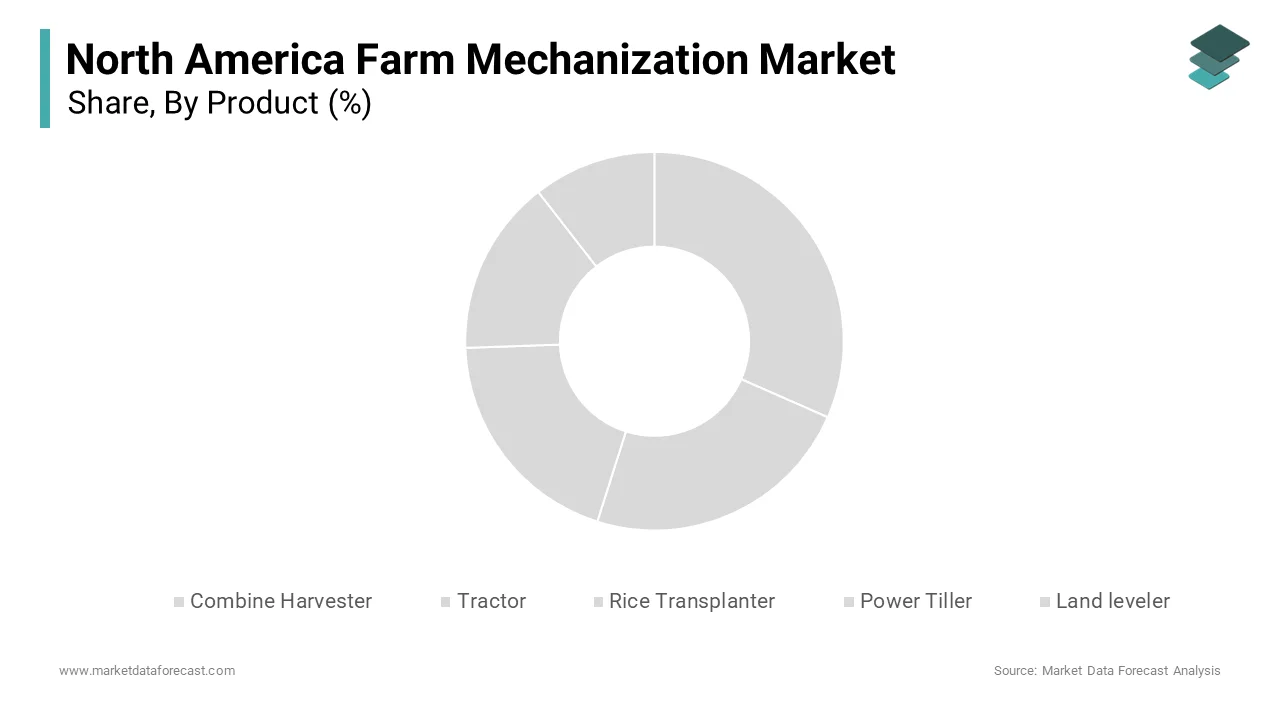
The combine harvester segment is one of the fastest-growing segments in the North America Farm Mechanization Market and is projected to expand at a CAGR of 7.2% between 2025 and 2033. This rapid growth is primarily fueled by the Rising need for efficient harvesting solutions amid labor shortages and increasing crop cultivation areas is primarily fuelling the rapid growth of the combine harvester segment.
These are becoming essential for large-scale grain producers, especially in the Midwest and Prairie provinces of Canada, where wheat, corn, and soybean production is expanding. Like, in the USA, the harvested area for corn alone reached 81 million acres in 2023, necessitating faster and more automated harvesting mechanisms. In response, manufacturers like John Deere and AGCO have introduced next-generation combines equipped with AI-powered sensors that optimize grain recovery and reduce post-harvest losses.
Further, technological advancements such as self-driving and IoT-integrated combine harvesters are gaining traction. These innovations, combined with rising demand for time- and cost-effective harvesting methods, are propelling the combine harvester segment to become one of the fastest-growing within the farm mechanization market in North America.
COUNTRY ANALYSIS
United States Farm Mechanization Market Analysis
The United States led the North American Farm Mechanization Market by contributing 73.2% of total regional revenue in 2025. As the world's top exporter of agricultural commodities, the U.S. relies heavily on advanced mechanization to maintain productivity and meet domestic and international demand. One of the primary drivers of this strong market position is the widespread adoption of precision agriculture technologies, including GPS-guided tractors, drone-based monitoring, and autonomous harvesters. Moreover, the federal government’s support through initiatives like the Farm Bill and state-level grants has accelerated technology adoption. Another key factor is the presence of major agricultural equipment manufacturers such as John Deere, AGCO, and CNH Industrial, which are headquartered or have significant operations in the U.S. Their continuous innovation in smart farming solutions reinforces domestic demand and positions the U.S. as a global leader in farm mechanization.
Canada Farm Mechanization Market Analysis
Canada is also a major player in the North American farm Mechanization. Given its vast agricultural land spanning over 69 million acres of cropland, according to Statistics Canada, the country has increasingly embraced mechanized farming to enhance productivity and sustainability. A major driver behind Canada’s growing mechanization trend is the rising investment in smart farming technologies, supported by federal and provincial funding programs. Besides, labor shortages in rural areas have intensified the shift toward mechanization, particularly in provinces like Alberta and Saskatchewan, where seasonal worker availability has declined.
Rest of North America
The Rest of North America, which includes Mexico and other smaller agricultural economies in the region, holds a smaller share of the North American Farm Mechanization Market. While relatively small compared to the U.S. and Canada, this segment presents growing potential due to evolving agricultural policies, technological diffusion, and increasing foreign investment in farm infrastructure. Despite traditionally relying on manual labor, the country is witnessing a gradual shift toward mechanization, particularly in high-value crop sectors such as fruits, vegetables, and coffee. Government initiatives like ProAgro Productivo, aimed at supporting smallholder farmers with access to modern equipment, are accelerating this transition. Moreover, foreign direct investment in Mexican agribusiness has risen by 11% since 2021, as per the World Bank, fostering greater adoption of mechanized practices. The expansion of U.S.-based equipment suppliers into Mexican markets, along with localized manufacturing partnerships, is further boosting farm mechanization.
COMPETITIVE LANDSCAPE
The competition in the North American Farm Mechanization Market is characterized by a mix of established industry leaders and emerging technology-driven entrants. Major players dominate due to their extensive product portfolios, robust R&D capabilities, and strong distribution networks. However, increasing demand for customized, efficient, and sustainable farming solutions is compelling even smaller firms to innovate and carve out niche markets. Technological differentiation plays a crucial role, with companies focusing on automation, connectivity, and AI-enabled systems to gain a competitive edge. Apart from these, customer support, ease of integration, and user-friendly interfaces are becoming decisive factors in purchasing decisions. As the market evolves, competition is intensifying not only in terms of product performance but also in digital service offerings, financing models, and localized support structures. This dynamic environment fosters continuous innovation and drives the industry toward more intelligent, scalable, and adaptable farm mechanization solutions across North America.
KEY MARKET PLAYERS
A few of the market players in the North America farm mechanization market include
- John Deere
- CNH Global
- AGCO
- Alamo Group
- Kubota
- International Harvester
- TAFE
- CLAAS
- Mitsubishi.
Top Players In The Market
- John Deere is a global leader in agricultural machinery and plays a dominant role in the North American farm machinery market. The company offers a comprehensive range of equipment, including tractors, harvesters, planters, and precision agriculture tools. Known for its innovation and reliability, John Deere has been instrumental in integrating automation and digital technologies into farming operations. Its commitment to sustainability and smart farming solutions has positioned it as a preferred choice among large-scale and mid-sized farms across the U.S. and Canada.
- CNH Industrial is a major player in the agricultural equipment sector, with well-established brands like Case IH and New Holland Agriculture under its umbrella. The company provides a diverse portfolio of mechanized farming solutions tailored to different crop types and field conditions. CNH Industrial emphasizes technological advancement, offering GPS-guided systems and autonomous machinery that enhance efficiency and productivity. Its strong distribution network and customer-centric approach have solidified its presence in the North American market.
- AGCO Corporation is a leading manufacturer of agricultural machinery, known for brands such as Fendt, Massey Ferguson, and Challenger. While globally focused, AGCO has a strong footprint in North America, where it continues to expand through product innovation and strategic partnerships. The company prioritizes sustainable farming practices and digital integration, delivering advanced mechanization solutions that cater to evolving agricultural needs. AGCO’s emphasis on localized service and support further strengthens its competitive position in the region.
Top Strategies Used by Key Market Participants
Innovation Through Digital Integration
Leading players are increasingly embedding digital technologies such as artificial intelligence, IoT, and machine learning into their equipment. This strategy enables real-time monitoring, predictive maintenance, and data-driven decision-making, enhancing both productivity and sustainability in farming operations.
Strategic Collaborations and Partnerships
To accelerate growth and expand their technological capabilities, companies are forming alliances with agritech startups, software developers, and research institutions. These collaborations help integrate cutting-edge innovations into existing product lines and improve adaptability to regional farming needs.
Expansion of After-Sales Support and Customer Engagement
Recognizing the importance of long-term relationships, key players are investing in enhanced after-sales services, including remote diagnostics, training programs, and mobile support units. Strengthening customer engagement ensures higher satisfaction, brand loyalty, and faster adoption of new mechanization technologies across diverse farming communities.
RECENT MARKET NEWS
- In February 202, John Deere launched an updated version of its Operations Center, integrating advanced analytics and real-time field data tracking features to enhance farm management efficiency. This move reinforced its leadership in precision agriculture solutions.
- In May 2024, CNH Industrial partnered with a leading agritech startup to develop autonomous tractor prototypes designed specifically for North American soil conditions and large-scale crop production needs.
- In July 2024, AGCO Corporation expanded its North American service network by opening five new regional support centers aimed at improving after-sales service and reducing equipment downtime for farmers.
- In September 2024, Deere & Company announced a collaboration with a renewable energy firm to power its manufacturing facilities using clean energy, aligning with its broader sustainability goals while reinforcing brand appeal among eco-conscious farmers.
- In November 2024, Kubota Corporation acquired a U.S.-based precision farming software provider to strengthen its digital agriculture platform and better serve North American customers seeking integrated farm mechanization solutions.
MARKET SEGMENTATION
This research report on the North American farm mechanization market is segmented and sub-segmented into the following categories.
By Product Type
- Combine Harvester
- Tractor
- Rice Transplanter
- Power Tiller
- Land leveler
By Country
- The U.S.
- Canada
- Rest of North America