- Product Description Description
- Table of Contents TOC
- List of Table & Figure LOT
- Get Free Sample PDF Sample PDF
North America Ferrite Magnet Market Summary
The North America Ferrite magnet market size was valued at USD 2.55 billion in 2025 and is anticipated to reach a valuation of USD 2.61 billion in 2026 and USD 3.17 billion by 2034, growing at a CAGR of 2.44%, from 2026 to 2034.
Key Market Trends & Insights
- The United States was the top performer in the North American market in 2025.
- Canadian ferrite magnet market is a specialized and strategic market in North America in 2025.
- Based on the Application, the Car Line Industry segment dominated and led the North market in 2025.
Market Size & Forecast
2025 Market Size: USD 2.61 Billion
2034 projected Market Size: USD 3.17 Billion
CAGR (2025 to 2033): 2.44%
USA: Largest Market in 2025
Canada: Strongest Growth Region
North America Ferrite Magnet Market Size
The North America Ferrite magnet market size was valued at USD 2.55 billion in 2025 and is anticipated to reach a valuation of USD 2.61 billion in 2026 and USD 3.17 billion by 2034, growing at a CAGR of 2.44%, from 2026 to 2034.
The ferrite magnet is composed primarily of iron oxide (Fe₂O₃) combined with strontium or barium carbonate. Their moderate magnetic strength and low energy density limit use in high-performance applications, but their affordability and durability ensure continued dominance in high-volume, efficiency-driven sectors. As per the U.S. Geological Survey, ferrite magnets account for over 70% of all permanent magnets consumed globally by volume, underlining their foundational role in electromechanical systems. In North America, the manufacturing base for ferrite magnets is closely aligned with the automotive, HVAC, and consumer electronics industries, where they are integral to brushless DC motors, alternators, and relay systems. Additionally, the rise of energy-efficient appliances driven by Department of Energy regulations has increased demand for reliable, low-cost magnetic materials.
MARKET DRIVERS
Expansion of the Electric Vehicle and Automotive Electrification Ecosystem
The rapid advancement of automotive electrification in auxiliary systems, where cost efficiency and reliability are paramount, is accelerating the growth of the North American ferrite magnet market. While high-performance traction motors rely on rare-earth magnets, numerous subsystems—including power windows, seat adjusters, windshield wipers, HVAC blowers, and starter motors—utilize ferrite-based DC motors due to their durability and low production cost. According to the Alliance for Automotive Innovation, over 1.4 million electric and hybrid vehicles were sold in the United States in 2023, each incorporating an average of 25 to 30 small electric motors, the majority of which use ferrite magnets. The U.S. Department of Energy notes that auxiliary motor content in electric vehicles is 20% higher than in internal combustion engine vehicles due to increased electronic features.
Growth in Energy-Efficient Appliance and HVAC Systems
The widespread adoption of energy-efficient appliances and heating, ventilation, and air conditioning (HVAC) systems is amplifying the growth of the North American ferrite magnet market. Regulatory mandates from the U.S. Department of Energy require incremental improvements in appliance efficiency, compelling manufacturers to replace inefficient induction motors with permanent magnet-based brushless DC (BLDC) motors, which frequently employ ferrite magnets due to their cost-performance balance. As per the Appliance Standards Awareness Project, over 80% of new refrigerators, washing machines, and dishwashers sold in the U.S. in 2023 incorporated BLDC motors, each requiring multiple ferrite magnet segments. These motors consume up to 30% less energy than traditional PSC motors, contributing to compliance with ENERGY STAR® standards. Additionally, the Inflation Reduction Act’s tax credits for high-efficiency home systems have accelerated consumer adoption, further stimulating demand. Companies like Whirlpool, Carrier, and LG have localized motor production in Ohio, North Carolina, and Quebec to ensure supply chain agility.
MARKET RESTRAINTS
Performance Limitations Relative to Rare-Earth Magnets in High-Density Applications
Their inherently lower magnetic energy product (BHmax) compared to rare-earth magnets such as neodymium-iron-boron (NdFeB) is limiting the growth of the North American ferrite magnet market. Ferrite magnets typically exhibit a BHmax of 3.5 to 4.5 MGOe, whereas neodymium magnets range from 35 to 52 MGOe, limiting ferrite applicability in compact, high-power systems. In the electric vehicle sector, while ferrites dominate auxiliary motors, the main traction motor overwhelmingly uses rare-earth magnets due to superior power-to-size ratios. The U.S. Department of Energy acknowledges that achieving equivalent torque with ferrite magnets would require a 40–50% increase in motor volume, rendering them impractical for primary propulsion. Additionally, ferrite magnets have lower remanence and coercivity, making them more susceptible to demagnetization under high temperatures or reverse fields. This restricts their use in under-hood automotive applications where ambient temperatures exceed 150°C. While manufacturers have improved temperature stability through strontium doping, the intrinsic limitations of the ceramic structure prevent parity with rare-earth alternatives.
Volatility in Raw Material Supply and Processing Energy Costs
The fluctuations in the availability and cost of key raw materials such as iron oxide and strontium carbonate, as well as rising energy demands for sintering, are limiting the growth of the North American ferrite magnet market. Iron oxide is largely derived from steel mill scale and mining byproducts, making its supply sensitive to industrial output cycles. As per the U.S. Geological Survey, domestic iron oxide production declined by 12% between 2021 and 2023 due to reduced steelmaking activity in the Midwest, forcing manufacturers to import from China and India. In 2022, export restrictions led to a 30% price spike, as reported by the Minerals Information Institute. Additionally, the sintering process for ferrite magnets requires sustained kiln temperatures of 1,200–1,300°C, consuming significant energy.
MARKET OPPORTUNITIES
Increasing Demand for Cost-Effective Motors in Consumer Electronics and White Goods
The expanding production of consumer electronics and white goods, where cost-sensitive, high-volume motor applications favor ferrite-based solutions, is creating new opportunities for the growth of the North American ferrite magnet market. Devices such as vacuum cleaners, hair dryers, electric fans, blenders, and robotic appliances rely on small, durable DC motors that do not require the high energy density of rare-earth magnets. According to the Consumer Technology Association, North American consumers purchased over 75 million small home appliances in 2023, each typically incorporating 2 to 5 ferrite magnet motors. The second major driver is the localization of manufacturing in response to supply chain resilience strategies. Companies like Dyson, Midea, and GE Appliances are shifting production from Asia to the U.S. and Mexico to reduce lead times and tariffs, increasing regional demand for domestically supplied magnetic materials. The U.S. Department of Commerce reports that appliance manufacturing employment rose by 18% between 2020 and 2023. Additionally, ferrite magnets’ resistance to corrosion and demagnetization makes them ideal for humid environments like kitchens and bathrooms.
Advancements in Ferrite Magnet Processing and Automation Technologies
The emerging innovations in manufacturing automation and sintering techniques are creating new opportunities for the North American ferrite magnet market by improving consistency, yield, and production efficiency. Traditional ferrite magnet manufacturing involves batch processing, manual handling, and energy-intensive kilns, but new automated pressing and continuous sintering lines are enhancing throughput and dimensional precision. As per the National Science Foundation, advanced dry-pressing technologies have reduced material waste by up to 25% and improved magnetic alignment through real-time field control during compaction. Companies like Arnold Magnetic Technologies and Dexter Magnetic Materials have implemented AI-driven quality monitoring systems that detect micro-cracks and density variations in real time, reducing scrap rates. The second key enabler is the integration of Industry 4.0 principles, including digital twin modeling and predictive maintenance, which optimize kiln performance and energy use. The Department of Energy’s Advanced Manufacturing Office has funded pilot projects using infrared sintering and microwave-assisted heating to reduce energy consumption by 30% compared to conventional methods. Additionally, research at institutions like the University of Florida is exploring nanostructured ferrites and grain boundary engineering to enhance coercivity without rare-earth additives.
MARKET CHALLENGES
Intense Competition from Recycled and Alternative Magnetic Materials
The growing competitive pressure from recycled rare-earth magnets and emerging alternative materials that threaten its cost advantage in certain applications is restricting the growth of the North American ferrite magnet market. Recycled rare-earth magnets are increasingly used in mid-tier motors, narrowing the performance gap while reducing environmental impact. Companies like Tesla and NXP Semiconductors are investing in SRM control systems that offer high efficiency and thermal resilience, eliminating dependency on magnetic materials. The National Renewable Energy Laboratory notes that SRMs are gaining traction in industrial pumps and compressors due to their ruggedness and low maintenance. Furthermore, polymer-bonded magnets and flexible magnetic sheets are being adopted in sensors and consumer devices, reducing ferrite usage.
Regulatory and Environmental Pressures on Sintering Emissions and Waste Management
The increasing scrutiny due to environmental impacts associated with high-temperature sintering and processing waste is also limiting the growth of the North American ferrite magnet market. The sintering process emits nitrogen oxides (NOx) and particulate matter, regulated under the U.S. Environmental Protection Agency’s National Emission Standards for Hazardous Air Pollutants (NESHAP) for mineral products. As per the EPA, a single ferrite kiln can emit up to 50 tons of NOx annually, requiring costly pollution control systems such as selective non-catalytic reduction (SNCR) to comply. Additionally, grinding and cutting operations generate fine ceramic dust, classified as a respiratory hazard by the National Institute for Occupational Safety and Health, necessitating advanced ventilation and filtration. The second major challenge is waste management; up to 15% of pressed ferrite blanks are rejected due to cracking or dimensional inaccuracies, creating non-biodegradable ceramic waste. The Environmental Research & Education Foundation notes that over 12,000 tons of ferrite processing waste were landfilled in the U.S. in 2023, with limited recycling infrastructure. While some manufacturers are exploring the reclamation of scrap into lower-grade products, the economic viability remains low.
REPORT COVERAGE
| REPORT METRIC | DETAILS |
| Market Size Available | 2025 to 2034 |
| Base Year | 2025 |
| Forecast Period | 2026 to 2034 |
| CAGR | 2.44% |
| Segments Covered | By Application, Country |
| Various Analyses Covered | Global, Regional, and Country Level Analysis; Segment-Level Analysis; DROC; PESTLE Analysis; Porter’s Five Forces Analysis; Competitive Landscape; Analyst Overview of Investment Opportunities |
| Regions Covered | The United States, Canada, Mexico, Rest of North America |
| Market Leaders Profiled | Ningbo Yunsheng Co. Ltd., Hangzhou Permanent Magnet Group, JPMF Guangdong Co. Ltd., Ninggang Permanent Magnet Materials Co. Ltd., Hitachi Metals L. |
SEGMENTAL ANALYSIS
By Application Insights
The Automotive Industry (referred to as "Car Line Industry" in the segmentation) segment held 43.2% of the North America ferrite magnet market share in 2025, owing to the extensive integration of ferrite magnets in electric motors used across vehicle subsystems. These motors power essential components such as power windows, seat adjusters, HVAC blowers, windshield wipers, and fuel pumps. According to the U.S. Department of Transportation, the average light-duty vehicle produced in North America in 2023 incorporated over 1.8 kilograms of ferrite magnets. While rare-earth magnets dominate the main drive motor, auxiliary systems still favor ferrite magnets to control costs and ensure reliability. Additionally, North America’s automotive manufacturing base, concentrated in Michigan, Ohio, Tennessee, and Ontario, relies on localized supply chains for magnetic components, reducing logistics complexity.
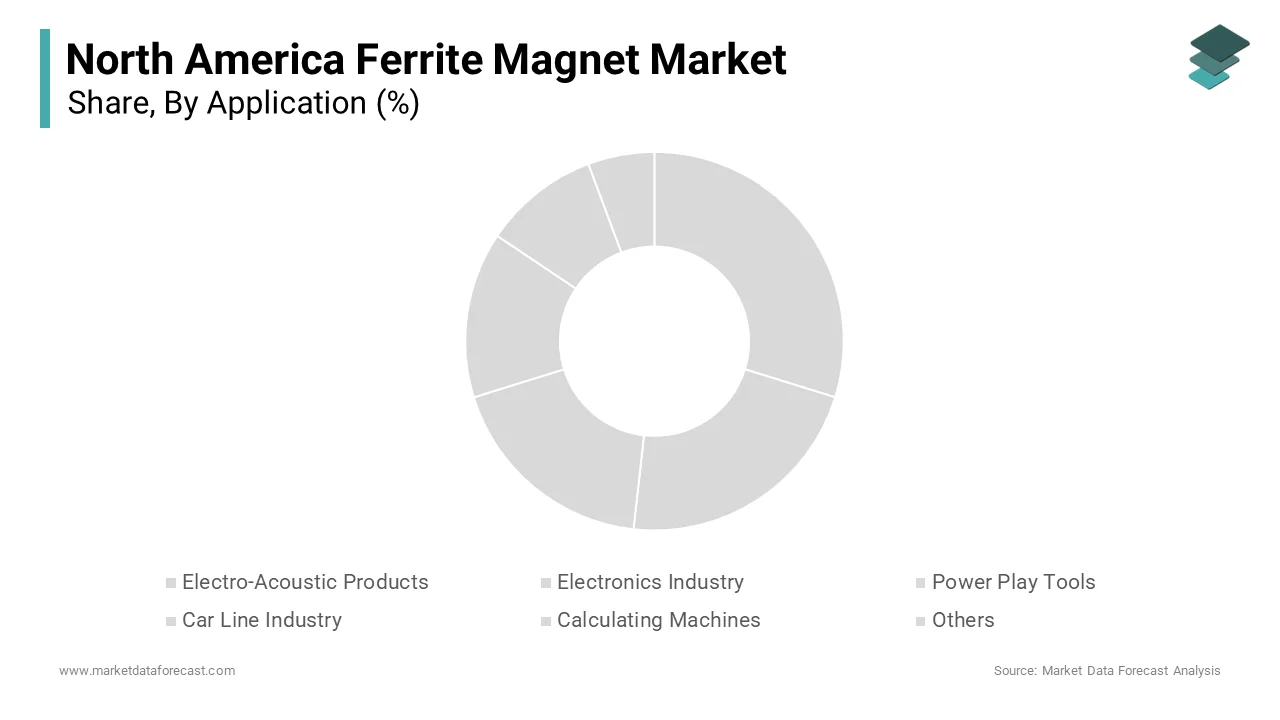
The electronics industry segment is likely to grow with an expected CAGR of 8.6% from 2025 to 2033, with the proliferation of compact, energy-efficient electronic devices that require small, reliable permanent magnet motors. Products such as smartphones (vibration motors), laptops (cooling fans), drones, wearable fitness trackers, and home automation systems increasingly incorporate ferrite-based micro-motors due to their low cost, corrosion resistance, and stable performance under variable loads. As per the U.S. Census Bureau, North American consumers purchased over 240 million electronic devices in 2023, with a 12% year-over-year increase in smart home gadget adoption. According to the National Institute of Standards and Technology, ferrite magnets in micro-fan motors consume 15–20% less energy than equivalent non-magnetic alternatives, which extends device battery life. Companies like Apple and Medtronic are prioritizing supply chain transparency, favoring suppliers with traceable, conflict-free materials. T
COUNTRY-LEVEL ANALYSIS
United States Ferrite Magnet Market Analysis
The United States was the top performer of the North American ferrite magnet market in 2025, with a robust industrial base encompassing automotive manufacturing, consumer electronics, and energy-efficient appliances, all major consumers of ferrite magnets. The country hosts key production facilities operated by Arnold Magnetic Technologies, Dexter Magnetic Materials, and Honeywell, ensuring a stable supply of high-performance ceramic magnets. The automotive sector alone, centered in the Midwest and Southeast, produces over 10 million vehicles annually, each integrating dozens of ferrite-based motors. Additionally, the Inflation Reduction Act has accelerated investment in domestic EV and appliance manufacturing, further stimulating magnet demand. The Department of Energy’s updated efficiency standards for motors and compressors have also mandated the use of permanent magnet-based systems, favoring ferrite adoption due to cost constraints. The presence of leading R&D institutions such as Oak Ridge National Laboratory and partnerships with universities in materials science are advancing sintering and automation technologies.
Canada Ferrite Magnet Market Analysis
The Canadian ferrite magnet market is a specialized and strategically evolving player within the regional landscape. The automotive industry in Ontario, which produces over 2 million vehicles annually, relies heavily on imported ferrite magnets for motorized subsystems, with growing interest in localized sourcing to mitigate supply chain risks. According to Natural Resources Canada, the country’s manufacturing sector consumed over 4,500 metric tons of ferrite magnets in 2023, primarily for use in HVAC systems, industrial motors, and electric power tools. Environment and Climate Change Canada is developing stricter emissions guidelines for industrial kilns, pushing importers and assemblers toward suppliers with verifiable environmental compliance.
COMPETITIVE LANDSCAPE
The competitive landscape of the North American ferrite magnet market is characterized by a blend of engineering excellence, supply chain resilience, and strategic specialization rather than price-based rivalry. Dominant players distinguish themselves through technical depth, customizability, and integration capabilities, catering to industries where reliability and performance consistency are non-negotiable. The market is insulated from commoditization due to the role magnets play in motor efficiency, system durability, and regulatory compliance. Competition is increasingly shaped by the ability to support localized manufacturing, reduce lead times, and meet stringent environmental and safety standards. While Asian producers dominate in volume and low-cost supply, North American companies maintain a strategic advantage in high-integrity, application-engineered solutions for automotive, aerospace, medical, and defense sectors. Intellectual property in material formulation, magnetic circuit design, and automated production processes serves as a key differentiator. The rise of electrification and energy efficiency mandates has intensified demand for technically advanced yet cost-effective magnetic materials, favoring firms with R&D agility and vertical integration. Additionally, customer loyalty is driven by long-term technical support, quality assurance, and responsiveness to design changes.
KEY MARKET PLAYERS
These are the market players that are dominating the Asia Pacific ferrite magnet market.
- Ningbo Yunsheng Co., Ltd
- Honeywell International Inc.
- Arnold Magnetic Technologies
- Dexter Magnetic Technologies
- Hangzhou Permanent Magnet Group
- JPMF Guangdong Co., Ltd.
- Ning Gang Permanent Magnet Materials Co., Ltd.
- Hitachi Metals L.
Top Players in the Market
- Arnold Magnetic Technologies is a leading innovator in advanced magnetic solutions, with a strong footprint in the North American ferrite magnet market. The company is renowned for its engineering expertise in custom magnetic assemblies, serving high-reliability sectors such as aerospace, defense, medical devices, and industrial automation. Arnold excels in tailoring ferrite magnet configurations to meet precise performance, thermal, and dimensional requirements, often integrating them into complex electromechanical systems. Its vertically integrated manufacturing capabilities enable tight control over material quality and production consistency, ensuring compliance with stringent industry standards. The company’s legacy of innovation in magnetic circuit design has positioned it as a trusted partner for OEMs requiring durable, cost-effective solutions.
- Dexter Magnetic Technologies stands as a cornerstone in the North American magnetic materials sector, offering comprehensive ferrite magnet solutions for automotive, electronics, and industrial applications. The company distinguishes itself through its consultative approach, working closely with clients to optimize magnetic performance within system-level constraints. Dexter provides end-to-end services—from design and prototyping to large-scale production by ensuring seamless integration of ferrite components into motors, sensors, and holding devices. Its technical expertise in magnetic modeling and testing allows for precise performance prediction and rapid iteration. The company places strong emphasis on supply chain reliability and quality assurance, catering to industries where failure is not an option. Dexter’s commitment to innovation is reflected in its development of enhanced-grade ferrites with improved coercivity and temperature stability.
- Honeywell plays a pivotal role in the ferrite magnet market through its advanced materials and sensing technologies division, leveraging its global R&D infrastructure to deliver high-performance magnetic solutions. While not primarily known as a standalone magnet producer, Honeywell integrates ferrite magnets into a wide array of proprietary systems, including aerospace actuators, industrial sensors, and smart building controls. The company’s strength lies in its systems-level engineering, where ferrite magnets are optimized for reliability, longevity, and operational efficiency in demanding environments. Its investment in material science and automation has led to innovations in magnet assembly and calibration processes.
Top Strategies Used by Key Market Participants
- A primary strategy among leading ferrite magnet manufacturers is the vertical integration of design, material processing, and application engineering to deliver fully optimized magnetic solutions. Companies are investing in in-house sintering, pressing, and coating capabilities to ensure consistency, reduce lead times, and maintain quality control across production cycles. This integration enables rapid customization and faster time-to-market for OEM clients requiring application-specific performance.
- Another key approach is the strengthening of technical partnerships with motor manufacturers, automotive suppliers, and appliance OEMs to co-develop next-generation magnetic systems. Companies ensure that ferrite magnets are designed in tandem with motor architecture, which improves efficiency and reduces system-level costs. These collaborations also facilitate early adoption of new material grades and configurations.
- A third major strategy is the focus on sustainability and regulatory compliance through the development of energy-efficient manufacturing processes and environmentally responsible sourcing. Firms are modernizing kiln technologies, reducing emissions, and enhancing the recyclability of processing waste to align with ESG mandates and customer sustainability goals. This positions them as preferred suppliers in regulated and environmentally conscious markets.
RECENT MARKET NEWS
- In March 2025, Arnold Magnetic Technologies launched a new advanced sintering facility in Maryland, designed to enhance production capacity for high-coercivity ferrite magnets used in automotive and industrial motors, which improves thermal stability and consistency.
- In February 2025, Dexter Magnetic Technologies introduced a proprietary coating technology for ferrite magnets that significantly improves resistance to moisture and mechanical chipping by extending service life in harsh environments such as under-hood automotive applications.
- In May 2023, Honeywell partnered with a major electric vehicle manufacturer to co-engineer a new generation of auxiliary motors using optimized ferrite magnet arrays by reducing system cost while maintaining reliability in HVAC and power-assist systems.
- In January 2025, Arnold Magnetic Technologies expanded its application engineering team in Michigan to provide on-site support for automotive OEMs transitioning to electrified subsystems, which is accelerating design integration and prototyping cycles.
- In April 2023, Dexter Magnetic Technologies implemented an AI-driven quality control system across its Ohio production line by enabling real-time defect detection and dimensional verification to ensure precision in high-volume ferrite magnet batches.
MARKET SEGMENTATION
This research report on the Asia Pacific ferrite magnet market is segmented and sub-segmented into the following categories.
By Application Type
- Electro-Acoustic Products
- Electronics Industry
- Power Play Tools
- Car Line Industry
- Calculating Machines
- Others
By Country
- The United States
- Canada
- Mexico
- Rest of North America