- Product Description Description
- Table of Contents TOC
- List of Table & Figure LOT
- Get Free Sample PDF Sample PDF
Market Size, 2025
$7,734.00 MnMarket Estimate, 2026
$8,127.66 MnMarket Forecast, 2034
$12.09 BnCAGR, 2026–2034
5.09%Executive Summary: North America Fillings and Toppings Market
- Market Scope: Comprehensive analysis of the North American fillings and toppings sector, covering product types, application segments, physical forms, flavor profiles, raw materials, regional/country frameworks, and the competitive industry landscape.
- Market Valuation: Valued at USD 7,734 million in 2025, estimated to reach USD 8,127.66 million in 2026, and projected to expand to USD 12.09 billion by 2034, growing at a steady CAGR of 5.09% from 2026 to 2034.
- Primary Growth Drivers: Surge in the size of the confectionery and bakery industries, alongside rising disposable incomes, urbanization, and technological advancements in food processing.
Key Market Segment Metrics
| Category | Leading Segment (Base Position) | Fastest-Growing / High-Growth Segment |
|---|---|---|
| By Type | Creams & Syrups (widely utilized across bakery and confectionery lines for texture, moisture retention, and visual appeal) | Fruits & Nuts & Pastes (high-growth segments driven by clean-label preferences and premium artisanal desserts) |
| By Application | Bakery Products & Confectionery (hold the major market share anchored by widespread consumption of cakes, pastries, and chocolates) | Frozen Desserts & Dairy Products (growing rapidly due to innovation in ice creams, yogurts, and functional dairy treats) |
| By Form | Liquid & Solid (dominant physical forms for standard syrups, fondants, sprinkles, and chunk inclusions) | Gel & Foam (expanding utility in aerated toppings, mirror glazes, and specialized confectionery fillings) |
| By Flavour | Chocolate & Vanilla (traditional mainstream favorites driving high-volume retail and industrial food production) | Fruit & Caramel (high-growth flavor profiles fueled by consumer demand for natural extracts and indulgent sweets) |
| By Raw Material | Sweeteners, Starch & Cocoa (foundational ingredients providing core body, sweetness, and viscosity across formulations) | Hydrocolloids & Specialty Fruits (growing demand for texture stabilization and authentic fruit inclusions) |
| By Region / Country | United States (anchor market with massive consumer spending on packaged baked goods and confectionery products) | Canada & Rest of North America (expanding industrial food sectors driving demand for specialized inclusions and toppings) |
Major Market Players & Industry Landscape
Market Structure: Highly competitive landscape featuring major multinational agricultural processors, ingredient specialists, and regional confectionery supply leaders.
Key Companies: Cargill (U.S.), Archer Daniels Midland Company (U.S.), Barry Callebaut (Switzerland), AAK AB (Sweden), Ashland (U.S.), Highlander Partners, Tate & Lyle PLC (U.K.), AGRANA (Austria), Associated British Foods plc (U.K.), and Zentis GmbH & Co. KG (Germany).
 Download Free Sample Report
North America Fillings and Toppings Market Size
The North America Fillings and Toppings Market size was expected to be worth USD 7,734 million in 2025 and is anticipated to be worth USD 12.09 billion by 2034, from USD 8,127.66 million in 2026, growing at a CAGR of 5.09% during the forecast period.
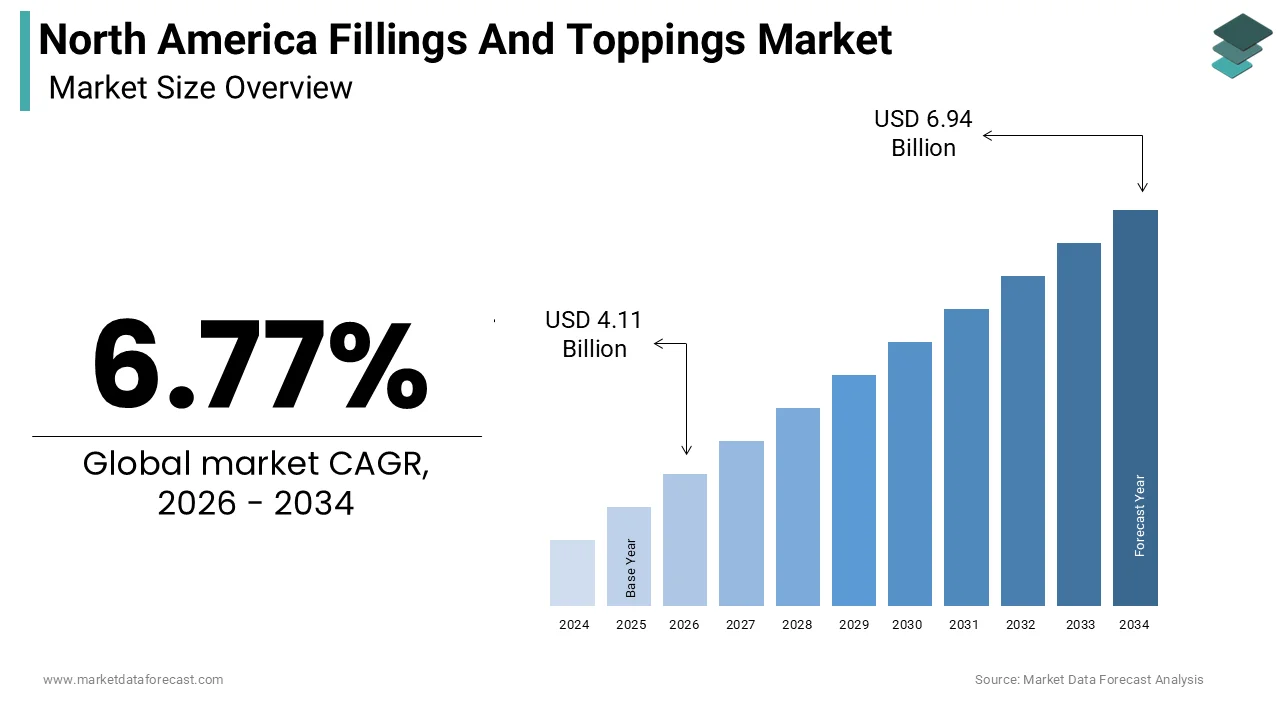
The fillings and toppings are the production, distribution and consumption of viscous sweet or savory substances used to enhance baked goods, dessert,s and snacks, across the United States and Canada. According to the United States Department of Agriculture, per capita consumption of added sugars in the United States remained at approximately 17 teaspoons daily in 2024, indicating sustained demand for sweet fillings despite health awareness campaigns. This persistent consumption pattern ensures steady procurement volumes for manufacturers supplying bakeries and confectionery brands. As per Statistics Canada, the food processing sector in Canada accounted for 18% of total manufacturing shipments in 2025, reflecting robust industrial activity that drives ingredient sourcing. These statistics illustrate the foundational link between regional manufacturing output and ingredient demand. The market operates within a complex regulatory framework emphasizing label transparency and ingredient safety. Manufacturers must adhere to strict guidelines while meeting consumer expectations for natural and clean label options. Understanding these fundamental elements provides clarity on how local dietary trends and industrial capabilities influence operational strategies.
MARKET DRIVERS
Expansion of Bakery and Confectionery Industry
The expanding bakery and confectionery industry is increasing demand for diverse flavor profiles and textural enhancements, which is leveraging the growth of the North America fillings and toppings market. Artisan breads, premium cakes, and decorated cookies rely heavily on high-quality fillings to differentiate products in a competitive retail environment. The higher procurement volumes of fruit jams, chocolate creams, and custard fillings are driven by manufacturers scaling production to meet consumer needs. The shift toward premiumization, where visual appeal and unique flavors drive purchase decisions. Manufacturers benefit from this trend by securing long-term contracts with major bakery chains and artisanal producers. The drive toward seasonal offerings also plays a role as companies introduce limited-edition fillings to create urgency. This shift reinforces the position of fillings and toppings as essential components in modern baking.
Rising Demand for Convenience Foods
The rapid growth in the convenience food sector is also promoting the growth of the North America fillings and toppings market. Pre-filled pastries, frozen desserts, and snack bars utilize specialized fillings that maintain stability during freezing and reheating processes. This expansion creates substantial opportunities for filling suppliers, who provide thermally stable and freeze-thaw resistant formulations. The substantial share indicates the scale at which fillings are integrated into commercial food service operations. Manufacturers prioritize ingredients that offer both functionality and ease of use, making standardized filling systems a preferred choice. The trend toward portion-controlled snacks further amplifies demand as consumers seek manageable indulgence. Producers respond by investing in advanced encapsulation technologies to prevent leakage and maintain freshness. The integration of fillings into diverse convenience categories underscores their versatility and indispensability in modern food systems.
MARKET RESTRAINTS
Health Consciousness and Sugar Reduction Trends
The growing health consciousness and sugar reduction initiatives are creating pressure to reformulate traditional high-sugar products, which is restricting the growth of the North America fillings and toppings market. Consumers increasingly scrutinize ingredient labels seeking lower-calorie and reduced-sugar alternatives, which challenges conventional filling formulations. According to the Centers for Disease Control and Prevention, obesity rates in the United States reached 42% in 2024, prompting public health campaigns that discourage excessive sugar consumption. This regulatory change forces manufacturers to invest in research and development for alternative sweeteners and fiber-based bulking agents. Reformulation processes are costly and time-consuming, often resulting in temporary product discontinuations. Small and medium enterprises face particular challenges as they lack resources for extensive R&D activities. The perception that healthy alternatives lack indulgence further complicates market acceptance. Manufacturers must balance nutritional profiles with sensory appeal, which often requires significant strategic adjustments.
Volatility in Raw Material Prices
Fluctuating raw material prices to create uncertainty in production costs and profit margins is additional factor declining the growth of the North America fillings and toppings market. Key ingredients such as cocoa, vanilla, fruits, and dairy products are subject to global commodity price swings due to weather events and supply chain disruptions. This instability forces manufacturers to adjust pricing strategies frequently, affecting their competitiveness in the retail sector. Higher input expenses reduce profitability and limit investment in capacity expansion or technological upgrades. Small and medium enterprises face particular challenges as they lack the financial buffers to absorb sudden cost increases. This constraint hinders their ability to compete with larger players who can negotiate better terms with suppliers. The reliance on imported ingredients such as vanilla and cocoa makes the market vulnerable to geopolitical tensions. Manufacturers must implement risk management strategies such as hedging or diversifying sourcing to mitigate these impacts.
MARKET OPPORTUNITIES
Innovation in Plant-Based and Vegan Options
The increasing demand for plant-based and vegan products, as consumers prioritize ethical and dietary preferences, is largely attributed to the growth of the North America fillings and toppings market. Traditional dairy-based creams and egg-containing custards are being replaced by coconut, almond, and oat-based alternatives that mimic texture and flavor. This surge creates avenues for filling producers to develop innovative vegan formulations using novel stabilizers and emulsifiers. This narrative of inclusive manufacturing appeals to diverse dietary needs. Manufacturers can leverage this opportunity by obtaining vegan certifications and marketing their fillings as clean and ethical alternatives. Partnerships with plant-based bakeries offer stable demand and higher margin potential. The trend extends beyond desserts to savory applications where vegetable-based spreads are gaining popularity. Companies that invest in transparent supply chains and sustainable practices gain competitive differentiation. This shift toward plant-based nutrition reshapes consumer expectations and opens new application areas.
Expansion into Functional and Fortified Ingredients
The growing interest in functional foods is diversifying application bases beyond traditional indulgence and is an additional factor to amplify the growth of the North America fillings and toppings market. Fillings fortified with proteins, fibers, probiotics, and vitamins transform standard desserts into nutrient-dense snacks that support overall wellness. According to the Council for Responsible Nutrition, supplement usage among adults in the United States reached 75% in 2024, indicating a strong culture of health optimization through diet. This cultural shift drives demand for functional ingredients that can be seamlessly integrated into familiar food formats like filled bars and yogurts. This trend creates sustained demand for specialized fillings that deliver specific health benefits without compromising taste. Manufacturers can capitalize on this opportunity by collaborating with nutritionists to develop scientifically backed formulations. Collaboration with health food brands provides access to specialized markets with less price sensitivity. Regulatory approvals for health claims enhance brand credibility and open export possibilities. Investing in research and development for specialized grades allows companies to capture higher value segments.
MARKET CHALLENGES
Supply Chain Disruptions and Logistics Constraints
The persistent supply chain disruptions and logistics constraints are affecting timely delivery and increasing operational costs, which is a major challenge for the growth of the North America fillings and toppings market. Infrastructure limitations, port congestion, and transportation bottlenecks hinder efficient distribution of perishable ingredients across the continent. These elevated costs reduce competitiveness and delay responsiveness for temperature-sensitive filling products. Manufacturers face difficulties in maintaining just-in-time delivery schedules, which are important for fresh fruit-based fillings. Transportation strikes, fuel price fluctuations, and border delays further exacerbate these issues. Companies must maintain larger safety stocks, which tie up capital and increase warehousing expenses. Reliability concerns affect customer relationships and contract fulfillment capabilities. Investing in alternative logistics routes or regional distribution centers requires substantial capital outlay. The complexity of coordinating multimodal transport adds administrative overhead. These logistical hurdles limit market expansion into remote areas and increase vulnerability to external shocks.
Stringent Regulatory Compliance and Labeling Requirements
The strict regulatory compliance and labeling requirements additionally hinder the expansion of the North American fillings and toppings market. Adhering to food safety standards, allergen declarations, and country of origin labeling requires significant investment in quality control systems and documentation. The rise in enforcement actions forces manufacturers to implement rigorous testing protocols and traceability systems. These financial barriers limit entry for new players and hinder the growth of existing small businesses. The complexity of navigating varying regulatory frameworks across different states and provinces adds administrative overhead. Non-compliance risks include fines, product recalls, and reputational damage. While regulations aim to protect public health, they inadvertently slow down product launches. Companies must balance compliance goals with speed to market, which often requires strategic adjustments.
REPORT COVERAGE
| REPORT METRIC | DETAILS |
| Market Size Available | 2025 to 2034 |
| Base Year | 2025 |
| Forecast Period | 2026 to 2034 |
| CAGR | 6.77% |
| Segments Covered | By Type, Application, Form, and Region |
| Various Analyses Covered | Global, Regional, & Country-Level Analysis; Segment-Level Analysis; DROC; PESTLE Analysis; Porter’s Five Forces Analysis; Competitive Landscape; Analyst Overview of Investment Opportunities |
| Regions Covered | US, Canada and Rest of North America |
| Market Leaders Profiled | Cargill, Archer Daniels Midland Company, Barry Callebaut, AAK AB, Ashland, Highlander Partners, Tate & Lyle PLC, AGRANA, Associated British Foods plc, L.P, and Zentis GmbH & Co. KG |
SEGMENTAL ANALYSIS
By Type Insights
The fruits and nuts segment accounted for 33.6% of the North America Fillings And Toppings Market share in 2025 due to consumer preference for natural flavors and perceived health benefits. This category includes berry compotes, apple fillings, almond paste,s and pecan pieces that enhance both taste and the nutritional profile of baked goods. The segment benefits from strong supply chains established with local orchards and international suppliers. Manufacturers leverage seasonal availability to create limited-edition offerings that drive consumer interest. The versatility of fruits and nuts allows application across cakes, pastries, and ice cream toppings. Health-conscious buyers prefer these ingredients due to their fiber and antioxidant content. This perception sustains demand even during periods of economic uncertainty. The segment’s dominance is maintained by continuous innovation in preservation techniques that maintain freshness and color.
The pastes and variegates segment is likely to exhibit the fastest CAGR of 11.2% from 2026 to 2034. Variegates are swirls of fruit or chocolate embedded in ice cream or yogurt, while pastes include smooth blends like hazelnut or pistachio. The expansion directly benefits manufacturers who produce specialized variegates that maintain stability at freezing temperatures. This growth rate outpaces traditional ,ling categories, indicating a shift toward sophisticated flavor profiles. The visual appeal of variegates drives social media engagement, which influences purchasing decisions among younger demographics. Manufacturers invest in advanced mixing technologies to ensure consistent distribution of swirls. The segment benefits from innovation in plant-based pastes that cater to vegan consumers. Customization options allow brands to create unique signature products that differentiate them in crowded markets. The convenience of ready-to-use pastes reduces preparation time for commercial bakeries.
By Application Insights
The bakery segment was the largest by occupying 45.7% of the North America Fillings And Toppings Market share in 2025 due to the widespread consumption of breads cakes pastries and donuts. Fillings such as custards, jams, and chocolate creams are essential for creating layered desserts and filled breads that appeal to diverse tastes. This high volume ensures steady procurement of fillings and toppings by major industrial bakeries and local artisans. The substantial contribution reflects the integral role of fillings in product differentiation and consumer satisfaction. The popularity of breakfast pastries and afternoon snacks further amplifies demand for convenient filled options. Manufacturers prioritize stability and ease of handling to streamline production processes. The segment benefits from established distribution networks and long-standing relationships with suppliers. Innovation in gluten-free and whole grain bakery products also utilizes specialized fillings to improve texture and moisture retention. The dominance of this segment is reinforced by cultural traditions surrounding baked goods for celebrations and daily consumption.
The confectionery segment is likely to grow at a fastest CAGR of 10.2% during the forecast period with the demand for premium chocolates and novelty candies. Filled chocolates, caramel centers, and jelly beans utilize specialized fillings that provide surprise elements and intense flavor bursts. The growth of the segment is also driven by the high-quality fillings that offer smooth texture and rich taste profiles. The growth rate outpaces traditional candy categories, indicating a structural shift toward premiumization. Consumers seek unique flavor combinations such as salted caramel or spicy chocolate, which require specialized filling formulations. Manufacturers invest in enrobing and molding technologies to ensure precise filling deposition. The segment benefits from strong branding and marketing campaigns that highlight craftsmanship and quality ingredients. Holiday seasons drive significant spikes in demand for boxed chocolates with assorted fillings. The rise of direct-to-consumer brands allows for rapid testing of new filling concepts.
By Form Insights
The solid form segment accounted for 22.1% of the North America Fillings And Toppings Market share in 2025 due to its ease of handling, storage stability, and versatility in various applications. Solid fillings include chunks of fruit, nuts, chocolate chips, and firm pastes that maintain shape during baking and processing. This is expected to support the dominance of solid forms which reduce mess ,a driven byify dosing mechanisms. The segment benefits from lower packaging requirements since solid materials do not leak or require sealed containers. Transportation costs are reduced due to higher density and stackability of solid products. Manufacturers benefit from established supply chains and widespread familiarity among procurement teams. Its compatibility with existing machinery enhances operational efficiency for downstream industries. These functional advantages ensure that solid fillings remain the cornerstone of regional consumption patterns.
The liquid form segment is esteemed to grow at a fastest CAGR of 9.4% during the forecast period with the convenience and immediate usability in beverage and dessert applications. Liquid fillings include syrups, sauces, and fluid creams that can be easily pumped, injected, or drizzled onto products. This expansion directly benefits liquid filling suppliers who offer tailored viscosities for specific equipment. The beverage industry particularly favors liquid toppings for coffee and dessert drinks. Ice cream manufacturers prefer liquid variegates for seamless integration into continuous freezers. The growth is further supported by advancements in stabilization technologies that prevent separation during storage. Regional distributors are expanding their liquid product portfolios to meet rising demand from quick service restaurants.
REGIONAL ANALYSIS
United States Fillings and Toppings Market Analysis
The United States was the top performer in the North America Fillings and Toppings Market by holding an 88.1% share in 2025 due to its large population, robust food processing industry, and high disposable income. The country serves as a major production and consumption hub for diverse filling types across bakery and confectionery sectors. The growth of the market in this country is directly driven by the rising demand for premium fillings and toppings as restaurants and bakeries expand their menus. The industrial expansion supports demand for efficient and high-quality filling solutions. The United States' abundant agricultural resources provide a competitive advantage for fruit- and nut-based fillings. Local manufacturers benefit from proximity to raw materials, reducing input costs. The country's well-developed logistics infrastructure facilitates efficient distribution to neighboring markets. Regulatory frameworks emphasize label transparency, encouraging adoption of clean label ingredients. Government incentives for sustainable practices further boost the sector.
Canada Fillings and Toppings Market Analysis
Canada's fillings and toppings market was ranked second, occupying a 10.1% share in 2025 by leveraging its strong agricultural base and high quality standards. The country serves as a key exporter of maple-based and berry fillings to international markets. The high compliance rate enhances supply chain resilience and reduces dependency on imports. Canada's proximity to the United States provides access to advanced technologies and best practices. The country's diverse industrial base includes bakery and dairy sectors that utilize specialized fillings. Free trade agreements facilitate competitive pricing and market access. Local producers focus on quality compliance to meet stringent domestic standards. Urbanization and changing dietary habits drive domestic consumption of convenience foods.
COMPETITIVE OVERVIEW
The competitive landscape of the North America Fillings And Toppings Market features a mix of global agribusiness giants and specialized ingredient suppliers, who compete on quality innovation and reliability. Major players differentiate themselves through vertical integration, securing raw material supplies from farms to factories and investing in advanced processing technologies. The market exhibits moderate consolidation as larger firms acquire niche brands to expand their flavor portfolios and geographic reach. Competition intensifies in segments requiring clean label credentials where transparency and natural sourcing act as key differentiators. Regional producers leverage local agricultural advantages such as berries and nuts to serve domestic markets effectively. Price sensitivity remains a factor but is often secondary to functional performance and consistency in industrial applications. Companies increasingly focus on sustainability initiatives to align with corporate social responsibility goals and meet retailer requirements. Innovation in texture modification and shelf life extension provides competitive advantages. Strategic partnerships with bakery chains help stabilize demand and foster co-development opportunities.
KEY MARKET PLAYERS
Major Key Players in the North American fillings And Toppings Market include
- Cargill
- Archer Daniels Midland Company
- Barry Callebaut
- AAK AB
- Ashland
- Highlander Partners
- Tate & Lyle PLC
- AGRANA
- Associated British Foods plc
- L.P
- Zentis GmbH & Co. KG
Top Strategies Used by Key Market Participants
Key market participants employ several strategic approaches to strengthen their position in the North America Fillings and Toppings Market. Vertical integration stands out as a primary strategy, allowing companies to control raw material sourcing from farms and reduce dependency on volatile commodity prices. This approach ensures stable input costs and consistent quality for end products. Sustainability initiatives form another critical pillar as firms invest in green technologies and obtain eco certifications to appeal to environmentally conscious buyers. These efforts enhance brand reputation and comply with tightening environmental regulations. Product differentiation through specialized grades and custom formulations helps companies capture higher-margin segments such as premium confectionery and artisanal bakery. Technical support services, including application guidance and formulation assistance, create sticky customer relationships and reduce switching risks. Geographic expansion via local production facilities or strategic partnerships reduces logistics costs and improves service levels. Digital transformation of supply chains enhances visibility, efficiency, and responsiveness to demand fluctuations.
Leading Players in the Market
- Ingredion Incorporated maintains a robust presence in the North America Fillings And Toppings Market through its extensive portfolio of texturants and sweeteners. The company leverages its deep expertise in starch modification to create stable fruit fillings and creamy custards that withstand high-temperature processing. Ingredion focuses on clean label solutions that align with consumer preferences for recognizable ingredients. Recent initiatives include expanding its application centers in Chicago to support customer innovation in plant-based dessert formulations. These improvements allow the company to meet growing demand from bakery and confectionery manufacturers while maintaining competitive pricing. Ingredion also invests in research and development to optimize rheological properties for better mouthfeel. The company's strong distribution network ensures reliable delivery to customers across multiple countries. Strategic partnerships with local fruit processors facilitate market penetration in niche segments. Ingredion's commitment to sustainability builds trust among environmentally conscious clients. The company actively participates in industry forums to shape regulatory standards for labeling.
- Cargill Incorporated contributes significantly to the North America Fillings And Toppings Market by offering premium chocolate compounds and fruit preparations. The company emphasizes supply chain transparency and sustainable sourcing, which resonates with ethically minded buyers in the region. Cargill has established strategic collaborations with cocoa farmers to ensure consistent quality and fair trade practices. Recent actions involve upgrading its chocolate production facilities in Wisconsin to enhance output capacity and reduce energy consumption. The company focuses on providing specialized ganaches and variegates for ice cream and bakery applications. Cargill invests in advanced tempering technologies to meet stringent texture and shine standards. Its team of experts works closely with clients to develop customized flavor profiles for seasonal launches. The company promotes circular economy principles by utilizing cocoa byproducts efficiently. Cargill active engagement in certification programs enhances its brand reputation. The company supports local communities through agricultural training and responsible sourcing initiatives.
- Archer Daniels Midland Company plays a vital role in the North America Fillings and Toppings Market through its expertise in oilseed processing and nut butters. The company integrates peanut, almond, and hazelnut pastes into broader portfolio offerings that address complex formulation challenges for confectioners. ADM focuses on creating synergies between its protein ingredients and filling textures to provide holistic nutritional solutions. Recent efforts include launching new flavor houses in Decatur to support product development and sensory testing. The company leverages its global sourcing capabilities to introduce exotic nut varieties for premium dessert applications. ADM prioritizes food safety and allergen management to ensure market access across different retail channels. Its strong brand recognition helps drive adoption among major candy manufacturers.
MARKET SEGMENTATION
This research report on the North America fillings and toppings market has been segmented and sub-segmented based on type, application, form, and region.
By Type
- Syrups
- Pastes & Variegates
- Fondants
- Creams
- Fruits & Nuts
- Sprinkles
By Application
- Confectionery products
- Bakery products
- Dairy products
- frozen desserts
- Convenience foods and Beverages
By Form
- Solid
- Liquid
- Foam
- Gel
By Region
- US
- Canada
- Rest of North America