- Product Description Description
- Table of Contents TOC
- List of Table & Figure LOT
- Get Free Sample PDF Sample PDF
Market Size, 2025
$1,811 MnMarket Estimate, 2026
$1,930 MnMarket Forecast, 2034
$3,211 MnCAGR, 2026–2034
6.57%North America Frac Sand Market Size, Growth, Trends & Forecast (2026–2034)
The size of the North America frac sand market was valued at USD 1,811 million in 2025, is anticipated to reach USD 1,930 million in 2026, and is projected to grow at a CAGR of 6.57% from 2026 to 2034, reaching USD 3,211 million by 2034. Driven by the surging demand for shale gas and oil extraction, technological advancements in proppant formulations, and increasing hydraulic fracturing operations across key US and Canadian basins, the regional industry continues to expand steadily.
Key Executive Metrics (At-a-Glance)
- 2025 Base Valuation: USD 1,811 Million
- 2026 Current Valuation: USD 1,930 Million
- 2034 Forecast Valuation: USD 3,211 Million
- Compound Annual Growth Rate (CAGR): 6.57% (2026–2034)
- Dominant Type Segment: White Sand (holding 60.5% of the market share in 2025 due to superior permeability and crush resistance in high-pressure wells)
- Fastest-Growing Type Segment: Resin-Coated Sand (projected at an 8.2% CAGR from 2026 to 2034 driven by deep-reservoir stability and reduced proppant flowback)
- Dominant Application Segment: Oil Exploitation (accounting for 55.4% of the market share in 2025 supported by massive shale oil extraction in reserves like the Permian Basin)
- Fastest-Growing Application Segment: Natural Gas Exploration (anticipated to register a 7.5% CAGR fueled by the clean energy transition and unconventional gas reserve development)
- Dominant Region/Country: United States (commanding 85.4% of the market share in 2025 backed by extensive shale plays in the Permian, Eagle Ford, and Marcellus formations)
- Fastest-Growing Region: Canada (capturing 12.3% share driven by unconventional oil and gas exploration in Alberta's oil sands and British Columbia's Montney Formation)
Core Market Drivers
- Surging Demand for Shale Gas and Oil: Massive reliance on hydraulic fracturing to unlock unconventional reserves using horizontal drilling and multi-stage completion techniques.
- Advancements in Proppant Technologies: Innovations in white sand, high-performance resin-coated sands, and specialized geo-conditioned formulations maintaining fracture conductivity.
Primary Market Restraints & Challenges
- Environmental Concerns & Regulatory Hurdles: Increasing scrutiny over water contamination, induced seismicity, state-level bans (e.g., New York, Maryland), and escalating compliance costs.
- Energy Price Volatility & Supply Chain Bottlenecks: Crude oil and natural gas price fluctuations impacting fracking activity, alongside logistical challenges, port closures, and transport bottlenecks.
North America Frac Sand Market Segmentation Breakdown
| Segment Category | Leading Sub-Segment (2025 Base) | Fastest-Growing Sub-Segment (2026–2034) |
|---|---|---|
| By Type | White Sand (holding 60.5% share due to superior permeability and high-pressure crush resistance) | Resin-Coated Sand (registering an 8.2% CAGR driven by deep-well performance and low flowback) |
| By Application | Oil Exploitation (holding 55.4% share backed by shale oil extraction and horizontal drilling) | Natural Gas Exploration (registering a 7.5% CAGR fueled by cleaner energy transition demand) |
| By Country | United States (holding 85.4% share supported by massive shale basins like the Permian and Marcellus) | Canada (capturing 12.3% share driven by Alberta oil sands and Montney Formation exploration) |
Major Industry Players Profiled
Key enterprises shaping the competitive North American frac sand market include U.S. Silica Holdings, Inc., Fairmount Santrol, Hi-Crush Inc., Covia Holdings Corporation, Smart Sand, Inc., Badger Mining Corporation, Black Mountain Sand, Source Energy Services, Atlas Sand Company, LLC, and Alpine Silica, LLC.
 Download Free Sample Report
North America Frac Sand Market Size
The North America frac sand market was valued at USD 1,811 million in 2025 and is anticipated to reach USD 1,930 million in 2026 and USD 3,211 million by 2034, growing at a CAGR of 6.57% during the forecast period from 2026 to 2034.
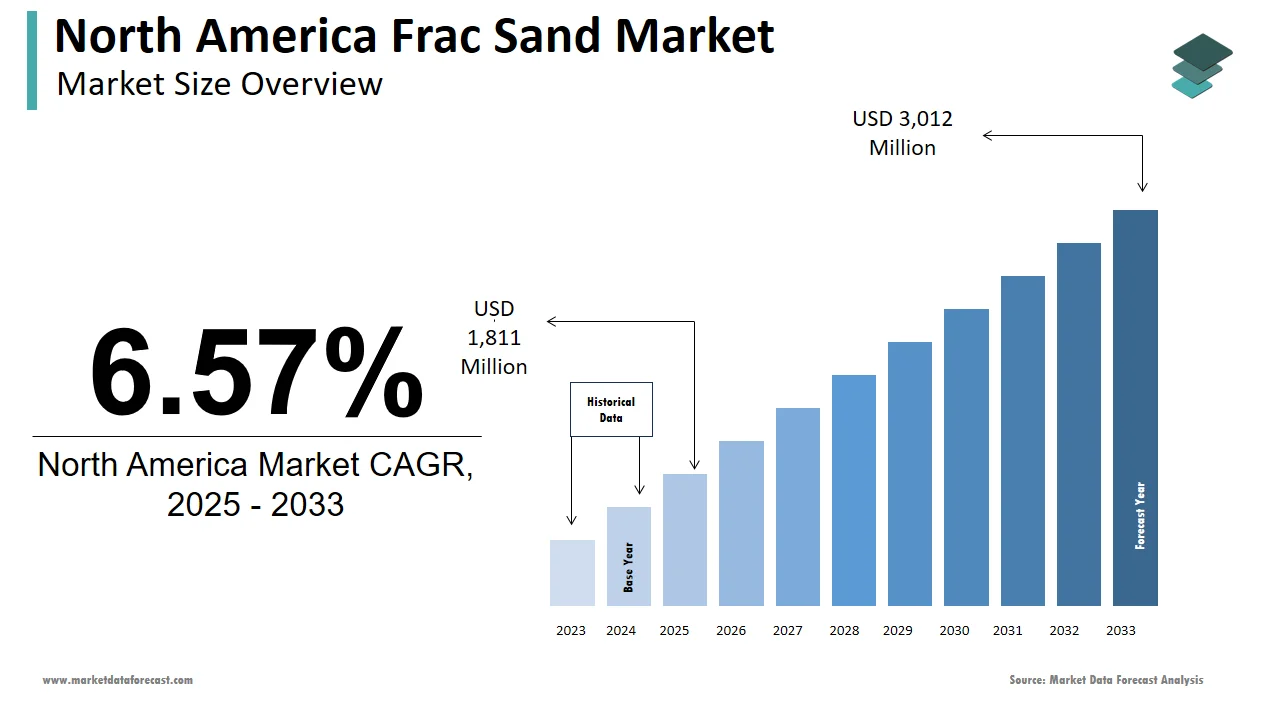
The North America frac sand market is driven by the increasing prominence of hydraulic fracturing for oil and natural gas extraction. According to the U.S. Energy Information Administration (EIA), shale gas production exceeded 80 billion cubic feet per day in 2022, with the demand for high-quality frac sand.
MARKET DRIVERS
Surging Demand for Shale Gas and Oil
The surging demand for shale gas and oil serves as a pivotal driver shaping the North America frac sand market. Hydraulic fracturing, which relies heavily on frac sand as a proppant, has become integral to unlocking unconventional reserves. According to the U.S. Energy Information Administration (EIA), shale gas production accounted for over 70% of total natural gas output in 2022. This growth is supported by technological advancements such as horizontal drilling and multi-stage fracturing, which require large quantities of high-quality frac sand.
Advancements in Proppant Technologies
Advancements in proppant technologies are another major driver fueling the North America frac sand market. Innovations in frac sand formulations, particularly white sand, have enhanced its performance in maintaining fracture conductivity during hydraulic fracturing. According to the Society of Petroleum Engineers, white sand offers superior permeability and crush resistance compared to brown sand by making it the preferred choice for high-pressure wells. Additionally, the development of resin-coated sands has expanded their applicability in deeper and more complex reservoirs. A report by the Independent Petroleum Association of America notes that resin-coated sands account for 15% of total proppant consumption in 2022 due to their growing popularity. Furthermore, the rise of precision fracking techniques has increased the demand for specialized frac sands tailored to specific geological conditions.
MARKET RESTRAINTS
Environmental Concerns and Regulatory Challenges
Environmental concerns and regulatory challenges pose significant restraints to the North America frac sand market. Hydraulic fracturing has faced increasing scrutiny due to its environmental impact, including water contamination and induced seismicity. Additionally, public opposition to fracking has led to bans in several states, such as New York and Maryland, reducing market opportunities. As per a study by the Natural Resources Defense Council, environmental compliance costs have increased by 20% for frac sand manufacturers by creating financial hurdles.
Volatility in Oil and Gas Prices
Volatility in oil and gas prices also acts as a restraint for the North America frac sand market. Fluctuations in global energy markets directly impact fracking activities, which are highly sensitive to price changes. According to the U.S. Energy Information Administration (EIA), crude oil prices dropped by 30% in 2020 due to the pandemic that is leading to a 15% decline in frac sand consumption. Similarly, geopolitical tensions and supply chain disruptions have exacerbated price volatility are creating uncertainty for manufacturers.
MARKET OPPORTUNITIES
Expansion into Emerging Markets
The expansion into emerging markets presents a lucrative opportunity for the North America frac sand market. Trade agreements like the USMCA have created avenues for exports to countries such as Mexico, where unconventional oil and gas exploration is gaining momentum. Additionally, government initiatives to modernize Mexico’s energy infrastructure have opened doors for specialized proppants. The spending on advanced fracking technologies is increasing every year that may pose huge growth opportunities for the market in next coming years.
Adoption of Sustainable Practices
The adoption of sustainable practices offers significant opportunities for the North America frac sand market. Companies are increasingly focusing on eco-friendly solutions to address environmental concerns and comply with stringent regulations. For instance, the development of recycled proppants and biodegradable coatings aligns with global sustainability goals. According to the Environmental Protection Agency (EPA), sustainable proppants reduce water usage by up to 25% is making them an attractive option for environmentally conscious operators. Additionally, innovations in low-impact fracking techniques have broadened the appeal of frac sand among regulators and stakeholders. As per a report by the Sustainable Energy Coalition, 40% of fracking projects now incorporate green technologies is driving demand for sustainable frac sand solutions.
MARKET CHALLENGES
Intense Competition from Alternative Proppants
Intense competition from alternative proppants poses a significant challenge to the North America frac sand market. Ceramic and resin-coated proppants are gaining traction due to their superior performance in high-pressure and high-temperature wells. According to the Society of Petroleum Engineers, ceramic proppants offer 30% higher crush resistance compared to frac sand by making them an attractive substitute for deep reservoirs. This creates a significant barrier for frac sand manufacturers, particularly in premium applications. Additionally, misconceptions about the cost-effectiveness of alternative proppants hinder adoption.
Supply Chain Disruptions
Supply chain disruptions caused by logistical challenges and natural disasters also act as a challenge for the North America frac sand market. For instance, the COVID-19 pandemic disrupted global supply chains, leading to increased transportation costs for manufacturers. According to the International Energy Agency, supply chain bottlenecks reduced frac sand availability by 10% in 2022 thereby impacting fracking operations. Additionally, port closures and labor shortages further exacerbated the issue by creating logistical hurdles for companies.
REPORT COVERAGE
| REPORT METRIC | DETAILS |
| Market Size Available | 2025 to 2034 |
| Base Year | 2025 |
| Forecast Period | 2026 to 2034 |
| Segments Covered | By Type, Application, and Region. |
| Various Analyses Covered | Global, Regional and Country-Level Analysis, Segment-Level Analysis, Drivers, Restraints, Opportunities, Challenges; PESTLE Analysis; Porter’s Five Forces Analysis, Competitive Landscape, Analyst Overview of Investment Opportunities |
| Countries Covered | United States, Canada, Mexico and Rest of North America. |
| Market Leaders Profiled | U.S. Silica Holdings, Inc., Hi-Crush Inc., Covia Holdings Corporation, Smart Sand, Inc., Badger Mining Corporation, Black Mountain Sand, Source Energy Services, Atlas Sand Company, LLC, Alpine Silica, LLC, Signal Peak Silica, LLC, and others. |
SEGMENTAL ANALYSIS
By Type Insights
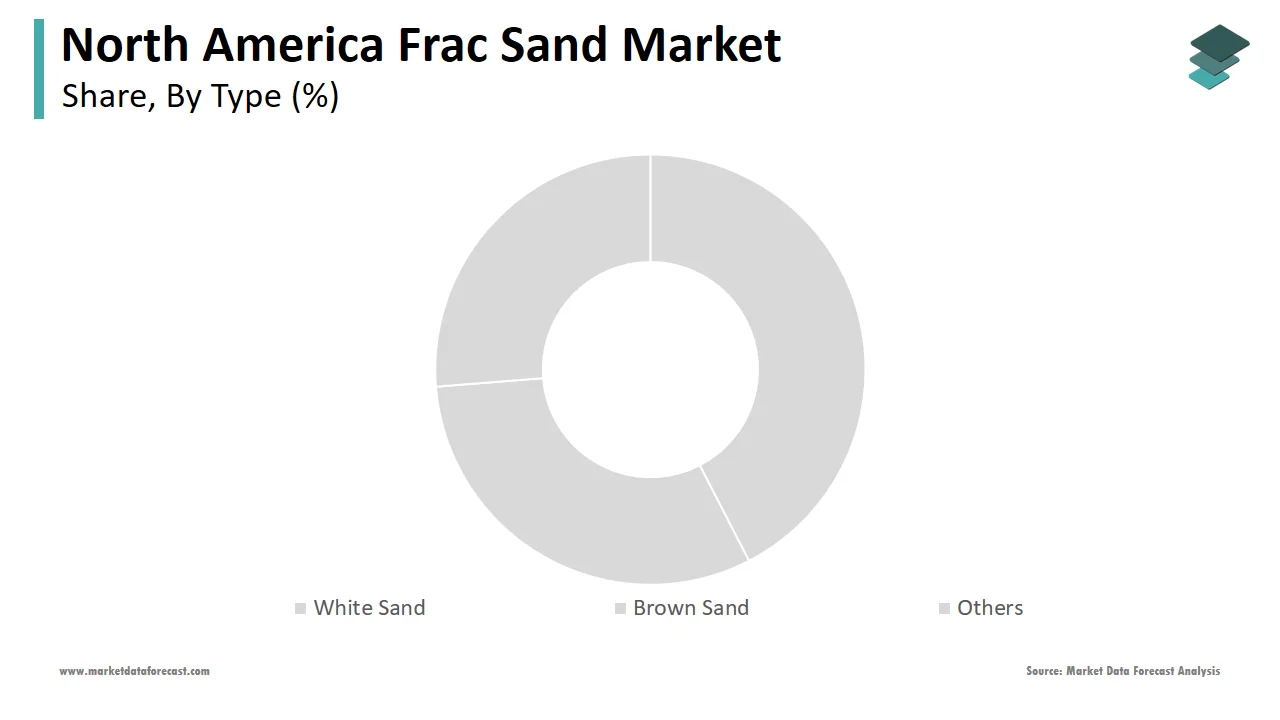
The white sand segment was the largest by occupying 60.5% of the North America frac sand market share in 2025. Its widespread adoption is attributed to its superior permeability and crush resistance is making it ideal for high-pressure wells. Industries such as shale gas and oil exploration rely heavily on white sand to maintain fracture conductivity during hydraulic fracturing. The U.S. Department of Energy emphasizes that 70% of fracking operations utilize white sand due to its ability to enhance production efficiency. Furthermore, advancements in mining technologies have enabled manufacturers to offer high-purity variants by aligning with regulatory requirements.
The resin-coated sand segment is likely to register a CAGR of 8.2% from 2026 to 2034. Its ability to withstand high temperatures and pressures makes it ideal for deep and complex reservoirs. The Society of Petroleum Engineers notes that resin-coated sand reduces proppant flowback by up to 40%, driving its adoption in premium applications. Additionally, its compatibility with advanced fracking techniques has expanded its applicability in unconventional reserves.
By Application Insights
The oil exploitation was the largest in the North America frac sand market by capturing 55.4% of the share in 2025 with the proliferation of shale oil reserves, which require hydraulic fracturing for extraction. The U.S. Energy Information Administration (EIA) reports that shale oil production exceeded 8 million barrels per day in 2022 with the need for efficient proppants. Additionally, advancements in horizontal drilling and multi-stage fracturing have further amplified frac sand usage in oil exploitation.
The natural gas exploration segment is likely to register a CAGR of 7.5% from 2026 to 2034. The rising demand for cleaner energy sources is propelling the segment’s growth, with natural gas serving as a key transition fuel. Additionally, government initiatives promoting sustainable energy have opened doors for frac sand in unconventional gas reserves.
COUNTRY LEVEL ANALYSIS

The United States was the largest contributor to the North America frac sand market, with an expected share of 85.4% in 2025 with its vast shale reserves in regions such as the Permian Basin, Eagle Ford, and Marcellus Shale. According to the U.S. Energy Information Administration (EIA), the country’s shale gas production exceeded 80 billion cubic feet per day in 2022, driving unprecedented demand for high-quality frac sand. Additionally, advancements in hydraulic fracturing technologies, such as horizontal drilling and multi-stage fracturing, have amplified the need for specialized proppants like white sand and resin-coated sands.
Canada was accounted in holding 12.3% of the North America frac sand market share in 2025 due to its growth trajectory is heavily influenced by unconventional oil and gas exploration in Alberta’s oil sands and British Columbia’s Montney Formation. The Canadian government’s commitment to reducing carbon emissions has significantly boosted demand for frac sand in cleaner energy projects. Additionally, Canada’s focus on sustainable mining practices has opened doors for innovations in eco-friendly proppants. Urban farming initiatives and government incentives for renewable energy projects have further propelled demand. These initiatives position Canada as a key player in shaping the regional market dynamics.
KEY MARKET PLAYERS
A few of the notable companies operating in the North America frac sand market profiled in this report are U.S. Silica Holdings, Inc., Hi-Crush Inc., Covia Holdings Corporation, Smart Sand, Inc., Badger Mining Corporation, Black Mountain Sand, Source Energy Services, Atlas Sand Company, LLC, Alpine Silica, LLC, Signal Peak Silica, LLC, and others.
LEADING PLAYERS IN THE MARKET
U.S. Silica Holdings
U.S. Silica Holdings stands as the leading player in the North America frac sand market. U.S. Silica caters to both large-scale operators and niche markets by offering solutions that align with stringent environmental regulations. Its commitment to sustainability is evident in its eco-friendly formulations, which comply with EPA standards.
Fairmount Santrol
Fairmount Santrol has carved a niche in the frac sand market. The company invests heavily in research and development to innovate products that meet evolving consumer demands. In 2023, Fairmount Santrol launched a resin-coated sand designed for deep reservoirs, targeting the growing demand for high-performance proppants. This aligns with global efforts to reduce environmental impact and promote green fracking practices. Fairmount Santrol’s global presence and diversified customer base enable it to capitalize on opportunities across various sectors, including oil exploitation and natural gas exploration.
Hi-Crush Inc.
Hi-Crush offers a wide range of frac sands, from white sand for high-pressure wells to specialized solutions for unconventional reserves. In 2023, the company expanded its manufacturing facility in Monterrey, Mexico, to cater to the growing demand in emerging markets. This strategic move amplifies its commitment to geographic expansion and market penetration.
TOP STRATEGIES USED BY KEY PLAYERS IN THE MARKET
Key players in the North America frac sand market employ a variety of strategies to maintain their competitive edge and drive growth. Mergers and acquisitions are a primary strategy, enabling companies to expand their product portfolios and strengthen their market presence. For instance, U.S. Silica Holdings’ acquisition of a regional frac sand supplier in 2022 bolstered its distribution network, enhancing its ability to serve industrial clients. Similarly, product innovation remains a cornerstone of growth, with companies investing heavily in research and development to introduce eco-friendly and high-performance solutions.
COMPETITION OVERVIEW IN THE MARKET
The North America frac sand market is characterized by intense competition. The market’s fragmented nature encourages innovation, as companies strive to differentiate themselves through product quality, performance, and sustainability. Regulatory compliance plays a critical role, with stringent environmental regulations driving the adoption of low-impact and eco-friendly proppants. Established players like U.S. Silica Holdings, Fairmount Santrol, and Hi-Crush Inc. dominate the market by leveraging their extensive resources, global reach, and technological expertise. However, smaller players focus on niche segments are offering specialized solutions tailored to specific industries or applications. The rise of e-commerce and digital marketing has further intensified competition by enabling smaller companies to reach a broader audience.
RECENT MARKET DEVELOPMENTS
- In April 2025, U.S. Silica Holdings acquired a regional frac sand supplier by enhancing its distribution network and strengthening its market presence in the Permian Basin.
- In June 2023, Fairmount Santrol launched a resin-coated sand designed for deep reservoirs by targeting the growing demand for high-performance proppants.
- In March 2023, Hi-Crush Inc. expanded its manufacturing facility in Monterrey, Mexico, to cater to the growing demand in emerging markets and enhance its geographic footprint.
- In January 2023, BASF partnered with a Canadian firm to develop sustainable proppants by focusing on reducing environmental impact and complying with regulatory standards.
- In October 2022, AkzoNobel introduced a biodegradable coating for frac sand by addressing the need for eco-friendly solutions in hydraulic fracturing operations.
MARKET SEGMENTATION
This research report on the North America frac sand market is segmented and sub-segmented into the following categories.
By Type
- White Sand
- Brown Sand
- Others
By Application
- Oil Exploitation
- Natural Gas Exploration
- Others
By Country
- United States
- Canada
- Mexico
- Rest of North America