- Product Description Description
- Table of Contents TOC
- List of Table & Figure LOT
- Get Free Sample PDF Sample PDF
Market Size, 2025
$23.19 BnMarket Estimate, 2026
$24.37 BnMarket Forecast, 2034
$36.23 BnCAGR, 2026–2034
5.08%North America Fresh Cherries Market Size, Growth, Trends & Forecast (2026–2034)
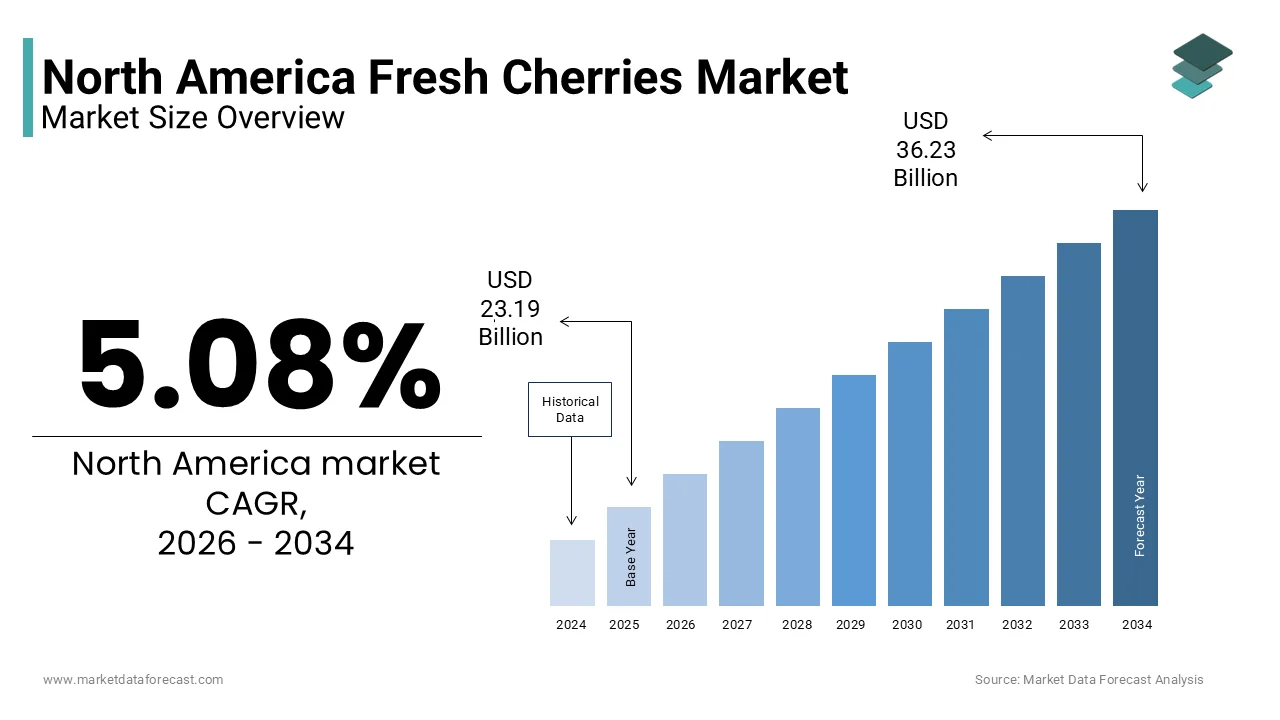
The North America fresh cherries market size was valued at USD 23.19 billion in 2025, is projected to reach USD 24.37 billion in 2026, and is anticipated to touch USD 36.23 billion by 2034, expanding at a compound annual growth rate (CAGR) of 5.08% from 2026 to 2034. Market expansion is driven by surging consumer preference for functional foods, health-focused natural snacks rich in antioxidants, and the seamless expansion of export-import networks ensuring year-round availability.
Key Executive Metrics (At-a-Glance)
- 2025 Base Valuation: USD 23.19 Billion
- 2026 Current Valuation: USD 24.37 Billion
- 2034 Forecast Valuation: USD 36.23 Billion
- Compound Annual Growth Rate (CAGR): 5.08% (2026–2034)
- Dominant Taste Segment: Sweet Cherries (held 82.3% of the market share in 2025 due to consumer preference and strong export demand)
- Fastest-Growing Taste Segment: Sour Cherries (projected to grow at a CAGR of 6.1% from 2026 to 2034 driven by recovery and functional benefits)
- Dominant Sales Channel: Modern Trade (held 38.2% share in 2025 via supermarket networks like Walmart, Costco, and Kroger)
- Fastest-Growing Sales Channel: Online Platforms / E-commerce (anticipated to register a robust CAGR of 11.5%)
- Dominant Application Segment: Direct Consumption (captured 44.3% market share in 2025 aligned with clean eating trends)
- Fastest-Growing Application Segment: Alcoholic Beverages (registering a CAGR of 8.7% due to rising craft beverages and RTD cocktails)
- Dominant Country: United States (accounted for 72.3% of the regional share in 2025)
Core Market Drivers
- Functional Food Appeal: Rising demand for antioxidant-packed superfoods offering anti-inflammatory properties, improved sleep, and exercise recovery support.
- Global Supply Chain Integration: Off-season imports from Chile, Australia, and New Zealand bridging domestic gaps to ensure year-round product availability.
Primary Market Restraints & Challenges
- Labor Shortages: Persistent agricultural labor deficits during peak harvest windows leading to increased harvest costs and post-harvest spoilage risks.
- Climate Vulnerability: Extreme weather events, late spring frosts, and unpredictable temperature shifts disrupting orchard yields and causing price volatility.
North America Fresh Cherries Market Segmentation Breakdown
| Segment Category | Largest Segment | Fastest-Growing Segment |
|---|---|---|
| By Taste | Sweet Cherries (82.3% Share in 2025) | Sour Cherries (6.1% CAGR, 2026–2034) |
| By Sales Channel | Modern Trade (38.2% Share in 2025) | Online Platforms (11.5% CAGR, 2026–2034) |
| By Application | Direct Consumption (44.3% Share in 2025) | Alcoholic Beverages (8.7% CAGR, 2026–2034) |
| By Country | United States (72.3% Share in 2025) | Canada (Higher Growth Velocity) |
Major Industry Players Profiled
Key market participants shaping the North American landscape include Cherryfields LLC, Stemilt Growers, LLC, Mission Produce, Vitin Fruits, Alacam Tarim, The Global Green Co. Ltd., Smelterz Orchard Co., Rainier Fruit Co., Leelanau Fruit Co., and BEL'EXPORT NV.
 Download Free Sample Report
North America Fresh Cherries Market Size
The North America fresh cherries market size was valued at USD 23.19 billion in 2025 and is predicted to reach USD 36.23 billion by 2034 from USD 24.37 billion in 2026 and grow at a CAGR of 5.08% from 2026 to 2034.
MARKET DRIVERS
Rising Consumer Preference for Functional Foods and Natural Snacks
The increasing consumer inclination toward functional foods and natural snacks that offer health benefits beyond basic nutrition is driving the growth of the North America fresh cherries market. Cherries are rich in antioxidants, particularly anthocyanins, which are associated with reduced inflammation, improved sleep quality, and enhanced exercise recovery. According to the American Journal of Clinical Nutrition, regular consumption of cherries has been linked to lower levels of uric acid, making them beneficial for individuals suffering from gout and arthritis. This scientific validation has bolstered marketing efforts by industry stakeholders such as the Cherry Marketing Institute, which promotes cherries as a superfood through targeted campaigns and partnerships with wellness influencers. Retailers and foodservice providers have capitalized on this trend by featuring fresh cherries in health-focused product lines, including smoothie bowls, oatmeal kits, and premium fruit platters.
Expansion of Export and Import Networks to Ensure Year-Round Availability
The expansion of international trade networks that ensure consistent supply throughout the year. While domestic production peaks during the summer months, imports from countries like Chile, Australia, and New Zealand play a crucial role in meeting consumer demand during the off-season. This integration of global supply chains has allowed retailers to offer fresh cherries nearly year-round, reducing seasonal price volatility and enhancing consumer accessibility. Supermarkets such as Walmart, Costco, and Loblaws have introduced dedicated cherry promotions during winter months, leveraging imported stock to maintain product visibility. As per the International Trade Centre, cross-border cherry trade between North America and Latin America has grown steadily over the past decade, supported by streamlined customs procedures and cold chain advancements.
MARKET RESTRAINTS
Labor Shortages Affecting Harvest Efficiency and Product Quality
The persistent shortage of skilled agricultural labor during peak harvest seasons is restraining the growth of the North America fresh cherries market. Cherry picking is a highly manual process that requires precision to avoid bruising and damage, yet many farms struggle to secure sufficient workforce availability. According to the U.S. Department of Agriculture, over 60% of cherry growers in Washington and California reported labor shortages in 2023 , leading to delayed harvesting and increased post-harvest losses. These labor constraints not only affect yield but also compromise fruit quality, as prolonged exposure to heat and humidity increases spoilage risks. Some producers have invested in mechanical harvesting solutions, but current technologies remain less effective than human pickers in preserving delicate cherries.
Climate Vulnerability and Yield Volatility
The vulnerability of cherry orchards to adverse climatic conditions, which can lead to significant fluctuations in annual yields and pricing volatility is limiting the growth of the North America fresh cherries market. Cherries require specific temperature ranges and frost-free periods during bloom to ensure successful pollination and fruit development. However, unpredictable weather pattern including late spring frosts, unseasonal heatwaves, and droughts have increasingly disrupted harvests in key producing regions. According to the National Oceanic and Atmospheric Administration (NOAA), extreme weather events affected over 40% of cherry-growing areas in the Pacific Northwest between 2020 and 2023. In addition to yield loss, climate variability complicates long-term planning for growers and creates uncertainty for buyers relying on consistent supply volumes. For example, Michigan’s cherry industry experienced significant setbacks in 2023 due to an early warm spell followed by a sudden freeze, which damaged blossoms and reduced projected output by nearly 30% , as noted by Michigan State University Extension.
MARKET OPPORTUNITIES
Growth of Premium Organic and Locally Sourced Cherry Offerings
The growing consumer preference for organic and locally sourced produce among health-conscious and environmentally aware shoppers is a trend for the growth of the North America fresh cherries market. As awareness of pesticide residues and sustainability concerns rises, more consumers are opting for cherries cultivated through eco-friendly farming methods. According to the Organic Trade Association, organic cherry sales in the U.S. increased by 18% in 2023 compared to the previous year , outpacing conventional counterparts. Supermarkets like Whole Foods, Sprouts Farmers Market, and Loblaw’s have prioritized organic cherries in their summer assortments, often regional origins and sustainability certifications to appeal to discerning customers. Additionally, research conducted by the Rodale Institute suggests that organic cherry farming improves soil health and biodiversity while maintaining competitive yields. Direct-to-consumer channels such as farmers’ markets and community-supported agriculture (CSA) programs have also gained traction by allowing growers to build brand loyalty and command premium pricing.
Expansion of Online Grocery Platforms and Direct-to-Consumer Sales
The rapid expansion of online grocery platforms and direct-to-consumer (DTC) sales channels, which offer higher margins and greater control over product quality is sustainability to propel the growth of the North America fresh cherries market. Consumers increasingly seek convenience and traceability, prompting e-commerce platforms and farm-direct subscription services to feature fresh cherries as part of seasonal specialty baskets. Major players such as Amazon Fresh, Instacart, and Shipt have introduced seasonal cherry bundles tailored for premium customers seeking doorstep delivery without compromising freshness. Social media-driven marketing campaigns and influencer endorsements have further heightened consumer awareness about cherry availability and health benefits, boosting online engagement and impulse buying.
MARKET CHALLENGES
Price Volatility Due to Seasonal Supply Constraints
The fluctuation in prices caused by seasonal supply constraints and inconsistent production cycles is major challenging factor for the growth of the North America fresh cherries market. Domestic production is highly dependent on favorable weather conditions, and unexpected freezes, hailstorms, or excessive rainfall can drastically reduce available volumes. In addition, export commitments and inventory management decisions by large-scale growers influence domestic pricing structures, sometimes leading to localized shortages despite overall national production levels. Retailers must navigate these fluctuations while maintaining consumer affordability, often resorting to promotional pricing or temporary substitutions when supplies dwindle.
Competition from Alternative Fruits and Processed Cherry Products
The growing competition from alternative fruits and processed cherry products that offer extended shelf life and convenience is additionally to inhibit the growth of the North America fresh cherries market. Consumers are increasingly turning to frozen cherries, dried cherries, cherry juices, and other value-added forms that provide similar nutritional benefits without the time-sensitive nature of fresh fruit. Moreover, other berries such as strawberries, blueberries, and raspberries continue to dominate retail shelves due to their broader culinary applications and longer availability throughout the year. These fruits benefit from well-established supply chains and aggressive marketing by producer groups, making it difficult for fresh cherries to maintain consistent shelf prominence outside of peak season. Additionally, imported fruits like lychees, pomegranates, and exotic berries have gained traction among gourmet and specialty consumers, further fragmenting the premium fruit category.
REPORT COVERAGE
| REPORT METRIC | DETAILS |
| Market Size Available | 2025 to 2034 |
| Base Year | 2025 |
| Forecast Period | 2026 to 2034 |
| CAGR | 5.08% |
| Segments Covered | By Taste, Sales Channel, Application, and Region |
|
Various Analyses Covered | Regional & Country Level Analysis, Segment-Level Analysis, DROC, PESTLE Analysis, Porter’s Five Forces Analysis, Competitive Landscape, Analyst Overview on Investment Opportunities |
| Regions Covered | The United States, Canada, Mexico, and Rest of North America |
| Market Leaders Profiled | Vitin Fruits, Alacam Tarim, The Global Green Co. Ltd, Smelterz Orchard Co., Rainier Fruit Co., Leelanau Fruit Co., BEL'EXPORT NV, and others |
SEGMENTAL ANALYSIS
By Taste Insights
The sweet cherries segment accounted in holding 82.3% of the North America fresh cherries market share in 2025 due to their popularity as a premium fresh fruit option among consumers seeking healthy snacks. According to the Cherry Marketing Institute, over 70% of surveyed U.S. consumers prefer sweet cherries for household use during summer months when they are most readily available. The strong export demand from Asian markets, which has incentivized North American producers to prioritize sweet cherry cultivation is additionally to propel the growth of the segment. As per the USDA Foreign Agricultural Service, U.S. exports of sweet cherries to China increased by 34% in 2023 , driven by growing middle-class affluence and shifting dietary preferences toward imported fruits.
The sour cherries segment is expected to grow with an expected CAGR of 6.1% from 2026 to 2034 with the mounting scientific evidence supporting the anti-inflammatory and antioxidant properties of sour cherries, particularly in relation to muscle recovery and joint health. According to a study published by the American Journal of Clinical Nutrition, regular consumption of tart cherry juice has been associated with reduced muscle soreness and improved recovery among athletes. Additionally, sour cherries are increasingly being used in functional beverages, ice creams, and bakery fillings, where their distinctive tangy flavor enhances product differentiation.
By Sales Channel Insights
The modern trade segment held 38.2% of the North America fresh cherries market share in 2025 with the dominance of modern trade is the widespread availability of fresh cherries in major supermarket chains such as Walmart, Costco, Kroger, and Loblaws, which serve as primary distribution points for both domestic and imported cherries. Another key reason for the continued leadership of modern trade is the emphasis on quality assurance and traceability, which appeals to health-conscious shoppers. As per the U.S. Food and Drug Administration, supermarkets implement rigorous supplier audits and shelf-life tracking systems to maintain freshness standards, reinforcing consumer trust. Additionally, promotional activities such as loyalty discounts and bundled offers further encourage bulk purchasing by enhancing overall sales volume in this channel.
The online platforms segment is anticipated to grow with a CAGR of 11.5% in the next coming years. The rapid expansion of e-commerce and digital grocery services has significantly altered how consumers access fresh produce by making online channels a key growth driver in the North America fresh cherries market. Moreover, social media-driven marketing campaigns and influencer endorsements have heightened consumer awareness about seasonal cherry availability and health benefits, boosting online engagement and impulse buying.
By Application Insights
The direct consumption segment was the largest by capturing 44.3% of the North America fresh cherries market share in 2025 with the growing preference for natural, nutrient-rich snacks that align with clean eating and wellness trends. Additionally, health influencers and nutritionists frequently recommend cherries as a post-exercise snack due to their anti-inflammatory properties, as noted by the Canadian Society of Exercise Physiology. The simplicity of preparation and minimal processing required which is making cherries an accessible fruit for households and on-the-go consumers.
The alcoholic beverages segment is expected to register a CAGR of 8.7% during the forecast period with the increasing use of fresh cherries in artisanal and commercial beverage production. According to the Distilled Spirits Council of the United States, cherry-flavored liqueurs and brandies experienced a 12% rise in sales in 2023, particularly among younger consumers seeking novel flavor profiles. Craft breweries and distilleries in states like Oregon, Colorado, and New York have also incorporated fresh cherries into limited-edition releases by leveraging their vibrant color and distinct taste to attract premium buyers. Additionally, the cocktail culture boom in urban centers has led to higher demand for cherry-based mixers and garnishes in bars and restaurants. Beverage brands are also launching ready-to-drink (RTD) cherry-infused cocktails that cater to convenience-driven consumers, further expanding the application scope of fresh cherries in the alcoholic beverages sector.
REGIONAL ANALYSIS
United States
The United States was the top performer of the North America fresh cherries market by occupying 72.3% of share in 2025. According to the USDA National Agricultural Statistics Service, U.S. cherry production reached over 800 thousand tons in 2023 , with a significant portion sold through supermarkets and farmers' markets. Domestic demand is driven by strong consumer preference for fresh cherries as a healthy snack and gourmet ingredient. Additionally, the U.S. plays a crucial role in cherry imports, particularly from Chile during off-season months. As per the U.S. Trade Representative, exports of fresh cherries from the U.S. to Canada and Mexico increased by 10% in 2023, reflecting stable cross-border trade dynamics.
Canada
Canada was positioned second in the North America fresh cherries market with 18.3% of share in 2025 with the strong import activity and growing domestic production in British Columbia and Ontario. Although local output remains relatively modest compared to the U.S., Canadian consumers exhibit high demand for premium cherries, particularly in urban centers like Toronto, Vancouver, and Montreal. According to Statistics Canada, fresh cherry imports exceeded 60 thousand tons in 2023, with Chilean cherries dominating the winter market. Supermarkets such as Loblaws, Sobeys, and Metro have expanded cherry offerings in premium packaging formats, targeting affluent shoppers seeking seasonal luxury items. In addition to imports, British Columbia’s cherry industry has seen steady growth due to favorable climate conditions and government-backed agricultural incentives. As per Agriculture and Agri-Food Canada, domestic cherry production increased by 5% in 2023, supported by investments in cold storage facilities and mechanized harvesting techniques. The region’s proximity to Asian markets has also positioned it as a potential export hub, though current volumes remain limited.
KEY MARKET PLAYERS AND COMPETITIVE LANDSCAPE
Key players in the North America Fresh Cherries Market are Vitin Fruits, Alacam Tarim, The Global Green Co. Ltd, Smelterz Orchard Co., Rainier Fruit Co., Leelanau Fruit Co., BEL'EXPORT NV, and others.
The competition in the North America fresh cherries market is marked by a blend of large-scale commercial producers, regional cooperatives, and boutique farms, all striving to capture market share in an industry shaped by seasonality, quality expectations, and evolving consumer preferences. Established growers benefit from well-developed infrastructure, advanced harvesting technologies, and strong trade relationships, enabling them to maintain a dominant presence in both domestic and export markets. However, emerging players are increasingly challenging this status quo by emphasizing organic certification, localized sourcing, and innovative packaging that aligns with modern lifestyle trends.
Market participants face intense pressure to differentiate themselves through branding, sustainability claims, and logistical efficiency. The battle for shelf space and consumer loyalty is intensifying. Companies are investing in vertical integration, strategic alliances, and targeted marketing campaigns that promotes product origin, nutritional benefits, and environmental responsibility as demand for premium cherries grows in urban centers and among health-conscious consumers.
TOP PLAYERS IN THE MARKET
Cherryfields LLC
Cherryfields LLC is a U.S.-based company specializing in premium sweet cherry production and distribution. Cherryfields plays a crucial role in supplying fresh cherries to North American and international markets is known for its sustainable farming practices and high-quality packaging. The company emphasizes traceability, freshness, and variety innovation, which is making it a preferred supplier for major retailers and foodservice providers.
Stemilt Growers, LLC
Stemilt Growers, LLC is a family-owned agribusiness based in Washington State, which is one of the largest cherry-producing regions in the U.S. Stemilt is recognized for its vertically integrated supply chain that spans from orchard to retail, ensuring consistent product quality and efficient logistics. The company has been instrumental in promoting organic and eco-conscious cherry production, which is catering to health-focused consumers across North America.
Mission Produce is although primarily known for avocados, has expanded into the cherry sector through strategic partnerships and cold chain expertise. Leveraging its global distribution network, Mission supports cherry growers with logistics, ripening solutions, and access to broader retail channels, enhancing market reach and product longevity in the competitive fresh fruit space.
TOP STRATEGIES USED BY KEY PLAYERS
Key players in the North America fresh cherries market are leveraging strategic initiatives to enhance their market position and ensure long-term sustainability. One major strategy involves expanding into value-added offerings , such as pre-pitted cherries, portion-controlled packs, and organic-certified varieties. These formats cater to convenience-driven consumers while supporting premium pricing strategies and reducing post-harvest waste.
Another important approach is investing in cold chain infrastructure and logistics optimization . Given the perishable nature of cherries, companies are strengthening their refrigerated transportation networks, investing in temperature-controlled storage facilities, and adopting real-time monitoring systems to maintain freshness and reduce spoilage during transit.
Firms are focusing on direct-to-consumer engagement through digital marketing and e-commerce platforms. These strategies help bridge the gap between seasonal availability and year-round demand, reinforcing market presence in a highly competitive landscape.
RECENT HAPPENINGS IN THE MARKET
- In January 2025, Cherryfields LLC introduced a new line of sustainably grown cherries packaged in biodegradable containers, which is reinforcing its commitment to environmental responsibility while appealing to eco-conscious consumers in North America.
- In March 2025, Stemilt Growers, LLC launched a blockchain-based traceability system by allowing retailers and consumers to track cherry origins, harvesting dates, and handling conditions, thereby enhancing transparency and building trust in product quality.
- In June 2025, Mission Produce expanded its cherry logistics division by investing in a state-of-the-art cold storage facility in California that aimed at improving supply chain efficiency and extending the shelf life of imported and domestic cherries.
- In September 2025, a leading U.S. cherry cooperative partnered with Instacart to offer exclusive seasonal cherry bundles through the platform’s same-day delivery service, which is capitalizing on the growing demand for convenient and fresh grocery options.
- In December 2025, a major Canadian cherry importer signed a multi-year exclusivity agreement with a British Columbia-based orchard, which is securing early-season supply for premium retail chains and strengthening its position in the luxury fruit segment.
MARKET SEGMENTATION
This research report on the North America fresh cherries market has been segmented and sub-segmented based on the following categories.
By Taste
- Sweet Cherries
- Sour Cherries
By Sales Channel
- Convenience Stores
- Online Channels
- Modern Trade
- Traditional Grocery Stores
- Various Retail Formats Including Direct Sales
By Application
- Alcoholic Beverages
- Direct Consumption
- Dairy Beverages
- Salads
- Ice Creams
- Jellies
- Jams
- Bakery
By Country
- The United States
- Canada
- Rest of North America