North America Garage Overhead Doors Market Size, Share, Trends & Growth Forecast Report By Door Type, Category, Material Type, Distribution Channel, and Country (The United States, Canada and Rest of North America), Industry Analysis From 2026 to 2034
Market Size, 2025
$4.08 BnMarket Estimate, 2026
$4.24 BnMarket Forecast, 2034
$5.73 BnCAGR, 2026–2034
3.85%North America Garage Overhead Doors Market Size
The North America Garage Overhead Doors Market is projected to grow from USD 4.08 billion in 2025 to USD 4.24 billion in 2026 and reach USD 5.73 billion by 2034, registering a CAGR of 3.85% from 2026 to 2034.
The garage overhead doors are designed for residential, commercial, and industrial garages, integrating structural durability, thermal performance, and automated operation. These doors, typically constructed from steel, aluminum, wood, or composite materials, are engineered to withstand environmental stressors while contributing to building envelope efficiency. Their design increasingly incorporates insulation, noise reduction, and smart connectivity, aligning with evolving homeowner expectations and building performance standards.
MARKET DRIVERS
Residential Construction and Single-Family Housing Expansion Driving Market Demand
The sustained growth in single-family home construction across North America is propelling the growth of the North America garage overhead doors market. According to the U.S. Census Bureau, 89% of new single-family homes completed in 2023 included an attached garage, reflecting a long-standing architectural preference rooted in climate adaptation, security, and lifestyle convenience. This structural norm directly translates into consistent demand for overhead door systems, with each new home requiring at least one unit. The National Association of Home Builders reports that the average size of new home garages has increased from 440 square feet in 2010 to 520 square feet in 2023, necessitating larger, more robust overhead door configurations.
Rising Consumer Emphasis on Home Energy Efficiency and Insulation Performance
The growing consumer focus on energy conservation and thermal performance in residential buildings is significantly enhancing the growth of the North America garage overhead doors market. According to the U.S. Department of Energy, heat loss through an uninsulated garage door can account for up to 20% of a home’s total heating energy consumption during winter months. This has prompted homeowners and builders to prioritize insulated models, particularly in regions with extreme temperatures such as the Midwest and Prairie Provinces. The American Society of Heating, Refrigerating and Air-Conditioning Engineers states that modern insulated garage doors with R-values of 10 or higher can reduce thermal bridging by 45% compared to non-insulated alternatives. Furthermore, as per the Environmental Protection Agency’s ENERGY STAR program, homes featuring high-performance garage doors experience an average reduction of 12% in annual heating and cooling costs. This economic incentive, combined with stricter building codes in states like California and Massachusetts, is accelerating the adoption of thermally optimized overhead systems. According to the Canada Green Building Council, 73% of new residential constructions in Quebec and British Columbia now include ENERGY STAR-qualified garage doors as part of broader net-zero-ready initiatives.
MARKET RESTRAINTS
High Replacement Costs and Long Product Lifespan Limiting Replacement Frequency
The extended lifespan of existing installations, which reduces the frequency of replacements and suppresses is majorly degrading the growth of the North America garage overhead doors market. Modern garage doors for those made from steel or fiberglass, are engineered to last between 15 and 30 years under regular maintenance, as reported by the National Association of Home Builders. This durability, while beneficial for consumers, creates a long replacement cycle that limits market turnover. According to the Joint Center for Housing Studies at Harvard University, the average homeowner replaces their garage door only once every 22 years, with many deferring upgrades unless structural damage or operational failure occurs. The U.S. Bureau of Labor Statistics notes that home improvement spending on garage systems grew at a slower rate than other exterior upgrades between 2020 and 2023, indicating budget prioritization elsewhere. Additionally, many older homes, particularly those built before 1990, still retain functional original doors, delaying replacement. According to the Insurance Institute for Business & Home Safety, only 38% of homes over 25 years old had upgraded their garage doors, despite advances in insulation and safety standards. This slow churn rate restricts market growth, in mature housing markets where new construction is limited, making it difficult for manufacturers to stimulate consistent demand without external catalysts such as regulatory mandates or widespread storm-related damage.
Labor Shortages in Skilled Installation and Maintenance Services
The scarcity of trained professionals capable of installing and servicing advanced door systems is restraining the growth of the North American garage overhead doors market. According to the U.S. Bureau of Labor Statistics, there is a deficit of over 45,000 qualified door installers and service technicians nationwide, with only 12,000 new certifications issued annually by the Door and Access Systems Manufacturers Association. This gap is exacerbated by an aging workforce; the average age of certified garage door technicians is 51, and nearly 30% are projected to retire by 2030. The Associated Builders and Contractors reports that 68% of door installation companies in the Midwest and Northeast delayed projects in 2023 due to lack of available labor. This shortage inflates service costs and extends wait times, discouraging homeowners from upgrading or repairing systems.
MARKET OPPORTUNITIES
Integration of Smart Home Technologies and IoT-Enabled Garage Systems
The integration of smart home ecosystems and Internet of Things (IoT)-enabled access systems is solely to elevate the growth opportunities for the growth of the North America garage overhead doors market. As residential automation becomes mainstream, consumers increasingly expect seamless connectivity between security, lighting, and access control systems. According to the Consumer Technology Association, 68% of U.S. households with smart devices in 2023 included at least one connected home security product, with smart garage openers emerging as a key component. Modern garage door controllers now support Wi-Fi, Bluetooth, and Zigbee protocols, enabling remote monitoring, voice activation via virtual assistants, and real-time alerts for unauthorized access. The Connectivity Standards Alliance reports that over 40 million Matter-compatible devices were shipped in 2023, facilitating interoperability between garage systems and platforms like Apple HomeKit, Google Home, and Amazon Alexa. Additionally, as per the Insurance Institute for Highway Safety, homes with smart garage monitoring experience a 27% lower incidence of vehicle theft, reinforcing their security value. Manufacturers such as Chamberlain and Genie have introduced AI-powered systems that learn user behavior and auto-close doors if left open, enhancing convenience and energy efficiency.
Growing Demand for Architectural Customization and Curb Appeal Enhancement
Homeowners and builders are increasingly viewing garage overhead doors as critical elements of exterior design and curb appeal, creating a significant opportunity for premium and aesthetically differentiated products. According to the National Association of Realtors, 74% of homebuyers in 2023 cited curb appeal as a decisive factor in their purchasing decisions, with garage door design ranking among the top three exterior elements influencing perception. This trend has spurred demand for custom finishes, window inserts, carriage-house styles, and material combinations that harmonize with architectural themes such as craftsman, modern farmhouse, or contemporary. The Architectural Woodwork Institute notes that sales of wood-look composite and custom-finished steel doors grew by 33% between 2021 and 2023, reflecting a shift toward design-conscious selection. Additionally, urban infill projects and accessory dwelling units (ADUs) are incorporating architecturally integrated garage entries to maintain neighborhood aesthetics.
MARKET CHALLENGES
Increasing Complexity of Building Codes and Safety Regulations
The growing complexity and regional variation of building codes and safety standards is quietly hindering the growth of the North America garage overhead doors market. According to the International Code Council, over 70% of U.S. jurisdictions have adopted amendments to the International Residential Code (IRC) that impose stricter requirements on garage door insulation, fire resistance, and automatic reversal mechanisms. In California, Title 24 mandates a minimum R-value of 8 for garage doors in new constructions, while Massachusetts requires fire-rated doors for garages adjacent to living spaces. According to the National Fire Protection Association, non-compliant installations accounted for 22% of failed home inspections in 2023, which is leading to costly rework. Additionally, the Consumer Product Safety Commission enforces rigorous testing for entrapment prevention systems, with penalties for non-compliance.
Vulnerability to Fluctuations in Raw Material Supply and Manufacturing Costs
The highly sensitive to volatility in the supply and pricing of key raw materials, particularly steel, aluminum, and polyurethane insulation is also to impede the growth of the North America garage overhead doors market. These inputs constitute over 60% of total production costs, as reported by the Metals Service Center Institute, making manufacturers vulnerable to global trade dynamics and logistical disruptions. According to the U.S. Bureau of Labor Statistics, hot-rolled steel prices fluctuated by 42% between 2021 and 2023 due to supply chain bottlenecks, import tariffs, and energy cost spikes, directly impacting door manufacturing margins. The American Iron and Steel Institute confirms that domestic steel production declined by 5.8% in 2022 due to plant closures and labor constraints, reducing availability for secondary fabricators. Similarly, polyurethane, used for insulating door cores, is derived from petrochemical feedstocks, making it susceptible to oil price volatility. The U.S. Energy Information Administration notes that crude oil price swings exceeding 30% in a single year led to a 25% increase in insulation material costs in 2022. Additionally, reliance on imported components for automated openers and sensors introduces further risk, particularly from Asia-based supply chains, limiting pricing flexibility and production scalability.
REPORT COVERAGE
| REPORT METRIC | DETAILS |
| Market Size Available | 2025 to 2034 |
| Base Year | 2025 |
| Forecast Period | 2026 to 2034 |
| Segments Covered | By Door Type, Category, Material Type, Distribution Channel, and Region |
|
Various Analyses Covered | Regional & Country Level Analysis, Segment-Level Analysis, DROC, PESTLE Analysis, Porter’s Five Forces Analysis, Competitive Landscape, Analyst Overview on Investment Opportunities |
| Regions Covered | The United States, Canada, Mexico, and Rest of North America |
| Market Leaders Profiled | Garaga Inc., Creative Door, Richards-Wilcox, Steel-Craft Door Products Ltd., Canada West Garage Doors Inc., Equal Door Industries, Wayne-Dalton, Colson Overhead Doors Ltd., Red Deer Overdoor, Croskill Overhead Doors Ltd., and Upwardor Inc, and others |
SEGMENTAL ANALYSIS
By Door Type Insights
The sectional door type dominated the North America garage overhead doors market by capturing a prominent share in 2025. Sectional doors operate on a track-and-trolley system that allows vertical lift and horizontal retraction within the garage ceiling, making them ideal for homes with shallow driveways or low headroom. According to the National Association of Home Builders, 92% of new single-family homes constructed in the United States between 2021 and 2023 were designed with ceiling-mounted garage door openers, which are compatible only with sectional configurations. This architectural integration has made sectional doors the default choice for builders and developers. Furthermore, the U.S. Department of Housing and Urban Development confirms that over 78% of residential garages in urban and suburban areas have ceiling obstructions such as ductwork or storage racks, rendering roll-up or slide-to-side mechanisms impractical.
Additionally, the dominance of sectional doors is reinforced by their compatibility with high-insulation panels and smart automation systems. The U.S. Department of Energy reports that 85% of insulated garage doors sold in 2023 were of the sectional type, owing to their multi-panel construction that allows for continuous thermal barriers. These doors can achieve R-values up to 17 when filled with polyurethane foam, significantly improving home energy efficiency.
The Slide-To-Side door type is likely to grow with an expected to grow with a CAGR of 9.4% from 2025 to 2033. According to the Congress for the New Urbanism, the average width of new urban lots in North America declined from 50 feet in 2010 to 38 feet in 2023, making traditional upward-lifting doors a hazard in tight driveways where vehicles extend beyond the garage footprint. The Slide-To-Side mechanism resolves this by moving laterally along a track mounted on the garage wall, requiring no swing space. According to the International Code Council, slide-to-side doors are exempt from certain headroom requirements under the 2021 International Building Code, enabling their use in low-ceiling retrofit projects. According to the Canadian Housing Design Council, municipalities in British Columbia and Ontario have approved over 120,000 ADUs since 2020, many of which utilize slide-to-side doors for compact vehicle access. Additionally, the Architectural Institute of America notes that this door type offers greater design flexibility by allowing for full-height glazing and seamless integration with modern façades.
By Category Insights
The automatic segment was accounted in holding a significant share of the North America garage overhead doors market in 2025. The prevalence of automatic garage doors is closely tied to the standardization of ceiling-mounted opener systems in new home construction. According to the National Association of Home Builders, 94% of single-family homes built in the United States after 2015 were delivered with pre-wired and pre-mounted automatic openers, making manual operation an afterthought. This builder-level adoption has created a structural dependency on automated systems, with retrofitting manual doors becoming increasingly rare. Additionally, the integration of automatic doors into smart home ecosystems has reinforced their dominance. As per the Connectivity Standards Alliance, over 50 million Matter-enabled devices were deployed in North American homes in 2023, with garage openers among the most commonly connected peripherals. Platforms like Apple HomeKit, Google Home, and Amazon Alexa now support voice-activated door control, geofencing, and auto-close functions, enhancing user experience.
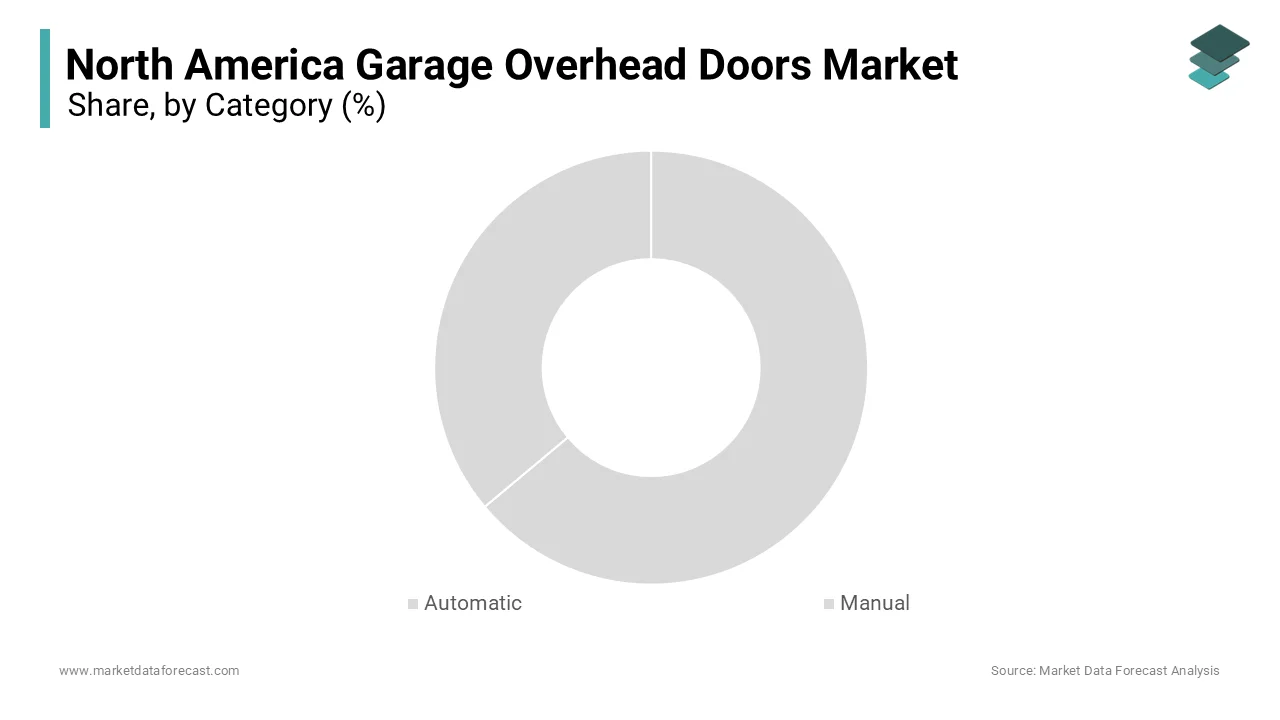
The Manual garage door segment is emerging with a CAGR of 6.8% from 2025 to 2033. In remote areas, particularly across the Mountain West and Northern Canada, homeowners are increasingly opting for manual doors to ensure operability during prolonged electrical disruptions. According to the National Oceanic and Atmospheric Administration, the average North American household experienced 3.2 power outages in 2023, with rural regions facing durations exceeding 12 hours due to storm-related grid failures. The Electric Reliability Council of Texas reports that during the 2021 winter storm, over 4.5 million homes lost power, rendering automatic garage doors inoperable and trapping residents. This vulnerability has prompted a shift toward manual systems in emergency preparedness planning. Additionally, the affordability and simplicity of manual doors make them ideal for secondary structures such as workshops, sheds, and agricultural buildings.
By Material Type Insights
The steel material segment was accounted in holding 58.3% of the North America garage overhead doors market share in 2025. Steel doors are engineered to withstand extreme weather conditions, from sub-zero winters in the Canadian Prairies to high-humidity summers in the U.S. Gulf Coast. According to the American Iron and Steel Institute, galvanized and galvalume-coated steel doors resist corrosion for up to 20 years, outperforming wood and aluminum in longevity. The U.S. Department of Energy confirms that steel is the only material capable of supporting continuous polyurethane foam injection, enabling R-values of 12 to 17—critical for reducing heat transfer between garages and living spaces. Field studies by the National Institute of Standards and Technology show that steel doors maintain structural integrity under wind loads exceeding 130 mph, meeting hurricane-resistant standards in coastal regions. Additionally, steel offers unparalleled design flexibility through embossing, painting, and composite layering. The Architectural Institute of America notes that over 70% of modern garage doors mimic wood grain or carriage-house aesthetics using steel substrates, combining visual appeal with low maintenance. Unlike wood, steel does not warp, crack, or require refinishing, reducing lifecycle costs.
The Fiberglass material segment is lucratively growing with an expected CAGR of 8.2% during the forecast period. Fiberglass is non-conductive and dimensionally stable, making it ideal for areas with intense solar exposure and salt-laden air. According to the National Weather Service, average UV index levels in Florida, Arizona, and Southern California exceed 8 for six months annually, causing wood to crack and paint on steel to degrade. The American Society for Testing and Materials reports that fiberglass doors retain 95% of their surface integrity after 1,500 hours of accelerated weathering, outperforming other materials. Additionally, the U.S. Naval Facilities Engineering Command specifies fiberglass for use in coastal installations due to its immunity to salt corrosion, a critical factor in seaside communities. Moreover, fiberglass offers high customization for architectural styles, particularly in historic districts and planned communities. The National Trust for Historic Preservation notes that 52% of renovation projects in Charleston, Savannah, and New Orleans used fiberglass doors to replicate colonial and Victorian designs without the maintenance burden of wood.
By Distribution Channel Insights
The Installer/Contractor channel dominated the North America garage overhead doors market share in 2025. Garage door installation involves precise alignment of tracks, torsion springs, and safety mechanisms, requiring specialized tools and certification. The Consumer Product Safety Commission reports that 78% of homeowners opt for contractor-installed doors to ensure compliance with UL 325 safety standards. Additionally, most manufacturers, including Clopay and Overhead Door Corporation, void warranties if doors are not installed by certified technicians, reinforcing reliance on this channel. The U.S. Department of Labor notes that over 28,000 licensed garage door contractors operate across the United States, providing localized service and same-day installation in urban areas. Furthermore, contractors serve as trusted advisors, guiding homeowners on insulation, material selection, and smart integration. The Joint Center for Housing Studies at Harvard University finds that 67% of consumers consult contractors before purchasing garage doors, particularly for retrofit projects.
The OEM/Direct channel is projected to expand with a CAGR of 7.9% from 2025 to 2033. According to the National Association of Home Builders, 54% of top-50 builders in the United States signed OEM supply contracts in 2023 to secure volume pricing and design consistency across developments. This shift reduces logistics costs and ensures architectural uniformity in master-planned communities. The Consumer Technology Association reports that online garage door sales grew by 52% in 2023, driven by younger, tech-savvy buyers seeking customization and transparency.
Additionally, OEM partnerships with smart home integrators are accelerating adoption. As per the Connectivity Standards Alliance, direct integration of garage door openers with home automation systems is now offered in 40% of new construction projects, which is facilitated by OEM-level software compatibility.
REGIONAL ANALYSIS
United States
The United States was the largest and held 91.2% of the North America garage overhead doors market share in 2025 with the country’s vast residential construction activity, suburban sprawl, and deeply ingrained car culture. The U.S. Department of Housing and Urban Development confirms that 81% of new homes include an attached two-car garage, creating consistent demand for overhead door systems. Additionally, the prevalence of extreme weather from blizzards in the Northeast to hurricanes in the Southeast drives demand for durable, insulated, and storm-rated doors. The National Oceanic and Atmospheric Administration reports that 4.2 million homes were affected by severe wind events in 2023, triggering replacement cycles.
Canada
Canada garage overhead doors market is gearing up with new opportunities in the coming years. While smaller in scale, the Canadian market is distinguished by its emphasis on thermal performance and structural resilience in extreme cold. Natural Resources Canada indicates that garage doors in northern provinces must withstand temperatures as low as -40°C, necessitating high-R-value insulation and freeze-resistant hardware. The Canadian Standards Association reports that 79% of new garage doors sold in 2023 met Energy Star certification, reflecting stringent energy codes in provinces like Quebec and British Columbia. According to the Canada Mortgage and Housing Corporation, urban densification in cities like Toronto and Vancouver has spurred demand for compact slide-to-side and sectional doors in townhomes and infill developments.
KEY MARKET PLAYERS AND COMPETITIVE LANDSCAPE
Garaga Inc., Creative Door, Richards-Wilcox, Steel-Craft Door Products Ltd., Canada West Garage Doors Inc., Equal Door Industries, Wayne-Dalton, Colson Overhead Doors Ltd., Red Deer Overdoor, Croskill Overhead Doors Ltd., and Upwardor Inc. are the key players in the North America garage overhead doors market.
The competitive landscape of the North America garage overhead doors market is characterized by a blend of legacy dominance and emerging innovation. Established manufacturers leverage decades of brand trust, extensive distribution networks, and deep relationships with contractors and homebuilders to maintain market influence. However, the rise of digital-first brands and direct-to-consumer models is challenging traditional retail pathways, introducing greater price transparency and customization options. Competition is increasingly centered on differentiation through design, energy performance, and smart integration rather than cost alone. Smaller players are gaining traction by focusing on niche segments such as architecturally accurate historic replicas or ultra-durable industrial-grade doors. The convergence of home automation and sustainability trends has elevated the garage door from a utilitarian component to a strategic element of home efficiency and security. Companies are investing heavily in R&D to improve insulation, noise reduction, and seamless connectivity with broader smart home systems. Brand reputation, installer certification programs, and warranty support remain critical differentiators, especially in a market where safety and long-term reliability are paramount.
TOP PLAYERS IN THE MARKET
Clopay Building Products
Clopay Building Products stands as a leader in the North America garage overhead doors market, renowned for its innovation in residential door design and integration of advanced insulation technologies. The company has set industry benchmarks with its premium Classic Collection and Modern Steel Series, which combine architectural aesthetics with structural resilience. Clopay’s deep collaboration with homebuilders and contractors has embedded its products into mainstream residential developments across the United States and Canada. Its emphasis on energy efficiency and curb appeal has influenced design trends, while its partnership with Hormann Group has expanded its engineering capabilities.
Overhead Door Corporation
Overhead Door Corporation, a pioneer in the industry since the invention of the upward-lifting garage door in 1921, remains a dominant force through its legacy of engineering excellence and nationwide service network. The company is widely recognized for its robust commercial and industrial door solutions, as well as its trusted residential product lines that emphasize durability and safety. Its integration of safety reverse mechanisms and quiet operation technologies has set operational standards across the sector. With a strong distribution footprint and certified installer partnerships, Overhead Door maintains high brand recognition and customer trust. The company’s focus on innovation in automation and material science continues to influence product evolution.
CHI Overhead Doors
CHI Overhead Doors has emerged as a key player by specializing in high-performance, customizable garage door solutions for both residential and light commercial applications. The company distinguishes itself through its commitment to craftsmanship, offering a wide range of design-centric products that cater to modern architectural trends. CHI’s doors are frequently selected for upscale housing developments and renovation projects where aesthetic integration is paramount. Its use of advanced composite materials and precision manufacturing enables superior thermal performance and long-term resilience.
TOP STRATEGIES USED BY KEY PLAYERS
One major strategy employed by leading companies is vertical integration of design, manufacturing, and distribution networks to ensure consistent quality and faster time-to-market. This approach also enables tighter alignment with building standards and faster adaptation to regional regulatory requirements.
The enhancement of digital customer engagement through online configurators, augmented reality tools, and e-commerce platforms. Companies are investing in interactive experiences that allow homeowners to visualize door styles on their homes, select finishes, and receive instant quotes. This digital transformation streamlines the purchasing journey and appeals to tech-savvy consumers seeking transparency and customization.
A collaboration with homebuilders, architects, and smart home ecosystem providers. By embedding their products into new construction specifications and integrating with platforms like Apple HomeKit or Google Nest, manufacturers secure early adoption and long-term brand loyalty. These partnerships position garage doors not as standalone components but as integrated elements of intelligent, energy-efficient homes.
RECENT HAPPENINGS IN THE MARKET
- In February 2024, Clopay Building Products launched a new line of ENERGY STAR-qualified garage doors featuring integrated thermal breaks and weather-resistant composite edges that designed to enhance energy efficiency in extreme climates.
- In May 2023, Overhead Door Corporation expanded its certified installer network by partnering with 150 independent contractors across the Midwest and Northeast by enhancing service coverage and ensuring compliance with updated safety standards.
- In January 2024, CHI Overhead Doors introduced a digital visualization platform that allows homeowners to preview custom door designs on their homes using augmented reality, which is improving customer engagement and design accuracy.
- In August 2023, Clopay announced a strategic collaboration with a leading smart home technology provider to embed Matter-compatible connectivity into its next-generation garage door openers by enabling seamless integration with major home automation ecosystems.
- In March 2024, Overhead Door Corporation unveiled a new commercial-grade fiberglass door series engineered for coastal environments, which is combining corrosion resistance with high-impact durability for use in hurricane-prone regions.
MARKET SEGMENTATION
This research report on the North America garage overhead doors market has been segmented and sub-segmented based on the following categories.
By Door Type
- Sectional
- Roll-up/Roller
- Slide-to-Side
- Side-Hinged
- Tilt-Up and Up-and-Over
- Swing-Out Carriage
By Category
- Automatic
- Manual
By Material Type
- Steel
- Aluminum
- Wood
- Fiberglass
- Vinyl
- Glass
- Composite/Hybrid
By Distribution Channel
- OEM/Direct
- Installer/Contractor
- Retail (Home Centers)
- E-commerce
By Country
- The United States
- Canada
- Rest of North America
Frequently Asked Questions
1. What are garage and overhead doors?
Garage and overhead doors are entry systems designed for vehicle access, typically used in residential, commercial, and industrial settings.
2. Which types of garage and overhead doors are popular in North America?
Sectional, roll-up, side-hinged, slide-to-side, and tilt-up doors are commonly used.
3. What factors are driving the North America garage and overhead doors market?
Urbanization, home renovations, commercial development, and security concerns.
4. Which countries lead the North America garage and overhead doors market?
The United States is the largest market, followed by Canada and Mexico.
5. Who are the key players in the North America garage and overhead doors market?
Major companies include Overhead Door Corporation, Clopay, Wayne Dalton, and CHI Overhead Doors.
6. What materials are commonly used for garage and overhead doors?
Steel, aluminum, wood, fiberglass, vinyl, and composite materials.
7. What trends are shaping the North America garage and overhead doors market?
Smart garage doors, insulated designs, and eco-friendly materials.
8. Which sectors are major users of garage and overhead doors in North America?
Residential, commercial, industrial, and agricultural sectors.
9. What challenges does the garage and overhead doors market face?
High installation costs, raw material price fluctuations, and maintenance needs.
10. How is technology influencing garage and overhead door design?
Features like remote operation, motion sensors, and enhanced insulation are becoming standard.
Related Reports
Access the study in MULTIPLE FORMATS
Purchase options starting from
$ 2000
Didn’t find what you’re looking for?
TALK TO OUR ANALYST TEAM
Need something within your budget?
NO WORRIES! WE GOT YOU COVERED!
Call us on: +1 888 702 9696 (U.S Toll Free)
Write to us: sales@marketdataforecast.com